

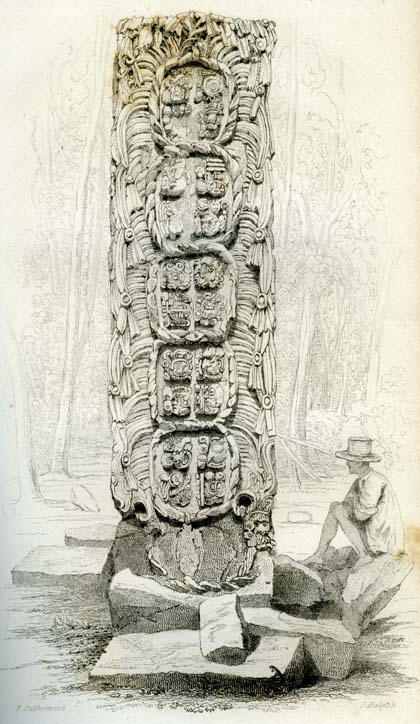
The general gist of this inscription has long been known (Stuart 1986, Newsome 2001). The dedication date is 9.14.10.0.0 5 Ajaw 3 Mak, and the text refers to the placement of the stela (lakamtuun) of Waxaklajuun Ubaah K’awiil (Ruler 13) on that day. The monument also seems to have had its own proper name, probably referencing Ruler 13’s own god impersonation on that ceremonial day.
Blocks A3 and A4 are now destroyed, but just enough can be seen in Catherwood’s drawing to propose their reconstruction. A3 looks to be the preposition TI- or TU- in front of a larger, murky glyph with a numerical superfix. As we will see, the context strongly suggests it is reconstructable as TI-4-AJAW, “In (K’atun) Four Ajaw,” given the mention of “15 K’atuns” (9.15.0.0.0) in the next block. A4 is half-effaced, but there is little doubt in Catherwood’s image that it is I-tz’a-[pa] or I-tz’a[(pa)-ja], for the verb i tz’ahpaj, “then it is erected…”. This makes perfect sense, given that the verb for the following dedicatory statement of the stela has been thought missing. Now we have it.
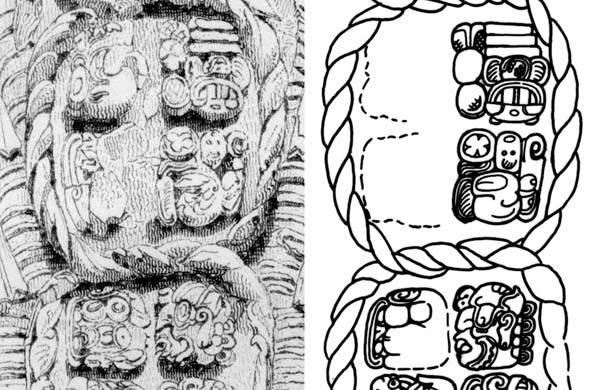
Like a number of Copan inscriptions, the Stela F text is unusual in some ways. The placement of repeating ti– and tu– propositions in front of the chronological glyphs (B1-B3) is noteworthy, after the “Initial Series Introducing Glyph” (A1) where no Initial Series exists. Reading from B1 through A4 we have:
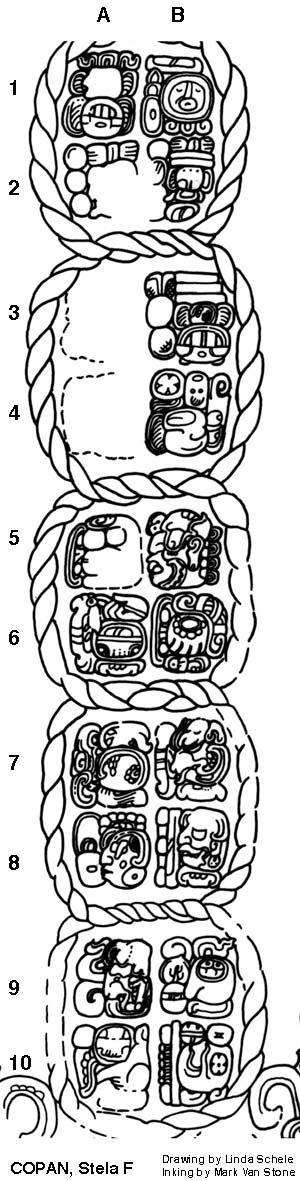
ti tahnlam-il
ti Chan Ajaw
tu Jo’lajuun Winikhaab(?)
i tzahpaj…
On Five Ajaw, the Third of Mak,
At the half-diminishing
in Four Ajaw,
in the Fifteenth K’atun,
then it is erected, …
So, the dedication day 5 Ajaw 3 Mak (9.14.10.0.0) is halfway into 9.15.0.0.0 4 Ajaw (13 Yax, not recorded). This is short-hand method of recording a Long Count date, not unlike examples known from the inscriptions of northern Yucatan. The proper name of Stela F comes in blocks B4-A6, before u k’aba’ u lakamtuun, “it is the name of his large stone” (B6, A7). Interestingly, block A5 is also much clearer in Catherwood’s drawing, showing a very clear spelling U-CHOK-ko-K’ABA’-a (u chok k’aba’, “its young name”) as part of the complex name phrase for the monument. Later, after A6, we come to an extended name phrase for the king, continuing up to A9. The text closes with some sort of descriptive phrase involving a collection of “lords” (ajawtak), possibly royal ancestors who oversaw the ritual and the king’s impersonation.
Catherwood’s drawing was made with a camera lucida under very difficult conditions, and at a point when he had no familiarity with the intricacies of Maya art and writing (Copan was the first great ruin they investigated). His careful rendering confirms what we had suspected was missing in the Stela F inscription, and so there is no great surprise in this analysis. But it’s good to see that this first great artist in Maya archaeological research still provides valuable information for modern epigraphy.