

This post follows up on a recent entry devoted to the “Del Río Throne” of Palenque, which stood inside House E of the Palace until it was dismantled in June, 1787. It’s clear that the inscribed bench is much more recent in date than the building that housed it, placed by a later king in what was essentially Pakal’s throne room. The time difference between the throne and the surrounding space presents an interesting situation for those interested in how the Palace grew and transformed over the course of the Late Classic period.
According to the Tablet of the 96 Glyphs, House E was dedicated on October 30, 654, just two years after K’inich Janab Pakal had celebrated the great K’atun ending on 9.11.0.0.0. This was a pivotal time in Palenque’s early history — Pakal had already been king since 615, but he had apparently held little power in those earlier decades, during what was a troubled political period instigated long before by wars with Calakmul and its allies. When House E was built it must have seemed a bold expression of Pakal’s new-found authority, and it helped set the stage for the architectural transformation of the Palace in the years that followed.
The style of the Oval Palace tablet dates to about the time of the building’s construction in 654, and shows a retrospective scene of the crowning of a young Pakal by his mother, Ix Sak K’uk’. Interestingly, the Del Rio throne itself is much later in date. As Mathews and Schele pointed out, the throne’s inscription records a series of royal accessions beginning with Pakal and continuing on to include his sons who ruled, K’inich Kan Bahlam and K’inich K’an Joy Chitam. An even later king may have been mentioned, since we know that the end portion of the text is still missing. Pakal’s grandson, K’inich Ahkal Mo’ Nahb, is featured in the late calligraphic text beautifully painted above the Oval Tablet, so this king’s modifications of the space may also have included a refurbishment of the throne (see Marken and Gonzalez Cruz 2007:154). At the very least we can be sure that the Del Río throne is significantly later than the Oval Palace Tablet, and that it presumably replaced one or more earlier thrones occupying the same space, beginning of course with the time of House E’s formal dedication in 654.
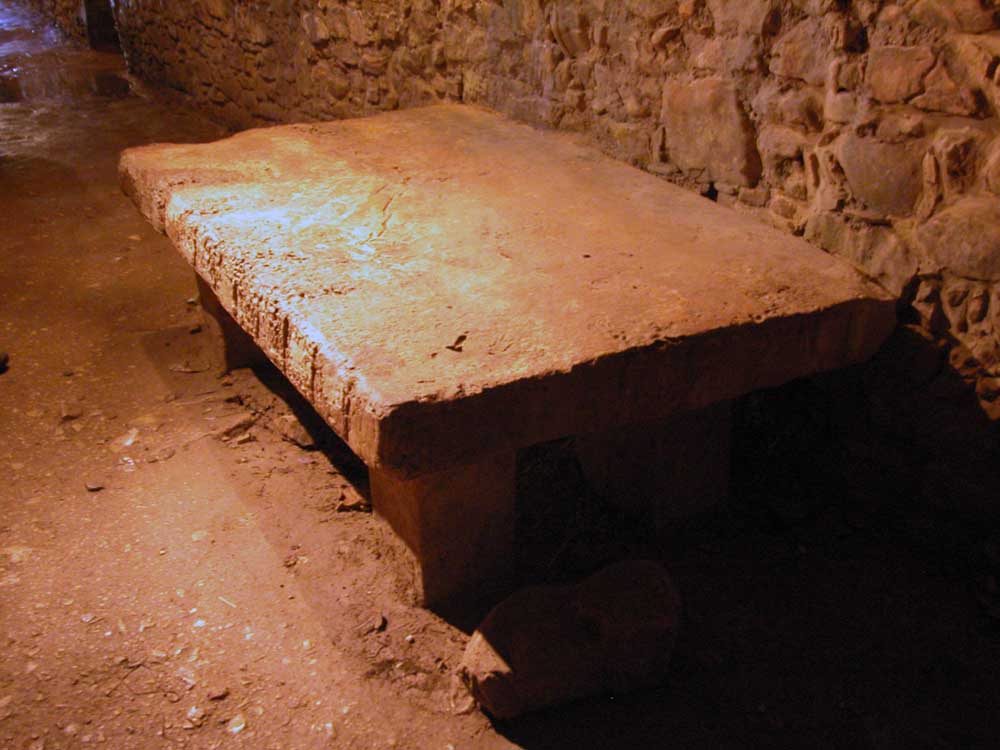
As it happens, the enclosed passages of the Palace’s lower levels — the so-called subterraneos — hold three table-like thrones, two of which are set against side walls of corridors, without any association with doors. One of these thrones (see photo), barely noticed by anyone who walks by in the wet, dark hallway, is inscribed with many eroded glyphs, including a Long Count date and, at the end, the clear name of K’inich Janab Pakal. The style is very early, similar to what we see on the Oval Palace Tablet and other inscribed blocks of the subterraneos. So why was this and another uncarved throne placed in these lower passageways? The subterraneos themselves seem to have been built and conceived as “buried” spaces, and were accessible through two stairways leading from two upper buildings, Houses E and K, which all look to be roughly contemporary with one another. There is good reason to believe these were all employed together as symbolic space integrating the underworld and the throne room (Baudez 1996; Stuart and Stuart 2008). What’s important here is that the subterraneos are directly attached to Pakal’s throne room above, located just up the stairs.
Given the late date of the Del Rio throne in House E, I have to wonder if the early inscribed bench now hidden away in the subterraneos served as the original royal seat beneath the Oval Tablet. That is, when replacing Pakal’s original throne with a new more elaborate one, did the Maya simply put the old seat in the basement, down the dark steps nearby? It does make sense to me, and the style of the faint glyphs is just about perfect for the time period of House E’s dedication.
So, here’s a thought: why not return Pakal’s early throne, or better yet a good copy, to its rightful place in House E? After all, Pakal’s throne room needs a throne!
Sources cited:
Baudez, Claude F.. 1996. Arquitectura y escenografía en Palenque: un ritual de entronización. RES 29/30.
Marken, Damien, and Arnoldo Gonzalez Cruz. 2007. Elite Residential Compounds at late Classic Palenque. In Palenque: Recent Investigations at the Classic Maya Center, pp. 135-160. D. Marken, ed. Altamira Press.
Stuart, David, and George Stuart. 2008. Palenque: Eternal City of the Maya. New York: Thames and Hudson.