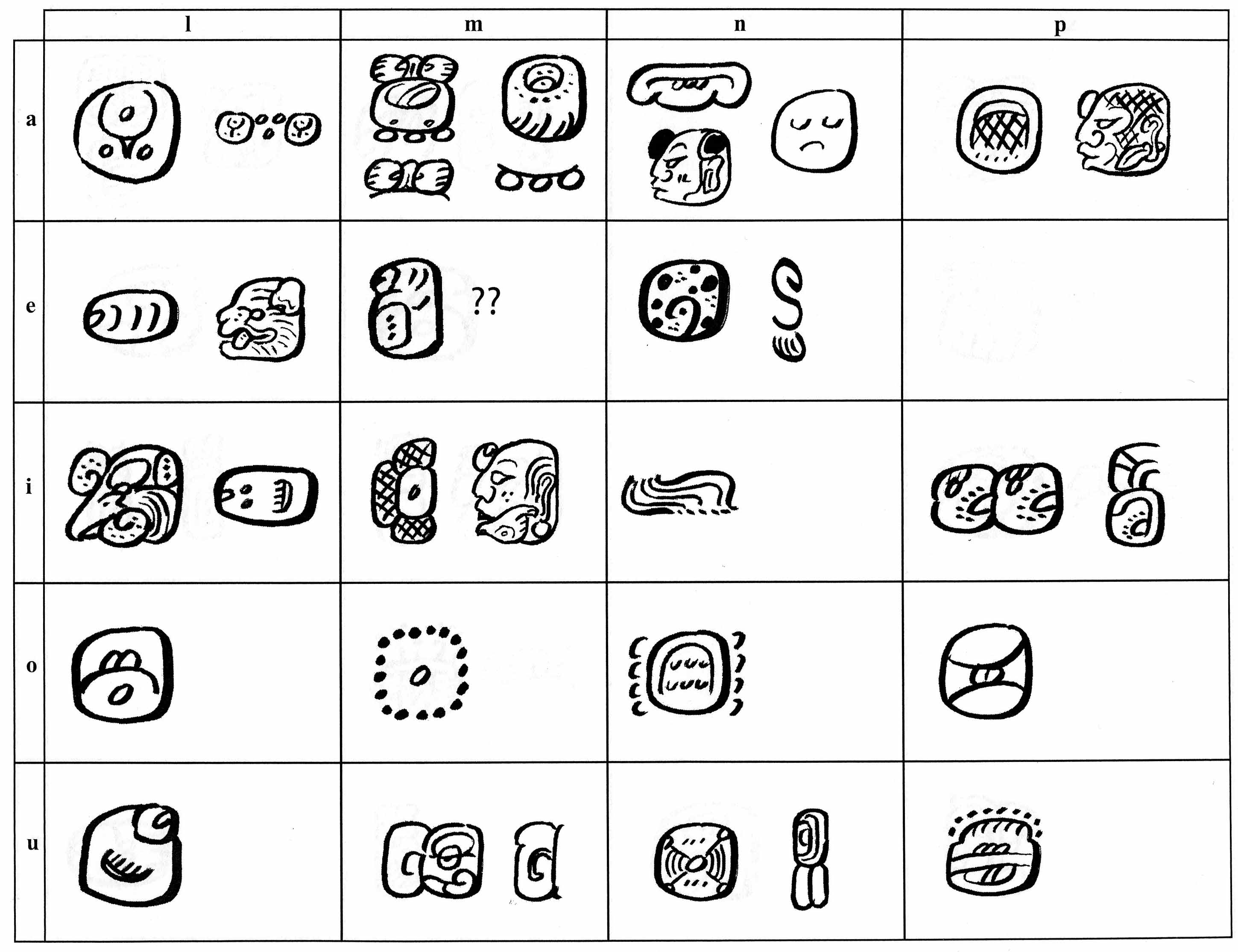
Maya Hieroglyphic Syllabary

glyphpg3I recently posted a pdf of a sign syllabary here on Maya Decipherment, under the new header category “Glyph Resources.” A number of other similar charts are available on the internet but many show a few small inaccuracies.  This syllabary only displays the principal variants of some signs and is in no way exhaustive; due to space constraints it omits some less common or obscure variants and forms.

The signs more-or-less reflect the style and paleography used by Maya scribes in the Late Classic period, around 700 A.D.

This is “Version 2” of the chart, slightly modified from one I prepared for the Sourcebooks of the UT Maya Meetings in 2005. I plan to update the syllabary form time-to-time as new readings or other changes come along.
Maya Hieroglyph Syllabary

ARCHIVES: Glyphs on Pots

by David Stuart

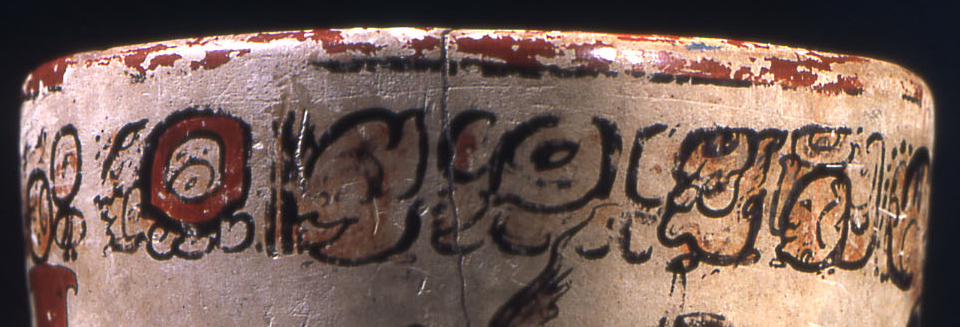
At the 2005 Maya Meetings at the University of Texas at Austin I presented a short analysis and overview of the “Dedicatory Formula,” the standardized glyphic text found on countless Maya ceramics and other (mainly) portable objects. This is also sometimes known as the “Primary Standard Sequence” (PSS), following Michael Coe’s original identification. As we came to understand during the 1980s, the Dedicatory Formula is basically a glorified name-tag for important objects and artworks.  At its core is a possessed noun for the thing itself (i.e., “her cup”) and the owner’s personal name. More extended versions add other details, such something about its decorative mode (painted or carved) and function (“for cacao,” for example). The Dedicatory Formula held great meaning in the artistic and economic life of Maya courts during the Early and Late Classic periods, marking personal connections for important prestige objects and gifts.

AltarDF

Here I’m posting a pdf of the 2005 sourcebook that accompanied my part of that year’s presentation, hoping it might be a useful resource. It should be noted that it doesn’t cover everything, and that some of the information here and there might be slightly out of date.

Glyphs on Pots: Decoding Classic Maya Ceramics by David Stuart (pdf file)

ARCHIVES: Poe on Stephens

by David Stuart

From time to time some small interesting item from the early days of Maya archaeology catches my eye. For example, I recently came across Edgar Allen Poe’s brief review of John Lloyd Stephens’s Incidents of Travel in Central America Chiapas and Yucatan (1839), from an 1841 issue of Graham’s Magazine. Poe chided Stephens for having mistranslated a couple of lines of Hebrew in his earlier book on Egypt and Arabia, but he had kind things to say about the new work, even though he hadn’t even read it yet(?!):

We are not prepared to say that misunderstandings of this character will be found in the present “Incidents of Travel.”  Of Central America and her antiquities Mr. Stephens may know, and no doubt does know, as much as the most learned antiquarian. Here all is darkness. We have not yet received from the Messieurs Harper a copy of the book, and can only speak of its merits from general report and from the cursory perusal which has been afforded us by the politeness of a friend. The work is certainly a magnificent one — perhaps the most interesting book of travel ever published. An idea has gone abroad that the narrative is confined to descriptions and drawings of Palenque; but this is very far from the case. Mr. S. explored no less than six ruined cities. The “incidents,” moreover, are numerous and highly amusing. The traveller visited these regions at a momentous time, during the civil war, in which Carrera and Morazan were participants. He encountered many dangers, and his hair-breadth escapes are particularly exciting.