Day Sign Notes: Caban

David Stuart (University of Texas at Austin)

This is the second in a series of occasional essays on the visual histories and iconographic associations of the Maya day signs. It follows up on previous studies that have explored some aspects of these wider connections (Mex Alboronoz 2021, Stone and Zender 2011, Thompson 1950). My emphasis here is on what might be called the iconographic “roots” of various days, exploring how their forms underwent significant transformations over the centuries, obscuring aspects of their visual origins and iconographic identifications. Each case study will work to help establish the wider point (more a working hypothesis)  that all of the Maya day signs originated in the Preclassic era as representations of deities or mythic animals, and that through constant copying and repetition, these were reduced and abstracted, often losing their original forms in the process. A few of these evolutions and “devolutions” are known to epigraphers (i.e., that the Ahau “face” was never a face to begin with). Still, they are more common than many realize, and laying out the developmental histories helps us to understand the broader history of the 260-day calendar in Mesoamerica.

Figure 1. Variants of the day sign Caban (Kaban) in chronological order (standard and animated versions). (a) UAX: Str. B-XIII murals, (b) TIK: St.31, (c) NAR: Alt 1, (d) PAL: T.XVII tablet, (e) XUN: Pan. 3, (f) PAL: T. XIX platform, (g) EKB, Mural 96 glyphs, (h) Dresden Codex, (i) RAZ, Tomb 12, east wall, (j) QRG: St. D, (k) COP: Corte Altar. Drawings by D. Stuart.

As with many of the Maya day signs, the visual origin of Caban, the seventeenth day of the sequence, has long been unclear (Figure 1a-h). Its form is identical to the common logogram KAB, “earth, ground,” and its name of course reflects a basic connection to that word (see Stone and Zender 2011:136-137). The visual histories of the day sign for Caban and of the KAB logogram show the same developmental trajectory, so we will them here as basically a single sign operating in different contexts. The sign normally shows a so-called “caban curl” element in the upper left and a semicircular form at the lower right. An internal border that runs along the top and down the left side is standard, although this is omitted in some cases. What does the sign represent? Agreeing with an interpretation first proposed by Eduard Seler, Thompson (1950:86) was adamant that it was “a lock of hair worn by Goddess I of the Maya codices.” While there is some resemblance to the hairlock we see on the late moon goddess, this supposed connection quickly dissolves once we realize that it is only in Postclassic representations of the goddess that we see any resemblance. Thompson only considered very late examples when making his comparisons. We need to look elsewhere for an explanation.

Figure 2. Maudslay’s 1889 presentation of the full figure 8 Caban from Quirigua, Stela D. Note the iconographic association made between the face and the standard Caban day. Drawing by Annie Hunter.

One important clue comes from an elaborate animated form of Caban on Stela D of Quirigua (Figure 1j). It shows a bejeweled man with bound hair and a distinctive curl behind the eye, similar to the inner detail we see in Caban. Perhaps with Goodman’s input, Maudslay (1889) made this connection early on in the published illustration of Stela D, showing a slightly reconstructed face of the day sign beside a standard Caban (Figure 2b). Other animated Caban day signs are rare. The only other examples known to me are a 4 Caban Year bearer day painted in Tomb * from Rio Azul (Figure 1i), and a damaged 7 Caban that appears on Dos Pilas, Hieroglyphic Stairway 2. A full-figure Caban appears on the so-called ”Corte Altar” from Copan (Figure 1k), again showing a young male with curl markings on his body. These examples provide a good overview of examples of what is essentially the same character, with distinctive iconographic attributes. So, while rare, this animated Caban must have existed in the background of Classic Maya scribal culture, within a standardized repertoire of imagery that was only occasionally called upon.

Figure 3. The head variant of KAB. (a) TIK: Marcador, (b) YAX: L. 22, (c) PAL: T.I.m., (d) CRN: E. 56, (e) ANL: Pan. 1, (f) four examples of U-KAB-ji-ya from NAR: St. 46. Drawings a-e by D. Stuart, f by A. Tokovinine.

We see many examples of this same head as the standard animation of the KAB logogram, used with far more regularity in the script (Figure 3a-e). Previously I have taken this head to be a somewhat informal elaboration on the basic KAB, where the scribe has chosen to make use of a generic-looking head as a way to lend it some animate quality. However, there is good reason to see this head for KAB and Caban day sign as more than simple personifications. This is perhaps indicated by its sheer frequency and its consistency of form in both early Classic and Late Classic examples. The curl appears behind the eye, or in some early examples, around it, like a descending vertical stripe. On Naranjo Stela 46, the head variant appears five (possibly six) times in spellings of U-KAB-ji-ya (u kab-[i]j-iiy) suggesting that the scribe saw it as a standard sign type (Figure 3f).

Figure 4. The animate number 11. (a) YAX: L. 47, (b) PNG: Pan. 2, (c) COP: Temple 26 inscription, (d) PAL: T. XVI stucco. Drawings by I. Graham (a), D. Stuart (b, c), and M. van Stone (d).
Figure 5. Patrons of the Month Tzec, including head forms of the KAB sign. (a) PNG: Pan. 12, (b) COL: Bonampak area, “Po Panel,” (c) PAL: TC. Drawings by D. Stuart (a), A. Safranov,(b), and Linda Schele (c).

Tellingly, this animated KAB appears in two other settings where it stands alone as a singular representation of a Maya deity. First, we see it as the deity that serves as the number 11 (Figure 4). One example (c) from Palenque’s Temple XVII takes a “celt” element as a prefix, a feature we see on several deity names in both the Classic and Postclassic, and replicating a deified term for the earth that we find on Copan, Stela A. The patron of the moth Tzec is the same thing (Figure 5a, b). Its earliest forms show it to be the deity we have already discussed, and the example from Piedras Negras Panel 12 is particularly complex. Here we see the marking “dripping” over the eye and more of a thickened, dark band with a zigzag. As with the day sign, the simpler KAB works also the month patron (Figure 5c). In this context, the deity head and the standard KAB are once again equivalent signs.

We can easily connect these portrait heads, in turn, to a god who is depicted in the postclassic codices (Figure 6). This is “God R,” so designated from the revisions made to Schellhas’s original list (Taube 1992:112). His portrait name glyph is preceded by the number 11, so there is little doubt it is the same as the deity shown in Figure 4. Note that the he has precisely the same Caban curls over or behind the eye, identical to the animate KAB sign.

Figure 6. “God R” in the Dresden Codex (pages 5b and 6a).

Animate Origins

Did the deity glyphs in Figure 3-5 arise out of the simpler KAB sign, as a personification, or was the reverse true: did the familiar KAB develop as an abstraction from the head? It is a chicken-and-egg conundrum, perhaps, but I do believe there is enough evidence to support the second of these options, that the profile of the deity is the original. As other case studies show, Maya day signs mostly originated as visually complex portraits of deities or animals, which were simplified out of scribal preference. The parallel contexts we have touched on here (day sign, logogram, Tzec patron, and the number 11) all would seem to indicate that their “root image” was the personified form, the deity. I posit that through the familiar process of graphic reduction, and via repeated calligraphic practice, the deity’s profile head was abstracted and reduced to its essentials and diagnostics – his painted eye. His nose, mouth, and eye were “lost” early on, producing a short-hand version, such that all that was left was the distinctive dark patch and curl, along with the border that had originally run along the top of the head. Beginning deep in time, the day sign we recognize as Caban was born out of a long process of visual transformation, ultimately taking on a life of its own. Still, some scribes and iconographers retained this mythological identity to the day, particularly within the restricted contexts of the Tzec month patron and in the animated number. I wonder if small vestiges of the profile face can be seen from time to time even in some later, standard Caban signs, as we see in Figure 1e, where just the lower lip of the face was preserved as a small, vestigial detail.

Figure 7. Fully animate Caban day signs (6 Caban and 4 Caban) from Copan, Altar T. Drawings by D. Stuart.

An allusion to this deeper historical connection comes through two playful and wonderfully odd examples of the day Caban used by later Maya scribes (Figure 7). Altar T of Copan displays two remarkably inventive day signs of Caban as full-figure glyphs, each holding a month glyph. The bejeweled figures have Caban glyphs as heads with a hint of a mouth, and numbers of their coefficients appear above, attached to the heads. On the left is the earlier of the two embodied dates, 6 Caban 10 Mol (9.16.12.5.17, the accession of Yax Pasaj Chan Yopaa) and on the right is the later anniversary, 4 Caban 10 Zip (9.17.12.5.17). Each head has an obsidian blade atop its head, which we also see on the animated number 11 and on the Caban sign from Quirigua. Here the nature of these odd figures as animate Cabans is not solely based upon their glyphic heads, but on their specific iconographic identities, as deities. The designer of Altar T artfully took the abstracted Caban signs, and almost with a knowing wink placed them where the faces of the day gods should be. Lucky for us, the artist revealed some esoteric knowledge of deep script history.

Figure 8. Repeating scenes of wading warriors with the Maize God. Note the dark Caban markings about the eyes, alternating with stripes. (a) K4117, (b) K1224, (c) K2011, (d) detail of K1365. Photographs by J. Kerr, drawing by D. Stuart.

Interestingly, God R of the codices has been described as a deity of war and sacrifice (Taube 1992:112-115). We can link this “Caban deity“ to several representations of obsidian-wielding warriors on codex-style vessels (Figure 8). These are single or multiple individuals who appear with the Maize God, Juun Ixi’m, in scenes that depict his entering the primordial waters. The facial Caban curls are clear in many of these depictions, and their obsidian weapons perhaps relate to the obsidian imagery we see in the glyphs. In two examples we also see ears or ear ornaments in the form of spondylus shells. Sometimes the distinctive Caban curls appear “floating” in front of the faces, as Taube (1992:112-115) has noted, in an apparent overlap with some representations of the Hero Twins (K1202 shows an image of Juun Ajaw with an identical curl before his face). On these warrior figures the Caban curls alternate freely with other painted eye marks in the form of doubled vertical stripes, or a stripe with an “IL” shape. It seems that the eye markings on all of these “Caban deities” could take a few different forms without affecting their identification. In general, they strongly resemble the darkened patch over the eye that we see in early examples of the KAB or Caban head described above (Figure 5a, for example). It would seem that the curl of the standard Caban hieroglyph was the lone vestige of the face, originating as the markings about the eyes, a distinctive characteristic of this particular god, or group of gods.

1 Caban at San Bartolo?

Figure 9. Day record (1 Caban?) from the east wall of Structure sub-1A chamber, San Bartolo, Guatemala. Drawing by D. Stuart.

The Late Preclassic murals of Structure sub1-A of San Bartolo include a painted day sign that once was on its east wall (Figure 9). Here we see a profile face with a spondylus shell ear, and striped “IL” markings over the eye. One of the two stripes bends backward, identical to the facial markings we see on some of the warriors just described in the mythological scenes of the Maize God’s watery entrance (FIgure 10). The shared spondylus shell ear is a feature that makes this connection especially compelling,  suggesting these are the same character — the same warrior with dark face paint over the eye.

Figure 10. Mythic warriors from K1366 and K2011, compared to the San Bartolo day sign. Details of rollout photographs by J. Kerr.

We therefore can entertain the possibility that the day sign at San Bartolo is not 1 Ahau, as I had previously believed, but rather 1 Caban. This day held importance in Maya calendar and forms the base date of one of the intervals written in the 4-column array from Structure 10K-2 (Macleod and Kinsman 2012). There, as the opening column, it is the header for the interval that established the base for the 819-day count cycle, a key component of Maya computational astronomy and four-quadrant cosmology (Linden and Bricker 2023). The 1 Caban from Structure sub1-A at San Bartolo has no surrounding elements that allow us to confirm such associations, but its juxtaposition with 3 Ik on the opposite wall was related to a four-part cosmological arrangement of the mural chamber (Stuart 2017, Stuart and Hurst 2018). In a future post, I will also explore how the day 1 Caban served an important role in the Year Bearer count as well.

Some Iconographic Implications

The simplified KAB sign appears in Classic Maya iconography as markings for ground lines and ground space (Stuart and Houston 1994:57-59). If we are to accept the idea that the image of KAB originated with the profile face, then these are best seen as non-textual extensions of the later abstraced glyph. I know of no examples of the KAB sign or its iconographic relatives in Preclassic Maya art, which is probably significant given the suggestions I’ve made here (it may not have existed as yet). The Classic period overlaps between sign and icon helps to accentuate the point that Maya iconography and writing, at least in its later stages, were inseparable visual and linguistic systems.

The basic meaning of kab as “earth, ground,” naturally suggests that the “God R” and the related warrior deities hold some identity with the earth itself. It is worth noting that there is no well-defined “earth god” in Maya mythology, so perhaps this Caban character (or characters) might qualify for such a role. Their imagery as warriors in the primordial waters of mythology may be related to this.

Finally, we should keep in mind the curious links that this Caban deity shows with Juun Ajaw and his other headband twin companion. This needs further exploration, for it may in the end offer some support for the initial identification I made of the San Bartolo day glyph as 1 Ahau. Nevertheless, for now, I see a stronger visual connection to the warrior deities discussed, pointing to its proper identification as 1 Caban. There is more to ponder, clearly.

Conclusions

The visual origin of the Caban day sign is now clearer, deriving from the profile portrait of a deity with distinctive facial markings (Figure 11). Its common, familiar form throughout the Classic period was a graphic shorthand of this portrait. The example from Rio Azul, dating to about 400 CE, hearkens back to the original and shows us the closest known Classic example to that underlying form, an example of which we may see as San Bartolo.

Figure 11. Hypothetical development of the Caban day sign from 100 BCE to ca. 682 CE. The first stage remains tentative. Drawings by D. Stuart.

This visual history takes us to a larger issue that was touched on briefly in my discussion of the day Men, and which bears repeating here. Underlying my interpretations of Caban and Men is the strong sense that most Maya day signs originated in the Preclassic as animated forms, as the heads of deities or animals. The very early use of the deer’s head for Manik at San Bartolo, at 300 BCE, is one example of this chronological tendency (we will explain the likely visual origin of the “Manik hand,” also the syllable chi, in a future post). To cite a couple of other examples, the common day sign for Chuen was first a portrait of the scribal monkey deity, and its eye came to be used as its standard shorthand representation. The day Ix similarly originated as the eye of a spotted feline. These original forms were still known to the artisans of Maya courts, but tended not to be used in regular scribal practice. What were once complex representations of deities and animals were simplified through expediency and convention, so that they began to take on abstract shapes and forms. I suspect this process began very early in the history of the script, long before the Classic period.

ADDENDUM (September 6, 2024):

I have remembered an important Late Classic example of the Caban day head variant, on a ceramic sherd on display in the Tonina site museum, illustrated below. This sign is the same as the KAB head variant we see in Figure 3, and a late version of the Rio Azul variant (Figure 1i and 11, middle).

Sources Cited

Linden, John, and Victoria R. Bricker. 2023. The Maya 819 day count and Planetary Astronomy. Ancient Mesoamerica 34(3):690-700. doi:10.1017/S0956536122000323

Macleod, Barbara, and Hutch Kinsman. 2012. Xultun Number A and the 819-day count. Maya Decipherment, June 11, 2012. https://mayadecipherment.com/2012/06/11/xultun-number-a-and-the-819-day-count/

Maudslay, Alfred P. 1889-1902. Biologia Centrali-Americana: Archaeology. Volume 2. R.H. Porter, London.

Mex Alboronoz, William Humberto. 2021. Tiempo y Destino entre los gobernantes mayas de Palenque: una perspective desde la cuenta de 260 días. Palabra de Clio, Mexico D.F.

Stone, Andrea, and Marc Zender. 2011. Reading Maya Art: A Hieroglyphic Guide to Ancient Maya Painting and Sculpture. Thames and Hudson, London.

Stuart, David. 2024. Day Sign Notes: Men / Tz’ik’in. Maya Decipherment, April 19, 2024. https://mayadecipherment.com/2024/04/19/day-sign-notes-men/

Stuart, David, and Stephen Houston. 1994. Classic Maya Place Names. Studies on Precolumbian Art and Archaeology, no. 33. Dumbarton Oaks, Washington, D.C.

Stuart, David, and Heather Hurst. 2020. Creation in Four Acts: The Narrative Structure of the San Bartolo Murals. Paper presented at the 2020 Mesoamerica Meetings, UT Austin.

Stuart, David, Heather Hurst, Boris Beltran and William Satunro. 2022. An Early Maya Calendar Record from San Bartolo, Guatemala. Science Advances, DOI:10.1126/sciadv.abl9290

Taube, Karl A. 1992. The Major Gods of Ancient Yucatan. Studies on Precolumbian Art and Archaeology, no. 32. Dumbarton Oaks, Washington, DC.

Thompson, J. Eric S. 1950. Maya Hieroglyphic Writing: An Introduction. Carnegie Institution of Washington, Washington, DC.

Day Sign Notes: Men / Tz’ikin

by David Stuart 

The Classic-period names for the days of the tzolk’in  (cholq’ij) are often obscure to us. This is true even where we see clear semantic connections to the familiar names used in colonial Yucatan (the names we still use today in describing the ancient Maya calendar, by convention). Was the day “Kan” actually called K’an in Palenque in 750 CE, or was it something else? The problem comes down to the pervasive use of single logograms in writing the days, with only an occasional phonetic sign attached here and there to offer a partial clue about their pronunciations. An additional stumbling block involves the history of the day glyphs themselves. Their forms changed in sometimes surprising ways over nearly two thousand years, such that late variants bear little resemblance to how they were originally designed. Here and in subsequent studies of the Classic Maya days, I offer a few historical and paleographical observations, looking particularly at the origins and iconographic connections of certain signs. The day glyphs have a deep history, unsurprisingly, and even their earliest examples point to centuries of previous development, reaching far back into the Preclassic era. The recent suggestion that the 260-day calendar can be discerned from architectural plans and alignments dating to the Middle Preclassic (or Middle Formative) is a powerful testament to its antiquity (Šprajc et al. 2023). So here we will look at the “visual etymologies” of certain day signs to tease out clues about their origin, as well as about their important associations with Maya iconography. Even with new semantic clues in hand, the ancient names of the days will probably remain difficult to know, at least in many cases.

We begin our series of observations with the fifteenth day, named Men in ancient Yucatan. This was also the name of the fifteenth day in Ch’ol, as reported by Campbell (1988:375). The only plausible source for the name the root men, which in both Yukatekan and Cholan languages is “make, do,” and forms the basis of the Yukatek word hmeen (“a doer, maker”), best known as the title for a ritual specialist or curandero. When a possessed noun, men can form a phrase that signals causation, as is Yukatek u men, “por causa de” or tu menel, “porque.” The same appears in Ch’orti’ u mener, “por, de, a causa de” (Hull 2016: 278). In Ch’ol, the verb mel, “to do,” may be related. The co-occurrence of the day name Men and root men within both Yukatekan and Ch’olan might suggest that the day name was shared throughout much of the lowlands in ancient times, and perhaps during the Classic period. We will return to this point shortly.

In highland Mayan languages the corresponding name for the fifteenth day is Tz’ikin, equivalent to the proto-Mayan word *tz’ikin, “bird.” Here we see a link to the widespread names meaning “Eagle” in Nahuatl, Otomi, and other languages of highland Mexico (Caso 1967, Kaufman 1989). Based on these widespread name patterns, Kaufman suggested that Men was that of an “eagle god,” whose Mayan name associates “with ‘Bird’ in general, as though he were the protean bird.” I agree with his assessment and would add that the best evidence for an “eagle god” may come from the Men’s historical development as a hieroglyphic form.

Figure 1. Classic period variants of Men, (a-e) head variants arranged chronologically, (f-i) simplified forms possibly based on the eye of the head (compare b and f). Drawings by David Stuart.

Two Classic-period variants of Men, arranged over time, are illustrated in Figure 1. The head variants – what we must assume was its “original” form – appear in the upper row of Figure 1 (a-e). These have received little discussion in the epigraphic literature, and many drawings reproduced in various books and other publications look to be highly inaccurate (see, for example, Thompson 1950: Fig. 9, 36&39). These all show a profile head of what appears to be a supernatural bird, with a distinctive squared inner eye. The eye is one clear indication of its deified nature, as are the “shiner” markings we find on the forehead in Early Classic variants. An avian beak is sometimes hard to make out in these highly abstracted forms, but we see it clearly in a few late examples, as from Piedras Negras Panel 3 (example c). Even by the Early Classic the bird’s head was highly abstracted and conventionalized, probably due to calligraphic practice over time, going back to the Late Pre-Classic (examples a and b).

Figure 2. Principal Bird Deity and accompanying name from K4546. Note resemblance of the portrait head glyph to the Men day sign. Drawing by David Stuart

These head variants agree not only with Kaufman’s idea of a “bird god,” but they are identical to representations of the Principal Bird Deity (Bardawil 1979, Cortez 1986, Guernsey 2006, Martin 2015, Nielsen and Helmke 2015), possibly named Kokaj Muut or Yax Kokaj Muut (Boot 2008). The visual equivalence is demonstrated by the name glyph of an aspect of the Principal Bird Deity we find on a codex-style vessel, Kerr 4546, captioning the bird’s portrait nearby (Figure 2). This is a portrait name glyph, and other examples of the bird’s name show the Principal Bird Deity in a more familiar, less abstract way (Figure 2c, d). These are in turn equivalent to what we find in the codices as the name of the more anthropomorphic God D, the Principal Bird being his avian avatar. No other avian figure from Maya art or iconography displays such deified characteristics, so it is clear that the day sign Men originated in the Preclassic and Early Classic as the portrait of the Principal Bird Deity. It seems that the name of the fifteenth day in Postclassic Mesoamerica, whether “Eagle” or “Bird,” are generic reflection of this day’s more mythical origin and identity.

Figure 3. Names of the four bird deities in the four world quarters, from Tomb 12 at Rio Azul, Guatemala. Note visual equivalence to early Men day sign. Drawings by David Stuart.


Figure 4. Directional bird names from Tomb 12, Rio Azul, and incised obsidians from cache at Tikal.

In further support of this connection to the great mythic bird, we can turn to other examples of the Principal Bird Diety’s glyphic name. In Tomb 12 of Rio Azul, four similar deity names feature this same head sign, written on the tomb’s four walls and associated with one of the four quarters or world directions (Figure 3). As I and others have argued, these are names of the Principal Bird Deity, each with a different adjectival descriptor (day, night, moon, and star) (Taube, et al. 2010:52-56). Later examples of these same directional names confirm the visual connection to the Principal Bird Deity (Figure 4). This chronological evolution suggests that the Principal Bird Deity used as the Men Day sign often retained an “early look” throughout much of the Late Classic. There are examples of Men, however, that are more representative of the later bird deity heads we see in Figure 4 (see Naranjo, Stela 23 [F17] and Stela 28 [G18]).

A rarer and far simpler variant of the day Men also appears in Classic-era texts (Figure 1, f-i). I believe this to be an enlarged representation of the great bird’s eye, a pars pro toto form meant as a simplification of the head variant (compare examples b and f in Figure 1). It is also remotely possible that it originated as a highly abstracted form of the bird’s head in full (compare a and f). Other day signs show an eye as a simpler form of a complex head variant (Lamat, Chuen, and Ix, are three examples that come to mind, which we will discuss in later notes). The “eye” forms of Men show a squared inner “pupil,” identical to the eyes we see in early representations of celestial deities, such as K’inich Ajaw. Some Late Classic examples also display small dots in the upper portion of the sign (Figure 1, g-h). I suspect that this minor elaboration arose through the sign’s general resemblance to the distinct logogram TAHN (“within”) which displays the line of dots or a quincunx as a consistent feature.  That is to say, in writing the simplified Men day sign, scribes sometimes were inclined to incorporate the dots out of habit, not realizing the origin of the element as an eye. Here it is interesting to note that representations of deities’ eyes changed throughout the Classic period, with the squared pupil moving from the lower left to the upper left. Yet the reduced form of Men retained the early look, supporting the notion that some scribes used the reduced form of Men without realizing its true visual origin.

So, the visual origin of the Men bird was the Principal Bird Deity, the avian aspect of the old God D (and God N) who was perhaps named Kokaj or Yax Kokaj Mut (Boot 2008, Martin 2015). Here the word men may provide an interesting semantic connection, for as the root for the verb “to make” it resonates with the names of certain creator deities among the later contemporary Maya. (H)meen, the religious title of Yucatan, is also analyzable as “maker, creator,” apt descriptions for the celestial god who we otherwise know was a diviner, and scribe, aj tz’ihb. In one text at Xcalumkin, God D or his avian aspect is called an aj k’in, “day-keeper, diviner” — a clear indication of his role not unlike that of Cipactonal of central Mexico (see Martin 2015: 223-225). Whatever the case, the visual history tells us that the Principal Bird Deity was the core mythical basis for Men, not simply a bird or an eagle.

Figure 5. Expanded names of the avian solar god, Wuk Chapaht Men(?) K’inich Ajaw. (a) Tikal, T. IV, Lintel 2, (b) the Cuychen Vase, rim text, (c) Copan, Altar of Stela 13, (d) Terminal Classic vessel in LACMA collections. Drawings a and c by David Stuart, drawing b by Christophe Helmke.

Outside of the context of the day, the same avian head appears as a part of the expanded name phrase of the solar god, K’inich Ajaw (Figure 5). Clearly, the Principal Bird Deity, or an aspect of it, was considered a solar being, a precedent for the Postclassic Mexican idea of the solar eagle. The name phrase is introduced by Uuk Chapaht (“Seven Centipede”), followed by our Men bird (or its reduced form) and then K’inich Ajaw. Semantically we can interpret this as “Seven-Centipede-BIRD.DEITY-Sun Lord.” Whereas I had previously considered TZ’IKIN as a possible reading of the bird logogram, this now seems unlikely. Tellingly, the noun tz’ikin, “bird,” while very old and traceable to proto-Mayan, is nowhere to be found in lowland languages. The day name Tz’ikin is restricted to the highlands as well (in both Eastern and Western Mayan), where it may well have been borrowed across languages and communities.  To reiterate, the attested name in both Yucatec and Ch’ol was Men. We might therefore entertain MEN or some cognate form as an alternate reading, both as a day name and as a logogram. The -na suffix on the head would conceivably agree with this, appearing on examples from the altar of Copan Stela 13, and a Terminal Classic polychrome vessel in the collections of LACMA (M.2010.115.685) (Figure 5c, d). So, while tentative, I believe we can entertain an analysis of the solar god’s full name as Wuk Chapaht Men(?) K’inich Ajaw. I should emphasize that a MEN reading and still needs to be tested outside the context of the tzolk’in.

Figure 6. Postclassic examples of Men from the Dresden Codex, Madrid Codex, and the murals of Coba. Drawings by David Stuart
Finally, we should turn to the very late forms of Men found in the codices (Figure 6). These are consistent in presenting a profile face with a series of parallel lines behind its mouth.  All are derived from the earlier reduced Classic variant where the face is not present (see Figure 1, f-i). I suspect that the eye had already been in long use in manuscripts as a more calligraphic form of the day and that this carried over into the manuscript tradition of the Postclassic. By then, scribes had fully lost any sense of its true visual origin, misinterpreting the eye as a human-like face, taking the small square at the lower left as a mouth, and the small dots above as “eyes” (the dots, we will recall, may have arisen out of yet another mistaken evocation of the TAHN logogram). No attempt was ever made to make it resemble a bird. It seems that the original head variant representing the Principal Bird Deity did not survive at all past the collapse of the Classic period. A visual summary of this proposed development, covering over a thousand years, is shown in Figure 7.

Figure 7. The development of Men. First, a portrait of Principal Bird Deity (Classic), then reduced to its eye as a simplified variant (Classic), then reinterpreted as a head (Postclassic)

Ancient misinterpretations of the Men’s visuals have led to at least one erroneous interpretation of the day’s meaning. In his lengthy discussion of the day signs Thompson (1950:82-84) was confident that it was “the day of the aged patroness of weaving (and) the aged moon goddess.” He was surely mistaken in this, however, basing his ideas only on the late forms of Men as found in the codices. Thompson’s take reflected a common methodological bias of his time when relatively few early Maya inscriptions were known. The early variants were unknown to him, as was the Principal Bird Deity itself.

Spanning over two millennia, the histories of the day signs are full of similar evolutionary twists and visual turns. Late forms often bear little resemblance to their Preclassic originals, which perhaps isn’t too surprising. Indeed, the signs of the tzolk’in often seem as if they operated within their particular ecosystem, set apart somewhat from the many other elements of the script. Tracking of similar paleographical sign histories remains an under-appreciated aspect of Maya epigraphy, in my view, and we will explore similar sign histories in future “Day Sign Notes.” To anticipate where some of these analyses will go, I feel confident in saying that the mundane-sounding names found in later Mesoamerican calendars – such as “Bird” or “Monkey” – can often obscure far older meanings rooted in Maya mythological identities. Likewise, Men was no generic “Eagle,” as the day was dubbed in Postclassic central Mexico. Being Maya in origin, it was first and foremost the Principal Bird Deity, a celestial and solar symbol par excellence. I suspect that each day of the tzolk’in had, in the Preclassic, its own specific iconographic identity as a deity. These are at times only dimly perceptible in later language and scribal usage, but they can still be accessed through the day signs’ visual histories, and the vestiges of meaning they convey.

References Cited

Bardawil, Laurence W. 1976. The Principal Bird Deity in Maya Art – An Iconogrpahic Study of Form and Meaning. In The Art, Iconography and Dynastic History of Palenque, Part III: Proceedings of the Segunda Mesa Redonda de Palenque, edited by Merle Greene Robertson, pp. 195-209. Robert Louis Stevenson School, Pebble Beach.

Bassie-Sweet, Karen. 2008 Maya Sacred Geography and the Creator Deities. University of Oklahoma Press, Norman.

Boot, Erik. 2008. At the Court of Itzam Nah Yax Kokaj Muut: Preliminary Iconographic and Epigraphic Analysis of a Late Classic Vessel. Online article. http://www.mayavase.com/God-D-Court-Vessel.pdf

Campbell, Lyle. 1988. The Linguistics of Southeast Chiapas, Mexico. New World Archaeological Foundation, Brigham Young University. Provo, UT.

Caso, Alfonso. 1967. Los Calendarios Prehispanicos. UNAM, Mexico.

Cortez, Constance. 1986. The Principal Cird Deity in Preclassic and Early Classic Maya Art. MA Thesis, Department of Art and Art History, University of Texas at Austin, Austin, TX.

Guernsey, Julia. 2006. Ritual and Power in Stone: The Performance of Rulership in Mesoamerican Izapan Style Art. University of Texas Press, Austin.

Hull, Kerry. 2016. A Dictionary of Ch’orti’ Mayan-Spanish-English. University of Utah Press, Salt Lake City.

Kaufman, Terry. 1989. The Mesomerican Calendar: The Day Names. Unpublished manuscript in author’s possession.

Martin, Simon. 2015. The Old Man of the Maya Universe: A Unitary Dimension to Ancient Maya Religion. In Maya Archaeology 3, edited by C. Golden, S. Houston and J. Skidmore, pp. 186-227. Precolumbia Mesoweb Press, San Francisco.

Nielsen, Jesper, and Chrisophe Helmke. 2015. The Fall of the Great Celestial Bird: A Master Myth in Early Classic Central Mexico. Ancient America 13. Boundary End Archaeological Research Center and Mesoamerica Center, UT Austin. Barnardsivlle, NC.

Šprajc, Ivan, Takeshi Inomata, and Anthony Aveni. Origins of Mesoamerican astronomy and calendar: Evidence from the Olmec and Maya regions. Science Advances 9eabq7675(2023).DOI:10.1126/sciadv.abq7675

Taube, Karl, William Saturno, David Stuart, and Heather Hurst. 2010. The Murals of San Bartolo, El Peten, Guatemala. Part 2: The West Wall. Ancient America 10. Boundary End Archaeology Research Center, Barnardsville, NC.

Thompson, J. Eric S. 1950. Maya Hieroglyphic Writing: An Introduction. Carnegie Institution of Washington, Washington. D.C.

The Solar Eclipse Record from Santa Elena Poco Uinic

by David Stuart

This entry is offered in anticipation of the solar eclipse visible over much of Mexico and the United States on April 8, 2024.

Only one record of a solar eclipse is known from Maya inscriptions of the Classic period. This appears on Stela 3 from Santa Elena Poco Uinic, a remote site in highland Chiapas, as part of a lengthy text relating several historical events of the late eighth century. This large monument was first recorded in 1926 by a team led by Enrique Juan Palacios, and it was shortly afterward that the great Mayanist John Teeple saw the published photographs and drawings (Palacios 1928), taking special note of a glyph showing a K’IN (sun) sign covered by two flanking elements (Figure 1b). Its strong resemblance to some “covered suns” represented within the eclipse tables of the Dresden Codex probably also caught Teeple’s eye.

Figure 1. (a) The lower portion of Stela 3 from Santa Elena Poco Uinic. (b) The eclipse glyph at the bottom of the central column. (Photograph by Miguel Othón de Mendizábal and Frank Tannenbaum; drawing by Nikolai Grube).


This “possible eclipse glyph,” as Teeple called it, follows a Calendar Round record of 5 Cib 14 Ch’en. Unlike other historical episodes recorded on the Poco Uinic stela, there is nothing more to the passage – no personal name, nor any other associated event or description. Rhetorically it serves as a simple calendrical statement, much like a Period Ending would be curtly described in a lengthy text, as a day of inherent noteworthiness, with no human actor. The day corresponds to the Long Count 9.17.19.13.16, firmly anchored by the larger narrative, including a Distance Number that connects it to the stela’s dedication date on the k’atun ending 9.18.0.0.0 11 Ahau 18 Mac, 84 days later. Teeple made the simple observation that “according to the Goodman correlation, which we have been using, this 5 Cib 14 Ch’en fell on July 16, 790, and on that day shortly after noon a total eclipse of the sun was visible from the spot where this monument was soon afterward erected” (Teeple 1931:115). Here we should remember that the correlation of ancient Maya and Gregorian calendars was still a matter of great debate when Teeple wrote these words. His masterful compilation of evidence from lunar records in the Classic inscriptions and other lines of evidence made him more comfortable in using a version of the Goodman (Goodman-Martinez-Thompson, or GMT) correlation, although he was still cautious in coming down too strongly in its favor.

Teeple’s eclipse was mentioned here and there in the epigraphic literature after 1931, but its importance was also strangely ignored. This changed in 2012, when Martin and Skidmore revisited the Poco Uinic text, featuring it in their elegant discussion of the correlation question. They made a clear case for its central importance in refining the match between Maya and Gregorian days (Martin and Skidmore 2012). The principal variants of the GMT correlation that most Mayanists used between 1931 and 2012 necessitated placements of the Poco Uinic date on July 13, 790 (using the 584283 Julian Day Number constant) or July 15, 790 (584285). In positing the Poco Uinic eclipse, Teeple had relied on a necessary one-day adjustment (584286), but this variation on the GMT had failed to gain wide acceptance in the years that followed. This was due in large measure to Thompson’s preference for the 584285, and his stubbornness to explore the issue only through postconquest documents of Yucatan (see Martin and Skidmore 2012:6, 9). Today, thanks to Teeple and, more recently, Martin and Skidmore, we can appreciate how a simple statement of a solar eclipse has allowed us to refine the correlation of Maya dates. My own work with new-moon records may offer some small support for it as well (Stuart 2020).

A recent astronomical study of the July 16, 790 eclipse by Hayakawa et al. (2021) noted how the path of totality passed 80 or so miles to the south of Santa Elena Poco Uinic. Still, its maximum magnitude was 0.946 at shortly after noon, and it surely would have been a noticeable event, as the authors note.

The eclipse record is part of a longer text on the Poco Uinic stela, the point of which was to celebrate the k’atun ending 9.18.0.0.0, which fell shortly later on October 8, 790. The inscription also features the accession of a local ruler named Yax Bahlam, which occurred on 9.17.11.14.16 5 Cib 14 Ceh, or September 16, 782. Significantly, the eclipse of 790 occurred on another 5 Cib (Martin and Skidmore 2012:6), as well as on a haab station that fell on the 14th day of Ceh, a “color” month similar to Ch’en. The occurrence of the eclipse on a day so resonant with the accession eight years earlier, and so close to the k’atun ending to come, is striking. It must have been especially meaningful to the Maya of Santa Elena Poco Uinic.

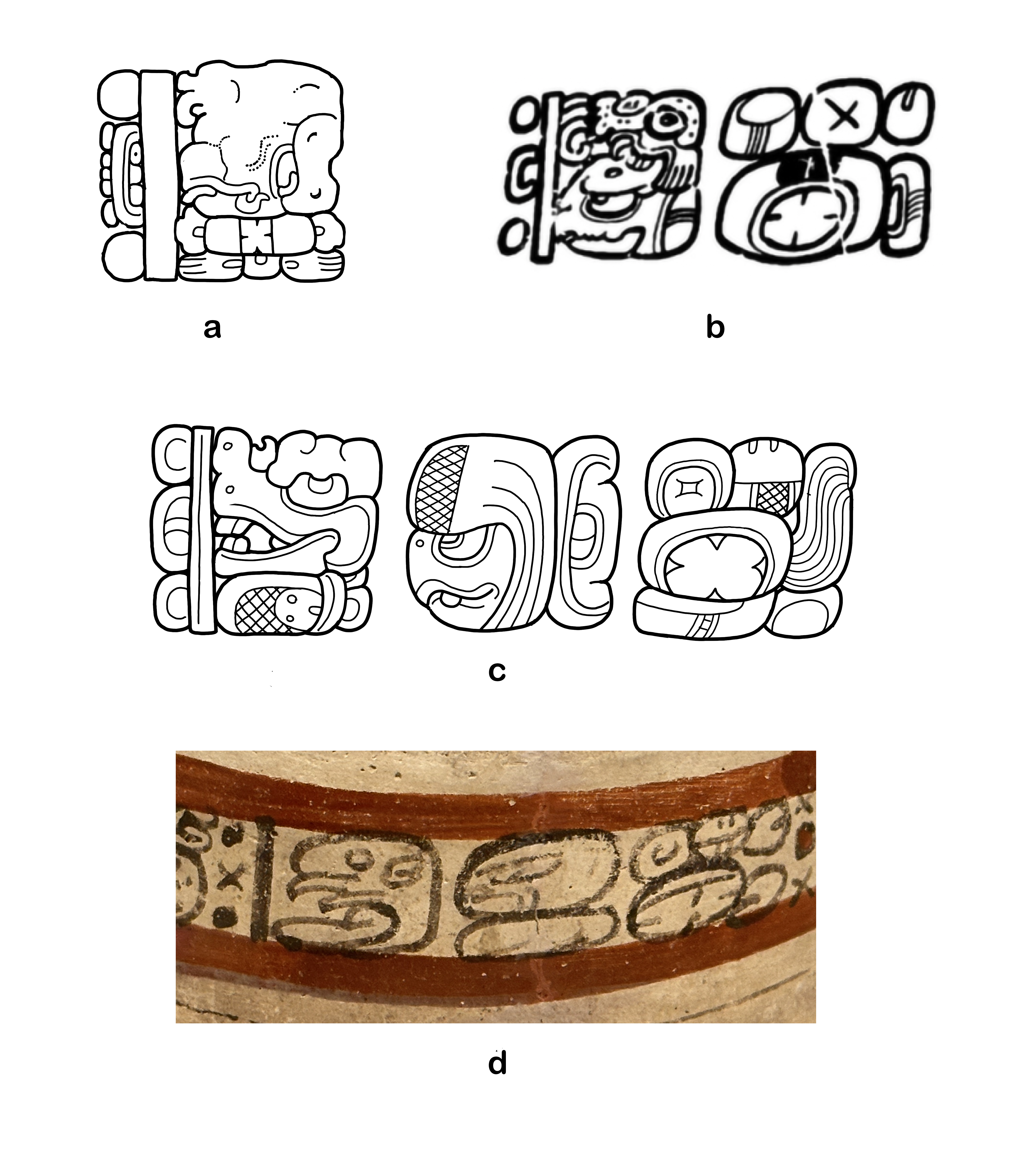
Regarding the eclipse glyph, its reading remains difficult to know. Prager (2006) has suggested that the covering elements around the central K’IN might be read as NAM, but this will need further testing. These strongly resemble the arching element that is part of the K’ABA’, “name,” glyph (Love 2018). The visual form of these covering elements has a complex history of its own, as reflected in one variety of Glyph X from the lunar series, where a reference to darkened suns and moons seems to be included in the proper names of certain lunations (Grube 2018). Love (2018) offers a useful overview of the glyph from Poco Uinic and rightly suggests that many of the so-called “eclipse” glyphs we find in Maya texts and iconography might not all be the same, with some referring to sun-darkening in a more general way.

With a solar eclipse approaching in a few days, visible over much of the United States and Mexico, it seems a good moment to revisit the unique text from Poco Uinic. A century after its recognition by Teeple, it remains a singular record of an intensive “sun-darkening” from Maya history, from over twelve centuries ago.

References Cited

Grube, Nikolai. 2018. The Forms of Glyph X of the Lunar Series. Research Note 9, Textdatenbank und Wörterbuch des Klassischen Maya. Universität Bonn, Bonn.

Hayakawa, Hisashi, Mistturu Soma, and J. Hutch Kinsman. 2021. Analyses of a Datable Solar Eclipse Record in Maya Classic Period Monumental Inscriptions. Publications of the Astronomical Society of Japan. DOI: 10.1093/pasj/psab088

Love, Bruce. 2018. The “Eclipse Glyph” in Maya Text and Iconography: A Century of Misinterpretation. Ancient Mesoamerica 29(1):219-244.

Martin, Simon, and Joel Skidmore. 2012. Exploring the 584286 Correlation between the Maya and European Calendars. The PARI Journal 13(2):3-16. https://www.mesoweb.com/pari/publications/journal/1302/Correlation.pdf

Palacios, Enrique Juan. 1928. En los confines de la selva lacandona. Exploraciones en el estado de Chiapas, Mayo-Agosto 1926. Talleres Gráficos de la Nación, México.

Prager, Christian. 2006. Is T326 a Logograph for NA:M “hide, to go out of sight”? Unpublished Manuscript.

Stuart, David. 2020. Yesterday’s Moon: A Decipherment of the Classic Mayan Adverb ak’biiy. Maya Decipherment (www.mayadecipherment.com), posted August 1, 2020.

Teeple, John E. 1931. Maya Astronomy. Contributions of American Archaeology, No. 2, pp. 29-116. Publication 403. Carnegie Institution of Washington, Washington D.C.

A New Drawing of the Inscription on the Cross Censer Stand from Palenque

by David Stuart (The University of Texas at Austin)

In 1979 Linda Schele and Peter Mathews published their important catalog, The Bodega at Palenque, Chiapas Mexico, presenting various sculpture fragments and artifacts recovered over the course of many years of excavation from the 1930s to the 1960s. Of significant interest to epigraphers, among many pieces, was a badly damaged stone censer stand that had been found on the slope of the Temple of the Cross in 1945 (Schele and Mathews 1979:281).

The sculpture is representative of a particular type that is distinct to Palenque – an upright stone with a near life-size face on its front, two prominent side flanges showing ear ornaments, and other iconography, often with inscriptions on its side edges and back. These stones were inspired by the famous large ceramic censer stands that adorned many of the temples of Palenque (Cuevas 2008). As with their ceramic counterparts, small shallow bowls with copal were placed on the stands, visually atop the elaborate headdresses.

Other examples of such stones, far better preserved, include the stand representing the nobleman Aj Sul, a contemporary of K’inich Janab Pakal, now in the Museo Regional de Palenque. Another is a larger piece in the Museo Amparo in Puebla with a portrait of an Aj K’uhuun from the same period, carved during the reign of K’inich Janab Pakal. The inscriptions on all of these, including the Cross example, are biographical, recounting events in the lives of the figures portrayed. Their narratives close with records of death and burial. Clearly, these served as funerary small funerary altars, bearing the images of deceased ancestors. I have tentatively identified the name of this type as k’ohob’tuun, “image/mask stones” (Stuart 2019). In function and design, these bear a remarkable similarity to some funerary altars from the Roman world.

Unfortunately, the portrait on the front of Cross censer stand is broken and almost completely gone. A long incised inscription on its rear is also badly damaged (see drawing). Its first publication by Schele and Mathews was accompanied by Schele’s drawing and their tentative chronological analysis. The dates of the text were later revised and corrected in an outstanding study made by Ringle (1996), who also recognized strong overlaps between the texts and the contents of the Temple XVIII stucco inscription. In the late 1980s, I determined that a small stone fragment recovered in the western stairs of the Palace, now on display at the Museo Nacional de Antropologia, was likely to be part of the same stone, bearing the opening Long Count date (see left side in drawing). The discovery of these pieces at a great distance from one another offers a fascinating instance of a monument’s intentional destruction and removal, probably after Palerque’s fall.

The fit of the side fragment prompted the drawing presented here, which will also be discussed as part of the upcoming workshop on the stucco glyphs from Temple XVIII, at Boundary End Archaeology Research Center (April 2024).

I agree with most Ringle’s revised chronology, differing only in a couple of dates from the middle of the text, given here only tentatively. The Gregorian dates are given using the Martin-Skidmore (584286) correlation.

9.10.15.6.8  4 Lamat 16 Pop   /   Mar 15, 648  / Birth of Tiwohl Chan Mat
9.11.5.0.0  5 Ahau 3 Zac   /   Sep 16, 657  /  Period Ending (PE)
9.11.6.16.17  13 Caban 10 Ch’en  /  Aug 14, 659  / Arrival of Nuun Ujol Chahk
9.11.7.0.0  10 Ahau 13 Yax  /   Sep 6, 659  /   PE
9.11.9.14.19  2 Cauac 17 Xul   /   Jul 11, 662  / Youth ritual?
9.11.10.0.0  11 Ahau 18 Ch’en  /   Aug 21, 662  /   PE
9.11.13.0.0  12 Ahau 3 Ch’en  /  Aug 5, 665  /  PE
9.11.15.10.7  3 Manik 0 Uayeb???  /  Feb 18, 668  /  Triad event
9.12.0.0.0  10 Ahau 8 Yaxkin  /  Jun 29, 672  / PE
9.12.0.6.18  5 Etz’nab 6 Kankin  / Nov 14, 672 / Death of Lady Tzakbu Ajaw
9.12.8.9.18  7 Etz’nab 6 Muan  /  Dec 2, 680  /  Death of Tiwohl Chan Mat
9.12.8.10.0  9 Ahau 8 Muan  /  Dec 4, 680  /  Burial
9.12.10.0.0  9 Ahau 18 Zotz’  /  May 8, 682  /  Dedication of stone

We see that the thirteen dates on the stone (an intentional number?) cover a thirty-five-year period, corresponding roughly to the life of the stone’s protagonist, Tiwol Chan Mat. As we find in other funerary texts on small stones, the inscription is biographical, recounting the major events of his life. The censer stand was dedicated at the half-k’atun on May 5, 682, 162 days after Tiwohl Chan Mat’s death. There is a poignance to the mention of Pakal overseeing the burial of his youngest son, only eight years after his wife passed away. In fact, The similarity in the death dates of the mother and the son – 5 Etznab 6 Kankin and 7 Etznab 6 Muan – may have given extra meaning to the narrative, linking the mother and her adult son. Pakal’s own death would come soon after.

The prominence of the 659 arrival of Nuun Ujol Chahk, probably the exiled ruler of the Mutul dynasty, is interesting.  This was a transformative event for Palenque’s court, featured prominently in Pakal’s own story as told in the Temple of the Inscriptions. The visit probably helped to advance Pakal’s own political and military power in the western region, and his conflicts against the great Kanul court and its allies. Tiwol Chan Maat was only eleven years old at the time of this royal visit, and it must have left quite a mark on the boy.

Lastly, the dedication of this funerary stone pre-dates the Temple of the Cross, where it was eventually found. This suggests that it was brought to the Cross a decade or more after it was carved. There it would have accompanied the many other ceramic censer stands found on the temple’s slope. The ancestral themes of the tablet in the Temple of the Cross may signal why it was brought there, adding Tiwohl Chan Mat’s story to his older brother’s greater dynastic narrative.

Sources Cited

Cuevas Garcia, Martha. 2008. Los incensarios efigie de Palenque: Diedades y rituales mayas. UNAM, Mexico.

Ringle, William M. 1996. Birds of a Feather: The Fallen Stucco Inscription of Temple XVIII, Palenque, Chiapas. In Eighth Palenque Round Table, 1993, edited by M.G. Robertson, M. J. Macri, and J. McHargue, pp. 45-61. Pre-Columbian art Research Institute, San Francisco.

Schele, Linda, and Peter Mathews. 1979. The Bodega of Palenque, Chiapas, Mexico. Dumbarton Oaks, Washington, D.C.

Stuart, David. 2019. A Possible Logogram for K’OJ or K’OJOB, “Mask, Image.” Unpublished talk (slides only) on academia.edu.

Further Observations on the MUT Logogram

by David Stuart

Figure 1. The complements mu and tu on the Tikal/Dos Pilas emblem glyph.

Back in 1993 I proposed that the main sign of the emblem glyph of Tikal and Dos Pilas/Aguateca is read as MUT, based on the affixes mu- and -tu that appear with it in different contexts, apparently as phonetic complements (Figure 1). My colleague Christian Prager noticed this pattern around the same time, also seeing these syllables as essential clues to the sign’s reading. Many examples of the emblem also show an additional -la suffix, suggesting that MUT-la is a fuller spelling that has led to the various reconstructions Mutal, Mutul, Mutuul. Mutu’l, or something similar (the precise nature of the vowel in such -Vl suffix remains a point of minor debate among epigraphers). My inclination is to see the ancient court name as related to the historical attested place name Mutul, known from both Yucatan and the Petén, as in the modern names Motul de San José, or Motul, Yucatan (home of huevos motuleños, a staple of restaurant breakfasts in Yucatán). “Mutul” is the form I will use here as the reading the full Tikal emblem. In the Classic period Tikal seems to have gone by the name Yax Mutul, “The First Mutul,” perhaps as a way of distinguishing it from earlier centers who also had claimed the Mutul name.

One key lexical item of support of the MUT reading – or so it seemed at the time – was that the sign represented tied bundle of hair, seeming to agree well with the Yukatek term mut pol, cited in the Vienna Dictionary meaning rodete hacer la mujer de sus cabellos (“bun made by a woman from her hair”), clearly related to mut as rodete para asentar olla o vasija (“[round] support for a jar or vase”). However, mut here this may be a corruption or even mis-transcription of the better-established noun met, meaning ruedo, rodete, o rodillo sobre que se asienta alguna vasija (from the Calepino Motul). This possibility had set some doubt in my own mind about the lexical basis of the MUT sign reading, despite the evidence of the syllabic complements we had found. The lack of any non-Yukatek sources for the reading seemed problematic as well, and I’ve long thought MUT needed a bit more backing. Still, it is important to note that there were several signs that ubstitute with one another in the context of the Tikal emblem, each featuring bound hair or a twisted braid, as first patterned out by Linda Schele (1985).

Here I point out a helpful substitution of signs that would appear seems to confirm the MUT value once and for all, in the spelling of the name of a royal woman cited in the inscriptions of Yaxchilan and environs (Figure 2). She was a noblewoman from the court of Hixwitz, a spouse or consort of Yuxuun Bahlam IV (Bird Jaguar IV) named Ix Mut(?) Bahlam. She is depicted on Lintels 17, 40, and 43, identifiable by her name, which damaged in two of the three instances. The best-preserved examples of from Lintel 17, where the name is IX-MUT-tu BAHLAM (Figure 2b). It was this example that gave us the final –tu as a likely phonetic complement to the supposed MUT sign.

Figure 2. Portrait of Ix Mut Bahlam, royal woman of Hixwitz, from Yaxchilan, Lintel 17. Name caption from Dos Caobas (a) compared to Lintels 17 (b) and 43 (c). Drawings by Ian Graham except (a) by David Stuart.


Figure 3. Dos Caobas, Stela 2. Photograph by David Stuart.


Another portrait of Ix But Bahlam comes from Stela 2 from Dos Caobas, a satellite of Yaxchilan whose two monuments are now on display in the Museo Regional of nearby Frontera Corozal, Chiapas (Figure 3). Stela 2 is a fascinating and unusual monument, depicting the ruler Yaxuun Bahlam seated high upon a pillow-throne, facing a standing male figure who holds an object to him. Standing behind are two women, one named Ix Wak Jamchan Ajaw, of the Ik’ or Ik’a’ court of the central Peten lake area. She is also portrayed on Yaxchilan’s Lintels 5 and 41, and perhaps also 15 and 38, with a slightly different spelling. The second woman is a slightly eroded caption that contains a Hixwitz title (IX-hi-HIX wi-tz-AJAW) (see Figure 2a), and is surely Ix Mut Bahlam. Indeed, the BAHLAM logogram of her name is clear, as is a revealing spelling of the first part of her name in the initial block: IX-mu-tu. This substitutes directly for the IX-MUT-tu from Lintel 17’s caption, and offers another welcome piece of evidence to bolster the MUT reading. 

Figure 4. The name Ix Ch’ajan(?) Mut, showing possible substitution of hair-bundle and bird. Drawings by William R. Coe (a,b) and Stefanie Teufel (c).

One last connection that may be relevant is the name of another woman who is cited on Tikal’s Stela 23, whose name I tentatively read as IX-CH’AJAN?-MUT-AJAW?, or Ix Ch’ajan Mut Ajaw (Figure 4a). This surviving passage from the stela’s text records her birth, with no other names or titles, so she was clearly a person of great importance. This name seems related to another woman or female deity mentioned on the much earlier Stela 26 (Figure 4b), where we see the same combination of elements with the addition of a “mirror” or “shiner” sign, perhaps read as li or LEM before the MUT, possibly for Ix Ch’ajanil Mut. Yet another possible variation of this name or reference comes from a much later context, on a carved bone from Topoxte’, Guatemala (Figure 4c). This object was owned by an individual whose mother is also named, bearing the royal title of Tikal (IX-MUT-AJAW). Here the personal name may be distinct, displaying the sign TAL, but I wonder if this is instead the same twisted cord sign I consider as CH’AJAN followed by a full-figure of a bird, easily recognizable as MUUT (“bird”). The combination could suggest the possibility of a logographic substitution between two near homophones: MUUT, “bird,” for the hair-bundle MUT we find in the spellings at Tikal.Differences among these names makes their equivalence somewhat iffy, but such a substitution fits a pattern we see elsewhere in texts after 750 CE or so, which disregard certain traditional distinctions in the internal vowels near-homophones. In this case, the scribe may to have replaced the logogram MUT (mu-tu) with a short /u/ with MUUT (mu-ti), with its long vowel /uu/. By the time this late text was composed the old distinction may have been lost, and the pronunciation of the two signs may have been quite close. 

All of this, especially the Dos Caobas example, is to buttress the original MUT reading of the hair-bundle sign that is the basis Tikal emblem glyph and its court name Mutul, as proposed three decades ago. Questions still surround the lexical background of this reading, but from an epigraphic angle the logogram’s value seems secure.

Reference

Schele, Linda. 1985. Balan-Ahau: A Possible Reading of the Tikal Emblem Glyph and a Title at Palenque. In Fourth Palenque Round Table, 1980, Vol. VI, edited by M.G. Robertson and E. P. Benson, pp. 59-66. Pebble Beach, CA: Pre-Columbian Art Research Institute.