Day Sign Notes: Ben / Aj

by David Stuart (The University of Texas at Austin)

In this essay we take a close look at the thirteenth Maya day, called Ben (or Been) in Yucatan, or Aj in several highland Guatemalan calendars. Throughout Mesoamerica, the corresponding day is almost universally understood as “Reed” (one of the meanings of aj) but the visuals of the Maya sign point to a different origin and meaning. And as with the other days we’ve examined, a deeper examination of the sign’s graphic history allows us to understand more about out its conceptual origin, specifically as a deity. Long ago, Eric Thompson (1950) linked Ben to concepts of young maize. He was generally right in this assessment, as we will see, even if he wasn’t aware of all the evidence for the idea, nor of the nature of the day sign as a specific deified form. As I hope to show, the sign’s visual history reveals the day’s close connections to the Middle Formative maize god, and to associated imagery of maize cobs or elotes. It was from this connection that “reed” and “green maize” later developed both graphically and semantically.

The name Ben or Be’en was the name of the day in Yucatec Tzeltal, Chuj, and Q’anjobal, and a possible cognate form was Bin, in Ch’ol (Campbell 1988:375). These similar forms have no obvious etymology or meaning. In modern Chuj, Be’e’n is reported as the name of a deity, a “dios de los pícaros” (Diego and Juan 1998). The semantics of the highland day name Aj, on the other hand, are much clearer, and it is universally translated as “reed” (caña). This corresponds to day names we find elsewhere in Mesoamerica, as in Nahuatl is Acatl, “Reed,’ referring to a variety of tall aquatic grass or bamboo species, and to the stiff reeds used to make arrows, which late examples of the Nahua day glyph emphasize [Note 1].  It is important to note that aj has a wider range of meanings in K’iche’ and other highland Mayan languages, as elote, “corn cob.” For example, in his colonial vocabulary Ximenez (1993:59) glosses ah both as “la caña” and also as “la mazorca tierna” (young ear of corn), as well as “la coronilla de la cabeza” (crown of the head). Similarly, in Kekchi’ Mayan, aj is both “elote” and “palo de carrizo.” These may have originated as two completely distinct Mayan words, from Proto-Mayan *ajn, “elote,” and Common Mayan *aaj, “reed,” respectively.

Figure 1. Variants of the Maya day Ben (a-f) over time, and related signs in Epi-Olmec writing (g-h). Compare especially the trefoils of a, g, and h. Drawings by D. Stuart, I. Graham (e), and P. Drucke (f).
Figure 2. Head variant of Ben from Panel 3 at Piedras Negras (Drawing by D. Stuart).

The Maya glyph for the thirteenth day was uniform during the Classic period, showing a simple geometric design with a horizontal line, two or more vertical lines in its lower half, and two small loops above (Figure 1a-f). The standard Ben of the Late Classic is a slight abstraction of an earlier type that assumed the shape of trefoil, almost flower-like in its outline. We see this in a very important early example on Stela 114 of Calakmul, roughly contemporaneous painted examples from Uaxactun and Rio Azul (Figure 1a). By the end of the Late Classic, the lobed trefoil or floral shape was replaced by a more abstracted form, which is the common Ben with which we are most familiar. One head variant (Figure 2), unique to my knowledge, displays what may be a Maize God, vaguely resembling animate forms of the day Kan (a maize tamale in its origin). This face displays the “IL” marking on its cheek, often a diagnostic feature of the young Maize God.

The Early Ben Sign

The  early examples in Figure 1 (a-c, g and h) provide an important clue to the day’s deeper iconographic connections. First, the trefoil of Ben is clearly the same sign that we see in the sign for the thirteenth day shown on the Chiapa de Corzo fragment, an Isthmian or Epi-Olmec text bearing a partial Long Count date (possibly 36 BCE) (Figure 1g). Here the three “leaves” of the trefoil are more prominent, emerging from a lower base that is obscured. It is also identical to the day sign we see at Cerro de las Mesas, Veracruz, which Kaufman and Justeson (2001:30) identify this day as “Reed,” the same as Ben (Figure 1h). The visual resemblance to the Maya day is clear, for they are all one sign, having a common origin.

Figure 3. Middle Formative maize motifs, showing cob and flanking leaves, usually atop Maize God’s head.

The Maya Trefoil

Extending the array of connections further, these early examples of Ben or “Reed” are likely derived from a motif we see in Middle Formative iconography, showing the trefoil usually with a square or circular base (Figure 3a-d). Peter David Joraleman (1971:13, 59) first identified this as an abstracted symbol of maize, showing a leafy cob, and this became an essential diagnostic of many maize gods throughout Mesoamerican art (Taube [1996]2022). Virginia Fields (1991:171) later noted that the trefoil design in Maya art and writing “clearly arose from an Olmec iconographic complex, identified here with maize vegetation.”  In all of the instances illustrated above, we see the elote and the corn leaves emerging from the top of the head of the snarling Maize God, or placed above his face in some manner. Sometimes this can also assume the form of a forehead element attached to a headband, as found in Olmec, Maya, and Zapotec art. In Early Zapotec writing and iconography, where both the maize cob and the more abstracted trefoil can also be seen (Figure 4) [Note 2].

Figure 4. The maize trefoil motif on Zapotec headbands. Note the headband hieroglyphs show the side-views of the trefoil (Drawings by D. Stuart and J. Urcid)

Virginia Fields (1991) also established that the trefoil atop the Olmec Maize God was the basis of the later Maya “Jester God,” or at least one version of it (Figures 5 and 6). This often adorns the headbands of Maya rulers, as we see in a well-known example on the Dumbarton Oaks celt (see Figure 6d). The greenstone head from Burial 96 at Tikal, dating to the very Early Classic period, is another example, without the face below (Figure 5b). Later in the Early Classic, both the animated and reduced forms (showing the trefoil alone) appear as a common headband element, and this can be traced to a few Late Classic examples as well (Figure 6f). These simplified and animated trefoils are the iconographic correlates of the Ben day sign, which is to say that the day sign started as the trefoil representation of a maize cob (see Figure 1a), and of the Maize God itself (Figure 6c being the earliest Maya example I know). It is his portrait that we see in the sole head variant of the day (compare Figures 2 and 6f).

Figure 5. Maya trefoil motifs as adornments for Maize God headbands. (a) San Bartolo murals, (b) greenstone head, Tikal, Burial 85, (c) Cival painting (Drawings by D. Stuart).


Figure 6. Animated trefoil elements. (c-f) Maya examples; (b) and (d-f) as headband adornments (Drawings by K. Taube [a-d] and D. Stuart [e-f]).

The much later “Reed” or Acatl day sign of Postclassic Nahuatl writing holds vestiges of the old trefoil maize design (Figure 7). This appears to have been visually derived from the trefoil form in Classic Zapotec and Nuiñe writing, which in turn evolved from the Formative trefoil we have described (Figure 8). Nahua scribes appear to have modified the basic trefoil to be an upright “reed” image, going so far as to sometimes show it as an arrow made from a reed. The Acatl sign contains vestiges of its actual maize sign, nonetheless, and establishes how the signs for Ben and Acatl, so vastly different in form by 1500 CE, derived from a common prototype that was in use in southern Mesoamerica at least two millennia earlier (Figure 9).

Figure 7. The day sign Acatl, “Reed” in Nahuatl (Aztec) writing. Note the trefoil form within (Drawing by D. Stuart).
Figure 8. Zapotec and Ñuiñe “Reed” signs (Drawings by D. Stuart).
Figure 9. The evolution of the thirteenth day, from Maize to Acatl and Ben.

In conclusion, if the imagery of the thirteenth day is anything to go on, the sign began as a representation of the personified elote, reduced to a maize cob with two flanking husks. Here, the attested highland day name Aj, meaning “elote,” becomes a perfect match for the image of the hieroglyph. As we have noted, in K’iche’an languages, aj was also applied to other tall, grass-like plants, including reeds of various kinds (“caña de los maizales, cuando verde”). Did “Reed” in other Mesoamerican calendars come about as an imperfect borrowing from Mayan aj, giving preference to one possible translation over another? This would raise yet more issues that still need to be pondered, and the spread and diffusion of the Mesoamerican days (both the names and the glyphs) still presents many unanswered questions. However this semantic disconnect came about, it nevertheless suggests that “Reed” was not the original meaning of the thirteenth day among the early Maya. Rather, the Ben sign was first conceived as the animated elote which came to be visually simplified over time, so much so that by the Classic period most if not all scribes had again already lost sight of its true visual origin (Figure 9). Although the word Ben remains obscure, its glyph seems best understood as a distant reference to an archaic maize deity that can be traced back to the Middle Formative era of Mesoamerica, bolstering Thompson’s old interpretation. 

Notes

Note 1 The aquatic nature of acatl is indicated by its parsing as (a-ca)-tl, referring to an “entity associated with water (atl).” See Andrews (2003:284).

Note 2. In some examples the Zapotec headband maize element bears a striking resemblance to the “trapeze and ray” design or “year sign” found in Teotihuacan visual culture. I suspect that the latter was a highly abstracted form derived also from the maize trefoil from Formative Mesoamerica. In early central Mexico, this design came to be used in the representations of headbands and crowns, as an essential symbol of rulership (Nielsen and Helmke 2019). The maize trefoil is also the headband jewel we see in worn on the forehead of the deified portrait of Moteczomah Xocoyotzin on the Aztec Piedra del Sol.

References Cited

Andrews, J. Richard. 2003. Introduction to Classical Nahuatl (Revised Edition). University of Oklahoma Press, Norman.

Campbell, Lyle A. 1988. The Linguistics of Southeast Chiapas. Papers of the New World Archaeological Foundation, no. 50. NWAF, Brigham Young University, Provo.

Diego, Mateo Felipe, and Juan Gaspar Juan. 1998. Diccionario de idioma chuj. Chuj-español. PLFM, Antigua Guatemala.

Fields, Virginia. 1991. The Iconographic Heritage of the Maya Jester God. In Sixth Palenque Round Table, 1986, edited by Merle Greene Robertson and Virginia M. Fields.  The University of Oklahoma Press, Norman.

Joralemon, Peter David. 1971. A Study of Olmec Iconography. Dumbarton Oaks, Washington D.C.

Kaufman, Terrence, and John Justeson. 2001. Epi-Olmec Hieroglyphic Writing and Texts. Notebook for the 2001 Texas Maya Meetings, Department of Art and Art History, University of Texas at Austin, Austin.

Nielsen, Jesper, and Christophe Helmke. 2019. Crowning Rulers and Years: Interpreting the Year Sign Headdress at Teotihuacan. Ancient Mesoamerica 31(2):1-16.

Taube, Karl A. [1996]2022. The Olmec Maize God: The Face of Corn in Formative Mesoamerica. In Studies in Ancient Mesoamerican Art and Architecture: Selected Works by Karl Andreas Taube, vol. 2, pp. 99–132. Precolumbia Mesoweb Press, San Francisco.

Thompson, J. Eric S., 1950. Maya Hieroglyphic Writing: Introduction. Carnegie Institution of Washington, Washington. D.C.

Ximenez, Francisco. 1993. Arte de las tres lenguas, kaqchikel, k’iche’ y tz’utujil. Academia de Geografía e Historia de Guatemala, Guatemala.

Day Sign Notes: Caban

David Stuart (University of Texas at Austin)

This is the second in a series of occasional essays on the visual histories and iconographic associations of the Maya day signs. It follows up on previous studies that have explored some aspects of these wider connections (Mex Alboronoz 2021, Stone and Zender 2011, Thompson 1950). My emphasis here is on what might be called the iconographic “roots” of various days, exploring how their forms underwent significant transformations over the centuries, obscuring aspects of their visual origins and iconographic identifications. Each case study will work to help establish the wider point (more a working hypothesis)  that all of the Maya day signs originated in the Preclassic era as representations of deities or mythic animals, and that through constant copying and repetition, these were reduced and abstracted, often losing their original forms in the process. A few of these evolutions and “devolutions” are known to epigraphers (i.e., that the Ahau “face” was never a face to begin with). Still, they are more common than many realize, and laying out the developmental histories helps us to understand the broader history of the 260-day calendar in Mesoamerica.

Figure 1. Variants of the day sign Caban (Kaban) in chronological order (standard and animated versions). (a) UAX: Str. B-XIII murals, (b) TIK: St.31, (c) NAR: Alt 1, (d) PAL: T.XVII tablet, (e) XUN: Pan. 3, (f) PAL: T. XIX platform, (g) EKB, Mural 96 glyphs, (h) Dresden Codex, (i) RAZ, Tomb 12, east wall, (j) QRG: St. D, (k) COP: Corte Altar. Drawings by D. Stuart.

As with many of the Maya day signs, the visual origin of Caban, the seventeenth day of the sequence, has long been unclear (Figure 1a-h). Its form is identical to the common logogram KAB, “earth, ground,” and its name of course reflects a basic connection to that word (see Stone and Zender 2011:136-137). The visual histories of the day sign for Caban and of the KAB logogram show the same developmental trajectory, so we will them here as basically a single sign operating in different contexts. The sign normally shows a so-called “caban curl” element in the upper left and a semicircular form at the lower right. An internal border that runs along the top and down the left side is standard, although this is omitted in some cases. What does the sign represent? Agreeing with an interpretation first proposed by Eduard Seler, Thompson (1950:86) was adamant that it was “a lock of hair worn by Goddess I of the Maya codices.” While there is some resemblance to the hairlock we see on the late moon goddess, this supposed connection quickly dissolves once we realize that it is only in Postclassic representations of the goddess that we see any resemblance. Thompson only considered very late examples when making his comparisons. We need to look elsewhere for an explanation.

Figure 2. Maudslay’s 1889 presentation of the full figure 8 Caban from Quirigua, Stela D. Note the iconographic association made between the face and the standard Caban day. Drawing by Annie Hunter.

One important clue comes from an elaborate animated form of Caban on Stela D of Quirigua (Figure 1j). It shows a bejeweled man with bound hair and a distinctive curl behind the eye, similar to the inner detail we see in Caban. Perhaps with Goodman’s input, Maudslay (1889) made this connection early on in the published illustration of Stela D, showing a slightly reconstructed face of the day sign beside a standard Caban (Figure 2b). Other animated Caban day signs are rare. The only other examples known to me are a 4 Caban Year bearer day painted in Tomb * from Rio Azul (Figure 1i), and a damaged 7 Caban that appears on Dos Pilas, Hieroglyphic Stairway 2. A full-figure Caban appears on the so-called ”Corte Altar” from Copan (Figure 1k), again showing a young male with curl markings on his body. These examples provide a good overview of examples of what is essentially the same character, with distinctive iconographic attributes. So, while rare, this animated Caban must have existed in the background of Classic Maya scribal culture, within a standardized repertoire of imagery that was only occasionally called upon.

Figure 3. The head variant of KAB. (a) TIK: Marcador, (b) YAX: L. 22, (c) PAL: T.I.m., (d) CRN: E. 56, (e) ANL: Pan. 1, (f) four examples of U-KAB-ji-ya from NAR: St. 46. Drawings a-e by D. Stuart, f by A. Tokovinine.

We see many examples of this same head as the standard animation of the KAB logogram, used with far more regularity in the script (Figure 3a-e). Previously I have taken this head to be a somewhat informal elaboration on the basic KAB, where the scribe has chosen to make use of a generic-looking head as a way to lend it some animate quality. However, there is good reason to see this head for KAB and Caban day sign as more than simple personifications. This is perhaps indicated by its sheer frequency and its consistency of form in both early Classic and Late Classic examples. The curl appears behind the eye, or in some early examples, around it, like a descending vertical stripe. On Naranjo Stela 46, the head variant appears five (possibly six) times in spellings of U-KAB-ji-ya (u kab-[i]j-iiy) suggesting that the scribe saw it as a standard sign type (Figure 3f).

Figure 4. The animate number 11. (a) YAX: L. 47, (b) PNG: Pan. 2, (c) COP: Temple 26 inscription, (d) PAL: T. XVI stucco. Drawings by I. Graham (a), D. Stuart (b, c), and M. van Stone (d).
Figure 5. Patrons of the Month Tzec, including head forms of the KAB sign. (a) PNG: Pan. 12, (b) COL: Bonampak area, “Po Panel,” (c) PAL: TC. Drawings by D. Stuart (a), A. Safranov,(b), and Linda Schele (c).

Tellingly, this animated KAB appears in two other settings where it stands alone as a singular representation of a Maya deity. First, we see it as the deity that serves as the number 11 (Figure 4). One example (c) from Palenque’s Temple XVII takes a “celt” element as a prefix, a feature we see on several deity names in both the Classic and Postclassic, and replicating a deified term for the earth that we find on Copan, Stela A. The patron of the moth Tzec is the same thing (Figure 5a, b). Its earliest forms show it to be the deity we have already discussed, and the example from Piedras Negras Panel 12 is particularly complex. Here we see the marking “dripping” over the eye and more of a thickened, dark band with a zigzag. As with the day sign, the simpler KAB works also the month patron (Figure 5c). In this context, the deity head and the standard KAB are once again equivalent signs.

We can easily connect these portrait heads, in turn, to a god who is depicted in the postclassic codices (Figure 6). This is “God R,” so designated from the revisions made to Schellhas’s original list (Taube 1992:112). His portrait name glyph is preceded by the number 11, so there is little doubt it is the same as the deity shown in Figure 4. Note that the he has precisely the same Caban curls over or behind the eye, identical to the animate KAB sign.

Figure 6. “God R” in the Dresden Codex (pages 5b and 6a).

Animate Origins

Did the deity glyphs in Figure 3-5 arise out of the simpler KAB sign, as a personification, or was the reverse true: did the familiar KAB develop as an abstraction from the head? It is a chicken-and-egg conundrum, perhaps, but I do believe there is enough evidence to support the second of these options, that the profile of the deity is the original. As other case studies show, Maya day signs mostly originated as visually complex portraits of deities or animals, which were simplified out of scribal preference. The parallel contexts we have touched on here (day sign, logogram, Tzec patron, and the number 11) all would seem to indicate that their “root image” was the personified form, the deity. I posit that through the familiar process of graphic reduction, and via repeated calligraphic practice, the deity’s profile head was abstracted and reduced to its essentials and diagnostics – his painted eye. His nose, mouth, and eye were “lost” early on, producing a short-hand version, such that all that was left was the distinctive dark patch and curl, along with the border that had originally run along the top of the head. Beginning deep in time, the day sign we recognize as Caban was born out of a long process of visual transformation, ultimately taking on a life of its own. Still, some scribes and iconographers retained this mythological identity to the day, particularly within the restricted contexts of the Tzec month patron and in the animated number. I wonder if small vestiges of the profile face can be seen from time to time even in some later, standard Caban signs, as we see in Figure 1e, where just the lower lip of the face was preserved as a small, vestigial detail.

Figure 7. Fully animate Caban day signs (6 Caban and 4 Caban) from Copan, Altar T. Drawings by D. Stuart.

An allusion to this deeper historical connection comes through two playful and wonderfully odd examples of the day Caban used by later Maya scribes (Figure 7). Altar T of Copan displays two remarkably inventive day signs of Caban as full-figure glyphs, each holding a month glyph. The bejeweled figures have Caban glyphs as heads with a hint of a mouth, and numbers of their coefficients appear above, attached to the heads. On the left is the earlier of the two embodied dates, 6 Caban 10 Mol (9.16.12.5.17, the accession of Yax Pasaj Chan Yopaa) and on the right is the later anniversary, 4 Caban 10 Zip (9.17.12.5.17). Each head has an obsidian blade atop its head, which we also see on the animated number 11 and on the Caban sign from Quirigua. Here the nature of these odd figures as animate Cabans is not solely based upon their glyphic heads, but on their specific iconographic identities, as deities. The designer of Altar T artfully took the abstracted Caban signs, and almost with a knowing wink placed them where the faces of the day gods should be. Lucky for us, the artist revealed some esoteric knowledge of deep script history.

Figure 8. Repeating scenes of wading warriors with the Maize God. Note the dark Caban markings about the eyes, alternating with stripes. (a) K4117, (b) K1224, (c) K2011, (d) detail of K1365. Photographs by J. Kerr, drawing by D. Stuart.

Interestingly, God R of the codices has been described as a deity of war and sacrifice (Taube 1992:112-115). We can link this “Caban deity“ to several representations of obsidian-wielding warriors on codex-style vessels (Figure 8). These are single or multiple individuals who appear with the Maize God, Juun Ixi’m, in scenes that depict his entering the primordial waters. The facial Caban curls are clear in many of these depictions, and their obsidian weapons perhaps relate to the obsidian imagery we see in the glyphs. In two examples we also see ears or ear ornaments in the form of spondylus shells. Sometimes the distinctive Caban curls appear “floating” in front of the faces, as Taube (1992:112-115) has noted, in an apparent overlap with some representations of the Hero Twins (K1202 shows an image of Juun Ajaw with an identical curl before his face). On these warrior figures the Caban curls alternate freely with other painted eye marks in the form of doubled vertical stripes, or a stripe with an “IL” shape. It seems that the eye markings on all of these “Caban deities” could take a few different forms without affecting their identification. In general, they strongly resemble the darkened patch over the eye that we see in early examples of the KAB or Caban head described above (Figure 5a, for example). It would seem that the curl of the standard Caban hieroglyph was the lone vestige of the face, originating as the markings about the eyes, a distinctive characteristic of this particular god, or group of gods.

1 Caban at San Bartolo?

Figure 9. Day record (1 Caban?) from the east wall of Structure sub-1A chamber, San Bartolo, Guatemala. Drawing by D. Stuart.

The Late Preclassic murals of Structure sub1-A of San Bartolo include a painted day sign that once was on its east wall (Figure 9). Here we see a profile face with a spondylus shell ear, and striped “IL” markings over the eye. One of the two stripes bends backward, identical to the facial markings we see on some of the warriors just described in the mythological scenes of the Maize God’s watery entrance (FIgure 10). The shared spondylus shell ear is a feature that makes this connection especially compelling,  suggesting these are the same character — the same warrior with dark face paint over the eye.

Figure 10. Mythic warriors from K1366 and K2011, compared to the San Bartolo day sign. Details of rollout photographs by J. Kerr.

We therefore can entertain the possibility that the day sign at San Bartolo is not 1 Ahau, as I had previously believed, but rather 1 Caban. This day held importance in Maya calendar and forms the base date of one of the intervals written in the 4-column array from Structure 10K-2 (Macleod and Kinsman 2012). There, as the opening column, it is the header for the interval that established the base for the 819-day count cycle, a key component of Maya computational astronomy and four-quadrant cosmology (Linden and Bricker 2023). The 1 Caban from Structure sub1-A at San Bartolo has no surrounding elements that allow us to confirm such associations, but its juxtaposition with 3 Ik on the opposite wall was related to a four-part cosmological arrangement of the mural chamber (Stuart 2017, Stuart and Hurst 2018). In a future post, I will also explore how the day 1 Caban served an important role in the Year Bearer count as well.

Some Iconographic Implications

The simplified KAB sign appears in Classic Maya iconography as markings for ground lines and ground space (Stuart and Houston 1994:57-59). If we are to accept the idea that the image of KAB originated with the profile face, then these are best seen as non-textual extensions of the later abstraced glyph. I know of no examples of the KAB sign or its iconographic relatives in Preclassic Maya art, which is probably significant given the suggestions I’ve made here (it may not have existed as yet). The Classic period overlaps between sign and icon helps to accentuate the point that Maya iconography and writing, at least in its later stages, were inseparable visual and linguistic systems.

The basic meaning of kab as “earth, ground,” naturally suggests that the “God R” and the related warrior deities hold some identity with the earth itself. It is worth noting that there is no well-defined “earth god” in Maya mythology, so perhaps this Caban character (or characters) might qualify for such a role. Their imagery as warriors in the primordial waters of mythology may be related to this.

Finally, we should keep in mind the curious links that this Caban deity shows with Juun Ajaw and his other headband twin companion. This needs further exploration, for it may in the end offer some support for the initial identification I made of the San Bartolo day glyph as 1 Ahau. Nevertheless, for now, I see a stronger visual connection to the warrior deities discussed, pointing to its proper identification as 1 Caban. There is more to ponder, clearly.

Conclusions

The visual origin of the Caban day sign is now clearer, deriving from the profile portrait of a deity with distinctive facial markings (Figure 11). Its common, familiar form throughout the Classic period was a graphic shorthand of this portrait. The example from Rio Azul, dating to about 400 CE, hearkens back to the original and shows us the closest known Classic example to that underlying form, an example of which we may see as San Bartolo.

Figure 11. Hypothetical development of the Caban day sign from 100 BCE to ca. 682 CE. The first stage remains tentative. Drawings by D. Stuart.

This visual history takes us to a larger issue that was touched on briefly in my discussion of the day Men, and which bears repeating here. Underlying my interpretations of Caban and Men is the strong sense that most Maya day signs originated in the Preclassic as animated forms, as the heads of deities or animals. The very early use of the deer’s head for Manik at San Bartolo, at 300 BCE, is one example of this chronological tendency (we will explain the likely visual origin of the “Manik hand,” also the syllable chi, in a future post). To cite a couple of other examples, the common day sign for Chuen was first a portrait of the scribal monkey deity, and its eye came to be used as its standard shorthand representation. The day Ix similarly originated as the eye of a spotted feline. These original forms were still known to the artisans of Maya courts, but tended not to be used in regular scribal practice. What were once complex representations of deities and animals were simplified through expediency and convention, so that they began to take on abstract shapes and forms. I suspect this process began very early in the history of the script, long before the Classic period.

ADDENDUM (September 6, 2024):

I have remembered an important Late Classic example of the Caban day head variant, on a ceramic sherd on display in the Tonina site museum, illustrated below. This sign is the same as the KAB head variant we see in Figure 3, and a late version of the Rio Azul variant (Figure 1i and 11, middle).

Sources Cited

Linden, John, and Victoria R. Bricker. 2023. The Maya 819 day count and Planetary Astronomy. Ancient Mesoamerica 34(3):690-700. doi:10.1017/S0956536122000323

Macleod, Barbara, and Hutch Kinsman. 2012. Xultun Number A and the 819-day count. Maya Decipherment, June 11, 2012. https://mayadecipherment.com/2012/06/11/xultun-number-a-and-the-819-day-count/

Maudslay, Alfred P. 1889-1902. Biologia Centrali-Americana: Archaeology. Volume 2. R.H. Porter, London.

Mex Alboronoz, William Humberto. 2021. Tiempo y Destino entre los gobernantes mayas de Palenque: una perspective desde la cuenta de 260 días. Palabra de Clio, Mexico D.F.

Stone, Andrea, and Marc Zender. 2011. Reading Maya Art: A Hieroglyphic Guide to Ancient Maya Painting and Sculpture. Thames and Hudson, London.

Stuart, David. 2024. Day Sign Notes: Men / Tz’ik’in. Maya Decipherment, April 19, 2024. https://mayadecipherment.com/2024/04/19/day-sign-notes-men/

Stuart, David, and Stephen Houston. 1994. Classic Maya Place Names. Studies on Precolumbian Art and Archaeology, no. 33. Dumbarton Oaks, Washington, D.C.

Stuart, David, and Heather Hurst. 2020. Creation in Four Acts: The Narrative Structure of the San Bartolo Murals. Paper presented at the 2020 Mesoamerica Meetings, UT Austin.

Stuart, David, Heather Hurst, Boris Beltran and William Satunro. 2022. An Early Maya Calendar Record from San Bartolo, Guatemala. Science Advances, DOI:10.1126/sciadv.abl9290

Taube, Karl A. 1992. The Major Gods of Ancient Yucatan. Studies on Precolumbian Art and Archaeology, no. 32. Dumbarton Oaks, Washington, DC.

Thompson, J. Eric S. 1950. Maya Hieroglyphic Writing: An Introduction. Carnegie Institution of Washington, Washington, DC.

An Innovative Ritual Cycle at Terminal Classic Ceibal

By Nicholas P. Carter, Harvard University

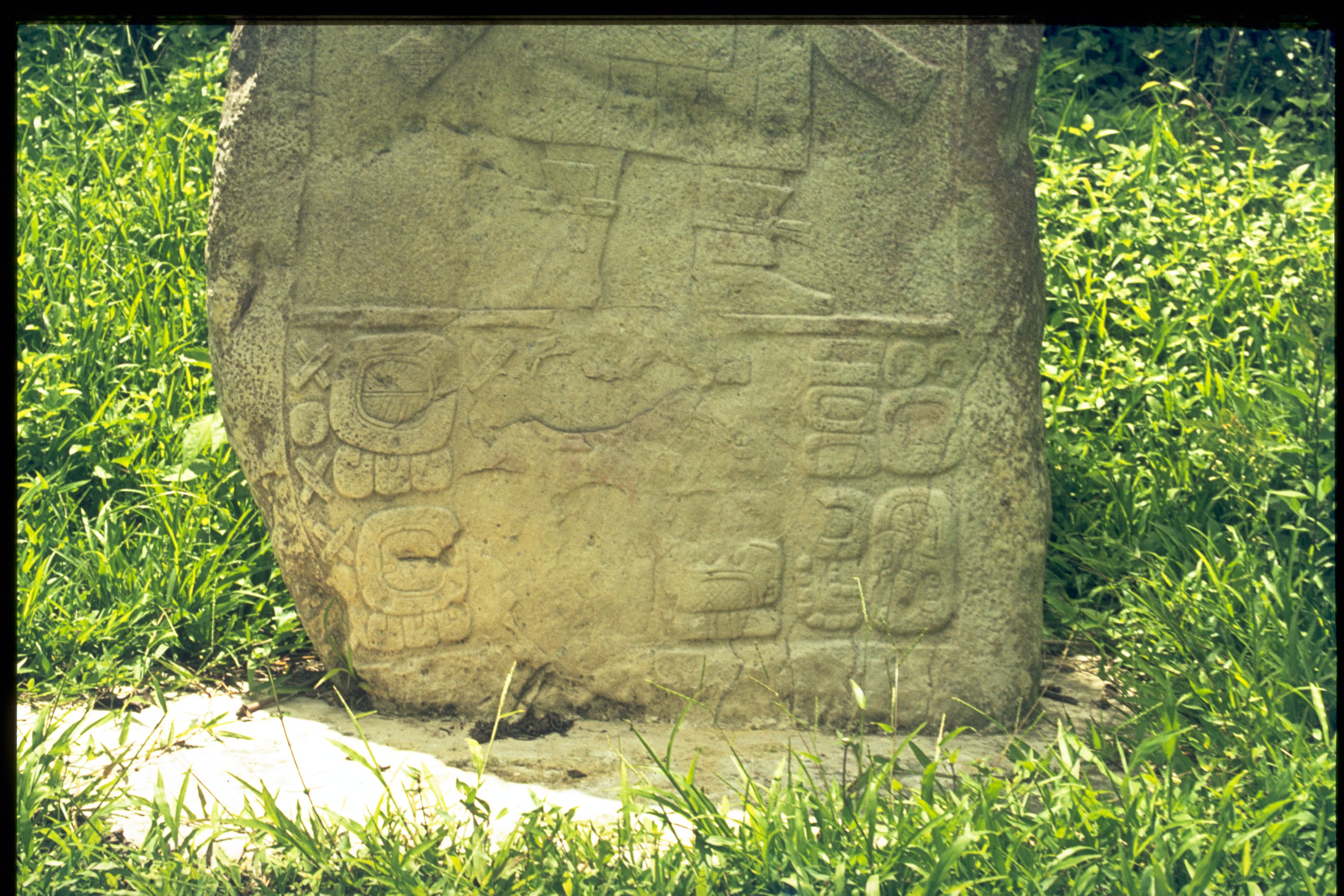
The site of Ceibal, in the southwestern Department of Petén, Guatemala, is well known for the exuberantly unconventional style and content of its Terminal Classic monuments. Among these, Stela 19 is especially interesting. The stela was erected in front of Structure A-5, on the east side of the South Plaza of Ceibal’s Group A (Figure 1). Group A was a major locus of royal construction activity during the Terminal Classic period, and the stela has long been understood to date to sometime in the ninth century A.D. Yet the precise date of the monument has proven difficult to establish because of damage to its inscription. This note proposes that the text alludes to the 10.3.0.0.0 k’atun ending (May 5, A.D. 889), but that it does so using an innovative count of four thirteen-day periods following the period ending. This count appears in the context of other religious innovations at Ceibal, but it recalls earlier ritual cycles at other Classic sites commemorating and anticipating k’atun endings.

Figure 1. Group A at Ceibal, showing Structure A-5 at lower right. Map courtesy of Takeshi Inomata, University of Arizona.
Figure 2. Ceibal Stela 19. Photograph by Linda Schele (103010), courtesy of the Foundation for Mesoamerican Studies, Inc.

The front surface of Stela 19 (Figure 2) is carved with a relief portrait of a ruler scattering incense with one hand, a standard trope on Maya royal stelae. Unusually for such monuments, however, the celebrant’s face is covered with a mask depicting the duck-billed Wind God, and he wears a skirt of narrow cloth strips instead of the apron-like garment more typical for such scenes. The only text on the monument consists of eight glyph blocks, two high by four wide, in a panel below the ruler’s feet (Figure 3). All four of the leftmost glyph blocks contain dates with numeric coefficients of 1, while the four blocks to the right contain noncalendrical signs. However, the middle four blocks (positions B1, C1, B2, and C2) were effaced in antiquity, some of them almost completely (J. Graham 1990:57). This has contributed to confusion about the nature of the dates and the reading order of the text. J. Graham (1990:60) thought the signs at positions A1 and B1 comprised a Calendar Round date of 1 Ben 1 Pop, corresponding to a Long Count date of 10.1.18.6.13 (January 9, A.D. 868). The implication would be that the text has to read from left to right in two rows of four glyph blocks, since one Calendar Round date immediately followed by a second such date (at A2 and B2) would be highly aberrant. Bryan Just (2004:27) placed the stela a little over thirty years later, around 10.3.0.0.0, on the basis of its style. Without committing to a specific date, Prudence Rice (2004:214) suggested that the inscription referred in some way to a half- or quarter-k’atun ending, indicated by the scattering of incense in the scene above.

Careful inspection of photographs by Ian Graham (I. Graham 1996:47) and Linda Schele (2005: photograph no. 103012) strongly suggests that the four leftmost glyph blocks contain tzolk’in dates exclusively, not full Calendar Round dates. The date 1 Ben at A1 is unmistakable. The date at B1 is not 1 Pop at all, but a tzolk’in date with a coefficient of 1; even though the interior details of the day name are destroyed, the contours of the cartouche are clear enough. The date at A2 is another well-preserved tzolk’in date, 1 Kawak. The date at B2 is destroyed except for traces of another numeral 1.

Figure 3. The inscription on Ceibal Stela 19. Drawing by the author after photograph by Linda Schele.

A set of four tzolk’in dates associated with calendrical rituals might suggest—at first—an ethnohistoric parallel with Maya celebrations of new haab years in the Calendar Round. Because each haab year has 365 days (eighteen months of twenty days, plus the five-day intercalary month of Wayeb at the end of the year), while there are twenty day names in the tzolk’in cycle, the first day of the haab year can only correspond to four tzolk’in day names, each five positions apart. Epigraphers call those tzolk’in positions Year Bearers because many Mesoamerican calendrical traditions use them to name haab years. For Late Postclassic Yucatec communities, the Year Bearers were Kan, Muluc, Ix, and Cauac. Diego de Landa recorded that “[i]n all the towns of Yucatan it was the custom to have at each of the four entrances to the town two heaps of stones, one in front of the other; that is, at the east, west, north, and south” (Landa 1978:62–67). Offerings to supernatural beings were made each year at one of the four stations, depending on which tzolk’in day would be the Year Bearer for the coming year: Kan corresponded to the southern altars, Muluc to the eastern, Ix to the northern, and Cauac to the western. Could Ceibal Stela 19 record similar rituals connected to the Year Bearers?

The two well-preserved tzolk’in dates on the monument, 1 Ben and 1 Cauac, indicate that it does not. While Cauac is one of the Postclassic Yucatec Year Bearers, Ben is not. The two day names are separated by six positions (counting from Ben to Cauac) or fourteen (counting from Cauac to Ben), whereas Year Bearers must be separated by multiples of five. Yet four dates, three of them definitely tzolk’in dates, all of them with coefficients of 1, and all so close to one another in the text, do point to a ritual pattern of some kind. If some of the dates are not Year Bearers, what could explain such a pattern?

Starting with the hypothesis that the stela dates to about the third k’atun ending of the tenth bak’tun, one possibility does suggest itself. Counting forward thirteen days from 10.3.0.0.0 1 Ahau 3 Yaxkin yields the date 1 Ben 16 Yaxkin. Thirteen days later is 1 Cimi 9 Mol, and thirteen days after that is 1 Cauac 2 Ch’en. If one further assumes that this inscription, like most others, reads in double vertical columns instead of in two horizontal rows, then the four glyphs at A1 through B2 can be reconstructed and connected to the k’atun ending. The elements in boldface below are preserved on the stela, while those in brackets are implied or reconstructed:

Carter table

The three surviving glyph blocks at the end of the text (D1, C2, and D2) all evidently contain nouns. D1 begins with the agentive pronoun AJ, “he of” or “one who,” followed by a direction, either OCH-K’IN (ochik’in, “west”) or EL-K’IN (elk’in, “east”), and then an eroded collocation. C2 contains the spelling PI’T-ta, pi’t (“palanquin”), and D2 consists of logographic K’UH. Conceivably, this “palanquin god” might have been one of the massive effigies carried on litters in war and ritual processions, illustrated, among other places, on late eighth-century wooden lintels at Tikal. Since the first four glyph blocks all contain dates, the verb can only have been in block C1. This is now totally effaced, but given the reference to a deity in blocks C2 and D2, it likely described a ritual of some kind.

A1 – B1: 1-BEN 1-[CIMI]
A2 – B2: 1-CAUAC 1-[EB]
C1 – D1: [ritual verb] AJ-?-K’IN-?-?-?K’UH
C2 – D2: ?-PI’T-ta K’UH
 juun ben, juun [?cham], juun ?chahuk, juun [eb], […] aj […] ?k’uh pi’t k’uh
On 1 Ben, 1 [Cimi], 1 Cauac, and 1 [Eb], [ritual verb] He of … God(?), Palanquin God.

On this view, the Stela 19 text records either four religious rituals that took place every thirteen days following the 10.3.0.0.0 k’atun ending, or else a single rite that happened 52 days (4 × 13) after the k’atun ending. This proposed 52-day commemoration of a period ending is to the author’s knowledge unique in the hieroglyphic record, and appears to represent a Terminal Classic innovation local to Ceibal. The k’atun ending itself is recorded on three other monuments in Ceibal’s Group A—Stelae 3, 18, and 20—each of which varies in its own way from earlier Classic Maya standards for period ending stelae. Stela 3 was erected in front of the pyramidal Str. A-6, across the South Plaza from Str. A-5 (I. Graham 1996:17; Smith 1982:90). Its main figural panel depicts a ritual celebrant wearing a headscarf in place of the typical Principal Bird Deity headdress worn by most Classic Maya lords on k’atun-ending monuments. Below, gods of wind and music provide auditory accompaniment; above sit two rain gods whose wild hair, Tlaloc faces, and nominal square day signs (5 Alligator and 7 Alligator, both rendered in non-Maya style) may connect them to the peoples of coastal Veracruz. Stela 18, at the base of Str. A-20 in the Central Plaza, and Stela 20, at the base of the Str. A-24 stairway, both depict a lord wearing the “Toltec” warrior regalia common in Terminal Classic sculpture at Chichen Itza.

While the missing signs are unrecoverable, the proposals above have several points in their favor. The double-column reading order this analysis presumes is standard for Classic Maya monumental texts. The implicit reference to a k’atun ending makes sense of the incense-scattering in the scene above, just as Rice (2004:214) suggested, while the specific k’atun-ending date of 10.3.0.0.0 is in line with Just’s (2004:27) stylistic date. All four tzolk’in dates must be separated by multiples of thirteen days because they share the same coefficient. In fact, the two fully preserved dates, 1 Ben and 1 Cauac, are 26 days apart—provided, as the reading order would suggest, that the latter date is the next 1 Cauac after 1 Ben.

Classic Maya ideas about numerology—inferred from representations of the cosmos, the properties of calendrical systems, and accounts of calendrical rites—provide a cultural context that makes sense of the proposed ritual cycle. The significance of the number thirteen is evident from the tzolk’in calendar, whose numeric component consists of a cycle of thirteen numbers. Thirteen periods of twenty days—the number of day names in the tzolk’in, and the number of days in one winal in the Long Count calendar—make 260 days, or the number of name-number combinations in the full tzolk’in cycle. The Maya identified four tzolk’in Year Bearer days, four aspects of the rain god Chahk, sets of four divine youths, and four cardinal directions associated with four sacred trees. Four cycles of thirteen days make 52 days, a number with its own esoteric resonance: positions in the Calendar Round, combining a tzolk’in date with a date in the ha’b calendar, recur once every 52 ha’b years.

While innovative in its reliance on thirteen-day periods, the proposed 52-day ritual cycle at Ceibal finds precedent in earlier texts from other Maya sites. Notable examples are the stelae erected by Copan ruler K’ahk’ U Ti’ Witz’ K’awiil in preparation for and commemoration of the 9.10.15.0.0 three-quarters k’atun ending (November 11, A.D. 647) and the 9.11.0.0.0 k’atun ending (October 15, A.D. 652). Here, the numbers 260 (13 × 20) and 40 take on particular importance. According to Stelae 2 and 12 at Copan, K’ahk’ U Ti’ Witz’ K’awiil celebrated the 9.10.15.0.0 date with a pilgrimage to a place called Naah Kab—perhaps the hill just east of the Acropolis on which Stela 12 was erected—then returned to the same spot 260 days later, on 9.10.15.13.0, to conduct a second ritual. Fittingly, the full k’atun ending occasioned greater ceremony. Preparations may have begun with a rite on 9.10.19.0.0 (October 21, A.D. 651), one 360-day Long Count year before the main event. 100 days later, on 9.10.19.5.0 (that is, 260 days before the k’atun ending), the king celebrated a second ritual, commemorated on Stela 10 on a hill across the Copan Valley from Stela 12. On 9.10.19.13.0, 260 days after 9.10.19.0.0, he conducted another rite, also recorded on Stela 10. 40 days later, on 9.10.19.15.0, he performed still another ritual, this one involving an altar dedicated to the avian Sun God. 40 days after that, on the k’atun ending itself, the celebrations reached their climax with K’ahk’ U Ti’ Witz’ K’awiil’s dedication of stone monuments and invocation of Copan’s patron deities.

K’ahk’ U Ti’ Witz’ K’awiil emphasized intervals of 260 days because the tzolk’in calendar is 260 days long, so that a period ending in the Long Count would have the same date in the tzolk’in as the day 260 days before or after it. In Maya religious thought, the tzolk’in date of a day made it auspicious or unlucky, suitable for certain kinds of activities and not others, and days with the same tzolk’in date were in an esoteric sense the same day. Two of K’ahk’ U Ti’ Witz’ K’awiil’s monuments appear to refer to the yearly movements of the sun using a similar principle: as seen from Stela 12 on the east side of the Copan Valley, the sun would appear to set behind Stela 10 to the west about 20 days after the spring equinox and before the autumnal equinox (Morley 1920:143). The days on which those observations were made would thus have the same tzolk’in day name, though not the same number, as the days of the equinoxes themselves. A similar principle could be at work in the Ceibal Stela 19 cycle: sharing a numeric coefficient with 1 Ajaw, each of the four tzolk’in dates temporally echoes the k’atun ending.

Ceibal already stands out among Terminal Classic southern lowland Maya kingdoms for the long survival of its royal court and for that court’s ritual and representational innovations. Hitherto, those changing images and practices have been most evident in the site’s ninth-century portraiture and iconography. Most very late texts at Ceibal are limited to Calendar Round dates; although it is longer, the unconventional text on Stela 13 thus far defies secure interpretation. Stela 19 thus presents a unique window onto local ideas about numerology and the temporal echoes of important calendrical endings in the late ninth century. Those ideas themselves fit within an older intellectual tradition, to which the last kings of Ceibal made their own contribution.

Acknowledgements

The ideas presented above benefited from discussions with Thomas Garrison, Charles Golden, Stephen Houston, Katharine Lukach, Franco Rossi, Andrew Scherer, and David Stuart. Takeshi Inomata, David Schele, and the Foundation for the Advancement of Mesoamerican Studies kindly provided illustrations, in the latter case a photograph.

Sources Cited

Graham, Ian. 1996. Corpus of Maya Hieroglyphic Inscriptions, Volume 7.1: Seibal. Peabody Museum of Archaeology and Ethnology, Harvard University, Cambridge.

Graham, John A. 1990. Excavations at Seibal, Department of Petén, Guatemala: Monumental Sculpture and Hieroglyphic Inscriptions. Memoirs of the Peabody Museum of Archaeology and Ethnology, vol. 17, no. 1. Harvard University, Cambridge.

Just, Bryan. 2007. Ninth-Century Stelae of Machaquila and Seibal. Foundation for the Advancement of Mesoamerican Studies, Incorporated. <www.famsi.org/01050>

Landa, Diego de. 1978. Yucatan Before and After the Conquest. William Gates, trans. and ed. Dover Publications, New York.

Morley, Sylvanus Griswold. 1920. The Inscriptions at Copan, Honduras. Carnegie Institution of Washington, Washington, D.C.

Rice, Prudence M. 2004. Maya Political Science: Time, Astronomy, and the Cosmos. University of Texas Press, Austin.

Schele, Linda. 2005. The Linda Schele Photograph Collection. Accessed 7-29-2015. <http://research.famsi.org/schele_photos.html&gt;

Smith, A. Ledyard. 1982. Excavations at Seibal, Department of Petén, Guatemala: Major Architecture and Caches. Memoirs of the Peabody Museum of Archaeology and Ethnology, vol. 15, no. 1. Harvard University, Cambridge.