David Stuart, The University of Texas at Austin
In a few recent studies I have examined how Maya day glyphs visually transformed over the centuries, becoming reduced or abstracted to the point that their original animate forms were obscured, even for the scribes who routinely wrote them. So far, I have looked at the days Manik’, Men and Caban, showing how they originated as specific deities we can identify in Maya iconography. All of the days began this way, as images of recognizable gods. A larger study now in preparation will aim to explore these deeper origins of the Maya days, and how they relate to the day glyphs in other Mesoamerican script traditions. In assessing these developments over the last year or so, I have become increasingly comfortable with the notion that the 260-day Mesoamerican day-count was perhaps even lowland Maya in origin, invented in the Middle Preclassic, and that the day glyphs and names we find elsewhere in Oaxaca or Central Mexico were borrowed from those prototypes, becoming transformed and abstracted even further (this is how Men, once the Principal Bird Deity, became distilled down to a generic “Eagle”).
Here we look at Imix, the first of the twenty named days of the tzolk’in, and the imagery associated with it (Figure 1). In some respects, Imix seems well-understood – at least better than many other Maya days – having established connections to water and to aquatic snakes of mythology. But its graphic history, etymology and deeper meanings deserve further reflection.


The day name was Imix in ancient Yucatán, and Imox or Imux still is used among day-keepers in the highlands of Guatemala. In Ch’ol the name may have been Nachan (Campbell 1988, Fox and Justeson, n.d., Kaufman 2020), probably analyzable as naah-chan, “first snake” or “primordial snake.” This word surely corresponds to the hieroglyph that we read as NAAH-KAN which is an integral part of the old name of the so-called Water Serpent. The connection is interesting, for, as we will see, for the Water Serpent was the true visual basis of the Imix sign (Figure 2). It is difficult to know if Imix or Naahchan (or Naahkan) was the name used in the Classic period lowlands, as either seems possible. Cipactli, usually translated as “cayman” or “crocodile,” is the corresponding day name in the Nahuatl system.
The meaning of Imix remains obscure. Its only known appearance outside the day name is in the Books of Chilam Balam, in the names of a set of directional world trees called either imix che’ or imix yaxche’ (Bolles n.d.; Knowlton and Vail 2010, Liljefors Persson 2011; Martin 2006; Roys 1933). In this context, many have translated imix as “abundance” (“abundancia” in Barrera Vasquez 1980). These directional trees, described as “pillars of the sky” (yocmal caan), were each designated by their appropriate color: chak imix che’, “red abundance tree” in the east, zac imix che’, “white abundance tree” (north), ek’ imix che’, black abundance tree (west) and k’an imix che’, “yellow abundance tree” (south). In the world-center (tu chumuk peten) was the yax imix che’, or “green abundance tree.” Roys (1933) noted that this probably refers to the ceiba (yaxche’), which was a symbol of fertility and sustenance. The Diccionario Maya Cordemex (Barrera Vásquez 1980:268) describes the world tree(s) designated by imix as the “origen de la vida.”
Delving into the etymology of the word, I believe that imix and imox may be derivations based on the proto-Mayan root *iihm, “breast.” In Yucatec, im is “breast.” Kaufman (2003) notes the fuller form iimi’iixh as the Mam word for “breast.” The day named Imx is explicitly linked to the word for “breast” in the Mam vocabulary of the Academia de Lenguas Maya de Guatemala (ALMG 2003:47):
Imx. Glándulas mamarias (calendario maya). Imx tb’i jun q’ij toj kyajlab’il qchman. Imx es día sagrado dentro del calendario maya-mam.
A connection to breasts, nursing and sustenance may seem odd at first, but it brings us back to the idea of an “abundance tree” just mentioned. In fact, in Aztec lore, an important cosmological tree was the chichihuacuahuitl, or “breast-tree”, located in the paradise of Tlalocan (the tree name is embedded in the place name Chichihuacuauhco). If imix is indeed derived from “breast,” this would offer a striking parallel to the term imix che’ or imix yax che’.

The forms of the standard Imix day sign (see Figure 1) show a small inner circle in its upper portion, usually darkened and surrounded by dots, with a series of parallel lines placed below. This has long been recognized as the representation of a waterlily blossom (Nymphaea ampla) as shown in Maya iconography, as first proposed by Thompson (1950:72) (Figure 3). This was discussed at length by Rands (1953) and later by Hellmuth (1987a, 1987b) and Houston and Taube (2011). In all Imix signs this blossom is oriented downward, with the dark spot representing the flower’s ovaries at the center and the lower parallel lines representing the pedals, pistils and stamen the emerge from it. The outer sepals are never shown in the glyph, but they are apparent in many iconographic representations.

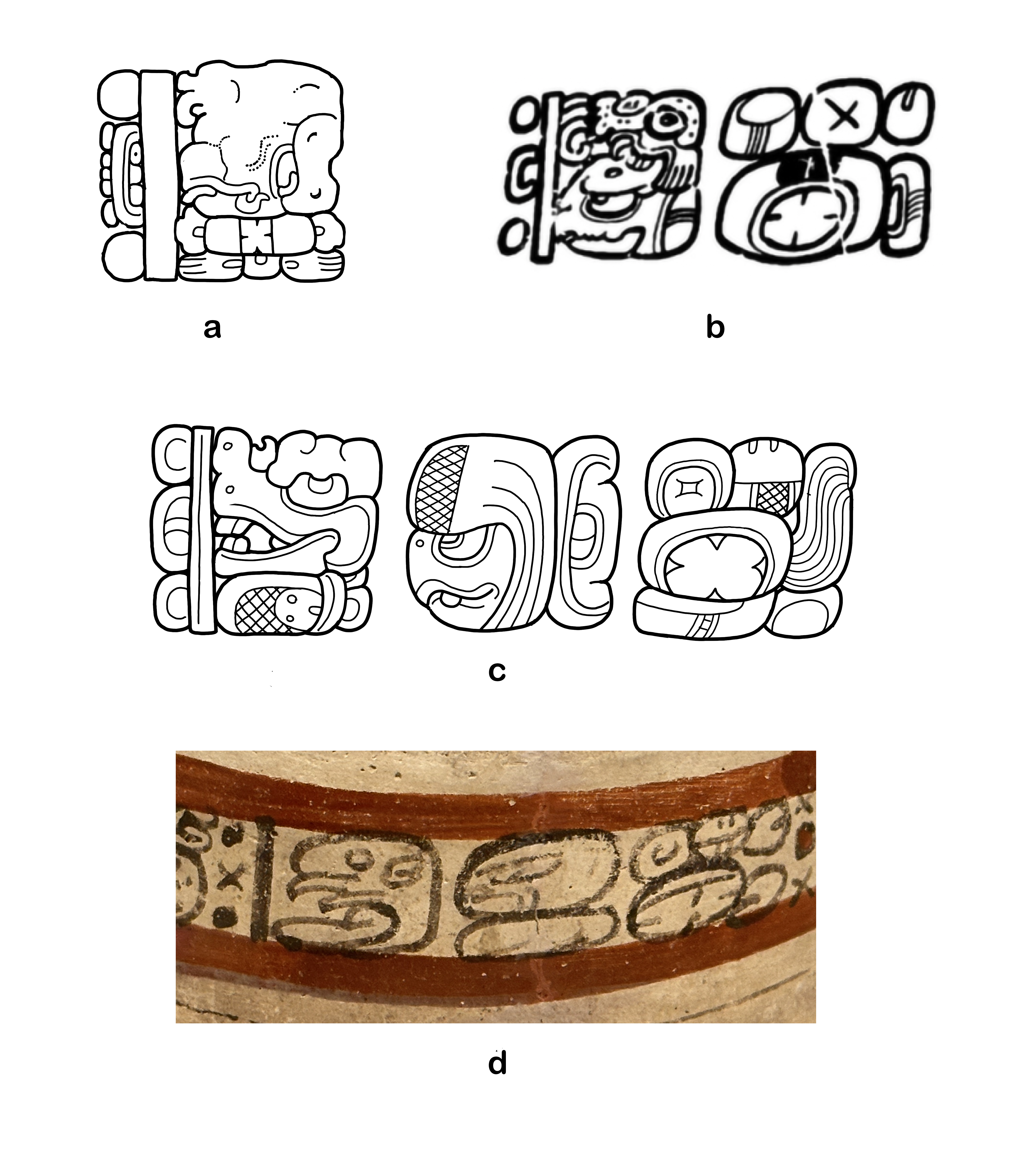
There is also an animated form of Imix, which assumes the form of a serpent’s head with an elongated snout (Figure 4d, Figure 5). In Late Classic examples, the blossom that is the standard Imix sign is the upper part of this serpent’s head. This is so-called Water Serpent (or Waterlily Serpent), as first observed by Eric Thompson (1950:145) (Figure 1e-g). Thompson first referred to this being as the “Imix Monster,” which later came to be called the “Lilypad Headdress Monster” (Hellmuth 1987. :160), the “Waterlily Monster” (Schele and Miller 1986:46), the Waterlily Serpent” (Taube 1992:59) or, as I prefer here, simply the “Water Serpent.”

The Water Serpent shows several distinct features, among them a waterlily pad at the forehead, a blossom tied to its front, and a fish biting or sucking at the flower. Often the same fish is shown biting or sucking at the tail of the serpent. Its fishy dorsal “fin” evolved over time to be shown as elongated long quetzal feathers (that is, it came to be a “feathered snake” of the water, probably also a conceptual relation or antecedent to K’uk’ulkan). Its body can simply be the undulating water band. This important iconography has been most recently by Coltman (2015), who examined its many connections in Mesoamerica, well beyond the Classic Maya world. In ancient Maya mythology this being was the primordial snake (naahkan) that was the essence of water, and who oversaw the creation and raising of the earth, supported by the four old men, the chantun itzam, at its corners. This role, although not yet well defined in the scholarly literature, is perhaps why he was the first day of the tzolk’in, the source of the world’s first sustenance [Note 1].

The same Water Serpent head we find as Imix was also used to write HA’ “water” (Figure 6b) and also WITZ’, “sprinkle, splash.” (Stuart 2007, Coltman 2015) (Figure 6c). A similar Water Serpent could also appear as the head for the number “thirteen” (Figure 6d) (Robertson 1990). A certain variant of the Water Serpent showing a dotted volute or spiral on the head was used to write HA’B, “year,” in Long Count dates and Distance Numbers (Figure 6e, f). This latter form never appears as Imix, which always emphasizes the waterlily blossom. These visual differences among various Water Serpent glyphs are subtle but real, and deserve further study, for it is clear that Imix (HA’, etc.) and HA’B took a slightly different developmental tracks (ha’b, “year,” is from ha’, “water, rain, rainy season,” so both the animate signs and the words are related).
One early representation of the Water Serpent at San Bartolo suggests a connection to the imix che’ of the Books of Chilam Balam. On the West Wall, we see a serpent’s body as an undulating water band. From its head emerges a tree that supports the Principal Bird Deity (Taube, et al. 2005) (Figure 7). Given that this portion of the murals is dedicated to directional world trees and year bearers, I suggest this is perhaps a precursor to the imix che’ or “abundance tree” mentioned above.

Thompson reasoned that his “Imix Monster” was a symbol of the earth. In this he was influenced by the ideas surrounding the corresponding central Mexican day named Cipactli, usually translated as “crocodile” or “alligator,” and long considered an earth symbol (Caso 1968:8-9). The Nahuatl word can be applied to a variety of aquatic beasts, including the caiman and the gar. It is important to note that the Maya “Imix Monster” or Water Serpent is never shown as a crocodilian (ayin), only as a watery snake. I suspect that the toothy Cipactli being represents a mythic character with somewhat different associations, and overlaps. As Martin (2009) has noted, crocodiles are important in the Maya iconography of certain world trees of abundance, especially cacao. This takes us back to the imix che’ concept mentioned above. A text from jade vessel excavated in Burial 116 at Tikal refers to the sprouting of a primordial cacao tree on the day 9 Imix, which is probably a symbolic connection to the same idea of earthly abundance and sustenance. The point here is that the Water Serpent was primarily a watery creature, not so much a being of the earth. It nevertheless had strong earth associations revolving around creation narratives and concepts revolving around abundance and growth.
Perhaps implicit in Thompson’s old discussion of the “Imix Monster” was an assumption that it is a visual or conceptual elaboration on the simpler, more common form of the day, the waterlily. Schele noted this relationship more explicitly, in designating the serpent-like head under the Imix and in other examples as the “personification head,” an element used to personify a unit of Maya writing, to give them sacred power (Schele and Miller 1986:44). In this way, the Water Serpent is often considered to be an artistic extension on the “standard” Imix or waterlily, basically its complex head variant. However, I suggest that the relationship is not one of increased elaboration and animation, from simple Imix to complex serpent, but the reverse, from serpent to the waterlily blossom. This involves process that is by now familiar, of visual reduction and simplification, using a part for the whole. The Water Serpent came first as the true essence of Imix, and through scribal practice it came to be simplified and even a bit distorted. Again, this may not be terribly surprising to those who have a deep knowledge of Maya script, but the specific nature of this formal reduction is important to stress, as it pertains directly to how we interpret the nature of the day itself.

As we see in Figures 5 and 8, a diagnostic feature of the Water Serpent is its waterlily pad headband, and large blossom, which is tied to it, protruding outward. usually with a fish nibbling away. Looking at the forms of the Imix day sign, we see the same waterlily blossom is above the serpent’s face. This surely arose form artist-scribes who routinely depicted the serpent with its waterlily. The blossom came to be the “short hand” form of the extremely ornate Water Serpent, which was the true visual origin of Imix. The reduction of the head to the forehead blossom — a headband flower — is the same visual relationship we see in Ahau, where the forehead floral ornament of Jun Ajaw’s (Hunahpu’s) headband becomes the pars pro toto of the full head. (We will eventually take a separate look at the visual history of Ahau, which is sometimes misunderstood, and which also has some surprising turns).
In researching Imix, I took a quick glance at Wikipedia’s entry on the Maya tzolk’in calendar, noting the two basic meanings it gives for the day: “waterlily” and “crocodile.” Neither is accurate. The basic Maya sign represents the waterlily flower, although we should understand this to be only a visual abbreviation, not the meaning. “Crocodile” is never emphasized in Maya names or imagery, but comes from the Nahuatl system (probably a late borrowing from southern Mesoamerica). As we have seen with other Maya days, a meaning is best approached through a systematic look at the deep visual history of the glyphs and iconography. The imagery reveals that the true essence of the Maya day is another important deity — the Water Serpent, with its aquatic flower and distinctive attributes. The snake was a principal actor in Maya creation narratives before 4 Ahau 8 Cumku, embodying the substance of water that sustained life. It had a more formal name as a type of naahkan, “first snake,” but the word Imix or Imox, based on the word form “breast,” also gets to its core function as a source of life, sustenance and abundance. The fishes are always depicted “suckling” upon the serpent’s body and on the waterlily blossom, probably allude to this basic meaning.
Note 1. It is interesting to note that in modern Achi Mayan, the day name Imox is described as “nagual del agua” (ALMG 2001), although this may be a modern understanding based on the HA’ sign. The Water Serpent is named as overseer of this creation episode on Lacanja-Tzeltal Panel 1. described as the “first stone-holding” or “first stone -raising” on 13 Ahau 13 Cumku, perhaps the “first” k’atun station of all (pre-era) on 12.9.0.0.0. This connection to a Period Ending on 13 Ahau probably accounts for the use of the Water Serpent as the head of 13.
References Cited
ALMG (Academia Linguistica Maya de Guatemala). 2001. U cholaj Ch’a’teem, Vocabulario Achi. ALMG, Guatemala.
ALMG (Academia Linguistica Maya de Guatemala). 2003. Pujb’il Yol Mam. Vocabulario Mam. ALMG, Guatemala.
Barrera Vásquez, Alfredo (ed.). 1980. Diccionario Cordemex, Maya-Español, Español-Maya. Cordemex, Mérida.
Bolles, David. n.d. Ti Can Titzel Caan, Ti Can Titzil Luum: A Collection of Papers about the Relationships between the World Directions, the Calendar, Prognostications, and the Mayan Deities. http://davidsbooks.org/www/Maya/WorldDirections.pdf
Caso, Alfonso. 1968. Los calendarios prehispanicos. UNAM, Mexico.
Campbell, Lyle. 1988. The Linguistics of Southeast Chiapas, Mexico. New World Archeological Foundation, Brigham Young University, Provo.
Coltman, Jeremy D. 2015. In the Realm of the Witz’: Animate Rivers and Rulership among the Classic Maya. The PARI Journal 15(3):15-30
Fox, John, and John S. Justeson. 1982ms. A Ch’olan Calendar in the Gates Collection.
Hellmuth, Nicholas A.. 1987a. The Surface of the Underwaterworld: Iconography of the Gods of Early Classic Maya Art in Peten, Guatemala. 2 vols. Foundation for Latin American Anthropological Research, Culver City, CA.
Hellmuth, Nicholas A. 1987b Monster und Menschen in der Maya-Kunst: Eine Ikonographie der alten Religionen Mexikos und Guatemalas. Academische Druk- u. Verlagsanstalt, Graz.
Houston, Stephen D., and Karl A. Taube. 2011. The Fiery Pool: Fluid Concepts of Water and Sea among the Classic Maya. In Ecology, Power and Religion in Maya Landscapes, edited by C. Isendahl and B. Liljefors Persson, pp. 11-37. Verlag Anton Saurwein, Markt Schwaben.
Kaufman, Terrance. 2020. The Day Names of the Meso-American Calendar: A Linguistic Perspective. https://www.researchgate.net/publication/341194005
Knowlton, Timothy, and Gabriel Vail. 2010. Hybrid Cosmologies in Mesoamerica: A Reevaluation of the Yax Cheel Cab, a Maya World Tree. Ethnohistory 57(4):709-739.
Liljefors Persson, Bodil. 2011. “Ualhi yax imix che tu chumuk”: Cosmology, Ritual and the Power of Place in Yucatec Maya (Con-)Texts. In Ecology, Power and Religion in Maya Landscapes, edited by C. Isendahl and B. Liljefors Persson, pp. 139-152. Verlag Anton Saurwein.
Martin, Simon. 2006. Cacao in Ancient Maya Religion: First Fruit from the Maize Tree and other Tales from the Underworld. In Chocolate in Mesoamerica: A Cultural History of Cacao, edited by Cameron McNeil. University Press of Florida, Gainesville.
Rands, Robert. 1953, The Water Lily in Maya Art: A Complex of Alleged Asiatic Origin. Bureau of American Ethnology, Bulletin 151: 75-153. BAE, Smithsonian Institution, Washington, D.C.
Robertson, Merle Greene. 1990. Celestial God of the Number 13. Triptych (Sept/Oct 1990),
pp. 26-31. The Museum Society, San Francisco.
Roys, Ralph. 1933. The Book of Chilam Balam of Chumayel. Carnegie Institution of Washington, Washington, DC.
Schele, Linda, and Mary Ellen Miller. 1986. The Blood of Kings: Dynasty and Ritual in Maya Art. Kimbell Art Museum, Fort Worth.
Stuart, David. 2007. Reading the Water Serpent as WITZ’. Maya Decipherment April 13, 2007.
Taube, Karl A. 1992. The Major Gods of Ancient Yucatan. Studies in Pre-Columbian Art and Archaeology 32. Dumbarton Oaks, Washington, D.C.
Taube, Karl A., William Saturno, David Stuart and Heather Hurst. The Murals of San Bartolo, El Peten, Guatemala. Part 2: The West Wall. Ancient America 10. Boundary End Archaeology Research Center, Barnardville, NC.
Thompson, J. Eric S. 1950. Maya Hieroglyphic Writing: Introduction. Carnegie Institution of Washington, Washington, DC.




You must be logged in to post a comment.