Day Sign Notes: Manik

David Stuart (The University of Texas at Austin)

This is the third in an anticipated series of essays on the visual histories and iconographic associations of the Maya day signs, presented in no particular order (previous studies have treated the days Men and Caban).

Figure 1. The standard hand form of the day Manik. (a) UAX: B-XIII murals, (b) NAR: St 43, (c) PAL: 96 Glyphs, (d) COM: Pendant 8A, (e) EKB: Mural of 96 Glyphs, (f) Dresden Codex. Drawings by D. Stuart (a, e, f), A. Tokovinine (b), and M. Zender (d).

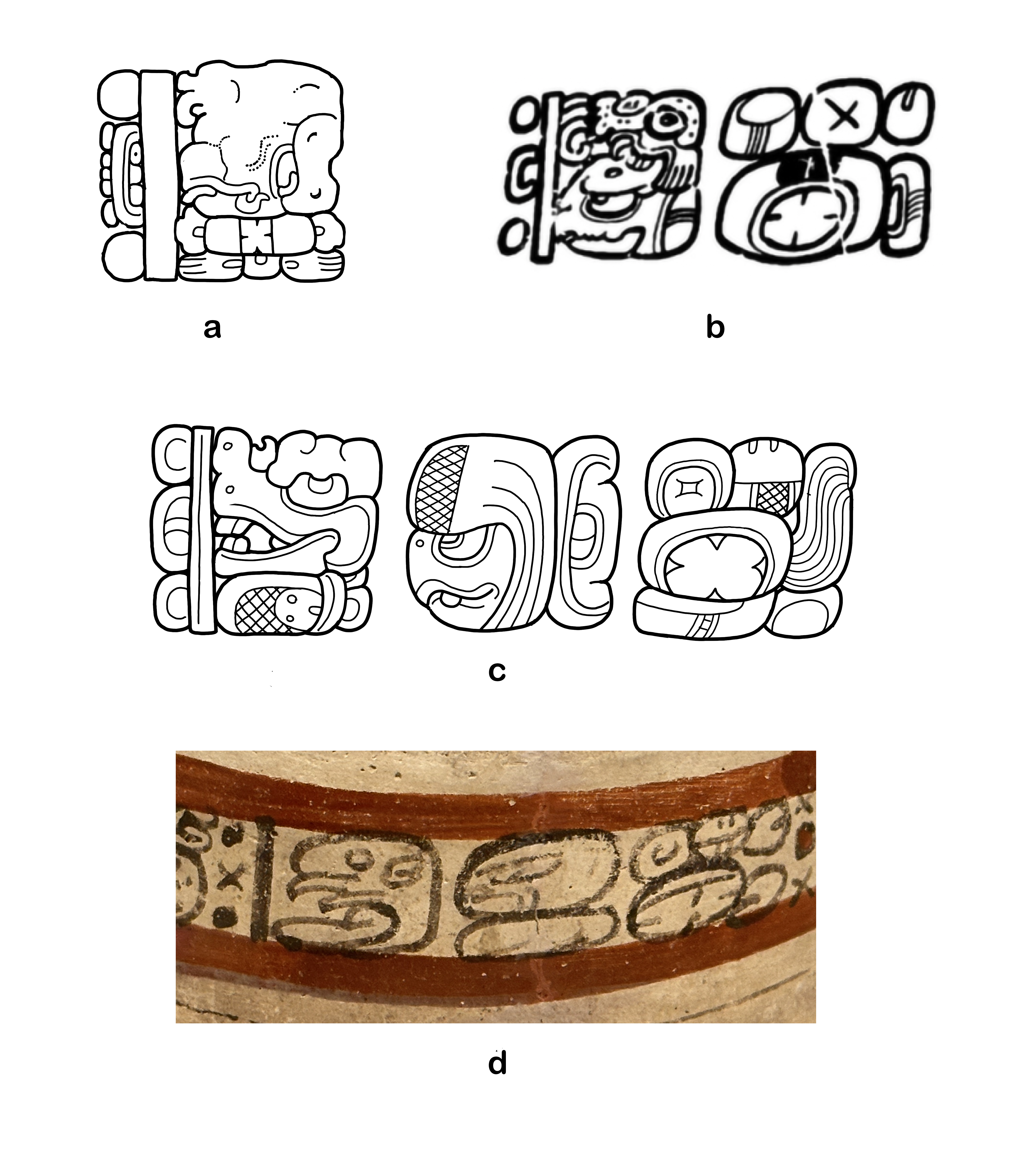
In his commentaries on the meanings and forms of the days of the tzolk’in, Eric Thompson (1950:76) expressed a special puzzlement surrounding Manik, the seventh day (Figure 1). In other Mesoamerican writing systems and languages, the corresponding signs and names for the day universally represented a deer (Figure 2). But the Yukatek name Manik, Thompson wrote, shows “no connection with deer; neither does the glyph, which is a hand, shown sideways with thumb and one figure touching or extended with back to the observer.” What Thompson didn’t know at the time is that Maya scribes also occasionally employed a deer’s head to represent Manik, following widespread Mesoamerican practice (Figure 3). As it turns out, the hand and the deer head are interchangeable as Manik, which makes the common use of the hand as the day sign even more vexing. Where does it come from? Here I would like to explore how the Manik hand might have originated early on as an alternate form of “deer,” which came to be used throughout the Maya script, and beyond the context of the day sign. 

Figure 2. Deer day signs in non-Maya writing systems. (a) Isthmian script (La Mojarra), (b) Zapotec script, (c) Cacaxtla writing, (d, e) Nahua script (Borgia Codex), (f) Nahua script (Piedra del Sol). Drawings by D. Stuart (a, d, e, f), J. Urcid (b), and C. Helmke (c).
Figure 3. Deer head variants of Manik in Maya script. (a) San Bartolo, Xbalanque structure, (b) La Corona, Element 4, (c) Palenque region, stucco glyph, (d) Yaxchilan region, door lintel.

The Yukatek name Manik’ is of obscure origin. Campbell (1988) and Kaufman (2020) reported a probable corresponding form in Ch’olan as Manich’, preserved in baptismal records of Chiapas (day names often were used as personal names, as we see in Nahuatl). Kaufman suggested these may be loans into lowland Mayan from proto-Sapotekan *mmani7, “mammal, large bird,” but I am not sure that this is a secure connection (as Kaufman noted, the attested Sapotekan name for the day is China, “Deer”). In Tzeltlan languages, the day name was Moxik, which is also of unknown origin. I agree with Kaufman’s (2020) suggestion these obscure lowland Mayan names may have had a religious association as the designation of a “deer god,” or as a deified patron of hunting (see Looper 2019:119-152). In highland Mayan languages, the form is consistently keej or a close cognate, corresponding to the generic word for “deer.” This geographical and linguistic pattern is interesting, for the names we see used in the Maya lowlands and Ch’olan-Tzeltalan sources were not the words for “deer” that we see elsewhere. It raises the possibility that the Classic Mayan day name was not “Deer” (Chij or Kej), but a more specific reference.

Figure 3. Late Preclassic Deer variant of Manik day sign from Xbalanque structure, San Bartolo, ca. 300 BCE. Note cartouche border behind the ears and antler. Drawing by D. Stuart.

The deer head was used as the Maya day sign from a very early date. In a recent paper, my colleagues and I discussed the discovery of the earliest known Maya date glyph, a Late Preclassic record of the day 7 Manik from San Bartolo, dating to approximately 300 BCE (Stuart et al. 2022). The form of the day sign is striking and important, for it shows us the head of a deer, much like we know from other Mesoamerican scripts. Its head is turned and faces left, with its neck gracefully bent, perhaps to show the common pose of a deer turned and nibbling at its side. Given its early date, the deer’s head at San Bartolo may represent an early stage in Maya script development before the closed hand emerged as the standard form for the day.

Today we widely recognize the Manik hand sign in non-calendrical settings as the syllable chi, a reading that had been considered off-and-on in the earliest years of Maya epigraphic research. Cyrus Thomas (1892) was the first to do so, noting with great insight that the hand element served as a purely phonetic element, “sometimes to be read chi, as in the symbol for chik’in, ‘west’.” Thompson later rejected this possibility, in keeping with his dismissal of phoneticism in Maya script overall. Ultimately it was Knorosov, six decades later, who resurrected Thomas’s chi value, and applied it to several spellings in the codices. One common variant of the chi syllable in the Classic script is a deer’s head, which can alternate with the hand in several contexts (Figure 4). It is particularly common in the sequence yi-chi in the dedicatory formula of vessels from the El Zotz region. So here we have the same pattern as in the day sign, a free substitution of the two allographs (Note 1).

Figure 4. Alternation of the hand and deer head as the chi syllable (yi-chi) from two vessels from the El Zotz region. (a) Kerr 4357, (b) vessel lid published by Coe (1973:86).

Incidentally, David Kelley (1976) suggested ke as an alternative syllabic reading of the hand, noting that it could stand alone in the codices at times for “deer” (Yukatek keeh), outside the context of the Manik’ day sign. While today ke is not seen as a viable reading for the hand, Kelley was right to note the fluid functionality of the hand sign, and the deer head can be syllabic ke in at least one case I am aware of (Note 2). One case is in the glyphic name of the deer shown coupled with Wuk Sip, the god of hunting, in the Dresden Codex (Figure 5a). This is the same deer we find depicted in some Classic period vases, with the very same name, chan chij winik (4-CHIJ-WINIK) (Looper 2019:138). Zender (2017) has investigated this particular being in the context of a mythic cycle involving the moon goddess, the maize god Juun Ixi’m, and the patron of hunting Wuk Sip. The numeral four on the name suggests a cosmological deer being with aspects in the world quarters. In Classic times the hand could also serve as a logogram for “deer,” as we see in the name caption of a wahy being, an eyeless deer coiled in a snake (Figure 6). These overall patterns demonstrate that the deer head and the Manik hand shared dual functions, both as the logogram CHIJ and as the syllable chi.

Figure 5. A deer god in the Dresden Codex and in Classic period iconography. Note the name glyph with the alternation of the hand and the deer head CHIJ. (a) Dresden Codex, 13c, (b) K8927.
Figure 6. The hand as the logogram for “deer,” in the name of a wahy being. Kerr 8733. Drawing by D. Stuart.


On the face of it, the syllabic chi value of the Manik hand seems a straightforward explanation for its use in the day sign, a phonetic allusion to the word chij, “deer.” But there are problems with this, in my view. It raises yet another conundrum, having to account for the near-constant use of a supposed CV syllable as a partial spelling of the word used for the day’s name. No other day sign is ever a syllable cueing a fuller word. Furthermore, all day signs are by nature logograms, so chi as the day seems a strange outlier of a long-standing pattern. What’s more, as we have noted, the day name in the lowlands was perhaps not even Chij, for only Manik’, Manich’ and Moxik are historically attested. In essence, we are still left with Thompson’s old puzzle, as well as the broader question: just how did the hand come to be used for chi, for Manik, and for “deer”? The three functions must be related, but what’s their true connection?

Figure 7. Graphic abbreviations of the Deer day sign at Cacaxtla (a, b) and in the Codex Féjerváry- Mayer (c, d). Drawings (a, b) by C. Helmke.

To begin to answer this, let’s first return to the wider Mesoamerican forms of the “Deer” day glyph. As we know, a deer’s head or body is attested in Maya writing, as well as throughout the rest of Mesoamerica (Figures 2 and 3). Occasionally, we see simplified forms that originated as parts of deer, as pars pro toto replacements. For example, in Nahuatl writing the day Mazatl can be shown as a deer’s hoof or, more commonly, as the antler of a deer (Figure 7c,d). Earlier, at Cacaxtla, we also see an antler used as a simplified way of writing the day “Deer,” in direct alternation with the deer’s head (Helmke and Neilsen 2011:4) (Figure 7a, b). This follows the familiar practice of day signs having simpler and even more familiar forms that originated as parts of these heads, as pars pro toto replacements. We have reviewed some examples of this in our earlier considerations of Men and Caban. Early on in the history of the Maya script, scribes established many of these reduced forms as standard ways to write the days, all of which I believe were first conceived as highly complex iconographic representations of specific deities and supernatural beings (Imix as the Water Serpent, for example, Men as the Principal Bird Deity, and so on).

This practice of visual reduction brings up what I see as an intriguing possibility for explaining the Manik or chi hand. Could this “hand” have originally been a representation of a deer’s antler, just as we see elsewhere, that came to be reanalyzed visually, and misunderstood? If we look at various representations of antlers in Maya art and writing, it seems not too far-fetched to see the odd positioning of the fingers and thumb in Manik as reflecting the visual structure of an antler, at least as the Maya represented it (Figure 8). Some early chi or Manik hands look almost identical, as we see in the spelling of the honorific title K’IN-chi for k’inich, on an altar recently recovered at Tonina (Figure 8e). If this is the case, the antler (later the “hand”) developed out of a standard pars pro toto reduction of the deer’s head, as a variant of what amounts to the same sign.

Figure 8. Antlers in Maya art and Writing. (a-d) Representations of deer antlers in iconography, (3) an antler-like chi in the spelling of chi-K’IN, from Tonina, (f-i) the sign XUKUB for “antler” and its possible head variant (i). Note the general resemblance to the shape of the Manik or chi hand. Drawings by D. Stuart.

One attractive aspect of this proposal is that it would explain cases where the hand serves as a logogram for “deer,” whether in the context of the day sign or elsewhere. It also agrees with the use of the deer’s head as a syllable for chi. That is, both signs work the same way because they are, in origin, the same thing. The syllable derived from the logographic form, I suggest, just as we see in many other signs. The sign for fish (KAY) gave rise to the syllable ka, which could also be written in reduced form as the tail fins (or a dorsal fin) of a fish (that is, Landa’s “ka comb” was originally a fin, but scribes had no sense of its origin even in the Classic period).

As an aside, it is interesting that deer antlers have been noted for their visual resemblance to human hands. The antler of a mature male white-tailed deer (the most common species in the Maya world) often has five points or “tines,” resembling a hand. Antlers can also be “palmated” or flattened in their centers, a term derived from the resemblance to the palm of a hand. Humans, in imitating deer in play or ritual, often place two hands with contorted fingers against the forehead to mimic the form of antlers (Note 3). Stephen Houston has suggested (personal communication, 2023) that a similar hand gesture may have been used as a signal among Maya deer hunters.

A resemblance also exists between the general shape of the chi hand and the logogram for “antler,” read as XUKUB, “antler, horn” (Lopes and Davletshin 2004) (Figure 8, f-i). The head variant of XUKUB seems the image of the hunting deity Wuk Sip (i) (see Grunbe 2012). One wonders if the hand developed as an intentional visual divergence, helping scribes to distinguish the graphic reduction of CHIJ from XUKUB. In any event, by the Classic period, CHIJ “deer” had its deer head and “hand” form, and XUKUB kept its representational appearance.

Conclusion

Here I suggest that the single Maya logogram for “deer” — certainly an old sign in the script — once had two related forms or allographs: a standard deer head, and a common abbreviation in the form of a deer antler. Both were used for the seventh day of the tzolk’in, Manik. However, over time, and before the Classic period, calligraphic practice led to the antler being perceived (misinterpreted) as a human hand with its distinct shape. Their functions never changed despite their graphic separation. The deer head was the logogram CHIJ and the syllable chi, as was its shorthand form (pun intended). Still, it must be said that there is no known archaic form of the day Manik that displays an antler; what I describe here is only a speculative extrapolation, an exercise in “visual etymology” working backward from later forms.

Notes

Note 1. The other common head variant of chi, not discussed here, represents an animate agave plant, based on CHIH, “agave, agave drink.” It too freely substitutes for the hand and deer in yi-chi and other contexts.

Note 2.  In one ceramic text I know, a deer head (not the hand) is syllabic ke in the spelling of ke(le)-ma, keleem, “youth.” This spelling can only be be specific to Yukatek, and a local innovation of a syllabic sign.

Note 3. The following is the description of the sign for “deer” in American Sign Language (ASL): “To sign “Deer” in American Sign Language (ASL), extend and spread out your fingers on both hands, resembling a pair of antlers. Move your hands by the sides of your head, ensuring that each thumb touches each side of your head. Each hand should form one antler.”

References Cited

Campbell, Lyle. 1988. The Linguistics of Southeast Chiapas, Mexico. New World Archaeological Foundation, Brigham Young University, Provo.

Coe, Michae D. 1973. The Maya Scribe and His World. Grolier Club, New York.

Grube, Nikolai. 2012. A Logogoram for SIP, “Lord of the Dear.” Mexicon XXXIV:138-141.

Kaufman, Terrence. 2020. The Day Names of the Meso-American Calendar: A Linguistic Perspective. https://www.researchgate.net/publication/341194005

Looper, Matthew. 2019. The Beast Between: Deer in Maya Art and Culture. Austin: University of Texas Press.

Lopes, Luis, and Albert Devletshin. 2004. The Glyph for Antler in the Mayan Script. Wayeb Notes 11.

Stuart, David, Heather Hurst, Boris Beltran and William Satunro. 2022. An Early Maya Calendar Record from San Bartolo, Guatemala. Science Advances, DOI:10.1126/sciadv.abl9290

Thompson, J. Eric. S. 1950. Maya Hieroglyphic Writing: Introduction. Carnegie Institution of Washington, Washington, D.C.

Zender, Marc. 2017. The Maize God & the Deer Lord’s Wife. Paper presented at the 22nd Annual European Maya Conference, Malmö University, Sweden, on December 16th, 2017.

Day Sign Notes: Men / Tz’ikin

by David Stuart 

The Classic-period names for the days of the tzolk’in  (cholq’ij) are often obscure to us. This is true even where we see clear semantic connections to the familiar names used in colonial Yucatan (the names we still use today in describing the ancient Maya calendar, by convention). Was the day “Kan” actually called K’an in Palenque in 750 CE, or was it something else? The problem comes down to the pervasive use of single logograms in writing the days, with only an occasional phonetic sign attached here and there to offer a partial clue about their pronunciations. An additional stumbling block involves the history of the day glyphs themselves. Their forms changed in sometimes surprising ways over nearly two thousand years, such that late variants bear little resemblance to how they were originally designed. Here and in subsequent studies of the Classic Maya days, I offer a few historical and paleographical observations, looking particularly at the origins and iconographic connections of certain signs. The day glyphs have a deep history, unsurprisingly, and even their earliest examples point to centuries of previous development, reaching far back into the Preclassic era. The recent suggestion that the 260-day calendar can be discerned from architectural plans and alignments dating to the Middle Preclassic (or Middle Formative) is a powerful testament to its antiquity (Šprajc et al. 2023). So here we will look at the “visual etymologies” of certain day signs to tease out clues about their origin, as well as about their important associations with Maya iconography. Even with new semantic clues in hand, the ancient names of the days will probably remain difficult to know, at least in many cases.

We begin our series of observations with the fifteenth day, named Men in ancient Yucatan. This was also the name of the fifteenth day in Ch’ol, as reported by Campbell (1988:375). The only plausible source for the name the root men, which in both Yukatekan and Cholan languages is “make, do,” and forms the basis of the Yukatek word hmeen (“a doer, maker”), best known as the title for a ritual specialist or curandero. When a possessed noun, men can form a phrase that signals causation, as is Yukatek u men, “por causa de” or tu menel, “porque.” The same appears in Ch’orti’ u mener, “por, de, a causa de” (Hull 2016: 278). In Ch’ol, the verb mel, “to do,” may be related. The co-occurrence of the day name Men and root men within both Yukatekan and Ch’olan might suggest that the day name was shared throughout much of the lowlands in ancient times, and perhaps during the Classic period. We will return to this point shortly.

In highland Mayan languages the corresponding name for the fifteenth day is Tz’ikin, equivalent to the proto-Mayan word *tz’ikin, “bird.” Here we see a link to the widespread names meaning “Eagle” in Nahuatl, Otomi, and other languages of highland Mexico (Caso 1967, Kaufman 1989). Based on these widespread name patterns, Kaufman suggested that Men was that of an “eagle god,” whose Mayan name associates “with ‘Bird’ in general, as though he were the protean bird.” I agree with his assessment and would add that the best evidence for an “eagle god” may come from the Men’s historical development as a hieroglyphic form.

Figure 1. Classic period variants of Men, (a-e) head variants arranged chronologically, (f-i) simplified forms possibly based on the eye of the head (compare b and f). Drawings by David Stuart.

Two Classic-period variants of Men, arranged over time, are illustrated in Figure 1. The head variants – what we must assume was its “original” form – appear in the upper row of Figure 1 (a-e). These have received little discussion in the epigraphic literature, and many drawings reproduced in various books and other publications look to be highly inaccurate (see, for example, Thompson 1950: Fig. 9, 36&39). These all show a profile head of what appears to be a supernatural bird, with a distinctive squared inner eye. The eye is one clear indication of its deified nature, as are the “shiner” markings we find on the forehead in Early Classic variants. An avian beak is sometimes hard to make out in these highly abstracted forms, but we see it clearly in a few late examples, as from Piedras Negras Panel 3 (example c). Even by the Early Classic the bird’s head was highly abstracted and conventionalized, probably due to calligraphic practice over time, going back to the Late Pre-Classic (examples a and b).

Figure 2. Principal Bird Deity and accompanying name from K4546. Note resemblance of the portrait head glyph to the Men day sign. Drawing by David Stuart

These head variants agree not only with Kaufman’s idea of a “bird god,” but they are identical to representations of the Principal Bird Deity (Bardawil 1979, Cortez 1986, Guernsey 2006, Martin 2015, Nielsen and Helmke 2015), possibly named Kokaj Muut or Yax Kokaj Muut (Boot 2008). The visual equivalence is demonstrated by the name glyph of an aspect of the Principal Bird Deity we find on a codex-style vessel, Kerr 4546, captioning the bird’s portrait nearby (Figure 2). This is a portrait name glyph, and other examples of the bird’s name show the Principal Bird Deity in a more familiar, less abstract way (Figure 2c, d). These are in turn equivalent to what we find in the codices as the name of the more anthropomorphic God D, the Principal Bird being his avian avatar. No other avian figure from Maya art or iconography displays such deified characteristics, so it is clear that the day sign Men originated in the Preclassic and Early Classic as the portrait of the Principal Bird Deity. It seems that the name of the fifteenth day in Postclassic Mesoamerica, whether “Eagle” or “Bird,” are generic reflection of this day’s more mythical origin and identity.

Figure 3. Names of the four bird deities in the four world quarters, from Tomb 12 at Rio Azul, Guatemala. Note visual equivalence to early Men day sign. Drawings by David Stuart.


Figure 4. Directional bird names from Tomb 12, Rio Azul, and incised obsidians from cache at Tikal.

In further support of this connection to the great mythic bird, we can turn to other examples of the Principal Bird Diety’s glyphic name. In Tomb 12 of Rio Azul, four similar deity names feature this same head sign, written on the tomb’s four walls and associated with one of the four quarters or world directions (Figure 3). As I and others have argued, these are names of the Principal Bird Deity, each with a different adjectival descriptor (day, night, moon, and star) (Taube, et al. 2010:52-56). Later examples of these same directional names confirm the visual connection to the Principal Bird Deity (Figure 4). This chronological evolution suggests that the Principal Bird Deity used as the Men Day sign often retained an “early look” throughout much of the Late Classic. There are examples of Men, however, that are more representative of the later bird deity heads we see in Figure 4 (see Naranjo, Stela 23 [F17] and Stela 28 [G18]).

A rarer and far simpler variant of the day Men also appears in Classic-era texts (Figure 1, f-i). I believe this to be an enlarged representation of the great bird’s eye, a pars pro toto form meant as a simplification of the head variant (compare examples b and f in Figure 1). It is also remotely possible that it originated as a highly abstracted form of the bird’s head in full (compare a and f). Other day signs show an eye as a simpler form of a complex head variant (Lamat, Chuen, and Ix, are three examples that come to mind, which we will discuss in later notes). The “eye” forms of Men show a squared inner “pupil,” identical to the eyes we see in early representations of celestial deities, such as K’inich Ajaw. Some Late Classic examples also display small dots in the upper portion of the sign (Figure 1, g-h). I suspect that this minor elaboration arose through the sign’s general resemblance to the distinct logogram TAHN (“within”) which displays the line of dots or a quincunx as a consistent feature.  That is to say, in writing the simplified Men day sign, scribes sometimes were inclined to incorporate the dots out of habit, not realizing the origin of the element as an eye. Here it is interesting to note that representations of deities’ eyes changed throughout the Classic period, with the squared pupil moving from the lower left to the upper left. Yet the reduced form of Men retained the early look, supporting the notion that some scribes used the reduced form of Men without realizing its true visual origin.

So, the visual origin of the Men bird was the Principal Bird Deity, the avian aspect of the old God D (and God N) who was perhaps named Kokaj or Yax Kokaj Mut (Boot 2008, Martin 2015). Here the word men may provide an interesting semantic connection, for as the root for the verb “to make” it resonates with the names of certain creator deities among the later contemporary Maya. (H)meen, the religious title of Yucatan, is also analyzable as “maker, creator,” apt descriptions for the celestial god who we otherwise know was a diviner, and scribe, aj tz’ihb. In one text at Xcalumkin, God D or his avian aspect is called an aj k’in, “day-keeper, diviner” — a clear indication of his role not unlike that of Cipactonal of central Mexico (see Martin 2015: 223-225). Whatever the case, the visual history tells us that the Principal Bird Deity was the core mythical basis for Men, not simply a bird or an eagle.

Figure 5. Expanded names of the avian solar god, Wuk Chapaht Men(?) K’inich Ajaw. (a) Tikal, T. IV, Lintel 2, (b) the Cuychen Vase, rim text, (c) Copan, Altar of Stela 13, (d) Terminal Classic vessel in LACMA collections. Drawings a and c by David Stuart, drawing b by Christophe Helmke.

Outside of the context of the day, the same avian head appears as a part of the expanded name phrase of the solar god, K’inich Ajaw (Figure 5). Clearly, the Principal Bird Deity, or an aspect of it, was considered a solar being, a precedent for the Postclassic Mexican idea of the solar eagle. The name phrase is introduced by Uuk Chapaht (“Seven Centipede”), followed by our Men bird (or its reduced form) and then K’inich Ajaw. Semantically we can interpret this as “Seven-Centipede-BIRD.DEITY-Sun Lord.” Whereas I had previously considered TZ’IKIN as a possible reading of the bird logogram, this now seems unlikely. Tellingly, the noun tz’ikin, “bird,” while very old and traceable to proto-Mayan, is nowhere to be found in lowland languages. The day name Tz’ikin is restricted to the highlands as well (in both Eastern and Western Mayan), where it may well have been borrowed across languages and communities.  To reiterate, the attested name in both Yucatec and Ch’ol was Men. We might therefore entertain MEN or some cognate form as an alternate reading, both as a day name and as a logogram. The -na suffix on the head would conceivably agree with this, appearing on examples from the altar of Copan Stela 13, and a Terminal Classic polychrome vessel in the collections of LACMA (M.2010.115.685) (Figure 5c, d). So, while tentative, I believe we can entertain an analysis of the solar god’s full name as Wuk Chapaht Men(?) K’inich Ajaw. I should emphasize that a MEN reading and still needs to be tested outside the context of the tzolk’in.

Figure 6. Postclassic examples of Men from the Dresden Codex, Madrid Codex, and the murals of Coba. Drawings by David Stuart
Finally, we should turn to the very late forms of Men found in the codices (Figure 6). These are consistent in presenting a profile face with a series of parallel lines behind its mouth.  All are derived from the earlier reduced Classic variant where the face is not present (see Figure 1, f-i). I suspect that the eye had already been in long use in manuscripts as a more calligraphic form of the day and that this carried over into the manuscript tradition of the Postclassic. By then, scribes had fully lost any sense of its true visual origin, misinterpreting the eye as a human-like face, taking the small square at the lower left as a mouth, and the small dots above as “eyes” (the dots, we will recall, may have arisen out of yet another mistaken evocation of the TAHN logogram). No attempt was ever made to make it resemble a bird. It seems that the original head variant representing the Principal Bird Deity did not survive at all past the collapse of the Classic period. A visual summary of this proposed development, covering over a thousand years, is shown in Figure 7.

Figure 7. The development of Men. First, a portrait of Principal Bird Deity (Classic), then reduced to its eye as a simplified variant (Classic), then reinterpreted as a head (Postclassic)

Ancient misinterpretations of the Men’s visuals have led to at least one erroneous interpretation of the day’s meaning. In his lengthy discussion of the day signs Thompson (1950:82-84) was confident that it was “the day of the aged patroness of weaving (and) the aged moon goddess.” He was surely mistaken in this, however, basing his ideas only on the late forms of Men as found in the codices. Thompson’s take reflected a common methodological bias of his time when relatively few early Maya inscriptions were known. The early variants were unknown to him, as was the Principal Bird Deity itself.

Spanning over two millennia, the histories of the day signs are full of similar evolutionary twists and visual turns. Late forms often bear little resemblance to their Preclassic originals, which perhaps isn’t too surprising. Indeed, the signs of the tzolk’in often seem as if they operated within their particular ecosystem, set apart somewhat from the many other elements of the script. Tracking of similar paleographical sign histories remains an under-appreciated aspect of Maya epigraphy, in my view, and we will explore similar sign histories in future “Day Sign Notes.” To anticipate where some of these analyses will go, I feel confident in saying that the mundane-sounding names found in later Mesoamerican calendars – such as “Bird” or “Monkey” – can often obscure far older meanings rooted in Maya mythological identities. Likewise, Men was no generic “Eagle,” as the day was dubbed in Postclassic central Mexico. Being Maya in origin, it was first and foremost the Principal Bird Deity, a celestial and solar symbol par excellence. I suspect that each day of the tzolk’in had, in the Preclassic, its own specific iconographic identity as a deity. These are at times only dimly perceptible in later language and scribal usage, but they can still be accessed through the day signs’ visual histories, and the vestiges of meaning they convey.

References Cited

Bardawil, Laurence W. 1976. The Principal Bird Deity in Maya Art – An Iconogrpahic Study of Form and Meaning. In The Art, Iconography and Dynastic History of Palenque, Part III: Proceedings of the Segunda Mesa Redonda de Palenque, edited by Merle Greene Robertson, pp. 195-209. Robert Louis Stevenson School, Pebble Beach.

Bassie-Sweet, Karen. 2008 Maya Sacred Geography and the Creator Deities. University of Oklahoma Press, Norman.

Boot, Erik. 2008. At the Court of Itzam Nah Yax Kokaj Muut: Preliminary Iconographic and Epigraphic Analysis of a Late Classic Vessel. Online article. http://www.mayavase.com/God-D-Court-Vessel.pdf

Campbell, Lyle. 1988. The Linguistics of Southeast Chiapas, Mexico. New World Archaeological Foundation, Brigham Young University. Provo, UT.

Caso, Alfonso. 1967. Los Calendarios Prehispanicos. UNAM, Mexico.

Cortez, Constance. 1986. The Principal Cird Deity in Preclassic and Early Classic Maya Art. MA Thesis, Department of Art and Art History, University of Texas at Austin, Austin, TX.

Guernsey, Julia. 2006. Ritual and Power in Stone: The Performance of Rulership in Mesoamerican Izapan Style Art. University of Texas Press, Austin.

Hull, Kerry. 2016. A Dictionary of Ch’orti’ Mayan-Spanish-English. University of Utah Press, Salt Lake City.

Kaufman, Terry. 1989. The Mesomerican Calendar: The Day Names. Unpublished manuscript in author’s possession.

Martin, Simon. 2015. The Old Man of the Maya Universe: A Unitary Dimension to Ancient Maya Religion. In Maya Archaeology 3, edited by C. Golden, S. Houston and J. Skidmore, pp. 186-227. Precolumbia Mesoweb Press, San Francisco.

Nielsen, Jesper, and Chrisophe Helmke. 2015. The Fall of the Great Celestial Bird: A Master Myth in Early Classic Central Mexico. Ancient America 13. Boundary End Archaeological Research Center and Mesoamerica Center, UT Austin. Barnardsivlle, NC.

Šprajc, Ivan, Takeshi Inomata, and Anthony Aveni. Origins of Mesoamerican astronomy and calendar: Evidence from the Olmec and Maya regions. Science Advances 9eabq7675(2023).DOI:10.1126/sciadv.abq7675

Taube, Karl, William Saturno, David Stuart, and Heather Hurst. 2010. The Murals of San Bartolo, El Peten, Guatemala. Part 2: The West Wall. Ancient America 10. Boundary End Archaeology Research Center, Barnardsville, NC.

Thompson, J. Eric S. 1950. Maya Hieroglyphic Writing: An Introduction. Carnegie Institution of Washington, Washington. D.C.