All the Small Things

Stephen Houston

For the small people in my life, Ezra and Adeline 

In his study of the sublime, Edmund Burke observed that, “[i]n the animal creation, out of our own species, it is the small we are inclined to be fond of; little birds, and some of the smaller kinds of beasts (Burke 1757:97). These creatures are beautiful; they inspire affection and pleasure. Then there are the things that are gigantic, uncontrolled, unbalanced, even monstrous. Marked by excess, they trigger awe, fear or distaste: “[a] great beautiful thing, is a manner of expression scarcely ever used; but that of a great ugly thing, is very common” (Burke 1757:97). Smallness pleases, largeness overwhelms. A feeling of vulnerability besets the viewer of that “great ugly thing” disliked by Burke (Mack 2007:54). For him, beauty and delight came in petite guise.

Among the Classic Maya, life-sized images were reserved for stone or perhaps wood, a material mastered by Maya sculptors but now largely gone because of tropical decay (Doyle and Houston 2014, 2016). The only clay effigy of comparable size dates later. A foot survives from a Postclassic statue found in 1921 at Mound I, Tayasal, Guatemala. Clearly of unusual size, it might once have sat in a temple. [1] For their part, stone carvings drew close to—or even exceeded—”one-to-one-ism,” a mimetic approximation of an actual human frame (Houston 2019; see below).

Yet the Maya made many small things. Abundant at some sites, scarce at others, “figurines” are described by a diminutive, very much a reduced version of what they depict (Halperin 2014:37–43). This is no less true of so-called “miniature” vessels or containers (Figure 1). [2] Varied in form and surface treatment, they tend to have restricted openings, if with slightly everted lips around the rim. Stoppers of perishable material held the contents in place. Whether the vessels were small so as to enhance portability, house a valuable substance, or made for some other reason remains the issue here.

Figure 1. Miniature ceramics, Magdalena, Guatemala, note ko-lo ch’o-ko on ‘a’ , to upper left (A. L. Smith and Kidder 1943:fig. 52).

Smallness has many motivations. The diminutive implies an innate comparison with the human body, “the gold standard in the realm of measurement” (Mack 2007:53; see also Hamilton 2018:28). The object being seen or held is related visually and experientially to the person doing the beholding. That gamut of size can run, in two whimsical examples, from the smallest Hebrew Bible, on a 0.5 mm2 chip, easily blown off a finger tip by a puff of air (Jaffe-Katz 2009), to, somewhere out on the Plains, a ball of twine so large it would flatten any fool trying to lift it—competition heats up over where that ball might be (Hwang 2014). The small, regardless of time or place, is also right for small people. Conceptually, the small-scale is to full-scale as a child is to an adult. For practical reasons too: in little hands, a doll is easier to grasp than a baby, the consequences less dire if dropped. There is playful imitation, a rehearsal for later roles. Caring for a doll or using a small tool helps to prepare for the local norms of adult work (Mack 2006:139–157).

The hand-held nurtures a feeling of intimacy. Holding an object pleases the viewer, a point made long ago by Claude Lévi-Strauss (1966:23–24). Large and “formidable” things put the viewer at a disadvantage; a mental image can only be pieced together after multiple views, one angle at a time. But more than pleasing, small objects lend themselves to eroticism. In 18th and 19th-century Anglo-America, miniaturists painted on ivory a lover’s eye with arched eyebrow or a full-lipped mouth. The images went into a locket or a slim tablet the size of a wallet. Private, kept close to the heart, they were at once a recollection of past contact and a promise of future raptures. And, contrary to Lévi-Strauss, they were small yet partial. The task of imagining the whole was less an unpleasant or onerous effort than the main point of such reverie.

Sometimes the painter was the lover. In 1828, Sarah Goodridge, a celebrated miniaturist, depicted her breasts for the statesman Daniel Webster (Figure 2; Barratt and Zabar 2010:125, fig. 12, #256). The painting highlighted, among other attributes, a single mole at the midline. It is a visual billet-doux, and the recipient must have known of this blemish. But the painting also idealized Goodridge’s body. She was nearly 40 years old, and these were the breasts of a younger woman. Perhaps the reception was not what Goodridge hoped for. Recently widowed, Webster soon married another.

This image has an empty alt attribute; its file name is dp141201.jpg
Figure 2. “Beauty Revealed,” by Sarah Goodridge, 1828, 6.7 x 8 cm, Metropolitan Museum of Art, 2006.235.74, CC0 1.0.

In such images, the meanings are non-general, the recipients targeted. This is where tactility comes into its own, in that the effects occur at close distance. The hand can and should hold them (Goldring 2019:2). Smallness also draws attention to the finely made, to a surfeit of detail, to precious material whose minute working asks for a second or third look. An opulent housing may attract the attention of others, and a private statement becomes (nearly) public by its glittering package (Goldring 2019:2). The Phoenix Jewel, designed by Nicholas Hilliard for Queen Elizabeth I of England, astonishes because of its flamboyance and, as a big part of its allure, the fine chasing and enameling, the summit of craftsmanship in this period (Goldring 2019:114–115). [3] Objects like this condense time, so great was the care that went into them. The viewer understands and enjoys that investment. And in what must be a cross-cultural impulse, exquisite things invite repeated visits. Minoan seals astound by their microscopic excellence, surely the focus of the makers and owners who handled them, and a revelation to those lucky enough to visit the Heraklion Museum in Crete (Weingarten 2012). Much later, Lorenzo the Magnificent spent hours scrutinizing his collection of gems and stone vases (Dunkelman 2010; Hellenstein 2013), and some of the largest collections of Russian Fabergé exist in the collections of the British royal family, who exchanged these bibelots as gifts (https://www.rct.uk/collection/themes/Trails/faberge-in-the-royal-collection). If there is such a thing as court culture, the small but sensational played an important role within it.

But the emotions are not always about pleasure. Writing of “tiny stone animals” in the Andes, Catherine Allen discerns “love, awe, reverence, gratitude, and, yes, anxiety and fear” (Allen 2016:416). The last two arise because the pebbles or carved rocks are, in a sense, persons with their own powers, or they relate to grand forces brought, as small sized objects, into the household (Allen 2016:419; see also Mack 2006:162–181). Smallness can be potent and microcosmic, relating to landforms and overall structures of the universe (Dehouve 2016:507–512). In the Andes, for example, families prosper by collecting and shaping stones imbued with the spirits of mountains (Allen 2016:418, 429). Yet with that use comes risk. A power strong enough to assist can slip out of control, and a blessing becomes a peril.

In sum, small things give pleasure by being hand-held, appreciated at one glance (if part of an imaginative process that ripples wider), and exemplary in skill and artful use of precious materials. These features make them precious, coveted, collectable, hoardable. As toys for children, they are literally playful. But by scale, by being smaller versions of much larger things—and inherently non-normative—they inspire a certain awe. What they represent lends some essence of the original to its copy. In some cases, they house spirits that make even the small seem powerful. And, above all, the small inspires a response, along with a range of wishes, emotions, and creative results (Stewart 1993).

Size is an absolute, characterized loosely or by precise measurement. Scale is inherently about comparison, a suggestion made by Andrew Hamilton (2018:27) in his invaluable study of Inca scale, size, and proportion. For him, scale can be loosely descriptive (“tiny, small, large, gigantic”), but has to be in relation to something else. Some are: (1) “reduced,” being smaller than their presumed original (a llama, house model, terraced fields with huaca, water courses, and puma, a textile with Inka checkerboard); (2) “enlarged,” being larger than their natural inspiration (an Aztec grasshopper or chapulín some 47 cm long); or (3) “commensurate,” being the same size as an original (Hamilton 2018:31, 244, pl. 70)—in other words, examples of “one-to-one-ism” (see above). There are, in some instances, ritual or spiritual implications to the relations thus established. A “co-activity” occurred in which “humans coordinate[d] their activities with nonhuman agents” (Pitrou 2016:479). This insight does need detail, however. The size and scale of a llama in gold or silver, or a grasshopper of lustrous stone but monstrous proportions, are not simply aesthetic in origin. They are not made just because they could be made. There were reasons and meanings behind them, a panoply of manufactures and uses, patrons and makers, an intended placement, either concealed or in view, along with names, identities, essences.

Maya data are deeply concerned with smallness. There are contemporary texts, rich resources from Mayan languages, and many relevant objects. The Ch’olan languages have the following: Ch’olti’, the language closest to may Classic-period inscriptions, has com (kom), as in com aic, “small thing,” com uinic, “small man,” coman, “idol,” comcom, “a little pot with a neck,” se-se, “small,” and tzitic tzitic (tz’itik?), “very small” (Ringle n.d.). Or, in Ch’orti’, there are b’ik’it, “small, little,” chuchu’, “small, little, young,” or the negation ma noj, “not big” (Hull 2016:70, 108, 144, 265); Ch’ol provides b’ik’it, “small,” ch’ok, “young, small, and tz’ita’, “a little bit” (Hopkins et al. 2010:22, 53, 249). More distantly related languages offer: Colonial Tzotzil bik’it, “little, narrow, thin, humble,” ch’am, “little, small, trifling,” or machal, “modest, even phlegmatic” (Laughlin 1988:166, 196, 253), or present-day Tzoztil ‘unen, “small, young, unripe, new (moon), leaf, rising (sun)” (Laughlin 1975:74). Tzeltal records bik’it, “pequeño, chico,” ch’in, “pequeño, chico,” ch’ujch’, “pequeño, menudo, diminuto,” pek’el, “bajo, pequeño,” tut/tutu’, “pequeño, chico (Polian 2017:156, 225, 234, 491, 577). Yukatek, lush with words, yields chan, chan chan, kom, ma’ noh, ts’e, and so on (Barrera Vásquez et al. 1980:83, 84, 334, 498, 880).

What is clear from this incomplete list is that: (1) the terms can apply to things, humans, and idols alike; (2) they can negate by overt comparison with their opposite (ma’ noh, “not large”); (3) words can intensify by means of reduplication (se-se [tz’e-tz’e?], tzitik tzitik [tz’itik tz’itik?], chuchu, tutu’, chan chan); (4) cognates exist across several languages (bik’it, chuchu’/ch’uhch’); and (5) bio-metaphors exist, or an expansive reference from one thing, a small or young being, to a new moon or rising sun, and vegetal growth that is small, and likened reciprocally to a child (ch’ok). Diminutives themselves have, in some Mesoamerican languages, a self-deprecatory quality, sometimes combined with honorifics (Romero 2014:69). They might also affirm a mode of polite, careful address (Brown 1993). Tzotzil projects the use of diminutives as part of story-telling or entreaty (Laughlin 1975:17–19). Tenderness and delicacy are there, but also an almost humble (even wheedling) tone if to a social superior or a supernatural. That Latin American Spanish makes pronounced use of diminutives raises the possibility of indigenous influence on such usage (Eddington 2017; Walsh 1944).

From the Classic period, an inventory of reduced-scale objects would include (Figure 3): a temple (wayib) for a dynastic god at Copan, Honduras (Fash 2011:160, fig. 184); a micro-stela from Tikal, Guatemala (Moholy-Nagy, with Coe 2008:fig. 218, gg); another said to be from Uaymil, Campeche (photograph from John Bourne; Zender and Reents-Budet 2012:103–102, #83); and a city precinct of limestone, also from Tikal, with small holes that may represent chultunes or storage cavities (Laporte and Fialko 1995:fig. 74; n.b: this model, not a maquette for builders, shows a degree of architectural compaction that would be impossible in Maya cities; it does not correspond to any known sector of Tikal). These are consistently smaller, both absolutely and at reduced scale, in comparison to their inspirations. The micro-stelae do not have the long, deep bases of actual monuments—without such “espigas,” real stelae would list by imbalance or soil creep or topple with gusts of hard wind. The Copan temple model, a dwelling for a deity, is set apart by its smallness. By its marked, notable reduction in scale, it offers a hint of “co-activity” with the humans living nearby. Although crudely executed, a miniature stela said to be from Uaymil, Campeche, appears to bear the name of its carver. Evidently, despite its regrettable opacity, the stela was valued. A closer reading of its text could tell us much about the meaning of smallness among the Classic Maya.

Figure 3. Reduced scale among the Late Classic Maya: House “model” for god, Copan, Group 10L-2 (photograph by Barbara Fash, Fash 2011:160, fig. 184); miniature stela, Tikal, Op. 20D–72/43 (7.5 cm high, Moholy-Nagy, with Coe 2008:fig. 218, gg); Uaymil, Campeche Mexico (56.5 x 12.8 x 9.7 cm, photograph from John Bourne, TL 2009.20.196); Tikal “maquette,” Structure 5C-54 (Laporte and Fialko 1995:fig. 74).

Scalar inventions are in some ways the basis of Maya writing. The glyphs are, in a word, “calibrated.” They are images adjusted to a glyphic domain where variant scale cannot be accommodated within a single band of writing (Andréas Stauder, personal communication, 2019). The glyphs for a pyramid platform, a frontal stairway leading to its summit, and a stone-pedestaled altar on the Copan Hieroglyphic Stairway are nowhere near their relative scale—they have passed through a graphic process that makes them equivalent in size (Figure 4). Such calibration is necessary to all hieroglyphic systems. They must obey linearity, a language-based sequencing, but be framed within an area set off as writing. They are “reduced” but clarified further by a second adjustment in which relative size no longer mattered. Each glyph was probably central to Maya concepts of civic settlement. These were the places where ritual duties were performed. In what seems a necessary duality, platformed buildings existed with open-air altars used for sacrifice, sometimes of humans (see Caracol Altars 22 and 23; Grube 2020:fig. 13). To judge from glyphic reading order, the platforms took rhetorical precedence over the altars.

Figure 4. Stepped platform of two levels and pedestaled altar, Copan Hieroglyphic Stairway, Honduras, upper portion (Gordon 1902:pl XII, H).

Reduced scale ceramics are found on Maya sites, if not in great number. But they do appeal to collectors, as in the large troves in the Kislak Collection at the Library of Congress (Dunkelman 2007:11, 12, 13, 42, most descriptions by John B. Carlson) and a set of unprovenanced examples in the Museo de Antropología e Historia de Guatemala, most in its storerooms. Simply put, they are highly collectable. They are a discrete category of small size and, on a piece-by-piece basis, modestly priced on the art market. Their use and formal composition show evidence of variety and playfulness. Not at few at Uaxactun, Guatemala, display what might be called “componential inventions.” In trompe l’oeil fashion, they appear to fuse two distinct shapes, an open bowl with a water jug. They are small yet, even at that size, playing with much bigger forms.

Figure 5. Componential inventions, “bowls” with inserted “tinaja,” Tzakol or Early Classic miniatures, Uaxactun, Guatemala (R. Smith 1955:66, A10, 11).

The metaphors in such miniatures vary greatly. They can be versions of trophy heads or skulls, one at the Library of Congress with pummeled, swollen eyes and lips (Figure 6a; for larger examples, see Chase and Chase 2018:fig. 75; Inomata et al. 2010:fig. 8.46, likely modeled as a deceased captive). A piece from the Aguateca palace complex appears to show a figure in which the miniature becomes its satchel held by tumpline (Inomata et al. 2010:fig. 8.28f); another exhibits a small bug, probably a firefly, on a small vase (Inomata et al. 2010:fig. 8.27g). Others are skeuomorphs—cross-media transfers—from perishable to non-perishable materials, as in a gourd-shaped miniature from Uaxactun or flat, canteen-like flasks that might have reflected leather or wooden originals (Figure 6b; cf. flat, horizontally elongated flasks in Eppich 2011, a shape well-suited to figural scenes), or the small houses common in square shapes, sloping roofs with fringed thatch or leaves (Figure 6c). Churned out in large number, these last exemplify the mold-made productions that heightened access to hieroglyphic texts and high-style images (Card and Zender 2016; Matsumoto 2018, 2019). Curiously, many seem to have been produced in the area of Copan, the Motagua River Basin, but with eventual find spots in areas that had little evident literacy in glyphs: readable texts that were unread if admired. What is worth noting too is that many miniatures have counterparts in larger pots, but not all do, especially the “flat” or “canteen-like” flasks. For unclear reasons, the imagery is largely decoupled from the probable function of the miniatures, one of the few exceptions being a flask with a tobacco plant (e.g., Houston et a. 2006:fig. 3.9b).

The wit here is notable, a skull like a receptacle, a “house” that stored limited contents, a gourd that did the same. They resemble, and are likened to, things they are not, but with a looser semblance of function. That marking of special shape and small holdings—tobacco is one likely content (Houston et al. 2006:114–116, figs. 3.9–3.10; see also Loughmiller-Cardinal and Zagorevski 2016)—may explain their inclusion in special deposits or caches at Caracol, Belize (e.g., Chase and Chase 2018:fig. 72a), and Tikal (Problematic Deposits 116, 169, Culbert 1993:figs. 114b, 148g, 155b), or in the Barranca Escondida chasm at Aguateca, Guatemala (Inomata et al. 2010:fig. 8.59). These are variant sizes in symbolically marked spaces. The presence of copal or resin in some such miniatures hints at other sacred offerings to be combusted by fire (R. Smith 1955:figs. 9k, 12n).

Figure 6. Miniatures and metaphors: (a) swollen, bleeding head, perhaps with eyes removed (Kislak Collection, Library of Congress); (b) a “gourd” (A. L. Smith and Kidder 1943:fig. 52d); (c) “house” with God D, quetzal bird, and dwarf, Tazumal, El Salvador (Card and Zender 2016:fig. 4); and a “house” flask with ballplayer scene (Yale University Art Gallery, 2018.12.8, gift of Peter David Joralemon).

A few, up on four supports, are more likely to be sedan chairs. A creature sprawls on its roof, and four feet elevate it for resting on an uneven or muddy surface. Both are portable, one by a single hand, the other, judging by the handbars, by at least two heaving porters (see also K6759). Other miniatures have two small “ears” for lashing the stopper or suspension around the neck—if with tobacco powder, a short distance to the nose (Inomata et al. 2010:figs. 8.15c, 8.16a, 8.19a, b, 8.25h, 8.27g).

Figure 7. Miniature as sedan chair, Magdalena, Guatemala (left, see Figure 1a, above), and Late Classic vase (right, K767, courtesy Justin Kerr).

In fact, an image of a male rat or pocket gopher may display a unique image of a miniature in use. The rodent clutches a small object that may be self-referential, the flask in use, close to the face (Figure 8).

Figure 8. Miniature shown in possible use, Bodega, Museo Nacional de Arqueología y Etnología (photograph Stephen Houston).  

The glyphs on the flasks and miniature jars need their own study. A few refer explicitly to tobacco snuff (see above), but, notably, the owner is not always specified: in flexible phrasing, “the dwelling [yotoot] of his or her snuff [may]” applies to the first owner all the way to the last. One who is specified carries almost a casual, stripped-down record, a-ku MO’-‘o, “Turtle Macaw,” without the titles that would further identify him.

Most texts are, if legible, highly formulaic, with glyphs repeated and reordered into what seems a jumble. One has an upside text (American Museum of Natural History 30.2/ 6083). These glyphs are generally syllabic, perhaps a nod to consumers unfamiliar with the language: ko-lo, che?-ye/HA’?-ka, AJAW, AJ-cha?-la, XOOK?, and, most clearly, ch’o-ko (e.g., K7122; one molded text may even allude to a “great youth,” CHAK ch’o-ko). The presence of this, a term for “youth,” could refer to these as flasks intended for young men as gifts in rites of passage (Houston 2018:80–81). At the least, their broad occurrence suggests a certain degree of impersonality, a more generic sort of reference. Yet the biometaphors for small things may indicate an alternative: the ch’ok are the objects themselves (Figures 1, 7). A flask with incised, post-fire text reinforces this possibility with a name-tag that simply reads, u-ch’o-ko ch’a-jo?-ma, u ch’ok ch’ajoom, “[this is] the ch’ok of the incense [priest]” (Coe 1971:137, pl. 76).

That there was aesthetic and emotional regard for miniature vases seems undeniable. Metaphors informed their shape and decoration. They may have satisfied cravings if filled with snuff, or served rituals as handy places for copal (tobacco might also be burned on such occasions). They were not just lowly and workaday but could find their way, votive-like, into sacred caches or, testifying to royal use, on the floors and benches of a rapidly abandoned palace. Like a locket, they could be kept on one’s person. The beauty of other small things invoked yet other metaphors. A small conch of unknown provenance has on it a text that spells out “[this is] his hummingbird conch” (Figure 9). [4] Not because any such bird cavorts on its surface, but because “hummingbird” was an expression—and is so used today—for a “very small” thing in Ch’orti’ Maya (Hull 2016:462). In that language, superbly documented by Kerry Hull, it concerns living things, a turkey (or, today, a chicken), a dog, rooster (gayu, from Spanish gallo), a person or, in this example, a small conch cradled in the hand. A tiny bird, anomalous in many ways—fragile yet fierce, of shocking speed and wayward flight—extends to a once-living shell that was probably a rarity in the place it was made.

Figure 9. Small conch, u-tz’u-nu2 HUB-nu, u tz’unun hub, “his hummingbird conch” (photographer unknown).

Reduced scale has many meanings, not all, for the ancient Maya, explicable on available evidence. The allusions could be “playful,” even if to a scooped-out head. (Amusement is a universal but not what prompts it.) And if affection and humility are discernible a millennium out, those feelings may also have enveloped small things. The small and the large appear to intensify responses to them. Some objects were crude, perhaps modeled by children, but there is no proof that the young were involved other than, perhaps, as recipients. Moreover, Burke’s conviction that only large things inspired awe has grounds for disbelief. From the Preclassic period on, the stone effigies of Chahk, the ferocious storm and rain god, were mostly small: powerful in ways that could split trees and blast rock yet rest in the hand; wielders of lightning some decimeters high at most; cut with care, brought to high polish, each quite tactile (e.g., Coe 1973:25, pl. 1, Yale Peabody Museum of Natural History, ANT.236866; Princeton University Art Museum, y1990-74; American Museum of Natural History 30.3/ 2507). Where these were kept in Classic or earlier times cannot be known. Yet, although things of awe, they could, by human contact, by their small, holdable size, come under human control.

[1] For the Tayasal image: https://images.hollis.harvard.edu/permalink/f/100kie6/HVD_VIApea533043. The Hollis repository also contains a photograph of a large seated figure from Laguna Cilvituk, a fired effigy that also dates to the Postclassic period (58-34-20/53638). The Tayasal statue might have had the same pose, the legs drawn up in throned position.

[2] As a label, “miniature” comes from the practice of limning small paintings. It derives from Latin minium, “red lead” or “cinnabar (see the Trésor de la Langue Française informatisé, http://stella.atilf.fr/Dendien/scripts/tlfiv5/advanced.exe?8;s=1921873545;).

[3] On the Phoenix Jewel: https://blog.britishmuseum.org/her-majestys-picture-circulating-a-likeness-of-elizabeth-i/.

[4] The term for conch may lose vowel complexity over time: hu[bi] and, in possessed form, yu-bi are attested (https://www.clevelandart.org/art/1965.550, position D1, the other from a photograph kindly shared by David Stuart). The example here contains a logograph HUB and a subfixed bu. For incisive discussion: Zender (2017:16–17, fn32), who proposes, for future discussion, a spelling less about vowel complexity than “selected [so as] to minimize orthographic variation in possessed contexts.”

Acknowledgments

My thanks go to Simon Martin for organizing a session, on Feb. 25, 2020, at the Kluge Center, Library of Congress, where I first presented some of these ideas. The meeting was stimulating, and a warm memory from just before the pandemic. Karl Taube was helpful in discussing little gods who were also “big,” and Christina Halperin and David Stuart were supportive too.

References

Allen, Catherine J. 2016. The Living Ones: Miniatures and Animation in the Andes. Journal of Anthropological Research 72(4):416–441.

Barratt, Carrie R., and Lori Zabar. 2010. American Portrait Miniatures in The Metropolitan Museum of Art. New York: Metropolitan Museum of Art.

Barrera Vásquez, Alfredo, Juan Ramón Bastarrachea, and William Brito Sansores. 1980. Diccionario Maya Cordemex. Mérida, Yucatan: Ediciones Cordemex.

Brown, Penelope. 1993. Gender, Politeness, and Confrontation in Tenejapa. In Gender and Conversational Interaction, edited by Deborah Tannen, pp. 144–162. Oxford: Oxford University Press.

Burke, Edmund. 1757. A Philosophical Enquiry into the Origin of our Ideas of the Sublime and Beautiful. London: R. and J. Dodsley. et al. 2010:
http://name.umdl.umich.edu/004807802.0001.000.

Card, Jeb C., and Marc Zender. 2016. A Seventh-Century Inscribed Miniature Flask from Copan Found at Tazumal, El Salvador. Ancient Mesoamerica 27:279–292.

Chase, Arlen F., and Diane Z. Chase. 2018. Markets and the Socio-Economic Integration of Caracol, Belize: Investigating Residential Groups and Public Architecture in the Vicinities of the Monterey Residential Group and the Puchituk Terminus: Caracol Archaeological Project Investigations for 2018. Report submitted to the Belize Institute of Archaeology and the Alphawood Foundation.

Coe, Michael D. 1973. The Maya Scribe and His World. New York: The Grolier Club.

Culbert, T. Patrick. 1993. Tikal Report No. 25, Part A: The Ceramics of Tikal: Vessels from the Burials, Caches, and Problematical Deposits. University Museum Monograph 81. Philadelphia: University Museum, University of Pennsylvania.

Dehouve, Danièle. 2016. A Play on Dimensions: Miniaturization and Fractals in Mesoamerican Ritual. Journal of Anthropological Research 72(4):504–529.

Doyle, James A., and Stephen D. Houston. 2014. Confederate Curio: A Wooden Carving from Tikal, Guatemala. Mexicon XXXVI(5):139–145.

——, and ——. 2016. A Maya Courtier in Wood: The Metropolitan’s Mirror-Bearer. Ms. in possession of author.

Dunkelman, Arthur. 2007. The Jay I. Kislak Collection at the Library of Congress: A Catalog of the Gift of the Jay I. Kislak Foundation to the Library of Congress. Washington, D.C.: Library of Congress.

Dunkelman, Martha. 2010. From Microcosm to Macrocosm: Michelangelo and Ancient Gems. Zeitschrift für Kunstgeschichte 73(3):363–376.

Eddington, David. 2017. Dialectal Variation in Spanish Diminutives: A Performance Model. Studies in Hispanic and Lusophone Linguistics 10(1):39–66. DOI 10.1515/shll-2017-0002.

Eppich, Keith. 2011 Tobacco Snuff Bottles: An 8th Century Tobacco Craze for the Late Classic Maya? Paper presented at the 2nd Annual South-Central Conference on Mesoamerica, San Antonio.

Fash, Barbara W. 2011. The Copan Sculpture Museum: Ancient Maya Artistry in Stucco and Stone. Cambridge, MA: Peabody Museum Press / David Rockefeller Center for Latin American Studies, Harvard University.

Goldring, Elizabeth. 2019. Nicholas Hilliard: Life of an Artist. New Haven: Yale University Press.

Gordon, George B. 1902. The Hieroglyphic Stairway, Ruins of Copan: Report on Expedition of the Museum. Memoirs of the Peabody Museum of American Archaeology and Ethnology, 1(5). Cambridge, MA: Harvard University.

Grube, Nikolai. 2020. A Logogram for YAH “Wound.” Textdatenbank und Wörterbuch des Klassischen Maya, Research Report 17. https://mayawoerterbuch.de/a-logogram-for-yah-wound/.

Halperin, Christina T. 2014. Maya Figurines: Intersections between State and Household. Austin: University of Texas Press.

Hamilton, Andrew J. 2018. Scale and the Incas. Princeton: Princeton University Press.

Helfenstein, Eva. 2013. Lorenzo De’ Medici’s Magnificent Cups: Precious Vessels as Status Symbols in Fifteenth-Century Europe. I Tatti Studies in the Italian Renaissance 16(1/2):415-44. Doi:10.1086/674434.

Hopkins, Nicholas A., J. Kathryn Josserand, and Ausencio Cruz Guzmán. 2010. A Historical Dictionary of Chol (Mayan): The Lexical Sources from 1789 to 1935. Tallahassee: Jaguar Tours. http://www.famsi.org/mayawriting/dictionary/hopkins/CholDictionary2010.pdf.

Houston, Stephen D. 2018. The Gifted Passage: Young Men in Classic Maya Art and Text. New Haven: Yale University Press.

——. 2019. Rescaling Reality: Size and Sumptuary Privilege among the Classic Maya. 42nd Midwest Conference on Mesoamerican Archaeology and Ethnohistory, Keynote Presentation, Lexington, KY, March 8.

——, David Stuart, and Karl Taube. 2006. The Memory of Bones: Body, Being, and Experience among the Classic Maya. Austin: University of Texas Press.

Hull, Kerry. 2016. A Dictionary of Ch’orti’ Mayan-Spanish-English. Salt Lake City: University of Utah Press.

Hwang, Tim. 2014. Twisted: The Battle to Be the World’s Largest Ball of Twine. The Atlantic September 9 https://www.theatlantic.com/technology/archive/2014/09/twisted-the-battle-to-be-the-worlds-largest-ball-of-twine/379828/?single_page=true.

Inomata, Takeshi, Daniela Triadan, and Estela Pinto. 2010. Complete, Reconstructible, and Partial Vessels. 180–361. In Burned Palaces and Elite Residences of Aguateca: Excavations and Ceramics, pp. 180–361. Monographs of the Aguateca Archaeological Project First Phase 1. Salt Lake City: University of Utah Press.

Jaffe-Katz, Amanda. 2009. Nano Kudos: The Technion Nano Bible. Focus: Technion, Israel Institute of Technology May: 1. https://www.yumpu.com/en/document/read/20904841/printable-version-technion-focus-magazine.

Laporte, Juan Pedro, and Vilma Fialko. 1995. Un reencuentro con Mundo Perdido, Tikal, Guatemala. Ancient Mesoamerica 6:41–94.

Laughlin, Robert M. 1975. The Great Tzotzil Dictionary of Santo Domingo Zinacantán. Washington, D.C.: Smithsonian Institution Press.

——. 1988. The Great Tzotzil Dictionary of Santo Domingo Zinacantán, Volume I, Tzotzil-English. Washington, D.C.: Smithsonian Institution Press.

Lévi-Strauss, Claude. 1966. The Savage Mind. University of Chicago Press, Chicago.

Loughmiller-Cardinal, Jennifer, and Dmitri Zagorevski. 2016. Maya Flasks: The “Home” of Tobacco and Godly Substances. Ancient Mesoamerica 27(1): 1–11. doi:10.1017/S0956536116000079.

Mack, John. 2007. The Art of Small Things. Cambridge, MA: Harvard University Press.

Matsumoto, Mallory. 2018. Replicating Writing: Moulding and Stamping Hieroglyphs on Classic Maya Ceramics. Cambridge Archaeological Journal, 28(2):299–320. doi:10.1017/S0959774317000944.

——. 2019. Copying in Clay: Maya Hieroglyphs and Changing Modes of Scribal Practice. Res: Anthropology and Aesthetics 71–72:52–63.

Moholy-Nagy, Hattula, with William R. Coe. 2018. Tikal Report 27, Part A: The Artifacts of Tikal: Ornamental and Ceremonial Artifacts and Unworked Material. University Museum Monograph 127. Philadelphia: University of Pennsylvania Museum of Archaeology and Anthropology.

Pitrou, Perig. 201 Co-activity in Mesoamerica and in the Andes. Journal of Anthropological Research 72(4):465–482.

Polian, Gilles. 2017. Diccionario Multidialectal del tseltal. Ms. in possession of author.

Ringle, William. n.d. Concordance of the Morán Dictionary of Ch’olti’. Ms. in possession of author.

Romero, Sergio F. 2014. Grammar, Dialectal Variation, and Honorific Registers in Nahuatl in Seventeenth Century Guatemala. Anthropological Linguistics 56(1):54–77. 

Smith, A. Ledyard, and Alfred V. Kidder. 1943. Explorations in the Motagua Valley, Guatemala. Contributions to American Anthropology and History, No. 41, pp. 101–182. Publication 546. Carnegie Institution of Washington, Washington, D.C.

Smith, Robert E. 1955. Ceramic Sequence at Uaxactun, Guatemala. Middle American Research Institute Publications, No. 20. New Orleans: Tulane University.

Stewart, Susan. 1993. On Longing: Narratives of the Miniature, the Gigantic, the Souvenir, the Collection. Durham, N.C.: Duke University Press.

Walsh, Donald D. 1944. Spanish Diminutives. Hispania 27(1):11–20.

Weingarten, Judith. 2012. Minoan Seals and Sealings. In The Oxford Handbook of the Bronze Age Aegean, ed. by Eric H. Cline. Oxford Handbooks Online. DOI: 10.1093/oxfordhb/9780199873609.013.0024.

Zender, Marc. 2017. Theory and Method in Maya Decipherment. The PARI Journal 18(2):1–48.

——, and Dorie Reents-Budet. 2012. 83: Miniature Stela. In Exploring Art of the Ancient Americas: The John Bourne Collection, by Dorie Reents-Budet, 102–103. Baltimore: Walters Art Museum / London: D. Giles.

Maya Creatures IV: Why Do Dogs Dress Up?

Stephen Houston and Andrew Scherer

To the memory of Robert M. Laughlin (1934–2020)

Quoting a psalm, Carl Linnæus began a major treatise on classification with words of praise for his Creator: “How great are your works! … how filled the Earth with your possessions!” [1] A few pages in, citing Seneca, he laid out his vision of this divine plan (Linnæus 1758:6, 12). Deus creavit, Linnaeus disposuit — “God creates” but “Linnaeus disposes” (Reid 2009:23). For him, political metaphors such as “empire” and “kingdom” embraced, among other classes, the novel term of “mammalia” for creatures that nursed their young and dominated the regnum animale. In that broader kingdom were other creatures, including birds, amphibians, fish, insects, and, last and least, worms, creatures without feet or wings, eyes, ears or nostrils. But, unlike plants, all could sense and move. The most basic category, lapides or “rocks,” simply “piled” up (Linnæus 1758:6).

Mammalia had one ambiguous occupant. To Linnæus, humans were the final and most perfect of the Creator’s works. Tasked with venerating their maker, they lodged at the summit of his classification yet also jostled with “simians,” lemurs, and bats (Linnæus 1758:7, 18). For theological reasons, this was a claim with consequences, disturbing at the time to Linnæus himself (http://www.alvin-portal.org/alvin/imageViewer.jsf?dsId=ATTACHMENT-0001&pid=alvin-record%3A223725&dswid=9797). Darwin, after all, lurked only a century away. Creatures so classified might represent a divine plan or share features arising from common descent. Each involved a different story or explanation. One had a sentient agent, an “author” of it all. The other unfolded in ways conditioned by gradual, unwitting process.

For Linnæus, relations between species and their settings—their “ecology”—was not of central concern, although he did pay attention to certain kinds of behavior. By an early theory of his, barn swallows left Sweden seasonally, not by flying south, but by wintering at the bottom of ponds (Reid 2009:23). Nor did he ignore time, for fossils clearly indicated some shifts from the past (Reid 2009:27). Folklore mixed with precise observation. In formative years, by some evidence, he might have believed in trolls.

For those who do not live in 18th-century Sweden, or write to others in Latin epistles, Linnæus still offers four relevant queries: (1) what, in other places and times, is an animal?; (2) are their traits changeable?; (3) what stories account for such animals?; and (4) how, if at all, are humans animals or animals human? These are sovereign questions of science but especially for anthropology. Much recent thinking on these matters comes from those who look at the peoples of Amazonia. Philippe Descola (2013, 2017) and Eduardo Vivieros de Castro (1998) are central contributors here, although their subtle ideas and debates evade rapid summary (see Vanzolini and Cesarino 2014, also Fitzgerald 2013; Halbmayer 2013; on inter-species communication, Kohn 2013; for antecedents, von Uexküll 2010 [1934, 1940]).

One theme stands out. People everywhere follow “schemas” that link, contrast, and relate themselves to other beings (Descola 2013:112–116). Descola (2013:207–209, 233, fig. 2) posits several, which he organizes into a grid of attributes defined by their “interiorities” (souls or minds) and “physicalities” (outward form, matter, and behavior). In Mesoamerica, for example, “analogism” involves living things that possess multiple essences and bodies (Descola 2013:226). A plurality of souls or energies inhabit quite different beings, but those surging forces may also extend from one to the other. Their “interiorities” are dissimilar, as are their “physicalities.” Exemplified by Amazonia, “animism” presents a major contrast, consisting of humans and other creatures with “similar interiorities” and “dissimilar physicalities” (Descola 2013:233, fig. 2). Whatever their external appearance, often of great diversity, animals may be “human” too. They share an interiority with us, or perhaps, if they were once like us, they no longer are (Halbmayer 2013:13). Stories help to explain how that happened.

Descola (2013: 129) absorbs plants into his classification, if lightly so, but he would not seem to entertain the possibility of other sorts of life. For some Maya, sources insist, malignant sewing machines, automobiles, evangelical music, scissors, rainbows, and ravenous outcrops harbor their own energies and willful minds, as, anciently, did water and whirlwinds (Houston 2006; Pitarch 2011:43, 44, 49; Stuart 2007). In a few of these, “[a]nger churns, along with an unforgiving appetite for vengeance” (cf. Houston 2014:79; n.b.: variation in such ideas and their underlying rationales are the norm, even within a single community [Laughlin 2000:105]). In general, Descola and Vivieros de Castro pass over the world of artifice and material culture, the objects and features not thought to be alive in Western thought (Houston 2014:78). Nor is it certain that one ontology excludes others, a point made by some Amazonian specialists in response to Descola (Coehlho de Souza 2013:427–428), or that the schemas fall into tidy Lévi-Straussian grids. This is not to discount the careful effort and intellectual ambition behind Descola’s work. Influenced by Keith Thomas (1983) on English animals, he has focused more recently on shifting relations between humans and birds (Descola (2001; 2017:118–121). Such creatures—talking, mimicking, emotional, intelligent, yet feathered and flying—serve as productive foils for people. No ideas on earth, not even ontological schemas, want for history (e.g., Atıl 1981; Boia 1995; Pastoureau 2005; Sahlins 2017; Salisbury 1994).

What is human or animal intrigued the Classic Maya and their descendants. Consider the terms for “animal.” In Colonial Tzotzil, they are tagged by locomotion or habitual position, with words relating to quadrupedalism. Thus: kot (Laughlin 1988, I:224) and, in other languages, koht (Tzeltal, Polian 2017:44, 87). In Ch’ol, there is a numeral classifier, kojt, for “animals,” as well as an intransitive verb, kojt, for standing on four legs (Hopkins et al. 2010:100, 103). In several languages, plants are “seeded” yet also planted, with no chance of mobility, whether on four legs or two (Ciudad Real 2001:479). Plants stay put. Curiously, Ch’orti’ employs a similar root for “person,” pak’ab’, perhaps because of pervasive beliefs about the vegetal, maize-like nature of humans (Hull 2016:322). The use of human anatomy to describe plants is common in languages such as Tzotzil. Humans and plants may be described by similar expression, hair equated to corn silk, or a lazy man to unproductive land (Laughlin 2000:tables 2–4).

Yukatek also contributes -kot for such “animals without reason” (Ciudad Real 2001:120), specifically quadrupeds (Barrera Vásquez et al. 1980:338; see also Common Ch’olan *kot, “bent over, crouching, like an animal [Kaufman and Norman 1984:123]). Possibly affected by Christian belief, Ch’ol refers, in an “obsolete” term, to animals by means of negation and a studied contrast with humans. They are creatures “without souls” (ma’ch’ujlel, Hopkins et al. 2010:138). In Q’eq’chi’, “animal,” xul, implies those who are unbaptized, wild, a label applied in rebuke to unruly children (Sam Juárez et al. 1997:420–421). Humans, by comparison, are winik. They have 20 digits, a sum implied by the fingers and toes tallied together. But they are also imbued with will and destiny in a calendrical framework organized in part by this number (Houston and Inomata 2009:57–58). People count with their bodies, a finger or hand at a time. Days are latent in those digits.

What binds rather than separates animals and humans is a sense that both are “born” of a female, al, and that both have “fleshy” bodies, bak’etel (Tzeltal, Polian 2017:119, 334, 684; cf. the possibly related Ch’orti’ arak’, “animal” [Hull 2016:40; cf. Wisdom 1950:453, arak, “domestic animal”; also in Yukatek, Barrera Vásquez et al. 1980:10; Ciudad Real 2001:62)]. Charles Wisdom notes that, in Ch’orti’, ar, “mammal, animal” is “opposed to plant” [Wisdom 1950:452]). Tzeltal speaks of “animals,” chambahlum, by seeming to combine two formidable creatures, “snake,” chan, and “jaguar,” bahlam, to encompass all animals (Polian 2017:178; cf. 138, 178; n.b.: by phonological assimilation, the nasal consonant n goes to m before a bilabial b; for “jaguar,” see Ch’ol bahlum [b’ajlum]; Hopkins et al. 2010:212).

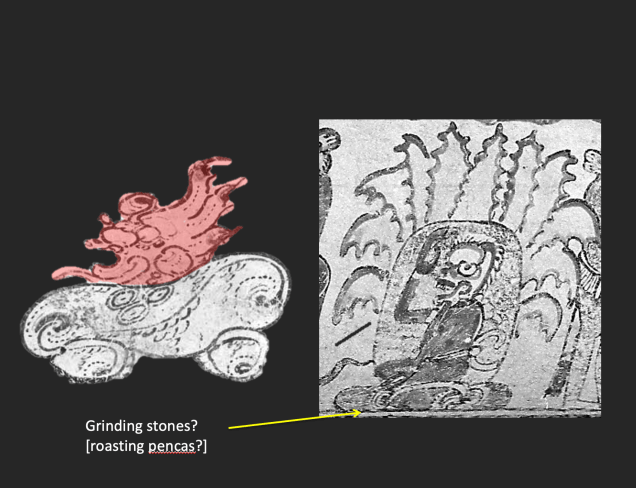
These distinctions, of habitual posture, relative mobility and wildness, or fleshiness, extend to certain plants. A late 6th-century vase in the Mint Museum–Randolph shows a variety of “just-so” stories worthy of Rudyard Kipling (Figure 1). One collection of Mayan tales calls them “‘how’ and ‘why’ stories” (Shaw 1971:24). The scene to the left could have been called “How the Jaguar Got Its Spots.” Holding a conch, ink receptacle, and brush, a rodent applies (one presumes) the spots on a feline—in all likelihood, a visual story that serves as etiology, an account of cause-and-effect. The pliant jaguar is in the kot position, if resting on its haunches. He sits atop what may be the Jaguar God of the Underworld, en face, with three stones in its mouth. A possible participant to the right—see the rodent’s tail reaching out, tendril-like, to touch this image—is a seated figure with hand raised to the forehead. Long ago, David Stuart identified this pose as the lamentation gesture associated with skeletal death gods or beings in distress (personal communication, 1983). Such a pose occurs with the Maize God, sinking in his canoe, on the incised bones from Tikal Burial 116 and also with a foreign day sign for “Death” on Jimbal Stela 1:B4. [2] On the vase are three stones just beneath this figure. Around his body flares an aureole of the serrated but succulent leaves (pencas) of the agave plant. From this plant comes the alcoholic beverage pulque, chih in Classic Ch’olti’an (Houston et al. 2006:120, 122, fig. 3.16). This is extracted from fluids (aguamiel) that pool, after human scraping, at the core of the plant (Parsons and Parsons 1990:35–45).

Figure 1. How the jaguar got its spots, and the agave plant full of woe (close-up, K1558, photograph courtesy Justin Kerr).

The figure in woe is personified agave, often shown with bony features or, in alternate form, with the head of the rain deity, Chahk (Figure 2; see also Ek’ Balam, Room 29sub, Mural of the 96 Glyphs, V1, http://www.famsi.org/reports/01057/01057LacadenaGarciaGallo01.pdf). On occasion, the penca may be a variant of that god, with the syllable ‘o on its forehead (Houston et al. 2006:123, fig. 3.19; note, however, that this sign may simply be a stylized agave leaf). The agave plant appears to be ground, as agave can be, to process its fibers in either a green or burned state (penca cruda or penca asada); eventually, the strands will be plied into netting and cloth (Stuart 2014; see also Parsons and Parsons 1990:152). Possibly, the skeletal nature of the agave plant relates to the death-like, unconscious states induced by alcohol or the rooting of agave in hard, rocky landscapes (David Stuart, Karl Taube, personal communications, 2020); Chahk too has stony associations in the context of certain month names, perhaps because of lightning strikes by this god and its vitalizing effects on bedrock (cf. La Muerta Monument 1, Guatemala [Suyuc et al. 2005:fig. 9]). [3]

This image has an empty alt attribute; its file name is screen-shot-2020-07-03-at-2.27.08-pm.png
Figure 2. Head of O’ Chahk(?) as agave for grinding or roasting (left, K1882), and personified agave in partly skeletal form (K1558, photographs courtesy Justin Kerr).

Or the metaphor of death ran deeper. By tradition, the tool for cutting the plant, a hooked blade known in highland Mexico as a tajadera, bears an eerie resemblance to hooked blades in Teotihuacan that snag hearts or drip with clotted, sacrificial blood (cf. Parsons and Parsons 1990:28, pls. 21–22; O’Neil 2017:fig. 25.5; Sugiyama 2017:pl. 61). Perhaps this was an agricultural trope for bloodletting and sacrifice. Slicing away at a penca to pry at its center recalled a similar act on a human torso. Because of its slashing, intrusive nature, the extraction of pulque killed the plant that yields it. For humans, heart extraction did the same (see Dehouve 2014).

Conceivably, the dark area around the agave deity represents the collecting node of raw liquid, aguamiel, the three stones below an allusion to the roasting of the plant for grinding into spinnable fiber, or even to a witz or hill (Parson and Parson 1990:152, 160–163). The evident pairing with the rodent and feline remain a mystery. What possible story was being told? The three stones under the agave plant and the jaguar suggest some commonality of hearth-like heat, beyond the speculations about the roasting of pencas and the stony, dry soil on which agave thrives. Taube wonders if those stones were simply allusions to witz or hills (personal communication, 2020). But most important here: the immobile plant bears arms, legs, fleshy body (if skeletal head). He wears a loincloth, has a mouth for eating, drinking, and talking, eyes to see. That the companion scene appears as an etiological image, an explanation for why the jaguar has spots, suggests it operates in the same domain of first things. To exist in a story, to interact with others, the plant must be animalized or made partly human.

Two observations: first, almost all creatures in Maya imagery are conventionalized; and, second, their visual treatment likely accords with a concept of “mythic prototypes” (Houston and Martin 2012). Classic images of animals can show remarkable sensitivity to behavior, a spider monkey scratching its armpit or a dog using its hind leg to relieve an itch in a hard-to-reach place (Figure 3). But armadillos (Dasypus novemcinctus) have many more armored bands than in Maya images, which greatly reduce the number of triangular osteoderm scales. Conventionalization isolates and enhances an essential identifier. But no bat known to the Maya flashed eyeballs or, in some cases, cross-bones on their wings, nor did most scratching dogs have jaguar paws. These highlight another feature, the mythic prototype, a “first exemplar” or, with the jaguar-dog, a distinct hybrid like nothing in nature: “[t]o see and depict such things and beings might have been, for the ancient Maya, a binocular process. It perceived the specific in the general, and the general amidst the wondrous particulars of ever-present myth” (Houston and Martin 2012). Less an armadillo, than the armadillo, or that armadillo, not any bat, but a very particular bat or monkey of which stories were told.

Figure 3. Conventionalized and mythologized animals: armadillo (upper left), Yaxha Offering 10 (YXMM 098, Wurster 1999[?]:30); bat (upper right, Museum of Fine Arts Boston MA 1988.1187, photograph courtesy Justin Kerr); spider monkey (lower left, K7525, photograph courtesy Justin Kerr); and hybrid dog (lower right, K7525, photograph courtesy Justin Kerr).

The monkey and the hybrid dog in Figure 3 are a kind of being identified some 30 years ago in Maya texts and imagery: the way, dream-“alter” or companion spirit (for decipherment and initial catalogue, Houston and Stuart 1989; Grube and Nahm 1994). For Descola (2013:208–217), such creatures in Mesoamerica embodied “analogism,” although it is doubtful he knew (or knows) of the glyphic evidence. The Mayanist literature on these beings is large, as is the number of controversies about their precise nature or role (for an excellent, illustrated review, see Just 2012, esp. pp. 131–132). Most appear in single registers (e.g., K531, K771, K1181, K5512, K9291), or they float in multiple registers, a few on a ground line. Several fly because they are creatures of the air, birds, bats, insects; others disobey gravity (K791, K927, K1211). A few lie almost on their bellies, constrained by the low height of a bowl that displays them (K1203). The format controls the scene, not vice versa. Hinting at unpredictability, they whip up to wild or indecorous motion (K3392). Mouths often gape; they are noisy, shake rattles or blow flutes and conches.

And they do things. One bowl displays, in order, a man-bat throwing stones, a person cutting off his own head, a small jaguar lashed to a stick held up by a human-animal, a partly defleshed jaguar brandishing an enema syringe and the olla to hold that liquid (K3395). They are never just a jaguar, just this or that animal. They involve hybrid, combinatory, naturally impossible creatures that exist in different times of day (dog and jaguar) or parts of the forest (deer on the ground, monkey in trees). Or they are beings, like skeletons, that should not walk but do. Making the impossible possible, they go to the essence of dreams and the physical liberations and unease of that experience. Notably, none have anything to do with each other. They are seemingly heedless of their neighbors on the pots. In a few cases there are subtle graphic integrations between them. A vase at the Princeton Art Museum shows a triadic pattern of sight-lines that plays out across the surface (Figure 4). These are probably a nod, too, to three viewing frames on a cylindrical vessel. Unlike the entire image, they could be seen without pivoting the vase. The standing figures are probably not in that position because of any hierarchy of spirits, but to “pace” and configure the graphic triads.

Figure 4. Interlocking eye-lines across field of way spirits, Ik’ kingdom (triangles added to K791, The Princeton Art Museum, Princeton, NJ PUAM# y1993-17, photograph courtesy Justin Kerr).

Others sport with discrete, non-integrated figures that nonetheless retain the dominant orientation of reading: starting at left, moving right (Figure 5). Note that the final figure—the first figure correlates, probably, with the beginning of the rim band text—swivels awkwardly, despite his body orientation, to match the other faces. All are hybrid animals, tapir-cats, fire-snorting peccaries, deer with eyes swinging out of their orbits. Yet none exhibit the kot, four-legged position that should confirm their animality. The bipedalism reinforces another element: they wear clothing, their privates are covered. The personified agave plant from the Mint Museum–Randolph has a loin cloth as well (Figure 2).

Figure 5. Facial orientation of way (K1743, photograph courtesy Justin Kerr).

The way beings exhibit another quality. They have a visual history. The glyph for them is attested in Early Classic texts, if mostly in what appear to be references to the Holmul area or temples (WAY[bi], loci where deities lay dormant until “awokened” (Estrada-Belli et al. 2009:246–248, fig. 10; Houston and Inomata 2009:fig. 2.3). The list of where way do not appear is impressive. It localizes to a very few kingdoms or regions: the Ik’ territory (named after the main component of its Emblem glyph), centered on the western reaches of Lake Peten Itza in Guatemala, in and around the so-called “Mirador” basin, but also north to Calakmul, Naranjo, and especially the polity of El Zotz. That city and its surroundings innovated this form of spiritual display. Several of its way occur on a number of pots—the reasons for their co-occurrence are unclear. Some are unique, as on K9254 (Figure 6). It displays a tailed, part-human, moving acrobatically, legs aloft, the hands doing the work. Indeed: the text describes him as mi-bi/BIX?-ni?, “no road/no goes [walks?],” followed by a reference to his status as a way (for BIX, see Stuart 2012). The way glyph materializes in a variant form, with infixed “ajaw,” that was first identified by David Stuart (personal communication, 1990). Karl Taube (2005:25–28, figs. 2–3) suggests it might be a version of the acrobatic Maize god, a form of a world tree that would be disinclined to move.

Figure 6. “Walking” (or not-walking”) on hands (excerpt, K9254, photograph courtesy Justin Kerr).

The first appearance of such tableaux at El Zotz, and hence of the Classic period, date to the first years of the 7th-century AD. They last for only a few generations, culminating sometime between AD 625–650. Most of the painters must have known each other, or they came from ateliers working over a relatively short span. The ceramics have a red background (a hallmark of local ceramics [de Carteret 2013]), unprovenanced but of similar date, highlighting an unusual graphic variant of a pronoun in their rim band texts; polychrome accents embolden their texts. The El Zotz vases also reveal a wide gradient of execution and legibility. The most skilled have regular spacing and a careful discharge of brush ink (K4922, K7525). Others display legible texts, but maladroit use of ink and diminished control over glyph sizes (K5084, K7720, K9098). At the far end are bare competence and sometimes worse (K1379).

There were regional emphases of way in these sets of drinking vessels. In the menagerie: ti-IL HIX, “Tapir Feline/Jaguar” (perhaps linked to Xultun, Guatemala); K’an Baah Ch’o “yellow pocket-gopher rat” (found modeled in stucco on the wall facade at Tonina, Mexico); a deer with extruded eyes on optical stalks (found also on “codex-style” vases to the north of El Zotz); a deer-monkey, ‘o-chi-la MA’X; a kind of fox, CHAK? ta-na~TAHN-na wa-xi~xa, “Red Chest Fox”; a hunter’s bundle with his conch and a deer head extruding a snake; a feline with enema equipment; and a fire-breathing bat and peccary. Why these way and no others were featured here has not been explained.

A well-known attribute is their relation to exalted dynastic titles and, on occasion, to places. At El Zotz, for example, a hunting death god was the way of local kings (Figure 8). Yet the vague, generic use of the royal titles, without reference to specific historical figures, raises the chance the way do not exist in contemporary time—i.e., they may not have a direct connection to dynastic figures of the Late Classic period. On one vase, a way is associated with Naah-5-Chan. This was the celestial abode of the so-called “paddler” gods, named after their service in a canoe with the Maize God (K791, Figure 4).

Figure 8. A local way of the kingdom of El Zotz; note the wasp-nest in his antler (excerpt, K2023, photograph courtesy Justin Kerr).

Only one figure, a male in swirling water with fishes (HA’-la wi-WINIK-ki, “watery man/person”), appears to relate intrinsically to an Emblem, one with bubbling, swirling fluid as a key component (Figure 9, K1256; see Helmke et al. 2018). In fact, all scenes potentially relate to mythic periods, their red background indexing ancient times when such gatherings took place: an ordering of gods (tz’ahkaj) at the “place of the sun,” K’IN-chi-IL (e.g., K7750). What had been a local aesthetic preference for red backgrounds may have acquired the symbolic nuance of “pre-dawn” events in a dim realm on the verge of sunlit ordering (Hamann 2002).

Figure 9. A Way, “Watery Man/Person” with Emblem glyph of swirling water (excerpt, K1256, photograph courtesy Justin Kerr).

Such are the way: asocial or even anti-social, active in wild ways, loud, far from the decorum of kings, composite in nature, the impossible made possible, gravity itself in question, and possibly timeless in their nature and depiction. The political grafting in some cases—a ruler mentioned for the dynasties of Tikal, Palenque, etc.—was projected far backwards, to unnamed, generic holders of high titles. Or rather, the assumption that such figures are depicted in dynastic time, when the pots were painted, is unproven. They are just as likely to exist in myth or some “other-time,” an alternative, parallel state. The historical references to their owners have few secure ties to the scenes on the body of these ceramics. A pot from the area of El Zotz refers to the local way; the renowned “Altar de Sacrificios” vase, clearly from Lake Peten Itza, and the territory of 13 K’uh, mentions its regional way, Chak Bahlam (with blood-gorged mouth; K3120, MNAE 07901). But these are the exceptions. Their association with other spirits on pots continues to baffle.

Why do these spirits occur, and in a particular order? The apparently random arrangements are highlighted on a vase in the Princeton Art Museum (Figure 10; cf. Figure 4). A courtly scene is explicable, a social hierarchy made visible—these are even clear in the divine analogies to courts that appear to have been “established” at the beginning of the Era, on 4 Ajaw 8 Kumk’u (K2796 and its expansion on K7750). The spatial organization of way conform to no sure rules.

Figure 10. Disposition of Emblems and place names with way on Late Classic vase, Ik’ kingdom (K791, The Princeton Art Museum, Princeton, NJ PUAM# y1993-17, photograph courtesy Justin Kerr).

Behind Linnæus was not just the meticulous comparison of formal, anatomical features or broad behavior. There was the Old Testament, a story, if one to be doubted at his peril. (Dismissal of the Bible was a bold step he had no interest in taking.) Stories as gendered as those of the Book of Genesis seem also to have configured Classic Maya practice. Time and distance shaped such story-telling. In Maya writing, all supposed speech acts, those that report conversations, are either in times somewhat past—those on Piedras Negras Panel 3 may involve people no longer alive at time of carving (Houston and Stuart 1993; Law et al. 2013; Zender 2017). Or they occurred in mythic time, long past, or in some alternative, concurrent stream of existence.

Some are a distinct subset, the y-ala-j-iiy expressions recording one-way comments between gods, hummingbirds, dwarves, rabbits, dog-coatis, kinds of parrot, and receptive ladies (e.g., K2026, K4999, K7727, K8885). They are hardly conversations, which imply give-and-take. In emotional tone, they veer from solemn to comical, and many involve that exalted personage, God D. Typically, hierarchs speak to subordinates, no back-talk allowed. Exceptions include lowly beings reporting on some disconsolate failure, a dearth, or having too much of something else (K2026). In texts, the conversation comes first, then its social contextualization. One incised alabaster bowl has that quotative contextualization on its bottom, only legible when the object is lifted for imbibing its contents (Princeton University Art Museum, 2002-370, K3296).

Two features of these interactions are worth noting. In fact, they apply to most animals in Classic Maya imagery. First, creatures in active interaction with humans usually wear human clothing. A few vases exhibit journeys—of a duration indicated, perhaps by sequent day names (the reversed day names, Ak’ab, Ik’, Imix, suggest a return trip or some more subtle unspooling of time). A spotted dog pads along beneath a lord’s litter as his evident companion, sounding alarms, sniffing out game (Figure 11). In the image to the left, a dog is a dog. In that to the middle, it may paw its master’s foot (God D’s) in entreaty, but it sits as a human might and wears a loincloth and cross-tie bracelets; the rope around the neck is an indication, along with the white cloth, of its captive, controlled state. To be truly interactive, in mythic contexts, the animals adopt human attributes. Presumably, this transformation enabled intelligible speech. Dogs dressed up because, this implies, full sociality requires some human attributes. An interactive ecology grounded in field and forest is transposed to human courts and built space.

This image has an empty alt attribute; its file name is dogs.jpg
Figure 11. Animals that do and do not dress up, two dogs and a ti-la ch’o-ko, “tapir youth” (left and center photographs courtesy Justin Kerr, “Aussie Pot,” photographer unknown).

With that interaction made possible, human females can have affective relations that range from nursing or coddling a small mammal to embracing a rabbit lover (Halperin 2014:fig. 4.28b), or they might be carried off (ku-cha-ja) by randy deer equipped with the pectorals, collars, and belts of human males (K1182, K2794); wrapped with masculine loincloths, woodpeckers speak to herons (K4931). They dress like people, they sit like them too. This is a matter of shared interiority, with acknowledgement of a dissimilar physicality that nonetheless blurs with humans. It also relates, in a manner consistent with Vivieros de Castro, to a “time when the cosmos’ multiple entities shared a generic human condition and were thus able to communicate with each other,” only to suffer, at some point “severe disruption, which results in the transformation of the numerous types of humans that existed…into the different present-day species of animals” (Vanzolini and Cesarino 2014). Writing of Tzotzil beliefs, Robert Laughlin (1979:2) observes: “[a]t a later stage in the history of the world animals still talked and men travelled as thunderbolts. Spooks and jaguars were rampant” (see also Shaw 1971:12). For the Classic Maya, this was not about a dominant schema, whether of animism or analogism. Depending on story and setting, it had aspects of both.

A festival of “humanimals” appears on the “Vase of the 31 Gods” (Figure 12). Not endowed with texts, it implies them in abundance, the exclusive reliance of imagery perhaps being the point. Viewers had to know these tales, relations, motivations, and outcomes of this bustle of intense conversations. The animals show surface dissimilarities, but many human properties too, including an upright, seated posture, loincloths, collars, and bracelets. The red background points to some far time.

Figure 12. Vase of the 31 Gods (K1386, photograph courtesy Justin Kerr).

Yet, despite the absence of glyphs, there is both a quasi-textual parsing and quasi-textual sequencing in the multiple ground-lines and presumed top-to-bottom ordering (Figure 13). The viewer needed to understand a great deal about the outcomes of these various meetings. The huddles could not have taken place at once, for God D makes several appearances. In possible self-reference, the images may even allude to the bowl that exhibits the images: three such receptacles occur in lower registers to the right, once in the company of a jaguar offering an enema syringe. This is a convivial assembly. And more than most, the complex, multi-frame scene offers a compendium of “humanimals,” with much still to decode.

Figure 13. Presumed grouping and “reading order”; contrastive outlines highlight distinct sets of interactions; “star” indicates possible beginning (photograph courtesy Justin Kerr).

The second observation confronts an overlooked attribute of Classic Maya images. Where genitalia are visible, or clothing worn, they seem all to be male or, at least gender-neutral or male default. Clothing is highly gendered in Maya imagery, serving as a surrogate for a less discreet display of penises or other primary or secondary characteristics. The deer that carried off human females: male. Scribal monkeys: male. The dogs discussed above: male. Lovers of women: male. The visual cues to females, principally by showing them with their young, are almost non-existent in Maya imagery, including the figurines of wide use and, in some sites, wide distribution (Halperin 2014:fig. 4.17, 4.23). Tales assembled by various scholars refer generically to this or that animal, yet, to curious extent, females of those species are scarcely mentioned. [4] Tricksters, found throughout the region, seem also to be masculine (cf. the Amazon, Basso 1997:111, 216.226, which nonetheless draws a line from tricksters to normative male aggression; Allen Christenson also comments to us that the K’iche’ Título de Totonicapán refers to one of the trickster “hero-twins” as female). Males or the gender-neutral appear to be the default in story-telling. Yet the effect is not always laudatory. Rendering animals as male underscores the androcentricity (male-centered quality) of Classic elites. It also implies that human males are more prone to animal-like behaviors and unchecked desires.

Images that pair male and female animals can be counted on one hand (Figure 14). A whistle from El Kinel, Guatemala, identifies a male turkey by his wattle and ostentatious jewelry, including a necklace. The female is, as in nature, of plainer, less strutting sort. A finer point may be discerned, that royal males were frequently shown in eye-catching display, “peacocking” in a word. But for cultural and aesthetic reasons: it would be an overreach to invoke evolutionary theories about securing mates (Prum 2017). Or, for animals and captives, the display of penises related to their innate bestiality, as well as to deliberate acts of humiliation—a zoöphobic trope attested in other Maya evidence (Houston et al. 2006:207–219). When more human than animal, the privates are covered. When less human, or degraded socially, they are not.

This image has an empty alt attribute; its file name is females2.jpg
Figure 14. Gender in animal depiction: (a) tom turkey and hen, El Kinel, Guatemala; (b) tom turkey figurine, Piedras Negras Operation 41D-21-2; (c) female monkey in human garb and pose, Piedras Negras Operation 46F-19-1; and (d) dog(?) in huipil (K3844, photograph courtesy Justin Kerr).

Yet, an ultimate explanation for the gendering may have to do with a profound inequality of the time. Most documented makers of images were men, who seem to have devised and upheld an androcentric mode of depiction (Houston et al. 2006:51–56; Houston 2016). Among the few female animals are a monkey, dressed as a human but with simian face (Figure 14c), and what may be a dog or fox, robed in a huipil or female garment (Figure 14d). The red-background, “glowing” eyes produced by excision, and darkness on foregrounded figures bespeak a different state, perhaps a very different time. The glyphs nearby (Sak 3 Ook K’inich) do not indicate a female, however. Unlike others in the image, this figure may have no caption.

Animalia indeed: the evidence points to a thorough-going, masculine (or male-default) skewing, whatever the explanation. Almost all way are male, with only two exceptions (e.g., K2286), and those lack animal features or an explicit way designator. Trans-species sociality, however, including an ability to converse, scheme, and cavort sexually, needed more than that. There had to be human poses and raiment, a replication, with slight hints of animality, of human society itself.

Such dialogue was not of an everyday present. It took place in the far past, or in some alternative, even timeless existence that was nonetheless “true” (Shaw 1971:24): in Tzotzil, batz’i, “true” but also “‘primary’, ‘actual’, ‘essential’, ‘very’, and ‘principal'” (Gossen 1974:78). This separation was no less applicable to Maya deities. With few exceptions, they did not interact with historical figures in narrative scenes from the Classic period. Those that do seem to have been cradled or held as magical fetishes, as at La Amelia or the diminutive, squirming Chahk and flower-breathing jaguars at Xultun. [5] Others took the form of vitalized carvings, of which only a few survive (e.g., Fields and Reents-Budet 2005:158–159, 191–192, #58, #89).

Howard Bloch (2004:69–71), a specialist on Medieval France, stresses that the fables around interactions with animals are never timeless. They respond to reflections about tumultuous change, in his case the development of cities, courts, and urban spaces. Flourishing Maya courts, more and more congested cities, a distancing from untouched jungle, may have led Maya calligraphers and carvers to reflect like Linnæus on what was human, beast or both.

Notes

[1] For other entries in the “Maya Creatures” series, see Maya Musk, Dragons, Mosquitoes, Teeth, Fox.

[2] As noted by Stuart: the Jimbal glyph, with the number “13” and square, non-Maya cartouche. It is clearly the day sign “Death,” to judge from its position between 12 “Snake” and “1 Deer.”

[3] The syllable hi, which derives from his stone-like head, may come from a common term for “sand,” *hi in Common Ch’olan (Kaufman and Norman 1984:120). Possibly this was understood in Classic times as a material related to the vitrified product (fulgurite-like residues) of lightning strikes.

[4] For contrastive traditions with female-animal transformations and “animal-wives,” see Goddard (2018) and Kobayashi (2015). Consult Steiner (2005) for a less subtle claim about long-standing, Western beliefs in the equivalence of humans and animals. Sorabji (1993:10) reports on Plato’s view of animals as reincarnated humans, a clear assertion of spiritual parity. See also Shaw for Mayan tales (1971:17–18). On monkeys, Laughlin (1979:8, 41, 259), Thompson (1930, 1970:361–363), as well as Foster (1945) and Siegel (1943). George Foster does refer to female dogs in a non-Mayan, Popoluca tale (Foster 1945:226). For a thematic orientation to Maya myth, as based on distinct kinds of personage, see an insightful study by Chinchilla Mazariegos (2017). Allen Christenson (personal communication, 2020) observes that, in K’iche’, both humans and companion spirits are capable of reasoned thought, no’j. For useful sources on the “humanimal,” there are Mechling (1989), Ritvo (1997), Sax (1998, 2017), and Zipes (2012).

[5] The pose may correspond to the expression, 1-tahn, “first [thing] of the chest.” Usually, this applies to the relation of a mother to a child, perhaps from birth order, but a sense of intimate, physical custodianship may explain the gesture here. Rulers at Palenque, especially Kan Balam, employed such an expression with deities and buildings (Temple of the Inscriptions, West Panel:S11, Tablet of the Cross:G17).

Acknowledgements

This essay developed, along with other efforts, from a 2012–2014 Sawyer Seminar funded by the Andrew G. Mellon Foundation, “Animal Magnetism: The Emotional Ecology of Animals and Humans,” organized by Susan Alcock, John Bodel, and Stephen Houston; the sponsor was Brown’s Program in Early Cultures, which those three directed. In 2012, the kernel of these thoughts were given by Houston as part of that Seminar. Charles Golden, David Stuart, and especially Karl Taube helped as always; Allen Christenson provided relevant evidence from K’iche’ sources. “K” numbers correspond to Justin Kerr’s indispensable archive of rollout photographs, used here with his kind permission.

References

Atıl, Esin. 1981. Kalila Wa Dimna: Fables from a Fourteenth-Century Arabic Manuscript. Washington, D.C.: Smithsonian Institution Press.

Basso, Ellen B. 1987. In Favor of Deceit: A Study of Tricksters in an Amazonian Society. Tucson: University of Arizona Press.

Bloch, R. Howard. 2004. The Wolf in the Dog: Animal Fables and State Formation. differences: A Journal of Feminist Cultural Studies 15(1):69–83.

Boia, Lucian. 1995. Entre l’ange et la bête: Le mythe de l’homme différent de l’Antiquité à nos jours. Paris: Plon.

Chinchilla Mazariegos, Oswaldo. 2017. Art and Myth of the Ancient Maya. New Haven: Yale University Press.

Ciudad Real, Antonio de. 2001. Calepino Maya de Motul, edited by René Acuña. Mexico City: Plaza y Valdés.

Coelho de Souza, Maricela. 2013. Descola’s Beyond Nature and Culture, Viewed from Central Brazil. Hau: Journal of Ethnographic Theory 4(3):419–429.

de Carteret, Alyce M. 2013. The Red Shift: Changing Tastes and their Implications at the Elite Maya Residence of El Diablo, Guatemala. MA thesis, Department of Anthropology, Brown University.

Dehouve, Danièle. 2014. “Voy a cortar a una muchacha con mi gran cuchillo porque quiero beber un poco”: La elaboración del pulque por los indígenas tlapanecos (México). Nuevo Mundo Mundos Nuevos [online], Questions du temps présent, mis en ligne le 09 avril 2014 https://journals.openedition.org/nuevomundo/66731#tocto2n1

Descola, Phillipe. 2001. Antropologie de la nature: Leçon inaugurale prononcée le jeudi 29 mars 2001. Collège de France https://books.openedition.org/cdf/1330

——. 2013. Beyond Nature and Culture. Chicago: University of Chicago Press.

——. 2017. Les animaux et l’histoire, par-delà nature et culture: Entretien avec Philippe Descola. Revue d’histoire du XIXe siècle 54(1):113–131. https://journals.openedition.org/rh19/5191.

Estrada-Belli, Francisco, Alexandre Tokovinine, Jennifer Foley, Hurst Heather, Gene Ware, David Stuart, and Nikolai Grube. 2009. A Maya Palace at Holmul, Peten, Guatemala and the Teotihuacan ‘Entrada’: Evidence from Murals 7 and 9. Latin American Antiquity 20(1):228–259.

Fields, Virginia M., and Dorie Reents-Budet. 2005. Lords of Creation: The Origins of Sacred Maya Kingship. Los Angeles: Los Angeles County Museum of Art.

Fitzgerald, Des. 2013. Philippe Descola’s Beyond Nature and Culture. Somatosphere: Science, Medicine, and Anthropology Oct. 11, 2013. http://somatosphere.net/2013/philippe-descolas-beyond-nature-and-culture.html/.

Foster, George M. 1945. Some Characteristics of Mexican Indian Folklore. Journal of American Folklore 58:225–235.

Goddard, Kate. 2018. Japanese Animal-Wife Tales: Narrating Gender Reality in Japanese Folktale Tradition by Fumihiko Kobayashi. Marvels & Tales 32(1):184–186.

Gossen, Gary H. 1974. Chamulas in the World of the Sun: Time and Space in a Maya Oral Tradition. Cambridge, MA: Harvard University Press.

Grube, Nikolai and Werner Nahm. 1994 A Census of Xibalba: A Complete Inventory of WAY Characters on Maya Ceramics. In The Maya Vase Book Volume 4, edited by Justin Kerr, pp. 686–715. New York; Kerr Associates.

Halbmayer, Ernst. 2013. Debating Animism, Perspectivism, and the Construction of Ontologies. Indiana 29:9–23. 

Hamann, Byron E. 2002. The Social Life of Pre-Sunrise Things: Indigenous Mesoamerican Archaeology. Current Anthropology 43(3):351–82.

Helmke, Christophe, Stanley P. Guenter, and Phillip J. Wanyerka. 2018. Kings of the East: Altun Ha and the Water Scroll Emblem Glyph. Ancient Mesoamerica 29(1):113–135.

Hopkins, Nicholas A., J. Kathryn Josserand, and Ausencio Cruz Guzmán. 2010. A Historical Dictionary of Chol (Mayan): The Lexical Sources from 1789 to 1935. Tallahassee: Jaguar Tours. http://www.famsi.org/mayawriting/dictionary/hopkins/CholDictionary2010.pdf.

Houston, Stephen. 2006. Hurricane! Mesoweb: http://www.mesoweb.com/articles/houston/Hurricane.pdf.

——. 2016. Crafting Credit: Authorship among Classic Maya Painters and Sculptors. In Making Value, Making Meaning: Techné in the Pre-Columbian World, edited by Cathy L. Costin, pp. 391–431. Washington, D.C.: Dumbarton Oaks Research Library and Collection.

——. 2014. The Life Within: Classic Maya and the Matter of Permanence. New Haven: Yale University Press.

——, and Takeshi Inomata. 2009. The Classic Maya. Cambridge: Cambridge University Press.

——, and Simon Martin. 2012. Mythic Prototypes and Maya Writing. Maya Decipherment: Ideas on Ancient Maya Writing and Iconography https://mayadecipherment.com/2012/01/04/mythic-prototypes-and-maya-writing/.

——, and David Stuart. 1989. The Way Glyph: Evidence for “Co-Essences among the Classic Maya. Research Reports on Ancient Maya Writing zno. 30. Washington, D.C.: Center for Maya Research. http://www.mesoweb.com/bearc/cmr/30.html

——, and David Stuart. 1993. Multiple Voices in Maya Writing:  Evidence for First- and Second-Person References. Paper presented at the 58th meeting of the Society for American Archaeology, St. Louis.

——, David Stuart, and Karl Taube 2006. The Memory of Bones: Body, Being, and Experience among the Classic Maya. Austin: University of Texas Press.

Hull, Kerry. 2016. A Dictionary of Ch’orti’ Mayan-Spanish-English. Salt Lake City: University of Utah Press.

Just, Bryan R. 2012. Dancing into Dreams: Maya Vase Painting of the Ik’ Kingdom. Princeton: Princeton University Art Museum.

Kaufman, Terrence, and William M. Norman. 1984. An Outline of Proto-Cholan Phonology, Morphology and Vocabulary. In Phoneticism in Mayan Hieroglyphic Writing, Institute for Mesoamerican Studies Publication 9, eds. John. S. Justeson and Lyle Campbell, pp. 77–166. Albany: State University of New York.

Kobayashi, Fumihiko. 2015. Japanese Animal-wife Tales: Narrating Gender Reality in Japanese Folktale Tradition. New York: Peter Lang.

Kohn, Eduardo. 2013. How Forests Think: Toward an Anthropology Beyond the Human. Berkeley: University of California Press.

Laughlin, Robert M. 1975. The Great Tzotzil Dictionary of Santo Domingo Zinacantán. Washington, D.C.: Smithsonian Institution Press.

——. 1977. Of Cabbages and Kings: Tales from Zinacantán. Washington, D.C.: Smithsonian Institution Press.

——. 1988. The Great Tzotzil Dictionary of Santo Domingo Zinacantán, Volume I, Tzotzil-English. Washington, D.C.: Smithsonian Institution Press.

——. 2000. Poetic License. In The Flowering of Man: A Tzotzil Botany of Zinacantán, by Dennis E. Breedlove and Robert M. Laughlin, pp. 101–108. Washington, D.C.: Smithsonian Institution Press.

Law, Danny, Stephen Houston, Nicholas Carter, Marc Zender, David Stuart. 2013. Reading in Context: The Interpretation of Personal Reference in Ancient Maya Hieroglyphic Texts. Journal of Linguistic Anthropology 23(2):23–47.

Linnæi, Caroli [Von Linné, Carl]. 1758. Systema naturæ per regna tria naturæ, secundum classes, ordines, genera, species, cum characteribus, differentiis, synonymis, locis. Tomus I. 10th edition. Holmiæ [Stockholm]: Salvius. https://www.biodiversitylibrary.org/item/10277#page/3/mode/1up

Mechling, Jay. 1989. “Banana Cannon” and Other Folk Traditions between Human and Nonhuman Animals. Western Folklore 48(4):312–323.

O’Neil, Megan E. 2017. Stucco-Painted Vessels from Teotihuacan: Integration of Ceramic and Mural Traditions. In Teotihuacan: City of Water, City of Fire, edited by Matthew H. Robb, pp. 180–187. San Francisco/Berkeley: Fine Arts Museum of San Francisco—De Young; University of California Press.

Parsons, Jeffrey R., and Mary H. Parsons. 1990. Maguey Utilization in Highland Central Mexico: An Archaeological Ethnography. Anthropological Papers Series, vol. 82. Ann Arbor: Museum of Anthropology, University of Michigan.

Pastoureau, Michel. 2011. Bestiaires du Moyen Âge. Paris: Seuil.

Pitarch, Pedro. 2011. The Jaguar and the Priest: An Ethnography of Tzeltal Souls. Austin: University of Texas Press.

Polian, Gilles. 2017. Diccionario Multidialectal del tseltal. Ms. in possession of authors.

Prum, David O. 2017. The Evolution of Beauty: How Darwin’s Forgotten Theory of Mate Choice Shapes the Animal World—and Us. New York: Doubleday.

Reid, Gordon McG. 2009. Carolus Linnaeus (1707–1778): His Life, Philosophy and Science and its Relationship to Modern Biology and Medicine. Taxon 58(1):18–31.

Ritvo, Harriet. 1997. The Platypus and the Mermaid: And Other Figments of the Classifying Imagination. Cambridge, MA: Harvard University Press.

Sahlins, Peter. 2017. 1668: The Year of the Animal in France. New York: Zone Books.

Sam Juárez, Miguel, Ernesto Chen Cao, Crisanto Xal Tec, Domingo Cuc Chen, Pedro Tiul Pop. 1997. Diccionario Q’eqchi’ Molob’aal Aatin. La Antigua Guatemala: Proyecto Lingüístico Francisco Marroquín.

Salisbury, Joyce E. 1994. The Beast Within: Animals in the Middle Ages. New York: Routledge. 

Sax, Boria. 1998. Bestial Wisdom and Human Tragedy: The Genesis of the Animal Epic. Anthrozoös 11(3):134–141.

——. 2017. Animals in Folklore. In The Oxford Handbook of Animal Studies, edited by Linda Kalof, pp. 456-474. Oxford: Oxford University Press.

Shaw, Mary (editor). 1971. According to Our Ancestors: Folk Texts from Guatemala and Honduras. Norman, OK: Summer Institute of Linguistics, University of Oklahoma.

Siegel, Morris. 1943. The Creation Myth and Acculturation in Acatan, Guatemala. Journal of American Folklore 56:120–126.

Sorabji, Richard. 1995. Animal Minds and Human Morals. Ithaca, NY: Cornell University Press.

Steiner, Gary. 2005. Anthropocentrism and Its Discontents. Pittsburgh, PA:
University of Pittsburgh Press.

Stuart, David. 2007. Reading the Water Serpent as WITZ’. Maya Decipherment: Ideas on Ancient Maya Writing and Iconography https://mayadecipherment.com/2007/04/13/reading-the-water-serpent/.

——. 2012. The Verb Bix, “Go, Go Away.” Maya Decipherment: Ideas on Ancient Maya Writing and Iconography https://mayadecipherment.com/2012/01/23/the-verb-bix-go-go-away/

——. 2014. A Possible Sign for Metate. Maya Decipherment: Ideas on Ancient Maya Writing and Iconography https://mayadecipherment.com/2014/02/04/a-possible-sign-for-metate/.

Sugiyama, Saburo. 2017. 61: Bifacial Blade, 200–250. In Teotihuacan: City of Water, City of Fire, edited by Matthew H. Robb, p. 264. San Francisco/Berkeley: Fine Arts Museum of San Francisco—De Young; University of California Press.

Suyuc, Edgar, Beatriz Balcárcel, Francisco Lópe, and Silvia Alvarado. 2005. Excavaciones en el sitio La Muerta, Cuenca Mirador, Petén. In XVIII Simposio de Investigaciones Arqueológicas en Guatemala, 2004, edited by Juan Pedro Laporte, Bárbara Arroyo, and Héctor Mejía, pp. 69–84. Guatemala City: Museo Nacional de Arqueología y Etnología.

Taube, Karl A. 2005. The Symbolism of Jade in Classic Maya Religion. Ancient Mesoamerica 16:23–50.

Thomas, Keith. 1983. Man and the Natural World: Changing Attitudes in England 1500-1800. London: Allen Lane.

Thompson, J. Eric S. 1930. The Ethnology of the Mayas of Southern and Central British Honduras. Field Museum of Natural History, Anthropology Series 17:23–214.

Vanzolini, Marina, and Pedro Cesarino. 2014. Perspectivism. Oxford Bibliographies DOI: 10.1093/OBO/9780199766567-0083

Viveiros de Castro, Eduardo. 1998. Cosmological Deixis and Amerindian Perspectivism. Journal of the Royal Anthropological Institute 4(3):469–488.

von Uexküll, Jakob. 2010 [1934, 1940]. A Foray into the Worlds of Animals and Humans, with A Theory of Meaning, translated by Joseph D. O’Neil. Minneapolis: University of Minnesota Press.

Wurster, Wolfgang. 1999(?). Yaxhá, laguna encantada: Naturaleza, arqueología y conservación. Guatemala City: Editorial Galería Guatemala, Fundación G&T.

Zender, Marc. 2017. Theory and Method in Maya Decipherment. The PARI Journal 18(2):1-48.

Zipes, Jack. 2012. The Irresistible Fairy Tale: The Cultural and Social History of a Genre. Princeton: Princeton University Press.