This is the second in a series of occasional essays on the visual histories and iconographic associations of the Maya day signs. It follows up on previous studies that have explored some aspects of these wider connections (Mex Alboronoz 2021, Stone and Zender 2011, Thompson 1950). My emphasis here is on what might be called the iconographic “roots” of various days, exploring how their forms underwent significant transformations over the centuries, obscuring aspects of their visual origins and iconographic identifications. Each case study will work to help establish the wider point (more a working hypothesis) that all of the Maya day signs originated in the Preclassic era as representations of deities or mythic animals, and that through constant copying and repetition, these were reduced and abstracted, often losing their original forms in the process. A few of these evolutions and “devolutions” are known to epigraphers (i.e., that the Ahau “face” was never a face to begin with). Still, they are more common than many realize, and laying out the developmental histories helps us to understand the broader history of the 260-day calendar in Mesoamerica.
Figure 1. Variants of the day sign Caban (Kaban) in chronological order (standard and animated versions). (a) UAX: Str. B-XIII murals, (b) TIK: St.31, (c) NAR: Alt 1, (d) PAL: T.XVII tablet, (e) XUN: Pan. 3, (f) PAL: T. XIX platform, (g) EKB, Mural 96 glyphs, (h) Dresden Codex, (i) RAZ, Tomb 12, east wall, (j) QRG: St. D, (k) COP: Corte Altar. Drawings by D. Stuart.
As with many of the Maya day signs, the visual origin of Caban, the seventeenth day of the sequence, has long been unclear (Figure 1a-h). Its form is identical to the common logogram KAB, “earth, ground,” and its name of course reflects a basic connection to that word (see Stone and Zender 2011:136-137). The visual histories of the day sign for Caban and of the KAB logogram show the same developmental trajectory, so we will them here as basically a single sign operating in different contexts. The sign normally shows a so-called “caban curl” element in the upper left and a semicircular form at the lower right. An internal border that runs along the top and down the left side is standard, although this is omitted in some cases. What does the sign represent? Agreeing with an interpretation first proposed by Eduard Seler, Thompson (1950:86) was adamant that it was “a lock of hair worn by Goddess I of the Maya codices.” While there is some resemblance to the hairlock we see on the late moon goddess, this supposed connection quickly dissolves once we realize that it is only in Postclassic representations of the goddess that we see any resemblance. Thompson only considered very late examples when making his comparisons. We need to look elsewhere for an explanation.
Figure 2. Maudslay’s 1889 presentation of the full figure 8 Caban from Quirigua, Stela D. Note the iconographic association made between the face and the standard Caban day. Drawing by Annie Hunter.
One important clue comes from an elaborate animated form of Caban on Stela D of Quirigua (Figure 1j). It shows a bejeweled man with bound hair and a distinctive curl behind the eye, similar to the inner detail we see in Caban. Perhaps with Goodman’s input, Maudslay (1889) made this connection early on in the published illustration of Stela D, showing a slightly reconstructed face of the day sign beside a standard Caban (Figure 2b). Other animated Caban day signs are rare. The only other examples known to me are a 4 Caban Year bearer day painted in Tomb * from Rio Azul (Figure 1i), and a damaged 7 Caban that appears on Dos Pilas, Hieroglyphic Stairway 2. A full-figure Caban appears on the so-called ”Corte Altar” from Copan (Figure 1k), again showing a young male with curl markings on his body. These examples provide a good overview of examples of what is essentially the same character, with distinctive iconographic attributes. So, while rare, this animated Caban must have existed in the background of Classic Maya scribal culture, within a standardized repertoire of imagery that was only occasionally called upon.
Figure 3. The head variant of KAB. (a) TIK: Marcador, (b) YAX: L. 22, (c) PAL: T.I.m., (d) CRN: E. 56, (e) ANL: Pan. 1, (f) four examples of U-KAB-ji-ya from NAR: St. 46. Drawings a-e by D. Stuart, f by A. Tokovinine.
We see many examples of this same head as the standard animation of the KAB logogram, used with far more regularity in the script (Figure 3a-e). Previously I have taken this head to be a somewhat informal elaboration on the basic KAB, where the scribe has chosen to make use of a generic-looking head as a way to lend it some animate quality. However, there is good reason to see this head for KAB and Caban day sign as more than simple personifications. This is perhaps indicated by its sheer frequency and its consistency of form in both early Classic and Late Classic examples. The curl appears behind the eye, or in some early examples, around it, like a descending vertical stripe. On Naranjo Stela 46, the head variant appears five (possibly six) times in spellings of U-KAB-ji-ya (u kab-[i]j-iiy) suggesting that the scribe saw it as a standard sign type (Figure 3f).
Figure 4. The animate number 11. (a) YAX: L. 47, (b) PNG: Pan. 2, (c) COP: Temple 26 inscription, (d) PAL: T. XVI stucco. Drawings by I. Graham (a), D. Stuart (b, c), and M. van Stone (d).Figure 5. Patrons of the Month Tzec, including head forms of the KAB sign. (a) PNG: Pan. 12, (b) COL: Bonampak area, “Po Panel,” (c) PAL: TC. Drawings by D. Stuart (a), A. Safranov,(b), and Linda Schele (c).
Tellingly, this animated KAB appears in two other settings where it stands alone as a singular representation of a Maya deity. First, we see it as the deity that serves as the number 11 (Figure 4). One example (c) from Palenque’s Temple XVII takes a “celt” element as a prefix, a feature we see on several deity names in both the Classic and Postclassic, and replicating a deified term for the earth that we find on Copan, Stela A. The patron of the moth Tzec is the same thing (Figure 5a, b). Its earliest forms show it to be the deity we have already discussed, and the example from Piedras Negras Panel 12 is particularly complex. Here we see the marking “dripping” over the eye and more of a thickened, dark band with a zigzag. As with the day sign, the simpler KAB works also the month patron (Figure 5c). In this context, the deity head and the standard KAB are once again equivalent signs.
We can easily connect these portrait heads, in turn, to a god who is depicted in the postclassic codices (Figure 6). This is “God R,” so designated from the revisions made to Schellhas’s original list (Taube 1992:112). His portrait name glyph is preceded by the number 11, so there is little doubt it is the same as the deity shown in Figure 4. Note that the he has precisely the same Caban curls over or behind the eye, identical to the animate KAB sign.
Figure 6. “God R” in the Dresden Codex (pages 5b and 6a).
Animate Origins
Did the deity glyphs in Figure 3-5 arise out of the simpler KAB sign, as a personification, or was the reverse true: did the familiar KAB develop as an abstraction from the head? It is a chicken-and-egg conundrum, perhaps, but I do believe there is enough evidence to support the second of these options, that the profile of the deity is the original. As other case studies show, Maya day signs mostly originated as visually complex portraits of deities or animals, which were simplified out of scribal preference. The parallel contexts we have touched on here (day sign, logogram, Tzec patron, and the number 11) all would seem to indicate that their “root image” was the personified form, the deity. I posit that through the familiar process of graphic reduction, and via repeated calligraphic practice, the deity’s profile head was abstracted and reduced to its essentials and diagnostics – his painted eye. His nose, mouth, and eye were “lost” early on, producing a short-hand version, such that all that was left was the distinctive dark patch and curl, along with the border that had originally run along the top of the head. Beginning deep in time, the day sign we recognize as Caban was born out of a long process of visual transformation, ultimately taking on a life of its own. Still, some scribes and iconographers retained this mythological identity to the day, particularly within the restricted contexts of the Tzec month patron and in the animated number. I wonder if small vestiges of the profile face can be seen from time to time even in some later, standard Caban signs, as we see in Figure 1e, where just the lower lip of the face was preserved as a small, vestigial detail.
Figure 7. Fully animate Caban day signs (6 Caban and 4 Caban) from Copan, Altar T. Drawings by D. Stuart.
An allusion to this deeper historical connection comes through two playful and wonderfully odd examples of the day Caban used by later Maya scribes (Figure 7). Altar T of Copan displays two remarkably inventive day signs of Caban as full-figure glyphs, each holding a month glyph. The bejeweled figures have Caban glyphs as heads with a hint of a mouth, and numbers of their coefficients appear above, attached to the heads. On the left is the earlier of the two embodied dates, 6 Caban 10 Mol (9.16.12.5.17, the accession of Yax Pasaj Chan Yopaa) and on the right is the later anniversary, 4 Caban 10 Zip (9.17.12.5.17). Each head has an obsidian blade atop its head, which we also see on the animated number 11 and on the Caban sign from Quirigua. Here the nature of these odd figures as animate Cabans is not solely based upon their glyphic heads, but on their specific iconographic identities, as deities. The designer of Altar T artfully took the abstracted Caban signs, and almost with a knowing wink placed them where the faces of the day gods should be. Lucky for us, the artist revealed some esoteric knowledge of deep script history.
Figure 8. Repeating scenes of wading warriors with the Maize God. Note the dark Caban markings about the eyes, alternating with stripes. (a) K4117, (b) K1224, (c) K2011, (d) detail of K1365. Photographs by J. Kerr, drawing by D. Stuart.
Interestingly, God R of the codices has been described as a deity of war and sacrifice (Taube 1992:112-115). We can link this “Caban deity“ to several representations of obsidian-wielding warriors on codex-style vessels (Figure 8). These are single or multiple individuals who appear with the Maize God, Juun Ixi’m, in scenes that depict his entering the primordial waters. The facial Caban curls are clear in many of these depictions, and their obsidian weapons perhaps relate to the obsidian imagery we see in the glyphs. In two examples we also see ears or ear ornaments in the form of spondylus shells. Sometimes the distinctive Caban curls appear “floating” in front of the faces, as Taube (1992:112-115) has noted, in an apparent overlap with some representations of the Hero Twins (K1202 shows an image of Juun Ajaw with an identical curl before his face). On these warrior figures the Caban curls alternate freely with other painted eye marks in the form of doubled vertical stripes, or a stripe with an “IL” shape. It seems that the eye markings on all of these “Caban deities” could take a few different forms without affecting their identification. In general, they strongly resemble the darkened patch over the eye that we see in early examples of the KAB or Caban head described above (Figure 5a, for example). It would seem that the curl of the standard Caban hieroglyph was the lone vestige of the face, originating as the markings about the eyes, a distinctive characteristic of this particular god, or group of gods.
1 Caban at San Bartolo?
Figure 9. Day record (1 Caban?) from the east wall of Structure sub-1A chamber, San Bartolo, Guatemala. Drawing by D. Stuart.
The Late Preclassic murals of Structure sub1-A of San Bartolo include a painted day sign that once was on its east wall (Figure 9). Here we see a profile face with a spondylus shell ear, and striped “IL” markings over the eye. One of the two stripes bends backward, identical to the facial markings we see on some of the warriors just described in the mythological scenes of the Maize God’s watery entrance (FIgure 10). The shared spondylus shell ear is a feature that makes this connection especially compelling, suggesting these are the same character — the same warrior with dark face paint over the eye.
Figure 10. Mythic warriors from K1366 and K2011, compared to the San Bartolo day sign. Details of rollout photographs by J. Kerr.
We therefore can entertain the possibility that the day sign at San Bartolo is not 1 Ahau, as I had previously believed, but rather 1 Caban. This day held importance in Maya calendar and forms the base date of one of the intervals written in the 4-column array from Structure 10K-2 (Macleod and Kinsman 2012). There, as the opening column, it is the header for the interval that established the base for the 819-day count cycle, a key component of Maya computational astronomy and four-quadrant cosmology (Linden and Bricker 2023). The 1 Caban from Structure sub1-A at San Bartolo has no surrounding elements that allow us to confirm such associations, but its juxtaposition with 3 Ik on the opposite wall was related to a four-part cosmological arrangement of the mural chamber (Stuart 2017, Stuart and Hurst 2018). In a future post, I will also explore how the day 1 Caban served an important role in the Year Bearer count as well.
Some Iconographic Implications
The simplified KAB sign appears in Classic Maya iconography as markings for ground lines and ground space (Stuart and Houston 1994:57-59). If we are to accept the idea that the image of KAB originated with the profile face, then these are best seen as non-textual extensions of the later abstraced glyph. I know of no examples of the KAB sign or its iconographic relatives in Preclassic Maya art, which is probably significant given the suggestions I’ve made here (it may not have existed as yet). The Classic period overlaps between sign and icon helps to accentuate the point that Maya iconography and writing, at least in its later stages, were inseparable visual and linguistic systems.
The basic meaning of kab as “earth, ground,” naturally suggests that the “God R” and the related warrior deities hold some identity with the earth itself. It is worth noting that there is no well-defined “earth god” in Maya mythology, so perhaps this Caban character (or characters) might qualify for such a role. Their imagery as warriors in the primordial waters of mythology may be related to this.
Finally, we should keep in mind the curious links that this Caban deity shows with Juun Ajaw and his other headband twin companion. This needs further exploration, for it may in the end offer some support for the initial identification I made of the San Bartolo day glyph as 1 Ahau. Nevertheless, for now, I see a stronger visual connection to the warrior deities discussed, pointing to its proper identification as 1 Caban. There is more to ponder, clearly.
Conclusions
The visual origin of the Caban day sign is now clearer, deriving from the profile portrait of a deity with distinctive facial markings (Figure 11). Its common, familiar form throughout the Classic period was a graphic shorthand of this portrait. The example from Rio Azul, dating to about 400 CE, hearkens back to the original and shows us the closest known Classic example to that underlying form, an example of which we may see as San Bartolo.
Figure 11. Hypothetical development of the Caban day sign from 100 BCE to ca. 682 CE. The first stage remains tentative. Drawings by D. Stuart.
This visual history takes us to a larger issue that was touched on briefly in my discussion of the day Men, and which bears repeating here. Underlying my interpretations of Caban and Men is the strong sense that most Maya day signs originated in the Preclassic as animated forms, as the heads of deities or animals. The very early use of the deer’s head for Manik at San Bartolo, at 300 BCE, is one example of this chronological tendency (we will explain the likely visual origin of the “Manik hand,” also the syllable chi, in a future post). To cite a couple of other examples, the common day sign for Chuen was first a portrait of the scribal monkey deity, and its eye came to be used as its standard shorthand representation. The day Ix similarly originated as the eye of a spotted feline. These original forms were still known to the artisans of Maya courts, but tended not to be used in regular scribal practice. What were once complex representations of deities and animals were simplified through expediency and convention, so that they began to take on abstract shapes and forms. I suspect this process began very early in the history of the script, long before the Classic period.
ADDENDUM (September 6, 2024):
I have remembered an important Late Classic example of the Caban day head variant, on a ceramic sherd on display in the Tonina site museum, illustrated below. This sign is the same as the KAB head variant we see in Figure 3, and a late version of the Rio Azul variant (Figure 1i and 11, middle).
Sources Cited
Linden, John, and Victoria R. Bricker. 2023. The Maya 819 day count and Planetary Astronomy. Ancient Mesoamerica 34(3):690-700. doi:10.1017/S0956536122000323
Maudslay, Alfred P. 1889-1902. Biologia Centrali-Americana: Archaeology. Volume 2. R.H. Porter, London.
Mex Alboronoz, William Humberto. 2021. Tiempo y Destino entre los gobernantes mayas de Palenque: una perspective desde la cuenta de 260 días. Palabra de Clio, Mexico D.F.
Stone, Andrea, and Marc Zender. 2011. Reading Maya Art: A Hieroglyphic Guide to Ancient Maya Painting and Sculpture. Thames and Hudson, London.
Stuart, David, and Stephen Houston. 1994. Classic Maya Place Names. Studies on Precolumbian Art and Archaeology, no. 33. Dumbarton Oaks, Washington, D.C.
Stuart, David, and Heather Hurst. 2020. Creation in Four Acts: The Narrative Structure of the San Bartolo Murals. Paper presented at the 2020 Mesoamerica Meetings, UT Austin.
Stuart, David, Heather Hurst, Boris Beltran and William Satunro. 2022. An Early Maya Calendar Record from San Bartolo, Guatemala. Science Advances, DOI:10.1126/sciadv.abl9290
Taube, Karl A. 1992. The Major Gods of Ancient Yucatan. Studies on Precolumbian Art and Archaeology, no. 32. Dumbarton Oaks, Washington, DC.
Thompson, J. Eric S. 1950. Maya Hieroglyphic Writing: An Introduction. Carnegie Institution of Washington, Washington, DC.
“[E]very age is an age of ignorance because the rise of some knowledges is often accompanied by the loss of others” (Burke 2024a:35)
“Ignorance” is an emotive term. It can be a valid description of gaps in knowledge or an accusation against others, those presumed to be, whether justifiably or not, less learned or schooled in the literature of this or that discipline. But who can deny that scholars come and go with the remorseless scything of time? A vade mecum, a body of work, will molder with eventual disuse and disattention; even in life, inevitably, people notice certain writings and then, as the authors depart or diminish in status or relevance, tend to cite them less and less.
Citations have their own history, of course, depending on discipline and person (Grafton 1997). To “footnote”—to cite—offers its own kind of positioning. People being people, there is always a social nexus involved, contingent on those doing the citing and those being cited. This is compounded by what has been called an “ignorance explosion,” i.e., rapid expansions of knowledge without comparable digestion of new ideas and evidence (Lukasiewicz 1974). Such an “explosion,” a surfeit of data, gives ample scope “for each one of us not to know” (Burke 2024a:36; see also Burke 2024b).
Some contributors, for reasons of deep injustice, never get their due, or not enough of it (Burke 2024a:32–33; Hutson 2002; Yan et al. 2024). Others are sent to oblivion, for solid reasons, yet their cases raise inevitable quandaries about referencing sound work by dubious people (Barofsky 2005; Rosenzweig 2020; Souleles 2020). The question becomes, how to acknowledge research, including those from one’s own oeuvre, in ways that are at once ethical and thoughtful (Kennedy and Planudes 2020)? How does one ponder, in the words of Donald Rumsfeld, “known unknowns” yet leave open a window to “unknown unknowns” (Burke 2024a:7–8)? Here may be a divide between overlooked yet detectible facts—some found, alas, by disreputable people—and things truly beyond our ken, the facta that are imperceptible and unconsciously ignored. At stake is the tough question of what creates the conditions for oblivion and obliviousness, the citational decisions that foment the unconscious and conscious forgetting of people and their work.
This is not a purely abstract issue. A recent fusillade against the largest US dig, at Tikal in the late 1950s and early 1960s, accuses it of subservience to “American big business,” in research informed, we are told, by “ineluctable dependencies between security, espionage, international politics, corporations, conservation, and donor economies” (Meskell 2023). A tarnish presumably descends on its many results, still being published 50+ years after fieldwork (e.g., Greene 2024). Are its conclusions or data disallowable once (if) we accept this reductive view? On this point, perhaps, the polemicist Richard Hofstadter would have an opinion.
Most Mayanists are not listening. To judge from widespread citation, they find abiding value in the results of the Tikal project (e.g., Martin 2015, with countless other examples), and are likely to understand that it did not take place in this decade, but a lifetime ago, in another world of funding, staff, labor relations, local and international politics, shifting academic landscapes, logistics, aims, and ideas. Anachronism does not absolve such work of its flaws. In a photographic database, women appear as human scales and helpmeets in the laboratory, allowed to study small things, evidently, and assigned to the quasi-“domestic” sphere of curating objects. Yet, by the standards of the time, there was at least a chance of good intentions and cogent results. Samuel Johnson said it well: “[t]here is nothing so minute or inconsiderable that I would not rather know it than not know it” (Boswell 1830:272).
Still, the biographical arc of citation is merciless. It rises, falls, flits out of view as scholars become notable and then…not. People die, their social networks fray and memory of them fades. This can be monitored, very roughly, with many provisos and constraints, in the Google Ngram viewer. When a few names are inputted, they appear to have different “topographies” of citation in book-based Ngrams. The names here are Gordon Willey, Michael Coe, Linda Schele, and, in self-study, as the instigator of this mischief, the essayist himself.
For much of the mid-century, going into its final quarter, there could be few more prominent scholars than Gordon Willey, the doyen of Maya archaeology and beyond. Courtly, generous, fortunate (and deserving enough) to fill a fulcrum job, Willey received a two-volume festscrift and subsequent, sympathetic evaluations by former students and close colleagues some five years after his death (Fash and Sabloff 2007; Leventhal and Kolata 1983; Vogt and Leventhal 1983). Then there are the Mayanists Michael Coe and Linda Schele, both of inestimable impact on the field (Coe 1998; Houston et al. 2021), with, as a squib at the end, the “boomer” of the bunch, Houston. The result is a set of spline charts over time (Figure 1. X-axis, years; Y-axis, highest point, for Schele in 1999, 0.0000023825%).
Figure 1. Google Ngram views of Gordon R. Willey (1913–2002), Michael D. Coe (1929–2019), Linda Schele (1942–1998), and Stephen Houston (1958–present) (data accessed Aug. 11, 2024).
Graphically, the splines reveal a complexity that is likely to mirror four academic passages to relative oblivion, if not yet there by any means. Gordon Willey’s spline, fashioned from a long life and career, involves a rapid rise, then a relatively constant level, a massif, that corresponds to his time as a professor of Harvard and distinction as an archaeologist (he was hired in 1950 and remained as a senior professor until 1987); what follows is a slow decline, peaking slightly at his death in 2002, heading inexorably down that same slope. Citations of him may, in the future, lean towards histories of archaeology and specific references to Willey’s descriptive monographs on artifacts from various excavations: direct data do not go out of fashion (Willey 1972).
In contrast, Michael Coe’s spline peaks at a lower level, has a bulge towards the end of his time as faculty at Yale (he retired in 1994), but then picks up appreciably, with only slight reduction up until 2022, the latest year in the data. The downward slope has been arrested. Linda Schele’s is the Mount Everest of the group, no ridgeline or plateau here, but it also falls precipitously at her untimely death: does this signal the influence of charisma or an energetic, personal (and personable) presence in media, or her innovative means of scholarly dissemination? Houston’s rises from his first year at graduate school (1980), plateaus at his arrival at Brown (the job-linked leveling noted for others), then picks up with an award and a period of higher productivity.
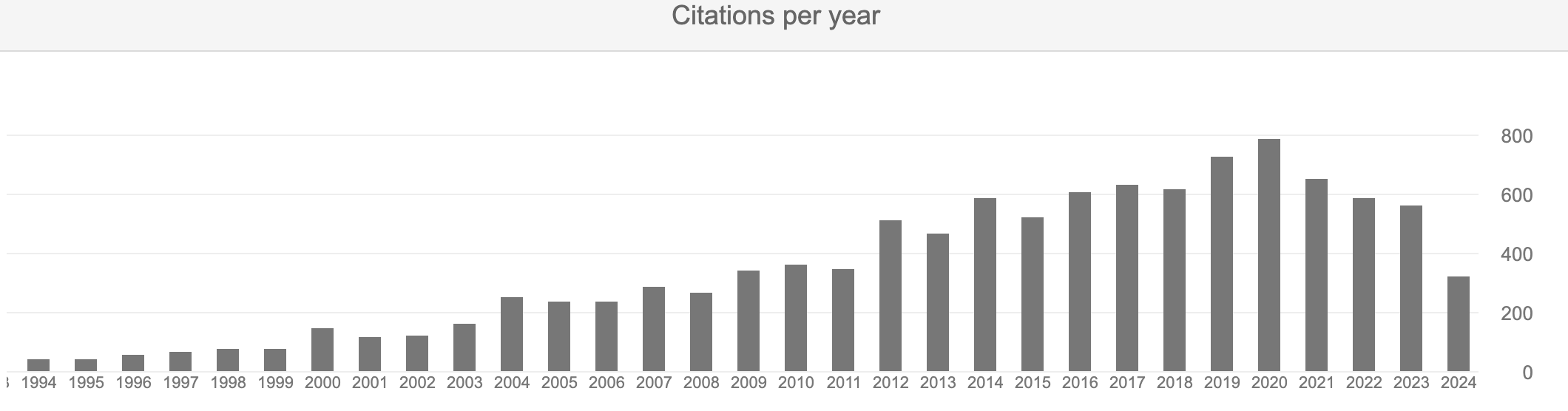
But a Google Scholar citation diagram, pehaps more accurate and finely tuned, indexes a more gloomy reality, in the statistics beloved of university bean counters (Figure 2): down, down, after 2020, as Covid takes hold, and people seem to cite him less, a pattern appreciable with some other Mayanists too. Is the bloom off studies of Maya glyphs and art, predictive of approaching oblivion, or is this some blip from a singular time? Notably, Tatiana Proskouriakoff, that decisive analyst of Maya history, has a lower Ngram level but one that stays remarkably level up to the present, a plateau merited by extraordinary breakthroughs. Yet individual scandals do, through Ngrams, reveal deliberate forgetting—oblivion—in citational terms. The slight surprise is that, aside from having splines with perceptible rise, individual contributions, this or that article or breakthrough, appear to be indiscernible in most trajectories. As Timothy Beach notes, a further complication is co-authorship, more prevalent in STEM-oriented Mayalogy.
Figure 2. The author in a Google Scholar citational index over time (accessed Aug. 11, 2024).
The end of this story, when scholars no longer “need to be known,” is itself unknowable. Academic careers and the advent of ready searchability indicate incremental declines in citational salience but not to any final disappearance. The human memory has now been decisively if artificially extended, and search engines do not forget. But there are patterns: ridge-like splines reflecting jobs at universities—ones that form graduate students to cite their professors’ work!—vertiginous ones like stratovolcanoes, varied slope angles (steep = rapid fame), and citational plateaus without foreseeable end. They all point, in their totality, to an undeniable truth. Academic figures are not abstractions, but people with distinctive if patterned arcs, as cited by a social nexus that chooses, amidst ever-growing information, to remember them…or to forget.
References
Barofsky, Robert. 2005. Yanomami: The Fierce Controversy and What We Can Learn from It. Berkeley: University of California Press.
Coe, Michael D. 2000. Linda Schele (1942–1998). American Anthropologist 102:133–35.
Fash, William, and Jeremy Sabloff. 2007. Gordon R. Willey and American Archaeology: Contemporary Perspectives. Norman: University of Oklahoma Press.
Grafton, Anthony. 1999. The Footnote: A Curious History. Cambridge, MA: Harvard University Press.
Greene, Virginia. 2024. Tikal Report No. 28: The Pottery Figurines of Tikal. Philadelphia: University of Pennsylvania Museum.
Houston, Stephen D., Mary Miller, and Karl Taube. 2021. Michael D. Coe (1929–2019): A Life in the Past. Ancient Mesoamerica 32(1):1–15.
Hutson, Scott R. 2002. Gendered Citation Practices in American Antiquity and Other Archaeology Journals. American Antiquity 67(2):331–342. doi:10.2307/2694570
Kennedy, Rebecca, and “Maximus Planudes.” 2020. An Ethics of Citation. Classics at the Intersection.
Leventhal, Richard M., and Alan L. Kolata (eds.). 1983. Civilization in the Ancient Americas: Essays in Honor of Gordon R. Willey. Albuquerque: Univeresity of New Mexico Press.
Meskell, Lynn. 2023. Pyramid Schemes: Resurrecting Tikal through the Military-Industrial-Academic Complex. Journal of Field Archaeology, 48(7):551–62. https://doi.org/10.1080/00934690.2023.2209398
Rosenzweig, Melissa S. 2020. Confronting the Present: Archaeology in 2019. American Anthropologist 122:284–305. https://doi.org/10.1111/aman.13411
Souleles, Daniel. 2020. What to Do with the Predator in your Bibliography? Allegra Lab.
Vogt, Evon Z., and Richard M. Leventhal (eds.). 1983. Prehistoric Settlement Patterns: Essays in Honor of Gordon R. Willey. Norman: University of Oklahoma Press.
Willey, Gordon R. 1972. The Artifacts of Altar de Sacrificios. Papers of the Peabody Museum of Archeology and Ethnology, 64(1). Cambridge, MA: Harvard University.
Yan, Veroica X., Katherine Muenks, and Marlone D. Henderson. 2024. I Forgot that You Existed: Role of Memory Accessibility in the Gender Citation Gap. American Psychologist. Advance online publication. https://doi.org/10.1037/amp0001299
Humans like their food warm. Heat reduces the number of pathogens, makes proteins easier to digest, and increases the amount of energy from meals (Carmody et al. 2011; Smith et al. 2015). Over millennia, this biological benefit became a pleasure, a trait of our species: “[w]e humans are the cooking apes, the creatures of flame” (Wrangham 2009:14). Perhaps, as pyrophiles, our ancestors even took detours, dumping meat for simmering in hot springs or eating flame-licked foods left by wildfires (Herzog et al. 2022; Sistiaga et al. 2020). Cool food has its place, but hot meals are better.
Still, pyrophilia has its limits. A fire keeps the body warm on chilly or frozen nights. In cooking, however, that same fire carries risks. It can spread out of control and, in more elaborate food preparation, requires kitchens that, in pre-Modern times (and even at present), reek of slops and swarm with flies (Woolgar 1999:140–41). For elites, these are problems. Costly buildings cannot be allowed to go up in flames, and cooking, no matter how refined, needs separation from the complicated, almost “balletic,” rank-accentuating displays of “grand eating” (Strong 2002:237; comparative evidence of royal courts in Adamson [ed.] 2000; Duindam et al. 2011). The churning machinery behind the scenes should stay there, away from dining as a social performance. Nor do elites welcome the rude talk and bustling noise of, in the European past, specialized, often male kitchens (Woolgar 1999:136). The idea of placing customers in the midst of food preparation may be popular today. Consider the “chef’s table” concept. But it would have horrified cuisiniers like Antonin Carême or Auguste Escoffier. In the France of Louis XIV, operational flaws—the parting of Oz’ curtain—had consequences, as when François Vatel, majordomo of Minister Fouquet and the Prince de Condé, ran himself through with a sword when seafood came late to a feast (Michel 1999). Keeping food labor away from diners accentuated their sense of refinement. It reinforced hierarchy and the illusion of seamless work. Yet the opposite was also true, for gaps and flaws in dining exposed deficits in the host.
Needs varied. At Versailles, during the reign of Louis XIV, closer, smaller kitchens did effective service when the king and queen dined en famille (Chateau de Versailles:2), a pattern seen also at the Château de Marly, Louis’ leisure retreat, where austere etiquette sometimes took a holiday (Bergeret 2014; Ringot and Sarmant 2012). In contrast, the more stultifying meals, the grand couvert, resulted from more distant, labor-intensive food preparation (Strong 2002:249–56). Many plates were necessary, many mouths had to be fed. Repasts required complicated place settings, service, habits of eating, and diktat about who sat (or stood) when and where. In general, both in France and elsewhere, royal food followed a long and complex trajectory from larder to mouth, to say nothing of the challenges of gathering foodstuffs at their source.
All of this meant that, as a cross-cultural matter, royalty could have, once the food made it to the table, a tepid and unappetizing meal. In Medieval France, after a suitable fanfare and washing of hands, “dinner was brought in” but “none too warm” (Wheaton 1983:6). At Eltham Palace, in greater London, English kings probably experienced the same, at least to judge from site plans. The royal kitchen lay across a moat from the dining hall, where meals must often have arrived lukewarm (Steane 1999:91, fig. 43). Serving order made this worse. If dishes were brought in all at once, in the service à la française named after customs at Versailles, food cooled and sauces congealed (Strong 2002:231; see also Fine 2020:7): all show, little pleasure. Fast eating would not solve the matter. Royal tables had too many dishes, too many strictures against gauche, lunging behavior, too many servers to do their work in proper order; plates might be whisked away before people had their fill. A later development, the service à la russe, with one course at a time, ensured warmer servings, but historical evidence from Medieval and Early Modern times suggests a mixture of both sorts of service (Woolgar 1999:161).
There were other remedies. In Medieval England, a “pentice,” a covered way, or a half-door, a “hatch,” allowed servants to rush-deliver a meal from kitchen to table (Steane 1999:91, fig. 43; Steane 2001:101–102; Woolgar 1999:145). Insulated boxes further helped to keep food warm (Taylor 2005:629, fig. 4), or there could be chafing dishes with a small flame underneath. These were about rewarming: a gentle heat only, and, in some cases, prongs to support the plate or bowl being heated, or an all-in-one combination of a bowl with flame and modicum of fuel (Vakasira 2020). In late 19th and early 20th century Europe and America, blurrings between kitchen and table service resulted in the so-called guéridon in which waiters prepared food on a trolley brought to the table (Naus 1991). Often gendered, these performances—a kitchen outside a kitchen!—became in other cases a focus of male camaraderie or domestic amusements of fleeting popularity. More extensive rewarming was done at the French Court, in the réchauffoir of the “hamlet” built for Marie-Antoinette at the Trianon villa (Heitzmann 2000: 71, 81–82). Thus, to maintain temperature, there could be expedited delivery, insulation or coverings (of middling effectiveness), and implements or places to rewarm food prepared elsewhere.
Worries about keeping food warm were not confined to Europe. Hernán Cortés’ “second letter” to Charles V, probably sent in 1520, describes an impressive protocol of dining for the Emperor Motecuhzoma Xocoyotzin, probably in his palace, the “Domus Don Muteczuma” (Boone 2011:34; see also Houston and Newman 2021).
“Three or four hundred boys came bringing the dishes, which were without number, for each time he lunched or dined, he was brought every kind of food: meat, fish, fruit and vegetables. And because the climate is cold, beneath each plate and bowl they brought a brazier with hot coals so that the food should not go cold. They placed all these dishes together in a great room where he ate, which was almost always full. …While he ate, there were five or six old men, who sat apart from him; and to them he gave a portion of all he was eating. One of the servants set down and removed the plates of food and called to others who were farther away for all that was required. Before and after the meal they gave him water for his hands and a towel which one used was never used again, and likewise with the plates and bowls, for when they brought more food they always used new ones, and the same with the braziers. He dressed each day in four different dressed again in the same ones” (Cortés [1524] 1996:111–12; emphasis mine; see also a similar description from Bernal Díaz, discussed in Coe 1994:74).
Here is evidence of service à la française, all the dishes coming at once, along with reports of food sharing, changes of clothing, and heating of food. The Florentine Codex, prepared in the period up to 1577, supplements and at times contradicts this description, albeit for non-imperial (if high status) banquets. A wealthy merchant would buy the spices, crockery, chocolate, baskets, cloth—for guests to wear or clean their hands?—garments, turkeys, and, according to the image in Book 9, folio 27v, instruct a woman as to their preparation (Figure 1). The virgules by the speaker’s mouth and his wagging finger suggest the heavy hand of gender roles: an instance of proto-mansplaining. There are hints, in Book 9, folio 28r, of sequencing too, a kind of service à la russe. The meal starts with tobacco, a key initiator of social interactions, then wafts of bouquets of flowers in specific order, a palette cleanser for the senses, followed by tamales. (Of late, gastronomy has once again found the importance of ambient smells, Spence 2022.) At the end comes chocolate, on folio 29r. This was to be given to high ranking people, along with a gourd with beating stick and a coil on which to rest it. The Nahuatl text makes it clear that all others received their chocolate in clay vessels, the perishable (a gourd) being accorded greater value than the permanent (a ceramic). Tamales seem only to occur in woven baskets, rather like the zhēnglóng (蒸笼; 蒸籠) bamboo steamers of China. Perhaps the similiarity came from the steamed nature of foods within, and the necessity of modulating or discharging moisture.
Figure 1. Stages or courses of a wealthy merchant’s feast (photographs from the Digital Florentine Codex, Getty Research Institute).
The overall setting for the Aztec feast appears to be outdoors, on flagstones; a schematic, masonry building occurs in the background without the circular cornice-insets of a lordly residence. Nonetheless, the host and guests sit on the high-backed tepotzoicpalli thrones of Indigenous lords. The reference to braziers, suitable for a cold clime, appears to be a chafing process, perhaps using the fuel mentioned on folio 27v in the Florentine Codex. The conquistador Bernal Díaz, an eyewitness, provided more detail about Motecuhzoma’s meals. When the weather was cold, servants warmed the emperor with braziers filled with non-smoking bark, along with a screen “worked in gold” to moderate the heat; his meals might conclude with another toke on a pipe filled with tobacco and sweetgum, followed by a nap (Coe 1994:74). In archaeological reports from Aztec sites, cooking braziers are not mentioned outside of vessels, usually globular jars in domestic contexts, or noted sparingly, but they may well have been transported closer to places of serving as a sort of mini-réchauffoir (Olson and Smith 2016:142, Table 2; Rodríguez-Alegría and Stoner 2016:199).
Book 8, folio 50v, of the Florentine Codex mentions foods of war, in essence, Aztec MREs, the provender of soldiers (Meals Ready to Eat). The directors of the markets were charged with gathering this food, “biscuits, dried maize and chía seeds, and dried maize dough, and dried, lime-treated maize dough.” The impression is that warriors traveled with cold foods, or preserved (but processed) foods that could be heated quickly near a campfire or nibbled en route to conflicts. Even in conditions of extended field operations or restricted intake, present-day estimates calculate a range of 1500 to 3600 kilocalories a day. A single tortilla averages about 240 kilocalories, a tamale just north of 200 (Weber et al. 1996). Presumably, these quantities—an absolute minimum of 6 to 7 tortillas and 8 to 9 tamales a day, and that in conditions of duress—were not transported by noble warriors but by tumplined servants and camp followers. Those people likely also carried the equipage of warriors, which could be burdensome, needing repair or patching and careful tending after each scuffle. But the point was that heating was desirable but not necessary.
Writing of the very early Colonial Maya of Yucatan, Diego de Landa also reports that banquets involved gifts of clothing and the washing of hands (Tozzer 1941:91–92). Both the Florentine Codex (Book 9 in particular) and Landa’s description of feasts append slightly surreal and, in the Aztec instance, hallucinatory rituals, dances, and music afterwards. To judge from the sequence in these descriptions in Landa and the Florentine Codex, these events may have followed banquets, a hypothetical “Stage 4” to the three other courses reflected in Figure 1: stretching on for hours and, for the Aztecs, with mushroom ingestion to release self-revelatory visions. A greater similiarity may lie in the apparent sequencing of consumption and the disposition of serving plates and vases within Classic Maya tombs: were they deposited in a way that, step-by-step, reflected notional food service at a banquet? A Maya service à la russe vs. service à la française? That is: not simply an aggregate of foods for the deceased but, in their placement and sequencing, a reflection of normative meal service. For their part, a banquet for the living might reflect, to reciprocal extent, the meals of the dead.
Such a functional segregation appears, for example, in the Early Classic royal tomb of Burial 9 at El Zotz, Guatemala (Houston et al. 2015:86–156, fig. 3.2). Drinking vessels, presumably for chocolate, were perishable, and found only with fragments of their painted stucco coverings; other sectors of the tomb floor had probable bowls for tamales and, under the royal bier, offerings of children, apparently understood as the sacrificial food of deities (Scherer and Houston 2018:128–29, figs. 5.16–5.19; see also the now-destroyed Structure 1, jamb, Tohcok, Campeche, with the Jaguar God of the Underworld poised over a small figure in an incense burner, beneath the so-called wi-TE’-*NAAH sign linked to Teotihuacan; that tie is reinforced, in further allusion to that city, by the 18 BAAH *CHAN deity in the text—note Xcalumkin Jamb 6 for a comparable association of Teotihuacan raiment and the name glyphs of this being).
The Maya Lowlands are, outside of tropical canopies, hot places for much of the year, although cloud cover and rain can chill the skin. In late December, sleeping in a hammock needs a light blanket to get through the night. These are not the Mexican highlands, however, although warm meals remain, as everywhere, desirable. To overwhelming extent, the solid foods consumed by the Classic Maya were, whatever the actual diet, exemplifed by tamales, waaj, often shown stuffed in the mouth, in counterpart to mouths with signs for “water,” ha’ (Figures 2; Houston et al. 2006:107–16; this fulcrum identification of tamales is in Taube 1989). The glyph itself, following a reading suggested by David Stuart, is WE’, “eat,” in the sense of softer mastication, not biting (k’ux), which is attested in hieroglyphs, in sacrificial contexts, or snacking on fruit (mak’), which is not (Zender 2000:1042–45; see also Tokovinine 2014:10, fig. 1; in some Mayan languages, words for “eat” are contingent on the food being consumed, Hinmán Smith 2004:44). The glyph in Figure 2 may read WE’-ne-la, perhaps, we’nVl, “eater/feaster” (‘eat [maize]’ + antipassivizer + nominalizer), namely, a participant in a banquet. (Incidentally, the transposition of the ne and la are most likely for aesthetic and practical reasons. A reduced ne, compacted to the side, could be confused with a ni syllable.)
Figure 2. Possible glyph for “eater/feaster.” Unprovenanced lintel from the kingdom of Yaxchilan, reign of Bird Jaguar IV, Feb. 1, 753; sculpted by Chakjalte’ (photograph by Stephen Houston).
The lintel from which the title comes is the only known image in the Classic period of what happens ritually at the shift from one year to the next. One celebrant is a sajal, a subordinate rank, the other a youth, ch’ok; both use the title in Figure 3. The scene is noisy, boisterous, full of off-kilter dance. Each figure holds two rattles, their bodies in mirrored symmetry. One represents a vulture, the other a macaw; the two birds appear as small heads above their faces. Indeed, the motion may simulate that of birds. For its part, the dyadic pattern (two men, two birds) hints obscurely at some tie to the old and new years and to the transition between them.
Figure 3. Apparent year bearer ceremony with vulture (uus, right) and macaw dancers (mo’, left), accompanied by rattles in each hand. Unprovenanced lintel from the kingdom of Yaxchilan, reign of Bird Jaguar IV, Feb. 1, 753; sculpted by Chakjalte’ (photograph by James Doyle).
Revenge is a dish best served cold. Not so tamales, which taste their best while warm or hot, their juices seeping in, the texture soft, added meats piping hot. An argument has been made that, at Classic Maya sites, presumed censer burners were in fact for cooking or rewarming (Figure 4; Ball and Taschek 2007:458–61; see also Chase and Chase 2004b:355, fig. 16.7c). They show eminent portability, unpackable into parts. All appear to be from the final years of the Classic period and some decades beyond. Similar composites or ceramics are attested at far earlier dates in highland Chiapas and Guatemala, where they had been interpreted as incense burners, even when imitated in the Maya Lowlands (e.g., Borhegyi 1959; Miller et al. 2005:166, fig. 3.13; Popenoe de Hatch 1997:164–65, fig. 160; Sharer 1978:fig. 34). Three-pronged thermal devices, the better to support the dish being heated, are also documented in the Early Classic period at Teotihuacan, Mexico, with evident acceptance of their role in cooking or warming (Solís 2009:384).
Figure 4. Braziers for possible cooking and warming of food: (upper left) Cayo Unslipped three-prong composite, based on partial examples from the Belize River valley, Belize (Ball and Taschek 2007:fig.1); (upper right) Cayo Unslipped brazier, Buenavista del Cayo palace (Ball and Taschek 2007:fig. 4); and (lower center) floor find, epicentral Caracol, Belize (Chase and Chase 2004:fig. 16.7w).
The striking feature is that Aguateca, the Late Classic “Pompeii” of the Maya, has, despite its in situ finds and large inventory of complete ceramics, no evidence for such warmers in a palatial setting (Inomata et al. 2010). Here, perhaps, is culinary history: near-coeval sites with different heating or warming practices, an inception of réchauffoirs in the Preclassic in Highland zones to the south of the Maya Lowlands, possibly the relative proximity of kitchens for initial preparation. At Aguateca, they may not have been far away, while, at Caracol, the excavators comment on the absence of cooking in its many palaces (Chase and Chase 2004a:3). That incense was never heated on these devices may be difficult to prove, however: massive three-pronged carvings at Late Preclassic Kaminaljuyu supported incense burners, not ceramics for food preparation (Parsons 1986:figs. 125–28). Their depiction of an early form of Chahk, the rain god, may indicate rites of rain-making, smoke being an obvious analogue (a stimulus?) to clouds. For ceramics, this is the eventual contribution of residue analysis, with the chance that, as among the Aztecs, fragrances could be regarded as a kind of food. Thermal devices, too, might have been put to multiple uses.
Another ceramic hedged in time is the basal-flanged bowl with lid, from the Early Classic period (Figure 5). These are clearly intended for tamales, and one example on exhibit at the Museum of Fine Arts, looted from the area of Naranjo, Guatemala, shows a Maize God head in its interior, a trope for the foods made from his body, and a glyphic reference to “eating [tamales],” uht-i we’-? (K5458). The exceptions are equally noteworthy. The lone plate (lak) that refers to “chocolate” is almost certainly, as suggested to me by Shanti Morell-Hart, a unique glyphic reference to a Maya mole or at least to chocolate-flavored tamales (now at the Peabody Museum, Harvard University, the ceramic derives from Structure F, Group 1, Holmul, Guatemala [11-6-20/C5666]; for varied drinks, see Beliaev et al. 2010). The dancing Maize God in the interior points to a delectable sauce for steamed breads or stews. The plate dates to the final decades of the Late Classic period and may betoken changing or introduced cuisines in a time of heightened foreign contact (Halperin 2023). No earlier reference to moles exists, although there would have been many available plates to do so. In much the same way, the restricted orifices of chocolate vases in the final years of the Classic period and into the Terminal and Postclassic periods raise the possibility that chocolate was frothed in a different way, perhaps, as in later times, with sticks (for such a drinking pot, see Martin 2020:fig. 73c). By common claim, the beating stick, the molinillo, is thought to be post-Conquest, and pouring was the proper—and well-documented—way to raise a froth (Coe and Coe 1996:87–88). Yet there is a pronounced similarity between restricted orifices on colonial chocolate pots and the small apertures and large bodies of chocolate vessels in Terminal Classic times (Coe and Coe 1996:images on pp. 131, 132, 160, 237). Evidence of stick-wear or the lack of it may prove decisive.
Figure 5. Early Classic basal-flanged bowl with lid, Vessel 19, Burial 9, El Diablo, El Zotz, Guatemala, ca. AD 400 (photograph by Jorge Pérez de Lara).
A notable contrast with later tamale and food-serving dishes is the presence of a lid. Not a single tamale plate from the Late Classic period retains a cover, if they ever had them. The thermal implications need some thought. The Early Classic lids plausibly helped to retain heat during long services, in an array of assembled dishes, or if kitchens lay at some remove from places of consumption. Several examples have open-bottomed ceramics that were inserted into spouted bowls (Houston et al. 2015:98, 118–19). These may have been employed for certain kinds of steamed cuisine, intensifying moisture, or perhaps as a way of retaining heat. (We do not know the role of the baskets stressed by the Aztec, for none of them survive other than as impressions in tomb muck or building fill.) By contrast, Late Classic depictions of tamales typically display them in uncovered bowls, ready for eating; perhaps they were covered with textiles, but there are no hints of this in surviving imagery. Are the bowls from the Early Classic an indication of service à la française, plates brought in unison, at hazard for cooling in a lengthy meal? (Whipping off a lid might have provided its own form of drama, a “reveal” to induce smiles and salivation.) Did the open plates of the Late Classic correspond, in service à la russe, to the timed delivery of individual dishes, or, as Andrew Scherer speculates to me, to a heightened emphasis on the display of food rather than its palatability? Alternatively, the discrepancy may simply have resulted from the shifting proximity of kitchens or the means to rewarm or reheat. Far-cooking, if delectability were the aim, needed measures that near-cooking did not.
The single image of service à la française comes from the final years of the Late Classic period, in a mythic scene where animals bring open tamale bowls and vases for chocolate to God D and a set of Twins; seemingly, two scribal monkeys tally the haul (Figure 6). The dishes and vases are held aloft in the t’abayi or k’ahlaj gesture of toasts and offerings (Houston 2018:62–67). Actual consumption in Classic imagery is almost never shown, and the food appears largely to flow to a royal presence: the regal body or its supernatural analogue is the consumer, with almost non-existent depictions of subsequent dispersal of gathered foods. A daring dwarf, probably thought to be amusing, quaffs a beverage on one pot, but the scene is highly unusual (Houston et al. 2006:127–28).
Figure 6. Offerings of tamale bowls and chocolate(?) drinks to late version of God D, ca. AD 800 (photograph by Justin Kerr, K3413).
There is another seldom-noted property of tamale plates from the Late Classic period. To my knowledge, not a single example shows a historical or dynastic scene, which is the heavy (but non-exclusive) content of imagery on the vases (for images on plates, see this, this, and that). If present, historical figures are in the distant, Teotihuacano-past, places might be referred to, drenched with maize-related glyphs, or a Hero Twin has his arm ripped off (Chinchilla Mazariegos 2017:figs. 64–65). All interior designs display the Maize God in various guises, or scenes from the Classic Maya mythos and calendrical notations (k’atun [winik-ha’b] endings) of impersonal if broad import. Another anomaly marks the earlier, lidded bowls: frequently appearing with modeled animal or human heads, almost none of them, other than peccary, relate to what might be in those bowls as food. The majority are heads of humans or scribal howler monkeys (mythic, not creatures of the canopy), or they show macaw or other birds (e.g., Houston et al. 2015:88–144). In general, these are, in an anthropological sense, “not-foods,” i.e., unfit for humans yet emplaced on receptacles for human fare. The sacralization and aberrancies seem pervasive in the foodware of the Classic Maya. Daily consumption acquired the tincture of the supernatural, of personages not in the present, of creatures abhorrent to human diets.
A final comment on heat. Four Late Classic ceramics in a “codex-style” (black line on beige background, red highlights on rims) spell out an enigmatic sequence of glyphs (Figure 7). One plate refers to itself, u-lak, but then follows with a metaphor: yotoot u-k’inil, “it is the dwelling/home of his warmth.” In Ch’orti’, the language closest to that of the glyphs, k’ihnir [k’inil in ancestral form] refers to “steam, vapor, heat, warmth” (Hull 2016:234). There could be some unexplained metaphor at play, but this may be an overt cue to warm foods in such plates. That one such text is on a vase—the example at the Fralin Museum in Charlottesville—keys in to the warm drinks, served at dawn, that were known among the Maya (Tozzer 1941:91).
Figure 7. Dwellings of “heat” or “warmth”(?), from top to bottom (Houston 1998:fig. 13, Dumbarton Oaks Hellmuth Archive, dr. 13-LC-p2-162; Dumbarton Oaks Hellmuth Archive, PC.M.LC.p2.213.4; Los Angeles County Museum of Art, M.2010.115.5, K7185, photograph by Justin Kerr; Fralin Museum of Art, University of Virginia, 1982.12.33, photograph by Yuriy Polyukhovych [Looper and Polyukhovych 2015:17]).
Maya foods have their journeys, their synergies and wrestling bouts with humans, a give-and-take by means of many hands, especially in elite kitchens (Morell-Hart 2020). A grain, a maize kernel, might pass from field to processing, to heated tamale, then on in formal service to tables with fancy pots…eventually, after digestion and defecation, collection and mulching, to the nightsoil that fertilized seeds (Keenan et al. 2021). But there was also change and the culinary equipment to take new directions: bowls that retained heat, or even caused foods to steam in their own juices, or warming stations brought right to the royal table. At the level of elite rhetoric there seemed to be, in final reflection, a curious blending of exaltation and anomaly. Repasts that highlighted gods, mythic beasts, and dead lords built on everyday needs, and the figured bodies of the inedible stepped up to house delicious things.
Acknowledgments Arlen Chase was helpful with bibliographic references, and useful comments came from Harper Dine, Shanti Morell-Hart, Esteban Herrera-Parra, and Andrew Scherer. David Stuart gave good feedback on the Yaxchilan-area lintel; James Doyle supplied a crucial image. Dmitri Beliaev tells me that, in this powerpoint, worth a close look, he and colleagues came independently to the same conclusion about the k’inil reading. The present essay arose while viewing pieces assembled by David Saunders and Megan O’Neil for “Picture Worlds: Greek, Maya, and Moche Pottery,” their exhibit, now closed, at The Getty Villa (Saunders and O’Neill 2024); my thanks to David for the invite.
References
Adamson, John [ed.]. The Princely Courts of Europe 1500-1750: Ritual, Politics, and Culture under the Ancient Regime 1500-1750. London: Seven Dials.
Ball, Joseph W., and Jennifer T. Taschek. 2007. Sometimes a “Stove” Is “Just a Stove”: A Context-Based Reconsideration of Three-Prong “Incense Burners” from the Western Belize Valley. Latin American Antiquity 18(4):451–70.
Beliaev, Dmitri, Albert Davletshin, and Alexandre Tokovinine. 2010. Sweet Cacao and Sour Atole: Mixed Drinks on Classic Maya Ceramic Vases. In Pre-Columbian Foodways: Interdisciplinary Approaches to Food, Culture, and Markets in Ancient Mesoamerica, edited by John E. Staller and Michael Carrasco:257–72. New York: Springer.
Boone, Elizabeth H. 2011. This New World Now Revealed: Hernán Cortés and the Presentation of Mexico to Europe. Word & Image: A Journal of Verbal/Visual Enquiry 27(1):31–46.
Borhegyi, Stephan F. 1959. The Composite or “Assemble-it-Yourself” Censer: A New Lowland Maya Variety of the Three-Pronged Incense Burner. American Antiquity 25(1):51–58.
Carmody, Rachel N., Gil S. Weintraub, and Richard E. Wrangham. 2011. Energetic Consequences of Thermal and Nonthermal Food Processing. Proceedings of the National Academy of Sciences 108(48):19199–203.
Chase, Arlen F., and Diane Z. Chase. 2004a.Searching for Support Staff and Kitchens: Continued Investigation of Small Structures in Caracol’s Epicenter: 2004 Field Report of the Caracol Archaeological Project. Report submitted to the Belize Institute of Archaeology.
______, and ______. 2004b. Terminal Classic Status-Linked Ceramics and the “Maya-Collapse”: Defacto Refuse at Caracol, Belize. In The Terminal Classic in the Maya Lowlands: Collapse, Transition, and Transformation, edited by Arthur Demarest, Prudence Rice, and Don Rice:342–66. Boulder: University Press of Colorado.
Chinchilla Mazariegos, Oswaldo. 2017. Art and Myth of the Ancient Maya. New Haven: Yale University Press.
Coe, Sophie D. 1994. America’s First Cuisines. Austin: University of Texas Press.
______, and Michael D. Coe. 1996. The True History of Chocolate. London: Thames & Hudson.
Cortés, Hernán. [1524] 1996. Hernán Cortés: Letters from México. Translated and edited by Anthony Pagden. New Haven: Yale University Press.
Duindam, Jeroen, Tülay Artan, and Metin Kunt [eds.]. 2011. Royal Courts in Dynastic States and Empires: A Global Perspective. Leiden: Brill.
Hinmán Smith, Joshua M. 2004. Manual of Spoken Tzeltal. Unpublished manuscript, translated by Stuart P. Robertson.
Houston, Stephen. 1998. Classic Maya Depictions of the Built Environment. In Form and Function in Classic Maya Architecture, edited by Stephen Houston:333–72. Washington, D.C.: Dumbarton Oaks Research Library and Collection.
______. 2018. The Gifted Passage: Young Men in Classic Maya Art and Text. New Haven: Yale University Press.
______, David Stuart, and Karl Taube. 2006. The Memory of Bones: Body, Being, and Experience among the Classic Maya. Austin: University of Texas Press.
Hull, Kerry. 2016. A Dictionary of Ch’orti’ Mayan-Spanish-English. Salt Lake City: University of Utah Press.
Inomata, Takeshi, Daniela Triadan, and Estela Pinto. 2010. Complete, Reconstructible, and Partial Vessels. In Burned Palaces and Elite Residences of Aguateca: Excavations and Ceramics, edited by Takeshi Inomata and Daniela Triadan:180–361. Monographs of the Aguateca Archaeological Project First Phase Volume 1. Salt Lake City: University of Utah Press.
Martin, Simon. 2020. Ancient Maya Politics: A Political Anthropology of the Classic Period 150–900 CE. Cambridge: Cambridge University Press.
Michel, Dominique. 1999. Vatel et la naissance de la gastronomie. Paris: Fayard.
Miller, Donald E., Douglas D. Bryant, John E. Clark, and Gareth W. Lowe. 2005. Middle Preclassic Ceramics. In Ceramic Sequence of the Upper Grijalva Region, Chiapas, Mexico: Part 1, edited by Douglas D. Bryant, John E. Clark, and David Cheetham:141–264. Papers of the New World Archaeological Foundation 67. Provo: New World Archaeological Foundation, Brigham Young University.
Morell-Hart, Shanti. 2020. Plant Foodstuffs of the Ancient Maya: Agents and Matter, Medium and Message. In Her Cup for Sweet Cacao: Food in Ancient Maya Society, edited by Traci Ardren:124–60. Austin: University of Texas Press.
Olson, Jan. M., and Michael E. Smith. 2016. Material Expressions of Wealth and Social Class at Aztec-Period Sites in Morelos, Mexico. Ancient Mesoamerica 27(1):133–47.
Parsons, Lee A. 1986. The Origins of Maya Art: Monumental Stone Sculpture of Kaminaljuyu, Guatemala, and the Southern Pacific Coast. Studies in Pre-Columbian Art and Archaeology 28. Washington, D.C.: Dumbarton Oaks Research Library and Collection.
Popenoe de Hatch, Marion. 1997. Kaminaljuyú/San Jorge: Evidencia Arqueológica de la Actividad Económica en el Valle de Guatemala 300 a.C a 300 d.C. Guatemala City: Universidad de Guatemala.
Ringot, Benjamin, and Thierry Sarmant. 2012. “Sire, Marly?”: usages et étiquette de Marly et de Versailles sous le règne de Louis XIV. Bulletin du Centre de recherche du château de Versailles 5.
Rodríguez-Alegría, Ricardo, and Wesley D. Stoner. 2016. The Trade in Cooking Pots under the Aztec and Spanish Empires. Ancient Mesoamerica 27:197–207.
Scherer, Andrew K., and Stephen Houston. 2018. Blood, Fire, Death: Covenants and Crises among the Classic Maya. In Smoke, Flames, and the Human Body in Mesoamerican Ritual Practice, edited by Vera Tiesler and Andrew K. Scherer:109–50. Washington, D.C.: Dumbarton Oaks Library and Research Collection.
Sharer, Robert J. 1978. The Prehistory of Chalchuapa, El Salvador: Volume Three, Pottery and Conclusions. Philadelphia: University of Pennsylvania Press.
Smith, Alex R. Smith, Rachel N. Carmody, Rachel J. Dutton, and Richard W. Wrangham. 2015. The Significance of Cooking for Early Hominin Scavenging. Journal of Human Evolution 84:62–70.
Solís, Felipe (ed.). 2009. Teotihuacan, Cité des Dieux. Paris: Musée de quai Branly/Somogy, Éditions d’Art.
Steane, John M. 1999. The Archaeology of the Medieval English Monarchy. London: Routledge.
____. 2001. The Archaeology of Power: England and Northern Europe AD 800–1600. Stroud: Tempus.
Strong, Roy. 2002. Feast: A History of Grand Eating. London: Jonathan Cape.
Taube, Karl A. The Maize Tamale in Classic Maya Diet, Epigraphy, and Art. American Antiquity 54(1):31–51.
Taylor, Valerie. 2005. Banquet Plate and Renaissance Culture: A Day in the Life. Renaissance Studies 19(5):621–33.
Tokovinine, Alexandre. 2014. Beans and Hieroglyphs: A possible IB Logogram in the Classic Maya Script. The PARI Journal 14(4):10–16.
Tozzer, Alfred M. 1941. Landa’s Relación de las cosas de Yucatán: A Translation. Papers of the Peabody Museum of American Archaeology and Ethnology XVIII. Cambridge, MA: Harvard University.
Weber, Charles W. Edwin A. Kohlhepp, Ahmed Idouraine, and Luisa J. Ochoa. 1993.
Nutritional Composition of Tamales and Corn and Wheat Tortillas. Journal of Food Composition and Analysis 6(4):324–35.
Wheaton, Barbara K. 1983. Savoring the Past The French Kitchen and Table from 1300 to 1789. Philadelphia: University of Pennsylvania Press.
Woolgar, C.M. 1999. The Great Household in Late Medieval England. New Haven: Yale University Press.
Wrangham, Richard. 2009. Catching Fire: How Cooking Made Us Human. New York: Basic Books.
Zender, Marc. 2000. A Study of Two Uaxactun-Style Tamale-Serving Vessels. In The Maya Vase Book: A Corpus of Rollout Photographs of Maya Vases, Volume 6, edited by Justin Kerr:1038–55. New York: Kerr Associates.




You must be logged in to post a comment.