by Stephen Houston (Brown University)
“[E]very age is an age of ignorance because the rise of some knowledges is often accompanied by the loss of others” (Burke 2024a:35)
“Ignorance” is an emotive term. It can be a valid description of gaps in knowledge or an accusation against others, those presumed to be, whether justifiably or not, less learned or schooled in the literature of this or that discipline. But who can deny that scholars come and go with the remorseless scything of time? A vade mecum, a body of work, will molder with eventual disuse and disattention; even in life, inevitably, people notice certain writings and then, as the authors depart or diminish in status or relevance, tend to cite them less and less.
Citations have their own history, of course, depending on discipline and person (Grafton 1997). To “footnote”—to cite—offers its own kind of positioning. People being people, there is always a social nexus involved, contingent on those doing the citing and those being cited. This is compounded by what has been called an “ignorance explosion,” i.e., rapid expansions of knowledge without comparable digestion of new ideas and evidence (Lukasiewicz 1974). Such an “explosion,” a surfeit of data, gives ample scope “for each one of us not to know” (Burke 2024a:36; see also Burke 2024b).
Some contributors, for reasons of deep injustice, never get their due, or not enough of it (Burke 2024a:32–33; Hutson 2002; Yan et al. 2024). Others are sent to oblivion, for solid reasons, yet their cases raise inevitable quandaries about referencing sound work by dubious people (Barofsky 2005; Rosenzweig 2020; Souleles 2020). The question becomes, how to acknowledge research, including those from one’s own oeuvre, in ways that are at once ethical and thoughtful (Kennedy and Planudes 2020)? How does one ponder, in the words of Donald Rumsfeld, “known unknowns” yet leave open a window to “unknown unknowns” (Burke 2024a:7–8)? Here may be a divide between overlooked yet detectible facts—some found, alas, by disreputable people—and things truly beyond our ken, the facta that are imperceptible and unconsciously ignored. At stake is the tough question of what creates the conditions for oblivion and obliviousness, the citational decisions that foment the unconscious and conscious forgetting of people and their work.
This is not a purely abstract issue. A recent fusillade against the largest US dig, at Tikal in the late 1950s and early 1960s, accuses it of subservience to “American big business,” in research informed, we are told, by “ineluctable dependencies between security, espionage, international politics, corporations, conservation, and donor economies” (Meskell 2023). A tarnish presumably descends on its many results, still being published 50+ years after fieldwork (e.g., Greene 2024). Are its conclusions or data disallowable once (if) we accept this reductive view? On this point, perhaps, the polemicist Richard Hofstadter would have an opinion.
Most Mayanists are not listening. To judge from widespread citation, they find abiding value in the results of the Tikal project (e.g., Martin 2015, with countless other examples), and are likely to understand that it did not take place in this decade, but a lifetime ago, in another world of funding, staff, labor relations, local and international politics, shifting academic landscapes, logistics, aims, and ideas. Anachronism does not absolve such work of its flaws. In a photographic database, women appear as human scales and helpmeets in the laboratory, allowed to study small things, evidently, and assigned to the quasi-“domestic” sphere of curating objects. Yet, by the standards of the time, there was at least a chance of good intentions and cogent results. Samuel Johnson said it well: “[t]here is nothing so minute or inconsiderable that I would not rather know it than not know it” (Boswell 1830:272).

Still, the biographical arc of citation is merciless. It rises, falls, flits out of view as scholars become notable and then…not. People die, their social networks fray and memory of them fades. This can be monitored, very roughly, with many provisos and constraints, in the Google Ngram viewer. When a few names are inputted, they appear to have different “topographies” of citation in book-based Ngrams. The names here are Gordon Willey, Michael Coe, Linda Schele, and, in self-study, as the instigator of this mischief, the essayist himself.
For much of the mid-century, going into its final quarter, there could be few more prominent scholars than Gordon Willey, the doyen of Maya archaeology and beyond. Courtly, generous, fortunate (and deserving enough) to fill a fulcrum job, Willey received a two-volume festscrift and subsequent, sympathetic evaluations by former students and close colleagues some five years after his death (Fash and Sabloff 2007; Leventhal and Kolata 1983; Vogt and Leventhal 1983). Then there are the Mayanists Michael Coe and Linda Schele, both of inestimable impact on the field (Coe 1998; Houston et al. 2021), with, as a squib at the end, the “boomer” of the bunch, Houston. The result is a set of spline charts over time (Figure 1. X-axis, years; Y-axis, highest point, for Schele in 1999, 0.0000023825%).

Graphically, the splines reveal a complexity that is likely to mirror four academic passages to relative oblivion, if not yet there by any means. Gordon Willey’s spline, fashioned from a long life and career, involves a rapid rise, then a relatively constant level, a massif, that corresponds to his time as a professor of Harvard and distinction as an archaeologist (he was hired in 1950 and remained as a senior professor until 1987); what follows is a slow decline, peaking slightly at his death in 2002, heading inexorably down that same slope. Citations of him may, in the future, lean towards histories of archaeology and specific references to Willey’s descriptive monographs on artifacts from various excavations: direct data do not go out of fashion (Willey 1972).
In contrast, Michael Coe’s spline peaks at a lower level, has a bulge towards the end of his time as faculty at Yale (he retired in 1994), but then picks up appreciably, with only slight reduction up until 2022, the latest year in the data. The downward slope has been arrested. Linda Schele’s is the Mount Everest of the group, no ridgeline or plateau here, but it also falls precipitously at her untimely death: does this signal the influence of charisma or an energetic, personal (and personable) presence in media, or her innovative means of scholarly dissemination? Houston’s rises from his first year at graduate school (1980), plateaus at his arrival at Brown (the job-linked leveling noted for others), then picks up with an award and a period of higher productivity.
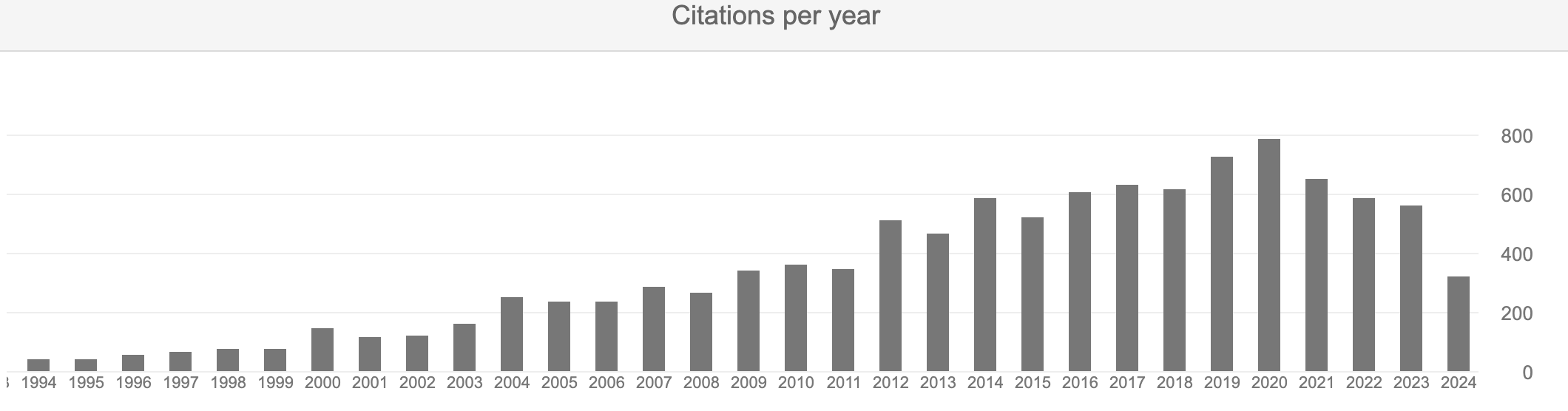
But a Google Scholar citation diagram, pehaps more accurate and finely tuned, indexes a more gloomy reality, in the statistics beloved of university bean counters (Figure 2): down, down, after 2020, as Covid takes hold, and people seem to cite him less, a pattern appreciable with some other Mayanists too. Is the bloom off studies of Maya glyphs and art, predictive of approaching oblivion, or is this some blip from a singular time? Notably, Tatiana Proskouriakoff, that decisive analyst of Maya history, has a lower Ngram level but one that stays remarkably level up to the present, a plateau merited by extraordinary breakthroughs. Yet individual scandals do, through Ngrams, reveal deliberate forgetting—oblivion—in citational terms. The slight surprise is that, aside from having splines with perceptible rise, individual contributions, this or that article or breakthrough, appear to be indiscernible in most trajectories. As Timothy Beach notes, a further complication is co-authorship, more prevalent in STEM-oriented Mayalogy.
The end of this story, when scholars no longer “need to be known,” is itself unknowable. Academic careers and the advent of ready searchability indicate incremental declines in citational salience but not to any final disappearance. The human memory has now been decisively if artificially extended, and search engines do not forget. But there are patterns: ridge-like splines reflecting jobs at universities—ones that form graduate students to cite their professors’ work!—vertiginous ones like stratovolcanoes, varied slope angles (steep = rapid fame), and citational plateaus without foreseeable end. They all point, in their totality, to an undeniable truth. Academic figures are not abstractions, but people with distinctive if patterned arcs, as cited by a social nexus that chooses, amidst ever-growing information, to remember them…or to forget.
References
Barofsky, Robert. 2005. Yanomami: The Fierce Controversy and What We Can Learn from It. Berkeley: University of California Press.
Boswell, James. 1830. The Life of Samuel Johnson, LL. D. London: J. Sharpe.
Burke, Peter. 2024a. Ignorance: A Global History. New Haven: Yale University Press.
______. 2024b. Writing a History of Ignorance. Yale University Press Blog.
Coe, Michael D. 2000. Linda Schele (1942–1998). American Anthropologist 102:133–35.
Fash, William, and Jeremy Sabloff. 2007. Gordon R. Willey and American Archaeology: Contemporary Perspectives. Norman: University of Oklahoma Press.
Grafton, Anthony. 1999. The Footnote: A Curious History. Cambridge, MA: Harvard University Press.
Greene, Virginia. 2024. Tikal Report No. 28: The Pottery Figurines of Tikal. Philadelphia: University of Pennsylvania Museum.
Houston, Stephen D., Mary Miller, and Karl Taube. 2021. Michael D. Coe (1929–2019): A Life in the Past. Ancient Mesoamerica 32(1):1–15.
Hutson, Scott R. 2002. Gendered Citation Practices in American Antiquity and Other Archaeology Journals. American Antiquity 67(2):331–342. doi:10.2307/2694570
Kennedy, Rebecca, and “Maximus Planudes.” 2020. An Ethics of Citation. Classics at the Intersection.
Leventhal, Richard M., and Alan L. Kolata (eds.). 1983. Civilization in the Ancient Americas: Essays in Honor of Gordon R. Willey. Albuquerque: Univeresity of New Mexico Press.
Lukasiewicz, Julius. 1974. The Ignorance Explosion. Leonardo 7:159–63.
Martin, Simon. 2015. The Dedication of Temple VI: A Revised Chronology. The PARI Journal 15(3):1–10.
Meskell, Lynn. 2023. Pyramid Schemes: Resurrecting Tikal through the Military-Industrial-Academic Complex. Journal of Field Archaeology, 48(7):551–62. https://doi.org/10.1080/00934690.2023.2209398
Rosenzweig, Melissa S. 2020. Confronting the Present: Archaeology in 2019. American Anthropologist 122:284–305. https://doi.org/10.1111/aman.13411
Souleles, Daniel. 2020. What to Do with the Predator in your Bibliography? Allegra Lab.
Vogt, Evon Z., and Richard M. Leventhal (eds.). 1983.
Willey, Gordon R. 1972. The Artifacts of Altar de Sacrificios. Papers of the Peabody Museum of Archeology and Ethnology, 64(1). Cambridge, MA: Harvard University.
Yan, Veroica X., Katherine Muenks, and Marlone D. Henderson. 2024. I Forgot that You Existed: Role of Memory Accessibility in the Gender Citation Gap. American Psychologist. Advance online publication. https://doi.org/10.1037/amp0001299
You must be logged in to post a comment.