by David Stuart
 In a few previous posts I examined the graphical history of certain Maya day signs, and what they reveal about their deeper histories and meanings. So far these have included preliminary examinations of the signs for Men, Caban and Imix, with many others still in development. All these case studies rest on the assumption that tracking the visual development of a given day sign over the long term has the potential to reveal much about the day’s deeper historical significance. I would hazard to suggest that the visual approach is more useful than a linguistic one, based on the names of the days we know from the colonial period and more recent sources (Kaufman 2020). One reason is that the extant visual forms of the day signs are far older, with some examples even dating to the Late Preclassic period. Seeing such changes over time, it becomes clear that many, if not all originated as portraits of specific deities, often visually complex. For example, the sign for the day Men was once the image of Principal Bird Deity, yet this visual origin was largely lost by the Postclassic, when simplified versions of the sign were developed. The standard Imix is a waterlily, a visual reduction of a portrait of the Water Serpent deity. Manik may have started out as a deer’s antler – a reduced form of a mythic deer – which soon took on the form of a contorted human hand. In similar ways, the conventional day glyphs turn out to be highly simplified and abstracted abbreviations for specific iconographic beings, often based on a small diagnostic feature of the god that became highly abstracted. These visual transformations occurred over a great span of time, from the Middle Preclassic to the final uses of the day signs in the sixteenth century.

Here I focus on the ninth day of the Maya system named Muluc in Postclassic Yucatan, and Toj in highland Guatemala. Its ancient sign is consistent in appearance throughout the Classic period (Figure 1). Early examples show that this represents a narrow-necked jar, as first recognized by John Justeson (see Fox and Justeson [1984:74]), and by Schele and Miller (1984:27,40). In most (not all) examples, the jar is inverted, with the mouth facing downward (Figure 1a-c). We ausually find a diagonal or curved line running from top to bottom across the jar, as well as a small darkened circular element to the left. By 700 CE, the contours of the jar are mostly lost, with only a small line or indentation to indicate the jar’s narrow neck. This small feature quickly went away, however, leaving the inner curved line and darkened circle as the standard presentation of Muluc during the Late Classic. Sometimes the inner line also disappeared, leaving just the circle at the very center of the sign. This very simplified form was used throughout the codices and up to the time of Landa’s list of days. By this time any idea of Muluc’s true visual origin as a representation of a jar or vessel was lost. [Note 1].

Muluc also has an animal head variant, first identified, I believe, by David Kelley (1976:123) (Figure 2). This is the BAAH logogoram in other contexts. Earlier studies wrestled with the animal’s identification, and Thompson (1962:354) dubbed it a “jog,” unable to choose between its identification as a jaguar or a dog (although he inclined toward the latter). Schele and Miller (1983:27) later proposed that it was a rabbit. In an insightful study published fifteen years earlier, Proskouriakoff (1968) had surmised that the animal sign could represent “one of the larger gophers.” The gopher identification was later confirmed by studies in the 1980s establishing its true reading as the logogram BAAH, used to represent the word baah “gopher,” and “self, body, person” (Bricker 1986:136, 213, Houston and Stuart 1998, Mora-Marín 2020, Schele 1990, Stuart 1996). The reading for the gopher element was established by the common substitution of the animal by the syllables ba-hi (or at times simply ba). Recently, Mora-Marín (2020) discussed the gopher logogram BAAH in detail, linking it to a sign in the Isthmian script. For our purposes, we can surmise that the animate form of Muluc represents a gopher, before we delve into the question of how this relates to the image of the water vessel [Note 2].

The use of a jar (inverted or upright) as the glyph for the ninth day has clear parallels in other Mesoamerican scripts, where the corresponding glyph represents a container or basin full of water (Figure 3). The resemblance is especially clear in Zapotec writing (Figure 3a, b). The day’s names outside of the Maya region consistently mean “Water” (Caso 1967, Kaufman 2020), as in Zapotec Tuta or Nahuatl Atl. The jar’s liquid contents are always emphasized or represented in Zapotec, Ñuiñe, and later Nahua writing. In this way, outside the Maya region, we see a visual throughline where the glyphic forms are consistent and match the widespread meaning of the day [Note 3].
Oddly, the names Muluc or Toj have no direct connection to water, nor to gophers. As Kaufman (2020) notes, Huastec (Mayan) mul is “water jar.” Mulul in Kiche’ is “jar, clay pot” (Edmonson 1965). The corresponding highland name Toj has been interpreted as “shower, thunder, storm” (Fox and Justeson 1984), with an indirect water connection. Kaufman (2020) posited Proto-Mayan *toj, “payment,” as its meaning, linking it to the highland storm deity Tojil. It is revealing that in K’iche’ the verb tojij is “to pour out (grain or liquid)” (Christenson 1990), perhaps relating to the image of the inverted jar we see in the Classic hieroglyph. What is translated loosely as “storm” might be better understood as “pouring (rain).”
Historically attested day names are late, so they may not always be helpful in revealing a given day’s deeper history and meaning. Muluc, like the other Maya days, had its own elaborate iconography. Its visual history also changed over time, obscuring its underlying origin and significance. We will use this “visual etymology” approach to access its nature as the image of a Maya deity, and to see how “Water” later emerged as the day name outside the Maya region.
The Gopher Wahy
The gopher Muluc can be traced through numerous Early Classic and Late Classic examples, at many sites. Why would this be the head variant of the day, alternating with the jar? It is a functional overlap that is unique to the day sign and does not apply to the identical gopher that is the BAAH logogram. As we have seen with other day sign histories, the animated forms are usually representations of deities, and here we should ask ourselves how a gopher might exist alongside those other days, as a deity. The explanation is once again based on some iconographic particulars. Here we turn to the wahyob, the demonic beings who mostly appear on vase paintings (Grune and Nahm 1994; Houston and Stuart 1989; Stuart 2020; Velásquez García 2020).

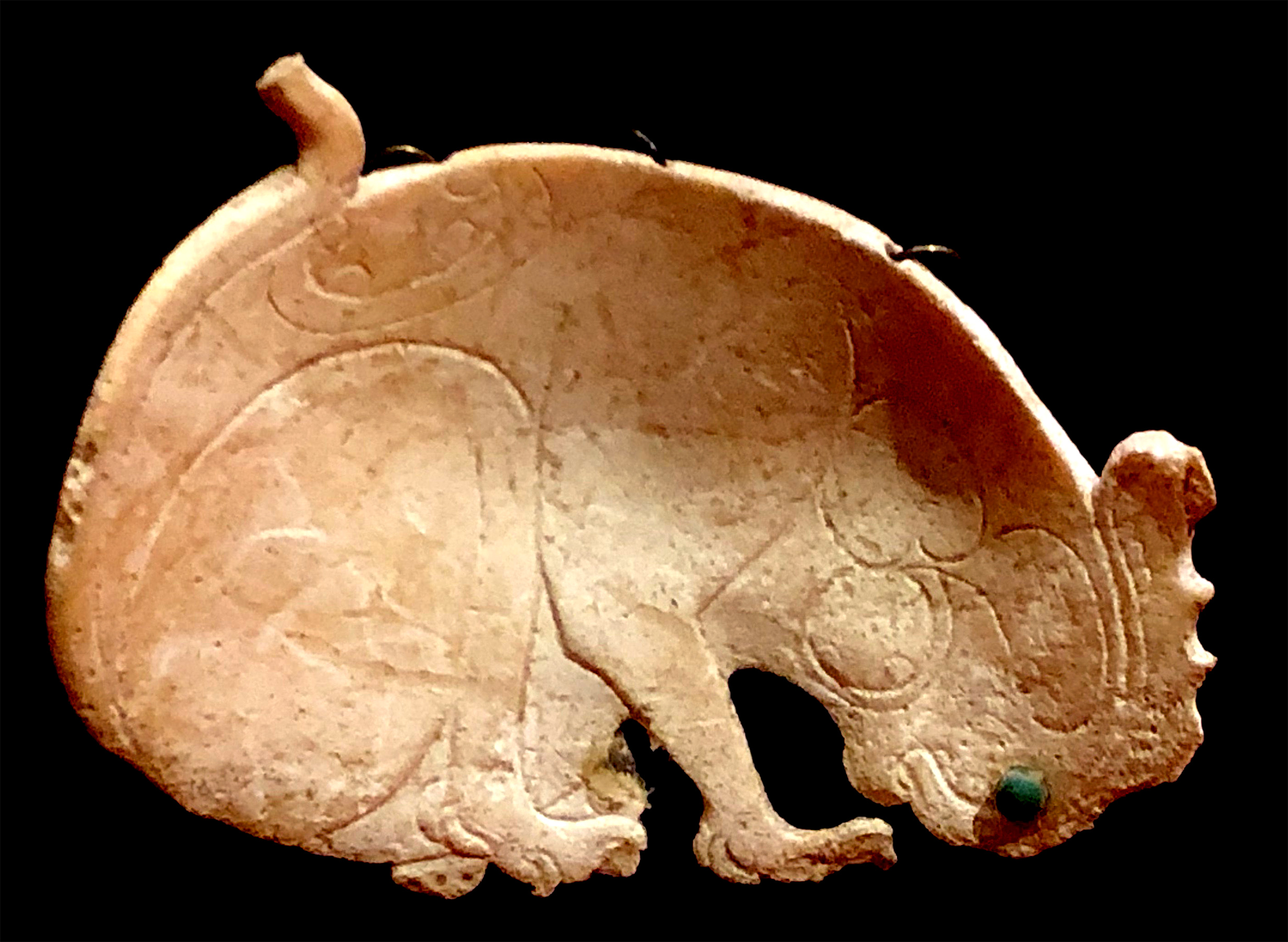
Grube and Nahm (1994:699-700) pointed out a prominent wahy they named K’an Baah Ch’o, the “Yellow-Gopher Mouse” (Figure 4). It is possible his name was more correctly K’an Baah Ch’ohok, given proto-Ch’olan *ch’ohok for “rat, mouse” [Note 4]. Like other wahyob, he is shown as a hybrid supernatural character, with close connections to witchcraft, sorcery and disease (Helmke 2009; Stuart 2020; Velásquez Garcia 2020). This “were-gopher” is shown standing in human-like fashion and holding a narrow-necked jar nearly always marked with an ak’bal (AK’AB) sign. Sometimes the jar is worn suspended from the animal’s collar. In one example the wahy is named in a reduced manner as simply K’an Baah, “Yellow Gopher” (Figure 4b). This truncated name corresponds to the gopher sign we see in late examples of Muluc and in the the BAAH logogram, with its k’an marking on the cheek [Note 5]. A carved shell pendant in a private collection depicts a corpulent pocket gopher with the same k’an element on its body (Figure 5). Despite the name, these “yellow” marks never appear in artistic representations of the wahy being.

K’an Baah Ch’o or K’an Baah Ch’ohok can also assume a human form, as a sacrificer prominently displaying a knife or axe along with the same “ak’bal jar” (Grube and Nahm 1994:699) (Figure 6). He has a prominent hank of dark hair above his face, marked with a white “x” (crossed long bones?) or eyes, and his clothing includes bloody strips of cloth or paper. Two captions for this character name him as K’an Baah Ch’ohok (Figure 6a and c). In the latter image, he decapitates another wahy being named Ch’ak Baah Akan (“Self-chopping Akan,” or “Head-chopping Akan”) (his hieroglyphic name is shown behind the leg) (Figure 6c). This particular victim appears in many other representations on vases (Grube 2004, Grube and Nahm 1994:708), and he seems in turn related to skeletal wahy beings who display decapitated heads [Note 6]. Perhaps it is for this reason that K’an Baah Ch’ohok appears on the Tonina stucco frieze adjacent to the skeletal figure holding a severed head, named there as Ahk Ook Chamiy (or Kamay), “Turtle-Foot-Death (or Illness).” The overlaps and connections among these characters are again indicated by a remarkable juxtaposition of portraits on vase K8936, where Ch’ak Baah Akan, axe and head in hand, kneels atop a round animal that seems hybrid in appearance, with the head of our baah gopher (note the diagnostic k’an marking on its cheek) (Figure 7). Behind them stands the prancing death god, holding another severed human head and jar marked not with an ak’bal glyph, but with dark contents. These prominent wahy characters, including the K’an Baah Ch’ohok, all appear thematically connected to sacrificers and wielders of the ak’bal jar, or “dark” vessel. Here we are entering into a confusing and esoteric series of patterns and associations, showing just how complex K’an B’aah Chohok was, both as a concept and visual form.

While depictions of K’an Baah Ch’ohok are varied, the jar is a consistent feature, always held or worn around the neck. The infixed ak’bal (“darkness”) element probably indicates the jar’s contents in some way, although the reference is difficult to understand. Houston and Taube (2012:45) note that a few representations of these vessels also include serpents, either as handles or shown emerging from the jar. They interpret the jars as vessels with “dark, water-filled rain.” I see ak’bal jars (associated with wahy beings, mostly) as having a somewhat darker sense. To speculate, a dark liquid associated with death and sacrifice might allude to necrochorume, the natural by-product of bodily decomposition (a dark liquid wielded by such characters doesn’t seem pleasant, in any case). Identical ak’bal vessels appear with varied deities and Akans in Maya art, often downturned or askew, and sometimes also associated with flies or other insects (Figure 8). On the Palenque panel at Dumbarton Oaks, an aspect of Chahk impersonated by K’inich K’an Joy Kitam holds just such a vessel, along with his customary axe. I see this as alluding to the iconography of Akan sacrificers, as much as to the storm god. In striking with his axe, Chahk was also a metaphorical destroyer and decapitator of war captives (Zender 2020).

Let’s return to the day sign. The “dark jar” so often held by the gopher wahy and its Akan relations reminds us of the inverted or upright jar we find as Muluc. I see them as the same, in fact, at least in origin, as indicated by the early Muluc form we see in the early day sign list of Uaxactun, Structure B-XIII, which seems to display a small ak’bal element as an infix (Figure 1a). This is the visual precursor to the simple black spot on the jar, which in turn becomes the sole diagnostic of the day sign in Late Classic and Post-Classic examples. It’s no coincidence that in the iconography of wahy beings, some ak’bal jars are shown simply with dark contents, like the spot (note the one held by the death figure in Figure 7). The Uaxactun example may prove pivotal, linking the day Muluc to the intricate iconography we have been discussing. The jar of Muluc may well be the jar of K’an Baah Ch’ohok and his macabre friends.
This pattern of associations would explain why the gopher serves as the Muluc head variant. I suspect it even came first, as the full animated form of the day sign. Over time (and through an early process we can’t see too clearly) Muluc was graphically abbreviated via its key visual diagnostics. As we have seen, other days routinely go through the same reduction process, as when we see an eye of the deity or animal used as its abbreviation (Lamat, Chuen, Ix, Men). Sometimes it is a prominent feature of the forehead (Imix, Kan, Manilk, Ben, Ahau). Muluc operates much the same way, using a key visual attribute, the dark jar, as the visual cue for the supernatural being, in this case K’an Baah Ch’ohok.
Maya Origins
Taking a wider view of the day and the day sign, the pattern we see in the visual history of Muluc has some important implications. The image of the jar that we find in Maya writing appears in early Zapotec writing as the corresponding day “Water,” a meaning we find throughout later traditions of Oaxaca and Central Mexico (Figure 3) (Caso 1967, Kaufman 2020, Urcid 2001). In very early examples from the Monte Alban I period, the image of water is emphasized in the vessel’s interior, with the jug dropping out altogether by the end of the Classic period. Assuming that the narrow-necked jars used in both the early Zapotec and Maya day signs are related, it is natural to conclude that the Zapotec form was borrowed from the reduced Maya form. This was a visual appropriation, not a semantic one. In other words, the Zapotec script adopted the simplified Muluc hieroglyph into their own system, analyzing it not as an attribute of a particular god, K’an Baah Ch’ohok, but simply as a representation of a water vessel. This is how the day came to be represented and named “Water” throughout Oaxaca and Central Mexico over the many centuries that followed. It is telling that nowhere in Maya writing does the ninth day have anything obvious to do with water.
I believe the Maya glyphs for the days were often the inspiration for the corresponding signs in other Mesoamerican systems. In their original iterations, the Maya days of the tzolk’in were specific deities, what are sometimes referred to today as the “Day Lords,” or Nawales. Here we need only refer back to Thompson (195o:96), who noted that among the Maya of today, “the days were originally gods, and it has been suggested that they were always considered as such.” With the passage of time and through geographic spread, the images of the deified days became generalized, simplified, and abstracted. Examples we have already seen include the day Men, which was originally the image of the Maya Principal Bird Deity. Through a complex history of borrowing, the great bird became “Eagle.” This same process seems to be repeated many times, with different days. The important takeaway here, perhaps controversial, is that the Mesoamerican 260-day calendar seems to have originated in the Pre-Classic Maya lowlands. Such a scenario agrees with our emerging sense that the 260-day system was already present in southeastern Mesoamerica during the Middle Preclassic, as Sprajc et al. (2023) have recently suggested through their study of astronomical alignment patterns in early monumental architecture.
Much more will be said on this broader point in future studies of the day signs. Suffice it to say that when a day’s visual development can be traced over time, we see similar patterns of borrowing from the Maya tradition.
Acknowledgement: I thank Nathan York for his help in preparing some of the illustrations. All typos are definitely my cat’s fault.
Notes
Note 1. The very same jar sign was used elsewhere in the Maya script as the phonetic sign u (Stuart 1990). This underwent a similar visual process of abstraction during the Late Classic, beginning as a jar or olla (inverted or upright) and morphing into something else. The u diverged from Muluc’s evolutionary track, however, retaining its essential form into the Postclassic codices. This represents an interesting example of visual divergence between signs that once had identical forms, with different functions.
Note 2. It is interesting to read Proskouriakoff’s 1968 paper today. In typical fashion, she perceived the semantics of the common U-BAAH glyph, but without regard to linguistic analysis. Still, she was very close to a full solution, noting the alternation of the “jog” animal head with the syllable ba that Kelley had identified shortly before. Proskouriakoff may have even used this as a clue to identify the animal as a gopher, but she never made this explicit. The barrier seems to have been her reluctance to see the gopher as a logogram, as we do today. The BAAH logographic value was well-established by the late 1980s (earlier than as stated by Mora-Marín [2020]) in the intensive studies of Copan’s inscriptions, especially in the context of the name of that site’s 13th ruler.
Note 3. Aware of these wider Mesoamerican meanings, early scholars such as Beyer, Thompson went to great lengths to interpret the very late variants of Muluc as a visual “water” signs, linking it specifically to jade (Beyer 1926, Thompson 1950:78). In some popular outlets about the Maya days, this connection to jade is still emphasized. The connection seems baseless, however.
Note 4. Regarding the “mouse” sign, we have long known that it is the syllable ch’o, and also a logogram based on the term for “mouse” or “rat.” In proto-Ch’olan the word is ch’ohok, which I use here as an alternate logographic value.
Note 5. During the Late Classic the BAAH logogram incorporated the k’an element as an infix. Early Classic variants do not show it. The same pattern seems to be true for the Muluc day sign.
Note 6. The Akan character has several iterations as a “death” being or cadaver, and many of them are wahy beings with distinct names (Grube 2004). Some generic-looking skull hieroglyphs in the script began as more specific Akan representations, but were visually simplified over time. The skull we find as one of the three variables in Glyph C of the Lunar Series is a case in point (see the Early Classic Copan, Stela 63, for the use of an Akan head, where a skull is usually found in later examples)
References Cited
Beyer, Hermann. 1926. Apuntes sobre el jeroglífico maya Muluc. Memorias y Revista del Sociedad Científica Antonio Alzate 45: 143-146. Mexico.
Caso, Alfonso. 1967. Los calendarios prehispánicos. UNAM, Mexico.
Christenson, Allan J. 1990. K’iche’-English Dictionary. https://www.famsi.org/mayawriting/dictionary/christenson/
Edmonson, Munro. 1965. Quiche-English Dictionary. MARI, Tulane University, New Orleans.
Fox, James A., and John S. Justeson. 1984. Polyvalence in Mayan Hieroglyphic Writing. In Phoneticism in Mayan Hieroglyphic Writing, pp. 17-76, edited by J. S. Justeson and L. Campbell. IMS, SUNY, Albany
Grube, Nikolai. 2004. Akan: The God of Drinking, Disease, and Death. In Continuity and Change: Maya Religious Practices in Temporal Perspective, edited by D. Graña-Behrens, N. Grube, C. Prager, F. Sachse, S. Teufel, and E. Wagner, pp. 59–76. Acta Mesoamericana Vol. 14. Verlag Anton Saurwein, Markt Schwaben
Grube, Nikolai, and Werner Nahm. 1994. A Census of Xibalba: A Complete Inventory of Way Characters on Maya Ceramics. In The Maya Vase Book, Volume 4, pp. 686-715. Kerr Associates, New York.
Hellmuth, Nicholas B., ed. 1976. Tzakol and Tepeu Maya Pottery Paintings: Portfolio of Rollout Drawings by Barbara van Hudson, Persis Clarkson and Lin Crocker. FLAAR, Guatemala City.
Helmke, Christophe. 2009. Hidden Identity and Power in Ancient Mesoamerica: Supernatural Alter-egos and Personified Diseases. Acta Americana, vol. 17 (2): 49-98
Houston, Stephen, and David Stuart. 1989. The Way Glyph: Evidence of Co-Essences among the Classic Maya. Research Reports on Ancient Maya Writing 30. Center for Maya Research, Washington, DC.
Houston, Stephen D, and Karl A. Taube. 2012. Carved Panel. Catalog entry in Ancient Maya Art at Dumbarton Oaks, edited by J. Pillsbury, M. Doutriaux, R. Ishihara-Brito, and A. Tokovinine, pp. 39-47. Dumbarton Oaks, Washington, D.C.
Kaufman, Terrence. 2020. The Day Names of the Mesoamerican Calendar: A Linguistic Perspective. Unpublished manuscript. https://www.researchgate.net/publication/341194005
Kelly, David H. 1976. Deciphering the Maya Script. University of Texas Press, Austin.
Mora-Marin, David. 2020/ Mayan T757/AP9, the “Gopher” Sign, and Its Iconographic Counterpart in Epi-Olmec/Isthmian Writing. Mesoamericanst Linguistics at UNC, Note 2. https://davidmm.web.unc.edu/2020/07/11/note-2/
Proskouriakoff, Tatiana. 1968. The Jog and Jaguar Signs in Maya Writing. American Antiquity 33(2):247-251.
Schele, Linda, and Jeffrey H. Miller. 1983. The Mirror, the Rabbit and the Bundle: “Accession” Expressions from the Classic Maya Inscriptions. Studies on Pre-Columbian Art and Archaeology, no. 25. Dumbarton Oaks, Washington, DC
Šprajc, Ivan, Takeshi Inomata, and Anthony Aveni. 2023. Origins of Mesoamerican astronomy and calendar: Evidence from the Olmec and Maya Regions. Science Advances 9,eabq7675. DOI:10.1126/sciadv.abq7675
Stuart, David. 1990. The Decipherment of “Directional Count Glyphs” In Maya Inscriptions. Ancient Mesoamerica, vol. 1, no. 2, pp. 213-224.
_________. 2020.The Wahys of Witchcraft: Sorcery and Political Power among the Classic Maya. In Sorcery in Mesoamerica, edited by Jeremy D. Coltman and John M.D. Pohl, pp. 179-205. University Press of Colorado, Boulder.
Thompson, J. Eric S. 1950. Maya Hieroglyphic Writing: Introduction. Carnegie Institution of Washington, Washington, D.C.
Urcid, Javier. 2001. Zapotec Hieroglyphic Writing. Dumbarton Oaks, Washington, D.C.
Velásquez García, Erik. 2020. New Ideas about the Wahyis Spirits Painted on Maya Vessels: Sorcery, Maladies, and Dream Feast in Prehispanic Art. The PARI Journal 20(4):15-28.
Zender, Marc. 2020. Disaster, Deluge and Destruction on the Star War Vase. The Mayanist 2(1):57-75.
You must be logged in to post a comment.