Identifying Regional Place Names, Part I: Maayha’

by David Stuart, The University of Texas at Austin

Today the word “Maya” stands as a broad cultural and archaeological label, but this wasn’t always the case. Before the late nineteenth century it referred only to the region, language and people of northern Yucatán, and even then it had already had a complex history and unwieldy range of meanings. In early sixteenth century sources, Maya was first and foremost a regional place name, corresponding more or less to  the Yucatán peninsula; it was from this use that other meanings and senses derived.

In my upcoming book, The Four Heavens: A New History of the Ancient Maya (Princeton University Press, 2026), I tentatively posit that there is an ancient hieroglyph which may correspond to the place name Maya. I had no space in the book to present any in-depth discussion of this idea, so here I would like to give an overview of my reasoning, along with some related observations about ancient Maya names of the earth, and its animated conception as a caiman or crocodile. This is the first part of several anticipated posts that examine Classic Maya place names on a regional scale, looking beyond just individual communities and polities.

Maya as a Place

Early writers were clear in their opinion that Maya originated as a geographical term. The linguist and philologist Carl Hermann Berendt wrote in 1878 that “the Maya language proper (mayathan) is spoken through the whole peninsula of Yucatan, the ancient name of which was Maya” (quoted in Tozzer 1921:5). Similarly, Daniel G. Brinton (1882:11) stated that Maya was “the proper name of the northern portion of the peninsula.” Earlier, the sixteenth-century Calepino Maya de Motul included the entry “Maya. nombre proprio desta tierra” which not be more direct (Ciuded Ruiz 2004:384). Landa’s first mention of the word comes in his account of the wreck of the ill-fated Valdivia expedition of 1511: …llegaron a la costa de Yucatan a una provincia que llamavan de la Maya, de la qual la lengua de Yucatan se llama Mayathan, que quiere dezir lengua de Maya (“they arrived at a province which was called Maya, from which the language of Yucatan takes its name, maya than, which means ‘the language of maya”) (Tozzer 1941:7). Tozzer also noted that an earlier appearance of the word is in a manuscript written by Bartholeme Colón in 1505 or 1506, where he noted that the trading canoe encountered by his brother in 1502 “came from a certain province called Maiam or Yucatam.”

Figure 1. Entry for “maya” in the Calepino Maya de Motul, sixteenth century manuscript. From photographic facsimile in author’s collection.

Other early vocabularies also emphasize Maya as a designation for “la tierra,” the general region. The colonial Diccionario de San Francisco (Michelson 1976) lists several examples where this comes into play:

maya ci, vino de esta tierra
maya kuch, hilo de la tierra
maya than, lengua vulgar o comun de esta tierra (Yucatán)
maya ulum, gallina de esta tierra

And again in the Motul (Ciudad Real 2001:384) we find:

maya vinic, hombre de Yucatan, indio
maya xiblal, varón de Yucatan
maya chhuplal, muger de Yucatan

Notice still how the emphasis always is on maya as a place and region. The Motul entry ah mayaa, “hombre o muger desta tierra de Yucatan,” echoes this point, as it conforms to a standard title of place-origin using the prefix ah– before a place name, as in ah campech, “person from Campeche” (Ciudad Real 2002:48). In the early colonial period, Maya was never really used as a collective term of affiliation or ethnic self-identity among indigenous communities (Restall 2004), but this soon changed, probably though usages such as maya uinicob, “Maya people.” And Maya as a regional name was quickly supplanted by “Yucatán,” preferred by the Spanish and again imposed from outside. By the end of the nineteenth century, the inherent bias in both archaeology and ethnohistory toward Yucatecan sources — all better published and more accessible — paved the way for Maya to converted yet again, into the wide cultural label we are familiar with today, even applied to speakers of non-Yucatecan languages.

Brinton (1895:10) may have been the first scholar to consider “Mayan” as a broad term for the various related languages, writing “I employ the adjective ‘Mayan’ when speaking of the whole stock, and confine ‘Maya,’ in an adjectival sense, to that branch of the stock resident in Yucatan.” At the same time, in an archaeological context, we can trace a similar extended usage to John T. Goodman, who in 1897 wrote in the opening “Explanatory Note” of his The Archaic Maya Inscriptions:

The adjectival term Maya, instead of Mayan at times, is employed throughout this book. The nice distinction, which it is sought bring into vogue, of applying the former only to matters pertaining to Yucatan and using the latter only with regard to affairs relating to the race in general, appears to me ill-advised and liable to result in confusion. I think it would be better to distinguish the separate developments by the terms Yucatec, Tzendal, Chiapec, Cakchiquel, and so on, as far as they can be thus intelligibly designated, retaining the adjective Maya alone as the simpler form, and employing it solely in a generic sense. Hence, not knowing what designation to give the authors of the inscriptions, I have simply applied the broad racial appellation to them, and used the single term Maya adjectively throughout (Goodman 1897).

Today “Maya” remains an unwieldy collective term for many diverse groups who speak one of the thirty or more Mayan languages. By the turn of the 20th century, it also came to be used by archaeologists to refer to the ancient culture more broadly, filling a need to describe the ruins, art and hieroglyphs in some unified way. By 1899 we read of “Maya art” and “Maya civilization” in the pages of A Glimpse at Guatemala, penned by Anne Cary Maudslay, wife of Alfred Maudslay (who, incidentally, had collaborated closely with Goodman, so it may reflect the latter’s influence). In this way, what had once been a linguistic label used to describe part of the “Maya language” or the “Maya-Quiche stock,” quickly came to be applied to the wide swath of archaeological remains, as those came into better focus and systematic study. Within a few years the modern senses of “Maya,” referring to people both ancient and modern, was well established, at least among linguists, anthropologists and archaeologists.

Brinton (1882:11) also wrote that: “No single province bore [the name Maya] at the date of the Conquest, and probably it had been handed down as a generic term from the period, about a century before, when this whole district was united under one government.” Here Brinton alludes to the appearance of Maya in the specific locational name of Mayapan, and indeed the two are related. Restall (2004) suggests Mayapan was the actual origin of the label Maya. His assertion is part of a broader and very nuanced treatment of shifting labels of ethnicity in Yucatan, from the Conquest up to the present day. In the complexities and misunderstandings of the long colonial era, this was quickly overextended by the authorities as an ethnic and a linguistic label, and it continued to be extended in new ways through the early twentieth century, as mentioned earlier. In this way, as Restall rightly points out,, the word Maya came to be invented as an ethnic identity, a designation for a broad cetagory people in the early colonial world.  This being said, it does seem that Maya a place name at the time of the Spanish invasion, referring to the area (or a part) that would also come to be called Yucatan, encompassing those territories and kuchkabaloob that were eventually under the confederacy at Mayapan.

Bishop Diego de Landa makes clear that Mayapan was a Yucatec-Nahua hybrid term, in stating that it means “el pendón de la Maya.”  This comes from the locative suffix –pan (“place” or “surface”) being analyzed as the Nahuatl noun pantli, “banner.” It is also homophonous with the noun pantli meaning “wall” or “enclosure” (as in tzompantli, a “wall of skulls”). In fact, in Nahuatl writing  the –pan locative suffix on place names can be represented with the glyph representing a masonry wall, based on the near identical sound. Given the unique fortification surrounding Mayapan, it is tempting to think that the place name is indeed hybrid, meaning “the Wall of Maya.” We should also keep in mind that Mayapan could more simply be a Nahuatl place name that incorporates the Maya one: Maya-pan, “place of Maya,” as a name of the region’s central capital. Either way, the specific name would allude to the region, given the city’s historical founding as a confederacy of several ruling lineages throughout Yucatán. In an alternative scenario noted above, it is also plausible that word Maya somehow grew out of the place name Mayapan and its old political oder (Restall 2004, Restall and Gabbert 2017), raising a complex chicken-and-egg question about which came first.

Just how far back can we trace “Maya” as a geographical or cultural term? Historically, notions of self-identity tended to hinge on localized towns, communities and lineages, at least as far back as the Classic period. The broken and balkanized political landscape of the Late Classic can be seen as the clearest evidence of this. The Classic Mayan word kabch’een (“earth-cave”) referred to basic organizing concept of a territory, or what we have long called a “city state” or “polity.” Even so, there are strong indications that the Maya of the Classic period also saw themselves as part of a larger cultural whole, holding a remarkable degree of cultural unity despite a long history of geopolitical fragmentation and reshuffling. Elites of the Classic period were aware of their common language (or related languages) in relation to other Mesoamerican peoples with whom they were at time strongly attached as well. And they also had a strong sense of mutual history, with cross-referenced records of dynastic events and royal lives. In this light, did the ancient Maya define themselves or their region more broadly in any way, using recognizable terms or place names?

 A “Maya” Hieroglyph?

The Classic inscriptions are full of place names, always in reference either to political centers or communities, ritual or cosmological centers, or even to particular buildings (Stuart and Houston 1996, Tokovinine 2013, Stuart 1998). There are also occasional references to numbered “divisions” (tzuk) and groups of allied centers that seem to be fairly large in their geographical scope (Beliaev 2000; Martin 2020). And here I would include also the wide-ranging directional title kaloomte’, associated with important rulers located in the four cardinal points (xaman kaloomte’. “the north kaloomte’). However we interpret it, the pattern reveals more than anything else how the Classic Maya understood their larger region as a whole, even if politically divided and balkanized at any given time. This term reiterates how the political organization of the Maya lowlands was seen as existing in a cosmological framework or scheme — an idea that has a long history in Maya studies (Marcus 1973, 1976, Martin 2020). What we have lacked in the ancient texts are any larger geographical terms, encompassing such wider regions or areas.

Figure 2. The basal toponymic register from Yaxchilan, Stela 7. Note the earth-caiman with the floral eye emanations. Drawing by Ian Graham.

As part of our identification of Classic place names, Houston and I discussed the importance of what we called “toponymic registers” in iconography, usually shown under the feet of a standing figure or captive, marking a location using an emblematic form of Maya writing (Stuart and Houston 1994:57-68). One such example appears on Yaxchilan, Stela 7’s base, as a complex, multilayered placename (Figure 2). The central element of the design is the head of a caiman or crocodile (ahiin), identifiable by its distinctive cross-banded eye and its upturned snout. In its forehead is the sign HA’, “water,” showing a cleft at its top. Above this, just visible, is the profile view of a solar cartouche, for K’IN. The components here suggest a hieroglyphic combination shown in a highly elaborated form, an example of emblematic writing, approaches and even merging with iconographic design. The cleft atop the head of the caiman and the water sign may suggest some subtle reference to the broader name pa’chan, “cleft-sky,” the name of the city and the polity (Martin 2004) (clearer examples of the Pa’chan glyph are found on the basal registers of Stela 4 and Step 3 of HS 3). Out of the eye of the caiman emerge two floral elements or tendrils, symmetrically placed to either side. These resemble  leaves or flowers, each forming a cartouche in which we see other designs incorporating animal-like forms, facing outward from the center. The animal on the left looks to be a rodent of some sort, with other specific components that are missing or damaged. The cartouche to the right is more complete. Details visible on the Maler photograph reveal it is a full-figure deer with a HA’ sign below, clearly glyphic (see Figure 6c, below). The deer is shown in a hunched, somewhat awkward pose, almost as if seated, with its front leg extended outward. It is difficult to know what to make of this glyph that is incorporated into the larger toponymic register, but the HA’ sign certainly points to it being a place name.

Figure 3. Toponymic paintings on east wall of Río Azul, Tomb 1. Drawing by Mary Jane Acuña.

In the Early Classic paintings of Río Azul, Tomb 1, we see another grouping of some of these same K’IN and AHIIN elements, bridging iconography and script (Figure 3) (Acuña 2015). Opposite this, to the left of the central text, is an elaborate WITZ (“hill”) head, placed above another head that is the animate sign for CH’EEN (“cave”). All of these elements are hieroglyphs, not iconography, with K’IN and AHIIN-na providing an interesting connection to Stela 7. We will explore this combination in more detail in Part II of this study, but suffice it to say for now that it is probably spelling the name K’inich Ahiin, “Solar Caiman,” which I take to be the proper name of the Maya earth-caiman, cited in several other artworks and inscriptions. The juxtaposition here of the name K’inich Ahiin with witz and ch’een strongly suggests a toponymic design emphasizing a broad conception of place. Their purpose here is maybe to provide the setting for the birth event recording in the central text, probably in reference to the resurrection of the deceased tomb occupant as the reborn sun (much like the theme conveyed in the iconography of Palenque’s famous sarcophagus of K’inich Janab Pakal).

Also part of the glyphic composition in Tomb 1 is our glyph representing a small deer in combination with HA’, identical to the distinctive combination of signs inserted into the composition on Stela 7 at Yaxchilan (see Figure 3, upper left). Why would it be here too? We should probably understand it to be another place name, especially considering the HA’ sign, meaning “water,” but also because of the stacked WITZ and CH’EEN signs on which it is perched (there is another hieroglyph shown here as well, showing a skull-like head, which is probably toponymic as well, given the context). The appearance of the deer-HA’ here at Río Azul and at distant Yaxchilan is curious, for it can hardly be a localized reference. Its proximity to the Solar Caiman in both places suggests that it  may even be cosmological in some sense.

Figure 4. Painted vase from Tayasal, Petén, Guatemala. Note “deer-HA'” hieroglyph (placed here in final position). Photo and drawing by Sven Gronemeyer.

The deer-HA’ combination occurs also on a ceramic vase with four painted glyphs, reportedly from the site of Tayasal, Peten (Figure 4). Gronemeyer (2010) first published this vessel, and in his report he also analyzed the deer-HA’ glyph as a place name, likewise citing its appearance in the Río Azul tomb. The other glyphs on the Tayasal vase include  IK’-a’, for the place name Ik’a’ (Gronemeyer 2010; Marc Zender, personal communication, 2025). This is probably a place reference to the site of Tayasal, or to the great lake itself, as “Windy Waters” (Tokovinine and Zender 2012). The two glyphs that follow are the heads for K’IN and AHIIN, which I take to be another instance the name of the Solar Caiman, K’inich Ajaw, and therefore identical to the name presented in Tomb 1. The deer and the HA‘ are very clear in the next glyph, emphasizing again the animal’s hunched pose and oversized head (by now it seems likely that this cannot be an alternate form of CHIJ, “deer,” given its distinctive form). The glyphic composition on the vase is playful, with the deer shown “emerging” from the HA’ sign and presenting its foreleg. This is the position of a fawn when born, emerging from the birth canal (Dr. Ann Stuart DVM, personal communication, 2023). The somewhat awkward poses we see in all of the examples might therefore be seen as artistic allusions to a young or newborn deer (see Figure 6, below).

What does all of this have to do with the word Maya? It strikes me that the combination of the “young deer” and the HA’ sign, clearly toponymic, might well be read as MAAY?-HA’. As background, I should note that MAAY or MAY is already a well-known logogram in the script, a sign that represents a deer’s leg and hoof (a reading first suggested by Linda Schele) (Figure 5).  This is because maay is the word for “hoof” used today in Yucatán, usually in reference to a horse’s hoof, but also to the foot of a deer. In the glyphs, the hoof sign is used most commonly to spelling the word maayij, “sacrifice, offering” in spellings such as MAAY-ji or MAAY-yi-ji (Bíró 2012; Stuart 2005a:154). In another role, the deer leg can spell the nearly homophonous noun may, “tobacco” (MAAY-ya or MAY-ya) (Loughmiller-Cardinal and Zagorevskii 2016, Stuart 2005b), although there was once probably a phonetic distinction between these words, with “hoof” having a long vowel (maay), as we will see. The word is perhaps also reflected in one Ch’ol term for “deer,” chijmay, combined with the older and far more widespread term, chij (Becerra 1937, Schumann 1973).

Figure 5. The logogram MAAY or MAY, representing a deer’s hoof. (a) example from Palenque, Temple 18 jamb panel, (b) in spelling MAAY-yi-ji, for mayij, “sacrifice,” (c) in spelling MAAY-ya, for may, “tobacco snuff.” Photo by D. Stuart, drawings by L. Schele (a) and D. Stuart (b).

Importantly, in Yucatec, maay is not only “hoof,” but also “ciervo joven” (young deer) or “venadillo pequeño criado in casa” (small deer raised in household) (Barrera Vásquez 1980). Another entry notes that it is a “nombre ritual de venado.” As Marc Zender points out (personal communication, 2025), the Motul entry for Maya is careful to note “acento en el primero” indicating that the first syllable must have had a long vowel, as in maay or màay,  This agrees with the word for “hoof” or “young deer,” also màay. And it seems likely that “hoof” was extended here to mean “young deer,” due to the newborn’s oversized legs and feet.  Considering this, I tentatively propose that the glyphic representations of the young fawn with its prominent foreleg might be a more elaborate MAY or MAAY, with this meaning (see Figure 6). The glyph would then read as MAAY?-HA’, “Young-Deer Water,” as a place name, corresponding nicely with the historic name màaya’, and revealing its actual etymology.

Figure 6. Three examples of the possible MAAY?-HA’ glyph. (a) Río Azul, Tomb 1, (b) Tayasal vase, (c) Yaxchilan, Stela 7. Drawings by Mary Jane Acuña (a) and David Stuart (b, c)

Perhaps for this reason, the Classic glyph Maayha’ appears at Yaxchilan and Río Azul embedded in icons and glyphs that refer to the earth and regional spaces, and on a scale wider than we are accustomed. At Río Azul it serves to “label” the landscape represented by the glyphs witz and ch’en, the “hills and caves.” On the Tayasal vase, it is tempting to see the same name Maayha’ with a string of other place glyphs, including that noted by Gronemeyer (2010) (Figure 7). These run from specific to regional: Ik’a / K’inich An / Maayha’, “Ik’a, (of the) Solar Caiman (Earth), (of the) Maya (region).” This may label the vessel itself in a playful way as a watery “place” – a water container that was a figurative, hand-held “Ik’a'” within a wider landscape.

Figure 7. A possible expanded toponym on the Tayasal vase. Drawing by Sven Gronemeyer.

Conclusion

Here we have examined a rare toponym that appears at different sites and at a considerable distance from each other, across the entirety of the present-day Petén region. At Yaxchilan and Rio Azul its  appears within complex glyphic designs that are locational and cosmological, occurring in direct association with the name of the animate earth, K’inich Ahiin. While the glyph is rare, and the proposal remains highly tentative, I suggest that the toponymic glyph in question might read MAAY?-HA’, raising the intriguing possibility that during the Classic period Maayha’ or Maaya’ was an ancient name for a large expanse within the peninsula or region.  I will present further perspectives and evidence on this in Part II, focusing on the possible name of the animate earth-caiman, K’inich Ahiin, and its relations. If it is indeed the glyph that corresponds to the historical place name Maaya’, we are left wondering what its scope could have been in ancient times: was it the proper name beyond just the northern lowlands of the peninsula? What was its extent? It is impossible to know, but it would seem a wide-ranging reference nonetheless.

Finally, returning to the basal register on Stela 7 at Yaxchilan (Figure 2), we see how the possible MAAY?-HA’ glyph appears opposite a corresponding icon at left, also in a floral cartouche, showing what looks to be a full-figure rodent. This animal appears in other contexts at Yaxchilan, which we will examine in more detail in Part II of this study. Here I will only mention that this is a mouse or rat, or ch’oh in Classic Mayan (the head of the animal basis of the syllable ch’o and the logogram CH’OH, “mouse, rat.”). Given that it also is likely to be a hieroglyphic form, I have to wonder if the rodent may open the door to reconstructing another broad, regional place name of Classic times, and perhaps one that survived historically as another well-known linguistic label in use today. There is much more to say on this and other related points. For now I would only posit that the MAAY?-HA’ hieroglyph was indeed the Classic-period counterpart to the regional place name Maaya’ known from Late Postclassic and contact-period Yucatán, where it was “el nombre propio desta tierra.”

Note: “Mayab” is sometimes thought to be an alternate variant of the place name Maya, or maybe even its original form. This seems doubtful, however, and it is more likely to be a recent word, or even a Spanish corruption, perhaps like Columbus’s “Maiam” (see Briton 1882:13).

Acknowledgements. I thank Tom Garrison, Stephen Houston, Danny Law, Katherine Schumann, and Marc Zender for their valuable feedback as these old ideas have churned-up again in recent weeks. Their encouragement has prompted this revisit of what was a working idea, now with a bit more evidence. The MAAY?-HA’ reading goes back nearly a k’atun, to a time when I remained hesitant to propose the idea without a deeper investigation of its contexts. I also thank Stephen Houston for sharing images of a cast of the deer glyph on Yaxchilan, Stela 7, which clarified several details.

SOURCES CITED

Acuña, Mary Jane. 2015. Royal Death, Tombs, and Cosmic Landscapes: Early Classic Tomb Murals from Rio Azul, Guatemala. In Maya Archaeology 3, edited by C. Golden, S. Houston, and J. Skidmore, pp. 168–185. Precolumbia Mesoweb Press, San Francisco.

Barrera Vásquez, Alfredo. 1980. Diccionario Cordemex, Maya-Español, Español-Maya. Ediciones Cordemex, Mérida.

Becerra, Marcos E. 1937. Vocabulario de Lengua Chol (México). Un vocabulario de Marcos E. Becerra anotado por Heinrich Berlin. Recopilado y transcrito por Sebastian Matteo. Brussels.

Beliaev, Dmitri. 2000. Wuk Tsuk and Oxlahun Tsuk: Naranjo and Tikal in the Late Classic. In The Sacred and the Profane: Architecture and Identity in the Maya Lowlands, edited by P. R. Colas, K. Delvendahl, M. Kuhnert, and A. Schubart, pp. 63–82. Acta Mesoamericana 10. Verlag Anton Saurwein, Markt Schwaben.

Bíró, Péter. 2012. The Non-Existent May Cycle: Methods, Colonial Texts, and Epigraphy. Journal de la Société des Américanistes 98(2):33-57.

Brinton, Daniel G. 1882. The Maya Chronicles. Brinton’s Library of Aboriginal American Literature, No. 1. Privately printed, Philadelphia.

____________. 1895. A Primer of Mayan Hieroglyphics. Publications of the University of Pennsylvania Series in Philology, Literature and Archaeology, vol. III, no. 2. Philadelphia.

Ciudad Real, Andres de. 2001. Calepino Maya de Motul: Edicion critica y anotada por René Acuña. Plaza y Valdés, Mexico.

Gronemeyer, Sven. 2010. A Painted Ceramic Vessel from Tayasal, El Peten, Guatemala: Museo Arqueologico Santa Barbara, Flores. Mexicon 32(6):145-147.

Loughmiller-Cardinal, Jennifer, and Dmitri Zagorevskii. 2016. Maya Flasks: The Home of Tobacco and Godly Substances. Ancient Mesoamerica 27(1):1-11.

Marcus, Joyce. 1973. Territorial Organization of the Lowland Classic Maya. Science 180(4089):911-916.

__________. 1976. Emblem and State in the Classic Maya Lowlands. Dumbarton Oaks, Washington, D.C.

Martin, Simon. 2004. A Broken Sky: The Ancient Name of Yaxchilan as Pa’chan. The PARI Journal 5(1):1-7.

_____________. 2020. Ancient Maya Politics: A Political Anthropology of the Classic Period, 150-900 CE. Cambridge University Press, Cambridge.

Maudslay, Anne Caray. 1899. A Glimpse at Guatemala, and Some Notes on the Ancient Monuments of Central America. J. Murray, London.

Michelson, Oscar (ed.). 1976. Diccionario de San Francisco. Akademische Druck- u. Verlagsanstalt, Graz.

Restall, Matthew. 2004. Maya Ethnogenesis. The Journal of Latin American Anthropology  9(1):64-89

Restall, Matthew and Wolfgang Gabbert. 2017. Maya Ethnogenesis and Group Identity in Yucatan, 1500-1900. In “The Only True People: Linking Maya Identities Past and Present, edited by B. J. Beyyette and L. J. LeCount, pp. 91-130. University Press of Colorado, Boulder.

Schumann, Otto. 1973. La Lengua Chol, de Tila (Chiapas). Cuaderno 8, UNAM. Mexico.

Stuart, David. 1998. “The Fire Enters His House”: Architecture and Ritual in Classic Maya Texts. In Function and Meaning in Classic Maya Architecture, edited by S. D. Houston, pp. 373-425. Dumbarton Oaks, Washington, DC.

_________. 2005a. The Inscriptions of Temple XIX at Palenque. Precolumbia Mesoweb Publications, San Francisco.

_________ 2005b. Glyphs on Pots: Decoding Maya Ceramics. In Sourcebook for the 29th Maya Meetings. The Mesoamerica Center, University of Texas at Austin., Austin.

Stuart, David, and Stephen Houston. 1994. Classic Maya Place Names. Studies in Precolumbian Art and Archaeology no. 33. Dumbarton Oaks, Washington, D.C.

Tokovinine, Alexandre. 2013. Place and Identity in Classic Maya Narratives. Studies in Precolumbian Art and Archaeology, no. 37. Dumbarton Oaks, Washington, D.C.

Tokovinine, Alexandre, and Marc Zender. 2012. Lords of Windy Water: The Royal Court of Motul de San José in Classic Maya Inscriptions. In Motul de San José: Politics, History, and Economy in a Maya Polity, edited by A. E. Foias and K. F. Emery, pp. 30-66. University Press of Florida, Gainesville.

Tozzer, Alfred M. 1921. A Maya Grammar. Papers of the Peabody Museum of Archaeology and Ethnology, vol. 9. Peabody Museum, Harvard University, Cambridge.
Design Transfer and the Classic Maya

Stephen Houston (Brown University)

Printing designs on textiles goes far back in time. An example at the Hunan Provincial Museum in China dates to the Western Han dynasty in the 2nd century BC. Likely produced by stencil, it reveals the ease of reproducing designs in this way but also the need, in places, for hand-coloring and fussy adjustment. More than just hastening the process, it yields a pleasing consistency, an orderly repetition of pattern. But it was seldom the act of one person.

Think of a Japanese print, be it an ukiyo-e (Edo-period) or shin-hanga (Meiji and post-Meiji Japan). Despite many museum labels, The Great Wave off Kanagawa, by Hokusai, was not literally by his hand. Hokusai made the original drawing, which was destroyed when a carver attached it to a board and set to work, highlighting the original inkwork while shaving down the background. Another person, a printer, then created what we see today, building on the help of assistants of varying status, in a production supervised by a publisher who took most of the profit (Salter 2002:11, 37, 60, 64).[1] Such complexities must also have entered into textile printing at the time of Hokusai, and earlier still in China and India (Riello 2010:8-9).  

The question is, did block-printing or, more broadly, design transfer occur among the ancient Maya? Evidence of a direct sort is poor. Bark cloth, which must have been abundant, judging from implements to make it, is almost impossible to find archaeologically, although it is well-attested among groups such as the Lacandon of Chiapas, Mexico (Moholy-Nagy 2003:figs. 101-105; Soustelle 1937:60-62, pls. ID, VA, VIC; Tozzer 1907:fig. 1, 129; see also Tolstoy 1963). For their part, early Maya textiles are only preserved under exceptional circumstances. They might occur in water-logged deposits, well-aerated caves, or endure by contact with metal or as decayed impressions visible on other objects (e.g., Johnson 1954; Lothrop 1992; Morehart et al. 2004; Ordoñez 2015). This means that Maya textiles survive in limited samples, although they are frequently depicted in ways that reflect their cut, color, and kind of weave (e.g., Halperin 2016). The quantities of such cloth must have been staggering, and not just for dress, costume or sacrificial offerings. Renderings of textiles on walls at Xelha, Quintana Roo, and suspension holes for cloth at Palenque, Chiapas, point to the wide use of such materials as changeable wall hangings (Anderson 1985; Ruiz Gallut 2001:lám. 13). When exposed, such textiles could not have lasted long. Soon mildewed, soggy, and faded, they would need replacement on a regular basis.

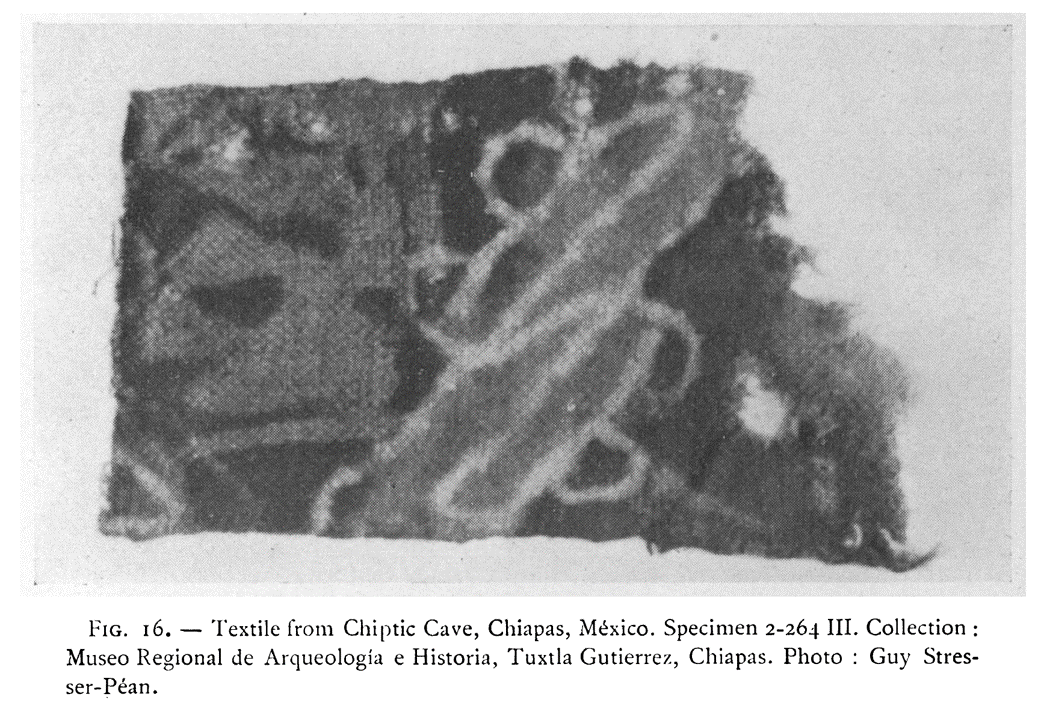
The direct and indirect evidence is that textile threads were colored with dyes, and, as added decoration, when weaving was finished, with freehand and resist painting, a technique attested in cave finds from Chiapas, Mexico (Figure 1, Johnson 1954:fig. 16; see also Filloy Nadal 2017:36). There is no question that the Classic Maya painted textiles and, in a few instances, tagged the calligraphers or the owners of clothing….if in coy ways that never identified such people. Names curl out of view or hide behind other items of dress (see Miller and Brittenham 2012:230, 233 [Captions I-5B, I-5C, I-49B]; Tokovinine 2012:70-71, figs. 32-33; note that such labels probably marked garments passing through tributary networks).

Figure 1. Textile from Chiptic Cave, Chiapas, Mexico, with use of resist paint (Johnston 1954:fig. 16).


There is a paradox, however. Surviving textiles and images show few clear signs of block-printing and its tidy repetitions. Yet there are archaeological objects, all of rugged or durable ceramic, that must have been used for printing or stamping.[2] Several are cylinders, with step-fret designs that are common on textiles and well-suited to the warp-weft constraints of weaving. Such cylinders extend deeply into the Mesoamerican past (Field 1967:22-38). That these cylinders were used in body painting seems improbable. If charged with pigment, they would have left messy or indistinct patterns with their expansive fields of color, and the designs on the cylinders are step-fret or of fragrant blossoms attested on other textiles (e.g., Filloy Nadal 2017:fig. 34). In any case, all images of body painting involve brushes (e.g., K1491, K4022).

Three cylinders occur in the probable tomb of a princess or queen at the site of Buenavista del Cayo, Belize; the tagged weaving bones in that burial hint that such designs might also have been rolled over textiles created by high-ranking women (Figure 2, Ball and Taschek 2018:485-487, fig. 14; see also Moholy Nagy 2008:fig. 219l).

Figure 2. Ceramic roller-stamps, Burial BV88-B13; note that each design could also be applied in inverted orientation (drawings by Jennifer Taschek, in Ball and Taschek 2018:fig. 14).


Others were flat stamps that, more than the cylinders, would have been ill-suited for use on human bodies. A large set was discovered in Tomb 6, a royal burial in Structure II, Calakmul, Mexico (Figure 3, Carrasco Vargas 1999:31). With their figuration, the Calakmul examples are anomalous in comparison to other stamps, a hint of varied, more narrative or setting-oriented imagery on stamped materials. As at Buenavista del Cayo, this less well-reported tomb contained weaving bones and was said unequivocally to hold the remains of woman, perhaps the spouse of the ruler. These finds of weaving implements and stamps, flat or cylindrical, suggest that stamping was a gendered activity among the Classic Maya. Its tools were linked to the process of finishing textiles, and large areas of cloth or barkpaper could be decorated with both speed and care. Nonetheless, as in Japan and elsewhere, more than one person presumably wove, made stamps, concocted pigments, and pressed them onto textiles. The volume of production and need for varying expertise may have demanded it…and an elite or royal lady would not have operated without servants. There is also a suspicion, challenging to prove, that the stamps at Calakmul and at other sites formed part of a much larger inventory during the Classic period. In India, at least historically, most stamps or blocks were of wood, and these would have disappeared long ago in the Maya Lowlands (Lewis 1924:1-2; see [2]).

Figure 3. Flat stamps with water lily creature, hummingbirds over cavity, Venus sign, spirals, and full-frontal images of Teotihuacan-style warrior; from possible burial of royal woman, Tomb 6, Structure II, Calakmul, Campeche; on display, Museo Arqueológico, Fuerte de San Miguel, Campeche, Mexico (photograph by Stephen Houston).


A unique illustration of direct transfer exists in the collection of the Museo Regional de Yucatán, Palacio Cantón (Figure 4); see Mediateca INAH, CC BY-NC). It has no provenience but appears to be a slateware, possibly Muna or Dzitas Slate, the latter associated with Chichen Itza, Yucatan–the dish would need closer study to establish its precise affiliation (George Bey, personal communication, 2023). The central element is a sign for k’in, “sun,” but also, more telling here, for NIK[TE’] or NICH[TE’], “flower.” An extraordinary touch is that the interior rim has a series of designs in which, not a brush, but a flower has been dipped in ink and repeatedly pressed into the surface. The flower itself is difficult to identity yet could relate to the Asteraceae family of plants (Shanti Morell-Hart, personal communication, 2023). The double reference in image and mode of decoration is likely to be deliberate. Perhaps this flowery ceramic was intended to contain flowers, as seen in one mythic scene with an anthropomorphic hummingbird and a youthful God D (K8008). The repeated design itself might have triggered a synesthetic sense of fragrance. The flower on the dish served as its own instrument of depiction; the central glyph nailed the floral reference and standardized it into canonical form.

Figure 4. Painting with flowers on a dish, Museo Regional de Yucatán, Palacio Cantón, Mérida. Mediateca INAH, CC BY-NC.


Whether this object has any parallels remains unclear. There are two images that show scribal gods dipping (or having dipped) an undulating, near-vegetal “brush” into a conch inkwell (Figure 5). They cannot be conventional brushes but do open unexpected possiblities for the toolkit of Maya painters.

Figure 5. Two scribal deities dipping or flourishing near-vegetal “brushes” (images from Justin Kerr Maya archive, Dumbarton Oaks, Trustees for Harvard University, Washington, DC, CC BY-SA 4.0).


Acknowledgments   My new colleague at Brown, Shanti Morell-Hart, assisted with the flower identifcation, and George Bey and William Ringle helped to type and possibly date the plate in the Palacio Cantón, Mérida. Joanne Baron kindly forwarded a high-resolution image of a Kerr photograph.


[1] An exception would be the sōsaku-hanga (“creative-prints”) of the early 20th century in Japan. These were painted, carved, and printed by a single artist, often inflected by Western art and its focus on individual production (Binnie 2013:65).

[2] These were probably not the only such blocks. As in India, examples in wood may have been far more numerous (Lewis 1924:1-2).

References

Anderson, Michael. 1985. Curtain Holes in the Standing Architecture of Palenque. In Fourth Palenque Round Table, 1980, edited by Elizabeth P. Benson, pp. 21-27. San Francisco: Pre-Columbian Art Institute.

Ball, Joseph W., and Jennifer T. Taschek. 2018. Aftermath A.D. 696—Late 7th and Early 8th Century Special Deposits and Elite Main Plaza Burials at Buenavista del Cayo, Western Belize: A Study in Classic Maya “Historical Archaeology.”Journal of Field Archaeology 43(6):472-491.

Binnie, Paul. 2013. The Legacy of Shin Hanga, by an Artist Working in the Tradition. In Fresh Impressions: Early Modern Japanese Prints, by Carolyn M. Putney, Kendall H. Brown, Koyama Shūko, and Paul Binnie, pp. 64-73. Toledo: Toledo Museum of Art.

Carrasco Vargas, Ramón. 1999. Tumbas reales de Calakmul. Ritos funerarios y estructura de poder. Arqueología Mexicana 7(40):28-31.

Field, Frederick V. 1967. Thoughts on the Meaning and Use of Pre-Hispanic Mexican Sellos. Studies in Pre-Columbian Art and Archaeology 3. Washington, DC: Dumbarton Oaks.

Filloy Nadal, Laura. 2017. Mesoamerican Archaeological Textiles: An Overview of Materials, Techniques, and Contexts. In PreColumbian Textile Conference VII / Jornadas de Textiles PreColombinos VII, edited by Lena Bjerregaard and Ann Peters, pp. 7–39. Lincoln: Zea Books.

Halperin, Christina. 2016. Textile Techné: Classic Maya Translucent Cloth and the Making of Value. In Making Value, Making Meaning: Techné in the Pre-Columbian World, edited by Cathy Coastin, pp. 431-463. Washington, DC: Dumbarton Oaks Research Library and Collection.

Johnson, Irmgard Weitlaner. 1954. Chiptic Cave Textiles from Chiapas, México. Journal de La Société Des Américanistes 43: 137–47.

Lewis, Albert B. 1924. Block Prints from India for Textiles. Anthropology Design Series 1. Chicago: Field Museum of Natural History.

Lothrop, Joyce M. 1992. Textiles. In Artifacts from the Cenote of Sacrifice, Chichen Itza, Yucatan, edited by Clemency C. Coggins, pp. 33-90. Memoirs, 10(3). Cambridge, MA: Peabody Museum of Archaeology and Ethnology, Harvard University.

Miller, Mary, and Claudia Brittenham. 2013. The Spectacle of the Late Maya Court: Reflections on the Murals of Bonampak. Austin: University of Texas Press; Mexico City: INAH and CONACULTA.

Moholy-Nagy, Hattula. 2003. The Artifacts of Tikal: Utilitarian Artifacts and Unworked Material. Tikal Reports 27B. Philadelphia: University Museum of Archaeology and Anthropology, University of Pennsylvania.

Moholy-Nagy, Hattula, with William R. Coe. 2008. The Artifacts of Tikal: Ornamental and Ceremonial Artifacts and Unworked Material. Tikal Reports 27A. Philadelphia: University Museum of Archaeology and Anthropology, University of Pennsylvania.

Morehart, Christopher T., Jaime J. Awe, Michael J. Mirro, Vanessa A. Owen, and Christophe G. Helmke. 2004. Ancient Textile Remains from Barton Creek Cave, Cayo District, Belize. Mexicon 26(3):5054.

Ordoñez, Margaret T. 2015. Appendix V: Textiles. In Temple of the Night Sun: A Royal Maya Tomb at El Diablo, Guatemala, by Stephen Houston, Sarah Newman, Edwin Román, and Thomas Garrixon, pp. 258-262. San Francisco: Precolumbia Mesoweb Press, San Francisco.

Riello, Giorgio. 2010. Asian Knowledge and the Development of Calico Printing in Europe in the Seventeenth and Eighteenth Centuries. Journal of Global History 5:1-28.

Ruiz Gallut, María Elena. 2001. Entre formas, astros y colores: aspectos de la astronomía y la pintura mural en sitios del área maya. In La Pintura Mural Prehispánica en México, II Área Maya, Tomo III, Estudios, edited by Leticia Staines Cicero, pp. 283-293. Mexico City: Instituto de Investigaciones Estéticas, Universidad Nacional Autónoma de México.

Salter, Rebecca. 2002. Japanese Woodblock Printing. Honolulu: University of Hawaii Press.

Soustelle, Jacques. 1937. La culture matérielle des Indiens Lacandons. Journal de la Société des Américanistes 29(1):1–95.

Tokovinine, Alexandre. 2012. Carved Panel. In Pre-Columbian Art at Dumbarton Oaks, Number 4: Ancient Maya Art at Dumbarton Oaks, edited by Joanne Pillsbury, Miriam Doutriaux, Reiko Ishihara-Brito, and Alexandre Tokovinine, pp. 68–73. Washington, DC: Dumbarton Oaks Research Library and Collection.

Tolstoy, Paul. 1963. Cultural Parallels between Southeast Asia and Mesoamerica in the Manufacture of Bark-cloth. Transactions of the New York Academy of Sciences 25:646–662.

Tozzer, Alred M. 1907. A Comparative Study of the Mayas and the Lacandones. New York: Macmillan Co.

Further Observations on the MUT Logogram

by David Stuart

Figure 1. The complements mu and tu on the Tikal/Dos Pilas emblem glyph.

Back in 1993 I proposed that the main sign of the emblem glyph of Tikal and Dos Pilas/Aguateca is read as MUT, based on the affixes mu- and -tu that appear with it in different contexts, apparently as phonetic complements (Figure 1). My colleague Christian Prager noticed this pattern around the same time, also seeing these syllables as essential clues to the sign’s reading. Many examples of the emblem also show an additional -la suffix, suggesting that MUT-la is a fuller spelling that has led to the various reconstructions Mutal, Mutul, Mutuul. Mutu’l, or something similar (the precise nature of the vowel in such -Vl suffix remains a point of minor debate among epigraphers). My inclination is to see the ancient court name as related to the historical attested place name Mutul, known from both Yucatan and the Petén, as in the modern names Motul de San José, or Motul, Yucatan (home of huevos motuleños, a staple of restaurant breakfasts in Yucatán). “Mutul” is the form I will use here as the reading the full Tikal emblem. In the Classic period Tikal seems to have gone by the name Yax Mutul, “The First Mutul,” perhaps as a way of distinguishing it from earlier centers who also had claimed the Mutul name.

One key lexical item of support of the MUT reading – or so it seemed at the time – was that the sign represented tied bundle of hair, seeming to agree well with the Yukatek term mut pol, cited in the Vienna Dictionary meaning rodete hacer la mujer de sus cabellos (“bun made by a woman from her hair”), clearly related to mut as rodete para asentar olla o vasija (“[round] support for a jar or vase”). However, mut here this may be a corruption or even mis-transcription of the better-established noun met, meaning ruedo, rodete, o rodillo sobre que se asienta alguna vasija (from the Calepino Motul). This possibility had set some doubt in my own mind about the lexical basis of the MUT sign reading, despite the evidence of the syllabic complements we had found. The lack of any non-Yukatek sources for the reading seemed problematic as well, and I’ve long thought MUT needed a bit more backing. Still, it is important to note that there were several signs that ubstitute with one another in the context of the Tikal emblem, each featuring bound hair or a twisted braid, as first patterned out by Linda Schele (1985).

Here I point out a helpful substitution of signs that would appear seems to confirm the MUT value once and for all, in the spelling of the name of a royal woman cited in the inscriptions of Yaxchilan and environs (Figure 2). She was a noblewoman from the court of Hixwitz, a spouse or consort of Yuxuun Bahlam IV (Bird Jaguar IV) named Ix Mut(?) Bahlam. She is depicted on Lintels 17, 40, and 43, identifiable by her name, which damaged in two of the three instances. The best-preserved examples of from Lintel 17, where the name is IX-MUT-tu BAHLAM (Figure 2b). It was this example that gave us the final –tu as a likely phonetic complement to the supposed MUT sign.

Figure 2. Portrait of Ix Mut Bahlam, royal woman of Hixwitz, from Yaxchilan, Lintel 17. Name caption from Dos Caobas (a) compared to Lintels 17 (b) and 43 (c). Drawings by Ian Graham except (a) by David Stuart.


Figure 3. Dos Caobas, Stela 2. Photograph by David Stuart.


Another portrait of Ix But Bahlam comes from Stela 2 from Dos Caobas, a satellite of Yaxchilan whose two monuments are now on display in the Museo Regional of nearby Frontera Corozal, Chiapas (Figure 3). Stela 2 is a fascinating and unusual monument, depicting the ruler Yaxuun Bahlam seated high upon a pillow-throne, facing a standing male figure who holds an object to him. Standing behind are two women, one named Ix Wak Jamchan Ajaw, of the Ik’ or Ik’a’ court of the central Peten lake area. She is also portrayed on Yaxchilan’s Lintels 5 and 41, and perhaps also 15 and 38, with a slightly different spelling. The second woman is a slightly eroded caption that contains a Hixwitz title (IX-hi-HIX wi-tz-AJAW) (see Figure 2a), and is surely Ix Mut Bahlam. Indeed, the BAHLAM logogram of her name is clear, as is a revealing spelling of the first part of her name in the initial block: IX-mu-tu. This substitutes directly for the IX-MUT-tu from Lintel 17’s caption, and offers another welcome piece of evidence to bolster the MUT reading. 

Figure 4. The name Ix Ch’ajan(?) Mut, showing possible substitution of hair-bundle and bird. Drawings by William R. Coe (a,b) and Stefanie Teufel (c).

One last connection that may be relevant is the name of another woman who is cited on Tikal’s Stela 23, whose name I tentatively read as IX-CH’AJAN?-MUT-AJAW?, or Ix Ch’ajan Mut Ajaw (Figure 4a). This surviving passage from the stela’s text records her birth, with no other names or titles, so she was clearly a person of great importance. This name seems related to another woman or female deity mentioned on the much earlier Stela 26 (Figure 4b), where we see the same combination of elements with the addition of a “mirror” or “shiner” sign, perhaps read as li or LEM before the MUT, possibly for Ix Ch’ajanil Mut. Yet another possible variation of this name or reference comes from a much later context, on a carved bone from Topoxte’, Guatemala (Figure 4c). This object was owned by an individual whose mother is also named, bearing the royal title of Tikal (IX-MUT-AJAW). Here the personal name may be distinct, displaying the sign TAL, but I wonder if this is instead the same twisted cord sign I consider as CH’AJAN followed by a full-figure of a bird, easily recognizable as MUUT (“bird”). The combination could suggest the possibility of a logographic substitution between two near homophones: MUUT, “bird,” for the hair-bundle MUT we find in the spellings at Tikal.Differences among these names makes their equivalence somewhat iffy, but such a substitution fits a pattern we see elsewhere in texts after 750 CE or so, which disregard certain traditional distinctions in the internal vowels near-homophones. In this case, the scribe may to have replaced the logogram MUT (mu-tu) with a short /u/ with MUUT (mu-ti), with its long vowel /uu/. By the time this late text was composed the old distinction may have been lost, and the pronunciation of the two signs may have been quite close. 

All of this, especially the Dos Caobas example, is to buttress the original MUT reading of the hair-bundle sign that is the basis Tikal emblem glyph and its court name Mutul, as proposed three decades ago. Questions still surround the lexical background of this reading, but from an epigraphic angle the logogram’s value seems secure.

Reference

Schele, Linda. 1985. Balan-Ahau: A Possible Reading of the Tikal Emblem Glyph and a Title at Palenque. In Fourth Palenque Round Table, 1980, Vol. VI, edited by M.G. Robertson and E. P. Benson, pp. 59-66. Pebble Beach, CA: Pre-Columbian Art Research Institute.

A New Drawing of the Marcador Inscription

by David Stuart

The Marcador from Group 6C-XVI of Tikal. Note the name of Eagle Striker in the center of the upper rosette, prossibly a war shield.

Posting a new drawing of the hieroglyphic texts on the famous Marcador sculpture of Tikal. I made this as part of my upcoming publication on aspects of Teotihuacan-Maya history, slated to appear next year with Dumbarton Oaks. The drawing is based on inspection of photos and digital scans, and corrects a few minor errors in other drawings that have appeared since the Marcador was discovered back in the early 1980s.

Each text panel focuses on a particular event. The first recalls the conquest of Tikal in 378 CE led by the famous Sihyaj K’ahk’, who in some capacity seems to have acted at the behest of the Teotihuacan ruler who I prefer to call Eagle Striker (“Spearthrower Owl” being an old nickname). Sihyaj K’ahk’ arrival to the Peten in that year was a transformative political event, broadly affecting the Maya political order of the Early Classic. The second text panel focuses on the dedication of the Marcador itself sixty years later in 414, highlighting its association with Eagle Striker, whose name is also prominently displayed within the center of sculpture’s rosette-like shield. As background for this, Eagle Striker’s accession in 374 is cited at the beginning of the second text panel (E1-E5).

A Sacrificial Sign in Maya Writing

Dmitri Beliaev and Stephen Houston

The human hand is, aside from the face, the most expressive of body parts. Held a certain way, fingers placed just so, it can reassure, offend, accentuate, direct. Among the Maya, as David Stuart observes, an extended pinky stands for elegance and skill. Dancers showed it, scribes too, perhaps to keep ink from smudging or to balance a brush over a page (https://mayadecipherment.com/2018/06/20/the-ugly-writing/).

The hand also inflects terms for making and doing. In English, there are words like “command,” “mandate,” “manipulate,” all taken in part from Latin manus, “hand”; a person can be “handy” (dexterous); and, in Germanic languages, a sense of emotion merges with a tactile sense of “feeling” (e.g., Alpenfels 1955:15–16). The time depth of these notions goes far back, perhaps to a distant past. By various theories, the hand became associated, as humanity evolved, with effective tool use, meaningful gestures, hierarchy, and “goal-directed action” (Cochet and Byrne 2013:531).

The ancient Maya certainly associated the human hand with action and broader sets of meaning (e.g., Houston et al 2006:30; Palka 2002; Stuart 2002). Much gets mapped on this extremity. In Ch’olti’, for example, a Mayan language of the Colonial period, the pinky is the “child of the hand” (v-y-al ca cab [yal ka k’ab]). Ch’orti’, its descendant language, identifies the thumb as the “mother” of the other fingers (u tu’ uk’ab, Houston et al. 2006: 30). But, apart from glyphs like K’AB, “hand” (or syllabic k’a-ba)—and a few characters derived from hand measurements (e.g., a valuable study by Boot 2003:6; see also M. Coe 2003:199–200; Zender 2004)—many such signs show objects being held, scattered, indexed or supported in some way. To tabulate a few: []AL, CHOK, CH’AM, K’AL, TZAK, TZUTZ, along with rarities of more debatable reading. There is, for instance, a hand grasping a stone that may record one of several sounds, JATZ’ (Lopes 2003; Zender 2004:5–8) or perhaps tz’o or TZ’ON (Stuart 1997, see independent work on tz’o by Albert Davletshin [2001]). [1]

To throw a stone is the most basic aggression. Such projectiles are to be found in Maya sites, and doctoral research by Omar Alcover Firpi suggests many more weapons like them exist, often tossed by archaeologists unaware of their function (Alcover 2020). In fact, one complex mythic narrative—hinting at some Maya “rape of the Sabines,” with children and bleeding women, as well as suggestions of forced movement—depicts a male flinging a white stone from a hilly redoubt (Figure 1a). Another glyph, occurring most often in names, represents a hand holding an atlatl. As a glyph, that weapon could be oriented horizontally and vertically in the hand, and is mainly limited to the Early Classic period (Figure 1b, c, d, e). It appears in the name of the Teotihuacan overlord “Spearthrower Owl,” who ruled from AD 374 to AD 439 (Figure 1b–e, Stuart 2000:481–489). Its reading is thought by some to be the same as the hand grasping the stone, JATZ’, “hit, strike” (Davletshin 2001; Stuart 1997). On Tikal Stela 31, there are subtle links to the images just below the glyphs. A figure on the left side of the monument—the ruler on front was his clear focus—orients the atlatl towards the center; on the right side, another figure reverses the atlatl so as to maintain that consistent orientation to the ruler (Jones and Satterthwaite 1982:figs. 51a, b). Both of these companions, likely an earlier king, Yax Nuun Ahiin, in posthumous depiction, wear different headdresses. Perhaps this advertised distinct roles for the same person.

Figure 1. Hands that grasp and hurl: (a) stone-throwing event in mythic time (excerpt, K5451, courtesy of Justin Kerr); and hand grasping atlatl, jatz’oom (b, c, Tikal Marcador:C3, E9; d, Tikal Stela 31:L4; e, Tikal Stela 31:N3, photographs from the Proyecto Atlas Epigráfico de Petén, courtesy of the Museo Nacional de Arqueología y Etnología de Guatemala, drawings, Jones and Satterthwaite 1981:figs. 51a, 52a).

The difficulty of analyzing this category of signs lies in their iconic composition. Since they represent a hand holding an object, it is hard to distinguish the basic form of the sign from superimposed glyphs that augment its reading. For example, on Altar 1 from Itzimte, Guatemala, a hand grasps a personified flint that potentially serves as a separate logogram. A royal name at Late Classic Itzimte, Jun Tzak Took’, confirms that the glyphs record two word signs, TZAK and TOOK’ (Beliaev and Vepretskii 2018:fig. 3). A similar pattern occurs on Stela 2 from Río Azul, Guatemala, where a TZAK hand grasps the head of God K (K’AWIIL) in the royal name Tzahkaj K’awiil (Beliaev 2017; Beliaev et al. 2017:118–120). Understanding these examples requires attention to context and variant spellings. Unitary signs, if complex in shape, need to be separated from those with two glyphs.

An undeniable logograph is a hand grasping a hooked obsidian blade, the standard shape for this dark, imported, sacrificial material (Figure 2, see also Houston 2014:23–27, fig. 15).

Figure 2. Obsidian-in-Hand glyph as part of name, Altar de Sacrificios Stela 12:C1–C3 (9.4.10.0.0.0, Aug. 25, AD 524 [Julian], J. Graham 1972:fig. 35). The photograph appears to depict the blade with a faint sign for “dark.”

When its exotic nature is emphasized, often with Teotihuacan-related imagery, a gob of blood drips off the end. If took’, “flint,” inflicts the injuries of war, often in connection with the Sun God, obsidian, taaj, cuts flesh in acts of sacrifice; in fact, deity impersonators may do some of this work (see also Saturno et al. 2017:4, 8; see also Taube 1991). One implement, flint, seems of the day, the other, to judge from the ‘ak’ab markings on obsidian, of the dark and night (its natural black sheen fits too). In the example above, from Altar de Sacrificios, it is probably no coincidence that the being linked to the “Obsidian-in-Hand” sign is a deity whose mouth fills with blood.

Yet there can be some overlap of function in these materials. A vase from the early 8th century AD shows an otherwise unique image of a figure holding up an obsidian blade. In front, a subordinate displays a split or tear in his bulging back (Figure 3). From that split emerges a serpent, along with a tandem effusion of growth. The person cut in this way seems remarkably unperturbed, for his arms cross in patient subordination. The text above records, in its first part: 13 Ak’bal 1 TE’? Zotz’ ju-ta-ja ‘Flint-Wound”-PAAT?-ti. The unusual verb may relate to Colonial Yukatek <hut.ah ub>, “to saw wood” (Acuña 1993:225) [2] and Colonial Tzeldal <ghut> “to make stripe marking,” “to mark with iron tool” (Ara 1986:298). Another term in Yukatek, hutul, “nacer los brutos animales” (‘to be born, the brutish animals’), correlates with the rip or tear, a common visual allusion to birth or emergence (Cuidad Real 2002:270). At the least, the flint and depiction of the human back gloss the scene. Textually, the serrated flint stands in for sacrificial obsidian.

Figure 3. Splitting or sawing of person’s back with obsidian blade or knife (Robicsek and Hales 1981:fig. 9).

Similar signs for “tearing” or wounding” occur with an obsidian blade or knife (David Stuart, personal communication, 2001). Often, this complex, multi-component sign fuses with another glyph (Figure 4). A warrior at Itzan, Guatemala—his count of captives (20) is impressive—refers to a captive’s name that joins the sign with BAHLAM, “jaguar” (Figure 4b, Beliaev et al. 2020:171, 173). A similar name, possibly of the same individual, occurs at Ixtutz, Guatemala: u-CHAN-na-“Wound-by-Obsidian”-BAHLAM-ma (Figure 4a). Elsewhere, the “Wound-by-Obsidian” may refer to an object. One is “raised up” in a text on a Spondylus shell from Piedras Negras Burial 13, the presumed tomb of Ruler 4 of that site, excavated by Dr. Héctor Escobedo in 1997 (Figure 4c). Or, at Dos Pilas, Guatemala, another is “received,” ch’am, as though something palpable were held in the hand (Figure 4d). Notably, the first bears the obsidian glyph, the second does not, yet the ‘a subfix suggests an equivalence between the variant forms.

Figure 4. “Wound-by-Obsidian” glyphs, obsidian blade and wound or damaged face highlighted in yellow: a) Ixtutz Panel 2, Block 4, S1–T1, text reversed because of clockwise reading order around the panel (photographs by the Atlas Epigráfico de Petén, Russian State University for the Humanities); b) Itzan Hieroglyphic Stairway 1, Block 4, B1–B2 (photograph by Ian Graham, rubbing by Merle Green Robertson); c) Piedras Negras Burial 13 (drawing by Stephen Houston); and d) Dos Pilas Hieroglyphic Stairway 3, Block III:D3 (drawing by Stephen Houston).

Possessed versions, with or without the obsidian, appear on a small altar from the kingdom of Yaxchilan (with ya prefix and an unclear subfix, Figure 5b, Grube and Luin 2014:42–43, fig. 6); Copan Stela J:E8, with subfixed la; and Tikal, Stela 10:G8, also with la (Figure 5c, Jones and Satterthwaite 1982:fig. 15). The earliest form of this sign dates to the 6th century AD. It is the example on Tikal Stela 10 (ca. AD 506). Close review of photos taken in 2013 by the Atlas Epigráfico de Petén of the Russian State University for the Humanities demonstrates that the wounded head bears an element marked by “darkness” on its forehead (Figure 5c). Presumably, this is an obsidian blade. A chronologically close (AD 537) example from Yaxchilan Lintel 37 (Figure 5a, I. Graham 1979:83) represents an obsidian blade adorned by feathers that pierces the wounded head (Fig. 5a). The original form of this sign depicted the direct action of cutting by an obsidian blade. Later, it developed along two parallel lines: (a) omitting the obsidian element and (b) placing the obsidian in front of the head.

Figure 5. Paleographic shifts and possessed forms of the “Wound-by-Obsidian” sign: (a) Yaxchilan Lintel 37:A4 (drawing by Ian Graham); (b) Tikal Stela 10:G8 (photographs by the Atlas Epigráfico de Petén, Russian State University for the Humanities, courtesy of Museo Nacional de Arqueología y Etnología de Guatemala); and (c) Yaxchilan-area altar, position 7 (photographs by the Atlas Epigráfico de Petén, Russian State University for the Humanities, courtesy of Museo Nacional de Arqueología y Etnología de Guatemala).

These clues point to a word that, depending on inflection, begins with a- and ends in -a’ or -al). It seems very probable, as David Stuart suggests to us, that the basic reading concerned a widespread word yah or ya’, “permanent wound,” and a related concept of “pain, soreness” (e.g., Barrera Vásquez et al. 1980:958–959; Kaufman 2003:1338; Wisdom 1950:764; Polian 2017:682, has yah, “lesión permanente, achaque [herida que nunca sanó por completo y sigue doliendo],” ‘permanent wound, achaque [injury that never heals completely and continues hurting]’; drawing on present-day Tzotzil Maya, Laughlin [1975:384] records yayih, “be wounded or cut, be broken up [fruit]”). [3] Perhaps homophones were at play too. The placement of the cut raises the disquieting possibility that the facial wound resulted from flaying. Skin masks appear in a number of Maya images (Houston et al. 2006:20, fig. 1.11), and, as David Stuart also suggests to us, with acute insight, there may be a depiction of a heaped, flayed skin in a scene of captive torture and brutalization (K6674; see also Houston 2008). [4] The hafted, circular “eccentric” above that folded, browned skin resembles excavated blades from Maya caches or burials, and also the Aleut, Inuit or Yupik ulu, ᐅᓗ, a curved implement for skinning and flaying animals (Frink et al. 2002). “Eccentric” lithics may not simply have been for display or insertion into tombs and caches. They sliced soft skin and flesh. The unlidded eyes in the “Wound-by-Obsidian” sign indicate the possible removal of their eyelids and surrounding skin.

A prince of Yaxchilan, Chooj, “Puma,” is also labeled by this conflation, but with BAAH, perhaps to mean “Head” or “First” person of “Wound-by-Obsidian,” Baah Ya’ (Figure 6; reading of “puma” from Marc Zender, personal communication, 2004). This accords with a possible ranking of people associated with “Wound-by-Obsidian,” a pattern recalling in turn BAAH with took’, “flint” or te’, “wood, staff” (Houston 2014:27–28, fig. 17).

Figure 6. Unprovenanced lintel, Yaxchilan-area, BAAH-“Wound-by-Obsidian [YA’?-‘a]” CHOOJ ch’o-ko PA’-CHAN-na-AJAW (photograph by Stephen Houston).

The natural advantages of obsidian, its ability to slice cleanly, drives home a connection between what might be described as its surgical use and its role in sacrifice. Another unprovenanced pot shows the Sun God in recumbent, newborn posture, his umbilicus—as understood at first glance—being cut by God L with a dark knife of obsidian (Figure 7). Unexpected inversions and alternations mark the scene: a male midwife, jauntily smoking his cheroot; a companion with dark face (rather like the taaj, “obsidian” personages shown with dark pigment at Xultun, Guatemala (Rossi 2017:93, fig. 4); and a “newborn,” the Sun God, shown, if not old, at least as robust and mature. A scene of birth is complicated, however, by the event—a change-of-state verb that is not yet deciphered—and, possibly, yo?-OHL-la K’INICH-AJAW, “the heart of the Sun God.” The contrived, liminal nature of the date, 13 Chuwen 19 Zip, is made clear by the numbers. It is the highest possible numeral for the trecena, and the most days of the month before it shifted to the next. The small, trilobate “flowers” on the “umbilicus” resemble clotted blood, the cord itself, perhaps, the intestine or a large artery (for a similar, almost vegetal extrusion from a heart sacrifice, see K9227). A nocturnal god saws away at a being who exemplifies the day. A birth looks also to be a painful death. In symbolic terms, the reverse may also have been true.

Figure 7. The “birth/sacrifice” of the Sun God (photographer unknown).

But how to read the “Obsidian-in-Hand” sign? A decisive piece of evidence comes from a vase in the Museo VICAL at the Casa Santo Domingo hotel in Antigua Guatemala (Figure 8a, d). The glyphs are somewhat slovenly or uneven, and a in a style far earlier than the two figures depicted on the pot in Teotihuacan gear (Beliaev et al. 2017). The person to the right is none other than Sihyaj K’ahk’, the Teotihuacan warrior mentioned before; that to the left is otherwise unattested, ku po-ma yo-OHL AHIIN, Kupoom Yohl Ahiin. A likely variant of his name occurs on one of the carved bones from Tikal Burial 116, but there with the “Obsidian-in-Hand” in place of the ku po-ma (Figure 8b). Another Late Classic vase records its owner as someone of precisely the same name (Figure 8c). On that vase, he is known as the “North Dog [tz’i’] Lord,” and the thought comes to mind that this is some reference to a coyote, a canine of higher, drier, northerly lands, such as those of Teotihuacan itself. This reference, as with the Tikal bone or the Museo VICAL pot, may be a Late Classic retrospection of an Early Classic personage, or it pertains to a later individual taking that name.

This image has an empty alt attribute; its file name is 8-2.jpg

Figure 8. Kupoom Yohl Ahiin, “Cutter [of] the Crocodile’s Heart”: a) Museo VICAL vase, B1–B4 (IDAEH registration 1.2.75.390, drawing by Philipp Galeev); b) Tikal Miscellaneous Text 336 (drawing by Sergei Vepretskii, cf. Moholy-Nagy 2008:fig. 195, h, which omits some of these features); c) unprovenanced “codex-style” vase (drawing by Stephen Houston; and d) the Museo VICAL vase (drawing by Philipp Galeev).

Current narratives about relations between the Maya and Teotihuacan correctly highlight a few important people, but there are other figures mentioned as well. One known as “Sihyaj ‘Dart’,” may, for example, not be Sihyaj K’ahk’ but, Houston believes, a distinct figure with his own, later arrival (cf. Hombre de Tikal:F5). A number of plates and pots indicate a larger field of dramatis personae at this critical time of interaction. OHL for “heart” is a logograph deciphered by Houston in 1989—the reading was signaled by a prefixed yo syllable and a postfixed la; the AHIIN, “crocodile,” finds confirmation in a spelling of ‘a-hi-*na on a vase at the Museo Popol Vuh in Guatemala City (K3058, David Stuart, personal communication, 2001).

Kup is key here. The root is attested in Ch’olti’, the language closest to most Classic texts: cupu, como palo u otro cosa equivale, “as in wood or other equivalent thing” (Robertson et al. 2010:306). Even closer is an entry in a dictionary of Colonial Tzotzil: kup, “afeitar a tijeras…cortar con sierra…matar sacrificando hombres,” ‘cut with scissors…cut with a saw…kill sacrificing men’ (Laughlin 1988, I:225). Or, in the same source, in fuller exposition: kupvanej ta moton ch’u, “human sacrifice,” with the connotation of sawing in a rite “endured” with “pain” (Laughlin 1988, I:225). There are other revealing details: “sacrificar y matar hombre comunmente dicen: xekupvan, jkup, i.e., corto o aserro. aquel acto de sacrificar asi. kupvanej ta smoton ch’u, porque xekupvan no es propiamente sino cortar como aserrando” (‘to sacrifice and kill people they usually say: <xekupvan, jkup>, i.e. cut or saw; that act of sacrificing like this [is] <kupvanej ta smoton ch’u>, because <xekupvan> is not properly [to cut] but to cut like sawing’) (Laughlin 1988, III:749). Edward Calnek, drawing on colonial Tzeltal, identifies a category of priest involved in human sacrifices: <ghcupauh> “sacrificador” (‘sacrifice’), and <ghcupvinic> “sacrificador” (‘sacrificer’) (Calnek 1988:1). The last term is of special interest because it is translated as “cortador de hombres” (‘cutter of men’), a specialized category of ritual specialist (Calnek 1988:49).

The form of a transitive root with an agentive suffix -oom is also found in the jatz’oom plausibly deciphered by colleagues (see above). A striking feature of the probable burial of Yax Nuun Ahiin at Tikal is its richness, including many features linked to Teotihuacan. But it also held a crocodile (Wright 2005:90, 91). The bones may not be preserved from that long-past excavation, but a reasonable inquiry is whether they present osteological evidence of heart extraction. Indeed, this may have been one of the roles of the figure on the vase at the Museo VICAL, Kupoom Yohl Ahiin, “Cutter [of] the Crocodile’s Heart.”

Heart extraction from animals is well-known in Mesoamerica, undertaken with felines, deer, turkeys, and other creatures (Tiesler and Olivier 2020:184; see also Chávez Balderas 2017). Done with deft motions of an obsidian blade, it would go quickly with a crocodile: necessarily so, unless the animal were drugged, made unconscious or tightly bound. Without such preparation, the beast would have been most uncooperative. Indeed, a Postclassic mural from Structure Q.95 at Mayapan, Yucatan, shows a bound crocodile floating in water, its lashed snout hissing out fragrant breath (Millbrath et al. 2010:7–8, fig. 7). This mural lay flat on the floor, with some stucco “lipping” on the sides. The conceit seems to have been of a mythic sea in correct, horizontal orientation. Those stepping on it were in the figurative act of wading. Or this was more than a visual conceit. The lipping hints at the presence of a shallow stuccoed basin, although, as Karl Taube points out to us, its location in a temple summit makes this less likely. What may be a jeweled spear penetrates its abdomen, close to the thorax. Alternatively—the painting is damaged and heavily restored—the wound may represent the results of heart extraction, the jewels an effusion of precious blood. [5] In Mesoamerica, crocodiles were often identified with the earth, an aged creator god, and reenactments of prior destructions of the world (Taube 2018 [1989]. For one ritual in early colonial Yucatan—the practice was doubtless pre-Conquest—a crocodile (lagarto) was painted and presumably sacrificed (de la Garza ed. 1983, 1:72; Taube 2018 [1989:110]).

Kupoom Yohl Ahiin pertains to animals. A final, telling piece of evidence comes from a vase in the Museum of Fine Arts in Boston (Figure 9). A disembodied deity, an incense bowl on its head, tugs away at the innards of a prone captive. This god with jaguar ear—close to that of a variant read TE’, but showing a world tree—is also mentioned further on, in a discontinuous text placed in various locations on a dark background. The date may be 7 Ben *6 Mak (there is repainting here), but the event for this horrific scene is ku-pa-ja, kuhpaj, “he is being cut, sawn, sacrificed.” This must rank as one of the most vivid evocations of heart extraction through or below the thorax.

Figure 9. Kuhpaj, ku-pa-ja, as glyph for heart sacrifice (K1377, Museum of Fine Arts, Boston, Gift of Landon T. Clay, 1988.1179)

Endnotes:

[1] The tz’o reading is supported, as Stuart notes, by spellings such as ja-?tz’o-ma, “beater?” (K2058), tz’o-na-ja, “shoot, throw,” in a ballgame context (Yaxchilan HS 2, Step VII:Q1; El Peru HS 1, Blocks XIV-XIV, Ian Graham field drawing), tz’o-no/’o?-niA-AKAN-na, “Groaner [Who] Throws [Stones]” (K791), and tz’o-to-la EK’ HIX, “Twisted Star Jaguar,” a term for a jaguar way enveloped by a snake, its whole body festooned with star signs (K1230, K1652, K5632). Tz’on is attested in Yukatek, in connection with rifle shots but also blowguns, and in Chontal for “shoot,” a transitive verb (Barrera Vásquez et al. 1980: 889; Knowles 1984:475). An unpublished “codex-style” sherd records nu?-tz’o/TZ’ON XIB above an image of young, mythic blow gunner; he may also relate, as an ‘a-SIBIK?-TE’, to a kind of celt/mirror bedecked tree nearby. The asterisms are notable in a number of these images: the jaguar way and, in the scene at Yaxchilan, dwarves with stars and evident tails or flatulence—tropes for meteors? In Room 2 of the Bonampak murals a figure in its band of asterisms above a battle appears to fling or shoot stars with an atlatl (Miller and Brittenham 2013:fig. 196, and personal observation by Houston during videography of the original). Some years ago, Marc Zender pointed out to Houston clues to a reading of ‘A Chak Ju’te‘ for a title attested on a carved shell at Aguateca (‘a-CHAK-ka ju-‘u-TE’) and, in logographic form, on a small but exquisitely painted vase from Burial 196 at Tikal (AJ-CHAK-JU’T?-TE-‘e, Culbert 1993:fig. 84; Inomata 1997:fig. 14). This is close to a Ch’orti’ word for “blowgun,” probably of onomatopoeiac origin from sudden aspirations of air: huht te’, “blowgun” (Wisdom 1950: 472). The logographic version at Tikal could derive from Ch’orti’ hut, ‘face of person or animal, front side or surface; facial appearance, manner or expression, appearance” (Wisdom 1950: 474). Thus, the epithet at Aguateca, which pertains to a royal youth, reads, “He of the great (chak) blowgun.” The title may have been literal, a reference to an accomplished hunter if of small game. Or there was a more freighted allusion: a youthful identity blended with the “hero twins” who blowgun the Principal Bird Deity out of a primordial world tree (e.g., K1226).

[2] The gloss hutahul, “saw wood” (Barrera Vásquez et al. 1980:258), seems to be an erroneous transcription of <hut.ah ub>, which, in the Vienna Dictionary, spells an active stem *hutah and a passive stem *hutub in one line (see also Bolles 2001, http://www.famsi.org/reports/96072/h/hut_huztic.htm).

[3] If merely a variant, the flint with the wounded back may read Ya’ Paat.

[4] The scene appears below, in an image courtesy of Justin Kerr (K6674). For comparable, crescentic blades—some are full crescents, others partial, some perforated, others not—see W. Coe (1959:figs. 11, 16k), Pendergast (1, 1979:fig. 23a; 2, 1982:figs. 37a, 62d, 63d; 3, 1990:figs. 17e, i, 158h, 160, c, e), Willey (1972:fig. 169, 170, who calls them “Elaborate Perforated Forms”). Many have basal tangs or knapped outsets near the handle. Perhaps, as in the image here, they helped to fit a carved mount. One wonders, with disquiet, what might be in the pink vase with basketry lid. Other organs or body parts? For a depiction of an eccentric in use, see K8351 and https://mayadecipherment.com/2016/07/22/maya-stelae-and-multi-media/. To judge from Aztec carvings, such flaying involved heart sacrifice, as revealed by sutured, transverse cuts across the chest (https://www.artic.edu/artworks/12742/ritual-impersonator-of-the-deity-xipe-totec; Museum der Kulturen Basel, Sammlung Lukas Vischer). Yet whole-body flayings may been one of several practices. Smaller, buccal flayings appear on some figurines and at least one ceramic mask (Schmidt et al. 1998:#102, 114, 115). These could have resulted from the V-shaped incisions seen in the glyph. Less thorough flayings might have taken place in pressed conditions on the battlefield—compare with the scalps secured rapidly by Plains warriors and other groups, including Europeans (Grinnell 1910:303–306). More elaborate processing of bodies perhaps occurred with captives under fuller control.

[5] The rendering by Barbara Escamilla Ojeda shows the sacrificial crocodile (Milbrath et al. 2020:fig.7).

[6] Not just adults experienced the agony of heart extraction. There are infants or mannikins too (black and white photograph by Stephen Houston, color by Justin Kerr, used with permission).

Acknowledgements As always, friends helped with our research. These include Nicholas Carter, Charles Golden, Albert Davletshin, Simon Martin, Andrew Scherer, Josh Schnell, David Stuart, Karl Taube, Alexandre Tokovinine, and Marc Zender, and, kindly providing a pre-publication article, Vera Tiesler and Guilhem Olivier. Note that this essay employs the spellings and spelling conventions favored by Robertson et al. (2007). “K” numbers identify photographs by Justin Kerr.

References

Acuña, René. 1993. Bocabulario de Maya Than, Codex Vindobonensis N. S. 3833, Facsímil y edición crítica anotada. Mexico City: Universidad Nacional Autónoma de México.

Ara, Domingo de. 1986. Vocabulario de lengua tzeldal según el orden de Copanabastla. Mexico City: Universidad Nacional Autónoma de México.

Alcover Firpi, Omar. 2020. Conflict, Defense, and Cooperation at Macabilero, Peten, Guatemala. Ph.D. Dissertation, Brown University, Providence, RI.

Alpenfels, Ethel J. 1955. The Anthropology and Social Significance of the Human Hand. Artificial Limbs: A Review of Current Developments 2:4–21. http://www.oandplibrary.org/al/pdf/1955_02_004.pdf

Barrera Vásquez, Alfredo, Juan Ramón Bastarrachea, and William Brito Sansores. 1980. Diccionario Maya Cordemex. Mérida, Yucatan: Ediciones Cordemex.

Beliaev, Dmitri. 2017. Río Azul Dynasty and Polity: New Epigraphic Evidence. Talk presented at the 3rd Annual Textdatenbank und Wörterbüch des Klassischen Maya Workshop, Bonn University, December 7–9.

Beliaev, Dmitri, David Stuart, and Camilo A. Luin. 2017. Late Classic Maya Vase with the Mention of Sihyaj K’ahk’ from the Museo VICAL, Casa Santo Domingo, Antigua Guatemala. Mexicon 39:1–4, 28.

Beliaev, Dmitri, and Sergei Vepretskii. 2018. Los monumentos de Itsimte (Petén, Guatemala): Nuevos datos e interpretaciones. Arqueología Iberoamericana 38:3–13.

Beliaev, Dmitri, Sergei Vepretskii, and Camilo A. Luin. 2020. Las inscripciones de los sitios secundarios de Petén. In Proyecto atlas epigráfico de Petén, fase VI: Informe final, temporada de campo junio 2019, edited by Dmitri Beliaev and Mónica de León, pp. 147–238. Report submitted to the Departamento de Monumentos Prehispánicos y Coloniales, Dirección General de Patrimonio Cultural, Instituto de Antropología e Historia, Ministerio de Cultura y Deportes, Guatemala.

Bolles, David. 2001. Combined Dictionary–Concordance of the Yucatecan Mayan Language (updated 2003). http://www.famsi.org/reports/96072/index.html

Calnek, Edward. 1988. Highland Chiapas Before the Spanish Conquest. Papers of the New World Archaeological Foundation No. 55. Provo, UT: New World Archaeological Foundation, Brigham Young University.

Chávez Balderas, Ximena. 2017. Sacrificio humano y tratamientos postsacrificiales en el Templo Mayor de Tenochtitlan. Mexico City: Instituto Nacional de Antropología e Historia.

Ciudad Real, Antonio de. 2001. Calepino Maya de Motul, edited by René Acuña. Mexico City: Plaza y Valdés.

Cochet, Hélène, and Richard W Byrne. 2013. Evolutionary Origins of Human Handedness: Evaluating Contrasting Hypotheses. Animal Cognition 16:531–42. doi:10.1007/s10071-013-0626-y

Coe, Michael D. 2003. Another Look at the Maya Ballgame. In Il sacro e il paesaggio nell’America indigena, edited by Davide Domenici, Carolina Orsini and Sofia Venturoli, pp. 197–204. Bologna: CLUEB.

Coe, William R. 1959. Piedras Negras Archaeology: Artifacts, Caches, and Burials. Philadelphia: University Museum, University of Pennsylvania.

Culbert, T. Patrick. 1993. Tikal Report No. 25, Part A: The Ceramics of Tikal: Vessels from the Burials, Caches, and Problematical Deposits. University Museum Monograph 81. Philadelphia: University Museum, University of Pennsylvania.

Davletshin, Albert. 2001. Possible reading of T674 syllable. Unpublished manuscript.

de la Garza, Mercedes, ed. 1983. Relaciones histórico-geográficas de la gobernación de Yucatán. 2 vols. Fuentes para el Estudio de la Cultura Maya 1. Mexico City: Universidad Nacional Autónoma de México.

Frink, Lisa, Brian W. Hoffman, and Robert D. Shaw. 2002. Ulu Knife Use in Western Alaska: A Comparative Ethnoarchaeological Study. Current Anthropology 44(1):116–122.

Graham, Ian. 1979. Corpus of Maya Hieroglyphic Inscriptions, Volume 3, Part 2: Yaxchilan. Cambridge, MA: Peabody Museum of Anthropology and Ethnology, Harvard University.

Graham, John A. 1972. The Hieroglyphic Inscriptions and Monumental Art of Altar de Sacrificios. Papers of the Peabody Museum of Archaeology and Ethnology 64(2). Cambridge, MA.

Grinnell, George B. 1910. Coup and Scalp among the Plains Indians. American Anthropologist, n.s. 12:296–310.

Grube, Nikolai, and Camilo A. Luin. 2014. A Drum Altar from the Vicinity of Yaxchilan. Mexicon 36:40–48.

Houston, Stephen. 2008. A Classic Maya Bailiff? Maya Decipherment: Ideas on Ancient Maya Writing and Iconography https://mayadecipherment.com/2008/03/10/a-classic-maya-bailiff/

Houston, Stephen. 2014. The Life Within: Classic Maya and the Matter of Permanence. New Haven: Yale University Press.

Houston, Stephen, David Stuart, and Karl Taube. 2006. The Memory of Bones: Body, Being, and Experience among the Classic Maya. Austin: University of Texas Press.

Inomata, Takeshi. 1997. The Last Day of a Fortified Classic Maya Center: Archaeological Investigations at Aguateca, Guatemala. Ancient Mesoamerica 8: 337–351.

Jones, Christopher, and Linton Satterthwaite. 1982. Tikal Report No. 33, Part A, The Monuments and Inscriptions of Tikal: The Carved Monuments. Philadelphia: The University Museum, University of Pennsylvania.

Kaufman, Terrence S. 2003. Preliminary Mayan Etymological Dictionary. Report to the Foundation for the Advancement of Mesoamerican Studies, Inc.

Knowles, Susan M. 1984. A Descriptive Grammar of Chontal Maya (San Carlos Dialect). Ph.D. dissertation, Tulane University, New Orleans.

Laughlin, Robert M. 1975. The Great Tzotzil Dictionary of Santo Domingo Zinacantán. Washington, D.C.: Smithsonian Institution Press.

Laughlin, Robert M. 1988. The Great Tzotzil Dictionary of Santo Domingo Zinacantán, Volume I, Tzotzil-English. Washington, D.C.: Smithsonian Institution Press.

Lopes, Luís. 2003. The “Stone-in-Hand” Glyph Revisited. Unpublished manuscript. https://pdfs.semanticscholar.org/dea0/c742539eddacc1da0ffb58dbdfd5d7acb6dd.pdf.

Love, Bruce. 2017. Corpus Volume 1: Museo Regional del Sureste de Petén Dr. Juan Pedro Laporte Molina. Contributions to Mesoamerican Studies, October 16, 2017. https://brucelove.com/corpus/corpus-volume-001

Milbrath, Susan, Carlos Peraza Lope, and Miguel Delgado Kú. 2010. Religious Imagery in Mayapan’s Murals. The PARI Journal 10(3):1–10.

Miller, Mary, and Claudia Brittenham. 2013. The Spectacle of the Late Maya Court: Reflections on the Murals of Bonampak. Austin: University of Texas Press; Mexico City: INAH and CONACULTA.

Moholy-Nagy, Hattula, with William R. Coe. 2018. Tikal Report 27, Part A: The Artifacts of Tikal: Ornamental and Ceremonial Artifacts and Unworked Material. University Museum Monograph 127. Philadelphia: University of Pennsylvania Museum of Archaeology and Anthropology.

Palka, Joel W. 2002. Left/Right Symbolism and the Body in Ancient Maya Iconography and Culture. Latin American Antiquity 13(4):419–443.

Pendergrast, David M. 1979–1990. Excavations at Altun Ha, Belize, 1964–1970. 3 vols. Toronto: Royal Ontario Museum.

Polian, Gilles. 2017. Diccionario Multidialectal del tseltal. Ms. in possession of authors.

Robertson, John, Stephen Houston, Marc Zender, and David Stuart. 2007. Universals and the Logic of the Material Implication: A Case Study from Maya Hieroglyphic Writing. Research Reports on Ancient Maya Writing No. 62. Universals

Robertson, John S., Danny Law, and Robbie A. Haertel. 2010. Colonial Ch’olti’: The Seventeenth-Century Morán Manuscript. Norman: University of Oklahoma Press.

Robicsek, Francis, and Donald M. Hales. 1981. The Maya Book of the Dead, The Ceramic Codex: The Corpus of Codex Style Ceramics of the Late Classic Period. Charlottesville, VA: University of Virginia Art Museum.

Rossi, Franco D. 2017. Pedagogy and State: An Archaeological Inquiry into Classic Maya Educational Practice. Cambridge Archaeological Journal 28:1:85–102

Saturno, William, Franco D. Rossi, David Stuart, and Heather Hurst. 2017. A Maya Curia Regis: Evidence for a Hierarchical Specialist Order at Xultun, Guatemala. Ancient Mesoamerica 28(2):423–440. doi:10.1017/S0956536116000432

Schmidt, Peter, Mercedes de la Garza, and Enrique Nalda, eds. 1998. Maya. New York: Rizzoli.

Stuart, David. 1997. Ts’o Notes. Unpublished chart.

——. 2000. ‘The Arrival of Strangers’: Teotihuacan and Tollan in Classic Maya History. In Mesoamerica’s Classic Heritage: From Teotihuacan to the Aztecs, eds. D. Carrasco, L. Jones, and S. Sessions, 465–513. Boulder: University Press of Colorado.

——. 2002. “Glyphs for ‘Right’ and ‘Left’?” https://www.mesoweb.com/stuart/notes/RightLeft.pdf

Taube, Karl. 1991. Obsidian Polyhedral Cores and Prismatic Blades in the Writing and Art of Ancient Mexico. Ancient Mesoamerica 2:61–70.

——. 2018. Itzam Kab Ain: Caimans, Cosmology, and Calendrics in Postclassic Yucatán. In Studies in Ancient Mesoamerican Art and Architecture: Selected Works by Karl Andreas Taube, 108–117. San Francisco: Precolumbia Mesoweb Press. [1989. Itzam Kab Ain: Caimans, Cosmology, and Calendrics in Postclassic Yucatán. Research Reports on Ancient Maya Writing 26:1–12. Washington, D.C.: Center for Maya Research.]

Tiesler, Vera, and Andrea Cucina. 2006. Procedures in Human Heart Extraction and Ritual Meaning: A Taphonomic Assessment of Anthropogenic Marks in Classic Maya Skeletons. Latin American Antiquity 17(4):494–510.

Tiesler, Vera, and Guilhem Olivier. 2020. Open Chests and Broken Hearts Ritual Sequences and Meanings of Human Heart Sacrifice in Mesoamerica. Current Anthropology 61(2):169–193.

Willey, Gordon R. 1972. The Artifacts of Altar de Sacrificios. Papers of the Peabody Museum of Archaeology and Ethnology 64(1). Cambridge, MA: Peabody Museum, Harvard University.

Wisdom, Charles. 1950. Materials of the Chorti Language. Middle American Cultural Anthropology Microfilm Series 5, item 28. University of Chicago Library. [Retyped by Brian Stross]

Wright, Lori E. 2005. In Search of Yax Nuun Ayiin I: Revisiting the Tikal Project’s Burial 10. Ancient Mesoamerica 16(1):89–100.

Zender, Marc. 2004. Glyphs for “Handspan” and “Strike” in Classic Maya
Ballgame Texts. The PARI Journal 4(4):1–9.