Dancing into Dreams: Maya Vase Painting of the Ik’ Kingdom
Bryan Just; with contributions by Christina T. Halperin, Antonia E. Foias, and Sarah Nunberg
Yale University Press, 2012
Dancing Into Dreams explores 8th-century Maya vase painting of the Ik’ kingdom, located in the tropical lowlands of present day Guatemala. Ik’ vases are acclaimed for their naturalistic color, veristic portraiture, and calligraphic line. Their painted surfaces depict historical subject matter and often include the names of the artists and patrons, as well as hieroglyphic explanations of the portrayed events and vessel production. Collectively, such self-consciously historical works offer a precision and nuance, unparalleled in the ancient Americas, to the study of the role of art in elite society.
Authoritative and accessible, this handsomely illustrated volume presents a history of Ik’ vase painting and describes the dramatic scenes represented on the vases with compelling and historically accurate vignettes.
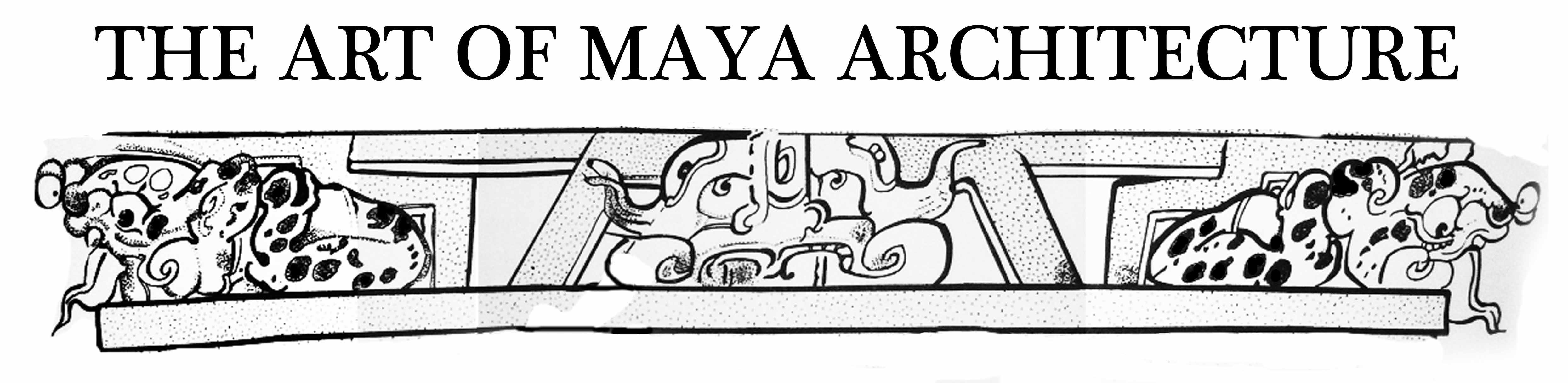
The 2013 Maya Meetings will explore new ideas about the art and meaning of ancient Maya architectural decoration and design. The last several years of archaeological research in the Maya region have revealed many examples of ornate temple decoration, as well as important reconsiderations of the symbolism and significance of buildings long known to archaeologists and art historians. Using archaeology, iconography, epigraphy, and the study of architectural forms, the Maya Meetings will focus on the built environment as expressions of ritual, cosmological and political space. This year we will have a number of compelling presenters, including several rising scholars in the field of Maya research.
At the European Maya Conference in Copenhagen in 2011, I sat in for a time in Sven Gronemeyer’s and Dmitiri Beliaev’s workshop “From Ochk’in Kaloomte to Dzuloob: Mesoamerica in the Maya World.” This workshop reviewed a number of so-called entrada events that occurred in the Maya lowlands over time, of which the most famous is probably that of Sihyaj K’ahk’ arriving at Tikal in A.D. 378 (Proskouriakoff 1993:4-10; Stuart 2000). In the sourcebook for the workshop, several examples of Sihyaj K’ahk’s name glyph were shown from a number of sites including El Peru, Tikal, Uaxactun, Rio Azul and others.
The question arose whether his name also appears on Stela 6 at La Sufricaya (Figure 1). The drawing of Stela 6 in the workbook comes from Grube’s study of the monuments of La Sufricaya (Grube 2003:700) in which he suggests the possibility that Sihyaj K’ahk’s name glyph appears at position D3. Although the drawing leaves some doubt as to the identification of the glyphs in question, the context is indeed suggestive. The Long Count date (8.17.?.9.9) seems roughly contemporaneous with Sihyaj K’ahk’s entrada to Petén (ibid., 700) and there are published artifacts and murals at the site in Teotihuacan style (Estrada-Belli 2009)(Note 1). In fact, Mural 7 from La Sufricaya marks the arrival of Sihyaj K’ahk’ to Tikal (although his personal name is absent) and appears to mark the one-year anniversary of that event (ibid.:238-243) (Figure 2).
Figure 1. La Sufricaya, Stela 6. Photograph by Bruce Love.Figure 2. Mural 7 from La Sufricaya, a painted text recording the arrival of Sihyaj K’ahk’ to Tikal in 378, and the dedication of a building on that day’s one year anniversary. Drawing by Heather Hurst.
In order to clarify the presence or absence of Sihyaj K’ahk’s name glyph, I asked Francisco Estrada-Belli, director of the Holmul Archaeological Project (of which La Sufricaya is an integral part), if I could photograph and draw Stela 6. As a result, on May 7, 2012, I photographed the stela, took detail shots of the glyphs with various light angles, and later made a drawing of the purported name glyph based on the photographs. The monument itself is currently housed in the IDAEH bodega in Melchor de Mencos, Petén.
The face of the monument is highly eroded as Figure 1 shows. The glyph in question is at D3.
In addition to the portrait photograph shown in Figure 1, several close-ups with different light angles were taken to record details. A selected close-up of D3, the one with the most information in my opinion, is shown in Figure 3 accompanied by a drawing of the same.
FIgure 3. Detail and drawing of glyph D3 on Stela 6. (Both by Bruce Love)
Although Sihyaj K’ahk’ is mentioned indirectly in the Mural 7 text, and (2) the Long Count date on the monument seems within the time period of his activities, and a number of monuments at sites in Petén do record the entrada event, I believe that Stela 6 does not. The results of this study indicate that the glyph in question fails to show any clear characteristics of Sihyaj K’ahk’s name.
Note 1. The tun and winal glyphs, not visible on the face of Stela 6, were found on a fragment that had separated from the main body of the monument.
Appreciation: I thank Sven Gronemeyer and Dmitri Beliaev for their workshop and the use of their workbook “From Ochk’in Kaloomte to Dzuloob: Mesoamerica in the Maya World,” 16th European Maya Conference, Copenhagen, 2011; and special thanks to Francisco Estrada-Belli for access to the monuments, for suggestions to improve this note, and encouragement to write these results.
References Cited
Estrada-Belli, Francisco, Alexandre Tokovinine, Jennifer Foley, Heather Hurst, Gene Ware, David Stuart, and Nikolai Grube. 2009. A Maya Palace at Holmul, Peten, Guatemala and the Teotihuacan ‘Entrada’: Evidence from Murals 7 and 9. Latin American Antiquity 20(1):228-259.
Grube, Nikolai. 2003. Monumentos jeroglíficos de Holmul, Petén, Guatemala. In XVI Simposio de Investigaciones de Arqueología de Guatemala, edited by Laporte, J. P., B. Arroyo, H. Escobedo, H. Mejía, pp. 701-710. Museo Nacional de Arqueología y Etnología, Guatemala.
Proskouriakoff, Tatiana. 1993. Maya History. University of Texas Press, Austin
Stuart, David. 2000. The “Arrival of Strangers”: Teotihuacan and Tollan in Classic Maya History. In Mesoamerica’s Classic Heritage: From Teotihuacan to the Aztecs, ed. by D. Carrasco, L. Jones, and S. Sessions, pp. 465-514. University Press of Colorado, Boulder.
As Stanley Guenter has shown, the name inscribed on the alabaster container found in the burial is the same as that of the woman depicted on El Peru Stela 34, now in the Cleveland Art Museum, dedicated in A.D. 692. She was originally from Calakmul, marrying into the El Peru dynasty as the spouse of the local ruler K’inich B’ahlam. The hieroglyphic term that labels the snail-shaped object or its contents (yu-ha?-b’a) is unique, and remains difficult to decipher at present.
Alabaster vessel from the tomb, in the form of a snail shell. (Photo: El Peru Waka Regional Archaeological Project)El Peru, Stela 34, with the portrait of “Lady K’abel” from Calakmul. Her name glyph appears in the text panel below her ceremonial shield, and also in one of the small cartouches in her feather headdress. (Cleveland Art Museum.)



You must be logged in to post a comment.