by Stephen Houston
Maya imagery often reminds us that it is ethereal and aristocratic, yet, at times, ribald, witty, earthy. [1] The discovery of ritual clowns and buffoonery in Maya art, along with some very detailed views of male genitalia, makes it clear that the Classic Maya had a lively side (e.g., Taube 1989). Their world was not only about the delicate scent of flowers and a decided prudery about royal and noble bodies (Houston et al. 2006:141-152).
Think of smells. Most of us live in sanitized societies with germ phobias, air-fresheners, and sport deodorants. Yet, any visit to a tropical settlement opens the nostrils. Trash rots and cooks slowly in the sun. (And not only tropical settlement: in Medieval France, the stench of charnel houses and malodors of executed criminals was said to permeate the food stalls of city markets [Corbin 1986:24-31, 48-56]). There are smells in the rainy season, too. My least favorite episode of fieldwork–mapping at Dos Pilas, Guatemala, in 1986–took place during Biblical downpours. The mildew was ineradicable. No amount of scrubbing would remove its smell from clothing, boots, bags or, it seemed, my person. For this reason, to search for a community in Colonial Yukatek was “to smell it like a dog,” presumably because of the mighty odor (Houston et al. 2006:141).
A relevant aside: on two occasions I have seen peccary in the wilds of northern Guatemala. Once, I smelled them first. Only after some minutes did the brush shake, sticks break. Two Collared Peccary (Tayassu tajacu) ran across the forest path. The second encounter was near the site of Bejucal, Guatemala. On three sides shuffled a very noisy herd of White-lipped peccary (Tayassu pecari). Their teeth clicked at fast pace. But, above all, there was that same smell, coming in wafts, potent, pressing into my nose.
If such musk exists—and it must have existed centuries ago, too–the Maya, so observant of nature, surely noted the odor. There is now some hard evidence of it.

A long-standing puzzle in Maya iconography is the peccary. On a bowl in the Dallas Museum of Fine Arts, the heads of four of these beasts do work as tetrapod supports (Figure 1). Their snouts plunge into the “ground,” probably in witty allusion to the way that peccary (and other pigs) eat by rooting around with their noses in jungle dirt and leaves. Such supports are relatively common in the Early Classic period, so the wit was widely understood. [2] On the foreheads of the Dallas peccaries is a sinuous line that epigraphers call the “Kaban curl” after its appearance in the Kaban day sign (Taube 2010:193). Eric Thompson, not always of unerring instinct, followed Eduard Seler in seeing this as the “lock of hair” worn by the Moon goddess (Thompson 1971:86). That lock is, of course, reversed, with a very different orientation. It is not clearly linked to the day sign at all.
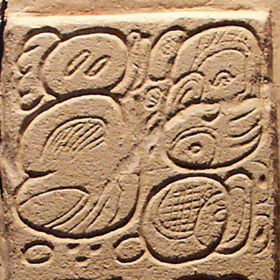
A more likely view, perhaps: the Kaban curl invokes a heady, glandular, earthy odor, the musk of the peccary or other mammal, thus joining many other cues in Maya imagery to the nature of smells, both strong and delicate. As a glyph, the sign is securely read KAB, “earth,” as shown by direct substitution with [ka-ba] in texts at Palenque and elsewhere. But, in imagery, “musk, strong odor” helps to explain a number of other features. Many of us have noticed the common appearance of the Kaban curl within the ears and, more rarely, the faces of deer, some of which occur as day signs (Figures 2 and 3, probably Kaban; see examples on panels proved by David Stuart to have come from La Corona in northern Guatemala).

Of the two types of deer in the Maya world, the White-tailed Deer (Odocoileus virginianus) is known for its glandular odor. Emitted from the forehead and in front of the eye, the smell is so powerful that it can be detected by the human nose. The chances are high that the presence of the Kaban curls on the face and ears of deer refers to this musk. [3]
A second feature is the presence of the Kaban curl with one of the Hero Twins, 1 Ajaw. The “spotted” twin, with large dark circles on his body and cheeks, is the hunter par excellence—indeed, a possible etymology for his name in K’iche’ is “One, He of the Blowgun” (see also Christenson 2007:fn. 163). In rare cases, the spotted Twin appears with deer ear and antlers (Figure 4a). Other scenes show him

as a warrior, with deer headdress also marked by a Kaban curl; notably, the same curl is not only on his face but floats in front of his nose (Figure 4b). Even without the headdress, the Twin may have these markings, in a pairing that makes it clear he is a variant of 1 Ajaw—his companion in this instance is the Classic version of Xbalanque, his expected Twin (Figure 4c). The curl in front of the face underscores the ethereal nature of the mark as a scent to be exhaled or smelled. In fact, there seems room for doubt whether the Kaban curl is really about “dirt” or “earth” per se, as opposed to the pungent smell of fresh, fertile, manured soil: in other words, by itself, the curl is an attributive mark, not a directly indexical one. From its earliest examples, the Kaban sign includes stone-markings, too, curving lines with dotted outline. A composite sign, it contains more than the single curl. I am not convinced that the Kaban curl alone is fully equivalent to the day sign in all its particulars. [4]
What to make of the curl and 1 Ajaw? I was raised in (what was then) rural Pennsylvania. As such, I am more than familiar with deer-hunting and its various equipment. For city dwellers, the strangest practice must be the purchase and liberal application of either scent-maskers–to most animals, human odor is quite penetrating and likely to alarm–or scent-attractors, which concentrate or mimic the odor of female deer so as to attract a buck. The 1 Ajaw may both identify with his prey in ways we do not fully understand and exude or smell the odor of his quarry. 1 Ajaw is a musky one, connected to strong, glandular scent. The act by which hunters paint their bodies, as on K1373, from about AD 600, may be mere camouflage. But one wonders whether odors had been prepared and applied according to the time-honored custom of hunters.
To those of us from northerly, colder climes, the Maya world has–and had–its own extremes: hot, humid, wet (or dry, depending on season), and, in final summation, strongly odorous as well. For the Classic Maya, musk appears, not surprisingly, to have infiltrated their elite imagery, offering yet further evidence of close, playful attention to tropical nature.
NOTES
[1] For other entries in the “Maya Creatures” series, see Dragons, Mosquitoes, Dogs, Teeth, Fox.
[2] A wahy or supernatural being on some Maya vases displays a “fire-breathing” peccary, as first studied by Nikolai Grube and Werner Nahm (1994:698). A plausible interpretation is that this reflects a mythic gloss on the snorting of peccary. The peccary herd in the upper mural of Room 2, Bonampak, situates the beast in a cosmic context, in an apparent reference to a Maya constellation, as pointed out long ago by Mary Miller.
[3] Several deer ears contain a crossed element, rather like two sticks, a feature found in a number of images (e.g., K1230, 1248, 1991, 2794, 8927). I have no explanation for them, but they must be in some opposed or complementary relation to the Kaban curls.
[4] Against this interpretation, however, is a point made by Michael Coe, that the curlicue is similar—but not identical–to the Postclassic Central Mexican sign for “excrement” (Coe 1973:100). It is reasonable to think that musk would be depicted as one of the smelliest products of the human body. The smell of excrement is one of the first odors encountered in life, and the disposal of ordure remains a ceaseless problem in all settled existence. Another complication here is the use of the Kaban curl in references to wax or the excrescence of bees (honey, e.g., Houston et al. 2006:fig. 3.11a). Did this allude to the idea that honey, like musk, was a waxy secretion, or did it relate to the strong smell of the balche’ drink that would have been brewed from honey?
REFERENCES
Christenson, Allen J. 2007 Popol Vuh: The Sacred Book of the Maya. Norman: University of Oklahoma Press.
Coe, Michael D. 1973. The Maya Scribe and His World. New York: The Grolier Club.
Corbin, Alain. 1986. The Foul and the Fragrant: Odor and the French Social Imagination. Cambridge, MA: Harvard University Press.
Grube, Nikolai, and Werner Nahm. 1994. A Census of Xibalba: A Complete Inventory of Way Characters on Maya Ceramics. In The Maya Vase Book: A Corpus of Rollout Photographs of Maya Vases, Volume 4, edited by Justin Kerr, pp. 686-715. New York: Kerr Associates.
Houston, Stephen D., David Stuart, and Karl Taube. 2006. The Memory of Bones: Body, Being, and Experience among the Classic Maya. Austin: University of Texas Press.
Taube, Karl A. 1989. Ritual Humor in Classic Maya Religion. In Word and Image in Maya Culture: Explorations in Language, Writing, and Representation, edited by William F. Hanks and Don S. Rice, pp. 351-382. Salt Lake City: University of Utah Press.
_________. 2010. Plate 66. In Fiery Pool: The Maya and the Mythic Sea, edited by Daniel Finamore and Stephen D. Houston, pp. 192-193. New Haven: Yale University Press, in cooperation with the Peabody-Essex Museum.
Thompson, J. Eric S. 1971. Maya Hieroglyphic Writing: An Introduction. 3rd ed. Norman: University of Oklahoma Press.


You must be logged in to post a comment.