Tikal, Tecali, Teotihuacan

by Stephen Houston (Brown University)

Alabaster was a rarity among the Classic Maya, reserved for fine bowls in elite settings, especially tombs or palaces (Houston 2014:258; Kubler 1977:5n1). Known as xix, a spelling attested in at least two glyphic texts, it appeared to refer to rocks affected by water (Houston et al. 2018; Luin et al. 2022:907, fig. 4). Geologically, xix is a white sedimentary calcite (CaCO3) mined in, among other places, a source near Zinacantan, Chiapas (Berlin 1946:27; for other quarries, see Urcid 2010:fig. 56). A comparable term, tecali, named after a community of that name, was applied to banded stone of similar composition in Mexico (Diehl and Stroh 1978:74). The Maya evidently prized the translucency, crystalline texture, and hard, white surface of alabaster, the better to highlight delicate incisions that could be filled in with red pigment.

An unusual find of two alabaster effigies comes from Burial 195, under Structure 5D-32 in the North Acropolis at Tikal, Guatemala (Figure 1, Coe 1990:565-568, 920, figs. 198-199, 330; Coggins 1975:344; Moholy-Nagy 2008:55, fig. 138). The tomb almost certainly belonged to a ruler of Tikal, ‘Animal Skull’, who died around AD 600.[1] The product of a tumultuous phase in Tikal’s history, Animal Skull does not clearly descend from earlier rulers of the city. His reign took place after a “rupture [that] follows hard on the heels of a major military defeat” at Tikal, leading to a “130-year monument hiatus and an interruption to its dynastic line” (Martin 2020:104, 247, 345).

Figure 1. Burial 195 and its two animal effigies of alabaster, marked “22” (partial plan: Coe 1990:fig. 1998; effigies: Moholy-Nagy 2008:fig. 138).


Despite the gap in monuments, there is no textual hiatus at Tikal. A suprisingly large number of pots belonged to Animal Skull, a pattern seen also with his near-contemporary, “Aj Numsaaj/Aj Nunsaaj” at Naranjo (Zender 2019:35, for discussion of the ruler’s name; see also Houston 2018:71-74). Prestige ceramics must have flowed in special abundance at this time. Perhaps it was a way to reconstitute frayed relationships and build new ones by means of gifted pots. In Animal Skull’s tomb, there was also a quite literal flow of silt that washed into the tomb some years after its completion and sealing. Surrounding perishable objects, it left cavities when offerings in the tomb rotted away, preserving original shapes and coverings of painted stucco. Among the finds was a covered wooden bowl with a remnant text (Martin 2008). It referred to a ruler from the antagonistic kingdom of Caracol, Belize, from which the bowl may have arrived as a gift or as war booty. Apparently, Animal Skull had other broad connections, including ties to the dynasty of Altar de Sacrificios, a royal seat some 100 km southwest of Tikal (Martin 2020:412n16).

Said to be “somewhat eroded,” the alabaster effigies measure ca. 28 cm long, 12 cm wide, and 15 cm high (Moholy-Nagy 2008:55, fig. 138). They occur side-by-side but otherwise alone in a quadrant of Burial 195. One carving is blockier, less curved than the other. Poised on their front legs and haunches, almost ready to jump, they were intended, it seems, to stare eternally at the head of Animal Skull. He lay flat on his back nearby. What sort of animals were they? Some scholars see them as agoutis or sereques (Dasyprocta punctata), but the fuller, rather alert tails point to another identification (Coe 1990:566; Moholy-Nagy 2008:fig. 138): they are rabbits, perhaps cottontails in particular. The small ears cue that mammal rather than hares. Famously procreative as a genus, the rabbits were placed in the tomb as a pair, suggesting a buck and his doe.

It is highly likely these carvings were non-local, deriving instead from the metropolis of Teotihuacan, which was largely in ruins when these alabaster–tecali–pieces were placed in Burial 195. Excavations at the apartment compound of Oztoyahualco found just such a carving, also, probably, of a rabbit, in the center of courtyard (Figure 2a). The dimensions, style of carving, and disposition of limbs are quite close to those of the alabasters at Tikal. Other such finds include a piece in a photographic archive, head gone but with similar limbs (Figure 2b), and two very different creatures, felines both (Figure 2c), including a calcite or tecali example that entered the collection of the British Museum in 1926 (Figures 2d). Two appear to have receptables on their backs for offerings, and the evident dyad of predators (felines) and prey (rabbits) may not be a coincidence. The rabbit at Oztoyahualco dates to the Xolalpan phase, ca. AD 350-550), the shattered mammal (supposedly) to the subsequent Metepec period (AD 550-660), at the time of Teotihuacan’s decisive decline (Beramendi-Orosco 2009:106-107).

Figure 2. Animals at Teotihuacan, Mexico: (a) Oztoyahualco 15b apartment compound (Ortiz Díaz 1993:522, 387); (b) Metepec-period carving (exact provenance unknown, from photo supplied by Joshua Kwoka); (c) image of feline, ca. AD 250-550, 17 x 17.5 x 10 cm (Baez 2009:261, pl. 59); and (d) tecali-feline, Teotihuacan, British Museum Am1926-22, 33 x 21 x 16 cm.


Study of animal bones at Oztoyahualco reveal a notable preponderence of rabbit, with other evidence in the form of possible pens, hide-preparing tools, and osteological signs of butchering (Somerville et al. 2016:3; see also Somerville and Sugiyama 2021:63-64). This evidence indicates that these animals were a key resource for the apartment compound and for Teotihuacan in general. The rabbit effigy itself appears to have been placed on top of a small temple platform in the middle of a courtyard at Oztoyahualco (Figure 3a). Whether this was in homage to a succulent rabbit god is speculative, but it does suggest that such platforms displayed the effigies for local ritual, that these were central, if portable, votive carvings. Indeed, an example of a temple “maquette,” with the same portability as the carvings from Oztoyahualco–and marked by the distinctive talud-tablero (slope-panel) feature of Teotihuacan–has its own super-structure, with a chamber large enough to accommodate such effigies (Figure 3b). Courtyard temples of similar sort have been found at Tikal (Figure 3c), including, not far away, to the east, a recent find in Group 6C-XV (Román et al. 2023)–the latter being part of the city that was abandoned at the end of the Early Classic period, ca. AD 500-600.[2] Perhaps such a temple, with now missing chambers, contained the effigies, which might be switched out for votive need or removal and use in intermittent displays or processions.

Figure 3. (a) effigy atop miniature temple with talud-tablero, Xolalpan (Ortiz Díaz 1993:522); (b) miniature temple, Zacuala, Teotihuacan, 59.5 x 52 x 92.8 cm, likely Xolalpan (Jiménez Delgado 2009:213, pl. 3); and (c) courtyard temple, Structure 48, Group 6C-XVI-Sub, Tikal, Guatemala, AD 400-500 (Laporte and Fialko 1995:66, fig. 44, drawing by Paulino Morales).


The calcite rabbits in Burial 195 have not been linked before to Teotihuacan. Yet they correspond to a type of carving attested at that site, in a material employed for at least one animal effigy of comparable size. Calcite carvings of this nature and scale are not otherwise known in the Maya region. As tomb furniture, this may reflect the need of an upstart ruler, Animal Skull, to find roots in more distant pasts and places…or perhaps in ritual effigies taken from a part of his city abandoned prior to his death and burial.

Acknowledgements  I thank Joshua Kwoka for sharing the image in Figure 2b and Mary Miller for reminding me that we are, as of this writing, in the Year of the Rabbit!

[1] As an epithet, “Animal Skull” is an ersatz place-holder. The actual name remains a puzzle, for it includes a turtle head and, at times, a feline ear, along with a suite of other titles and affixes or infixes that come and go.

[2] Oztoyahualco does not only offer a parallel to Tikal (Taube and Zender 2009:188-189, fig. 7.15). A manopla or boxing cudgel from Caracol, Belize, bears a striking resemblance to an object found in the apartment complex (left below, Oztoyohualco Burial 13, Teotihuacan: Ortiz Díaz 1993:527, 533, 536, figs. 389, 391; right below, Caracol, Belize: Royal Ontario Museum, 971.466, Anderson 1959, mislabeled as a “monkey skull” but correctly noted to be Early Classic in date). Note the “dead” or discolored incisor on the skull, an idiosyncratic hint that it matches an actual person with this injury or decay.


References

Anderson, A. Hamilton. 1959. Actas del XXXIII Congreso Internacional de Americanistas, San José, 20-27 Julio 1958:211-218.

Baez, Miguel. 2009. Sculpture de Jaguar. In Teotihuacan, Cité des Dieux, edited by Felipe Solís, 261. Paris: Musée du Quai Branly/Somogy Éditions d’Art.

Beramendi-Orosco, Laura E., Galia Gonzalez-Hernández, Ana Soler-Arechalde, Manzanilla LR. 2021. A High-Resolution Chronology for the Palatial Complex of Xalla in Teotihuacan, Mexico, Combining Radiocarbon and Archaeomagnetic Dates in a Bayesian Model. Radiocarbon 63(4):1073-1084.

Coe, William R. 1990. Excavations in the Great Plaza, North Terrace, and North Acropolis of Tikal. Philadephia: The University Museum, University of Pennsylvania.

Coggins, Clemency C. 1975. Painting and Drawing Styles at Tikal: An Historical and Iconographic Reconstruction. Unpublished Ph.D. Dissertation, Department of Fine Arts, Harvard University, Cambridge.

Diehl, Richard A., and Edward G. Stroh, Jr. 1978. Tecali Vessel Manufacturing Debris at Tollan, Mexico. American Antiquity 43(1):73–79.

Houston, Stephen D. 2014. Miscellaneous Texts. In Life and Politics at the Royal Court of Aguateca: Artifacts, Analytical Data, and Synthesis. Aguateca Archaeological Project First Phase Monograph Series, Volume 3, edited by Takeshi Inomata and Daniela Triadan, 258–269. Salt Lake City: University of Utah Press.

—-. 2018. The Gifted Passage: Young Men in Classic Maya Art and Text. New Haven: Yale University Press.

—-, David Stuart, and Marc Zender. 2018. If…Alabaster Could Talk. Maya Decipherment: Ideas on Maya Writing and Iconography, Boundary End Archaeological Research Center.

Jiménez Delgado, Jonathan E. 2009. Miniature d’un Temple et de son Soubassement. In Teotihuacan, Cité des Dieux, edited by Felipe Solís, 213. Paris: Musée du Quai Branly/Somogy Éditions d’Art.

Kubler, George. 1977. Aspects of Classic Maya Rulership on Two Inscribed Vessels. Studies in Pre-Columbian Art and Archaeology No. 18. Washington, D.C.: Dumbarton Oaks, Trustees for Harvard University.

Laporte, Juan Pedro, and Vilma Fialko. 1995. Un reencuentro con Mundo Perido, Tikal, Guatemala. Ancient Mesoamerica 6(1):41–94.

Luin, Camilo A., Dmitri Beliaev, and Sergei Vepretskii. 2022. La vasija de travertino del Museo Popol Vuh. In 34 simposio de investigaciones arqueológicas en Guatemala, 2021, tomo 2, edited by Bárbara Arroyo, Luis Méndez Salinas, and Gloria Ajú Álvarez, 903-912. Guatemala City: Ministerio de Cultura y Deportes, Instituto de Antropología e Historia, Asociación Tikal.

Martin, Simon. 2008. A Caracol Emblem at Tikal. Maya Decipherment: Ideas on Maya Writing and Iconography, Boundary End Archaeological Research Center.

—-. 2020. Ancient Maya Politics: A Political Anthropology of the Classic Period 150–900 CE. Cambridge: Cambridge University Press.

Moholy-Nagy, Hattula, with William R. Coe. 2008. The Artifacts of Tikal: Ornamental and Ceremonial Artifacts and Unworked Material. Tikal Reports 27A. Philadelphia: University Museum of Archaeology and Anthropology, University of Pennsylvania.

Ortiz Díaz, Edith. 1993. Ideología y vida doméstica. In Anatomía de un conjunto residencial Teotihuacano en Oztoyahualco, 1: Excavaciones, edited by Linda Manzanilla, 519-547. Mexico City: Instituto de Investigaciones Antropológicas, Universidad Nacional Autónoma de México.

Román Ramírez, Edwin, Lorena Paiz AragónAngelyn BassThomas GarrisonStephen HoustonHeather Hurst, David Stuart, Alejandrina Corado Ochoa, Cristina García Leal, and Rony Estuardo Piedrasanta Castellanos. 2023. A Teotihuacan Altar at Tikal, Guatemala: Central Mexican Ritual and Elite Interaction in the Maya Lowlands, unpublished manuscript. 

Somerville, Andrew D., and Nawa Sugiyama. 2021. Why Were New World Rabbits Not Domesticated? Animal Frontiers 11(3):62–68.

—-, —-, Linda R. Manzanilla, and Margaret J. Schoeninger. 2016. Animal Management at the Ancient Metropolis of Teotihuacan, Mexico: Stable Isotope Analysis of Leporid (Cottontail and Jackrabbit) Bone Mineral. PLoS ONE 11(8): e0159982. doi:10.1371/journal.pone.0159982.

Taube, Karl A., and Marc Zender. 2009. American Gladiators: Ritual Boxing in Ancient Mesoamerica. In Blood and Beauty: Organized Violence in the Art and Archaeology of Mesoamerica and Central America, edited by Heather Orr and Rex Koontz, 161–220. Los Angeles: Cotsen Institute of Archaeology Press.

Urcid, Javier. 2010. Valued Possessions: Materiality and Aesthetics in Western and Southern Mesoamerica. In Pre-Columbian Art at Dumbarton Oaks, Number 3: Ancient Mexican Art at Dumbarton Oaks, Central Highlands, Southwestern Highlands, Gulf Lowlands, edited by Susan T. Evans, 127-220. Washington, D.C.: Dumbarton Oaks Research Library and Collection.

Zender, Marc. 2019. The Classic Maya Causative. The PARI Journal 20(2):28-40.

Seeing Blindness

Stephen Houston (Brown University)

In 1560, a pictorial census was compiled for the province of Huexotzinco in what is now the Mexican state of Puebla (Aguilera 1996:529). Taxation – or its avoidance – was the aim. Known today as the Matrícula de Huexotzinco, this document arose from local complaints about burdens on Indigenous nobility (Prem 1974:708-9). The census seems to have done its job. Don Luis de Velasco y Ruiz de Alarcón, the second Viceroy of New Spain, cited it when turning down later attempts to tax native elites in the area.

Now in the Bibliothèque Nationale de France, where it is labeled Ms. Mex. 387, the Matrícula offers a large trove of Aztec glyphs. Tributaries are shown with heads to specify age and gender, wrinkles for the former, disinctive hair for the latter, along with small lines leading to individual names in Aztec writing (see Houston and Zender 2018). Among other graphs, the Matrícula even has a way of denoting blindness (Wood 2020-present). This occurs on fol. 546v, which declares, in Nahuatl, yzcate yn popoyome, “here are the blind people,” just above a column of at least five heads (Figure 1). Each head has two horizontal bands across the face, one above the eye, the other below. Similar devices appear on fol. 608r, which records blindness, not with bands, but lateral smudges and globs of black ink (Figure 2).

Figure 1. “Here are the blind people,” Matrícula de Huexotzinco, with sample of two male heads and their respective name glyphs, fol. 546v (Creative Commons, “Attribution-NonCommercial-ShareAlike 3.0 License,” CC-BY-NC-SAq 3.0).


Figure 2. Blind individual, Matrícula de Huexotzinco, fol. 608r (Creative Commons, “Attribution-NonCommercial-ShareAlike 3.0 License,” CC-BY-NC-SAq 3.0).


As noted by David Stuart and his colleagues (2017), Aztec script drew at times on earlier systems of writing, including that of the Maya. Examples include the Aztec sign for “writing,” evidently copying a Maya “sky band,” and two distinct glyphs for “day, sun, heat” that are dead-ringers for the “day” (k’in) and “Venus” (ek’) signs (Figure 3). All are celestial in nature, suggesting a certain esotericism to these appropriations.

Figure 3. Aztec signs likely to have originated in Maya writing (source images: Wood 2020-present).


The mark for “blindness” may be a borrowing too. One Maya supernatural, ‘Akan, a being associated in the Classic period with death imagery and inebriation, has among his attributes a dark band and a sign for “night” or “darkness” across his eyes and, in places, his forehead (Figure 4; for ‘Akan, see Grube and Nahm 1994:707-9). To judge from the eyeband, he is probably a god who cannot see.

Figure 4. ‘Akan, a death god: (a) K927 (photograph by Justin Kerr); (b) a patron god of El Perú, Guatemala, with eyes covered by cross-hatching to show the color black, Tikal area, Guatemala (La Fundación La Ruta Maya, No. de Registro IDAEH: 1.2.144.1017, brought to my attention by David Stuart); and (c) the lordly title for Acanceh, Yucatan, ‘AKAN[KEH]-AJAW-wa (drawing by Simon Martin). Note the “percentage” sign that may indicate corruptive splits in flesh.

On the celebrated “Altar” vase, ‘Akan chops his own head off, but gropingly so, his eyes concealed (Figure 5).

Figure 5. CH’AK?-BAAH-‘AKAN-na, “Head-chopping ‘AKAN,” Altar de Sacrificios Vase, Guatemala, with concealed eyes and the “percentage” sign of death gods on his cheek (photograph copyright Inga Calvin).


‘Akan may embody recent death, the eyes open but unseeing, in contrast to skeletal beings stripped of flesh (on eye opening and loss of brain activity, see Laureys 2007). In a kind of taphonomic staging, he corresponds to the newly dead, not those long putrified and excarnated. Analogies may be found in the Kusōkan images of Japan, which contemplate “the nine stages of a decomposing corpse” (Kanda 2005).

For the Classic Maya, the disabling of sight is securely linked to those who have just died. This is attested in two phrases, one from a wooden box citing the death (or “road-entering”) of a lord from the kingdom of Tortuguero, Mexico; the other occurs on a panel from Lacanjá Tzeltal, also in Mexico (Figure 6). Rich in euphemism – both operate in complex cross-references to death – they categorically negate sight, reading: ma-‘a ‘i-‘ILA-ji, “not seeing.” That ‘Akan was also a creature of inebriation leads to another trope, that of being “blind-drunk,” a state in which the eyes coordinate poorly, if at all, with their ready cognition (Clifasefi et al. 2006; for ‘Akan as a drinking god, see Grube 2004).

Figure 6. Death as “not seeing”: (a) wooden box from area of Tortuguero, Mexico:C2-D2 (drawing by Diane Griffiths Peck [Coe 1974]); and (b) Lacanjá Tzeltal Panel 1:G2, Mexico (photograph by Omar Alcover, courtesy Charles Golden and Andrew Scherer [see also Golden et al. 2020]).

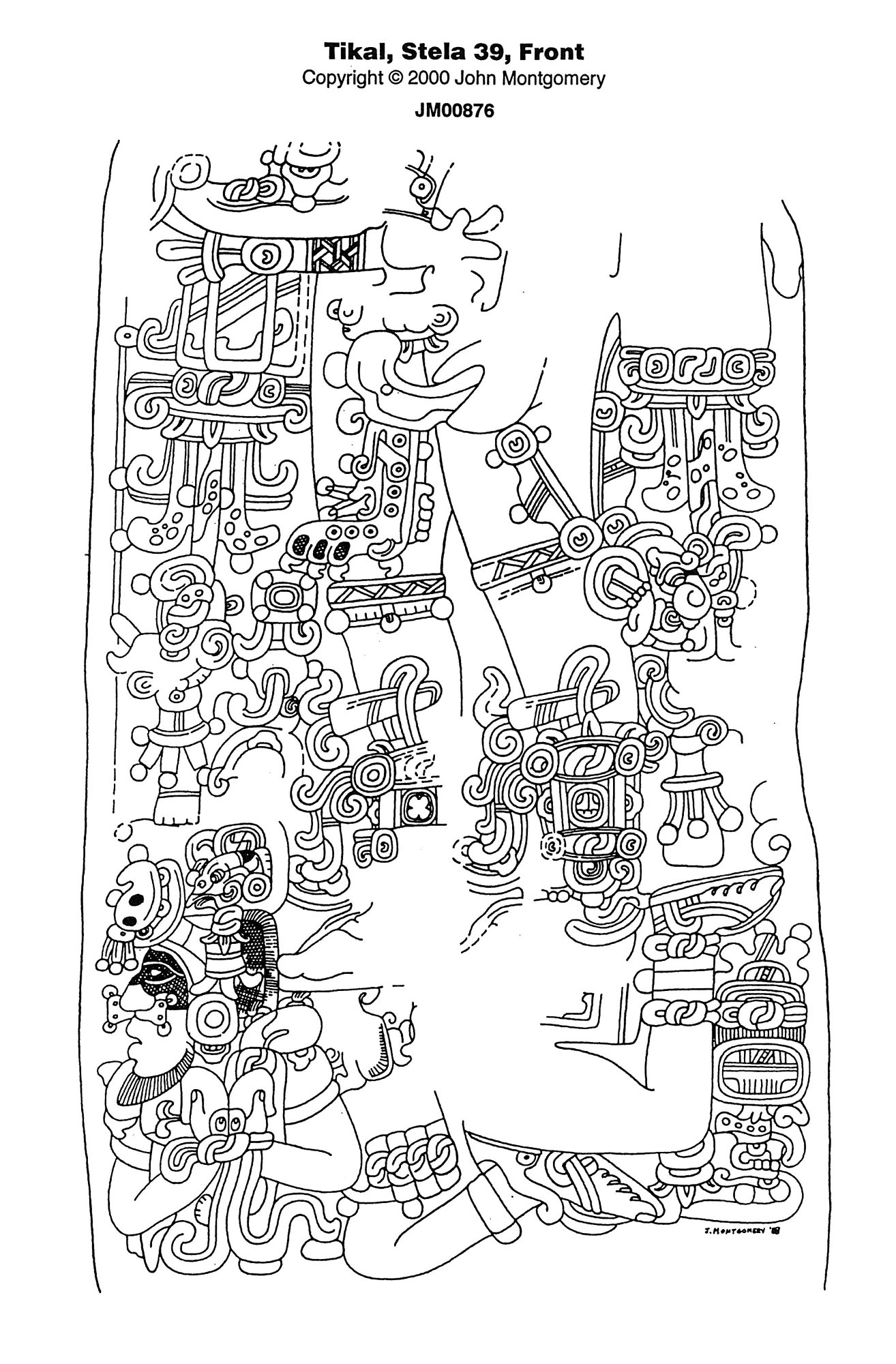
Blinding may not only have come from death. A captive with eyeband from Tikal Stela 39 could conceivably have received this torture at the hands of his captors (Figure 7; for the systematic blinding of captives, if in a Balkan context, see Holmes 2012). This was, to say the least, an immiseration that would hinder opponents and inflict broader psychological trauma.

Figure 7. A possible blinded captive on Tikal Stela 39, Guatemala (drawing by John Montgomery, FAMSI repository).


A captive who was likely blinded – his slit eye oozes with blood – occurs yet more clearly on a vase from the Ik’ kingdom of northern Guatemala (Figure 8).

Figure 8. Blinded captive, Ik’ kingdom, Guatemala, now in a private collection (photographer unknown).


That blindness was shown in Classic Maya text and imagery should not be surprising given the strong, positive emphasis on its opposite, the extromissive powers of sight (Houston et al. 2006:163-76). By comparison, there is, in recent literature on the senses, a latter-day deemphasis on sight, a dethroning of vision in favor of other senses (Jay 1993). To be “ocularcentric” is to miss larger worlds of perception and lend pernicious weight to “sensory normativity” (Petty 2021:297, 298). But the Maya might have disagreed: near-perfect humans were, according to mythic accounts from Highland Guatemala, capable of penetrative sight, to the extent of angering the gods of creation (Groark 2008:427-8). Removing that acuity, as the gods did, reduced the capacities of their hubristic creations. For most humans, death and sightlessness lay ahead in an inevitable future.

Acknowledgements  This essay benefited from comments by Charles Golden, Andrew Scherer, David Stuart, and Karl Taube.


References 

Aguilera, Carmen. 1996. The Matrícula de Huexotzinco: A Pictorial Census from New Spain. Huntington Library Quarterly 59(4):529-41.

Clifasefi, Seema L., Melanie K.T. Takarangi, and Jonah S. Bergman. 2006. Blind Drunk: The Effects of Alcohol on Inattentional Blindness. Applied Cognitive Psychology: The Official Journal of the Society for Applied Research in Memory and Cognition 20(5):697-704.

Coe, Michael D. 1974. A Carved Wooden Box from the Classic Maya Civilization. In Primera Mesa Redonda de Palenque (Part II), edited by Merle Greene Robertson, pp. 51–58. Pebble Beach, CA: Robert Louis Stevenson School, Pre-Columbian Art Research.

Golden, Charles, Andrew K. Scherer, Stephen HoustonWhittaker SchroderShanti Morell-HartSocorro del Pilar Jiménez ÁlvarezGeorg Van KolliasMoises Yerath Ramiro TalaveraMallory MatsumotoJeffrey Dobereiner, and Omar Alcover Firpi. 2020. Centering the Classic Maya Kingdom of Sak Tz’i’. Journal of Field Archaeology 45(2):67-85, DOI: 10.1080/00934690.2019.1684748

Groark, Kevin P. 2008. Social Opacity and the Dynamics of Empathic In-Sight among the Tzotzil Maya of Chiapas, Mexico. Ethos 36(4):427–48.

Grube, Nikolai. 2004. Akan: The God of Drinking, Disease, and Death. In Continuity and Change: Maya Religious Practices in Temporal Perspective, edited by Daniel Graña Behrens, Nikolai Grube, Christian M. Prager, Frauke Sachse, Stefanie Teufel, and Elisabeth Wagner, pp. 59-7. Mark Schwaben: Verlag Anton Saurwein.

__ , and Werner Nahm. 1994. Census of Xibalba: A Complete Inventory of Way Characters on Maya Ceramics. In The Maya Vase Book: A Corpus of Rollout Photographs of Maya Vases, Volume 4, edited by Barbara Kerr and Justin Kerr, pp. 686–715. New York: Kerr Associates.

Holmes, Catherine. 2012. Basil II the Bulgar-slayer and the Blinding of 15,000 Bulgarians in 1014: Mutilation and Prisoners of War in the Middle Ages. In How Fighting Ends: A History of Surrender, edited by Holger Afflerbach, and Hew Strachan, pp. 85-98. Oxford: Oxford University Press.

Houston, Stephen, and Marc Zender. 2018. Touching Text in Ancient Mexican Writing. Maya Decipherment: Ideas on Maya Writing and Iconography – Boundary End Archaeological Research Center.

Jay, Martin. 1993. Downcast Eyes: The Denigration of Vision in Twentieth-Century French Thought. Berkeley: University of California Press.

Kanda, Fusae. 2005. Behind the Sensationalism: Images of a Decaying Corpse in Japanese Buddhist Art. The Art Bulletin 87(1):24–49. http://www.jstor.org/stable/25067154.

Laureys, Steven. 2007. Eyes Open, Brain Shut. Scientific American 296(5):84-89.

Petty, Karis J. 2021. Beyond the Senses: Perception, the Environment, and Vision Impairment. Journal of the Royal Anthropological Institute 27(2):285-302.

Prem, Hanns J. 1974. Matrícula de Huexotzinco: Ms. mex. 387 der Bibliothèque Nationale Paris: Ed., Kommentar, Hieroglyphenglossar. Graz: Akademische. Druck- u. Verlagsanstalt.

Stuart, David, Stephanie M. Strauss, and Elliot Lopez-Finn. 2017. “Art from the Ancient East: Echoes of Classic Maya Writing and Iconography in Aztec-Period Aesthetics.” Paper presented at the University of Texas, Austin, Maya Meeting, Tlillan Tlapallan: The Maya as Neighbors in Ancient Mesoamerica, Jan. 14, 2017, Austin, Texas.

Wood, Stephanie, ed. 2020-present. Visual Lexicon of Aztec Hieroglyphs. Eugene: Wired Humanities Projects, University of Oregon, Version 1.0.

Design Transfer and the Classic Maya

Stephen Houston (Brown University)

Printing designs on textiles goes far back in time. An example at the Hunan Provincial Museum in China dates to the Western Han dynasty in the 2nd century BC. Likely produced by stencil, it reveals the ease of reproducing designs in this way but also the need, in places, for hand-coloring and fussy adjustment. More than just hastening the process, it yields a pleasing consistency, an orderly repetition of pattern. But it was seldom the act of one person.

Think of a Japanese print, be it an ukiyo-e (Edo-period) or shin-hanga (Meiji and post-Meiji Japan). Despite many museum labels, The Great Wave off Kanagawa, by Hokusai, was not literally by his hand. Hokusai made the original drawing, which was destroyed when a carver attached it to a board and set to work, highlighting the original inkwork while shaving down the background. Another person, a printer, then created what we see today, building on the help of assistants of varying status, in a production supervised by a publisher who took most of the profit (Salter 2002:11, 37, 60, 64).[1] Such complexities must also have entered into textile printing at the time of Hokusai, and earlier still in China and India (Riello 2010:8-9).  

The question is, did block-printing or, more broadly, design transfer occur among the ancient Maya? Evidence of a direct sort is poor. Bark cloth, which must have been abundant, judging from implements to make it, is almost impossible to find archaeologically, although it is well-attested among groups such as the Lacandon of Chiapas, Mexico (Moholy-Nagy 2003:figs. 101-105; Soustelle 1937:60-62, pls. ID, VA, VIC; Tozzer 1907:fig. 1, 129; see also Tolstoy 1963). For their part, early Maya textiles are only preserved under exceptional circumstances. They might occur in water-logged deposits, well-aerated caves, or endure by contact with metal or as decayed impressions visible on other objects (e.g., Johnson 1954; Lothrop 1992; Morehart et al. 2004; Ordoñez 2015). This means that Maya textiles survive in limited samples, although they are frequently depicted in ways that reflect their cut, color, and kind of weave (e.g., Halperin 2016). The quantities of such cloth must have been staggering, and not just for dress, costume or sacrificial offerings. Renderings of textiles on walls at Xelha, Quintana Roo, and suspension holes for cloth at Palenque, Chiapas, point to the wide use of such materials as changeable wall hangings (Anderson 1985; Ruiz Gallut 2001:lám. 13). When exposed, such textiles could not have lasted long. Soon mildewed, soggy, and faded, they would need replacement on a regular basis.

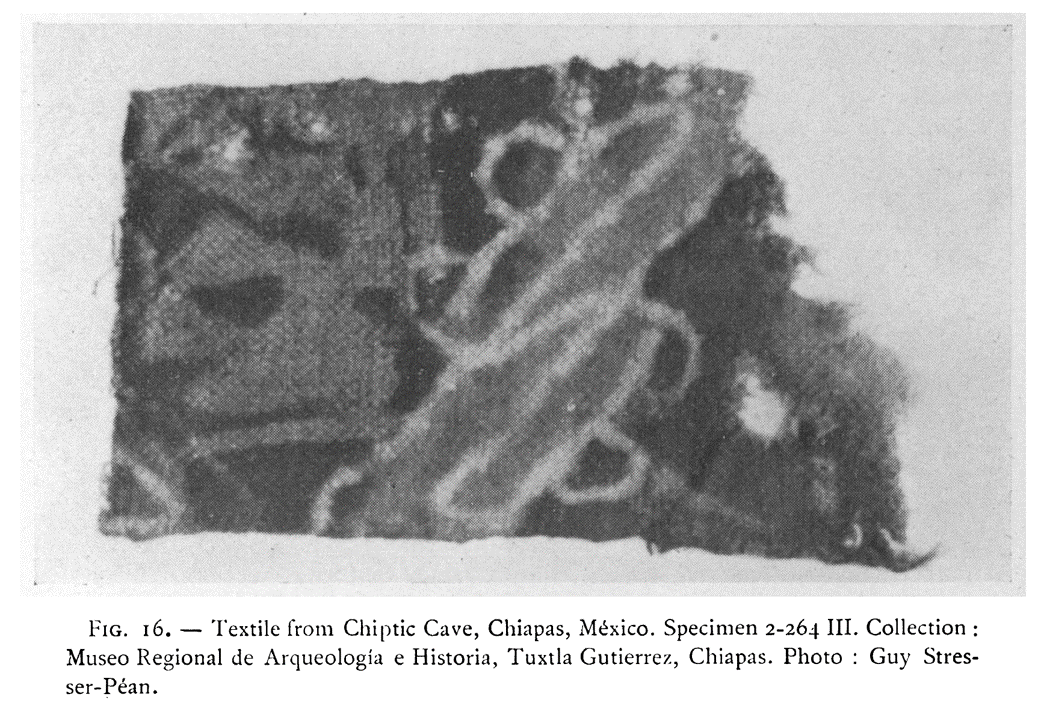
The direct and indirect evidence is that textile threads were colored with dyes, and, as added decoration, when weaving was finished, with freehand and resist painting, a technique attested in cave finds from Chiapas, Mexico (Figure 1, Johnson 1954:fig. 16; see also Filloy Nadal 2017:36). There is no question that the Classic Maya painted textiles and, in a few instances, tagged the calligraphers or the owners of clothing….if in coy ways that never identified such people. Names curl out of view or hide behind other items of dress (see Miller and Brittenham 2012:230, 233 [Captions I-5B, I-5C, I-49B]; Tokovinine 2012:70-71, figs. 32-33; note that such labels probably marked garments passing through tributary networks).

Figure 1. Textile from Chiptic Cave, Chiapas, Mexico, with use of resist paint (Johnston 1954:fig. 16).


There is a paradox, however. Surviving textiles and images show few clear signs of block-printing and its tidy repetitions. Yet there are archaeological objects, all of rugged or durable ceramic, that must have been used for printing or stamping.[2] Several are cylinders, with step-fret designs that are common on textiles and well-suited to the warp-weft constraints of weaving. Such cylinders extend deeply into the Mesoamerican past (Field 1967:22-38). That these cylinders were used in body painting seems improbable. If charged with pigment, they would have left messy or indistinct patterns with their expansive fields of color, and the designs on the cylinders are step-fret or of fragrant blossoms attested on other textiles (e.g., Filloy Nadal 2017:fig. 34). In any case, all images of body painting involve brushes (e.g., K1491, K4022).

Three cylinders occur in the probable tomb of a princess or queen at the site of Buenavista del Cayo, Belize; the tagged weaving bones in that burial hint that such designs might also have been rolled over textiles created by high-ranking women (Figure 2, Ball and Taschek 2018:485-487, fig. 14; see also Moholy Nagy 2008:fig. 219l).

Figure 2. Ceramic roller-stamps, Burial BV88-B13; note that each design could also be applied in inverted orientation (drawings by Jennifer Taschek, in Ball and Taschek 2018:fig. 14).


Others were flat stamps that, more than the cylinders, would have been ill-suited for use on human bodies. A large set was discovered in Tomb 6, a royal burial in Structure II, Calakmul, Mexico (Figure 3, Carrasco Vargas 1999:31). With their figuration, the Calakmul examples are anomalous in comparison to other stamps, a hint of varied, more narrative or setting-oriented imagery on stamped materials. As at Buenavista del Cayo, this less well-reported tomb contained weaving bones and was said unequivocally to hold the remains of woman, perhaps the spouse of the ruler. These finds of weaving implements and stamps, flat or cylindrical, suggest that stamping was a gendered activity among the Classic Maya. Its tools were linked to the process of finishing textiles, and large areas of cloth or barkpaper could be decorated with both speed and care. Nonetheless, as in Japan and elsewhere, more than one person presumably wove, made stamps, concocted pigments, and pressed them onto textiles. The volume of production and need for varying expertise may have demanded it…and an elite or royal lady would not have operated without servants. There is also a suspicion, challenging to prove, that the stamps at Calakmul and at other sites formed part of a much larger inventory during the Classic period. In India, at least historically, most stamps or blocks were of wood, and these would have disappeared long ago in the Maya Lowlands (Lewis 1924:1-2; see [2]).

Figure 3. Flat stamps with water lily creature, hummingbirds over cavity, Venus sign, spirals, and full-frontal images of Teotihuacan-style warrior; from possible burial of royal woman, Tomb 6, Structure II, Calakmul, Campeche; on display, Museo Arqueológico, Fuerte de San Miguel, Campeche, Mexico (photograph by Stephen Houston).


A unique illustration of direct transfer exists in the collection of the Museo Regional de Yucatán, Palacio Cantón (Figure 4); see Mediateca INAH, CC BY-NC). It has no provenience but appears to be a slateware, possibly Muna or Dzitas Slate, the latter associated with Chichen Itza, Yucatan–the dish would need closer study to establish its precise affiliation (George Bey, personal communication, 2023). The central element is a sign for k’in, “sun,” but also, more telling here, for NIK[TE’] or NICH[TE’], “flower.” An extraordinary touch is that the interior rim has a series of designs in which, not a brush, but a flower has been dipped in ink and repeatedly pressed into the surface. The flower itself is difficult to identity yet could relate to the Asteraceae family of plants (Shanti Morell-Hart, personal communication, 2023). The double reference in image and mode of decoration is likely to be deliberate. Perhaps this flowery ceramic was intended to contain flowers, as seen in one mythic scene with an anthropomorphic hummingbird and a youthful God D (K8008). The repeated design itself might have triggered a synesthetic sense of fragrance. The flower on the dish served as its own instrument of depiction; the central glyph nailed the floral reference and standardized it into canonical form.

Figure 4. Painting with flowers on a dish, Museo Regional de Yucatán, Palacio Cantón, Mérida. Mediateca INAH, CC BY-NC.


Whether this object has any parallels remains unclear. There are two images that show scribal gods dipping (or having dipped) an undulating, near-vegetal “brush” into a conch inkwell (Figure 5). They cannot be conventional brushes but do open unexpected possiblities for the toolkit of Maya painters.

Figure 5. Two scribal deities dipping or flourishing near-vegetal “brushes” (images from Justin Kerr Maya archive, Dumbarton Oaks, Trustees for Harvard University, Washington, DC, CC BY-SA 4.0).


Acknowledgments   My new colleague at Brown, Shanti Morell-Hart, assisted with the flower identifcation, and George Bey and William Ringle helped to type and possibly date the plate in the Palacio Cantón, Mérida. Joanne Baron kindly forwarded a high-resolution image of a Kerr photograph.


[1] An exception would be the sōsaku-hanga (“creative-prints”) of the early 20th century in Japan. These were painted, carved, and printed by a single artist, often inflected by Western art and its focus on individual production (Binnie 2013:65).

[2] These were probably not the only such blocks. As in India, examples in wood may have been far more numerous (Lewis 1924:1-2).

References

Anderson, Michael. 1985. Curtain Holes in the Standing Architecture of Palenque. In Fourth Palenque Round Table, 1980, edited by Elizabeth P. Benson, pp. 21-27. San Francisco: Pre-Columbian Art Institute.

Ball, Joseph W., and Jennifer T. Taschek. 2018. Aftermath A.D. 696—Late 7th and Early 8th Century Special Deposits and Elite Main Plaza Burials at Buenavista del Cayo, Western Belize: A Study in Classic Maya “Historical Archaeology.”Journal of Field Archaeology 43(6):472-491.

Binnie, Paul. 2013. The Legacy of Shin Hanga, by an Artist Working in the Tradition. In Fresh Impressions: Early Modern Japanese Prints, by Carolyn M. Putney, Kendall H. Brown, Koyama Shūko, and Paul Binnie, pp. 64-73. Toledo: Toledo Museum of Art.

Carrasco Vargas, Ramón. 1999. Tumbas reales de Calakmul. Ritos funerarios y estructura de poder. Arqueología Mexicana 7(40):28-31.

Field, Frederick V. 1967. Thoughts on the Meaning and Use of Pre-Hispanic Mexican Sellos. Studies in Pre-Columbian Art and Archaeology 3. Washington, DC: Dumbarton Oaks.

Filloy Nadal, Laura. 2017. Mesoamerican Archaeological Textiles: An Overview of Materials, Techniques, and Contexts. In PreColumbian Textile Conference VII / Jornadas de Textiles PreColombinos VII, edited by Lena Bjerregaard and Ann Peters, pp. 7–39. Lincoln: Zea Books.

Halperin, Christina. 2016. Textile Techné: Classic Maya Translucent Cloth and the Making of Value. In Making Value, Making Meaning: Techné in the Pre-Columbian World, edited by Cathy Coastin, pp. 431-463. Washington, DC: Dumbarton Oaks Research Library and Collection.

Johnson, Irmgard Weitlaner. 1954. Chiptic Cave Textiles from Chiapas, México. Journal de La Société Des Américanistes 43: 137–47.

Lewis, Albert B. 1924. Block Prints from India for Textiles. Anthropology Design Series 1. Chicago: Field Museum of Natural History.

Lothrop, Joyce M. 1992. Textiles. In Artifacts from the Cenote of Sacrifice, Chichen Itza, Yucatan, edited by Clemency C. Coggins, pp. 33-90. Memoirs, 10(3). Cambridge, MA: Peabody Museum of Archaeology and Ethnology, Harvard University.

Miller, Mary, and Claudia Brittenham. 2013. The Spectacle of the Late Maya Court: Reflections on the Murals of Bonampak. Austin: University of Texas Press; Mexico City: INAH and CONACULTA.

Moholy-Nagy, Hattula. 2003. The Artifacts of Tikal: Utilitarian Artifacts and Unworked Material. Tikal Reports 27B. Philadelphia: University Museum of Archaeology and Anthropology, University of Pennsylvania.

Moholy-Nagy, Hattula, with William R. Coe. 2008. The Artifacts of Tikal: Ornamental and Ceremonial Artifacts and Unworked Material. Tikal Reports 27A. Philadelphia: University Museum of Archaeology and Anthropology, University of Pennsylvania.

Morehart, Christopher T., Jaime J. Awe, Michael J. Mirro, Vanessa A. Owen, and Christophe G. Helmke. 2004. Ancient Textile Remains from Barton Creek Cave, Cayo District, Belize. Mexicon 26(3):5054.

Ordoñez, Margaret T. 2015. Appendix V: Textiles. In Temple of the Night Sun: A Royal Maya Tomb at El Diablo, Guatemala, by Stephen Houston, Sarah Newman, Edwin Román, and Thomas Garrixon, pp. 258-262. San Francisco: Precolumbia Mesoweb Press, San Francisco.

Riello, Giorgio. 2010. Asian Knowledge and the Development of Calico Printing in Europe in the Seventeenth and Eighteenth Centuries. Journal of Global History 5:1-28.

Ruiz Gallut, María Elena. 2001. Entre formas, astros y colores: aspectos de la astronomía y la pintura mural en sitios del área maya. In La Pintura Mural Prehispánica en México, II Área Maya, Tomo III, Estudios, edited by Leticia Staines Cicero, pp. 283-293. Mexico City: Instituto de Investigaciones Estéticas, Universidad Nacional Autónoma de México.

Salter, Rebecca. 2002. Japanese Woodblock Printing. Honolulu: University of Hawaii Press.

Soustelle, Jacques. 1937. La culture matérielle des Indiens Lacandons. Journal de la Société des Américanistes 29(1):1–95.

Tokovinine, Alexandre. 2012. Carved Panel. In Pre-Columbian Art at Dumbarton Oaks, Number 4: Ancient Maya Art at Dumbarton Oaks, edited by Joanne Pillsbury, Miriam Doutriaux, Reiko Ishihara-Brito, and Alexandre Tokovinine, pp. 68–73. Washington, DC: Dumbarton Oaks Research Library and Collection.

Tolstoy, Paul. 1963. Cultural Parallels between Southeast Asia and Mesoamerica in the Manufacture of Bark-cloth. Transactions of the New York Academy of Sciences 25:646–662.

Tozzer, Alred M. 1907. A Comparative Study of the Mayas and the Lacandones. New York: Macmillan Co.

Sun Shadows and Maya Stelae

Stephen Houston (Brown University)

For the ever-sunny George Stuart, on his birthday

Humans have long been intrigued by the sun, its shadows, and the ways of monitoring them over time. The reasons for that interest are obvious: by paying attention to the effects of the sun, observers could tell the time of day, determine the seasons, and separate or mark parts of the year. But how does one do such tasks precisely? In antiquity, this was mostly made possible by that “simplest” of “scientific instrument[s],” the gnomon (Isler 1991:155). Often little more than a vertical stick or pole, the gnomon cast little shadow at midday. But when the sun rose or fell, shadows extended considerably, and, if observed at equinoxes, aligned with reasonable accuracy to “true” east and west (Isler 1991:180; see also Dash 2017). In China, gnomons (gui biao) showed another innovation. Holes in them would be used to project shadows onto horizontal scales laid out north-south in relation to the vertical gnomon (Li and Sun 2009:1380, fig. 2).

A sundial focuses on the direction of shadows to establish the time of day.[1] More elaborate gnomons target the length of shadows, for this allows the time of year to be determined. In some cases, as in imperial China and early India, measurements of shadows were tabulated over centuries (Yano 1986:26), and the instruments to measure them could be large or even monumental. At Denfeng in Henan province, China, the horizontal scale ran over over 31 m (Li and Sun 2009:fig. 2). Places to observe the positions of the sun have been proposed for much of Mesoamerica, including: caves with overhead openings to permit the entry of sunlight; the celebrated “E-groups,” in part with solar orientations, that coalesced in the Preclassic period; buildings oriented towards sunrise events; and solstitial alignments in doorways at Yaxchilan, Mexico (e.g., Anderson 1981; Aylesworth 2015:787–789; Espinasa-Pereña and Diamant 2012:table 2; Zaro and Lohse 2005:89–93; Tate 1992:94–96). These involved observations, but whether they were “observatories” per se depends on whether a particular feature is “performative rather than practical, a theater rather than a laboratory, a planetarium rather than an observatory” (Aveni 2003:163). In other words, they might have borne witness to solar events, those almost miraculous synchronizations of light, shadow, and place. But they were not “scientific” instruments collecting data over time.

The focus on the sun and its diurnal passage may elucidate an unusual stela erected at the city of Machaquila, Guatemala. Dating to Dec. 2, A.D. 711 (Julian), this monument is, on its front and back, an almost square carving with a head protruding from its top (Figure 1, Graham 1967:87–88, figs. 33). At the bottom is a witz or “hill” element, an emblem of fixity. Just above floats the local king as the embodiment of lordly time at the close of a katun (20-year) period. The glyphs frame that day sign portrait of the ruler with a relatively unembellished, angular sky band that once contained glyphs, now in a poor state of preservation. (Many stylized sky bands take this shape, suggesting a rather rectilinear view of that part of the cosmos.) As for the head, it shows many characteristics of the Classic Maya Sun God: the large “eagle eyes,” possibly crossed (pupils closer to the nose), and a polished mirror-like element in the forehead. Notably, this is the first datable monument at Machaquila, and Andrés Ciudad Real and colleagues have wondered if this carving came just after the movement of the Machaquila dynasty from another location on the Pasión river to the southwest (Ciudad Ruiz et al. 2013:77). The ruler of this time was one Sihyaj K’in Chahk, or Chahk [being] Born from the Sun, a fact inferred from a statement of parentage on the all-glyphic Stela 11 at Machaquila (Graham 1967:fig. 63). Stela 11 dates 30 years after Stela 13, and the reference to this individual by a sequent ruler fits the chronology. That this ruler was “born” from an entity highlighted on the carving is unlikely to be a coincidence. Stela 11 faces west, so viewers would see the Sun God rising from the east, framed above the sky and the floating image, doubtless a portrait, of the current ruler. Much like Chahk, his namesake, the king grasps an axe. He evidently hovered above or was about to land on the firmament of Machaquila itself.

Figure 1. Machaquila Stela 13 (Graham 1967:figs. 66, 67).

A superb visualization by Andrés Ciudad Ruiz and colleagues reveals the setting of Stela 13  (Figure 2). To the west is a sunken quatrefoil, found on excavation to contain incensario fragments, whistles, and other ceremonial artifacts (Cuidad Ruiz et al. 2010:133–141). As Stuart and Houston noted long ago, this quatrefoil matches the place name of Machaquila (Stuart and Houston 1994:33, fig. 37). On another carving, Stela 10, Chahk looks up from that quatrefoil, in the face-up position assumed by newborns (Graham 1967:fig. 60). This could be another allusion to the first-known ruler at the city, a figure whose very name refers to birth (sihyaj). We do not know for certain, but the quatrefoil could have been basin that filled with water; after all, its excavators note that it was probably plastered at one time, an effective means of keeping water in place (Ciudad Ruiz et al. 2010:133). Behind Stela 13 is an arrangement of two buildings, Structures 17 and 16, numbered from north to south. The cleft between them aligns closely with the top of Stela 13.

Figure 2. Central Machaquila, showing Plaza A, Altar 4, Stela 13, and Structures 16 and 17 (reconfigured and emended from Ciudad Ruiz et al. 2012:figs. 6, 8).


This is where the Sun God’s head comes into play. It was not just a deity above a sky band but possibly a gnonom, in the narrow sense of a vertical device used to cast shadows. The sun would rise between the buildings behind the stela, and the shadow of the head thereby reach to quatrefoil in the plaza. For its part, the head would be surrounded by an aureole of light in the early morning. In a straight line from there to the other side of the plaza was a stone model of a cosmic turtle: Altar 4, a conventional representation of the terrestrial world (Graham 1967:92–95, figs. 71–74). The carvings and plaza must have been planned with this alignment in mind. As a sequence of carvings and hollows, Plaza A at Machaquila enchained the sun, time, water, and the earth’s rocky surface (Figure 3).

Figure 3. Map by Ian Graham, with emendations, of Stela 13 in relation to the mythic turtle, Altar A; the sunken quatrefoil lies in between (Graham 1967:fig. 42, with emendations).


The shape of Stela 13 has parallels in other sites that are relatively close by. Stela with such everted “tangs” are also documented at the related site of Cancuen, Guatemala, where the Machaquila Emblem is attested in joint use with another, more local title. That second Emblem might have first been used at Tres Islas, a small settlement between the two, larger communities of Machaquila and Cancuen. It was also a place evincing close attention to solar alignments. The three Early Classic stelae at Tres Islas clearly form a single composite image of a central figure over a cave with an ancestral female (Stela 2), flanked by two figures in the dress of Teotihuacan warriors (Stelae 1 and 3); the layout in turn evokes the composition and content of the front and sides of Tikal Stela 31, with the main difference being the separation at Tres Islas of one overall image into  three separate carvings. More to the point, the stelae at Tres Islas have been credibly tied to solar alignments (Barrios and Quintanilla 2008: 215–217; Tomasic et al. 2005:392–396). A viewing point from an altar just to the west would look east to the stelae. Behind them, the sun would rise at “true” east for the central stelae, at the equinoxes (or quarter year) for the other two.

At Cancuen, the tanged sculptures include Stelae 1 and 2 (both carved), and Stelae 5 and 8 (both “plain” or unadorned, Tourtellot et al. 1978:227–231). In all cases, these carvings were oriented with one side to the east, another to the west (Maler 1908:fig. 8; Morley 1937:pl. 196b; but note that Gair Tourtellot and colleagues [1978:fig. 5] situated Stela 1 facing south, a fact countered by earlier sources reporting on the site before its carvings were disturbed or moved). Much like Machaquila Stela 13, the tangs on the carvings could also serve as gnomons on an east-west orientation. Indeed, according to Sylvanus Morley, who visited Cancuen in 1915, Stelae 1 and 2 were placed in an east-west line with respect to each others (Morley 2021:230). Stela 1 has another relevant feature (Figure 4). The east side depicts a local queen, the west a later ruler of Cancuen (Maler 1908:pl. 13). Yet the stela also has two quite distinct holes made with obvious care by the sculptor(s); he (or they) visually accommodated the holes by surrounding them with smoky volutes. In addition, there were smaller holes along the side, prompting Maler to speculate that “victims were bound …to these stelae, the sacrifice probably being usually performed with the victim in an upright position” (Maler 1908:44). Such perishable attachments are known in imagery and on Stela 1 from Ixkun, Guatemala (Houston 2016; Stuart 2014), but the main holes hint at conduits for sunlight, in ways that recall the deliberate, calibrated perforations of Chinese gnomons. In China these were arranged north-south, so the parallel cannot be exact. Yet the orientation at Cancuen suggests at least some solar motivation for the holes. At dawn or sunset light would pass through, to shine on some surface in front or behind the stelae, and perhaps on each other.

Figure 4. Cancuen Stela 1, east and west (viewer’s left and right respectively, Maler 1908:pl. 13).


The suggestion that the Sun God head at Machaquila, the “tangs” at Cancuen, or the perforations on Stela 1 at that site operated as gnomons for light and shadow accords with their position, orientation, and imagery, especially at Machaquila. If gnomons, they could have been performative, even providing a kind of cosmic theater, but the play of light perhaps helped with observations too. A careful study of them is impeded by looting and displacement of carvings; many monuments are no longer in their original position. Nonetheless, it seems possible that, at sites far beyond Machaquila and Cancuen, the Maya choreographed and manipulated beams and shadows from the sun. Stelae were freestanding, yet, by such displays, in ways not yet fully studied or understood, they interacted with spaces and surfaces nearby.

[1] In a recent email, Walter Witschey, a Mayanist colleague, informs me that, for a time, he held the record for the largest analemmatic (graduated scale) sundial ever made: “for size (1/3 acre)[,] gnomon height (25′)[,] and accuracy (30 sec midday and 5 sec early morning and late afternoon).” Clearly, this is not an exhausted skill or art form. After this was first posted, Kristin Landau also drew my attention to an intriguing paper on Copan Stela D as a possible gnomon (Pineda de Carías et al. 2017). 

References

Anderson, Neal S. 1981 The Solar Observatory at Xochicalco and the Maya Farmer’s Almanac. Archaeoastronomy 4(2):22–25.

Aveni, Anthony F. 2003. Archaeoastronomy in the Ancient Americas. Journal of Archaeological Research 11(2):149–191

Aylesworth, Grant R. 2015. E-Group Arrangements. In Handbook of Archaeoastronomy and Ethnohistory, edited by Clive L. N. Ruggles, pp. 783–791. New York: Springer.

Barrios, Edy, and Claudia Quintanilla. 2008. Tres Islas: Un pequeño centro de comercio de las Tierras Bajas en el río Pasión, Sayaxche, Petén. In XXI Simposio de Investigaciones Arqueológicas en Guatemala, 2007, edited by Juan Pedro Laporte, Bárbara Arroyo, and Héctor Mejía, pp. 214–238. Guatemala CityÑ Museo Nacional de Arqueología y Etnología.

Ciudad Ruiz, Andrés, Alfonso Lacadena García-Gallo, Jesús Adánez Pavón, and Ma. Josefa Iglesias Ponce de León. 2010. Espacialidad y ritual en Machaquilá, Petén, Guatemala. In El ritual en el mundo maya: de lo privado a lo público, edited by Andrés Ciudad Ruiz, Ma. J. Iglesias Ponce de Léon, and Miguel Sorroche Cuerva, pp. 129–151. Madrid: Sociedad Española de Estudios Mayas-Grupo de Investigación, Andalucía-América-Centro Peninsular en Humanidades y Ciencias Socials, UNAM.

——. 2013. Crisis y supervivencia en Machaquilá, Petén, Guatemala. In Millenary Maya Societies: Past Crises and Resilience, edited by M.-Charlotte Arnauld and Alain Breton, pp. 73–91 (on Mesoweb).

Dash, Glen. 2017. Occam’s Egyptian Razor: The Equinox and the Alignment of the Pyramids. Journal of Ancient Egyptian Architecture 2:1–8.

Espinasa-Pereña, Ramón and Ruth Diamant. 2012. Possible Use of a Lava Tube as a Zenithal Observatory Near Cantona Archaeological Site, Puebla, Mexico. Latin American Antiquity 23(4):585–596.

Isler, Martin. 1991. The Gnomon in Egyptian Antiquity. Journal of the American Research Center in Egypt 28:155–185.

Graham, Ian. 1967. Archaeological Explorations in El Peten, Guatemala. Middle American Research Institute, Publication 33, New Orleans: Tulane University.

Houston, Stephen. 2016. Maya Stelae and Multi-Media. Maya Decipherment: Ideas on Ancient Maya Writing and Iconography.

Li, Yong, and Xiao-Chun Sun. 2009. Gnomon Shadow Lengths Recorded in the Zhoubi Suanjing: The Earliest Meridian observations in China? Research in Astronomy and Astrophysics 9(12):1377–1386.

Maler, Teobert. 1908. Explorations of the Upper Usumatsintla and Adjacent Region: Altar de Sacrificios; Seibal; Itsimté-Sácluk; Cankuen. Reports of Explorations for the Museum, Memoirs 4(1). Cambridge, MA: Peabody Museum of American Archaeology and Ethnology, Harvard University.

Morley, Sylvanus G. 1937. The Inscriptions of Peten, Volume V, Part 2, Plates. Publication 437. Washington, D.C.: Carnegie Institution of Washington.

——. 2021. The Archaeological Field Diaries of Sylvanus Griswold Morley, 1914–1916, edited by Prudence M. Rice and Christopher Ward, Mesoweb.

Pineda de Carías, María C., Nohemy L. Rivera, and Cristina M. Argueta. 2017. Stela D: A Sundial at Copan, Honduras. Ancient Mesoamerica 28(2):543-557. DOI: https://doi.org/10.1017/S0956536116000286

Stuart, David. 2014. Notes on a Sacrifice Scene. Maya Decipherment: Ideas on Ancient Maya Writing and Iconography.

——, and Stephen Houston. 1994. Classic Maya Place Names. Studies in Pre-Columbian Art and Archaeology 33. Washington, D.C.: Dumbarton Oaks Research Library and Collection.

Tate, Carolyn E. 1992. Yaxchilan: The Design of a Maya Ceremonial City. Austin: University of Texas Press.

Tomasic, John, Claudia Quintanilla, and Edy Barrios. 2005. Excavaciones en el sitio arqueológico Tres Islas, Río Pasión, Petén. In XVIII Simposio de Investigaciones Arqueológicas en Guatemala, 2004, edited by Juan Pedro Laporte, Bárbara Arroyo, and Héctor Mejía, pp. 403–412. Guatemala: Museo Nacional de Arqueología y Etnología.

Tourtellot, Gair, III, Jeremy A. Sabloff, and Robert Sharick. 1978. A Reconnaissance of Cancuen. In Excavations at Seibal, Department of Peten, Guatemala, edited by Gordon R. Willey, pp. 191–240. Memoirs 14(2). Cambridge, MA: Peabody Museum of Archaeology and Ethnology, Harvard University,

Yano, Michio. 1986. Knowledge of Astronomy in Sanskrit Texts of Architecture (Orientation Methods in the Īśānaśivagurudevapaddhati). Indo-Iranian Journal 29(1):17–29.

Zaro, Gregory, and Jon C. Lohse. 2005 Agricultural Rhythms and Rituals: Maya Solar Observation in Hinterland Blue Creek, Northwestern Belize. Latin American Antiquity 16(1):81–98.

Captains of the Team

Stephen Houston (Brown University) and David Stuart (University of Texas, Austin)


Sporting events are much in mind these days, as we watch the end of the Tokyo Olympics. There is exhaustive training that leads to heartbreak or a medal and coveted position on the podium. But it is the team events that crowd with social drama, including athletes who languish on the bench and others, the captains, who toss the coin, lead the charge, and argue with referees. Not surprisingly — there is much money and prestige involved — scholars of sports give occasional thought to who might be chosen captain. The tasks are heavy, and selection cannot be undertaken lightly (Cotterill and Cheetham 2016), yet bonds of affection and kinship, a mistaken evaluation of someone for leadership, tend to operate more often than not (Fransen et al. 2019). The wrong person is put in charge, bungles things, and is kept there only by social pressures. Yet prowess comes into play as well. Leadership might be bestowed, as in soccer, on stars who manage better than others to dribble around opponents and land a shot, or, in the sports that involve horses, bring a team of them past the finish mark. Many dead Romans are forgotten, but not so Gaius Appuleius Diocles, who, in the early 2nd century AD, raced his chariot to many victories and a fortune greater than that of many Roman senators (Bell 2014:498; Struck 2010). A cunning and aggressive competitor, Diocles might lead from the beginning of the race (occupavit et vicit), dart around in the final moments (eripuit et vicit) or accelerate from far behind to swift victory (successit et vicit; Devitt 2019:186 fn.488).

For Maya ballplay, there is growing awareness of how big rubber balls might be — very big, as pointed out by Michael Coe (2003) — and the various acts by which they were thrown, yahlaj or possibly tz’ohnaj(?) being two such motions (see Beliaev and Houston 2020:fn.1; Stuart 1997; for an alternative reading of the second as jatz’naj, see Taube and Zender 2009:202–203, fig. 7.24; Zender 2004). There may even be an expression for the kneeling that takes place when a player is about to strike a ball, as on the Colonia La Esperanza marker from Chiapas, Mexico (Figure 1, Kowalski 1989:22fn.1). The text reads u-BAAH ta-OCH-K’AHK’ ta-ke-hi-na?, u baah ta ochk’ahk’ ta kehiin?, “his image/body in [the act] of fire-entering, in [the act] of… That final element recalls colonial Tzoztil, kejan ba, “bow, kneel” and kejel, “to be kneeling,” along with kehi, “kneel,” kehleh, “kneeling,” and kehuh, “genuflect” in present-day Tzotzil (Laughlin 1975:171; 1988, I:22); for its part, Tzetal has kejaj, “kneel,” and kejel, “kneeling” (Berlin and Kaufman 1997:35). The ballplayer is both dedicating the marker (or its court[?]) through the ritual of och-k’ahk’, “fire-entering” (Stuart 1998:387–389), and referring to the kneeling shown on the stone.

Figure 1 Colonia La Esperanza Ballcourt Marker (right, cropped photograph by Wolfgang Sauber, Creative Commons; close-up, lower center, photograph by Stephen Houston).

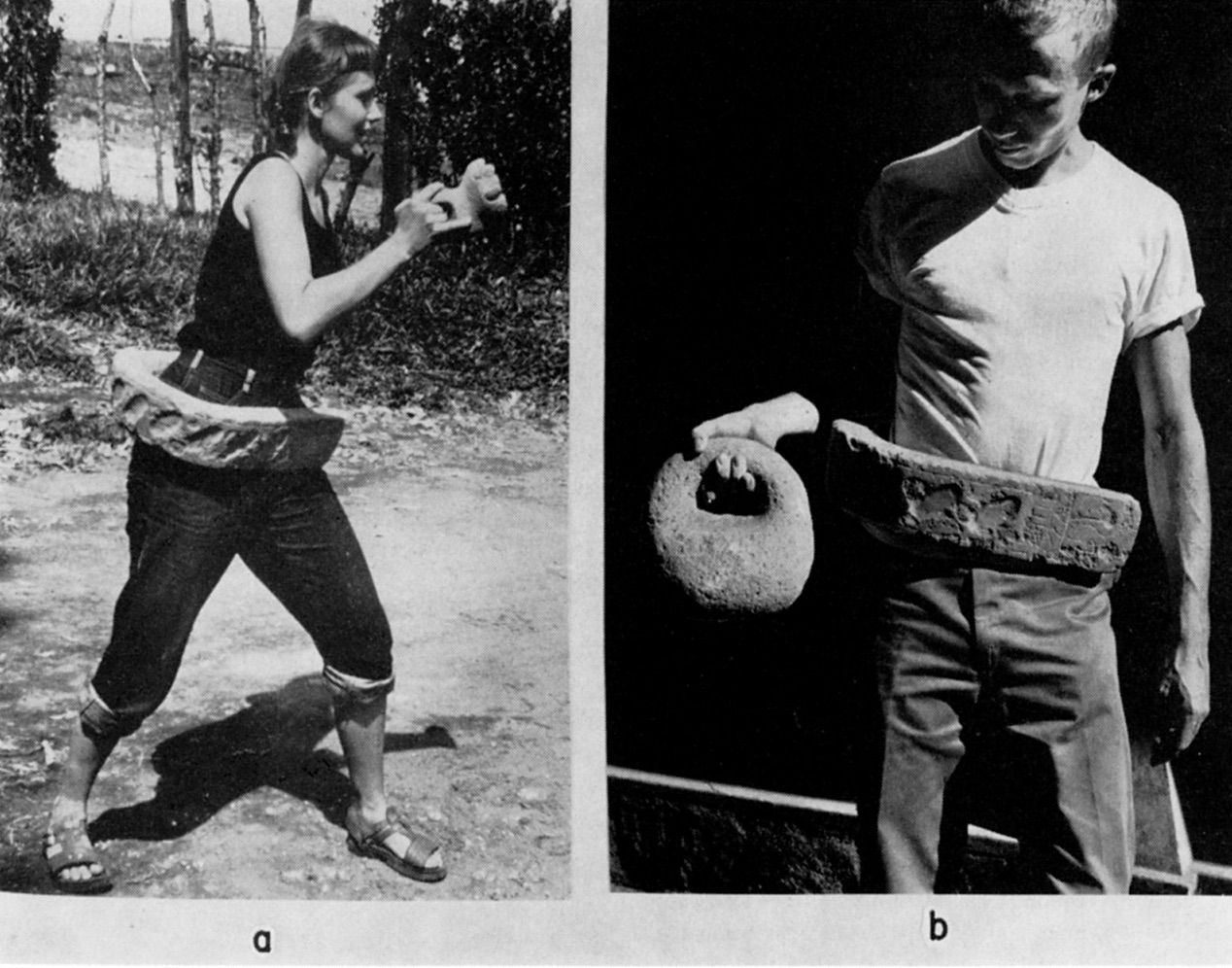
An important essay by Karl Taube and Marc Zender (2009) details the many acts of violence that took place in Maya ballcourts. An equally useful essay by Christophe Helmke and colleagues (2018) studies the equipment for the game. As scholars have long noted, a divide appears to exist in such gear. To one side are perishable originals, including the apparent “yoke” (yugo) or hip-protector found by chance as a cavity left by decay in the fine matrix of Burial 195 — this was the probable tomb of “Animal Skull” (K’inich Wawa’n[?] Ahk Bahlam) at Tikal, Guatemala (Guillemin 1968; Moholy-Nagy, with Coe 2008:66, fig. 231b, #12U-106/27; its plaster and gesso would lighten weight but presumably also flake and crack under vigorous use). Then there are the skeuomorphs, the imperishable versions in stone of which several have been found at Maya sites (Cruz Romero 2012; Shook and Marquis 1996:27–59). The “yuguitos” or “small yugos,” for example, appear to reproduce the knee pads worn by players while kneeling. If used, however, they would quite smash, in patellar agony, the body part they were supposed to protect (Helmke et al. 2018:12–13, fig. 6). There is a proposal that stones were worn but in slower ritual movement, in evocations of actual ballplay but without its actual, herky-jerky violence (for debates on wearability, see Alegría 1951:349; Clune 1963; Ekholm 1946, 1961). Gordon Ekholm notes that, despite their 18 to 27 kilo weight, many yokes might be worn around the hips provided the user were “not an exceptionally large person and still retains a certain athletic slimness… [of] non-civilized peoples” (Ekholm 1946:596). The most fetching illustration of this comes from an article by Stephan De Borhegyi, which shows a suitably slim man and woman — the author and his wife, Suzanne? — decked out in such gear (Figure 2).

Figure 2 Stone yokes and manopolas (saps) in use, in photographs from 1948 (a) and 1959 (b); equipment from El Baúl, Guatemala (De Borhegyi 1964:fig. 1).

Looking at all ballgear is beyond the reach of a blog. But a glyphically embellished find from the site of Bolonk’in, not far from Chilón, Chiapas, raises the question of what to call the yoke (Figure 3, Shesheña and Lee Whiting 2004; the image, although missing a few glyphs, such as a 7 Imix day sign, is beautifully redrawn in Helmke et al. 2018:fig. 5). The shell glyphs on the yoke were inlaid (Shesheña and Lee Whiting 2004:fig. 1) and leave little doubt, as others have explained, that this is a name-tagged object belonging to the subordinate of a ruler of Tonina, Mexico (Helmke et al. 2018:11–12). The key element is the first glyph block in the text below. On the basis of a recent decipherment, it must read u-ya’-tuun, not u-tun-‘a or some other possibility (see Grube 2020:fig. 7). A proposal by Stuart, YA’ or ya’, is securely tied to concepts of “pain” in some readings, and this meaning seems valid in many contexts (Beliaev and Houston 2020; see also Grube 2020). But Maya glyphs also employ homophones. That principle of substitution may operate here.

Figure 3. Text of shells on a yugo reputed to be from Bolonk’in, Chiapas, Mexico; u-[YA’]- ‘a-TUUN-ni ya-ja-K’UH-na ya-AJAW-TE’ pi-tzi-la K’INICH-CHAPAAT-BAAKNAL-CHAHK (drawing by Christopher Helmke [Helmke et al. 2018:fig. 5).

A perusal of Mayan dictionaries reveals an entry of *jol ya’ for “cadera” or hip in Ch’ol (Aulie and Aulie 1998:121; see also b’äkel ya’ “cadera” in Hopkins et al. 2010:15). The use of “head” (jol) to preface body parts, or rather, parts of body parts, occurs in Ch’orti’ as well: jor-b’aker, “hip,” and jor-pik, “waistband area of a skirt” (Hull 2016:178; see also Wisdom n.d.:471 [hor uya’, “hipbone, hip”], 477 [ikar uor uya’, “aigre (night air, malady) of thigh or hip”], and  577 [bahk uya’, “hip joint”] with thanks to Dmitri Beliaev [personal communication, 2022] for recalling the Wisdom sources to us). The term ya’ for “hip” is probably also documented as ‘o’il, “hip” in Tzotzil, a language with well-attested variance between /a/ and /o/ phonemes (Laughlin 1975:452), and in Ch’ol terms for “thigh,” i ya’ (Warkentin and Scott 1980:116), and a,”muscle/thigh” in Ch’olti’ (Robertson et al. 2010:331), to which might be added, from Tzeltal, a’, “thigh (muslo in Spanish [Polian 2020, a source also recalled to us by Beliaev). Thus, the term on the yoke is not “pain” but “hip”—indeed, a “hip-stone,” as shown in De Borhegyi’s playful image.

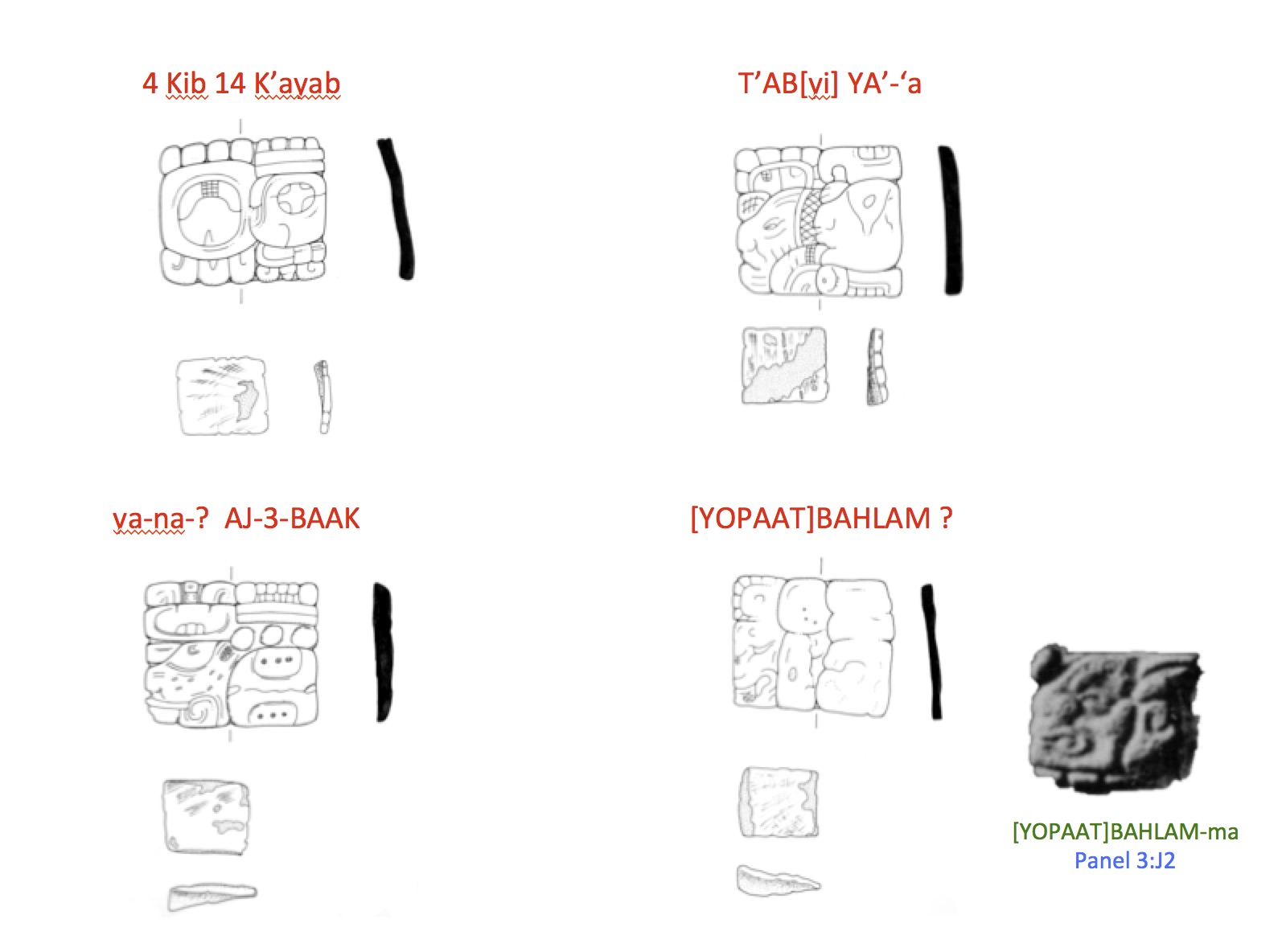
The reading opens many possibilities. An issue with reading ya’ as “pain” is that objects were clearly involved in a number of texts. There were things taken or received, ch’am, or, in one instance, name-tagged to a long-decayed backing (Beliaev and Houston 2020:figs. 4c, d). The exquisite shells from Piedras Negras offer a test-case of this. Found by Héctor Escobedo in the first days of a multi-year project with Houston, these proved eventually to come from the tomb of a ruler at the city, Itzam K’an Ahk, a.k.a. “Ruler 4” in the ordering of Tatiana Proskouriakoff (Figure 4, Escobedo 2004:279). Further study of these shells led to the realization that they mentioned Yopaat Bahlam, the “missing” king of Yaxchilan who was recorded on Panel 3 at Piedras Negras (Martin and Grube 2008:149; Martin 2020:134). The date in the first glyph is likely 9.15.15.10.16, Jan. 3, AD 747, one of the few calendrical records for a lord otherwise erased from Yaxchilan’s official history. But it is the name tag that is relevant here, for it displays ya’ with its prefixed (and purely iconic) obsidian blade, along with a subfixed ‘a to reinforce the reading.


Figure 4. Shells from Burial 13, Structure O-13, Piedras Negras; glyph to lower right from Panel 3:J2 (drawings by Stephen Houston, photograph from the University of Pennsylvania Museum Archive, use courtesy of Jeremy Sabloff).

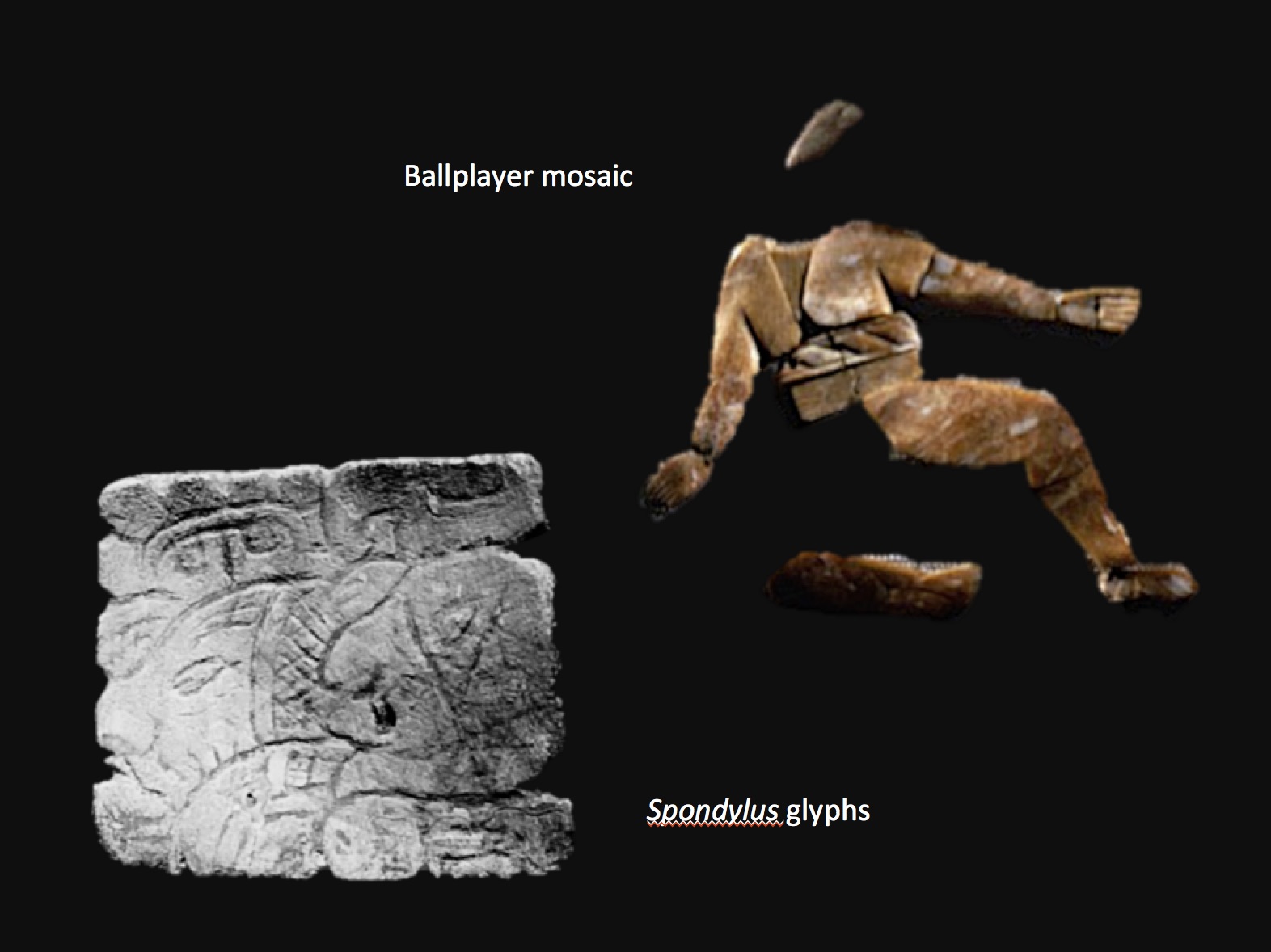
In the same tomb is the mosaic, also in Spondylus shell, of a ballplayer pieced together by Zac Hruby, the lithicist for the Piedras Negras Project (Figure 5). It seems plausible that the glyphs pertain to this image, and that the shells once fitted either into a perished tableau of ballplaying or, as seen enduringly in the Bolonk’in piece, a long-disappeared yoke. The ya’ simply referred to “hip” but also to the “yoke” that simulated and protected this body part. (In English, by a similar convention,”girdle” refers to the pelvis but also to an item of clothing encircling the waist.) Yopaat Bahlam came to visit Piedras Negras — did he also play there or provide a piece of ballgame gear to the local king? Or was it won as a trophy in play? It was certainly valued enough to be included in his host’s tomb.

Figure 5. Mosaic ballplayer in Spondylus shell, Burial 13, Piedras Negras, along with relevant glyphs, T’AB[yi]-YA’-‘a (photograph to left, Jorge Pérez de Lara, to right, Kenneth Garrett).

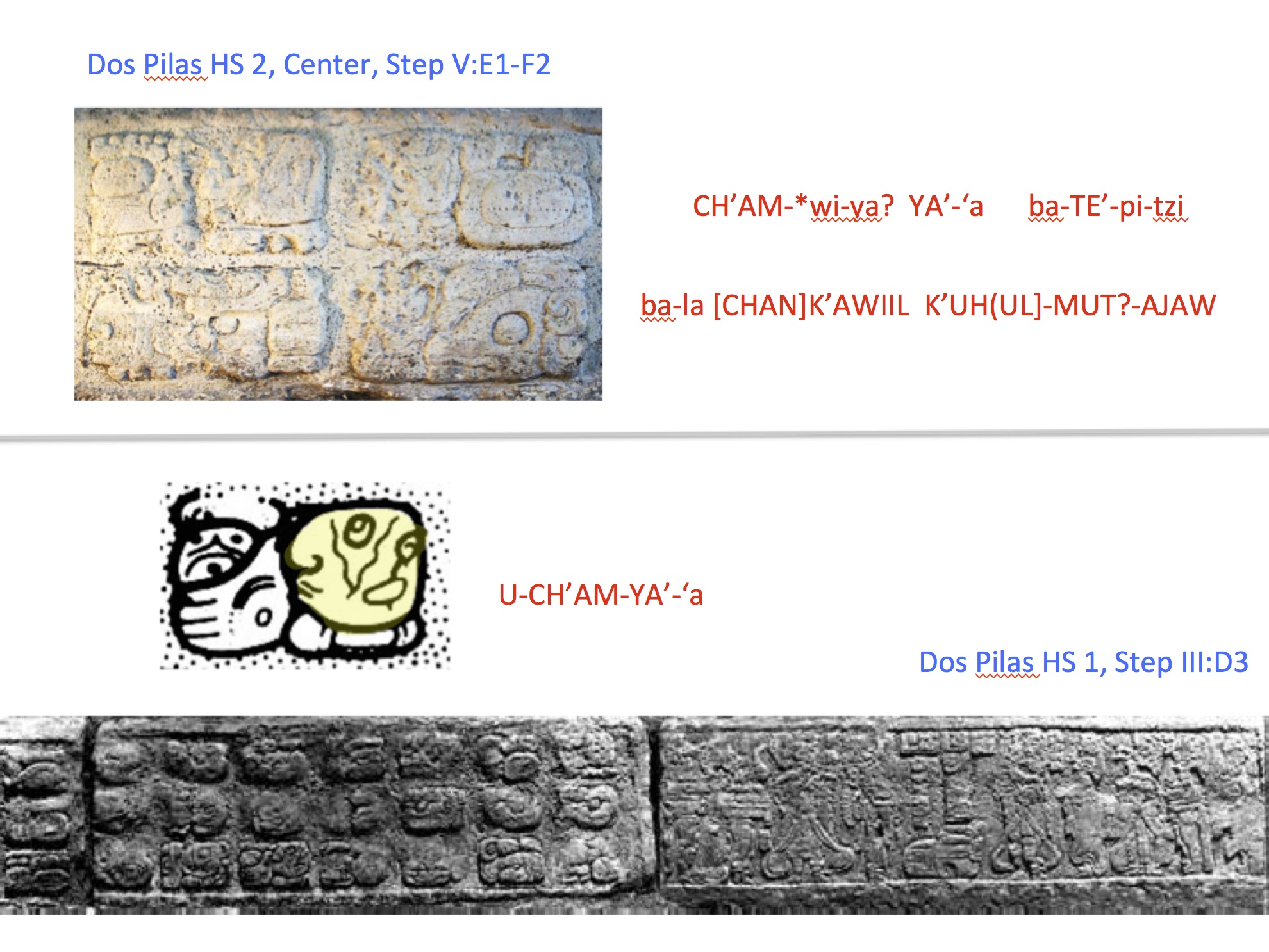
Dos Pilas, Guatemala, also has ya’ spellings that cue a concrete, portable object and affirm a link to ballplay (Figure 6). The earliest known monumental inscription at the city, Hieroglyphic Stairway 2, Center, refers to a ch’am “take, receive” event with a probable yoke at 9.10.10.16.9 4 Muluk 2 Mak, Oct. 29, AD 643. At this juncture, the local Lord, Balaj Chan K’awiil, was 18 years old and, a few years before, at 9.10.1.3.19, had been involved in some bloody event, perhaps ‘i-LOK'[yi] ti-ta-ji, taaj being a well-known term for “obsidian.” That is, he was surely mature enough for rough activity. The text referring to the yoke is partly eroded, but the reference is followed by a title string associated with “ballplay,” ba-TE’ pi-tzi (cf. Dos Pilas Hieroglyphic Stairway 4, Step IV:K1–L1). This is unlikely to be a coincidence. The other allusion to “receiving/taking a yoke” appears on Dos Pilas Hieroglyphic Stairway 1. Although an unfinished text, especially its upper riser (which may date later), the stairway adjoins this reference to a scene of ballplayers in full gear. They are evidently in some ritual in which gear is being broken out or balls unwrapped.[1] As at Piedras Negras, the juxtaposition of text and image is unlikely to have arisen by chance.

Figure 6 . Ya’ as “yoke” on two texts from Dos Pilas, one with ballplayer title (bate’ pitz), the other with ballplayer scene (top image, PARI; bottom, drawing by Stephen Houston, image from PARI).

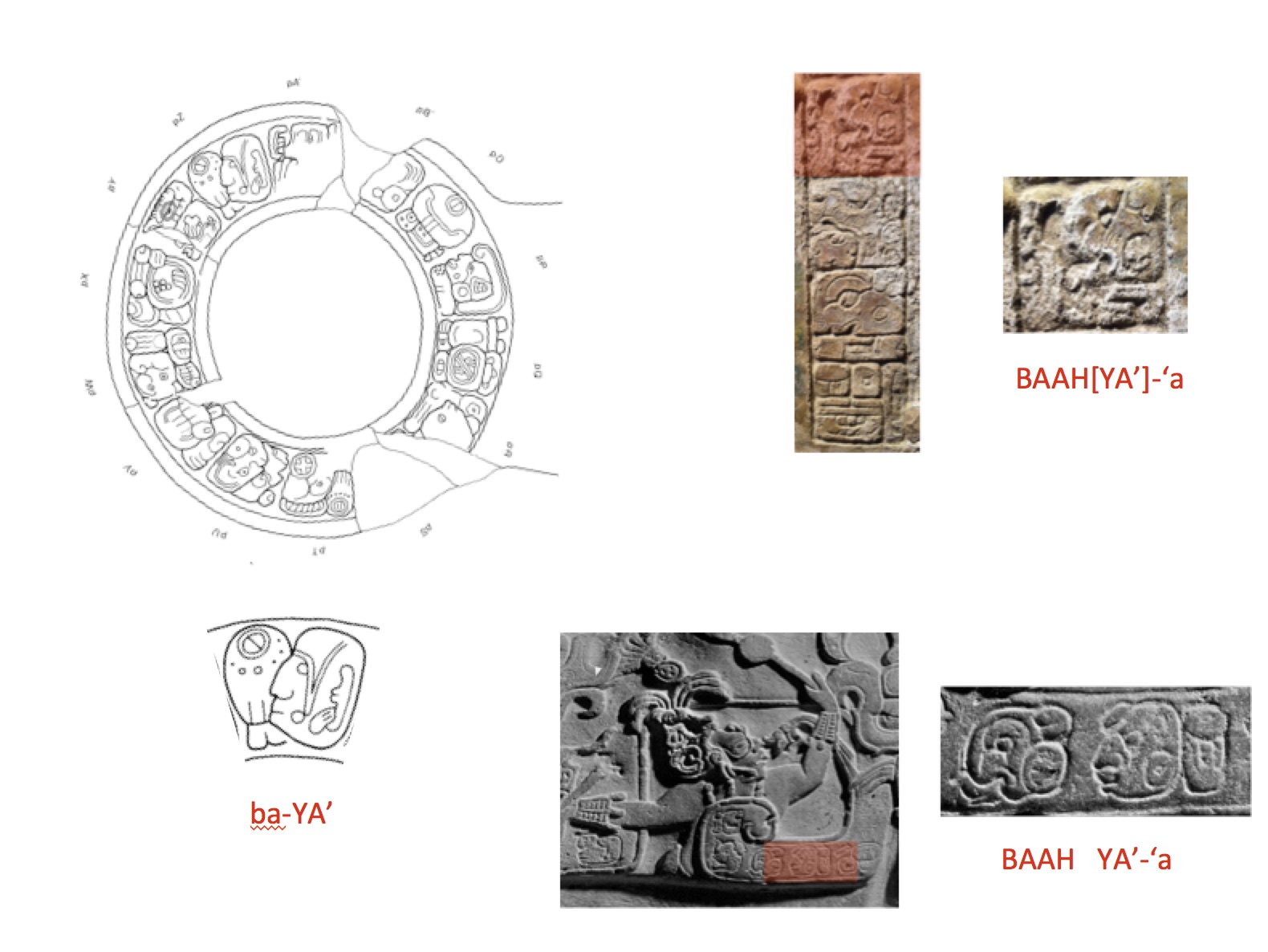
In sum, there is evidence that YA’ functioned as a homophonic sign. In a few examples it also occurs as a title, usually of subordinate lords, even princes at court. YA’ is prefixed by BAAH or ba, doubtless for baah, “head, first.” Similar constructions occur in Maya texts, where that prefix creates a title by attaching itself to the name of an object, a flint (took’), shield (pakal), staff (te’) or throne (tz’am, Houston 2014:27–28, fig. 17). The title implies habitual service; the adjective “head” or “first” denotes salience in those duties. They apply to people in principal charge of — or most skilled at — the care or use of an object at dynastic courts. Examples in Figure 7 attest to a similar pattern with yokes. Young princes of royal houses appear to be the “Head Yoke” or “Head [Person of the] Yoke.”[2] The ballcourt ring from Oxkintok refers to the local ruler in the company of “youths” (ch’oktaak) and may then give two names in succession, concluding with baah (or ba) ya’, the “head yoke” or “head person of the yoke. The very setting points to an overt association with ballplay. The other examples hint that they too were given distinction in this sport. Perhaps the Baah Ya’ were victorious athletes or, as leaders, “captains of the team.”


Figure 7. “Head Yoke” as a title of princes and subordinates: Oxkintok Ballcourt Ring (left, position pZ1, García-Gallo 1992:fig. 2); Yaxchilan-area panel (upper right, photograph by Stephen Houston); and carver or owner’s tag on stone mace (photography courtesy of Justin Kerr [for shape of artifact, see Robicsek and Hales 1981:fig. 38).

[1] Dressing scenes in Maya imagery tend to be anticipatory, not about packing up afterwards; see Bonampak Room 1 and K2695, in which royalty is being prepared for dance.

[2] Marc Zender (personal communication from 2018) wonders whether there might be an implicit agentive ‘a or aj in such spellings. That is a real possibility, as hinted at in Figure 7, BAAH-‘a~AJ[YA’] by one reading. But it would not shift the general meaning here.


References

Alegría, Ricardo E. 1951. The Ball Game Played by the Aborigines of the Antilles. American Antiquity 16:348–352.

Aulie, H. Wilbur, and Evelyn W. de Aulie. 1998. Diccionario Ch’ol de Tumbalá y Sabanilla, edited Emily F. Scharfe de Stairs. Mexico City: Instituto Lingüístico de Verano.

Beliaev, Dmitri, and Stephen D. Houston. 2020. A Sacrificial Sign in Maya Writing. Maya Decipherment: Ideas on Ancient Maya Writing and Iconography. Accessed Aug. 4, 2021.

Bell, Sinclair. 2019. Roman Chariot Races: Charioteers, Factions, Spectators. In A Companion to Sport and Spectacle in Greek and Roman Antiquity, edited by Paul Christesen and Donald G. Kyle, pp. 492–504. Chichester: Wiley-Blackwell.

Berlin, Brent, and Terrence Kaufman. 1997. Un pequeño glosario Tzeltal de Tenejapa, Chiapas, Mexico. Athens, GA: Department of Anthropology, University of Georgia.

Clune, Francis J., Jr. 1963. Borhegyi’s Interpretation of Certain Mesoamerican Objects as Ball-Game Handstones. American Antiquity 29:241–242.

De Borhegyi, Stephan F. 1964. Pre-Columbian Ball-Game Handstones: Rejoinder to Clune. American Antiquity 30:84–86.

Coe, Michael D. 2003. Another Look at the Maya Ballgame. In Il sacro e il paesaggio nell’America indigena, edited by Davide Dominici, Carolina Orsini, and Sofia Venturoli, pp. 197–204. Bologna: Cooperativa Libraria Universitaria Editrice Bologna.

Cotterril, Stewart T., and Richard Cheetham. 2016. The Experience of Captaincy in Professional Sport: The Case of Elite Professional Rugby. European Journal of Sport Science 17:2, 215–221.

Cruz Romero, José L. 2012. Los yugos y hachas votivas de Palenque. Arqueología Mexicana 113:52–55.

Ekholm, Gordon F. 1946. The Probable Use of Mexican Stone Yokes. American Anthropologist 48:593–606.

—. 1961. Puerto Rican Stone Collars. In Essays in Pre-Columbian Art and Archaeology, edited by Samuel K. Lothrop “and others,” pp. 356–371. Cambridge, MA: Harvard University Press.

Escobedo, Héctor L. 2004. Tales from the Crypt: The Burial Place of Ruler 4, Piedras Negras. In Courtly Art of the Ancient Maya, by Mary Miller and Simon Martin, pp. 277–279. London: Thames and Hudson.

Fransen, Katrien, Stewart T. Cotterill, Gert Vande Broek, and Filip Boen. 2019. Unpicking the Emperor’s New Clothes: Perceived Attributes of the Captain in Sports Teams. Frontiers in Psychology 10:2212.

García-Gallo, Alfonso. 1992. El anillo jeroglífico del juego de pelota de Oxktinok. In Oxkintok 4, edited by Miguel Rivera Dorado, pp. 177– 184. Madrid: Proyecto Oxkintok, Misión Arqueológica de España en México.

Grube, Nikolai. 2010. A Logogram for YAH “Wound.” Textdatenbank und Wörterbuch des Klassischen Maya, Research Note 21. Accessed Aug. 4, 2021.

Guillemin, Jorge F. 1968. Un “yugo” de madera para el juego de pelota. Antropología e Historia de Guatemala 20:25–33.

Helmke, Christophe, Jason Yaeger, and Mark Eli. 2018. A Figurative Hacha from Buenavista del Cayo, Belize. The PARI Journal 18(3):7-26. Accessed Aug. 4, 2021.

Hopkins, Nicholas A., J. Kathryn Josserand, and Ausencio Cruz Guzmán. 2010. A Historical Dictionary of Chol (Mayan): The Lexical Sources from 1789 to 1935. Tallahassee: Jaguar Tours. Accessed Aug. 4, 2021.

Houston, Stephen D. 2012 Painted Vessel (Plate 56). In Ancient Maya Art at Dumbarton Oaks, edited by Joanne Pillsbury, Miriam Doutriaux, Reiko Ishihara-Brito, and Alexandre Tokovinine, pp. 314-321. Washington, DC: Dumbarton Oaks Research Library and Collection.

—. 2014. The Life Within: Classic Maya and the Matter of Permanence. New Haven: Yale University Press.

Hull, Kerry. 2016. A Dictionary of Ch’orti’ Mayan-Spanish-English. Salt Lake City: University of Utah Press.

Kowalski, Jeff K. 1989. The Mythological Identity of the Figure on the La Esperanza (“Chinkultic“) Ballcourt Marker. Research Reports on Ancient Maya Writing 26–27. Washington, DC: Center for Maya Research.

Laughlin, Robert M. 1975. The Great Tzotzil Dictionary of Santo Domingo Zinacantán. Washington, DC: Smithsonian Institution Press.

—.1988. The Great Tzotzil Dictionary of Santo Domingo Zinacantán, Volume I, Tzotzil-English. Washington, DC: Smithsonian Institution Press.

Martin, Simon. 2020. Ancient Maya Politics: A Political Anthropology of the Classic Period 150–900 CE. Cambridge: Cambridge University Press.

—, and Nikolai Grube 2008. Chronicle of the Maya Kings and Queens: Deciphering the Dynasties of the Ancient Maya. 2nd edition. London: Thames and Hudson.

Moholy-Nagy, Hattula, with William R. Coe. 2008. The Artifacts of Tikal: Ornamental and Ceremonial Artifacts and Unworked Material. Tikal Reports 27A. Philadelphia: University Museum of Archaeology and Anthropology, University of Pennsylvania.

Polian, Gilles. 2020. Tseltal-Spanish multidialectal dictionary.
Dictionaria 10. 1-8109. DOI: 10.5281/zenodo.3660891 (Available online at https://dictionaria.clld.org/contributions/tseltal, Accessed Oct. 20, 2022).

Robertson, John S., Danny Law, and Robbie A. Haertel. 2010. Colonial Ch’olti’: The Seventeenth-Century Morán Manuscript. Norman: University of Oklahoma Press.

Robicsek, Francis, and Donald M. Hales. 1981. The Maya Book of the Dead, The Ceramic Codex: The Corpus of Codex Style Ceramics of the Late Classic Period. Charlottesville, VA: University of Virginia Art Museum.

Sheseña, Alejandro, and Thomas A. Lee Whiting. 2004. Yugo incrustado con glifos mayas procedente de los
alrededores de Chilón, Chiapas. Mexicon 26:127–132.

Shook, Edwin M., and Elayne Marquis. 1996. Secrets in Stone: Yokes, Hachas and Palmas from Southern
Mesoamerica
. Memoirs of the American Philosophical Society Held at Philadelphia for Promoting Useful Knowledge Volume 217. Philadelphia: American Philosophical Society.

Struck, Peter T. 2010. Greatest of All Time. Lapham’s Quarterly. Accessed Aug. 4, 2021.

Stuart, David. 1997. Ts’o Notes. Unpublished chart.

–. 1998. “The Fire Enters His House”: Architecture and Ritual in Classic Maya Texts. Function and Meaning in Classic Maya Architecture, edited by Stephen Houston, pp. 373-425. Washington, DC: Dumbarton Oaks Research Library and Collection.

Taube, Karl A., and Marc Zender. 2009. American Gladiators: Ritual Boxing in Ancient Mesoamerica. In Blood and Beauty: Organized Violence in the Art and Archaeology of Mesoamerica and Central America, edited by Heather Orr and Rex Koontz, pp.161–220. Los Angeles: Cotsen Institute of Archaeology Press.

Warkentin, Viola, and Ruby Scott. 1980. Gramática Ch’ol. Serie gramática de lenguas indígenas de México 3. Mexico City: Instituto Lingüístico de Verano.

Wisdom, Charles. 1950. Materials of the Chorti Language. Middle American Cultural Anthropology Microfilm Series 5, Item 28. University of Chicago Library.

Zender, Marc. 2004. Glyphs for “Handspan” and “Strike” in Classic Maya Ballgame Texts. The PARI Journal 4(4):1–9.