The 2018 Mesoamerica Meetings

MESOAMERICAN PHILOSOPHIES: ANIMATE MATTER, METAPHYSICS, AND THE NATURAL ENVIRONMENT

January 9-13, 2018

The 2018 Mesoamerica Meetings are coming soon! Please join us in Austin next month for our stimulating series of workshops and our two-day symposium, focused on “Mesoamerican Philosophies.” Registration for the Meso Meetings is open to the public and all are welcome. Presenters include Chris Beekman, Linda Brown, David Carrasco, Michale Carrasco, Andrew Finegold, Patrick Hajovsky, Chrisptophe Helmke, Lucia Henderson, Julie Hogarth, Nick Hopkins, Zack Hruby, Danny Law, Elliot Lopez-Finn, Leonardo López Luján, James Maffie, Barbara Macleod, Alexus McLeod, Osiris Sinuhe Gonzalez Romero, David Stuart, Alex Tokovinine, Karl Taube, and Marc Zender.

Workshops, Symposium Program and Registration Information

23659539_1667278949969927_2865689155549888444_n

Forty years ago, in 1978, UT Austin hosted the first Maya Hieroglyphic Workshop by Linda Schele, and an institution was born. Over the years the annual event grew as an open and vibrant gathering of scholars, students and others, sharing in the newest research in (mostly) Maya art, archaeology and related disciplines. 2018 brings exciting new changes, marking not only the beginning of our third k’atun, but also our new identity as the UT Mesoamerica Meetings, emphasizing the interconnectedness of all Mesoamerican cultures. To celebrate our anniversary and our new direction, we will devote our 2018 conference to a novel topic: Mesoamerican Philosophies: Animate Matter, Metaphysics, and the Natural Environment.

Ancient Mesoamerican religion and worldview hinges on a special understanding of “matter” and the metaphysical expression of the sacred. The world and what inhabited it – landscapes, buildings, objects, illnesses, even time itself — were considered animate and “living” in some sense, creating a dynamic system of interactions and relationships between people, gods, and things. These ideas found a constant expression, at different scales, in the region’s art, imagery, architecture, and ritual deposits, yet it is fair to say that these elemental notions have not been organized as a cohesive philosophy in any systematic way. At the 2018 Mesoamerica Meetings scholars and students will bring ancient Mesoamerican philosophy and religion into sharper focus, looking at how the ancient Maya, Aztecs, and other Mesoamerican cultures communicated these important ideas, and developed many notions of their own. In short, the conference will be looking at some of the most foundational but least articulated concepts of a cohesive ancient Mesoamerican worldview.

Among the questions we will be asking are: How do we refine our picture of Mesoamerican ideas as a cohesive system, a philosophy that might be placed alongside other ancient traditions worldwide? How did Mesoamerican peoples represent and interact with “living” things, spaces, materials and landscapes to express their understanding of human action in an animate world? Can we come up with a more accurate idea of “animism” in describing aspects of the Mesoamerican worldview? In what ways do such ideas have direct bearing on archaeological interpretation? These are large issues, and other related questions will no doubt arise during the conference. We see it as the beginning of a new and necessary foray into defining Mesoamerican thought as a set of philosophical traditions with key repercussions in scholarly research and cultural understanding.

Workshops, Symposium Program and Registration Information

How to Identify Real Fakes: A User’s Guide to Mayan “Codices”

by Michael Coe (Yale University) and Stephen Houston (Brown University)

Forgeries have long been a scourge to archaeology and art history alike, rearing up whenever money mixes with “excessive desire and bad judgment” (Meyer 1973:103, see also Lapatin 2000:45). According to Ascanio Condivi, even Michelangelo got into the act by passing off one of his carvings as a valuable antiquity (Holroyd 1903:21–22). Yet fakes also serve as fascinating evidence in the history of crime, especially for that special con by which the cleverness of a forger matches wits with scholars.

Fakers may win for a time—think of the “Etruscan warriors” concocted by the brothers Pio and Alfonso Riccardi and later sold to the Metropolitan Museum of Art (von Bothmer and Noble 1961). But mostly they lose. No one can look today at van Meegeren’s banal paintings and think, as Hermann Göring did, that Vermeer had a hand in their making (Godley 1967). Scientific techniques play a role in separating fakes from genuine pieces, along with a systematic probing of provenience, outright confessions—proudly made in some cases (Beltracchi and Kunst)—and the mere fact that every generation draws on greater knowledge. Faking becomes harder and harder, and the myth, say, that a forger knows more than specialists in Maya art and writing is scarcely credible. The wise analyst must also ask the standard gumshoe questions: who was the victim, who the perpetrator, was there any intent to deceive, was harm done as a result (Chappell and Polk 2009:3, 16)?

There are, no doubt, works that continue to puzzle. The Getty Kouros, for example, is either a fake that deeply skews our understanding of Greek art or it is a revealing anomaly that shows our “imperfect understanding of what remains, and the limits of our perspectives, preconceptions, and comprehension” (Lapatin 2000:46). And then there are the stunningly terrible fakes that do not so much represent a “crisis of criteria” (Lapatin 2000:43), a tough decision to be made between competing claims, as obvious forgeries that would fool no scholar.

Think about Maya fakes. There are many of them (Eberl and Prager 2000; Eberl and Prem 2011), some published, to our amazement, in important traveling exhibits (Gallenkamp and Johnson 1985:pls. 62, 63, 69, 72, 74). A few have needed further research. Typically, the more challenging cases are colonial, with only a few purported signs or images of indigenous nature (Hanks 1992; Jones 1992). But, under hard scrutiny, they too eventually yield their secrets. As for “Pre-Columbian books,” the tell-tale indicator is whether they exist as a pastiche, a rough assortment of glyphs or pictures. Often in nonsensical order, and mostly lifted from well-known sources, the glyphs and images tumble out in combinations that are, to expert eyes, anachronistic, stylistically inconsistent or incoherent, and contrary to recent decipherments of Maya writing.

With Maya books, of which only four intact examples remain, there is no real “crisis of criteria.” Quite simply, the fakes are glaring, at times laughable: who would be fooled by them today? In truth, few scholars ever were. The first such studies were done by Frans Blom (1935a, 1935b; 1946) and by a sprinkling of others (Brainerd 1948; Wassén 1942).

The “codices” tend to have a number of attributes, including:

(1) recognizable day and month signs, sometimes interspersed with wishful squiggles intended to simulate glyphs (Figure 1; compare with Figure 3, below);

Slide2.jpg

Figure 1. Comparison of faked codex with source image in Dresden 19a. 


(2) a crudely polished leather base, with follicles clearly evident, or on what appears to be amate (fig-tree bark) or even coconut fiber (Figures 2, 3);


Slide4.jpg

Figure 2. Faked leather codex and source image (K594, photograph copyright Justin Kerr, used with permission).


(3) little to no confidence of line, the “hand” being ill-practiced in calligraphy (Figure 3);


Slide1.jpg

Figure 3. Unpracticed handling of paint, illegible signs and crude leather base.

(4) overbold and liberal use of polychromy (Figure 4; see also Figure 5, from the Peabody Museum at Yale University);

Slide6.jpg

Figure 4. Bright polychromy: source image to right, “Pellicer Vase,” Museo Regional de Antropología Carlos Pellicer Cámara (photograph to right: Stephen Houston). 


Yale PM fake obverse.jpg

Figure 5. Garish polychromy on the Yale Peabody Museum Codex (photograph by Michael Coe); note also the copying from Dresden 56b.

(5) transparent copying from widely available sources, especially the Dresden Codex and sundry illustrations from general books.

A few of these examples will suffice. One smuggles in a poorly interpreted vulture from a page of the Dresden Codex (Figure 1). The hammock and courtly figures on the so-called “Pellicer vase” from the Museo Regional de Antropología Carlos Pellicer Cámara, Villahermosa, Tabasco, transfer neatly to another “codex” (Figure 4; vase published in Covarrubias 1957), and a Late Classic image of a mythic figure from a polychrome vase excavated at Uaxactun Guatemala finds an inept copy on yet another leather codex (Figure 6). Mixing periods–—the mural dates to the late 300s, early 400s—the faker also quoted freely from the well-published Ratinlixul Vase, excavated in 1917 by Robert Burkitt near Chamá, Guatemala, and now in the University of Pennsylvania Museum (UPM No. NA 11701, Danien 1997:38, Fig. 1).

What is abundantly evident is the sheer laziness or uninventive mentality of forgers. Sylvanus Morley’s The Ancient Maya (1946), first edition, was a particularly generous source for them, as it contained a handy list of Maya day glyphs (fig. 18), month signs (fig. 19), glyphs for time periods (fig. 22), Initial Series (fig. 25), and thorough coverage of the Maya calendar (pp. 265–295). The Ratinlixul Vase had its own line drawing too (pl. 88b). Of slightly earlier date was the useful, inexpensive, and widely available edition of Maya codices by the Villacortas in Guatemala (Villacorta and Villacorta 1933).


Slide7.jpg

Figure 6. Copy of images from Uaxactun and the Ratinlixul vase on a forged leather codex (photograph to lower left, copyright Justin Kerr, used with permission).

A final example shows how blatant such copying can be (Figure 6). This codex lifts half of the center ballcourt marker from Copan Ballcourt BII (excavated by Gustav Strømsvik in the 1930s), as well as a frontal image from Palenque’s Temple of the Skull (upper left) and a smattering of full-figure glyphs from Copan Stela D (center left; see Stuart Temple of the Skull); Maudslay 1889–1902:pl. 48).


Slide8.jpg

Figure 6. Fake codex and, at center, image taken from Copan Ballcourt II, center marker (drawing by John Montgomery). 

A few of these documents are in institutions (American Museum of Natural History, no. 30–9530, in a gift of c. 1901–1904, from the Duc de Loubat [Glass 1975:204]; Peabody Museum, Yale University [No. 137880]; Världskulturmuseet, Göteborg [Glass 1975:305]), but most are only known to us by way of unsolicited communications or, for one manuscript, via a glossy facsimile published in Guatemala (Benítez 2005; said to be from Chichicastenango, Guatemala, it even has a supposed radiocarbon date of “BP 200 + 28,” which, by odd arithmetic, the author pushes back to “1650 A.D.” [Benítez 2005:4–5]). Most fakes had two episodes of preparation, beyond the painting itself. Immersion in dirt or (we suspect) cow patties provided the right patina, and then a hurried cleaning gave some visibility for the dupe being invited to purchase the book.

A striking element is that many share elaborate “origin” stories. As a random selection, these concern a now-deceased relative who had traveled in Mexico/Guatemala, etc., a stray find in a Maya town in Guatemala, caves, scuba-diving or, in an example seen by one of us (Houston) in Provo, Utah, an heir wishing to donate the manuscript to a worthy public institution. A few seem to have gone through the hands of the late Pablo Bush Romero, “Mexico’s distinguished diver, self-made scholar and restless millionaire-at-large” (Sports Illustrated 1964). The presence of others of far earlier date, as in that acquired by the Duc de Loubat, show multiple hands behind their manufacture: the temptation to fake such codices clearly had deep roots (Glass 1975:305–306; for the Duc, Loubat obituary). The Yale forgery is described on the museum website as: a “Maya codex purchased in Mexico City, 1905, from an old priest around the corner from the southeast corner of the Alameda. This codex was first shown in 1887; he then declined to sell it, but in 1905, having been so ill that both his legs were amputated, and not expecting to live longer, he offered to sell the codex (to a friend?) of his in Merida who was then a druggist. This codex was examined by Dr. Alfred Tozzer of Harvard University, who considered it a reproduction, partly because the…various day signs were not in the proper Maya order” (Yale codex).

At this point, one of us (Coe) has seen over a dozen such codices. All are supremely unconvincing to the trained eye. The inept painting, ignorance of Maya coloration, slavish (yet scrambled) copying of well-known sources, anachronisms, inattention to decipherments, improvised, ad hoc “signs,” rough preparation and obvious attempts at artificial aging—all characterize these examples, without exception. It is unthinkable that any in this corpus of pictorial failure would pass muster, technical analysis or glyphic and iconographic exegesis.

To understand what is not a fake, as in the Grolier Codex (Coe et al. 2015), we are well-advised to study what is a fake. This rogues’ gallery shows that compelling deceptions of ancient Maya books are easier to claim than to create.


References 

Benítez, Henry. 2005. Códice Chugüilá (1650 d.C.). Guatemala: Editorial Piedra Santa.

Blom, Frans. 1935a. A Checklist of Falsified Maya Codices. Maya Research 2(3):251–252.

______. 1935b. The ‘Gomesta Manuscript’, A Falsification. Maya Research 2(3):233–248.

______. 1946. Forged Maya Codex. The Masterkey 20:18.

Brainerd, George W. 1948. Another Falsified Maya Codex. The Mastery 22:17–18.

Chappell, Duncan, and Kenneth Polk. 2009. Fakers and Forgers, Deception and Dishonesty: An Exploration of the Murky World of Art Fraud. Current Issues in Criminal Justice 20 (3):393–412 (pp. 1–20, online).

Coe, Michael, Stephen Houston, Mary Miller, and Karl Taube. 2015. The Fourth Maya Codex. In Maya Archaeology 3, eds., Charles Golden, Stephen Houston, and Joel Skidmore, 116–167.San Francisco,: Precolumbia Mesoweb Press.

Covarrubias, Miguel. 1957. Indian Art of Mexico and Central America. New York: Knopf.

Danien, Elin. 1997. The Ritual on the Ratinlixul Vase: Pots and Politics in Highland Guatemala. Expedition 39(3):37–48. Danien 1997

Eberl Markus, and Christian Prager. 2000. A Fake Maya BoneMexicon 22(1):5.

Eberl, Markus, and Hanns Prem. 2011. Identifying a Forged Maya Manuscript in UNESCO’s World Digital Library. Ancient Mesoamerica 22(1):155–166.

Gallenkamp, Charles, and Regina E. Johnson. 1985. Maya: Treasures of Ancient Civilization. New York: Harry N. Abrams.

Glass, John B. 1975. A Catalog of Falsified Middle American Pictorial Manuscripts. In Handbook of Middle American Indians, Volume 14: Guide to Ethnohistorical Sources, Part 3, ed. Howard F. Cline (assoc. eds., Charles Gibson and H. B. Nicholson), 297–310. Austin: University of Texas Press.

Godley, John R. 1967. Van Meegeren: A Case History. New York: Charles Scribner’s Sons.

Hanks William F. 1992. The Language of the Canek ManuscriptAncient Mesoamerica 3:269279.

Holroyd, Charles. 1903. Michael Angelo Buonarroti. New York: Charles Scribner’s Sons.

Jones, Grant D. 1992. The Canek Manuscript in Ethnohistorical PerspectiveAncient Mesoamerica 3:243268.

Lapatin, Kenneth D. S. 2000. Proof? The Case of the Getty Kouros. Source: Notes in the History of Art 20(1):43–53.

Maudslay, Alfred P. 1889–1902. Biologia Centrali-Americana, or, Contributions to the Knowledge of the Fauna and Flora of Mexico and Central America, vols. 55–9, Archaeology. London: R. H. Porter and Dulau.

Meyer, Karl E. 1973. The Plundered Past: Traffic in Art Treasures. New York: Athenaeum. 

Morley, Sylvanus G. 1946. The Ancient Maya. Stanford: Stanford University Press.

Villacorta, J. Antonio C., and Carlos A. Villacorta. 1933. Códices Mayas: Dresdensis— Peresianus—Tro-Cortesianus. Guatemala: Tipografía Nacional.

Von Bothmer, Dietrich, and Joseph V. Noble. 1961. An Inquiry into the Forgery of the Etruscan Terracota Warriors in the Metropolitan Museum of Art. Metropolitan Museum of Art, Papers 11. New York.

Wassén, S. Henry. 1942. A Forged Maya Codex on Parchment: A Warning. Etnologiska Studier 1213:293–304.


Forgetting Chocolate: Spouted Vessels, Coclé, and the Maya

by Stephen Houston (Brown University)


The Romans and the Greeks before them cherished the taste of a particular resin. Tapped from silphium, a wild plant growing along the coast of North Africa, the flavoring went well with roast meat, brought savor to tripe, udder, and sow’s womb, partnered nicely with vegetables, salted tuna, and sea squirt (an invertebrate anchored to ocean floors), helped digestion, and even went into eye-drops (Dalby 2000:17–19). But its popularity and fussy conditions of growth undid the plant. Grazing sheep displaced its natural habitat, and the last root went down the gullet of the Emperor Nero (Dalby 2000:18).

Beloved foods come and go. How many Europeans still consume garum, that smelly fish sauce—Pliny the Elder called it a “secretion of putrefying matter”—traded throughout the Mediterranean and into the furthest reaches of the Roman empire (Curtis 1983:232)? Legionnaires in a British or German military camp doubtless grumbled if they failed to receive their ration or special issue of oil. In the United States, molasses, a viscous treacle resulting from cane refining, sweetened many foods in the 19th century, but gradually gave way to refined sugars. Boston’s Molasses Disaster of 1919, in which a burst tank released a brown tsunami 15 feet high, killing 21 people, would be unthinkable today, for a variety of reasons (Molasses Disaster; I am told that on hot days a cloying odor still fills the neighborhood). Mostly, though, such quantities are not needed. Shoofly pie, of gooey molasses, is no longer much on the menu, although it was in my Pennsylvania childhood.

Consider, if one can, another unthinkable: forgetting chocolate or cacao, from a plant found wild and later cultivated in ancient America. Avid debate surrounds the pharmacological effects of this “chemical kaleidoscope”—whether it serves as an anti-depressive or libido enhancer cannot be easily shown (S. Coe and M. Coe 1996:28–34). But craved it was, in many forms. As a liquid, for example, chocolate “introduce[d] Europe to the pleasures of alkaloid consumption” (Coe and Coe 1996:31). Yet there are grounds for believing that, as an elite consumable, it did indeed drop out of use in one area, the Grand Coclé of Panama. Mortuary deposits in that area, as excavated by Samuel Lothrop and J. Alden Mason—as well as looters and “amateur archaeologists”—revealed staggering wealth, especially in gold but also hundreds of vessels and other goods (Lothrop 1937, 1942; Hearne and Sharer 1992). An element of that wealth, flaunted in feasts, may have been the consumption of chocolate by techniques imported from northern Central America or Mesoamerica, and perhaps indirectly from the Maya.

The main clue is a particular shape of ceramic. In his final opus, James Ford, striving for a grand synthesis of New World diffusion—heroically, for he was dying of cancer—charted the movement of ceramic “complexes” across “Formative” America (Ford 1969). One diagnostic: the “jar with bridge spout” or “teapot vessel,” long-understood by most specialists in Mesoamerica and northern Central America to characterize early agricultural settlements (Figure 1; Ford 1969:19, 21, 116, 120–123, Chart 16; on Ford and his diffusionist interests, see Willey 1988:68–70). Not all spouted jars or vessels are the same, of course. These evinced a consistent shape: a bulbous body (sometimes with a well-defined circumference at the mid-line); a vertical if slightly inclined neck; a flattened eversion around the rim; and a straight or gently inclining spout often, but not always, connected to the rim by a ceramic bridge. Volume varied, as did the presence of paint or modeling into effigies.


Screen Shot 2017-09-23 at 1.15.29 PM.png

Figure 1. Bridge spouts and “Formative” America, esp. Chiapas, Tehuacan, and Veracruz, as excerpted from a chart by James Ford (1969:Chart 16). Dark squares mark time, visible here in 500 year increments from bottom to top, 1500 BC to AD 500. 


A notable strand in Mayanist archaeology is a claim for function. Thomas Gann, working in what was then British Honduras, called one example “the usual Maya chocolate pot” (Figure 2; Gann 1918:77, 128, fig. 74, quotation on p. 128). Mostly he seemed skeptical. Another had “a curious upturned spout” so configured “that it would be impossible either to drink or pour out the contents therefrom” (Gann 1918:77). And: “they were supposed” to have been used for chocolate “but drinking from them must have been a feat of legerdemain” (Gann 1918:77). Where did Gann get the idea? Who had “supposed” this use in the first place? One suggestion is that it came from a description of chocolate vessels “with spouts” by the “Anonymous Conqueror,” among the few Spaniards to leave an eyewitness account of the conquest of Mexico (Spouts; see Merwin and Vaillant 1932:64fn2).

The finest to survive may be an archaicizing object, the stone “Diker Bowl” at the Metropolitan Museum of Art, where the text appears to refer to drinking from the vessel, and possibly to a glyph for seed or grano (pulverized beans?, Houston 2011). Not surprisingly, some of these—and other, even earlier ceramics—have tested positive for theobromine, a key constituent of chocolate (Henderson et al. 2008:18939–18940; Joyce and Henderson 2007:649–651; Powis et al. 2002:97–98; Powis et al. 2011:8597–8599). Whether these drinks were alcoholic or not is an intriguing proposal. Some suggest the first such drinks arose from fermented cacao pulp, i.e., they were inebriants, not a frothed, non-alcoholic beverage made from water and ground beans (e.g., Joyce and Henderson 2010:170). But using residues to distinguish the two remains a challenge.


Slide1.jpg

Figure 2. Chocolate pots among the Maya: (left) “Mound 31,” near the Río Nuevo, Belize (Gann 1918:fig. 74); (right) the “Diker Bowl,” Metropolitan Museum of Art, #1999.484.3 (Diker MMA, photograph courtesy of Justin Kerr, pencil drawing by Stephen Houston, see Houston 2011 Diker Archaicism). 


More recent scholarship takes the reasonable tack that the spout helped in spuming chocolate drinks, a well-known practice in Mesoamerica (McAnany et al. 1999:138; Powis et al. 2002:94). To prepare the drink, someone blew into the spout, in contrast to later practices in which liquid chocolate was beaten with a stick or poured back and forth to raise a head of spume (S. Coe 1994:141): pure taste as the bubbles burst, leaving flavor behind. It is impossible to prove, but this might have followed shifts in perceived hygiene. Did some find it disagreeable to drink chocolate touched, perhaps, by another’s saliva…particularly that of a servant? Or was the change motivated by a need for heightened drama? I have seen this myself. On the north coast of Asturias, Spain, while gorging on razor clams, I once admired a waiter pouring cider from beaker to cup. Not a drop spilled as he drew the beaker further and further away, attaining at last an arc over a yard long.

Generations ago, in a time of diffusionist thought, the broader link between the “chocolate pots” and points south seemed self-evident. Raymond Merwin and George Vaillant (1932:64) noted that the form was “common at Coclé in Panama,” and, in his doctoral dissertation of 1921, published in 1926, Samuel Lothrop observed similar shapes in Costa Rica and Nicaragua, “related to the group of Maya pottery usually known as chocolate pots,” if of far later date (Figure 3; Lothrop 1926:117). The comparison made sense, for Lothrop was one of the last archaeologists to work in all parts of the Americas and, with colleagues, had looked closely at early links across the region (Lothrop 1927; Willey 1976). 


Screen Shot 2017-09-21 at 9.47.03 AM.png

Figure 3. Turkey effigy jar, Bolsón, Guanacaste, Costa Rica (Lothrop 1926:pl. XIII).


The Coclé vessels are notable for their quantity and quality (Figure 4). Yet, the chance that these held chocolate and that such drinks were of intense interest to Coclé elites appears to have faded away. Over the last decades, the archaeological literature shows little to no mention of chocolate in early Panama. One specialist expresses skepticism about much contact with Mesoamerica (Cooke 2005:155; but see Coggins and Shane 1984:pls. 44–50; Lothrop 1952; Pendergast 1970; Pillsbury et al. 2017:#164, for secure evidence of Coclé gold at Altun Ha, Belize, and Chichen Itza, Mexico). In another essay, he targets “rank” and “status” in the Grand Coclé region, commenting on prestigious drinks in the balsería “ritual game” of the Guaymí of Panama but not, at least in that paper, extending such ties back in time (Cooke 2004:274). Nor do drinks make an appearance in a recent, elegant synthesis of evidence from the Grand Coclé (Cooke 2011).


cocle.png

Figure 4. Spouted jars from Grave 26, Sitio Conte, Panama (Lothrop 1942:fig. 197). 


The diffusionist tendency of earlier archaeology has been a migraine from which some areas have only just recovered: localism, in-situ process, the dignified integrity of regions—these are all concerns that merit a sympathetic response. But then there is chocolate. In a classic study of the Bribri, a Chibchan group along the border of Costa Rica and Panama, Alanson Skinner recorded drying platforms for cacao and the consumption of cacao with plantains, the latter to sweeten the former (Skinner 1920:55, 93, 94). Lothrop (1942b:113) himself mentions Nahua (or Nahuatl?) groups in Panama, evidently engaged in the production or trade of cacao. That account also gives them a “tail more than a third of a yard long,” so one wonders a little about its reliability.

Girolamo Benzoni’s Historia del Mondo Nuevo (2017[1565]:75) does report on the widespread use of cacao in “Muhammad’s Paradise” (a.k.a, Nicaragua): “The fruit is like an almond and grows in a shell about the size of a pumpkin…When it is ripe, the seeds are removed and placed in the sun to dry. When they want to drink, they roast the seeds in a pan over the fire, and then they use the stones they use to make bread to grind them. They put this paste in vases (which are like gourds grown in a certain tree that is found in every part of the Indies) and add warm water bit by bit.” Obligingly, he illustrates a cacao tree, dry seeds, and, of rather less relevance, a woman making fire—was this image about roasting seeds (Figure 5)? To be sure, there is a view that cacao in Nicaragua was of relatively recent origin, having been brought there by Nahua speakers migrating from the north (Stanislawski 1983:8, citing Gonzalo Fernández de Oviedo y Valdés, cronista de Indias). Not all agree. The widespread mention of such cultivation down into Panama suggests far greater antiquity, especially for the processing of beans rather than simply the fermentation of pulp (Steinbrenner 2006:265, 267; see also Young 1994:15, for a line between these methods as far south as Colombia).


cachuate tree benzoni 177.jpg

Figure 5. A cacao tree (cacauate) under sheltering arbor, with probable seeds drying in the background (Benzoni 1565, Lib. II:103, Benzoni scan). 


Has the cultivation and use of cacao by Coclé elites been forgotten or overlooked, by both archaeologists and later chiefs? Is cacao the silphium or garum of ancient Panama?

The jars at Sitio Conte and elsewhere have an almost startling similarity to those of the Preclassic Maya and other peoples in northern Central America. In colonial times, not far from Coclé, cacao was processed into beans, presumably for liquid consumption. And there is demonstrable if perhaps indirect contact attested in the form of gold work brought north well before the Spanish conquest. A comment found on-line hints that similar thoughts about cacao have occurred to the curators of the “Beneath the Surface: Life, Death, and Gold in Ancient Panama,” a 2015 exhibit from the University of Pennsylvania Museum (“Straws” for Chocolate).

The main puzzles are the dates. Local specialists suggest that such spouted ceramics in the Grand Coclé must be at least 3–4 centuries after they ceased to be used in the Maya region (Cooke 2011, esp. 158, at c. AD 750–900). Yet, oddly enough, in the Huastec region of Veracruz, Mexico, that same shape is roughly the same date or just before Sitio Conte (Huastec AMNH; Harner Collection). Too much can be made of formal resemblances. Similar jars could service divergent functions, distinct recipes or drinks. But the charge should also be clear: that the Grand Coclé spouted vessels need testing for theobromine. If the alkaloid is present, they will join gold, emeralds, and sperm whale teeth as luxurious items, chocolate vessels, used long ago in Panama.

Acknowledgements

I thank John Hoopes and Jeffrey Quilter for discussions about spouted pots from Panama; Claudia Brittenham, Charles Golden, and Andrew Scherer offered helpful comments too.

References

Benzoni, Girolamo. 2017. The History of the New World: Girolamo Benzoni’s Historia del Mondo Nuevo, edited by Robert C. Schwaller and Jana Byars. Pennsylvania State University Press, University Park.

Coe, Sophie D. 1994. America’s First Cuisines. University of Texas Press, Austin.

Coe, Sophie D., and Michael D. Coe. 1996. The True History of Chocolate. Thames and Hudson, London.

Coggins, Clemency C., and Orrin C. Shane, III, eds. 1984. Cenote of Sacrifice: Maya Treasures from the Sacred Well at Chichén Itzá. University of Texas Press, Austin.

Cooke, Richard G. 2004. Rich, Poor, Shaman, Child: Animals, Rank, and Status in the ‘Gran Coclé’ Culture Area of Pre-Columbian Panama. In Behaviour behind Bones: The Zooarchaeology of Ritual, Religion, Status and Identity, edited by Sharyn O’Day, Wim van Neer, and Anton Ervynck, 271–284. Oxbow, Liverpool.

Cooke, Richard G. 2005. Prehistory of Native Americans on the Central American Land Bridge: Colonization, Dispersal, and Divergence. Journal of Archaeological Research 13(2): 129–187.

Cooke, Richard G. 2011. The Gilcrease Collection and Gran Coclé. In To Capture the Sun: Gold of Ancient Panama, by Duane H. King, Richard G. Cooke, Nicholas J. Saunders, John W. Hoopes, and Jeffrey Quilter, 129–173. Gilcrease Museum, Tulsa, OK.

Curtis, Robert I. 1983. In Defense of Garum. The Classical Journal 78(3):232–240.

Dalby, Andrew. 2000. Dangerous Tastes: The Story of Spices. University of California Press, Berkeley.

Ford, James A. 1969. A Comparison of Formative Cultures in the Americas: Diffusion or the Psychic Unity of Man. Smithsonian Contributions to Anthropology 11. Smithsonian Institution Press, Washington, DC.

Gann, Thomas, W. 1918. The Maya Indians of Southern Yucatan and Northern British Honduras. Bureau of American Ethnology Bulletin 64. Smithsonian Institution, Washington, DC.

Hearne, Pamela, and Robert J. Sharer, eds. 1992. River of Gold: Precolumbian Treasures from Sitio Conte. University Museum, University of Pennsylvania, Philadelphia.

Henderson, John S., Rosemary A. Joyce, Gretchen R. Hall, W. Jeffrey Hurst, and Patrick E. McGovern. 2007. Chemical and Archaeological Evidence for the Earliest Cacao Beverages. Proceedings of the National Academy of Sciences of the United States of America 104 (48): 18937–18940.

Houston, Stephen. 2011. Bending Time Among the Maya. Maya Decipherment: Ideas on Ancient Maya Writing and Iconography Bending Time

Joyce, Rosemary A., and John S. Henderson. 2007. From Feasting to Cuisine: Implications of Archaeological Research in an Early Honduran Village. American Anthropologist, n.s, 109(4):642–653.

Joyce, Rosemary A., and John S. Henderson. 2010. Forming Mesoamerican Taste: Cacao Consumption in Formative Period Contexts. In Pre-Columbian Foodways: Interdisciplinary Approaches to Food, Culture, and Markets in Ancient Mesoamerica, edited by John E. Staller and Michael Carrasco, 157–173. Springer, New York.

Lothrop, Samuel K. 1926. Pottery of Costa Rica and Nicaragua. Contributions from the Museum of the American Indian, Volume VIII. Heye Foundation, New York.

Lothrop, Samuel K. 1927. Pottery Types and Their Sequence in El Salvador. Indian Notes and Monographs, Vol. 1, No. 4. Museum of the American Indian, Heye Foundation, New York.

Lothrop, Samuel K. 1937. Coclé: An Archaeological Study of Central Panama, Part I: Historical Background, Excavations at the Sitio Conte, Artifacts and Ornaments. Memoirs of the Peabody Museum of Archeology and Ethnology, Harvard University, Vol. VII. Cambridge, MA.

Lothrop, Samuel K. 1942a. Coclé: An Archaeological Study of Central Panama, Part II. Pottery of the Sitio Conte and other Archeological Sites. Memoirs of the Peabody Museum of Archeology and Ethnology, Harvard University, Vol. VIII. Cambridge, MA.

Lothrop, Samuel K. 1942b. The Sigua: Southernmost Aztec Outpost. In Proceedings of the 8th American Scientific Congress, Volume II: Anthropological Sciences, edited by Paul Oehser, 109–116. Department of State, Washington, DC.

Lothrop, Samuel K. 1952. Metals from the Cenote of Sacrifice, Chichén-Itzá, Yucatán. Memoirs of the Peabody Museum of Archaeology and Ethnology, Harvard University, Vol, 10(2). Cambridge, MA.

McAnany, Patricia A., Rebecca Storey, and Angela K. Lockard. 1999. Mortuary Ritual and Family Politics at Formative and Early Classic K’axob, Belize. Ancient Mesoamerica 10:129–146.

Merwin, Raymond E., and George C. Vaillant. 1932. The Ruins of Holmul, Guatemala. Memoirs of the Peabody Museum of Archaeology and Ethnology No.2, Vol 3. Harvard University, Cambridge.

Pendergast, David M. 1970. Tumbaga Object from the Early Classic Period, Found at Altun Ha, British Honduras. Science 168: 116–118.

Pillsbury, Joanne, Timothy Potts, and Kim N. Richter, eds. 2017. Golden Kingdoms: Luxury Arts in the Ancient Americas. J. Paul Getty Museum and Getty Research Institute, Los Angeles.

Powis, Terry G., Fred Valdez, Jr., Thomas R. Hester, W. Jeffrey Hurst, and StanleyM. Tarka, Jr.  2002. Spouted Vessels and Cacao Use among the Preclassic Maya. Latin American Antiquity 13(1):85–106.

Powis, Terry G., Ann Cyphers, Nilesh W. Gaikwad, Louis Grivetti, and Kong Cheong. 2011. Cacao Use and the San Lorenzo Olmec. Proceedings of the National Academy of Sciences of the United States of America 108(21):8595–8600.

Skinner, Alanson. 1920. Notes on the Bribri of Costa Rica. Indian Notes and Monographs VI(3). Museum of the American Indian, Heye Foundation, New York.

Stanislawski, Dan. 1983. The Transformation of Nicaragua, 1519–1548. University of California Press, Berkeley.

Steinbrenner, Larry. 2006. Cacao in Greater Nicoya: Ethnohistory and a Unique Tradition. In Chocolate in Mesoamerica: A Cultural History of Cacao, edited by Cameron L. McNeil, 253–270.  University Press of Florida, Gainesville, FL.

Willey, Gordon R. 1976. Samuel Kirkland Lothrop, July 6, 1892–January 10, 1965. National Academy of Sciences, Biographical Memoirs 48:252–272.

Willey, Gordon R. 1988. Portraits in American Archaeology: Remembrances of Some Distinguished Americanists. University of New Mexico Press, Albuquerque.

Young, Allen M. 1994. The Chocolate Tree: A Natural History of Cacao. Smithsonian Institution Press, Washington, DC.


Conference: The 2018 Mesoamerica Meetings at UT-Austin

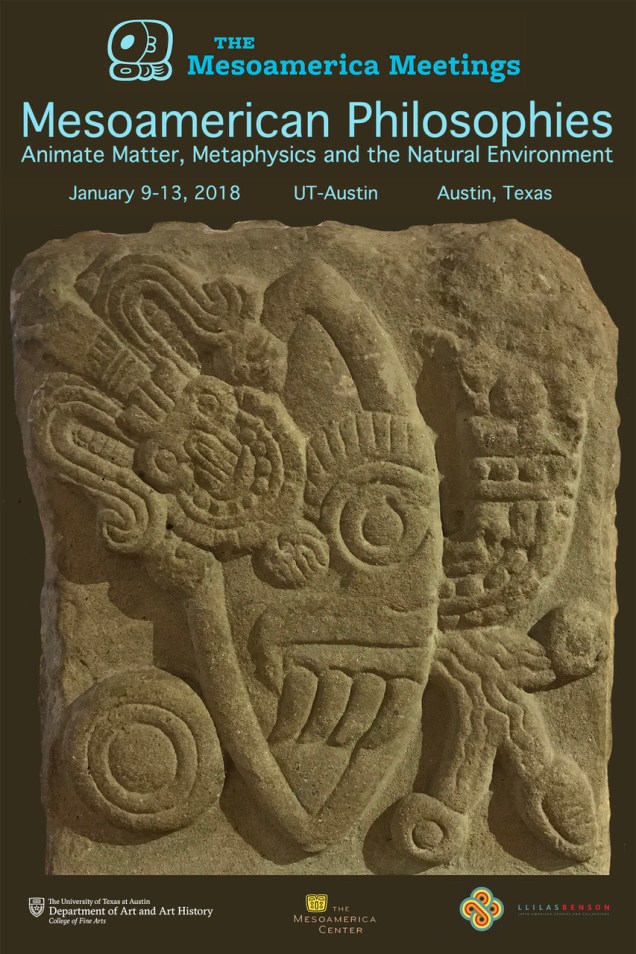
The 2018 Mesoamerica Meetings (Workshops and Symposium), will be held January 9-13, 2018, at the University of Texas at Austin.

Forty years ago, in 1978, UT Austin hosted the first Maya Hieroglyphic Workshop by Linda Schele, and an institution was born. Over the years the annual event grew as an open and vibrant gathering of scholars, students and others, sharing in the newest research in (mostly) Maya art, archaeology and related disciplines. 2018 brings exciting new changes, marking not only the beginning of our third k’atun, but also our new identity as the UT Mesoamerica Meetings, emphasizing the interconnectedness of all Mesoamerican cultures. To celebrate our anniversary and our new direction, we will devote our 2018 conference to a novel topic: Mesoamerican Philosophies: Animate Matter, Metaphysics, and the Natural Environment.

Ancient Mesoamerican religion and worldview hinges on a special understanding of “matter” and the metaphysical expression of the sacred. The world and what inhabited it – landscapes, buildings, objects, illnesses, even time itself — were considered animate and “living” in some sense, creating a dynamic system of interactions and relationships between people, gods, and things. These ideas found a constant expression, at different scales, in the region’s art, imagery, architecture, and ritual deposits, yet it is fair to say that these elemental notions have not been organized as a cohesive philosophy in any systematic way. At the 2018 Mesoamerica Meetings scholars and students will bring ancient Mesoamerican philosophy and religion into sharper focus, looking at how the ancient Maya, Aztecs, and other Mesoamerican cultures communicated these important ideas, and developed many notions of their own. In short, the conference will be looking at some of the most foundational but least articulated concepts of a cohesive ancient Mesoamerican worldview.

Among the questions we will be asking are: How do we refine our picture of Mesoamerican ideas as a cohesive system, a philosophy that might be placed alongside other ancient traditions worldwide? How did Mesoamerican peoples represent and interact with “living” things, spaces, materials and landscapes to express their understanding of human action in an animate world? Can we come up with a more accurate idea of “animism” in describing aspects of the Mesoamerican worldview? In what ways do such ideas have direct bearing on archaeological interpretation? These are large issues, and other related questions will no doubt arise during the conference. We see it as the beginning of a new and necessary foray into defining Mesoamerican thought as a set of philosophical traditions with key repercussions in scholarly research and cultural understanding.

For more information on the symposium and the workshops, including paper submissions, please visit the 2018 Mesoamerica Meetings webpage.

MM 2018 poster

Bamboo–A Neglected Maya Material?

by Stephen Houston (Brown University), Karl Taube (UC-Riverside), Sheryl Luzzadder-Beach (UT-Austin), and Timothy Beach (UT-Austin)


Building sites in Hong Kong often show a collision between tradition and modernity: bamboo scaffolds, some thirty stories high, envelop skyscrapers under construction (Figure 1; Waters 1998; also Sky-high scaffoldsBamboo spider-men). The virtues of the material are that it is “primitive without being old-fashioned, time-saving without being insecure, and economical without being impracticable” (Waters 1998:20). Less eloquent explanations are that, unlike scaffolds of metal, bamboo can be stored in the open without risk of theft; the material is also inexpensive, sustainable, flexible, reusable (up to three times, depending on conditions of storage), quickly erected, and cantilevered with relative ease over empty spaces (Waters 1998:26, 30).


2913962912_175d800993_b.jpg

Figure 1. Bamboo scaffolding, Causeway Bay neighborhood, Hong Kong (Photograph by Claire Gribbin, Creative Commons License).


Bamboo tends to be seen as quintessentially oriental. Its tender shoots, processed to remove toxins (cyanogenic glycosides, also in cassava), find their way into many dishes, and an entire sub-genre of Chinese painting, the “Four Gentlemen” or “Noble Ones,” focuses on its depiction along with peers like the plum blossom, chrysanthemum, and orchid (bamboo embodies the summer, the others, respectively, winter, autumn, spring; see also Cahill 1997:187–192; see also Bickford 1999:147, on literary and visual traditions of bamboo and other plants; Hsü 1996:25, on links to gentlemanly virtue). The experience of a bamboo forest, as Houston has experienced it on the outskirts of Kyoto, figures among the “100 Soundscapes of Japan” under protection by the Japanese Ministry of the Environment (Torigoe 1999).

But bamboo occurs more widely than that, and with consequences for understanding the ancient Maya. According to one source, “New World bamboos account for approximately half of the total generic and specific bamboo diversity” (Clark 1990:126; for Guatemala, see McClure 1973:88, 105, 106). An ethnobotany of the Tzotzil in Zinacantán, Chiapas, accords a page to them, and gives the plants a full array of local terms: bix (the generic category, “all bamboos, reeds or sprawling, reed-like plants,” Breedlove and Laughlin 2000:150), muk’ta ne kotom, yaxal otot, antzil bix, ton bix, chanib, and k’ox ne kotom (Figure 2; re: muk’ta ne kotom, “large coati tail,” there is a ko-to-ma on La Rejolla Stela 1:I9 [files at the Corpus of Maya Hieroglyphic Inscriptions, Peabody Museum, Harvard University], but the context is unclear; note, too, that the term “bamboo,” evidently of Malay origin, did not enter European languages until the 1590s or later, etymology). Some grow to over 20 m long, within “ravines in the understory of tropical deciduous forests in the lower temperate and lowland areas” (Breedlove and Laughlin 2000:150). Others are cut by men but brought home to women for use in looms, or do service as banner poles or the staffs of shamans (Breedlove and Laughlin 2000:150). A vigorous shake of a staff will protect the shaman from watchdogs. Many native species are known in Guatemala (bamboo in Guatemala). Today, in the Peten, the northernmost province, workers on archaeological projects used saplings or bamboo in equal measure, depending on proximity (Andrew Scherer, personal communication, 2017).


bamboo breedlove.jpg


Figure 2. Bamboos among the Tzotzil Maya (Breedlove and Laughlin 2000:plate 10). 


While charged with working on the stuccoes of the Diablo pyramid at El Zotz, Guatemala, one of us (Taube) noted the presence of scaffold images with unusual attributes (Taube and Houston 2015:219–221). Criss-crossed poles had cross-wise stripes (a sign of darkness or even the color red? [see Stone and Zender 2011:124–125]), symmetrical volutes at what appeared to be natural joins in the material, and signs of lashing to keep the frame solid (Figure 3A). It soon became clear that the sign appeared on a variety of so-called “accession scaffolds” ranging in date from the San Bartolo murals of c. 100 BC to stelae at Piedras Negras, Guatemala, of Late Classic date (Figure 3C; Taube and Houston 2015:fig. 5.12). Other such trussed scaffolds exist, as on Stelae 1 and 2 at Cancuen, Guatemala, but there with what appear to be ta/TAJ signs for “pine,” also a lightweight material (Maler 1908:plates 12.2, 13.1; Figure 3B). For the first set of images, Taube conjectured that the vegetal material was none other than bamboo, in which small tufts shoot directly out of the surface (the culm internodes), often at joins (Figure 4).


Slide1.jpg

Figure 3. Bamboo in Maya imagery: (A) Diablo Structure F8-1 Sub IB, with cross-bands indicated (image by CAST); (B) Cancuen Stela 1, east side, with queen, pine struts cued (Maler 1908:plate 13.1); and (C) Piedras Negras Stela 11, base (drawing by David Stuart). 


Slide2.jpg

 Figure 4. Bamboo: (A) trunk with tufts at natural breaks [culm nodes] (Creative Commons); and (B) curling tufts, Sagano Bamboo Forest, Arashiyama district, Kyoto, Japan (photograph by Stephen Houston).


A singular advantage of Maya text and image, where both stand in close relation, is that, if plausibly interpreted, one helps to explain the other. It is possible that two spellings buttress the reading: one comes from a tomb painting at Río Azul, the other from the name of the Temple of the Foliated Cross (or at least its interior temple) at Palenque (Figure 5; see also the spelling on the altar of Temple XXI:G10). The example at Palenque may be our best point of entry, for it appears to contain bamboo struts, as well as two other elements (a snouted being and K’AN crosses). The one missing element, other than the NAAH for “structure,” are three vertical sprouts of vegetation. That is, an epigraphic control exists in which bamboo and its glyphic referent appear to be isolable. In fuller form, as at Río Azul, another part of the sprouted glyph appears, in this case a sign with vertical lines and horizontal dots. This glyph recalls another, a slightly distinct one, with tufts rather than leaf-like extrusions, that carries a proposed reading of AK or AKAN, “grass” (Stuart 2005:180 fn.59).


Slide3.jpg

Figure 5. Bamboo in imagery, possibly in text: (A) East wall of Río Azul Tomb 6 (photograph by George F. Mobley, courtesy George Stuart); (B) glyphs of the Temple of the Foliated Cross, Alfarda:H1 (drawing by Linda Schele, photographer unknown); (C) roof of interior shrine, Temple of the Foliated Cross, bamboo cross-struts with K’AN crosses, corresponding to elements of name glyph (drawing by David Stuart); and (D) wall panel from interior shrine, Temple of the Foliated Cross (drawing by Linda Schele, Schele and Mathews 1979:#302). 


But what to make of the sign that appears to refer to bamboo, the element with three vertical shoots? Pondering this evidence, Houston posited a reading of JAL because of the subfixed la syllable at Río Azul; a second such version, spelling ch’o-ko ?JAL-la yi-?cha-ni AJAW, is far later, from a jamb in Temple XIX at Palenque [Stuart 2005:fig. 20a]). Moreover, the YAX-JAL-la NAAH, “Green-blue Bamboo House” (a notional arbor?), seemed quite similar to the term for “bamboo” in Tzotzil: yaxal otoot (the latter being the word for “dwelling,” see above).

Of further interest were the following entries in Ch’orti’ Maya, the language closest to most of the inscriptions (Wisdom 1950, with the usual substitution in that language of r for l in some contexts):

harar                 ‘reed [generic], carrizo (a tall wild grass), arrow’

harar ak           ‘cane grass, reed grass [generic]; zacate amargo (tall wild carrizo-like                                                grass)’

noxi’ harar       ‘a wild cane’

…and the telling gloss,

mak te’ harar   ‘vara de bambu (lowland dwarfish bamboo)’

Makte’ is simply a term for “fence” (“enclosure-tree/wood”), here specified as to construction material. Note too that, in cognate terms, j substitutes for h in many other Mayan languages, hence har/hal equates in such cases to jal (Kaufman 1983:1158). The usual trajectory of glyphic research is for someone else to have been there first. So too here, in a lexical listing by Erik Boot (2009:26, 82). Boot however, focused on “reed,” when other plants, namely, varieties of bamboo, might have been the actual target here.

The implications for Maya civilization are potentially momentous. Bamboo is one of the fastest growing plants in the world. The Guinness Book of World Records mentions species known to thrust upwards at 91 cm a day (Guinness). The rhizome-dependent pattern of growth in bamboo also makes them, to many a gardener’s dislike, hard to control yet endlessly abundant under certain conditions. Was this, in fact, an overlooked resource in Mayanist research, planted, tended, harvested, and widely employed when other vegetation proved scarce because of deforestation?

In the Orient, bamboo goes into buckets and all manner of receptacles, medicines, building materials, delectable food (again, if processed). A list from a traditional village in China dizzies with possibilities: “They live in bamboo houses, eat bamboo shoots, wear bamboo hats and shoes, cook food in utensils made of bamboo culm internodes, walk over bamboo bridges or cross rivers on bamboo rafts, and farm with bamboo tools” (Yang et al. 2004:161, Table 4). Such broad use, including use in the making of musical instruments, occurs throughout the indigenous Americas (Berlin et al. 1974:131; Judziewicz et al. 1999). Utensils in some Maya imagery might have been made of this perishable material, providing, according to one proposal, the formal source of Maya cylinder vases, later reproduced in fired clay (Bruhns 1994). The segmentation of bamboo also characterizes the depiction of atlatl or spear-throwers at the beginnings of the Late Classic period (Figure 6). Bamboo would have been grown, selected for desired width, and cut to suitable length.


Slide4.jpg

Figure 6. Possible use of bamboo atlatl or spear-throwers (K2036, Photograph by Justin Kerr, © Justin Kerr). 

Other thoughts intrude: were the external holes in walls at Tikal simply for ventilation, or did some serve as footings for bamboo scaffolds? The relentless assault on plaster in the tropics, with the logical need for future repair, might explain these features (Figure 6, upper left; see also Coe 1990:figs. 209, 321; also, Penn Tikal Archive, #C63-004-0021, for close-up views of Temple I and its comparable holes). That is, provision was made for continued refurbishment or washes of lime-plaster. The complete decay of some vault-struts, now seen only as holes, many round, raise the possibility that at least some of them were of bamboo. Moreover, at Piedras Negras, Guatemala, Houston and his team found bushels of bajareque, mud placed on wattle that had baked into near-ceramics by random (or set) fires in buildings. The bajareque often preserves evidence of cylindrical wattle, perhaps also of readily harvested bamboo (unfortunately, few sections are long enough to detect its distinct segmentation); a similar find, wit. Such remains were found with wattle-and-daub at Cerén, El Salvador (Lentz and Ramírez-Soza 2002:34). And if deforestation were at all relevant, as appears to be true in many places, bamboo, with its rapid in growth and varied use, might even have been cultivated.


Slide5.jpg

Figure 7. Upper left, back of Structure 5D-23, 1st-B, rear elevation, holes highlighted in red (Coe 1990:fig. 129), and, lower right, bajareque, Operation PN11A-3-4 (photograph by Stephen Houston).


A chart of biosilicates extracted from the main aguada or reservoir in El Zotz, Guatemala, reveals a possible signature of this cultivation: the abundance, in the Late Classic period, of “native grasses,” which may represent the residue of bamboo (Figure 8; Beach et al. 2015:272). Bamboo has been found in late tombs in Río Bec, Mexico (Dussol et al. 2016:67), as well as in Chinikiha, also in Mexico (Trabanino and Núñez 2014: 156), but it seems also that the “great anatomic homogeneity of the monocotyledons [a flowering plant category to which bamboo belongs], as well as the lack of an anatomic reference collection specific to neotropical bamboos,” complicates their precise detection (Dusoll et al. 2016:67, for quotation, 63). Further, as archaeological residue, bamboos are fragile, preserve poorly, and “rapid combustion [of them] generally does not produce charcoal remains” (Dusoll et al. 2016:66). Another specialist underscores the problems of identification: “Poaceae pollen [in the taxonomic family that contains bamboo] is very plain in appearance via light microscopy, and the palynologist must always be careful not to confuse maize pollen with the similar-looking pollen of other grasses, aquatic grasses, or bamboos” (Morse 2009:177, citing Horn 2006:368). For his part, Kazuo Aoyama (personal communication, 2017), the most expert practitioner of microwear analysis in the Maya region, has actually tested bamboo and found it indistinguishable from other woods and pithy material in its effect on lithics (Aoyama 1989:202; Aoyama 1995:131; 1996:Tables 3.13. 3.14). Its “signature” appears to be ambiguous.

Perhaps, as has been suggested for pine, such plants were more commonly used than supposed, to be grown, moved, and traded as valued resources (Lentz et al. 2005). Its working, if discernible as to family or genus, may yet appear as residue on Maya stone tools (Andrew Scherer, personal communication, 2017). Or, like bamboo in many places, the plants grew to copious extent but became less salient in Maya lives as the forests (and other vegetal materials) recovered, populations declined, and need dropped. Of sufficient importance to appear in Classic art, and in dynastic and godly shrines, bamboo had receded in cultural and practical importance: it had become the stuff of shamans’ staffs yet sidelined from widespread use.


Slide6.jpg

Figure 8. Diagram of biosilicates, including possible bamboo pollen from El Zotz, Guatemala (Beach et al. 2015:Fig. 12.5).


Acknowledgements  This essay benefitted greatly from discussions with David Stuart, who drew our attention to the Boot citation. Our good colleague, Jeffrey Moser, helped with sources on Chinese painting, Kazuo Aoyama commented on bamboo and microwear, Barbara Arroyo provided a key source, and Andrew Scherer offered comments on plant use in Peten, Guatemala.


References

Aoyama, Kazuo. 1989. Estudio experimental de las huellas de uso sobre material lítico de obsidiana y sílex. Mésoamerica 17:185–214.

Aoyama, Kazuo. 1995. Microwear Analysis in the Southeast Maya Lowlands: Two Case Studies at Copan, Honduras. Latin American Antiquity 6(2): 129–144.

Aoyama, Kazuo. 1996. Exchange, Craft specialization, and Ancient Maya State Formation: A Study of Chipped stone Artifacts from the Southeast Maya Lowlands. Ph.D. dissertation, Department of Anthropology, University of Pittsburgh.

Aulie, Wilbur, and Evelyn W. de Aulie. 1978. [ed. Emily F. Scharfe de Stairs] Diccionario Ch’ol de Tumbalá, Chiapas, con variaciones dialectales de Tila y Sabanilla. Mexico City: Instituto Lingüístico de Verano.

Beach, Timothy, Sheryl Luzzadder-Beach, Jonathan Flood, Stephen Houston, Thomas G. Garrison, Edwin Román, Steve Bozarth, and James Doyle. In Tikal: Paleoecology of an Ancient Maya City, edited by David L. Lentz, Nicholas P. Dunning, and Vernon L. Scarborough, 258–279. Cambridge: Cambridge University Press.

Berlin, Brent, Dennis E. Breedlove, and Peter H. Raven. 1974. Principles of Tzeltal Plant Classification: An Introduction to the Botanical Ethnography of a Mayan-Speaking People of Highland Chiapas. Academic Press, New York.

Bickford, Maggie. 1999. Three Rams and Three Friends: The Working Lives of Chinese Auspicious Motifs. Asia Major 12(1):127–158.

Boot, Erik. 2009. The Updated Preliminary Classic Maya‐English, English‐Classic Maya Vocabulary of Hieroglyphic Readings. Mesoweb Resources .pdf

Breedlove, Dennis E., and Robert M. Laughlin. 2000. The Flowering of Man: A Tzotzil Botany of Zinacantán. Abridged edition. Washington, D.C.: Smithsonian Institution Press.

Bruhns, Karen O. 1994. The Original Maya Cylinder Vase? Mexicon 16(2):71.

Cahill, James. 1997. The Yuan Dynasty (1271–1368). In Three Thousand Years of Chinese Painting, 136–195. New Haven: Yale University Press / Beijing: Foreign Languages Press.

Clark, Lynn G. 1990. Diversity and Biogeography of Neotropical Bamboos (Poaceae: Bambusoideae). Acta Botanica Brasilica 4(1):125–132.

Coe, William R. 1990. Excavations in the Great Plaza, North Terrace and North Acropolis of Tikal. Tikal Report No. 14, Volume IV. Philadelphia: University Museum, University of Pennsylvania.

Dussol, Lydie, Michelle Elliott, Grégory Pereira, and Dominique Michelet. 2016. The Use of Firewood in Ancient Maya Funerary Rituals: A Case Study from Río Bec (Campeche, Mexico). Latin American Antiquity 27(1):51–73.

Horn, Sally P. 2006. Pre-Columbian Maize Agriculture in Costa Rica: Pollen and Other Evidence from Lake and Swamp Sediments. In Histories of Maize: Multidisciplinary Approaches to the Prehistory, Linguistics, Biogeography, Domestication, and Evolution of Maize, edited by John E. Staller, Robert H. Tykot, and Bruce F. Benz, 367–380. Burlington, Mass.: Elsevier.

Hsü, Ginger Cheng-Shi. 1996. Incarnations of the Blossoming Plum. Ars Orientalis 26:23–45.

Hull, Kerry. 2016. A Dictionary of Ch’orti’ Mayan-Spanish-English. Salt Lake City: University of Utah Press.

Judziewicz, Emmet, Lynn G. Clark, Ximena Londoño, and Margaret J. Stern. 1999. American Bamboos. Smithsonian Institution Press, Washington, D.C.

Kaufman, Terrence S. 2003. Preliminary Mayan Etymological Dictionary. Report to the Foundation for the Advancement of Mesoamerican Studies, Inc. On-line resource at http://www.famsi.org/reports/01051/pmed.pdf.

Lentz, David, and Carlos Ramírez-Soza. 2002. Cerén Plant Resources: Abundance and Diversity. In Before the Volcano Erupted: The Ancient Cerén Village in Central America, edited by Payson Sheets, 33–42. University of Texas Press, Austin.

Lentz, David, Jason Yaeger, Cynthia Robin, and Wendy Ashmore. 2005. Pine, Prestige, and Politics of the Late Classic Maya at Xunantunich, Belize. Antiquity 79(305): 573–585.

Maler, Teobert. 1908. Explorations of the Upper Usumatsintla and Adjacent region: Altar de Sacrificios; Seibal; Itsimté-Sácluk; Cankuen. Memoirs of the Peabody Museum of American Archaeology and Ethnology, Vol. IV, No. 1. Cambridge, Mass.: Harvard University.

McClure, Floyd A. 1973. Genera of Bamboos Native to the New World (Gramineae: Bambusoideae). Ed. Thomas R. Soderstrom. Smithsonian Contributions to Botany 9. Washington, D.C.: Smithsonian Institution Press.

Morse, Mckenzie L. 2009. Pollen from Laguna Verde, Blue Creek, Belize: Implications for Paleoecology, Paleoethnobotany, Agriculture, and Human Settlement. Ph.D. dissertation, Department of Anthropology, Texas A&M University.

Schele, Linda, and Peter Mathews. 1979. The Bodega of Palenque, Chiapas, Mexico. Washington, D.C.: Dumbarton Oaks.

Stone, Andrea, and Marc Zender. 2011. Reading Maya Art: A Hieroglyphic Guide to Ancient Maya Painting and Sculpture. London: Thames and Hudson.

Stuart, David. 2005. The Inscriptions from Temple XIX at Palenque: A Commentary. San Francisco: Pre-Columbian Art Research Institute.

Taube, Karl, and Stephen Houston. 2015. Masks and Iconography. In Temple of the Night Sun: A Royal Tomb at El Diablo, Guatemala, by Stephen Houston, Sarah Newman, Edwin Román, and Thomas Garrison, 208–229. San Francisco: Precolumbia Mesoweb Press.

Torigoe, Keiko. 1999. “A Strategy for Environmental Conservation.” In From Awareness to Action: Proceedings from “Stockholm, Hey Listen!,” Conference on Acoustic Ecology, Stockholm June 9–13, 1998, edited by Henrik Karlsson, 103–109. Stockholm: Royal Swedish Academy of Music.

Trabanino, Felipe, and Luis Fernando Núñez. 2014. Guadua como elemento mortuorio en sepulturas mayas. Boletín de Antropología. Universidad de Antioquia, Medellín 29(48):144–163. Guadua

Waters, Dan. 1998. The Craft of the Bamboo Scaffolder. Journal of the Royal Asiatic Society, Hong Kong Branch 37: 19–38. .pdf

Wisdom, Charles. 1950. Materials of the Chorti Language. Middle American Cultural Anthropology Microfilm Series 5, item 28. University of Chicago Library. [Retyped by Brian Stross]

Yang Yuming, Wang Kanglin, Pei Shengji, and Hao Jiming. 2004. Bamboo Diversity and Traditional Uses in Yunnan, China. Mountain Research and Development 24(2): 157–165. traditional uses