Recrowned Kingdoms

by Stephen Houston, Brown University

In memory of Erik Boot, explorer of ancient Maya history and culture

By wide evidence, kingly lines come to an end. The Rurikids, descended from Vikings, ruled Russia until 1598. After a period of dynastic tumult, they gave way to the Romanovs, whose own story as rulers ended, rather badly, in 1918. (The earlier tumult led to Tsar Boris Godunov…and, by good luck, to a fine play by Pushkin and an opera by Mussorgsky.) At core, kingship relies on a premise of bloodline and lineal continuity. In most cases, it also rests on claims to tangible places. There were human subjects to be sure. Hard effort by others had to underwrite all that high living. But dominion over land and settlements proved equally relevant, according a certain concrete fixity to lordship and real (or notional) control over resources. “Nobiliary particles” reflect that emphasis. German, ‘von + toponymic’ signaled the origin of a family, ‘zu + toponymic’ its current residence. Today, distant relations of the Thai monarch add na Ayudhya to their surnames, alluding to a precursor state that dissolved in 1767 under the onslaught of armies from Burma (Horn 1995). Implicit here is another verity of kingship, that royal lines fail or get driven out, to be replaced by other rulers and systems of governance, or by nothing at all.

Among the many advances in Maya epigraphy is an understanding that dramatic shifts marked certain kingdoms of the Classic period. Simon Martin (2005) has opened the disquieting possibility that the important city of Calakmul was ruled by one royal family and then shifted to another—that of the so-called “Snake” or Kaan kingdom—in the late 500s, early 600s. A perceptive idea tends to find grounding in data. As if by cue, a panel studied by David Stuart at La Corona, fixes the rooting of that dynasty in Calakmul at 9.10.2.4.4 12 Kan 17 Woh (April 9, AD 635 [Julian] in the Martin-Skidmore Correlation). Then, in further support, a panel has come to light at Xunantunich, Belize. It appears to situate some of these shifts in civil wars between two branches of the royal family of the Snake kingdom (Helmke and Awe 2016: 9–11). The losing relative died, perhaps by sacrifice or in battle, on 9.10.7.9.17 1 Kaban 5 Yaxk’in (July 4, AD 640 [Julian]).

In 2007 I presented evidence for another such shift, very much with Martin’s proposal in mind. That was at the annual Maya Meetings at Texas, in a talk of 30-minute duration that may need some fuller record of its contents. The proposal concerns the dynastic seat of Altar de Sacrificios, Guatemala, whose somewhat aberrant Emblem (the supreme royal title, other than the kaloomte’) came to notice in 1986 (Houston 1986). The epigraphy of Altar (as I shall call it from now on) is both fascinating and challenging. When studied by Gordon Willey’s project, it contained a relatively large number of inscriptions, with at least 14 carved stelae and two panels flanking a stairway, labeled ye-buyehb (“St.”4:B11). The panels fronted a presumed mortuary structure with several royal interments (Graham 1972: figs. 12, 14). [Note 1] There were also three glyphically inscribed altars and yet other sculpted panels, including a spolium or re-used block in Structure A-1 (Figure 1; Graham 1972: fig. 60).

The spolium is intriguing. It may be one of those rare texts, like the Caracol hieroglyphic stairway studied by Martin, that found its eventual home in the seat of a hostile dynasty. The final glyph is likely to be a partly eroded kaloomte’, with subfixed ma syllable, a title not otherwise known at Altar. The right side is abraded, but it probably held the TE’ sign of the kaloomte’. Above it, perhaps, is a rare ajaw, “lord,” variant in the shape of an animal head (a vulpine or opossum face?; cf. Palenque Temple of the Inscriptions, East Tablet:K11, although in that text it is almost certainly a le syllable). Was the mutilated block brought to Altar from a foreign kingdom, to be placed on its side, with implied disrespect, in a masonry wall?

screen-shot-2016-12-20-at-5-56-01-pm

Figure 1. “Sculptured Panel 9,” reused in the masonry of Str. A-1 (Graham 1972: fig. 60). 

In most cases, preservation at Altar is indifferent or poor, making the rubbings by Merle Greene Robertson, done at John Graham’s behest in 1969, somewhat unrevealing. The Altar texts needed a real “autopsy,” i.e., direct consultation with weathered stone, a tactile distinction between carving and its erosive mimics, and then, with much raking light, a set of carefully considered field drawings. At the close of the Harvard Project at Altar, at least one stela seems to have been buried to ensure its protection (A. Ledyard Smith, personal communication, 1982). My letter from Smith–I had asked for more information–is long lost. What I recall is something like a pirate map: “…walk 15 paces from the palm tree,” information of obviously limited use today in a deforested zone. A joint publication by Willey and Ledyard Smith (the latter full-time at the site, Willey being more of an intermittent visitor) mentions the burial of “smaller stelae in Group B…near Str. B-I. Their exact whereabouts are known to the proper Guatemalan authorities” (Willey and Smith 1969:36). Alas, I do not think so! [Note 2] When I visited Altar in 1988, the carvings had been subjected to seasonal burning for milpa (slash-and-burn agriculture). The situation can hardly have improved today. Google Earth shows most of Altar denuded of trees, in full pasture with evident mounds and wall-lines. The Harvard Project must have thought the site would remain remote. There was, as far as I could tell in 1988, no backfilling. Smith’s pits and slot-trenches were still open after 25 years. [Note 3]

The epigraphy of the city has interested me since the early 1980s, when I embarked on a study of glyphs in the Pasión drainage (Houston 1993). Later, Zachary Nelson (1998), then an undergrad under my supervision, prepared a useful BA thesis on the subject. For Altar, we had relied on a basic reference, John Graham’s 1972 redaction of his 1962 doctoral dissertation at Harvard. That work carried its own set of challenges. For some reason, Graham had decided not to incorporate new historical insights from Maya decipherment, although he flagged them as “notable advances” (Graham 1972: v). The oversight is puzzling. A decade had passed since his original study, with several papers in between on epigraphic breakthroughs. While at Harvard, Graham was also in sustained contact with Tatiana Proskouriakoff, principal decoder of Classic Maya history (Graham 1972: v; for a useful list of publications, see bibliography). His main influence or model appears rather to have been Linton Satterthwaite, a resolute student of Maya calendrics and astronomy who “gave [in Graham’s words] so much time and stimulation in discussions and lengthy, detailed letters” (Graham 1972: v). One can understand the diffidence about anything other than dates. The eroded texts do not lend themselves to any decisive reconstruction of royal names, much less a chronicle of local events.

But I must be clear: Graham’s treatise contains much of value. Among his observations was that, in its sculpture, Altar experienced a datable shift in materials, going at about 9.10.5.0.0 (December 30, AD 637 AD [Julian]) from sandstone to limestone (Graham 1972: 118). The sandstone probably came from the “nearest known outcrops, about 9 km up the Pasión River; the closest limestone [being] on the river…21 km. upstream” (Smith 1972: 115). [Note 4] Such distances from quarry to dynastic seat are unusual but not unprecedented—Calakmul Stela 9, a slate monument whose stone came from Belize, is a notable example. At Altar, movement was doubtless facilitated by the downstream location of the city and by the torpid, unthreatening nature of the Pasión. The Usumacinta nearby is the river with the reputation for being, in a local description I have heard all-too-often, a “killer of men.” [Note 5]

Another observation is Graham’s isolation of three temporal blocks in the monuments of Altar (Figure 2).

Screen Shot 2016-12-20 at 5.39.49 PM.png

Figure 2. Blocks of dates at Altar de Sacrificios.

There is much to say about Altar epigraphy, perhaps for another occasion. What is pertinent here is the contrast between the Emblems of the city at different times. In 1986, I proposed the existence of an unusual title for rulers of the city, one that included a xib, “male,” head within a round cartouche that is indistinguishable from an element in the name glyph of the Sun God (GIII) variant at Palenque (Houston 1986: 2–3). [Note 6] The Altar Emblem is not entirely readable. It appends na and si(?) syllables, and sometimes only a si (Stela 18:C11; also Adams 1971: fig. 53a, glyph “C”). Probable spellings at El Chorro and Itzan hint at different arrangements, with a subfixed si and ni (El Chorro Hieroglyphic Stairway 1, Misc. Block 9; Itzan Stela 17:D13). Had there been a shift from vowel disharmony to synharmony in these later monuments?  For its part, Stela 18 at Altar indicates that the Emblem must have begun life as a place name and only later spread to use as an Emblem.

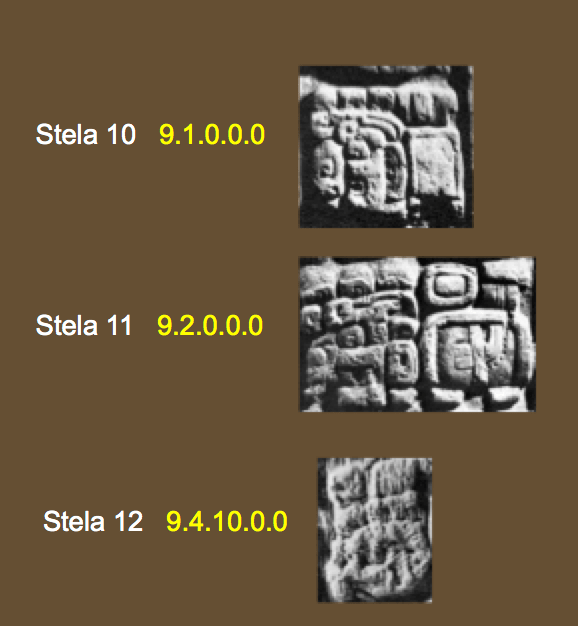
But this Emblem was not always employed by the local dynasty. The earliest block of dates at Altar reveals consistent use of an entirely different set of glyphs. Each contains an ajaw or “lord” sign, often with pendant la syllable that occurs with some emblems. But the main element appears to be the Yopaat avatar of Chahk, the rain god—he may be the raging form of the deity, a violent storm passing across the afternoon sky. The small, dotted volutes are also found on later versions of his name (Figure 3).
Screen Shot 2016-12-20 at 9.47.58 PM.png

 Figure 3. A possible earlier Emblem Glyph of Altar de Sacrificios (Graham 1972: figs. 31, 32, 35).

It may be that, in the 6th century AD, Altar went through the same process as other Classic Maya dynasties. Like Calakmul, which appears to have shifted locations in AD 635, Altar did the same only a few years before, just prior to the second block of dates in its sequence, c. 9.9.5.0.0, April 14, AD 618 [Julian]. This shift is roughly coeval with the implanting at Dos Pilas of a branch of the Tikal dynasty (Houston 1993: 100–101). The incursion at Dos Pilas is often linked to Bajlaj Kan K’awiil, a ruler about whom we know a great deal, including his birth in AD 625. Yet Tikal’s presence may go deeper still. A vessel of Tepeu 1 date with the Tikal Emblem and the name of a “great youth” (Chak Ch’ok Keleem) was found in a cave at Dos Pilas (Houston 1993: fig. 4–6). The style of that vessel is far closer to AD 600 than to decades later. Of course, as a portable object it could always have come to the area at a later time.

Tikal may have played a similar role at Altar. In 1990 or so, I noticed that the name of the Tikal ruler, now known as “Animal Skull” (probably some variant of a turtle head), probably occurred on Stela 8 at Altar (Figure 3; Graham 1972: fig. 19, position D2-C3, shown correctly in Robertson’s rubbing, jumbled in a photo mosaic [Graham 1972: fig. 21]). As usual, the text is eroded and in desperate need of an accurate drawing. But even the titles of this lord occur in expected position, just before his name: a color prefixed to a “capped ajaw” and a set of undeciphered logographs; cf. Martin and Grube 2008:40 for the same series of glyphs on a plate form the area of Tikal. A parallel text with syllables, on a Tepeu 1 bowl in the San Diego Museum of Man, suggests that some of the signs equated to …su-mu ‘a-ku-yi). “Animal Skull,” the 22nd ruler of Tikal, was in place by the final decades of 6th century AD (Martin and Grube 2008: 40–41), a date that accords with mention of him on Stela 8 (9.9.15.0.0, February 21, AD 628 [Julian]). There is a plausible suggestion that “Animal Skull” was the father of the Altar ruler who erected the stela, but I suspect the names of the parents followed. The mother’s are clear, and there is room for a father (see D5 in particular), hinting that “Animal Skull” had some other relation to the local lord. Was the Tikal ruler some sort of overlord?

Altar Stela 8 left side.png

Figure 4. Possible name of “Animal Skull” on Stela 8, left side, D2–C3, title cluster at C2 (photo by Stephen Houston, 1988).

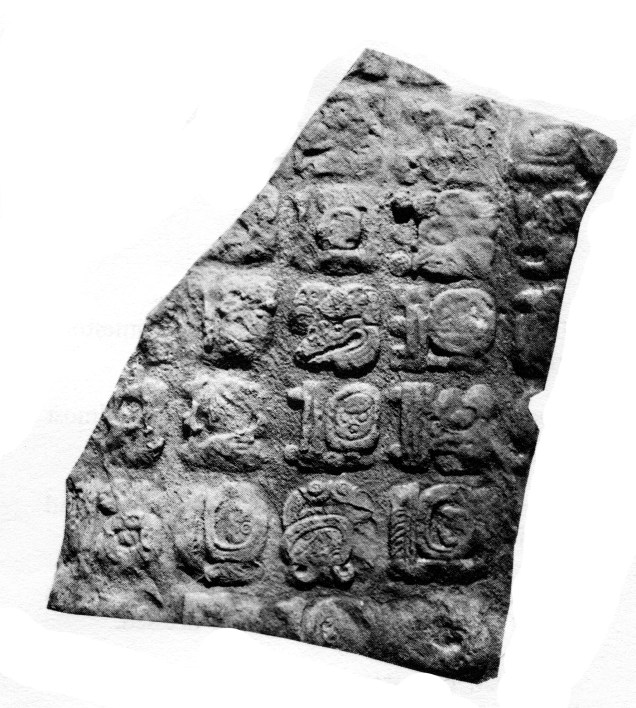
More to the point, did this connection have anything to do with the shift in Emblem? Another text, Sculptured Panel 4, dates by style to the early years of the Late Classic period. It may provide an explanation. At pC5–pD5 is a clear Calendar Round, probably 12 Ix 17 Muwaan. Such a combination of day and month, albeit with a different number for the day, also occurs with a “star-storm” event on Dos Pilas Hieroglyphic Stairway 2 (west section, step 3, B2). I suspect the date at Altar was 9.8.16.10.14, Jan. 3, AD 610 (Julian), just prior to the second block of dates at Altar. (A later placement, in AD 661, would accord less well with the style of the ajaw sign.) Terrible things happened. “He of ‘Altar'” (recall: the xib head within a cartouche is a place name) had been attacked, in a phrase with a superimposed KAB sign that echoes the assaults noted on the Dos Pilas stairway. The rest of the text has legible details, but erosion makes it difficult to discern a fuller account. (Houston’s law: “if there is a crucial detail of text, necessary to larger argument, then it shall be in poor and unreadable condition.”)
sculpted panel 1.jpg

Figure 5. Sculptured Panel 4 (Graham 1972: fig. 59).

Here, then, is a story cobbled together from difficult material. There has been a shift of Emblem and dynasty but not of place name. An earlier royal line was replaced by another with an entirely new way of describing itself, now as a family with a direct purchase on land. But the newcomers must have had some illustrious lineage, for Stela 9, at 9.10.0.0.0 (January 25, AD 633 [Julian]), refers to at least 36 rulers in line from a distant founder. As always among the Classic Maya, politics is not so much local as regional or a melange of both—Altar may have had its own bruising encounter with Tikal. Altar lies at a crucial node of interaction, close to a major confluence of rivers. Quite simply, it may not have escaped the machinations of larger powers.

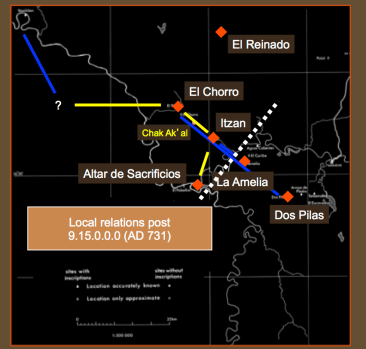
The long-term pattern serves as a coda. The overall region of the lower Pasión reveals similar blocks of time, separated in Figure 6 by vertical green lines. Prior to AD 731, the river served as a conduit of amity, after that to apparent conflict (Figure 7A, B). Physical zones do not determine dynastic behavior but give it affordances, in places where kingdoms found new crowns to wear.

Screen Shot 2016-12-21 at 12.46.35 PM.png

Figure 6. Textual activity in the lower Pasión region (ALS = Altar de Sacrificios; AML = La Amelia; ITN = Itzan; Pato/El Chorro = PCR; RND = El Reinado, whose dynastic record has been studied by David Stuart, in personal communications).

Screen Shot 2016-12-21 at 12.55.22 PM.png   (A)

 screen-shot-2016-12-21-at-12-55-59-pm   (B)

Figure 7.  (A) relations prior to AD 731; (B) relations post AD 731, with blue lines indicating hostility, yellow lines amity.  Dotted line signals a boundary zone of hostility along the lower Pasión.

Postscript:  Another essay on new blocks at Xunantunich has appeared only a short time after this piece, offering further insights into the establishment of a snake dynasty at Calakmul (Helmke and Awe 2016). The find and its discussion are useful and important, but I differ somewhat in how these events are to be transcribed glyphically and what they might represent. For a future post…

Note 1. Stela 4 (in fact a panel paired with “Stela 5” on the other flank of a stairway) opens with an unusual Initial Series referring to a royal death, at 9.10.3.17.0. The final date, some 12 months later, represents, I presume, the amount of time it took to build the structure behind the panels. That building, Structure A-1, must have been mortuary in function. It is rather surprising how many death references occur at Altar, from yet another panel on Structure A-1 (Sculptured Panels 1 and 2) to Altar 2, found in the South Plaza of the city.

Note 2. Government guards in the 1980s were, when I researched the Pasión in 1984 and 1986, under the control of a corrupt official, Gilberto Segura de la Cruz, a comisionado militar for Ríos Montt’s army and the son of Ledyard Smith’s foreman at Altar de Sacrificios and later at Ceibal. Indeed, it was Smith who gave Segura de la Cruz his start. Segura’s father, the preceding foreman, had died suddenly during fieldwork at Ceibal. As a favor to the family, Smith replaced him with Gilberto, who could not have been much more than a teenager. In the late 1970s and early 1980s, just before my arrival, sculptures were being routinely looted from the Parks and protected animals hunted as exotic meat for restaurants in the regional capital of Flores, Guatemala. I have a vivid recollection, in 1984, of Park guards summoned to do seine fishing in the Aguateca arroyo. Nearby, the comisionado‘s family lolled and picnicked. Few fish escaped that comprehensive slaughter. Of course, I was young and oblivious at the time, somewhat clueless as to what was accepted local practice and what was not. Later, members of the comisionado‘s family, including my provisioner of rice, beans, and kerosene lamps, became capos for the Sayaxche drug cartel. At least one of them was eventually gunned down in the muddy streets of the town (Sayaxche cartel).

Note 3. Jessica Munson, a former student of Takeshi Inomata’s, is starting work at Altar. I am confident that much will come from this valuable research, especially of early periods.

Note 4. Purely local building materials of mud, clay, and mussel shell characterize the earliest Preclassic construction. Altar was a city that required some sweat and medium-distance transport to achieve its eventual bulk.

Note 5. I have an appalling memory of passing, in 1995, with my good friend Héctor Escobedo, the mauled fragments of a boat carrying immigrants down the river to Mexico and beyond. All had perished. Shredded, flimsy life vests, their stuffing ripped out, littered the rocky shore below the Chicozapote falls.

Note 6. A semblant form, with headband, has been found on a shattered vessel at Cuychen Cave, Belize (Helmke et al. 2015: 26, fig. 16, fig. 18). In my judgment, that is not the same sign. The head departs too much from the standard xib.

References

Adams, Richard E. W. 1971. The Ceramics of Altar de Sacrificios. Papers of the Peabody Museum of Archaeology and Ethnology 63(1). Cambridge, MA.

Graham, John A. 1972. The Hieroglyphic Inscriptions and Monumental Art of Altar de Sacrificios. Papers of the Peabody Museum of Archaeology and Ethnology 64(2). Cambridge, MA.

Helmke, Christophe, and Jaime Awe. 2016. Death Becomes Her: An Analysis of Panel 3, Xunantunich, Belize. The PARI Journal 16(4):1 –14. http://www.mesoweb.com/pari/publications/journal/1604/Xunantunich.pdf

Helmke, Christophe, and Jaime Awe. 2016. Sharper than a Serpent’s Tooth: A Tale of the Snake-head Dynasty as Recounted on Xunantunich Panel 4. The PARI Journal 17(2):1–22. http://www.mesoweb.com/pari/publications/journal/1702/Helmke-Awe.pdf

Helmke, Christophe, Jaime J. Awe, Shawn G. Morton, and Gyles Iannone. 2015. The Text and Context of the Cuychen Vase, Macal Valley, Belize. In Maya Archaeology 3, edited by Charles Golden, Stephen Houston, and Joel Skidmore, 8–29. Precolumbia Mesoweb Press, San Francisco.

Horn, Robert. 1995. Thai Bluebloods Must Work for a Living. Los Angeles Times (Dec. 17). http://articles.latimes.com/1995-12-17/news/mn-15031_1_extended-royal-family

Houston, Stephen D. 1986. Problematic Emblem Glyphs: Examples from Altar de Sacrificios, El Chorro, Río Azul, and Xultun. Research Reports on Ancient Maya Writing 3. Center for Maya Research, Washington, DC.

Houston, Stephen D. 1993. Hieroglyphs and History at Dos Pilas: Dynastic Politics of the Classic Maya. University of Texas Press, Austin.

Martin, Simon. 2005. Of Snakes and Bats: Shifting Identities at Calakmul. The PARI Journal 6(2):5-13. http://www.mesoweb.com/pari/publications/journal/602/SnakesBats_e.pdf

Martin, Simon, and Nikolai Grube. 2008. Chronicle of the Maya Kings and Queens: Deciphering the Dynasties of the Classic Maya. 2nd ed. Thames & Hudson, London.

Nelson, Zachary. 1998. Altar de Sacrificios Revisited: A Modern Translation of Ancient Writings. BA honor’s thesis, Brigham Young University.

Smith, A. Ledyard. 1972. Excavations at Altar de Sacrificios: Architecture, Settlement, Burials, and Caches. Papers of the Peabody Museum of Archaeology and Ethnology 62(2). Cambridge, MA.

Stuart, David. 2012. Notes on a New Text from La Corona. Maya Decipherment: Ideas on Ancient Maya Writing and Iconographyhttps://mayadecipherment.com/2012/06/30/notes-on-a-new-text-from-la-corona/

Willey, Gordon R., and A. Ledyard Smith. 1969. The Ruins of Altar de Sacrificios, Department of Peten, Guatemala: An Introduction. Papers of the Peabody Museum of Archaeology and Ethnology 62(1). Cambridge, MA.

Caracol at Cambridge

by Stephen Houston, Brown University, and Alexandre Tokovinine, University of Alabama

Cambridge University is known for many things—punting, the excellence of College meals at high table, clotted cream and scones at The Orchards, only a short ways up along the River Cam. Above all, there is the University’s generous tradition of intellectual hospitality.

But it is not known for Maya archaeology. A. P. Maudslay went there, studying Natural Sciences, as did Eric Thompson some 50 plus years later. And rolling forward another 50 years or so, Norman Hammond took his Ph.D. at Peterhouse. One of us, Houston, could not have been more surprised, then, to see, in a small vitrine in the Museum of Archaeology and Anthropology, a small bowl from the beginnings of the Late Classic period. Doubling his astonishment was something else. A label assigned the ceramic to Caracol, Belize. By odd chance, that was where he first trained in Maya archaeology with Arlen and Diane Chase during the initial seasons of their field project. A third surprise, too: the bowl was clearly from the area of Naranjo, Guatemala, in a style fully consistent with that provenance.

By what route did this bowl go from Caracol to a case in distant Cambridge? The main figure here is A.H.Anderson, M.B.E. (1901–1967), Archaeological Commissioner of (then) British Honduras. Born in Australia to immigrant parents from Scotland, Anderson exemplified the geographical quirks of empire and the movements of its servants. He went to school in Nairobi, on to Glasgow for further education, shifting to Burma, where he became accomplished in the language, and finally moving on, at his father’s request, to join the family business in British Honduras (Pendergast 1968:90–91). That was in 1927. By the time of his death, in 1967, he had served as Private Secretary to the Governor, founder of the colony’s library service, Chief Price Control Officer, Commissioner of two districts (Stann Creek, followed by Cayo, in whose area Caracol lay). During a stint with Pan Am Airways, he even traveled with Charles Lindbergh, who piloted him over parts of British Honduras.

Confident in certain abilities, such as the repair of ancient Land Rovers, Anderson was modest in other ways. He knew his limits as an archaeologist, although he did acquire some tutelage, in 1950, 1951, and 1953, under Linton Satterthwaite at Caracol. Motivated by what we would now call “boosterism,” he practically pleaded with Geoffrey Bushnell, curator of the Cambridge Museum: “I do hope that Cambridge will be able to join us here, we have plenty to offer” (Letter from Anderson to Bushnell, Oct. 15, 1953, Archives, MAA). That was not to happen. Until a few decades ago, and in Houston’s early experience—his first visit was in 1981—Caracol was a deucedly difficult place to reach. And, after hard rains, to exit. Satterthwaite moved on to Tikal, but Anderson was able to secure funds from the Crowther-Beynon endowment at Cambridge (doubtless facilitated by Bushnell) to continue work in a part of the site suspected to contain tombs (others had been found in 1953; Anderson 1959:211).

In 1958, Anderson located and cleared what he termed “Burial 5” (Figure 1; Anderson 1959:214–215). A sizable crypt, it contained parts of an earlier building with cord-holders: at one time, the living, not the dead, used this structure. A masonry bench along one wall supported an extended body, head to the south, teeth inlaid with jade (often a marker of royal rank [Andrew Scherer, personal communication, 2014]). Another skeleton lay on its side, just off the bench, its head to the north, now with hematite dental inlays. The finds indicate high status, probably a member of the Caracol dynasty. There were two polychrome bowls (one now at Cambridge, Cat. #63.260), “the sherds of a plain dish along with a pottery figurine, a pottery whistle in the form of a bird, a very small pottery monkey effigy pot, two obsidian blades and several other small artifacts,” along with beads of shell and jade, interspersed with Oliva shells (Anderson 1959:214–215). His description, somewhat confusingly, then refers to “two nests of two pottery bowls each,” one of them the bowl at Cambridge, replete with “allegorical drawings” (Anderson 1959:215).

slide1

Figure 1. Excavations in 1958 by A. H. Anderson, Burial 5, Caracol (Anderson 1959:211, 213). 

In an email, Arlen Chase confirmed that Anderson had penetrated what is now termed “Structure D18” of the South Acropolis. In 2003, this was re-excavated by the University of Central Florida project, which documented the tomb profile and plan (Figure 2; Chase and Chase 2003:9–10, figures 63–68). Early constructions seem to have been, to judge from ceramics in fill, of Early Classic date. The tomb was part of a 6th (perhaps early 7th) century refurbishment, a repurposing of the building.  

slide1

Figure 2. Re-excavation of tomb by UCF project (Chase and Chase 2003:figures 67–68).

In Anderson’s case, tragedy came a few years after his dig. With peak winds of 160 mph, Hurricane Hattie mauled British Honduras in 1961. Anderson’s office was badly hit, his notes destroyed, artifacts forever scattered or destroyed. Yet, by improbable chance, two objects survived from Burial 5, if buried deeply in mud. In 1963, Anderson gave these bowls to the Cambridge MAA in gratitude for the funds given by Bushnell for the work in Burial 5…and perhaps as an inducement for other assistance and expeditions. These bowls are now in the Museum, catalogued as #1963.260 (the “Naranjo” vessel) and #1963.261 (Figure 2, 3). Another bowl photographed by Anderson appears to have disappeared in Hattie’s fury. 

slide2

Figure 3. Two vessels from Burial 5, pre-Hurricane Hattie (Anderson 1959:216). 

The three known vessels (two surviving, one only photographed) leave little doubt that the set was temporally coherent, namely, made (and probably deposited) at more or less the same time. All are securely “Tepeu 1,” probably from the later 500s. The monochrome agrees with that placement (Figure 4).

slide3

Figure 4. Monochrome brown, Burial 5, MAA #1963.261, dia. 14 cm, ht. 8 cm.   

The “Naranjo” find measures 14 cm in diameter and 8.7 cm in height. One of us (Tokovinine) reworked images kindly sent by Dr. Wingfield into a rollout and then a drawing (Figure 5). 

rollout_01

rollout_drawing300dpi_corrected

Figure 5. Rollout and rendering by Tokovinine from images sent by Dr. Chris Wingfield, Cambridge Museum of Archaeology and Anthropology.

There can be little doubt the object is linked to Naranjo, Guatemala, and, in particular, to a key ruler of the late Early Classic/transitional Late Classic period. The iconography, of Itzam Old Gods in their feathered shells, water birds, Spondylus creatures, and fish are consistent with the mythic names favored for other such vessels (they display Principal Bird Deities, dancing jaguars, monkeys or maize gods, partying ritual clowns, many with signs for fragrant air in the background). His name, whose precise reading in Maya eludes complete consensus, is simply “Ruler I” in some sources, albeit with certain elements that can be decoded (AJ-?NUUM-sa-ji, Martin and Grube 2008:71–72; Martin et al. 2016:617; n.b.: no sa or ji variants ever occur in this spelling, suggesting some conventional fixity of form or, as a less welcome possibility, alternative or logographic values of those signs). Said to have been the 35th ruler since the founding of kingship at Naranjo, Ruler I was quite the novice. Rather like a Maya Louis XIV, he came to the throne young, at 12 years of age, in AD 546, dying sometime around AD 615. His is among the longest reigns—perhaps the longest—in Classic Maya history.

A large number of chocolate pots were said either to have belonged to him or to bear close resemblances in their layout, form and size, use of color, and paleography (e.g., K681, 774, 1558, 2704, 4562, 4958, 5042, 5362, 5746, 6813, 7716, 8242). Most appear to designate the king as a chak ch’ok keleem (but see K681). For Houston, this is a secure token of the king’s youth when the pots were commissioned.[Footnote 1] They also hint that many of these were created in sets, not as ad hoc productions from workshops over time. The Caracol bowl at Cambridge is close in style to others, including one excavated in a primary tomb, Burial 72, under a 6+ m high, west-facing pyramid in a peripheral part of Tikal (Figure 6, Becker 1999:figure 55). 

2704

Figure 6. Ruler I vessel from Burial 72, Str. 5G-8, Tikal (K2704, photograph © Kerr Associates).

Potsherds found at Naranjo itself are also close to those on the Cambridge bowl (Figure 7), as are those from a variety of related vessels: note especially the variants of the T’AB-yi and ka?-ka-wa signs (Figure 8) [Footnote 2]. 

comparanda_B15Figure 7. Glyph fragments from special deposit (Midden NRB-003) in Str. B-15-sub (Central Acropolis), Naranjo: a) u[tz’i?]-ba (after Fialko 2009:fig. 47a); b) -bi ? (after Fialko 2009:fig. 27); c) 5?-KAB yu- (after Fialko 2009:fig. 47a); d) CHIT?-? CHAK- (after Fialko 2009:fig. 47a).

slide4

Figure 8. Stylistic comparison of Cambridge bowl with other vases from the reign of Ruler I of Naranjo (photographs © Kerr Associates). 

If one thing has become clear in recent years, including a fresh find at Xunantunich (Xunantunich Finds, Helmke and Awe 2016), it is that relations between Caracol and Naranjo were highly complicated. Historically, they also make sense in terms of macro-politics, viz., the strategic, enduring, and pervasive antagonisms between the “Snake kingdom” and Tikal that Simon Martin has studied intensively (e.g., Martin 2014).

Ruler I, doubtless the owner or commissioner of the bowl in Cambridge, was closely allied with the Snake kingdom. And so too, after initial bonds with Tikal, broken by heavy-handed intervention from the Snake kingdom, was Caracol (Martin and Grube 2008:89). In effect, this remote overlord had some purchase over much of what is now the border between Belize and Guatemala. (Perhaps the branch of the “Snake” family at Dzibanche, due north of the two sites, was the major force in the region.) At the least, the presence of the bowl at Caracol dates to that time of the Snake kingdom’s influence over these two allies. It was a time in which a pot could move with freedom along ties of relative amity. 

All of this would change markedly after the passing of Ruler I. Within two decades, a fury like Hattie’s would spill over Naranjo. The city would be assaulted by Caracol under the aegis of the Snake lords. It seems probable, from the Xunantunich finds, and those at La Corona (Simon Martin and David Stuart, personal communications, 2016), that this was in part the result of schisms within that powerful dynasty to the north.

By about AD 635, the dust had settled. One branch of the Snake family emerged triumphant. But the pot from happier times already lay in its tomb, awaiting discovery and, by curious quirks of weather and history, a move across the Atlantic to Cambridge, England. 


Footnote 1. A vessel at the Los Angeles County Museum of Art (K7716) is the puzzle in this set: it refers to his youthful titles, but also to a more advanced personal age by means of the so-called “katun notations” that frame a royal life in terms of 2o-year, anticipatory segments. Houston has examined this vessel. He is unsure whether the number with the “katun” notation is a 2 or 4, the former more consistent with a youthful epithet, the latter wildly off. In any case, could it be that this vessel, the only one with an historical scene, blends earlier events and later ages of the lord? The scene itself displays the “palanquin” or patron deity (a hummingbird-feline-Old God) of the Naranjo dynasty (Martin 1996:224–230, figures 1, 2). The Los Angeles bowl remains enigmatic in what it shows, but could the palanquin have come at an earlier date to Naranjo from some other site? Warriors congregate to viewer’s left, and the sense is of offering, highlighted by incensing in a brazier placed in front of the ruler. 

Footnote 2. There is still discussion about where these bowls were made. Preliminary neutron activation studies situate their workshop in Holmul, a known subsidiary (at least for a time) of Naranjo (Dorie Reents-Budet, personal communication, 2016; see also Estrada-Belli and Tokovinine 2016:163–165). Yet, to date, there is no evidence that the Holmul potters were literate, although their exposure to inscribed pottery is revealed by many whole vessels and sherds with imitations of writing (Tokovinine has examined those collections closely). Moreover, to our knowledge, sampling of sherds has not been full at Naranjo itself, and their place of origin may well shift back to that site. For us, it would seem likely that so many pots mentioning a ruler of Naranjo would originate in his home city, not a more distant subordinate.  

Acknowledgements: Prof. Cyprian Broodbank was the warmest of hosts in Cambridge, offering Houston a week’s stay as a Distinguished Visiting Fellow at the McDonald Institute for Archaeological Research. This visit, enlivened by a visit to the Grantchester Meadows with Cyprian’s family, also allowed Houston to give the 2nd Raymond and Beverley Sackler Distinguished lecture in Archaeology in honour of Professor of Norman Hammond. Dr. Chris Wingfield, Senior Curator of the Museum of Archaeology and Anthropology at Cambridge, could not have been more helpful with Houston’s requests for information, which Chris supplied at remarkable speed, and with kind equanimity. Houston must also thank, for their hospitality, Graeme Barker (Cyprian’s immediate predecessor as Disney Professor), Elizabeth DeMarrais, Cameron Petrie, Nicholas Postgate, Kate Spence (host at Emmanuel College, former home of many Puritans), Simon Stoddart, Prof. John Robb hosted a memorable high table, in glorious Medieval murk, at Peterhouse College. Sara Harrop, personal assistant to Cyprian, needs promotion to Vice-Chancellor of the University: all problems smoothed, thoughtful always. Arlen Chase was most collegial in sharing information from his re-excavation of Anderson’s operations at Caracol. Licda. Vilma Fialko graciously allowed Tokovinine to examine and document the sherds from Naranjo. 

References 

Anderson, A. Hamilton. 1959. Actas del XXXIII Congreso Internacional de Americanistas,San José, 20-27 Julio 1958:211-218.

Becker, Marshall J. 1999. Tikal Report No. 21: Excavations in Residential Areas of Tikal: Groups with Shrines. University Museum Monograph 104. University Museum, University of Pennsylvania, Philadelphia.

Chase, Arlen F., and Diane Z. Chase. 2003. At Home in the South: Investigations in the Vicinity of Caracol’s South Acropolis: 2003 Field Report of the Caracol Archaeological Project. Report submitted to the Belize Institute of Archaeology. http://www.caracol.org/wp-content/uploads/2016/05/Season-Report-2003.pdf.

Estrada-Belli, Francisco, and Alexandre Tokovinine. 2016. A King’s Apotheosis: Iconography, Text, and Politics from a Classic Maya Temple at Holmul. Latin American Antiquity 27(2):149–168.

Fialko, Vilma. 2009 Archaeological Research and Rescue Project at Naranjo: Emerging Documentation in Naranjo’s Palacio de la Realeza, Petén, Guatemala (2005). FAMSI Grant report. http://www.famsi.org/reports/05005/05005Fialko01.pdf.

Helmke, Christophe, and Jaime J. Awe. 2016. Death Becomes Her: An Analysis of Panel 3, Xunantunich. The PARI Journal 16(4):1–14. Xunantunich Article Helmke and Awe

Martin, Simon. 1996. Tikal’s “Star War” Against Naranjo. In Eighth Palenque Round Table, 1993, eds. Martha J. Macri and Jan McHargue, pp. 223–236. Pre-Columbian Art Research Institute, San Francisco.

Martin, Simon. 2014. The Classic Maya Polity: An Epigraphic Approach to a Pre-Hispanic Political System. Ph.D. dissertation, University College, London. 

Martin, Simon, and Nikolai Grube. 2008. Chronicle of the Maya Kings and Queens: Deciphering the Dynasties of the Classic Maya. 2nd ed. Thames & Hudson, London.

Martin, Simon, Vilma Fialko, Alexandre Tokovinine, and Fredy Ramirez. 2016.   Contexto y texto de la estela 47 de Naranjo-Sa’aal, Peten, Guatemala. In XXIX Simposio de Investigaciones Arqueológicas en Guatemala, 2015, ed. by B. Arroyo, L. Méndez Salinas, G. Ajú Álvarez, pp. 615–628. Ministerio de Cultura y Deportes; Instituto de Antropología e Historia, Guatemala.

Pendergast, David M. 1968. A.H.Anderson, 1901–1967. American Antiquity 33(1): 90-92.

Jesuits, Angels, and Pipil Writing

by Stephen Houston, Brown University 

The list of Mesoamerican writing systems is not large. Of these, only a few are deciphered to a standard that would satisfy a Champollion or a Ventris. Among the most enigmatic and sparsely documented must be the script of the Pipil, a group of Nahuat speakers who lived in parts of Guatemala (near modern-day Escuintla), El Salvador, and even Honduras. A linked group, the Nicarao, flourished in the Rivas area of western-most Nicaragua, and possibly into the Guanacaste region of Costa Rica (the classic study of these peoples remains Fowler 1989). In Colonial times, their larger settlements tended to cluster on the south coast of Guatemala and El Salvador (Sampeck 2015:fig. 1).

There is little doubt that the Pipil wrote (Sampeck 2015:477; see also Sampeck 2013). What is less clear is what can be said of their system.

The only pictorial source, a meager corpus of signs and a purported text from Nicaragua, occurs in the Recordación Florida of Francisco Antonio de Fuentes y Guzmán (1969–1972 [1699]:72–75). A powerful figure in the Kingdom of Guatemala, Fuentes y Guzmán (c. 1634–1700) soared at relatively young age to the position of Regidor Perpetuo, later becoming an Alcalde of what is now Antigua Guatemala (Warren 1973:105). This appointment doubtless resulted from his own merits but also received, one imagines, a heavy boost from influential relatives: Bernal Díaz del Castillo, originator of many elite families in Guatemala, was an ancestor. Fuentes y Guzmán wanted more, however, and sought a position as “chronicler of the Kingdom of Guatemala” (Warren 1973:105). That ambition precipitated into the Recordación Florida, along with other books, now lost.

A carefully considered work on Pipil writing by Kathryn Sampeck (2015:figs. 4, 6) reviews the signs in the Recordación, with close comparison to the original manuscript in the Archivo General de Centro América (Figures 1 and 2; see also Chinchilla Mazariegos 1990:45–46). It is fair to say that Sampeck, who makes her case with detailed attention to the signs, takes these pages at face value. Her premise is that, in some measure, Fuentes y Guzmán recorded a Pipil version of the interpretive trove offered by Bishop Diego de Landa. The signs were not Maya, but, as reproduced by Fuentes y Guzmán, formed an interpretable, coherent record of a late Pre-Columbian/early Colonial writing system that could be related to systems in central Mexico. To Sampeck, the content was heavily focused on tribute, “showing their unusual emphasis of cacao and money as well as the ways in which Pipil writing defined their literary identity” (Sampeck 2015:477). Yet the inventory of signs suggested some variance from sister-scripts in Mexico. “Pipil writing appears to be characterized by more schematic graphic symbols, a distinctive literary identity for the region” (Sampeck 2015:480).


Figure 1

Figure 1. Pipil writing as explained by Fuentes y Guzmán (1969–1972, II:72–73).

Figure 2

Figure 2. Further Pipil writing as explained by Fuentes y Guzmán (1969–1972, II:74–75).

Mayanists were burned long ago when they dismissed Landa’s “alphabet,” widely recognized as the key to phonic decipherment (e.g., Valentini 1880). But, read today, Fuentes y Guzmán on Pipil script induces a disquiet that is hard to shake. What were his sources really, how faithful was his account of this writing?  There is an alternative hypothesis. A missing inspiration may be someone who does not appear in much (any?) scholarly mention of the Recordación Florida. That is Athanasius Kircher (1602-1680), a Jesuit polymath, “the last man who knew everything,” resident in Rome yet broadly read and admired by figures in Colonial Mexico such as Don Carlos de Sigüenza y Góngora and Sor Juana Inés de la Cruz, both more or less contemporaries of Fuentes y Guzmán (Findlen 2004:343–359). A well-educated person of the time, in Guatemala too, where the Jesuits were present, would surely have known of Kircher’s work. The location of the Compañía de Jesus, the Jesuit center of learning and piety in the Colonial capital of Guatemala, was purchased from Bernal Díaz del Castillo’s descendants in 1655, during Fuentes y Guzmán’s lifetime and almost certainly with his knowledge (Jesuit building in Antigua Guatemala). 

That Kircher influenced Fuentes y Guzmán is plausible. Consider Fuentes y Guzmán’s illustration of the Postclassic site of Zaculeu, Guatemala, here compared to Kircher’s views of pyramids from his Oedipi Aegyptiaci (1653) and his last book, the Turris Babel (“Tower of Babel,” 1679; Figure 3). Much differs, but some that does not. Note the blocky, stepped pyramids at the same rough angle and orientation. Figures 3A and 3C have the same smaller pyramids to the side, if edited in number and adjusted in placement. Figures 3A and 3B display a ditch and the Nile respectively, but they loop in roughly the same place above the pyramid, which clips this feature slightly. As Oswaldo Chinchilla points out, Fuentes y Guzmán specifically attributed such constructions to influence from Egypt and “la torre de Babilonia,” Old World models par excellence (Chinchilla Mazariegos 1999: 52).

Figure 3

Figure 3. Fuentes y Guzmán (A, 1969–1972, III:53) and Kircher (B, C, 1679 and 1653, respectively).

Another such template may inspire Fuentes y Guzmán’s “hieroglyph” (jeroglífico) for the “life of the king Sinacam” (Figure 4, left). The emblem to the right is from Kircher (1653:367). To the left, in the “hieroglyph,” there is no ark or set of Egyptian gods, no horses or rooster. But there is the same stepped motif and, above, what looks like a stab at the same peacock, if reversed by Fuentes y Guzmán.

Slide1

Figure 4. Fuentes y Guzmán’s “hieroglyph” for Sinacam (left) and mystic emblem from Kircher (1653:367).  

Look at the Pipil signs themselves. Many may be copies of Aztec signs (if misinterpreted or mis-reproduced) from books that Fuentes y Guzmán refers to as showing “similar things” (e.g., deLaet 1633; Fuentes y Guzmán 1969–72, II:73, fn61). The flint glyphs and circles are close to those reproduced by Kircher, also in his treatise on Egyptian writing; these Mexican signs derive from the Codex Mendoza, an early Colonial source on Aztec tribute (Kircher’s image of the Codex Mendoza f2r). The internal line of the flint always runs from upper-left to lower-right (cf. Figures 1, 2 above). The circles, each with dot inside, are like the Codex too, but recall Kircher’s exposition on an identical sign for the number “one” among the Egyptians (1653:42–43).

Some of the glyphs recorded by Fuentes y Guzmán are heavily conditioned by Western convention. This affects Mexican systems, too, but, among the Pipil signs, we have the presence of axes and “lozas” (crockery) with depth of field or Aztec flowers juxtaposed with western ones; there is even a cozy house in 3/4 view (Figures 1, 2). These reinforce a feeling that the author was being loose or injecting features with a high degree of license. Or, to be less charitable, he was simply making things up, a point underscored by the Nicaraguan slab of wood and Fuentes y Guzmán’s rather opaque description of what actually reached his hands (the piece was said to have been in the “poder” of a certain venerable [“antiguo”] Mercedarian friar (Fuentes y Guzmán 1969–1972:74). If it was not in Fuentes y Guzmán’s possession, and merely described by means of ekphrasis, to be imagined by him, then the signs are identical to those he reproduces elsewhere. If one set is made up, why not all of them?

Kircher has become a figure of ridicule to later generations, especially in his research on Egyptian writing (Pope 1999:28–38). But the Jesuit did know Coptic, the descendant language of ancient Egyptian and still spoken as a daily language during Kircher’s lifetime (it has since shifted to liturgical use). The alert reader has to wonder, is the supposed sign for “400,” the so-called sontle, a Coptic ph, from the Greek, as rendered by Kircher in his 1653 publication (Figure 5)? Is the triangle with dot above Coptic d or th? Are other signs, especially those embellished with circles, the ur-writing of esoterica (Chaldean letters from Babylon) or the writing revealed by angels (Drucker 1999:181, 183, 193)?  The final signs on the Nicaraguan slab, of three spike-like wedges, bring to mind one of the main components of the Jesuit coat of arms, the three nails driven into Christ’s flesh at the Crucifixion (Figure 6).

Slide1

Figure 5. Comparison of esoteric scripts from Kircher and signs from Fuentes y Guzmán. 

Slide2

Figure 6. The nails of Christ in the Jesuit coat of arms and the final signs of the Nicaraguan slab.

There may be a reason the purported Pipil script has “more schematic graphic symbols.” They were lifted from Kircher’s widely distributed works and composed by Fuentes y Guzmán into a mélange that brought the ancient world, then thought to be the origin of New World peoples, into union with Aztec images from deLaet and others.

Did the Pipil write in indigenous script? Probably. Is Fuentes y Guzmán a reliable source on that writing? Perhaps not.

References

Chinchilla Mazariegos, Oswaldo. 1999. Francisco Antonio de Fuentes y Guzmán, precursor de la arqueología americana. Anales de la Academia de Geografía e Historia de Guatemala 74:39–69.

deLaet, Johannes. 1633. Novus Orbis seu descriptionis Indiae Occidentalis Libri XVIII authore Joanne de Laet Antverp. Novis talulis geographicis et variis animantium, Plantarum Fructuumque iconibus illustrata. Elsevir, Leiden.

Drucker, Johanna. 1999. The Alphabetic Labyrinth: The Letters in History and Imagination. Thames and Hudson, London.

Findlen, Paula. 2004. A Jesuit’s Books in the New World: Athanasius Kircher and His American Readers. In Athanasius Kircher: The Last Man Who Knew Everything, ed. P. Findlen, pp. 329-364. Routledge, New York.

Fowler, William. 1989. The Cultural Evolution of Ancient Nahua Civilizations: The Pipil-Nicarao of Central America. University of Oklahoma Press, Norman.

Fuentes y Guzmán, Francisco Antonio de. 1969–72.Obras históricas de Francisco Antonio de Fuentes y Guzmán. Edición y estudio preliminar de Carmelo Sáenz de Santa María. Vols. 230, 251, 259 of Biblioteca de Autores Españoles, desde la Formación del Lenguaje hasta Nuestros Días. Ediciones Atlas, Madrid.

Kircher, Athanasius. 1653. Oedipi Aegyptiaci: Complectens Sex Posteriores Classes, Tomi Secundi, Pars Altera. Vitalis Mascardi, Rome. Kircher

—1679. Turris Babel, Sive Archontologia Qua Primo Priscorum post diluvium hominum vita, mores rerumque gestarum magnitudo, Secundo Turris fabrica civitatumque exstructio, confusio linguarum, & inde gentium transmigrationis, cum principalium inde enatorum idiomatum historia, multiplici eruditione describuntur & explicantur. Jansson-Waesberge, Amsterdam.

Pope, Maurice. 1999. The Story of Decipherment: From Egyptian Hieroglyphs to Maya Script. Rev. ed. Thames and Hudson, London.

Sampeck, Kathryn E. 2013. El campo letrado: Reflexiones sobre la lectura y la escritura en regiones mayas de Mesoamérica. Mesoamérica 55:191–204.

—2015. Pipil Writing: An Archaeology of Prototypes and a Political Economy of Literacy. Ethnohistory 62(3):469–495.

Valentini, Philipp J.J. 1880. The Landa Alphabet: A Spanish Fabrication. Proceedings of the American Antiquarian Society 75:59–91.

Warren, J. Benedict.  1973. An Introductory Survey of Secular Writings in the European Tradition on Colonial Middle America, 1503-1818.” In Handbook of Middle American Indians, Volume Thirteen: Guide to the Ethnohistorical Sources, Part Two, ed. H. F. Cline, pp. 42–137. University of Texas Press, Austin.

More Deathly Sport

by Stephen Houston, Brown University

Some years ago, I posted a blog suggesting a distinct pattern in urban form among the ancient Maya. This was an alignment in which ballcourt alleys pointed towards royal interments (Houston 2014, Deathly Sport). Another example now comes to mind. A fine map by George Bey and William Ringle shows the location, at Ek’ Balam, Yucatan, of the ballcourt at the site. A reference to that feature may appear in the local texts, in Room 29sb, Mural B, yet the preceding, partly effaced sign, …bu, probably cues a stairway, ehb. Ballplay sometimes took place on such features.

Here is my photograph of the much-restored ballcourt (Figure 1), followed, in the next image, by the Bey/Ringle map (Figure 2).

thumb_IMG_2341_1024 (1).jpg

Figure 1. Ek’ Balam ballcourt, with alley pointing toward the “Acropolis” at the site (note thatching over tomb building, top-center; photograph by Stephen Houston).

Screen Shot 2016-07-23 at 1.49.04 PM.png

Figure 2. Map of epicentral Ek’ Balam, with arrow added for orientation and sight-line towards tomb (cartography by George Bey and William Ringle).

The skewed alignment, headed not towards the center of the Acropolis but to an area just west of its main axis, transports the gaze to the location of a spectacular tomb. That grave was found under Room 49 by Leticia Vargas de la Peña and Víctor R. Castillo Borges. To my knowledge, the tomb has not been published in full. But, as shown by Alfonso Lacadena (2004), it surely belonged to the principal lord of the site, U Kit Kan Lehk (the final word of his name is insecurely transliterated).

Screen Shot 2016-07-23 at 2.16.35 PM.png

Figure 3. Location of royal tomb in Acropolis (map by Vargas de la Peña y Víctor R. Castillo Borges).

There are as yet no detailed publications on the relative chronology of these features—did the ballcourt come before the tomb or after?  Nor do I have any precise readings from a Total Station, as that would have given (or refuted) a more certain alignment. But these buildings may well add to the growing evidence for links between ballplay and the illustrious dead. 

References

Houston, Stephen. 2014. Deathly Sport. Maya Decipherment: Ideas on Ancient Maya Writing and Iconography Deathly Sport.

Lacadena García-Gallo, Alfonso. 2004.The Glyphic Corpus from Ek’ Balam, Yucatán, México. Report to the Foundation for the Advancement of Mesoamerican Studies, Inc. Ek’ Balam texts

Maya Stelae and Multi-Media

by Stephen Houston, Brown University 

Most Maya stelae are slabs of quarried limestone. Others come from the volcaniclastic tuff of Copan or the slate of western Belize and the sites linked to that region. Anyone looking at Stela 9 of Calakmul, a slender, easily fractured monument of slate, must wonder how it got there intact (Ruppert and Denison 1943:101–2; see also Healy et al. 1995).

But what survives of a stela may be just a fraction of its former self.

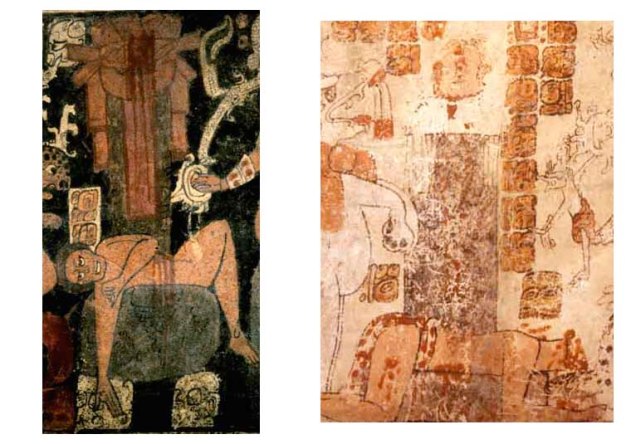
In a chilling note, suitable for Halloween, when it was posted, David Stuart drew attention to a few, rare images of Maya stelae on pots (Stuart 2014, Sacrifice Scene). Sacrifice is afoot, literally so in the form of deities or impersonators padding or dancing about (Figure 1). In one scene a pedestaled altar supports a gutted figure in unusual pose. The victim looks out at the viewer. The call for empathy, revulsion or some other, unfathomable emotion is direct, the “fourth wall” quite broken in this case. Viewing equates to participation. The other image takes this process a bit further or in a new direction. The victim is now prone rather than supine, if still on an altar. His detached head appears on top of the stela. Blades or bone awls scourged and pierced the body before its decapitation. As in the Bonampak murals, or other images of tortured war captives, he bleeds from wounds on the thigh and perhaps the stomach (Miller and Brittenham 2013:fig. 210; see also Houston 2008, Maya Bailiff).

Stela with feitshes above

Figure 1. Maya stelae and human sacrifices (K8351 [left] and K8719 [right], photographs by Justin Kerr, © Kerr Associates). 

Other media draw our attention too. Consider the fetish-like arrangement of paper or cloth, some of it knotted or tied into bows, possibly entangled with extracted body parts. Are those entrails on top of the stela to the left? I suspect the victims were still alive for part of this agony. After all, in Europe, disembowelment and external spooling of intestines were the usual punishments for regicides. The aim was to stretch out, literally and figuratively, the horror of conscious dying (Jardine 2005; for Japanese seppuku, see Fuse 1980).

As archaeologists, we tend to overlook the perishable world. Our focus, of course, is on what lies at hand. Yet there are unusual circumstances where bits of wood or scraps of cloths survive. Or, as in these examples, certain images suggest that Maya stelae were not just blocks of stone. They could also display or incorporate perishables, things inherently ephemeral and needing periodic replacement or alternation. This may even explain why the term for Maya stelae, deciphered as lakamtuun by David Stuart, meant, among the range of possible readings, “banner-stone” (Stuart 2010, LAKAM Logogram; see also Lacadena García-Gallo 2008:36, citing Barrera Vásquez 1980:434). In such a descriptive, cloth combines with stone.

There are other well-known depictions of stelae with perishables. First is a graffito from Tikal, on the south wall of Str. 5D-43, that shows cross-hatching over its surface (Figure 2 [left]). To be sure, this may simply be a way of indicating darkness or red paint, a convention found in many times and places (e.g., Myrberg 2010) and often used to show something dark or black in Maya color-coding (Houston et al. 2009:33–35). The other, on a peccary skull excavated from Tomb I at Copan, is somewhat clearer (Figure 2 [right], see also Peccary scan). Tautly entwined ropes cross the front of the stela, leaving exposed the stone underneath. From this evidence, Stuart argued, on good grounds, that stelae or altars sometimes had such wrappings (Stuart 1996). Stone may have been visible, then covered, then uncovered again. Carvings were less about sustained legibility than intermittent exposure or, in a paradox, their “concealed presence,” an understanding that something was there but reserved from public gaze.

Figure 2

Figure 2. Graffiti recorded by Helen Trik (Kampen and Trik 1983:fig. 46b) and close-up, Peccary Skull, Peabody Number 92-49-20/C201 (photographer unknown).

Mayanists have taken this evidence to heart. The data are nothing new. Seldom mentioned, however, at least in recent memory, is a relevant carving from Ixkun, Guatemala (Figure 3). I first visited the site in 2015, accompanied by two former students, Nicholas Carter and Sarah Newman. There, on the immense Stela 1, I was astonished to see multiple holes drilled around the sides and top. “Immense” fits this stone to a T: the carving is 3.72 m high, exclusive of its buried stela-butt, and the carving wide. Sylvanus Morley noted “[a] series of holes pass through the two front edges of the shaft, four on each side, for fastening something to the front vertical edges of the monument” (Morley 1938:183). In a later visit, Ian Graham observed: “[o]n either side four cord holders have been drilled at intervals along the rear edge, passing through to the back” (Graham 1980:137). 

Ixkun stela holes_Page_1

Figure 3. Drill holes on Ixkun Stela 1 (photograph by Nicholas Carter). 

What to make of this? First, there is the obvious, that perishables were attached to Stela 1 on an intermittent basis. A one-off ceremony, an unveiling only, would not account for such carefully drilled holes. But were there only cords, as on the Peccary Skull, or full coverings to conceal the carving underneath? Attaching skulls, body parts, and sundry fetishes is a more distant possibility. The position of the holes signals a wish for even coverage of the surface by some wrapping. The location of Stela 1 across from an E-Group, a building oriented towards solar, horizon events, hints at when the stela was exposed, i.e., calendrically or by auspicious appearances of the sun. Fire-drilling and incensing also highlight parts of its text and image. Both captives take, in fact, the ch’ajoom, “incenser” epithet in the very first glyph block of their names. A gendered take on this composite, multi-media production is worth mentioning too. By all available clues, carvings of this sort were made by men. A covering of cloth probably involved the work of women.

Ixkun Stela 1 may be an anomaly. If such holes exist on other stelae, I do not know of them. But the drill holes suggest the periodic covering or lashing and unwrapping of dynastic monuments, especially for ones the size and width of the Ixkun stela. Carvings of stone were only part of these composite productions.

References

Barrera Vásquez, Alfredo. 1980. Diccionario Maya Cordemex: Maya-Español, Español-Maya. Ediciones Cordemex, Mérida.

Fuse, Toyomas. 1980. Suicide and Culture in Japan: A Study of Seppuku as an Institutionalized Form of Suicide. Social Psychiatry 15:57–63. Seppuku

Graham, Ian. 1980. Corpus of Maya Hieroglyphic Inscriptions, Volume 2, Part 3: Ixkun, Ucanal, Ixtutz, Naranjo. Peabody Museum of Archaeology and Ethnology, Harvard University, Cambridge.

Healy, Paul F., Jaime J. Awe, Gyles Iannone, and Cassandra R. Bill. 1995. Pacbitun (Belize) and Ancient Maya Use of Slate. Antiquity 69:337-348.

Houston, Stephen. A Classic Maya Bailiff? Maya Decipherment: Ideas on Ancient Maya Writing and Iconography Maya Bailiff.

Houston, Stephen, Claudia Brittenham, Cassandra Mesick, Alexandre Tokovinine, and Christina Warinner. 2009. Veiled Brightness: A History of Ancient Maya Color. University of Texas Press, Austin.

Jardine, Lisa. 2005. The Awful End of Prince William the Silent: The First Assassination of a Head of State with a Handgun. HarperCollins, New York.

Lacadena García-Gallo, Alfonso. 2008. El titulo Lakam: Evidencia epigráfica sobre la organización tributaria y militar interna de los reinos mayas del clásico. Mayab no. 20, pp. 23-43.

Miller, Mary, and Claudia Brittenham. 2013. The Spectacle of the Late Maya Court: Reflections on the Murals of Bonampak. University of Texas Press, Austin.

Morley, Sylvanus G. 1938. The Inscriptions of Peten, Volume II. Carnegie Institution of Washington, Publication 437. Washington, D.C.  

Myrberg, Nanouschka. 2010. The Colour of Money: Crusaders and coins in the Thirteenth-century Baltic Sea. In Making Sense of Things: Archaeologies of Sensory Perception, edited by Fredrik Fahlander and Anna Kjellström, pp. 83–102. Stockholm Studies in Archaeology 53. Department of Archaeological and Classical history, Stockholm University, Stockholm

Ruppert, Karl, and John H. Denison, Jr. 1943. Archaeological Reconnaissance in Campeche, Quintana Roo, and Peten. Carnegie Institution of Washington, Publication 543. Washington, D.C.  

Stuart, David. 1996. Kings of Stone: A Consideration of Stelae in Ancient Maya Ritual and Representation. RES, Anthropology and Aesthetics 29/30:148–171. Kings of Stone

—2014. Notes on a Sacrifice Scene. Maya Decipherment: Ideas on Ancient Maya Writing and Iconography Sacrifice Scene.

Trik, Helen, and Michael E. Kampen. 1983. Tikal Report No. 31: The Graffiti of Tikal. University Museum Monograph 57. University Museum, University of Pennsylvania, Philadelphia.