Maya Creatures III: Mosquitoes and Maddening Noise

by Stephen Houston (Brown University)

The sound comes before the sighting: that high-pitched, oscillating whine mosquitoes make as they hover nearby. [1] The naturalist E. O. Wilson (1984) claims that humans are predisposed to “biophilia,” a pleasing sense of affiliation with the lush, evolutionary miracle that surrounds us. With these creatures, biophilia surely gives way to different reactions—rage, a desire to destroy, yes, E. O. Wilson, even “bioanimus”: “where is that pest, when will it bite, can I kill it before it does?”

Few would dispute that the mosquito makes a most maddening noise, foretelling pain, itching, vexation, disease. Captain Haddock, beloved curmudgeon of the Tintin books, could not agree more—note the artist, Hergé (Georges Remi), and his idea of what these critters sound like, later proved to be the clamor of a descending helicopter (Fig. 1).

Screen Shot 2018-05-19 at 6.54.25 PM.png

Figure 1. What mosquitoes sound like (Hergé 1960:29).

Sounds of animals are, in most languages, understood in terms of echoic mimicry, a perception, influenced by varying motivations, of what noise is seemingly heard from this or that animal: bow-wow for speakers of English, vov-vov in Swedish, the language of my youth. Perhaps, according to some researchers, the size of an animal makes a difference too, high tones associating with smaller creatures, such as birds (tweet-tweet), low tones and back vowels with bigger, lumbering beasts like cows (moo; Bredin 1996:567; see also an early formulation by Jespersen 1922:402).

The Maya region does not lack for mosquitoes. Some are small, others equipped with white-tipped legs or they may shimmer with blue iridescence—their bites can be dainty, often unnoticed pricks, or, in larger ones, they may feel like painful drillings. Long ago, Karl Taube pointed out to me how striking, even beautiful, mosquitoes can be when depicted in Maya vase painting (Fig. 2; see also K1223, K2759). Rich in plumage, with dark wings (that marking was first studied in other creatures by Marc Zender), they excreted blood, and, in a curious feature, showed long proboscides perforating a single flower.

This last doubtless accorded with close observation of nature, but not too close, for it is based on gender confusion. The males nourish themselves with juices or nectars, while the females require blood to sustain their eggs. These respective attributes were not, it seems, minutely understood by the Maya. An overriding feature is the emphasis on the skeletal, even exoskeletal, nature of such insects, along with an extra eye on the forehead, and, at times, leaking or smoking protuberances at their bottoms. An example from the Princeton University Art Museum, pointed out by Bryan Just, combines a mosquito with the features of a bird (PUAM 2003-291, MS2089), probably a gloss on a shared capacity for flight. But, for the mosquitoes, the key component is a set of two volutes, identified some time ago by David Stuart as blood scrolls. Evidently, the mosquitoes were sloppy eaters, and the excess spilled messily from their jaws.

figure 2.png

Figure 2. Dazzling mosquito feeding repeatedly on a cormorant(?)—an image of sustained agony (K2668, photograph by Justin Kerr, used with permission).

Such noxious creatures are not unique in Maya imagery. There may also be depictions of ticks or lice with hook-like talons, bloody mouths, and a disturbing profusion of eyes, perhaps a comment on the complex visual apparatus of insects (Fig. 3). In Maya imagery, these afflict a bloated mammal, an association pointed out to me some years ago by Karl Taube, but comparison with another vase demonstrates a seemingly free alternation with mosquitoes, K1223; see also Chinchilla Mazariegos 2017:12–15, who suggests that the mammal combines jaguar and tapir). In both cases Chahk, the Storm God, poises to strike these bloodsuckers. With axe in hand, he takes ferocious aim at them.

Untitled 2.png

Figure 3. Possible ticks or lice (K555, photograph by Justin Kerr, used with permission).

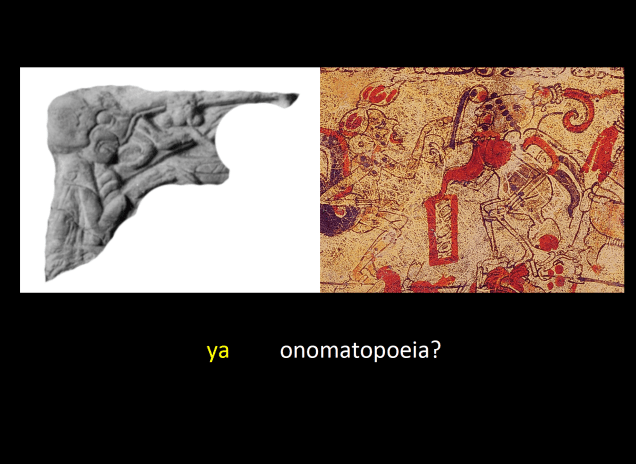
This essay began with a reference to sound. Echoic mimicry—that deeply annoying sound of mosquitoes—may explain a variant form of the ya syllable in Maya writing (Fig. 4). It is clearly skeletal, has a long beak, and disgorges bloody volutes. What is different in this example is that the creature is supplied with wings (one thrusts horizontally to viewer’s right) and, on its proboscis, is  a probable flower or gout of blood. The ya variant is likely a mosquito.

Screen Shot 2018-05-19 at 8.06.02 PM.png

Figure 4. A mosquito in place of the syllable ya (Yaxchilan Throne 2, photograph provided by Ian Graham), compared with blood-drooling, blood dripping mosquito (K9225).

Captain Haddock may have heard BZZRRBZR, but it takes little imagination to see yayayaya (and so forth) as the perceived sound of Maya mosquitoes, segmented into a front vowel, i, gliding into a low front a and back again, along a long stream of torment foretold. Alternatively, the basis for the syllable ya was simply a term (a mimetic one too, from ya!, the sound of misery?)  for “pain” or “sickness,” as in Chontal yaj (Keller and Luciano 1997:292), perhaps linked in Maya minds with the vexing bite of mosquitoes.

[1] For other entries in the “Maya Creatures” series, see Maya Musk, Dragons, Dogs.

Acknowledgements   Thanks go to Karl Taube for discussing many nasty creatures over the course of our long friendship. Oswaldo Chinchilla posed a useful question about the tick/louse-infested beast, as did Bryan Just about a piece under his care at the Princeton University Art Museum.

References

Bredin, Hugh. 1996. Onomatopoeia as a Figure and a Linguistic Principle. New Literary History 27(3):559–569.

Chinchilla Mazariegos, Oswaldo. 2017. Art and Myth of the Ancient Maya. New Haven: Yale University Press.

Hergé [Georges Remi]. 1960. The Adventures of Tintin: The Calculus Affair. London: Methuen.

Jespersen, Otto. 1922. Language: Its Nature, Development, and Origin. London: George Allen and Unwin.

Keller, Kathryn C., and Plácido Luciano G. 1997. Diccionario Chontal de Tabasco. Tucson: Instituto Lingüístico de Verano.

Wilson, Edward O. 1984. Biophilia. Cambridge, MA: Harvard University Press.

Tubing

by Stephen Houston (Brown University) and Joshua Schnell (Brown University)

Maya ruins, if excavated well (and if preservation allows), yield a variety of bone tubes (Fig. 1). Some are only a few cm in length, others longer—the size of the animal and its long bones placing obvious limits on dimensions (e.g., Franco C. 1968:18, lám. III; Inomata and Emery 2014:132, fig 8.4.a–d, fig. 8.9, fig. 8.11; Lee 1969:163–165, fig. 122; Moholy-Nagy, with Coe 2008:fig. 214; Taschek 1994:fig. 37). Tube production is well-understood. Epiphyses must be removed and surface irregularities trimmed or polished, leaving a “shaft core” for further working (Emery 2008:211; Emery 2009:fig. 6).


Screen Shot 2018-05-12 at 8.50.58 AM.png

Figure 1.  Variety of bone tubes from Aguateca, Guatemala (Inomata and Emery 2014:fig. 8.4c, d [left]) and Uaxactun, Guatemala (Kidder 1947:fig. 81b [upper right, fig. 81c [lower right]).


Yet the use of such tubes remains unclear. A few may have been left at an unfinished stage, on their way to becoming bone needles, rings, pointed awls, snuff spoons, weaving pins, hair ornaments or slivers and plaques (some appear to be on sale in a market scene from the murals of Str. Sub 1–4 from Calakmul, Mexico [Martin 2012:76, fig. 40]). Marked by transverse grooves, others may have operated as musical rasps, although few of these show expected wear from percussive abrasions (e.g., Coe 1959:fig. 55n, o). “Tubing,” the use of bone cylinders in the Maya past, needs more thought, if only to enlarge the range of possible functions.

Consider curing. Maya healing involved many concepts, from the restoration of unstable, wayward souls or breath-force to the neutralization of noxious spirits, all the while accompanied by incantations, movements, and offerings (Vogt 1069:425–446). Anciently, as among Nahuatl speakers, gods relevant to certain maladies must have been propitiated by “flattery, promises, threats, warnings…and word magic” (Ruiz de Alarcón 1984:25). “Sucking” by specialists to extract objects from patients formed one component of traditional healing, with references attested in Nahuatl as early as the great Molina dictionary, tlacuicuilia [tlacuihcuīliā],chupar el hechizero al enfermo” (Molina 1571:36v; for vowel length, Karttunen 1983:259).

How this was done might have depended on gender. Fifty years ago, among the Totonac of Veracruz, Mexico, “female shamans use[d] the lips or fist to suck, whereas male shamans use[d] a reed” (Dow 2001:87), the object so extracted being either real (pebbles or blades) or merely notional—the distinction did not seem to matter much. Today, specialists performing this task are known as chupadores, “suckers,” who heal alongside healers setting bones, working with herbs, and cleansing and curing with herbs, copal or eggs (Rubel and Browner 2001:302).

Healing tubes are widely known in indigenous North America and even in the toolkit of rain-making shamans (Hopkins et al. 2012:fig. 3; see Hernando Alarcón’s account, from 1540, of such “blowing” in the lower Colorado River [Alarcón 1970:21]). During the Spanish period in California, healers “sometimes sucked and at other times blew, but both as hard as they were able” (McGuire 1899:386–387; for Eastern groups, see Holliman 1970; Olbrechts 1929). Most such bones were thin (an internal diameter of some 10–12 mm), and often, as among the Cherokee, cut from trumpet weed (Olbrechts 1929:21). A decoction of poplar bark might be blown on or over the patient, at a distance if the curer were a male, the patient a female (Olbrechts 1929:272, 279; this account is equally intriguing for linking scarification and skin-pricks by blades and thorns to acts of healing). Accounts are also recorded, in Amazonia, of “each in turn blowing this powder (ground parica or Anadenanthera peregrina) with great force through a hollow cane into the nostrils of his friend” (McGuire 1899:402).

Tubing, then, might have played similar curative roles among the ancient Maya or at least that possibility needs to be entertained. At the least, composite tobacco pipes of straight outline appear throughout the images of the Colonial Aztec Florentine Codex (e.g., Book 4). Used in feasts but also for religious rituals, tobacco might also have been ingested through bone tubes slotted into a second section charged with combustible plant (Wilbert 1987). Being detachable, the tube might have been less subject to fire damage, providing fewer indications of its function to archaeologists.

Then there are handles for rattles (Houston 2008; Taube 2004). Indeed, examples with small holes in Figure 1 might have served to fasten a long-gone gourd, nut or wooden rattle. The most secure examples come from Tikal Burial 116, the tomb of Jasaw Chan K’awiil, a Late Classic ruler of that city (Moholy-Nagy 2008:fig. 198b). The term for “rattle” was, as confirmed by one hieroglyphic spelling, chikab, a word for such instruments in Ch’olti’ and Ch’orti’ Maya (Grube and Gaida 2006:213–214; n.b.: the text, which ran across two, paired handles—the usual for Maya maracas—was on bone tubes only 4.1 cm high, meaning that the handles must have been longer and detachable, perhaps of some other, more perishable material).

Yet that term, chikab, possibly based on an onomatopoeic chik sound, is not clearly present on the Tikal handles, which refers, with its paired rattle, to the burning and death of a young deity of music (MT 29 [Moholy-Nagy 2008:fig. 198a]; see Yukateko chi’ik, “shake the head as when rattles sound” [Barrera Vásquez et al. 1980:87]). The opaque narrative may recount some story about the deity, his ties to the first music, with allusions to travails, even death, insofar as deities can die (Houston 2008:endnote 1). Yet, in their grimmer details, these events cannot be matched to any known iconography. The more usual associations are, not death after severe burns, but dance and euphonious performance.

Figure 2 MT30.png


Figure 2. Handle of rattle, with reference to Young God of Music (or Wind), and YAX-‘Rattle’-la-WINKIL[li], “First ‘Rattle’ Person,” with possible supervision by a hummingbird (tz’u-nu) in the company of a celestial being (ti-KA’N-la-WINKIL[li]), (MT 30 [Moholy-Nagy 2008:fig. 198b], reading of WINKIL suggested by David Stuart, personal communication, 2014).


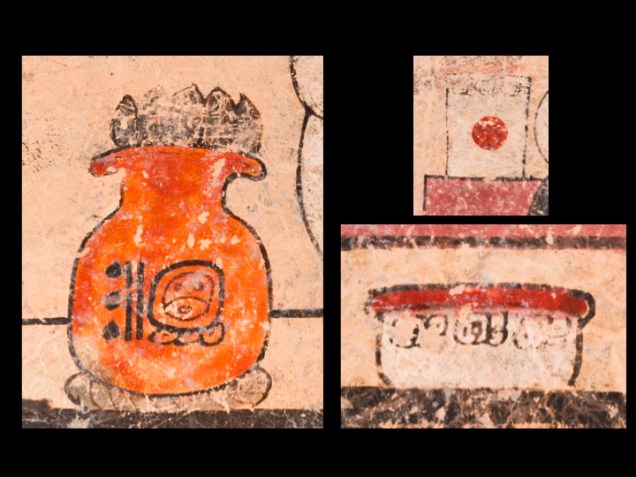
Then there is consumption. Bone tubes might well have been inserted into enema clysters, a proposal made long ago by Michael Coe (Coe 1988:230; Furst and Coe 1977; see also Heizer 1939:86, writing of the New World generally, who describes “a hollow cylindrical bone…used for the [enema] tube”; see also Barrera Rubio and Taube 1987:12). But there are alternative uses. A Classic-era painting from Bonanil Actun, Loltun, Yucatan, shows all the features of good and riotous living (Fig. 3). The young music god appears to the left, followed by a distinctive, lashed jar with protruding cylinder, and the probable head of Ahkan, a deity tied to inebriation (Stone 1995:fig. 4–29; see also Grube 2004; Nielsen and Helmke 2017:153–156).


pot.png

Figure 3. Bonanil Actun, Loltun, Yucatan (photograph by David Hixson, Hood College).


In Postclassic and early Colonial Mexico, the jars containing pulque (octli), an alcoholic drink from the sap of the agave or maguey plant, are often shown with such lashings (Figure 4; see also Nielsen and Helmke 2017:fig. 9). More to the point, at feasts, the collective and sociable practice was to suck out the drink from long tubes, perhaps evoking the extraction, by sucking through an acocote tube of aguamiel sap from the maguy itself (Parsons and Parsons 1990:43–44, figs. 39–42; such sucking of pulque is also highlighted in Nielsen and Helmke [2017], who have discerned such consumption in the “Realistic Paintings” of Tetitla, Teotihuacan). Such a tube could be precisely the object sticking out of the lashed olla at Bonanil Actun. Drinking might have made sense in the inner recesses of that cave, the better to accentuate disorientation. The sequence of the God of Music, then the olla, then a supernatural of inebriation scans almost like a prescriptive ordering of actions, sound to set the stage, drink to lubricate it, then a release into wild-haired drunkenness, impulses barely contained if at all. (In early Colonial Mexico, imbibing that fifth cup was thought to lead to an unseemly loss of self-composure [Córdova 2015]).


Screen Shot 2018-05-12 at 10.43.18 AM.png Figure 4. Pulque jars or ollas and feasting with long tubes (Mural 5, Room 12, Conjunto del Sol, Teotihuacan, with distinctive markings of pulque in three gouts of liquid, perhaps marked with “cotton” textures to denote a white substance [personal communication, Karl Taube, 2018, upper left, Nielsen and Helmke 2017:fig. 3b, photograph by Christophe Helmke]; Florentine Codex, Book 4, Chapters 4–5 [lower left]; and Codex Magliabechiano f. 85r [right]). 


Yet the image with tube from Bonanil Actun is unique. All other Maya images of drunkenness, almost always of youths or elderly debauched gods and their paramours, show jars of pulque (chi in Classic Ch’olti’an) with agave leaves stuffed in—a possible means of intensifying the drink (Houston 2018:128–132)? The scenes are not common, to be sure, but this raises another possible use: that some tubes were about spuming chocolate. For example, a theme found in the figural imagery of West Mexico consists of a figure, tube in mouth, leaning over a proffered cup (Fig. 5).

2010.23.1_PS6.jpg

Figure 5. Jalisco. Seated Couple, ca. 100 B.C.E.-300 C.E. Ceramic, 17 1/2 x 151/4 x 10 in. (44.5 x 38.7 x 25.4 cm). Brooklyn Museum, Gift of the Coltrera Collection, 2010.23.1. Creative Commons-BY (Photo: Brooklyn Museum, 2010.23.1_PS6.jpg).

The usual explanation is that pulque is being delicately sipped in this fashion, a reasonable thought given such tubes among the Aztec and the emphasis in other local imagery on parts of the maguey plant (Butterwick 1998:102–105). Nonetheless, West Mexico has a well-attested focus on cacao production, if in selective areas (Mathiowetz 2011:543–569). By now, it is a commonplace in Maya archaeology—the thought goes back as far as Thomas Gann working in then-British Honduras during the 1910s— that vases with constricted necks and built-in, vertical or slightly everted tubes were employed in achieving a chocolate spume that appealed to ancient peoples of Mesoamerica (Houston 2017; see also Powis et al. 2002). This practice, perhaps thought decidedly unhygienic, was then replaced by pouring liquid back and forth to attain a fine bubbly head (S. Coe 1994:141–142).

But what if this account of culinary history were partial and other forms of spuming continued? A cumbersome tube on a pot might have been, in a sense, “detached” and applied more broadly to any manner of ceramics or gourds with chocolate. If the head settled, it might be refreshed by vigorous blowing down a tube.  And then, giving shudders to archaeologists, that same tube might have been used for multiple purposes, for sucking, blowing, smoking, perhaps even attached to a rattle. The ingenuity of Maya tubing requires its own inventive response, with a directive to look for telling residues, where relevant, and tentative experiments, where possible, to assay ancient function.

Acknowledgements   Christopher Beekman was most helpful with comments and encouragement, as were Karl Taube and Leonardo López Luján.

References

Alarcón, Hernando. 1979. Explorations of Hernando Alarcon in the Lower Colorado River Region, 1540. Journal of California and Great Basin Archaeology 1(1):8–37.

Barrera Rubio, Alfredo, and Karl Taube. 1987. Los relieves de San Diego: Una nueva perspectiva. Boletín de la Escuela de Ciencias Antropológicas de la Universidad de Yucatán 14:3–18.

Barrera Vásquez, Alfredo, Juan Ramón Bastarrachea, and William Brito Sansores. 1980. Diccionario Maya Cordemex. Mérida, Yucatan: Ediciones Cordemex.

Butterwick, Kristi. 1998. Food for the Dead: The West Mexican Art of Feasting. In Ancient West Mexico: Art and Archaeology of the Unknown Past, ed. Richard F. Townsend, 88–105. Chicago: The Art Institute of Chicago.

Coe, Michael D. 1988. Ideology of the Maya Tomb. In Maya Iconography, eds. Elizabeth P. Benson and Gillett G. Griffin, 222–235. Princeton: Princeton University Press.

Coe, Sophie D. 1994. American’s First Cuisines. Austin: University of Texas Press.

Coe, William R. 1959. Piedras Negras Archaeology: Artifacts, Caches, and Burials. Philadelphia: University Museum, University of Pennsylvania.

Córdova, James M. 2015. Drinking the Fifth Cup: Notes on the Drunken Indian Image in Colonial Mexico. Word & Image 31(1):1–18.

Dow, James W. 2001. Central and North Mexican Shamans. In Mesoamerican Healers, ed. Brad R. Huber and Alan R. Sandstrom, 66–94. Austin: University of Texas Press.

Emery, Kitty F. 2008. Techniques of Ancient Maya Bone Working: Evidence from a Classic Maya Deposit. Latin American Antiquity 19(2):204–221.

Emery, Kitty F. 2009. Perspectives on Ancient Maya Bone Crafting from a Classic Period Bone-Artifact Manufacturing Assemblage. Journal of Anthropological Archaeology 28(4): 458–470.

Franco C, José Luis. 1968. Objetos de hueso de la época precolombina. Mexico City: Museo Nacional de Antropología, Instituto Nacional de Antropología e Historia.

Furst, Peter T., and Michael D. Coe. 1977. Ritual Enemas. Natural History March:88–91

Grube, Nikolai. 2004. Akan—the God of Drinking, Disease, and Death. In Continuity and Change: Maya Religious Practices in Temporal Perspective, eds. Daniel Graña Behrens, Nikolai Grube, Christian M. Prager, Frauke Sachse, Stefanie Teufel, and Elizabeth Wagner, 59–76. Acta Mesoamerican 14. Markt Schwaben: Verlag Anton Saurwein.

Grube, Nikolai, and Maria Gaida. 2006. Die Maya: Schrift und Kunst. Berlin: Ethnologisches Museum, Staatliche Museen zu Berlin-DuMont.

Heizer, Robert F. 1939. The Bulbed Enema Syringe and Enema Tube in the New World. Primitive Man 12:85–93.

Holliman, R. B. 1970. Evidence of a Prehistoric Physician in Virginia. Virginia Medical Monthly 97(10):642–644.

Hopkins, Jerry N., Gerrit L. Fenenga, Alan P. Garfinkel, Samantha Riding-Red-Horse, and Donna Miranda-Begay. 2012. Further Reflections on California Rain-Making Shamanism: “The Other Half” of the Tübatulabal Shaman’s Rain-Making Bundle. Journal of California and Great Basin Anthropology 32(2):127–140.

Houston, Stephen. 2008. The xa Syllable as an Example of Onomatopoeia? Maya Decipherment: Ideas on Ancient Maya Writing and Iconography Xa syllable

Houston, Stephen. 2017. Forgetting Chocolate: Spouted Vessels, Coclé, and the Maya. Maya Decipherment: Ideas on Ancient Maya Writing and Iconography Forgetting Chocolate

Houston, Stephen. 2018. The Gifted Passage: Young Men in Classic Maya Art and Text. New Haven: Yale University Press.

Inomata, Takeshi, and Kitty Emery. 2014. Bone and Shell Artifacts. In Life and Politics at the Royal Court of Aguateca: Artifacts, Analytical Data, and Synthesis, eds. Takeshi Inomata and Daniela Triadan, 127–157. Monographs of the Aguateca Archaeological Project First Phase Volume 2. Salt Lake City: University of Utah Press.

Jolly, Fletcher, III. 2004. Early Woodland Tubular Pipe from Eastern Tennessee: “Medicine Tube” or Smoking Pipe. Central States Archaeological Journal 51(4):13–15.

Kidder, Alfred V. 1947. The Artifacts of Uaxactun, Guatemala. Publication 576. Washington, D.C.: Carnegie Institution of Washington.

Lee, Thomas A., Jr. 1969. The Artifacts of Chiapa de Corzo, Chiapas, Mexico. Papers of the New World Archaeological Foundation 26. Provo: Brigham Young University.

Martin, Simon. 2012. Hieroglyphs from the Painted Pyramid: The Epigraphy of Chiik Nahb Structure Sub 1–4, Calakmul, Mexico. In Maya Archaeology 2, eds. Charles Golden, Stephen Houston, and Joel Skidmore, 60–81. San Francisco: Precolumbia Mesoweb Press.

Mathiowetz, Michael D. 2011. The Diurnal Path of the Sun: Ideology and Interregional Interaction in Ancient Northwest Mesoamerica and the American Southwest. Ph.D., Department of Anthropology, University of California, Riverside.

McGuire, Joseph D. 1899. Pipes and Smoking Customs of the American Aborigines, Based on Material in the U.S. National Museum. Washington, D.C.: Government Printing Office.

Moholy-Nagy, Hattula, with William R. Coe. 2018. Tikal Report 27, Part A: The Artifacts of Tikal: Ornamental and Ceremonial Artifacts and Unworked Material. University Museum Monograph 127. Philadelphia: University of Pennsylvania Museum of Archaeology and Anthropology.

Molina, Alonso de. 1571. Vocabulario en lengua castellana y mexicana. Mexico City: Antonio de Spinoza.

Nielsen, Jesper, and Christophe Helmke. 2017. Los bebedores de Tetitla: representaciones del consumo ritual en los murales de Teotihuacan. In Las pinturas realistas de Tetitla, Teotihuacan: estudios a través de la obra de Agustín Villagra Caleti, eds. Leticia Staines Cicero and Christophe Helmke, 135–163. Mexico City: Instituto Nacional de Antropología e Historia Secretaría de Cultura; Instituto de Investigaciones Estéticas, Universidad Nacional Autónoma de México.

Olbrechts, Frans M. 1929. Some Notes on Cherokee Treatment of Disease. Janus Revue Internationale de L’histoire des Sciences, de la Médicine, de la Pharmacie et de la Technique 33:271–80.

Parsons, Jeffrey R., and Mary H. Parsons. 1990. Maguey Utilization in Highland Central Mexico: An Archaeological Ethnography. Anthropological Papers No. 82. Ann Arbor: Museum of Anthropology, University of Michigan.

Powis, Terry G., Fred Valdez, Jr., Thomas R. Hester, W. Jeffrey Hurst, and Stanley M. Tarka. 2002. Spouted Vessels and Cacao Use among the Preclassic Maya. Latin American Antiquity 13(1):85–106.

Rubel, Arthur J., and Carole H. Browner. 2001. Curing and Healing. In The Oxford Encyclopedia of Mesoamerican Cultures: The Civilizations of Mexico and Central America, eds. Davíd Carrasco and Scott Sessions, 300–304. Oxford: Oxford University Press.

Ruiz de Alarcón, Hernando. 1984. Treatise on the Heathen Superstitions that Today Live Among the Indians Native to This New Spain, 1629, trans. & ed. J. Richard Andrews and Ross Hassig. Norman: University of Oklahoma Press.

Stone, Andrea. 1995. Images from the Underworld: Naj Tunich and the Tradition of Maya Cave Painting. Austin: University of Texas Press.

Taschek, Jennifer T. 1994. The Artifacts of Dzibilchaltun, Yucatan, Mexico: Shell, Polished Stone, Bone, Wood, and Ceramics. Middle American Research Institute Publication 50. New Orleans: Tulane University.

Taube, Karl A. 2004. Flower Mountain: Concepts of Life, Beauty, and Paradise among the Classic Maya. RES: Anthropology and Aesthetics 45: 69-98.

Vogt, Evon Z. 1969. Zinacantan: A Maya Community in the Highlands of Chiapas. Cambridge, MA: Belknap Press, Harvard University Press.

Wilbert, Johannes. 1987. Tobacco and Shamanism in South America. New Haven: Yale University Press.

Cotton, Snow, and Distant Wonders

by David Stuart (University of Texas, Austin) and Stephen Houston (Brown University)

Dedicated to our dear friend, Alfonso Lacadena

We seldom think of wintry wonderlands when considering mostly tropical Mesoamerican landscapes. But parts of the Maya highlands in Guatemala sometimes see very occasional snowfall during the winter months, always exciting curiosity and wonder, if not a little consternation and concern over crops (Figure 1). Whenever snow falls and coats the ground, public media must explain the phenomena to local readers, describing its distinction from hail (see Prensa Libre 4/21/2017; also Prensa Libre 12/18/2016). Recently, the national disaster agency (CONRED) even thought it necessary to report that snow can be “associated with precipitation and low temperatures” (Boletín Informativo No. 3046). While rare and noteworthy, snow was ever-present in a few select areas of the central Mexican highlands, atop prominent volcanic peaks such as Orizaba, Popocatépetl, and others.


8413909381_87bdf97f56_o.jpg

Figure 1. A rare snowfall in Cerro Cotzic, Ixchiguan, San Marcos, Guatemala, Jan. 25, 2013 (Creative Commons 2.0 Generic). 


For those who have never experienced snow, it might come as a challenge to describe verbally its many sensations and textures — slushy, clump-flaked, powder-dry, and so on. Then there is the messy residue as it melts, along with its endurance, over months, at altitude or to the far north. At root, to show distant wonders or to talk about them is an imaginative task, drawing on all the tools of the story-teller and the wiles of visual artists. For this, analogies or metaphors work well, especially when distances are great and the unfamiliar acutely strange.

As one example, taking us closer to the Precolumbian past, an unknown maker of woodblock prints devised the first known European image of the Aztec city of Tenochtitlan. Published, probably, in Augsburg, Germany, in 1522, it refers to the city of “dem konig Madotzoma…herr von grossen Venedig,” displaying the causeways or dikes of that city as arching bridges, sailboats passing underneath, and the many temples as turreted buildings (Figure 2; Newe Zeitung). Square-shoed burghers with hose stockings, flat caps, belt purses, and fur collars would have dumbfounded the Mexica Aztec they depict. But they do at least try to describe the unfamiliar. There are settlements like European ones (if walled and likened to Venice, a frequent comparison of the time, going back to Cortés and others [Kim 2006]), and people dressed in the everyday garb of Augsburg.


Screen Shot 2018-01-26 at 8.13.56 AM.png

Figure 2. Earliest European depiction of Tenochtitlan (Unknown 1522:5, John Carter Brown Library, Providence, RI).


The Classic Maya may have been no different. Among the texts linked to contact with the civilization of Teotihuacan, and almost surely with Teotihuacan itself, is the famous  “Marcador” of Tikal, found during excavations overseen by Juan Pedro Laporte south of the Mundo Perdido Group (Figure 3, Laporte and Fialko 1995:66–70). This object is strikingly similar to so-called “ball markers” from Teotihuacan, ranging from one depicted in the murals of Tepantitla (perhaps a goalpost for a stick game) to a carving with separable components at La Ventilla; the latter is well-garnished with yet other cultural references, to the volutes of El Tajín, Veracruz (Solís 2009:#124). The semantic layering in these images and carvings is rich and only partly understood, as there must also have been a reference to standing, banner-like shields (e.g., Taube 2009:figs. 2b, c). The Tikal find, from Group 6C-XVI, potentially bears another link to ballplay. A large raised area nearby, thought by earlier investigators to be a natural hill, is revealed by LiDAR to be eerily close in orientation and layout, if at halved-scale, to the Ciudadela at Teotihuacan (processing and interpretation by Houston and Thomas Garrison of Ithaca College). As if by cue, the Ciudadela has just been shown to contain, in an earlier phase of its existence, a large ballcourt (Gómez Chávez and Gazzola 2015).


marcador.jpg

Figure 3. Tikal Marcador, Group 6C-XVI, on display in the Museo Nacional de Arqueología y Etnología de Guatemala (photographer unknown). 


In part, the historical links between Tikal and Teotihuacan (or its proxies) have been understood for some time (Proskouriakoff 1993:8–9; Stuart 2000; see also Martin and Grube 2000:29–31). An enigmatic personage whose name was probably Sihyaj K’ahk’, “Born from Fire” (coming from a fiery war dart to boot), “arrived” (huliiy) or “completed” a journey (tzutzyi) to Tikal on 8.17.1.4.12 11 Eb 15 Mac in the Maya calendar, or Jan. 16, AD 378 in the Maya-Christian correlation we favor. His presence was clearly martial, as indicated by the Marcador glyph that situates the arrival in terms of conquest, using the familiar term och ch’een, “to cave-enter”  Most likely too, Sihyaj K’ahk’ galvanized or even reorganized the political geography of much of what is now northern Guatemala. Every few years or so a new reference to him comes to light, suggesting that many more are to be found (e.g., Estrada-Belli et al. 2009; Stuart 2014; note that the Maya could also hint at later ambivalence about Teotihuacanos [Houston et al. 2016]).1

The Marcador text is relevant for another reason. In addition to the “arrival,” which highlights the first part of the inscription, the second side of the monument reaches back to two dates: (1) May 5, AD 374 [8.16.17.9.0, 11 Ajaw *3 Wayeb, an unusual, perhaps dire date, presumably, as it falls in the five final days of the year], the evident accession of another figure associated with Teotihuacan, “Spearthrower [ja-tz’o?-ma] Owl” (Martin 2003:13; Stuart 2000:483); and (2) Jan. 24, AD 414 [8.18.17.14.9, 12 Muluk 12 K’ank’in], the dedication of Marcador itself (Figure 4).


Fig. 4.png

Figure 4.  Tikal Marcador, E1–H9 (rubbing provided by Juan Pedro Laporte, with heightened contrast). 


In part, the Marcador remains a highly opaque text. Yet an apparent place name tied to Spearthrower Owl contains recognizable elements, including the number 5, a glyph known since the time of Eric Thompson to represent the downy texture of “cotton” (Thompson 1972:83–83), a syllabic ma (shown in its fuller form, as a prefix and suffix framing the main sign), and the well-known WITS, “hill, mountain” (Figure 5). Thus: the “5 ‘something’ Hills/Mountains,” and as locations or a single place affiliated in some way with a person tied to Teotihuacan or its proxies.


5 snow mountains

Figure 5. Place name associated with Spearthrower Owl, Tikal Marcador, E4, G6 (drawings by Linda Schele).


The one undeciphered sign is probably a representation of “cotton.” The rows of small “u”-shapes are standard in Mesoamerican art as markers for spun cotton or cotton as shown by iconographic clues assembled by Karl Taube and others (e.g., Taube 1993:657). In Maya art we also see the same “u”-shapes on cloth, as on the panel fragment from Palenque shown in Figure 6, depicting the ruler K’inich Ahkal Mo’ Nahb aiding with what might be a cotton bundle containing tribute goods (Stuart 1998:413).


PAL tribute panel

Figure 6. Panel fragment from Palenque, showing large cloth tumpline bundle with “cotton” markings (Drawing by David Stuart).

John Dienhart suggested that the hieroglyphic sign with these same u-shapes reads NOK’, “clothes, cloth” (Dienhart 1986:53). Almost epigraphers have accepted, from multiple sets of evidence, a syllabic value of no, derived, following Dienhart’s lead, from nok’, “clothes, cloth” in Common Ch’olan (Kaufman and Norman 1984:127). The decipherment makes sense. It explains expressions with antipassive suffixes such as ‘a-AK’-no-maak’-n-oom, in the area of Cancuen (Príncipe Maya Panel:E5), ‘a-k’a-no-ma, ak’-n-oom, at Palenque (Temple of the Inscriptions, West Tablet:C6) or the “shaker” title employed frequently by later rulers of Calakmul (yu-ku-no-ma, yuk-n-oom, Martin 2017).

Dienhart may have been both wrong and right: wrong because the “cotton” sign, as a logograph, was perhaps incorrectly deciphered as NOK’ (“cloth”), but right because it did correspond to a word for “cotton.” The logical candidate we propose here is tinam, read TINAM as a glyph, a term well-attested as meaning “cotton” in Common Ch’olan and all its descendant languages (Norman and Kaufman 1984:132). On the Marcador, the term explains the ma syllable—here serving as a reinforcement for TINAM. A no syllable would not account for this usage, yet there can be little doubt that, as a visual form, the glyph corresponds to that fluffy substance.

There may even be a more general protocol in place for generating signs. A Maya innovator (it is hard to see this as anything other than a singular, intentional act) first extracted a syllable no from nok’, the former no longer having any meaning. The scribe then used that sign to record a distinct if conceptually related term, one for the material itself. The motivating word had been left behind, to be replaced in logographic usage by another, loosely linked term. To our knowledge, a “fish” sign, a ka syllable, never references its motivating word, kay, a to syllable fails to deliver tok, “cloud, fog,” and so on. One of the few exceptions may be bi and BIH, “road,” a handy term for a people who liked to move in processions and on various journeys.

But why “cotton” mountains? Why “5” of them, why the tie to Teotihuacanos? And how is this an evocative, analogical description, of the unfamiliar made familiar to readers in a tropical zone?

Central Mexico, the general setting for Teotihuacan, is a far colder place than steamy Tikal, Guatemala. Peaks in visible range of Teotihuacan—at least in times prior to urban pollution—are girt with snow, some of it seasonal, some few examples perennial. A poetic analogy for someone describing this distant, fantastical land might be to reach for the familiar (cotton) to picture the radically foreign (snow). The scribe composing the Marcador text, masterfully proficient in Maya writing, knew much about Spearthrower Owl’s civilization—the text of the Marcador contains several non-Maya signs, and the overall carving exhibits many Teotihuacano elements. It may thus have been referring to a place he had not visited but could describe in terms of fluffy white “down” on high mountains, five of them in fact, perhaps Popocatépetl, Iztaccíhuatl, Orizaba, and others. (One of the authors [Stuart] is collaborating with David Carballo in a future study that will consider these specific connections in more detail.)

The analogy might have been familiar in parts of Mexico. In Oaxaca, the Codex Nuttall, a Mixtec pictorial book from the 14th century, portrays a couple between two peaks (Figure 7). They are a pair, Lady 1 Flower and Lord 1 Jaguar, who founded a particular Mixtec dynasty (Anders et al. 1992:108). Cotton marks, a spread of small “u”-shapes, cover and streak down the peaks, and a small cotton spool at the base of the mountain to the right both accentuates this conceit and employs, according to one interpretation, a Mixtec homophone, yuhua, “cotton spool” or “snow” (Anders et al. 1992:107fn5). A commentary on the Nuttall describes these as the “Montes Nevados” (the snowy mountains), and possibly as a particular location, Icpantepec Nieves in the Mixteca Baja of Oaxaca, Mexico (Anders et al. 1992:33). Snow may have been as unfamiliar to them as to the Lowland Maya of the Early Classic period, but, as on the Marcador, they invoked a metaphor that worked with wit to excite the imagination.


Nuttall 11.png

Figure 7. “Cotton-covered” mountains, possibly Icpantepec Nieves, Mixteca Baja, Codex Nuttall, p. 11, detail, British Museum ADD.MSS 39671 (© Trustees of the British Museum, Creative Commons BY-NC-SA 4.0). 


  1. In 1983 or so, Houston saw another text referring to Sihyaj K’ahk’. It was on an exquisitely inlaid shell in the temporary keeping of Gordon Ekholm, then a curator at the American Museum of Natural History. Etched lightly with glyphs, the shell displayed areas of jade and Spondylus, inserted by some clay-like adhesive into drilled areas of the surface. A scene of emergence, with a single head looking upwards through a symmetrical effusion of foliage, served as the principal image. At the time, Houston made a quick sketch of the text, including an evident statement of overlordship by Sihyaj K’ahk’. The object, considerably damaged by erosion in its hollow, has since disappeared. It may have been in the process of evaluation by Ekholm and his associate, Robert Sonin, an authenticator and former curator at the Brooklyn Museum, who came to Ekholm’s office during Houston’s visit.

Untitled 3.png


Acknowledgements  This essay has benefitted greatly from discussions with David Carballo, Karl Taube, and Marc Zender.


References

Anders, Ferdinand, Maarten Jansen, and Gabina A. Pérez Jiménez. 1992. Crónica Mixteca: El rey 8 Venado, Garra de Jaguar, y la la dinastía de Teozacualco-Zaachila, libro explicativo del llamado Códice Zouche-Nuttall, Ms. 39671 British Museum, Londres. Madrid/Graz/Mexico City: Sociedad Estatal Quinto Centenario/Akademische Druck-u. Verlagsanstalt/Fondo de Cultura Económica.

Aveleyra Arroyo de Anda, Luis. 1963. La Estela teotihuacana de La Ventilla. Cuadernos del Museo Nacional de Antropología I. Mexico City: Instituto Nacional de Antropología e Historia, México.

Beliaev, Dmitri, David Stuart, and Camilo A. Luin. 2017. Late Clasic Maya Vase with the Mention of Sihyaj K’ahk’ from the Museo VICAL, Casa Santo Domingo, Antigua Guatemala. Mexicon XXXIX(1):1–4.

Dienhart, John M. 1986. The Mayan Glyph for Cotton. Mexicon 8(3):52–56.

Estrada-Belli, Francisco, Alexandre Tokovinine, Jennifer Foley, Heather Hurst, Gene Ware, David Stuart, and Nikolai Grube. 2009. A Maya Palace at Holmul, Peten, Guatemala and the Teotihuacan ‘Entrada’: Evidence from Murals 7 and 9. Latin American Antiquity 20(1):228–259.

Gómez Chávez, Sergio, and Julie Gazzola. 2015. Una posible cancha de juego de pelota en el área de la ciudadela, Teotihuacan. Anales de Antropología 49(10):113–133.

Houston, Stephen, Simon Martin, and Karl Taube. 2016. Xenophobia and Grotesque Fun. Maya Decipherment: Ideas on Ancient Maya Writing and Iconography Xenophobia

Kaufman, Terrence, and William M. Norman. 1984. An Outline of Proto-Cholan Phonology, Morphology and Vocabulary. In Phoneticism in Mayan Hieroglyphic Writing, Institute for Mesoamerican Studies Publication 9, eds. John. S. Justeson and Lyle Campbell, 77–166. Albany: State University of New York.

Kim, David Y. 2006. Uneasy Reflections: Images of Venice and Tenochtitlan in Benedetto Bordone’s Isolario. RES: Anthropology and Aesthetics 49/50:81–92.

Laporte, Juan Pedro, and Vilma Fialko. 1995. Un reencuentro con Mundo Perdido, Tikal, Guatemala. Ancient Mesoamerica 6(1):41–94.

Martin, Simon. 2003. In Line of the Founder: A View of Dynastic Politics at Tikal. In Tikal: Dynasties, Foreigners, and Affairs of State, ed. Jeremy A. Sabloff, 3–45. Santa Fe/Oxford: School of American Research Press/James Curry.

Martin, Simon. 2017. Secrets of the Painted King List: Recovering the Early History of the Snake Dynasty. Maya Decipherment: Ideas on Ancient Maya Writing and Iconography Secrets

Martin, Simon, and Nikolai Grube. 2000. Chronicle of the Maya Kings and Queens: Deciphering the Dynasties of the Ancient Maya. London: Thames and Hudson.

Proskouriakoff, Tatiana. 1993. Maya History. Rosemary Joyce, ed. Austin: University of Texas Press.

Solís, Felipe (ed.). 2009. Teotihuacan, Cité des Dieux. Paris: Musée du Quai Branly.

Stuart, David. 1998. ‘The Fire Enters His House’: Architecture and Ritual in Classic Maya Texts.” In Function and Meaning in Classic Maya Architecture, ed. S. D. Houston, 373–425. Washington, DC: Dumbarton Oaks Research Library and Collection.

Stuart, David. 2000. ‘The Arrival of Strangers’: Teotihuacan and Tollan in Classic Maya History. In Mesoamerica’s Classic Heritage: From Teotihuacan to the Aztecs, eds. D. Carrasco, L. Jones, and S. Sessions, 465–513. Boulder: University Press of Colorado.

Stuart, David. 2014. Naachtun’s Stela 24 and the Entrada of 378. Maya Decipherment: Ideas on Ancient Maya Writing and Iconography Naachtun’s Stela 24

Taube, Karl A. 1994. The Birth Vase: Natal Imagery in Ancient Maya Myth and Ritual. In The Maya Vase Book, Volume 4, ed. Justin Kerr650–685. New York: Kerr Associates.

Taube, Karl. 2009. La religion à Teotihuacan. In Teotihuacan, Cité des Dieux, ed. Felipe Solís, 152–159. Paris: Musée du Quai Branly.

Thompson, J. Eric S. 1972. A Commentary on the Dresden Codex: A Maya Hieroglyphic Book. Memoirs of the American Philosophical Society, Vol. 93. Philadelphia: American Philosophical Society.

Unknown. 1522. Newe Zeittung. Von dem Lande. Das die Sponier funden haben ym 1521. Iare genant Jucatan.; Newe Zeittung vo[n] Prussla, vo[n] Kay: Ma: Hofe 18 Martze. 1522.; Newe Zceyt von des Turcken halben von Offen geschrieben. Augsburg? [John Carter Brown Library, J522 .N543z]

How to Identify Real Fakes: A User’s Guide to Mayan “Codices”

by Michael Coe (Yale University) and Stephen Houston (Brown University)

Forgeries have long been a scourge to archaeology and art history alike, rearing up whenever money mixes with “excessive desire and bad judgment” (Meyer 1973:103, see also Lapatin 2000:45). According to Ascanio Condivi, even Michelangelo got into the act by passing off one of his carvings as a valuable antiquity (Holroyd 1903:21–22). Yet fakes also serve as fascinating evidence in the history of crime, especially for that special con by which the cleverness of a forger matches wits with scholars.

Fakers may win for a time—think of the “Etruscan warriors” concocted by the brothers Pio and Alfonso Riccardi and later sold to the Metropolitan Museum of Art (von Bothmer and Noble 1961). But mostly they lose. No one can look today at van Meegeren’s banal paintings and think, as Hermann Göring did, that Vermeer had a hand in their making (Godley 1967). Scientific techniques play a role in separating fakes from genuine pieces, along with a systematic probing of provenience, outright confessions—proudly made in some cases (Beltracchi and Kunst)—and the mere fact that every generation draws on greater knowledge. Faking becomes harder and harder, and the myth, say, that a forger knows more than specialists in Maya art and writing is scarcely credible. The wise analyst must also ask the standard gumshoe questions: who was the victim, who the perpetrator, was there any intent to deceive, was harm done as a result (Chappell and Polk 2009:3, 16)?

There are, no doubt, works that continue to puzzle. The Getty Kouros, for example, is either a fake that deeply skews our understanding of Greek art or it is a revealing anomaly that shows our “imperfect understanding of what remains, and the limits of our perspectives, preconceptions, and comprehension” (Lapatin 2000:46). And then there are the stunningly terrible fakes that do not so much represent a “crisis of criteria” (Lapatin 2000:43), a tough decision to be made between competing claims, as obvious forgeries that would fool no scholar.

Think about Maya fakes. There are many of them (Eberl and Prager 2000; Eberl and Prem 2011), some published, to our amazement, in important traveling exhibits (Gallenkamp and Johnson 1985:pls. 62, 63, 69, 72, 74). A few have needed further research. Typically, the more challenging cases are colonial, with only a few purported signs or images of indigenous nature (Hanks 1992; Jones 1992). But, under hard scrutiny, they too eventually yield their secrets. As for “Pre-Columbian books,” the tell-tale indicator is whether they exist as a pastiche, a rough assortment of glyphs or pictures. Often in nonsensical order, and mostly lifted from well-known sources, the glyphs and images tumble out in combinations that are, to expert eyes, anachronistic, stylistically inconsistent or incoherent, and contrary to recent decipherments of Maya writing.

With Maya books, of which only four intact examples remain, there is no real “crisis of criteria.” Quite simply, the fakes are glaring, at times laughable: who would be fooled by them today? In truth, few scholars ever were. The first such studies were done by Frans Blom (1935a, 1935b; 1946) and by a sprinkling of others (Brainerd 1948; Wassén 1942).

The “codices” tend to have a number of attributes, including:

(1) recognizable day and month signs, sometimes interspersed with wishful squiggles intended to simulate glyphs (Figure 1; compare with Figure 3, below);

Slide2.jpg

Figure 1. Comparison of faked codex with source image in Dresden 19a. 


(2) a crudely polished leather base, with follicles clearly evident, or on what appears to be amate (fig-tree bark) or even coconut fiber (Figures 2, 3);


Slide4.jpg

Figure 2. Faked leather codex and source image (K594, photograph copyright Justin Kerr, used with permission).


(3) little to no confidence of line, the “hand” being ill-practiced in calligraphy (Figure 3);


Slide1.jpg

Figure 3. Unpracticed handling of paint, illegible signs and crude leather base.

(4) overbold and liberal use of polychromy (Figure 4; see also Figure 5, from the Peabody Museum at Yale University);

Slide6.jpg

Figure 4. Bright polychromy: source image to right, “Pellicer Vase,” Museo Regional de Antropología Carlos Pellicer Cámara (photograph to right: Stephen Houston). 


Yale PM fake obverse.jpg

Figure 5. Garish polychromy on the Yale Peabody Museum Codex (photograph by Michael Coe); note also the copying from Dresden 56b.

(5) transparent copying from widely available sources, especially the Dresden Codex and sundry illustrations from general books.

A few of these examples will suffice. One smuggles in a poorly interpreted vulture from a page of the Dresden Codex (Figure 1). The hammock and courtly figures on the so-called “Pellicer vase” from the Museo Regional de Antropología Carlos Pellicer Cámara, Villahermosa, Tabasco, transfer neatly to another “codex” (Figure 4; vase published in Covarrubias 1957), and a Late Classic image of a mythic figure from a polychrome vase excavated at Uaxactun Guatemala finds an inept copy on yet another leather codex (Figure 6). Mixing periods–—the mural dates to the late 300s, early 400s—the faker also quoted freely from the well-published Ratinlixul Vase, excavated in 1917 by Robert Burkitt near Chamá, Guatemala, and now in the University of Pennsylvania Museum (UPM No. NA 11701, Danien 1997:38, Fig. 1).

What is abundantly evident is the sheer laziness or uninventive mentality of forgers. Sylvanus Morley’s The Ancient Maya (1946), first edition, was a particularly generous source for them, as it contained a handy list of Maya day glyphs (fig. 18), month signs (fig. 19), glyphs for time periods (fig. 22), Initial Series (fig. 25), and thorough coverage of the Maya calendar (pp. 265–295). The Ratinlixul Vase had its own line drawing too (pl. 88b). Of slightly earlier date was the useful, inexpensive, and widely available edition of Maya codices by the Villacortas in Guatemala (Villacorta and Villacorta 1933).


Slide7.jpg

Figure 6. Copy of images from Uaxactun and the Ratinlixul vase on a forged leather codex (photograph to lower left, copyright Justin Kerr, used with permission).

A final example shows how blatant such copying can be (Figure 6). This codex lifts half of the center ballcourt marker from Copan Ballcourt BII (excavated by Gustav Strømsvik in the 1930s), as well as a frontal image from Palenque’s Temple of the Skull (upper left) and a smattering of full-figure glyphs from Copan Stela D (center left; see Stuart Temple of the Skull); Maudslay 1889–1902:pl. 48).


Slide8.jpg

Figure 6. Fake codex and, at center, image taken from Copan Ballcourt II, center marker (drawing by John Montgomery). 

A few of these documents are in institutions (American Museum of Natural History, no. 30–9530, in a gift of c. 1901–1904, from the Duc de Loubat [Glass 1975:204]; Peabody Museum, Yale University [No. 137880]; Världskulturmuseet, Göteborg [Glass 1975:305]), but most are only known to us by way of unsolicited communications or, for one manuscript, via a glossy facsimile published in Guatemala (Benítez 2005; said to be from Chichicastenango, Guatemala, it even has a supposed radiocarbon date of “BP 200 + 28,” which, by odd arithmetic, the author pushes back to “1650 A.D.” [Benítez 2005:4–5]). Most fakes had two episodes of preparation, beyond the painting itself. Immersion in dirt or (we suspect) cow patties provided the right patina, and then a hurried cleaning gave some visibility for the dupe being invited to purchase the book.

A striking element is that many share elaborate “origin” stories. As a random selection, these concern a now-deceased relative who had traveled in Mexico/Guatemala, etc., a stray find in a Maya town in Guatemala, caves, scuba-diving or, in an example seen by one of us (Houston) in Provo, Utah, an heir wishing to donate the manuscript to a worthy public institution. A few seem to have gone through the hands of the late Pablo Bush Romero, “Mexico’s distinguished diver, self-made scholar and restless millionaire-at-large” (Sports Illustrated 1964). The presence of others of far earlier date, as in that acquired by the Duc de Loubat, show multiple hands behind their manufacture: the temptation to fake such codices clearly had deep roots (Glass 1975:305–306; for the Duc, Loubat obituary). The Yale forgery is described on the museum website as: a “Maya codex purchased in Mexico City, 1905, from an old priest around the corner from the southeast corner of the Alameda. This codex was first shown in 1887; he then declined to sell it, but in 1905, having been so ill that both his legs were amputated, and not expecting to live longer, he offered to sell the codex (to a friend?) of his in Merida who was then a druggist. This codex was examined by Dr. Alfred Tozzer of Harvard University, who considered it a reproduction, partly because the…various day signs were not in the proper Maya order” (Yale codex).

At this point, one of us (Coe) has seen over a dozen such codices. All are supremely unconvincing to the trained eye. The inept painting, ignorance of Maya coloration, slavish (yet scrambled) copying of well-known sources, anachronisms, inattention to decipherments, improvised, ad hoc “signs,” rough preparation and obvious attempts at artificial aging—all characterize these examples, without exception. It is unthinkable that any in this corpus of pictorial failure would pass muster, technical analysis or glyphic and iconographic exegesis.

To understand what is not a fake, as in the Grolier Codex (Coe et al. 2015), we are well-advised to study what is a fake. This rogues’ gallery shows that compelling deceptions of ancient Maya books are easier to claim than to create.


References 

Benítez, Henry. 2005. Códice Chugüilá (1650 d.C.). Guatemala: Editorial Piedra Santa.

Blom, Frans. 1935a. A Checklist of Falsified Maya Codices. Maya Research 2(3):251–252.

______. 1935b. The ‘Gomesta Manuscript’, A Falsification. Maya Research 2(3):233–248.

______. 1946. Forged Maya Codex. The Masterkey 20:18.

Brainerd, George W. 1948. Another Falsified Maya Codex. The Mastery 22:17–18.

Chappell, Duncan, and Kenneth Polk. 2009. Fakers and Forgers, Deception and Dishonesty: An Exploration of the Murky World of Art Fraud. Current Issues in Criminal Justice 20 (3):393–412 (pp. 1–20, online).

Coe, Michael, Stephen Houston, Mary Miller, and Karl Taube. 2015. The Fourth Maya Codex. In Maya Archaeology 3, eds., Charles Golden, Stephen Houston, and Joel Skidmore, 116–167.San Francisco,: Precolumbia Mesoweb Press.

Covarrubias, Miguel. 1957. Indian Art of Mexico and Central America. New York: Knopf.

Danien, Elin. 1997. The Ritual on the Ratinlixul Vase: Pots and Politics in Highland Guatemala. Expedition 39(3):37–48. Danien 1997

Eberl Markus, and Christian Prager. 2000. A Fake Maya BoneMexicon 22(1):5.

Eberl, Markus, and Hanns Prem. 2011. Identifying a Forged Maya Manuscript in UNESCO’s World Digital Library. Ancient Mesoamerica 22(1):155–166.

Gallenkamp, Charles, and Regina E. Johnson. 1985. Maya: Treasures of Ancient Civilization. New York: Harry N. Abrams.

Glass, John B. 1975. A Catalog of Falsified Middle American Pictorial Manuscripts. In Handbook of Middle American Indians, Volume 14: Guide to Ethnohistorical Sources, Part 3, ed. Howard F. Cline (assoc. eds., Charles Gibson and H. B. Nicholson), 297–310. Austin: University of Texas Press.

Godley, John R. 1967. Van Meegeren: A Case History. New York: Charles Scribner’s Sons.

Hanks William F. 1992. The Language of the Canek ManuscriptAncient Mesoamerica 3:269279.

Holroyd, Charles. 1903. Michael Angelo Buonarroti. New York: Charles Scribner’s Sons.

Jones, Grant D. 1992. The Canek Manuscript in Ethnohistorical PerspectiveAncient Mesoamerica 3:243268.

Lapatin, Kenneth D. S. 2000. Proof? The Case of the Getty Kouros. Source: Notes in the History of Art 20(1):43–53.

Maudslay, Alfred P. 1889–1902. Biologia Centrali-Americana, or, Contributions to the Knowledge of the Fauna and Flora of Mexico and Central America, vols. 55–9, Archaeology. London: R. H. Porter and Dulau.

Meyer, Karl E. 1973. The Plundered Past: Traffic in Art Treasures. New York: Athenaeum. 

Morley, Sylvanus G. 1946. The Ancient Maya. Stanford: Stanford University Press.

Villacorta, J. Antonio C., and Carlos A. Villacorta. 1933. Códices Mayas: Dresdensis— Peresianus—Tro-Cortesianus. Guatemala: Tipografía Nacional.

Von Bothmer, Dietrich, and Joseph V. Noble. 1961. An Inquiry into the Forgery of the Etruscan Terracota Warriors in the Metropolitan Museum of Art. Metropolitan Museum of Art, Papers 11. New York.

Wassén, S. Henry. 1942. A Forged Maya Codex on Parchment: A Warning. Etnologiska Studier 1213:293–304.


Forgetting Chocolate: Spouted Vessels, Coclé, and the Maya

by Stephen Houston (Brown University)


The Romans and the Greeks before them cherished the taste of a particular resin. Tapped from silphium, a wild plant growing along the coast of North Africa, the flavoring went well with roast meat, brought savor to tripe, udder, and sow’s womb, partnered nicely with vegetables, salted tuna, and sea squirt (an invertebrate anchored to ocean floors), helped digestion, and even went into eye-drops (Dalby 2000:17–19). But its popularity and fussy conditions of growth undid the plant. Grazing sheep displaced its natural habitat, and the last root went down the gullet of the Emperor Nero (Dalby 2000:18).

Beloved foods come and go. How many Europeans still consume garum, that smelly fish sauce—Pliny the Elder called it a “secretion of putrefying matter”—traded throughout the Mediterranean and into the furthest reaches of the Roman empire (Curtis 1983:232)? Legionnaires in a British or German military camp doubtless grumbled if they failed to receive their ration or special issue of oil. In the United States, molasses, a viscous treacle resulting from cane refining, sweetened many foods in the 19th century, but gradually gave way to refined sugars. Boston’s Molasses Disaster of 1919, in which a burst tank released a brown tsunami 15 feet high, killing 21 people, would be unthinkable today, for a variety of reasons (Molasses Disaster; I am told that on hot days a cloying odor still fills the neighborhood). Mostly, though, such quantities are not needed. Shoofly pie, of gooey molasses, is no longer much on the menu, although it was in my Pennsylvania childhood.

Consider, if one can, another unthinkable: forgetting chocolate or cacao, from a plant found wild and later cultivated in ancient America. Avid debate surrounds the pharmacological effects of this “chemical kaleidoscope”—whether it serves as an anti-depressive or libido enhancer cannot be easily shown (S. Coe and M. Coe 1996:28–34). But craved it was, in many forms. As a liquid, for example, chocolate “introduce[d] Europe to the pleasures of alkaloid consumption” (Coe and Coe 1996:31). Yet there are grounds for believing that, as an elite consumable, it did indeed drop out of use in one area, the Grand Coclé of Panama. Mortuary deposits in that area, as excavated by Samuel Lothrop and J. Alden Mason—as well as looters and “amateur archaeologists”—revealed staggering wealth, especially in gold but also hundreds of vessels and other goods (Lothrop 1937, 1942; Hearne and Sharer 1992). An element of that wealth, flaunted in feasts, may have been the consumption of chocolate by techniques imported from northern Central America or Mesoamerica, and perhaps indirectly from the Maya.

The main clue is a particular shape of ceramic. In his final opus, James Ford, striving for a grand synthesis of New World diffusion—heroically, for he was dying of cancer—charted the movement of ceramic “complexes” across “Formative” America (Ford 1969). One diagnostic: the “jar with bridge spout” or “teapot vessel,” long-understood by most specialists in Mesoamerica and northern Central America to characterize early agricultural settlements (Figure 1; Ford 1969:19, 21, 116, 120–123, Chart 16; on Ford and his diffusionist interests, see Willey 1988:68–70). Not all spouted jars or vessels are the same, of course. These evinced a consistent shape: a bulbous body (sometimes with a well-defined circumference at the mid-line); a vertical if slightly inclined neck; a flattened eversion around the rim; and a straight or gently inclining spout often, but not always, connected to the rim by a ceramic bridge. Volume varied, as did the presence of paint or modeling into effigies.


Screen Shot 2017-09-23 at 1.15.29 PM.png

Figure 1. Bridge spouts and “Formative” America, esp. Chiapas, Tehuacan, and Veracruz, as excerpted from a chart by James Ford (1969:Chart 16). Dark squares mark time, visible here in 500 year increments from bottom to top, 1500 BC to AD 500. 


A notable strand in Mayanist archaeology is a claim for function. Thomas Gann, working in what was then British Honduras, called one example “the usual Maya chocolate pot” (Figure 2; Gann 1918:77, 128, fig. 74, quotation on p. 128). Mostly he seemed skeptical. Another had “a curious upturned spout” so configured “that it would be impossible either to drink or pour out the contents therefrom” (Gann 1918:77). And: “they were supposed” to have been used for chocolate “but drinking from them must have been a feat of legerdemain” (Gann 1918:77). Where did Gann get the idea? Who had “supposed” this use in the first place? One suggestion is that it came from a description of chocolate vessels “with spouts” by the “Anonymous Conqueror,” among the few Spaniards to leave an eyewitness account of the conquest of Mexico (Spouts; see Merwin and Vaillant 1932:64fn2).

The finest to survive may be an archaicizing object, the stone “Diker Bowl” at the Metropolitan Museum of Art, where the text appears to refer to drinking from the vessel, and possibly to a glyph for seed or grano (pulverized beans?, Houston 2011). Not surprisingly, some of these—and other, even earlier ceramics—have tested positive for theobromine, a key constituent of chocolate (Henderson et al. 2008:18939–18940; Joyce and Henderson 2007:649–651; Powis et al. 2002:97–98; Powis et al. 2011:8597–8599). Whether these drinks were alcoholic or not is an intriguing proposal. Some suggest the first such drinks arose from fermented cacao pulp, i.e., they were inebriants, not a frothed, non-alcoholic beverage made from water and ground beans (e.g., Joyce and Henderson 2010:170). But using residues to distinguish the two remains a challenge.


Slide1.jpg

Figure 2. Chocolate pots among the Maya: (left) “Mound 31,” near the Río Nuevo, Belize (Gann 1918:fig. 74); (right) the “Diker Bowl,” Metropolitan Museum of Art, #1999.484.3 (Diker MMA, photograph courtesy of Justin Kerr, pencil drawing by Stephen Houston, see Houston 2011 Diker Archaicism). 


More recent scholarship takes the reasonable tack that the spout helped in spuming chocolate drinks, a well-known practice in Mesoamerica (McAnany et al. 1999:138; Powis et al. 2002:94). To prepare the drink, someone blew into the spout, in contrast to later practices in which liquid chocolate was beaten with a stick or poured back and forth to raise a head of spume (S. Coe 1994:141): pure taste as the bubbles burst, leaving flavor behind. It is impossible to prove, but this might have followed shifts in perceived hygiene. Did some find it disagreeable to drink chocolate touched, perhaps, by another’s saliva…particularly that of a servant? Or was the change motivated by a need for heightened drama? I have seen this myself. On the north coast of Asturias, Spain, while gorging on razor clams, I once admired a waiter pouring cider from beaker to cup. Not a drop spilled as he drew the beaker further and further away, attaining at last an arc over a yard long.

Generations ago, in a time of diffusionist thought, the broader link between the “chocolate pots” and points south seemed self-evident. Raymond Merwin and George Vaillant (1932:64) noted that the form was “common at Coclé in Panama,” and, in his doctoral dissertation of 1921, published in 1926, Samuel Lothrop observed similar shapes in Costa Rica and Nicaragua, “related to the group of Maya pottery usually known as chocolate pots,” if of far later date (Figure 3; Lothrop 1926:117). The comparison made sense, for Lothrop was one of the last archaeologists to work in all parts of the Americas and, with colleagues, had looked closely at early links across the region (Lothrop 1927; Willey 1976). 


Screen Shot 2017-09-21 at 9.47.03 AM.png

Figure 3. Turkey effigy jar, Bolsón, Guanacaste, Costa Rica (Lothrop 1926:pl. XIII).


The Coclé vessels are notable for their quantity and quality (Figure 4). Yet, the chance that these held chocolate and that such drinks were of intense interest to Coclé elites appears to have faded away. Over the last decades, the archaeological literature shows little to no mention of chocolate in early Panama. One specialist expresses skepticism about much contact with Mesoamerica (Cooke 2005:155; but see Coggins and Shane 1984:pls. 44–50; Lothrop 1952; Pendergast 1970; Pillsbury et al. 2017:#164, for secure evidence of Coclé gold at Altun Ha, Belize, and Chichen Itza, Mexico). In another essay, he targets “rank” and “status” in the Grand Coclé region, commenting on prestigious drinks in the balsería “ritual game” of the Guaymí of Panama but not, at least in that paper, extending such ties back in time (Cooke 2004:274). Nor do drinks make an appearance in a recent, elegant synthesis of evidence from the Grand Coclé (Cooke 2011).


cocle.png

Figure 4. Spouted jars from Grave 26, Sitio Conte, Panama (Lothrop 1942:fig. 197). 


The diffusionist tendency of earlier archaeology has been a migraine from which some areas have only just recovered: localism, in-situ process, the dignified integrity of regions—these are all concerns that merit a sympathetic response. But then there is chocolate. In a classic study of the Bribri, a Chibchan group along the border of Costa Rica and Panama, Alanson Skinner recorded drying platforms for cacao and the consumption of cacao with plantains, the latter to sweeten the former (Skinner 1920:55, 93, 94). Lothrop (1942b:113) himself mentions Nahua (or Nahuatl?) groups in Panama, evidently engaged in the production or trade of cacao. That account also gives them a “tail more than a third of a yard long,” so one wonders a little about its reliability.

Girolamo Benzoni’s Historia del Mondo Nuevo (2017[1565]:75) does report on the widespread use of cacao in “Muhammad’s Paradise” (a.k.a, Nicaragua): “The fruit is like an almond and grows in a shell about the size of a pumpkin…When it is ripe, the seeds are removed and placed in the sun to dry. When they want to drink, they roast the seeds in a pan over the fire, and then they use the stones they use to make bread to grind them. They put this paste in vases (which are like gourds grown in a certain tree that is found in every part of the Indies) and add warm water bit by bit.” Obligingly, he illustrates a cacao tree, dry seeds, and, of rather less relevance, a woman making fire—was this image about roasting seeds (Figure 5)? To be sure, there is a view that cacao in Nicaragua was of relatively recent origin, having been brought there by Nahua speakers migrating from the north (Stanislawski 1983:8, citing Gonzalo Fernández de Oviedo y Valdés, cronista de Indias). Not all agree. The widespread mention of such cultivation down into Panama suggests far greater antiquity, especially for the processing of beans rather than simply the fermentation of pulp (Steinbrenner 2006:265, 267; see also Young 1994:15, for a line between these methods as far south as Colombia).


cachuate tree benzoni 177.jpg

Figure 5. A cacao tree (cacauate) under sheltering arbor, with probable seeds drying in the background (Benzoni 1565, Lib. II:103, Benzoni scan). 


Has the cultivation and use of cacao by Coclé elites been forgotten or overlooked, by both archaeologists and later chiefs? Is cacao the silphium or garum of ancient Panama?

The jars at Sitio Conte and elsewhere have an almost startling similarity to those of the Preclassic Maya and other peoples in northern Central America. In colonial times, not far from Coclé, cacao was processed into beans, presumably for liquid consumption. And there is demonstrable if perhaps indirect contact attested in the form of gold work brought north well before the Spanish conquest. A comment found on-line hints that similar thoughts about cacao have occurred to the curators of the “Beneath the Surface: Life, Death, and Gold in Ancient Panama,” a 2015 exhibit from the University of Pennsylvania Museum (“Straws” for Chocolate).

The main puzzles are the dates. Local specialists suggest that such spouted ceramics in the Grand Coclé must be at least 3–4 centuries after they ceased to be used in the Maya region (Cooke 2011, esp. 158, at c. AD 750–900). Yet, oddly enough, in the Huastec region of Veracruz, Mexico, that same shape is roughly the same date or just before Sitio Conte (Huastec AMNH; Harner Collection). Too much can be made of formal resemblances. Similar jars could service divergent functions, distinct recipes or drinks. But the charge should also be clear: that the Grand Coclé spouted vessels need testing for theobromine. If the alkaloid is present, they will join gold, emeralds, and sperm whale teeth as luxurious items, chocolate vessels, used long ago in Panama.

Acknowledgements

I thank John Hoopes and Jeffrey Quilter for discussions about spouted pots from Panama; Claudia Brittenham, Charles Golden, and Andrew Scherer offered helpful comments too.

References

Benzoni, Girolamo. 2017. The History of the New World: Girolamo Benzoni’s Historia del Mondo Nuevo, edited by Robert C. Schwaller and Jana Byars. Pennsylvania State University Press, University Park.

Coe, Sophie D. 1994. America’s First Cuisines. University of Texas Press, Austin.

Coe, Sophie D., and Michael D. Coe. 1996. The True History of Chocolate. Thames and Hudson, London.

Coggins, Clemency C., and Orrin C. Shane, III, eds. 1984. Cenote of Sacrifice: Maya Treasures from the Sacred Well at Chichén Itzá. University of Texas Press, Austin.

Cooke, Richard G. 2004. Rich, Poor, Shaman, Child: Animals, Rank, and Status in the ‘Gran Coclé’ Culture Area of Pre-Columbian Panama. In Behaviour behind Bones: The Zooarchaeology of Ritual, Religion, Status and Identity, edited by Sharyn O’Day, Wim van Neer, and Anton Ervynck, 271–284. Oxbow, Liverpool.

Cooke, Richard G. 2005. Prehistory of Native Americans on the Central American Land Bridge: Colonization, Dispersal, and Divergence. Journal of Archaeological Research 13(2): 129–187.

Cooke, Richard G. 2011. The Gilcrease Collection and Gran Coclé. In To Capture the Sun: Gold of Ancient Panama, by Duane H. King, Richard G. Cooke, Nicholas J. Saunders, John W. Hoopes, and Jeffrey Quilter, 129–173. Gilcrease Museum, Tulsa, OK.

Curtis, Robert I. 1983. In Defense of Garum. The Classical Journal 78(3):232–240.

Dalby, Andrew. 2000. Dangerous Tastes: The Story of Spices. University of California Press, Berkeley.

Ford, James A. 1969. A Comparison of Formative Cultures in the Americas: Diffusion or the Psychic Unity of Man. Smithsonian Contributions to Anthropology 11. Smithsonian Institution Press, Washington, DC.

Gann, Thomas, W. 1918. The Maya Indians of Southern Yucatan and Northern British Honduras. Bureau of American Ethnology Bulletin 64. Smithsonian Institution, Washington, DC.

Hearne, Pamela, and Robert J. Sharer, eds. 1992. River of Gold: Precolumbian Treasures from Sitio Conte. University Museum, University of Pennsylvania, Philadelphia.

Henderson, John S., Rosemary A. Joyce, Gretchen R. Hall, W. Jeffrey Hurst, and Patrick E. McGovern. 2007. Chemical and Archaeological Evidence for the Earliest Cacao Beverages. Proceedings of the National Academy of Sciences of the United States of America 104 (48): 18937–18940.

Houston, Stephen. 2011. Bending Time Among the Maya. Maya Decipherment: Ideas on Ancient Maya Writing and Iconography Bending Time

Joyce, Rosemary A., and John S. Henderson. 2007. From Feasting to Cuisine: Implications of Archaeological Research in an Early Honduran Village. American Anthropologist, n.s, 109(4):642–653.

Joyce, Rosemary A., and John S. Henderson. 2010. Forming Mesoamerican Taste: Cacao Consumption in Formative Period Contexts. In Pre-Columbian Foodways: Interdisciplinary Approaches to Food, Culture, and Markets in Ancient Mesoamerica, edited by John E. Staller and Michael Carrasco, 157–173. Springer, New York.

Lothrop, Samuel K. 1926. Pottery of Costa Rica and Nicaragua. Contributions from the Museum of the American Indian, Volume VIII. Heye Foundation, New York.

Lothrop, Samuel K. 1927. Pottery Types and Their Sequence in El Salvador. Indian Notes and Monographs, Vol. 1, No. 4. Museum of the American Indian, Heye Foundation, New York.

Lothrop, Samuel K. 1937. Coclé: An Archaeological Study of Central Panama, Part I: Historical Background, Excavations at the Sitio Conte, Artifacts and Ornaments. Memoirs of the Peabody Museum of Archeology and Ethnology, Harvard University, Vol. VII. Cambridge, MA.

Lothrop, Samuel K. 1942a. Coclé: An Archaeological Study of Central Panama, Part II. Pottery of the Sitio Conte and other Archeological Sites. Memoirs of the Peabody Museum of Archeology and Ethnology, Harvard University, Vol. VIII. Cambridge, MA.

Lothrop, Samuel K. 1942b. The Sigua: Southernmost Aztec Outpost. In Proceedings of the 8th American Scientific Congress, Volume II: Anthropological Sciences, edited by Paul Oehser, 109–116. Department of State, Washington, DC.

Lothrop, Samuel K. 1952. Metals from the Cenote of Sacrifice, Chichén-Itzá, Yucatán. Memoirs of the Peabody Museum of Archaeology and Ethnology, Harvard University, Vol, 10(2). Cambridge, MA.

McAnany, Patricia A., Rebecca Storey, and Angela K. Lockard. 1999. Mortuary Ritual and Family Politics at Formative and Early Classic K’axob, Belize. Ancient Mesoamerica 10:129–146.

Merwin, Raymond E., and George C. Vaillant. 1932. The Ruins of Holmul, Guatemala. Memoirs of the Peabody Museum of Archaeology and Ethnology No.2, Vol 3. Harvard University, Cambridge.

Pendergast, David M. 1970. Tumbaga Object from the Early Classic Period, Found at Altun Ha, British Honduras. Science 168: 116–118.

Pillsbury, Joanne, Timothy Potts, and Kim N. Richter, eds. 2017. Golden Kingdoms: Luxury Arts in the Ancient Americas. J. Paul Getty Museum and Getty Research Institute, Los Angeles.

Powis, Terry G., Fred Valdez, Jr., Thomas R. Hester, W. Jeffrey Hurst, and StanleyM. Tarka, Jr.  2002. Spouted Vessels and Cacao Use among the Preclassic Maya. Latin American Antiquity 13(1):85–106.

Powis, Terry G., Ann Cyphers, Nilesh W. Gaikwad, Louis Grivetti, and Kong Cheong. 2011. Cacao Use and the San Lorenzo Olmec. Proceedings of the National Academy of Sciences of the United States of America 108(21):8595–8600.

Skinner, Alanson. 1920. Notes on the Bribri of Costa Rica. Indian Notes and Monographs VI(3). Museum of the American Indian, Heye Foundation, New York.

Stanislawski, Dan. 1983. The Transformation of Nicaragua, 1519–1548. University of California Press, Berkeley.

Steinbrenner, Larry. 2006. Cacao in Greater Nicoya: Ethnohistory and a Unique Tradition. In Chocolate in Mesoamerica: A Cultural History of Cacao, edited by Cameron L. McNeil, 253–270.  University Press of Florida, Gainesville, FL.

Willey, Gordon R. 1976. Samuel Kirkland Lothrop, July 6, 1892–January 10, 1965. National Academy of Sciences, Biographical Memoirs 48:252–272.

Willey, Gordon R. 1988. Portraits in American Archaeology: Remembrances of Some Distinguished Americanists. University of New Mexico Press, Albuquerque.

Young, Allen M. 1994. The Chocolate Tree: A Natural History of Cacao. Smithsonian Institution Press, Washington, DC.