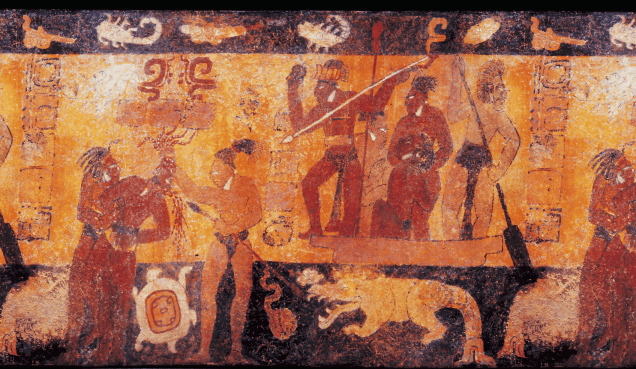
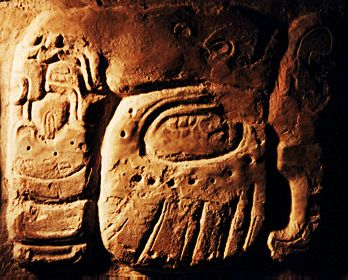
Maya Creatures IV: Why Do Dogs Dress Up?

Stephen Houston and Andrew Scherer

To the memory of Robert M. Laughlin (1934–2020)

Quoting a psalm, Carl Linnæus began a major treatise on classification with words of praise for his Creator: “How great are your works! … how filled the Earth with your possessions!” [1] A few pages in, citing Seneca, he laid out his vision of this divine plan (Linnæus 1758:6, 12). Deus creavit, Linnaeus disposuit — “God creates” but “Linnaeus disposes” (Reid 2009:23). For him, political metaphors such as “empire” and “kingdom” embraced, among other classes, the novel term of “mammalia” for creatures that nursed their young and dominated the regnum animale. In that broader kingdom were other creatures, including birds, amphibians, fish, insects, and, last and least, worms, creatures without feet or wings, eyes, ears or nostrils. But, unlike plants, all could sense and move. The most basic category, lapides or “rocks,” simply “piled” up (Linnæus 1758:6).

Mammalia had one ambiguous occupant. To Linnæus, humans were the final and most perfect of the Creator’s works. Tasked with venerating their maker, they lodged at the summit of his classification yet also jostled with “simians,” lemurs, and bats (Linnæus 1758:7, 18). For theological reasons, this was a claim with consequences, disturbing at the time to Linnæus himself (http://www.alvin-portal.org/alvin/imageViewer.jsf?dsId=ATTACHMENT-0001&pid=alvin-record%3A223725&dswid=9797). Darwin, after all, lurked only a century away. Creatures so classified might represent a divine plan or share features arising from common descent. Each involved a different story or explanation. One had a sentient agent, an “author” of it all. The other unfolded in ways conditioned by gradual, unwitting process.

For Linnæus, relations between species and their settings—their “ecology”—was not of central concern, although he did pay attention to certain kinds of behavior. By an early theory of his, barn swallows left Sweden seasonally, not by flying south, but by wintering at the bottom of ponds (Reid 2009:23). Nor did he ignore time, for fossils clearly indicated some shifts from the past (Reid 2009:27). Folklore mixed with precise observation. In formative years, by some evidence, he might have believed in trolls.

For those who do not live in 18th-century Sweden, or write to others in Latin epistles, Linnæus still offers four relevant queries: (1) what, in other places and times, is an animal?; (2) are their traits changeable?; (3) what stories account for such animals?; and (4) how, if at all, are humans animals or animals human? These are sovereign questions of science but especially for anthropology. Much recent thinking on these matters comes from those who look at the peoples of Amazonia. Philippe Descola (2013, 2017) and Eduardo Vivieros de Castro (1998) are central contributors here, although their subtle ideas and debates evade rapid summary (see Vanzolini and Cesarino 2014, also Fitzgerald 2013; Halbmayer 2013; on inter-species communication, Kohn 2013; for antecedents, von Uexküll 2010 [1934, 1940]).

One theme stands out. People everywhere follow “schemas” that link, contrast, and relate themselves to other beings (Descola 2013:112–116). Descola (2013:207–209, 233, fig. 2) posits several, which he organizes into a grid of attributes defined by their “interiorities” (souls or minds) and “physicalities” (outward form, matter, and behavior). In Mesoamerica, for example, “analogism” involves living things that possess multiple essences and bodies (Descola 2013:226). A plurality of souls or energies inhabit quite different beings, but those surging forces may also extend from one to the other. Their “interiorities” are dissimilar, as are their “physicalities.” Exemplified by Amazonia, “animism” presents a major contrast, consisting of humans and other creatures with “similar interiorities” and “dissimilar physicalities” (Descola 2013:233, fig. 2). Whatever their external appearance, often of great diversity, animals may be “human” too. They share an interiority with us, or perhaps, if they were once like us, they no longer are (Halbmayer 2013:13). Stories help to explain how that happened.

Descola (2013: 129) absorbs plants into his classification, if lightly so, but he would not seem to entertain the possibility of other sorts of life. For some Maya, sources insist, malignant sewing machines, automobiles, evangelical music, scissors, rainbows, and ravenous outcrops harbor their own energies and willful minds, as, anciently, did water and whirlwinds (Houston 2006; Pitarch 2011:43, 44, 49; Stuart 2007). In a few of these, “[a]nger churns, along with an unforgiving appetite for vengeance” (cf. Houston 2014:79; n.b.: variation in such ideas and their underlying rationales are the norm, even within a single community [Laughlin 2000:105]). In general, Descola and Vivieros de Castro pass over the world of artifice and material culture, the objects and features not thought to be alive in Western thought (Houston 2014:78). Nor is it certain that one ontology excludes others, a point made by some Amazonian specialists in response to Descola (Coehlho de Souza 2013:427–428), or that the schemas fall into tidy Lévi-Straussian grids. This is not to discount the careful effort and intellectual ambition behind Descola’s work. Influenced by Keith Thomas (1983) on English animals, he has focused more recently on shifting relations between humans and birds (Descola (2001; 2017:118–121). Such creatures—talking, mimicking, emotional, intelligent, yet feathered and flying—serve as productive foils for people. No ideas on earth, not even ontological schemas, want for history (e.g., Atıl 1981; Boia 1995; Pastoureau 2005; Sahlins 2017; Salisbury 1994).

What is human or animal intrigued the Classic Maya and their descendants. Consider the terms for “animal.” In Colonial Tzotzil, they are tagged by locomotion or habitual position, with words relating to quadrupedalism. Thus: kot (Laughlin 1988, I:224) and, in other languages, koht (Tzeltal, Polian 2017:44, 87). In Ch’ol, there is a numeral classifier, kojt, for “animals,” as well as an intransitive verb, kojt, for standing on four legs (Hopkins et al. 2010:100, 103). In several languages, plants are “seeded” yet also planted, with no chance of mobility, whether on four legs or two (Ciudad Real 2001:479). Plants stay put. Curiously, Ch’orti’ employs a similar root for “person,” pak’ab’, perhaps because of pervasive beliefs about the vegetal, maize-like nature of humans (Hull 2016:322). The use of human anatomy to describe plants is common in languages such as Tzotzil. Humans and plants may be described by similar expression, hair equated to corn silk, or a lazy man to unproductive land (Laughlin 2000:tables 2–4).

Yukatek also contributes -kot for such “animals without reason” (Ciudad Real 2001:120), specifically quadrupeds (Barrera Vásquez et al. 1980:338; see also Common Ch’olan *kot, “bent over, crouching, like an animal [Kaufman and Norman 1984:123]). Possibly affected by Christian belief, Ch’ol refers, in an “obsolete” term, to animals by means of negation and a studied contrast with humans. They are creatures “without souls” (ma’ch’ujlel, Hopkins et al. 2010:138). In Q’eq’chi’, “animal,” xul, implies those who are unbaptized, wild, a label applied in rebuke to unruly children (Sam Juárez et al. 1997:420–421). Humans, by comparison, are winik. They have 20 digits, a sum implied by the fingers and toes tallied together. But they are also imbued with will and destiny in a calendrical framework organized in part by this number (Houston and Inomata 2009:57–58). People count with their bodies, a finger or hand at a time. Days are latent in those digits.

What binds rather than separates animals and humans is a sense that both are “born” of a female, al, and that both have “fleshy” bodies, bak’etel (Tzeltal, Polian 2017:119, 334, 684; cf. the possibly related Ch’orti’ arak’, “animal” [Hull 2016:40; cf. Wisdom 1950:453, arak, “domestic animal”; also in Yukatek, Barrera Vásquez et al. 1980:10; Ciudad Real 2001:62)]. Charles Wisdom notes that, in Ch’orti’, ar, “mammal, animal” is “opposed to plant” [Wisdom 1950:452]). Tzeltal speaks of “animals,” chambahlum, by seeming to combine two formidable creatures, “snake,” chan, and “jaguar,” bahlam, to encompass all animals (Polian 2017:178; cf. 138, 178; n.b.: by phonological assimilation, the nasal consonant n goes to m before a bilabial b; for “jaguar,” see Ch’ol bahlum [b’ajlum]; Hopkins et al. 2010:212).

These distinctions, of habitual posture, relative mobility and wildness, or fleshiness, extend to certain plants. A late 6th-century vase in the Mint Museum–Randolph shows a variety of “just-so” stories worthy of Rudyard Kipling (Figure 1). One collection of Mayan tales calls them “‘how’ and ‘why’ stories” (Shaw 1971:24). The scene to the left could have been called “How the Jaguar Got Its Spots.” Holding a conch, ink receptacle, and brush, a rodent applies (one presumes) the spots on a feline—in all likelihood, a visual story that serves as etiology, an account of cause-and-effect. The pliant jaguar is in the kot position, if resting on its haunches. He sits atop what may be the Jaguar God of the Underworld, en face, with three stones in its mouth. A possible participant to the right—see the rodent’s tail reaching out, tendril-like, to touch this image—is a seated figure with hand raised to the forehead. Long ago, David Stuart identified this pose as the lamentation gesture associated with skeletal death gods or beings in distress (personal communication, 1983). Such a pose occurs with the Maize God, sinking in his canoe, on the incised bones from Tikal Burial 116 and also with a foreign day sign for “Death” on Jimbal Stela 1:B4. [2] On the vase are three stones just beneath this figure. Around his body flares an aureole of the serrated but succulent leaves (pencas) of the agave plant. From this plant comes the alcoholic beverage pulque, chih in Classic Ch’olti’an (Houston et al. 2006:120, 122, fig. 3.16). This is extracted from fluids (aguamiel) that pool, after human scraping, at the core of the plant (Parsons and Parsons 1990:35–45).

Figure 1. How the jaguar got its spots, and the agave plant full of woe (close-up, K1558, photograph courtesy Justin Kerr).

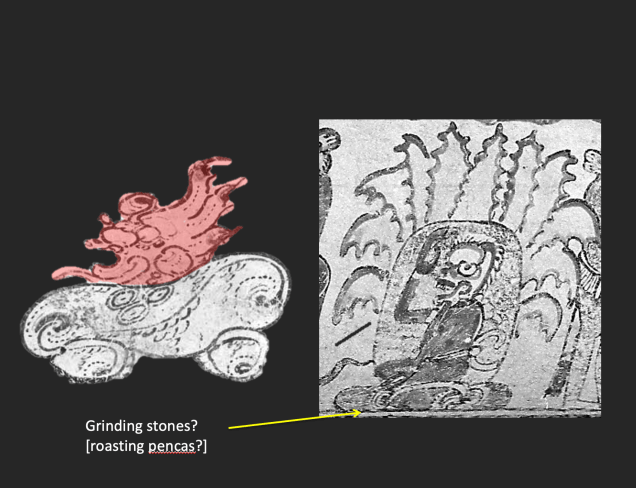
The figure in woe is personified agave, often shown with bony features or, in alternate form, with the head of the rain deity, Chahk (Figure 2; see also Ek’ Balam, Room 29sub, Mural of the 96 Glyphs, V1, http://www.famsi.org/reports/01057/01057LacadenaGarciaGallo01.pdf). On occasion, the penca may be a variant of that god, with the syllable ‘o on its forehead (Houston et al. 2006:123, fig. 3.19; note, however, that this sign may simply be a stylized agave leaf). The agave plant appears to be ground, as agave can be, to process its fibers in either a green or burned state (penca cruda or penca asada); eventually, the strands will be plied into netting and cloth (Stuart 2014; see also Parsons and Parsons 1990:152). Possibly, the skeletal nature of the agave plant relates to the death-like, unconscious states induced by alcohol or the rooting of agave in hard, rocky landscapes (David Stuart, Karl Taube, personal communications, 2020); Chahk too has stony associations in the context of certain month names, perhaps because of lightning strikes by this god and its vitalizing effects on bedrock (cf. La Muerta Monument 1, Guatemala [Suyuc et al. 2005:fig. 9]). [3]
This image has an empty alt attribute; its file name is screen-shot-2020-07-03-at-2.27.08-pm.png
Figure 2. Head of O’ Chahk(?) as agave for grinding or roasting (left, K1882), and personified agave in partly skeletal form (K1558, photographs courtesy Justin Kerr).

Or the metaphor of death ran deeper. By tradition, the tool for cutting the plant, a hooked blade known in highland Mexico as a tajadera, bears an eerie resemblance to hooked blades in Teotihuacan that snag hearts or drip with clotted, sacrificial blood (cf. Parsons and Parsons 1990:28, pls. 21–22; O’Neil 2017:fig. 25.5; Sugiyama 2017:pl. 61). Perhaps this was an agricultural trope for bloodletting and sacrifice. Slicing away at a penca to pry at its center recalled a similar act on a human torso. Because of its slashing, intrusive nature, the extraction of pulque killed the plant that yields it. For humans, heart extraction did the same (see Dehouve 2014).

Conceivably, the dark area around the agave deity represents the collecting node of raw liquid, aguamiel, the three stones below an allusion to the roasting of the plant for grinding into spinnable fiber, or even to a witz or hill (Parson and Parson 1990:152, 160–163). The evident pairing with the rodent and feline remain a mystery. What possible story was being told? The three stones under the agave plant and the jaguar suggest some commonality of hearth-like heat, beyond the speculations about the roasting of pencas and the stony, dry soil on which agave thrives. Taube wonders if those stones were simply allusions to witz or hills (personal communication, 2020). But most important here: the immobile plant bears arms, legs, fleshy body (if skeletal head). He wears a loincloth, has a mouth for eating, drinking, and talking, eyes to see. That the companion scene appears as an etiological image, an explanation for why the jaguar has spots, suggests it operates in the same domain of first things. To exist in a story, to interact with others, the plant must be animalized or made partly human.

Two observations: first, almost all creatures in Maya imagery are conventionalized; and, second, their visual treatment likely accords with a concept of “mythic prototypes” (Houston and Martin 2012). Classic images of animals can show remarkable sensitivity to behavior, a spider monkey scratching its armpit or a dog using its hind leg to relieve an itch in a hard-to-reach place (Figure 3). But armadillos (Dasypus novemcinctus) have many more armored bands than in Maya images, which greatly reduce the number of triangular osteoderm scales. Conventionalization isolates and enhances an essential identifier. But no bat known to the Maya flashed eyeballs or, in some cases, cross-bones on their wings, nor did most scratching dogs have jaguar paws. These highlight another feature, the mythic prototype, a “first exemplar” or, with the jaguar-dog, a distinct hybrid like nothing in nature: “[t]o see and depict such things and beings might have been, for the ancient Maya, a binocular process. It perceived the specific in the general, and the general amidst the wondrous particulars of ever-present myth” (Houston and Martin 2012). Less an armadillo, than the armadillo, or that armadillo, not any bat, but a very particular bat or monkey of which stories were told.

Figure 3. Conventionalized and mythologized animals: armadillo (upper left), Yaxha Offering 10 (YXMM 098, Wurster 1999[?]:30); bat (upper right, Museum of Fine Arts Boston MA 1988.1187, photograph courtesy Justin Kerr); spider monkey (lower left, K7525, photograph courtesy Justin Kerr); and hybrid dog (lower right, K7525, photograph courtesy Justin Kerr).

The monkey and the hybrid dog in Figure 3 are a kind of being identified some 30 years ago in Maya texts and imagery: the way, dream-“alter” or companion spirit (for decipherment and initial catalogue, Houston and Stuart 1989; Grube and Nahm 1994). For Descola (2013:208–217), such creatures in Mesoamerica embodied “analogism,” although it is doubtful he knew (or knows) of the glyphic evidence. The Mayanist literature on these beings is large, as is the number of controversies about their precise nature or role (for an excellent, illustrated review, see Just 2012, esp. pp. 131–132). Most appear in single registers (e.g., K531, K771, K1181, K5512, K9291), or they float in multiple registers, a few on a ground line. Several fly because they are creatures of the air, birds, bats, insects; others disobey gravity (K791, K927, K1211). A few lie almost on their bellies, constrained by the low height of a bowl that displays them (K1203). The format controls the scene, not vice versa. Hinting at unpredictability, they whip up to wild or indecorous motion (K3392). Mouths often gape; they are noisy, shake rattles or blow flutes and conches.

And they do things. One bowl displays, in order, a man-bat throwing stones, a person cutting off his own head, a small jaguar lashed to a stick held up by a human-animal, a partly defleshed jaguar brandishing an enema syringe and the olla to hold that liquid (K3395). They are never just a jaguar, just this or that animal. They involve hybrid, combinatory, naturally impossible creatures that exist in different times of day (dog and jaguar) or parts of the forest (deer on the ground, monkey in trees). Or they are beings, like skeletons, that should not walk but do. Making the impossible possible, they go to the essence of dreams and the physical liberations and unease of that experience. Notably, none have anything to do with each other. They are seemingly heedless of their neighbors on the pots. In a few cases there are subtle graphic integrations between them. A vase at the Princeton Art Museum shows a triadic pattern of sight-lines that plays out across the surface (Figure 4). These are probably a nod, too, to three viewing frames on a cylindrical vessel. Unlike the entire image, they could be seen without pivoting the vase. The standing figures are probably not in that position because of any hierarchy of spirits, but to “pace” and configure the graphic triads.

Figure 4. Interlocking eye-lines across field of way spirits, Ik’ kingdom (triangles added to K791, The Princeton Art Museum, Princeton, NJ PUAM# y1993-17, photograph courtesy Justin Kerr).

Others sport with discrete, non-integrated figures that nonetheless retain the dominant orientation of reading: starting at left, moving right (Figure 5). Note that the final figure—the first figure correlates, probably, with the beginning of the rim band text—swivels awkwardly, despite his body orientation, to match the other faces. All are hybrid animals, tapir-cats, fire-snorting peccaries, deer with eyes swinging out of their orbits. Yet none exhibit the kot, four-legged position that should confirm their animality. The bipedalism reinforces another element: they wear clothing, their privates are covered. The personified agave plant from the Mint Museum–Randolph has a loin cloth as well (Figure 2).

Figure 5. Facial orientation of way (K1743, photograph courtesy Justin Kerr).

The way beings exhibit another quality. They have a visual history. The glyph for them is attested in Early Classic texts, if mostly in what appear to be references to the Holmul area or temples (WAY[bi], loci where deities lay dormant until “awokened” (Estrada-Belli et al. 2009:246–248, fig. 10; Houston and Inomata 2009:fig. 2.3). The list of where way do not appear is impressive. It localizes to a very few kingdoms or regions: the Ik’ territory (named after the main component of its Emblem glyph), centered on the western reaches of Lake Peten Itza in Guatemala, in and around the so-called “Mirador” basin, but also north to Calakmul, Naranjo, and especially the polity of El Zotz. That city and its surroundings innovated this form of spiritual display. Several of its way occur on a number of pots—the reasons for their co-occurrence are unclear. Some are unique, as on K9254 (Figure 6). It displays a tailed, part-human, moving acrobatically, legs aloft, the hands doing the work. Indeed: the text describes him as mi-bi/BIX?-ni?, “no road/no goes [walks?],” followed by a reference to his status as a way (for BIX, see Stuart 2012). The way glyph materializes in a variant form, with infixed “ajaw,” that was first identified by David Stuart (personal communication, 1990). Karl Taube (2005:25–28, figs. 2–3) suggests it might be a version of the acrobatic Maize god, a form of a world tree that would be disinclined to move.

Figure 6. “Walking” (or not-walking”) on hands (excerpt, K9254, photograph courtesy Justin Kerr).

The first appearance of such tableaux at El Zotz, and hence of the Classic period, date to the first years of the 7th-century AD. They last for only a few generations, culminating sometime between AD 625–650. Most of the painters must have known each other, or they came from ateliers working over a relatively short span. The ceramics have a red background (a hallmark of local ceramics [de Carteret 2013]), unprovenanced but of similar date, highlighting an unusual graphic variant of a pronoun in their rim band texts; polychrome accents embolden their texts. The El Zotz vases also reveal a wide gradient of execution and legibility. The most skilled have regular spacing and a careful discharge of brush ink (K4922, K7525). Others display legible texts, but maladroit use of ink and diminished control over glyph sizes (K5084, K7720, K9098). At the far end are bare competence and sometimes worse (K1379).

There were regional emphases of way in these sets of drinking vessels. In the menagerie: ti-IL HIX, “Tapir Feline/Jaguar” (perhaps linked to Xultun, Guatemala); K’an Baah Ch’o “yellow pocket-gopher rat” (found modeled in stucco on the wall facade at Tonina, Mexico); a deer with extruded eyes on optical stalks (found also on “codex-style” vases to the north of El Zotz); a deer-monkey, ‘o-chi-la MA’X; a kind of fox, CHAK? ta-na~TAHN-na wa-xi~xa, “Red Chest Fox”; a hunter’s bundle with his conch and a deer head extruding a snake; a feline with enema equipment; and a fire-breathing bat and peccary. Why these way and no others were featured here has not been explained.

A well-known attribute is their relation to exalted dynastic titles and, on occasion, to places. At El Zotz, for example, a hunting death god was the way of local kings (Figure 8). Yet the vague, generic use of the royal titles, without reference to specific historical figures, raises the chance the way do not exist in contemporary time—i.e., they may not have a direct connection to dynastic figures of the Late Classic period. On one vase, a way is associated with Naah-5-Chan. This was the celestial abode of the so-called “paddler” gods, named after their service in a canoe with the Maize God (K791, Figure 4).

Figure 8. A local way of the kingdom of El Zotz; note the wasp-nest in his antler (excerpt, K2023, photograph courtesy Justin Kerr).

Only one figure, a male in swirling water with fishes (HA’-la wi-WINIK-ki, “watery man/person”), appears to relate intrinsically to an Emblem, one with bubbling, swirling fluid as a key component (Figure 9, K1256; see Helmke et al. 2018). In fact, all scenes potentially relate to mythic periods, their red background indexing ancient times when such gatherings took place: an ordering of gods (tz’ahkaj) at the “place of the sun,” K’IN-chi-IL (e.g., K7750). What had been a local aesthetic preference for red backgrounds may have acquired the symbolic nuance of “pre-dawn” events in a dim realm on the verge of sunlit ordering (Hamann 2002).

Figure 9. A Way, “Watery Man/Person” with Emblem glyph of swirling water (excerpt, K1256, photograph courtesy Justin Kerr).

Such are the way: asocial or even anti-social, active in wild ways, loud, far from the decorum of kings, composite in nature, the impossible made possible, gravity itself in question, and possibly timeless in their nature and depiction. The political grafting in some cases—a ruler mentioned for the dynasties of Tikal, Palenque, etc.—was projected far backwards, to unnamed, generic holders of high titles. Or rather, the assumption that such figures are depicted in dynastic time, when the pots were painted, is unproven. They are just as likely to exist in myth or some “other-time,” an alternative, parallel state. The historical references to their owners have few secure ties to the scenes on the body of these ceramics. A pot from the area of El Zotz refers to the local way; the renowned “Altar de Sacrificios” vase, clearly from Lake Peten Itza, and the territory of 13 K’uh, mentions its regional way, Chak Bahlam (with blood-gorged mouth; K3120, MNAE 07901). But these are the exceptions. Their association with other spirits on pots continues to baffle.

Why do these spirits occur, and in a particular order? The apparently random arrangements are highlighted on a vase in the Princeton Art Museum (Figure 10; cf. Figure 4). A courtly scene is explicable, a social hierarchy made visible—these are even clear in the divine analogies to courts that appear to have been “established” at the beginning of the Era, on 4 Ajaw 8 Kumk’u (K2796 and its expansion on K7750). The spatial organization of way conform to no sure rules.

Figure 10. Disposition of Emblems and place names with way on Late Classic vase, Ik’ kingdom (K791, The Princeton Art Museum, Princeton, NJ PUAM# y1993-17, photograph courtesy Justin Kerr).

Behind Linnæus was not just the meticulous comparison of formal, anatomical features or broad behavior. There was the Old Testament, a story, if one to be doubted at his peril. (Dismissal of the Bible was a bold step he had no interest in taking.) Stories as gendered as those of the Book of Genesis seem also to have configured Classic Maya practice. Time and distance shaped such story-telling. In Maya writing, all supposed speech acts, those that report conversations, are either in times somewhat past—those on Piedras Negras Panel 3 may involve people no longer alive at time of carving (Houston and Stuart 1993; Law et al. 2013; Zender 2017). Or they occurred in mythic time, long past, or in some alternative, concurrent stream of existence.

Some are a distinct subset, the y-ala-j-iiy expressions recording one-way comments between gods, hummingbirds, dwarves, rabbits, dog-coatis, kinds of parrot, and receptive ladies (e.g., K2026, K4999, K7727, K8885). They are hardly conversations, which imply give-and-take. In emotional tone, they veer from solemn to comical, and many involve that exalted personage, God D. Typically, hierarchs speak to subordinates, no back-talk allowed. Exceptions include lowly beings reporting on some disconsolate failure, a dearth, or having too much of something else (K2026). In texts, the conversation comes first, then its social contextualization. One incised alabaster bowl has that quotative contextualization on its bottom, only legible when the object is lifted for imbibing its contents (Princeton University Art Museum, 2002-370, K3296).

Two features of these interactions are worth noting. In fact, they apply to most animals in Classic Maya imagery. First, creatures in active interaction with humans usually wear human clothing. A few vases exhibit journeys—of a duration indicated, perhaps by sequent day names (the reversed day names, Ak’ab, Ik’, Imix, suggest a return trip or some more subtle unspooling of time). A spotted dog pads along beneath a lord’s litter as his evident companion, sounding alarms, sniffing out game (Figure 11). In the image to the left, a dog is a dog. In that to the middle, it may paw its master’s foot (God D’s) in entreaty, but it sits as a human might and wears a loincloth and cross-tie bracelets; the rope around the neck is an indication, along with the white cloth, of its captive, controlled state. To be truly interactive, in mythic contexts, the animals adopt human attributes. Presumably, this transformation enabled intelligible speech. Dogs dressed up because, this implies, full sociality requires some human attributes. An interactive ecology grounded in field and forest is transposed to human courts and built space.

This image has an empty alt attribute; its file name is dogs.jpg
Figure 11. Animals that do and do not dress up, two dogs and a ti-la ch’o-ko, “tapir youth” (left and center photographs courtesy Justin Kerr, “Aussie Pot,” photographer unknown).

With that interaction made possible, human females can have affective relations that range from nursing or coddling a small mammal to embracing a rabbit lover (Halperin 2014:fig. 4.28b), or they might be carried off (ku-cha-ja) by randy deer equipped with the pectorals, collars, and belts of human males (K1182, K2794); wrapped with masculine loincloths, woodpeckers speak to herons (K4931). They dress like people, they sit like them too. This is a matter of shared interiority, with acknowledgement of a dissimilar physicality that nonetheless blurs with humans. It also relates, in a manner consistent with Vivieros de Castro, to a “time when the cosmos’ multiple entities shared a generic human condition and were thus able to communicate with each other,” only to suffer, at some point “severe disruption, which results in the transformation of the numerous types of humans that existed…into the different present-day species of animals” (Vanzolini and Cesarino 2014). Writing of Tzotzil beliefs, Robert Laughlin (1979:2) observes: “[a]t a later stage in the history of the world animals still talked and men travelled as thunderbolts. Spooks and jaguars were rampant” (see also Shaw 1971:12). For the Classic Maya, this was not about a dominant schema, whether of animism or analogism. Depending on story and setting, it had aspects of both.

A festival of “humanimals” appears on the “Vase of the 31 Gods” (Figure 12). Not endowed with texts, it implies them in abundance, the exclusive reliance of imagery perhaps being the point. Viewers had to know these tales, relations, motivations, and outcomes of this bustle of intense conversations. The animals show surface dissimilarities, but many human properties too, including an upright, seated posture, loincloths, collars, and bracelets. The red background points to some far time.

Figure 12. Vase of the 31 Gods (K1386, photograph courtesy Justin Kerr).

Yet, despite the absence of glyphs, there is both a quasi-textual parsing and quasi-textual sequencing in the multiple ground-lines and presumed top-to-bottom ordering (Figure 13). The viewer needed to understand a great deal about the outcomes of these various meetings. The huddles could not have taken place at once, for God D makes several appearances. In possible self-reference, the images may even allude to the bowl that exhibits the images: three such receptacles occur in lower registers to the right, once in the company of a jaguar offering an enema syringe. This is a convivial assembly. And more than most, the complex, multi-frame scene offers a compendium of “humanimals,” with much still to decode.

Figure 13. Presumed grouping and “reading order”; contrastive outlines highlight distinct sets of interactions; “star” indicates possible beginning (photograph courtesy Justin Kerr).

The second observation confronts an overlooked attribute of Classic Maya images. Where genitalia are visible, or clothing worn, they seem all to be male or, at least gender-neutral or male default. Clothing is highly gendered in Maya imagery, serving as a surrogate for a less discreet display of penises or other primary or secondary characteristics. The deer that carried off human females: male. Scribal monkeys: male. The dogs discussed above: male. Lovers of women: male. The visual cues to females, principally by showing them with their young, are almost non-existent in Maya imagery, including the figurines of wide use and, in some sites, wide distribution (Halperin 2014:fig. 4.17, 4.23). Tales assembled by various scholars refer generically to this or that animal, yet, to curious extent, females of those species are scarcely mentioned. [4] Tricksters, found throughout the region, seem also to be masculine (cf. the Amazon, Basso 1997:111, 216.226, which nonetheless draws a line from tricksters to normative male aggression; Allen Christenson also comments to us that the K’iche’ Título de Totonicapán refers to one of the trickster “hero-twins” as female). Males or the gender-neutral appear to be the default in story-telling. Yet the effect is not always laudatory. Rendering animals as male underscores the androcentricity (male-centered quality) of Classic elites. It also implies that human males are more prone to animal-like behaviors and unchecked desires.

Images that pair male and female animals can be counted on one hand (Figure 14). A whistle from El Kinel, Guatemala, identifies a male turkey by his wattle and ostentatious jewelry, including a necklace. The female is, as in nature, of plainer, less strutting sort. A finer point may be discerned, that royal males were frequently shown in eye-catching display, “peacocking” in a word. But for cultural and aesthetic reasons: it would be an overreach to invoke evolutionary theories about securing mates (Prum 2017). Or, for animals and captives, the display of penises related to their innate bestiality, as well as to deliberate acts of humiliation—a zoöphobic trope attested in other Maya evidence (Houston et al. 2006:207–219). When more human than animal, the privates are covered. When less human, or degraded socially, they are not.

This image has an empty alt attribute; its file name is females2.jpg
Figure 14. Gender in animal depiction: (a) tom turkey and hen, El Kinel, Guatemala; (b) tom turkey figurine, Piedras Negras Operation 41D-21-2; (c) female monkey in human garb and pose, Piedras Negras Operation 46F-19-1; and (d) dog(?) in huipil (K3844, photograph courtesy Justin Kerr).

Yet, an ultimate explanation for the gendering may have to do with a profound inequality of the time. Most documented makers of images were men, who seem to have devised and upheld an androcentric mode of depiction (Houston et al. 2006:51–56; Houston 2016). Among the few female animals are a monkey, dressed as a human but with simian face (Figure 14c), and what may be a dog or fox, robed in a huipil or female garment (Figure 14d). The red-background, “glowing” eyes produced by excision, and darkness on foregrounded figures bespeak a different state, perhaps a very different time. The glyphs nearby (Sak 3 Ook K’inich) do not indicate a female, however. Unlike others in the image, this figure may have no caption.

Animalia indeed: the evidence points to a thorough-going, masculine (or male-default) skewing, whatever the explanation. Almost all way are male, with only two exceptions (e.g., K2286), and those lack animal features or an explicit way designator. Trans-species sociality, however, including an ability to converse, scheme, and cavort sexually, needed more than that. There had to be human poses and raiment, a replication, with slight hints of animality, of human society itself.

Such dialogue was not of an everyday present. It took place in the far past, or in some alternative, even timeless existence that was nonetheless “true” (Shaw 1971:24): in Tzotzil, batz’i, “true” but also “‘primary’, ‘actual’, ‘essential’, ‘very’, and ‘principal'” (Gossen 1974:78). This separation was no less applicable to Maya deities. With few exceptions, they did not interact with historical figures in narrative scenes from the Classic period. Those that do seem to have been cradled or held as magical fetishes, as at La Amelia or the diminutive, squirming Chahk and flower-breathing jaguars at Xultun. [5] Others took the form of vitalized carvings, of which only a few survive (e.g., Fields and Reents-Budet 2005:158–159, 191–192, #58, #89).

Howard Bloch (2004:69–71), a specialist on Medieval France, stresses that the fables around interactions with animals are never timeless. They respond to reflections about tumultuous change, in his case the development of cities, courts, and urban spaces. Flourishing Maya courts, more and more congested cities, a distancing from untouched jungle, may have led Maya calligraphers and carvers to reflect like Linnæus on what was human, beast or both.

Notes

[1] For other entries in the “Maya Creatures” series, see Maya Musk, Dragons, Mosquitoes, Teeth, Fox.

[2] As noted by Stuart: the Jimbal glyph, with the number “13” and square, non-Maya cartouche. It is clearly the day sign “Death,” to judge from its position between 12 “Snake” and “1 Deer.”

[3] The syllable hi, which derives from his stone-like head, may come from a common term for “sand,” *hi in Common Ch’olan (Kaufman and Norman 1984:120). Possibly this was understood in Classic times as a material related to the vitrified product (fulgurite-like residues) of lightning strikes.

[4] For contrastive traditions with female-animal transformations and “animal-wives,” see Goddard (2018) and Kobayashi (2015). Consult Steiner (2005) for a less subtle claim about long-standing, Western beliefs in the equivalence of humans and animals. Sorabji (1993:10) reports on Plato’s view of animals as reincarnated humans, a clear assertion of spiritual parity. See also Shaw for Mayan tales (1971:17–18). On monkeys, Laughlin (1979:8, 41, 259), Thompson (1930, 1970:361–363), as well as Foster (1945) and Siegel (1943). George Foster does refer to female dogs in a non-Mayan, Popoluca tale (Foster 1945:226). For a thematic orientation to Maya myth, as based on distinct kinds of personage, see an insightful study by Chinchilla Mazariegos (2017). Allen Christenson (personal communication, 2020) observes that, in K’iche’, both humans and companion spirits are capable of reasoned thought, no’j. For useful sources on the “humanimal,” there are Mechling (1989), Ritvo (1997), Sax (1998, 2017), and Zipes (2012).

[5] The pose may correspond to the expression, 1-tahn, “first [thing] of the chest.” Usually, this applies to the relation of a mother to a child, perhaps from birth order, but a sense of intimate, physical custodianship may explain the gesture here. Rulers at Palenque, especially Kan Balam, employed such an expression with deities and buildings (Temple of the Inscriptions, West Panel:S11, Tablet of the Cross:G17).

Acknowledgements

This essay developed, along with other efforts, from a 2012–2014 Sawyer Seminar funded by the Andrew G. Mellon Foundation, “Animal Magnetism: The Emotional Ecology of Animals and Humans,” organized by Susan Alcock, John Bodel, and Stephen Houston; the sponsor was Brown’s Program in Early Cultures, which those three directed. In 2012, the kernel of these thoughts were given by Houston as part of that Seminar. Charles Golden, David Stuart, and especially Karl Taube helped as always; Allen Christenson provided relevant evidence from K’iche’ sources. “K” numbers correspond to Justin Kerr’s indispensable archive of rollout photographs, used here with his kind permission.

References

Atıl, Esin. 1981. Kalila Wa Dimna: Fables from a Fourteenth-Century Arabic Manuscript. Washington, D.C.: Smithsonian Institution Press.

Basso, Ellen B. 1987. In Favor of Deceit: A Study of Tricksters in an Amazonian Society. Tucson: University of Arizona Press.

Bloch, R. Howard. 2004. The Wolf in the Dog: Animal Fables and State Formation. differences: A Journal of Feminist Cultural Studies 15(1):69–83.

Boia, Lucian. 1995. Entre l’ange et la bête: Le mythe de l’homme différent de l’Antiquité à nos jours. Paris: Plon.

Chinchilla Mazariegos, Oswaldo. 2017. Art and Myth of the Ancient Maya. New Haven: Yale University Press.

Ciudad Real, Antonio de. 2001. Calepino Maya de Motul, edited by René Acuña. Mexico City: Plaza y Valdés.

Coelho de Souza, Maricela. 2013. Descola’s Beyond Nature and Culture, Viewed from Central Brazil. Hau: Journal of Ethnographic Theory 4(3):419–429.

de Carteret, Alyce M. 2013. The Red Shift: Changing Tastes and their Implications at the Elite Maya Residence of El Diablo, Guatemala. MA thesis, Department of Anthropology, Brown University.

Dehouve, Danièle. 2014. “Voy a cortar a una muchacha con mi gran cuchillo porque quiero beber un poco”: La elaboración del pulque por los indígenas tlapanecos (México). Nuevo Mundo Mundos Nuevos [online], Questions du temps présent, mis en ligne le 09 avril 2014 https://journals.openedition.org/nuevomundo/66731#tocto2n1

Descola, Phillipe. 2001. Antropologie de la nature: Leçon inaugurale prononcée le jeudi 29 mars 2001. Collège de France https://books.openedition.org/cdf/1330

——. 2013. Beyond Nature and Culture. Chicago: University of Chicago Press.

——. 2017. Les animaux et l’histoire, par-delà nature et culture: Entretien avec Philippe Descola. Revue d’histoire du XIXe siècle 54(1):113–131. https://journals.openedition.org/rh19/5191.

Estrada-Belli, Francisco, Alexandre Tokovinine, Jennifer Foley, Hurst Heather, Gene Ware, David Stuart, and Nikolai Grube. 2009. A Maya Palace at Holmul, Peten, Guatemala and the Teotihuacan ‘Entrada’: Evidence from Murals 7 and 9. Latin American Antiquity 20(1):228–259.

Fields, Virginia M., and Dorie Reents-Budet. 2005. Lords of Creation: The Origins of Sacred Maya Kingship. Los Angeles: Los Angeles County Museum of Art.

Fitzgerald, Des. 2013. Philippe Descola’s Beyond Nature and Culture. Somatosphere: Science, Medicine, and Anthropology Oct. 11, 2013. http://somatosphere.net/2013/philippe-descolas-beyond-nature-and-culture.html/.

Foster, George M. 1945. Some Characteristics of Mexican Indian Folklore. Journal of American Folklore 58:225–235.

Goddard, Kate. 2018. Japanese Animal-Wife Tales: Narrating Gender Reality in Japanese Folktale Tradition by Fumihiko Kobayashi. Marvels & Tales 32(1):184–186.

Gossen, Gary H. 1974. Chamulas in the World of the Sun: Time and Space in a Maya Oral Tradition. Cambridge, MA: Harvard University Press.

Grube, Nikolai and Werner Nahm. 1994 A Census of Xibalba: A Complete Inventory of WAY Characters on Maya Ceramics. In The Maya Vase Book Volume 4, edited by Justin Kerr, pp. 686–715. New York; Kerr Associates.

Halbmayer, Ernst. 2013. Debating Animism, Perspectivism, and the Construction of Ontologies. Indiana 29:9–23. 

Hamann, Byron E. 2002. The Social Life of Pre-Sunrise Things: Indigenous Mesoamerican Archaeology. Current Anthropology 43(3):351–82.

Helmke, Christophe, Stanley P. Guenter, and Phillip J. Wanyerka. 2018. Kings of the East: Altun Ha and the Water Scroll Emblem Glyph. Ancient Mesoamerica 29(1):113–135.

Hopkins, Nicholas A., J. Kathryn Josserand, and Ausencio Cruz Guzmán. 2010. A Historical Dictionary of Chol (Mayan): The Lexical Sources from 1789 to 1935. Tallahassee: Jaguar Tours. http://www.famsi.org/mayawriting/dictionary/hopkins/CholDictionary2010.pdf.

Houston, Stephen. 2006. Hurricane! Mesoweb: http://www.mesoweb.com/articles/houston/Hurricane.pdf.

——. 2016. Crafting Credit: Authorship among Classic Maya Painters and Sculptors. In Making Value, Making Meaning: Techné in the Pre-Columbian World, edited by Cathy L. Costin, pp. 391–431. Washington, D.C.: Dumbarton Oaks Research Library and Collection.

——. 2014. The Life Within: Classic Maya and the Matter of Permanence. New Haven: Yale University Press.

——, and Takeshi Inomata. 2009. The Classic Maya. Cambridge: Cambridge University Press.

——, and Simon Martin. 2012. Mythic Prototypes and Maya Writing. Maya Decipherment: Ideas on Ancient Maya Writing and Iconography https://mayadecipherment.com/2012/01/04/mythic-prototypes-and-maya-writing/.

——, and David Stuart. 1989. The Way Glyph: Evidence for “Co-Essences among the Classic Maya. Research Reports on Ancient Maya Writing zno. 30. Washington, D.C.: Center for Maya Research. http://www.mesoweb.com/bearc/cmr/30.html

——, and David Stuart. 1993. Multiple Voices in Maya Writing:  Evidence for First- and Second-Person References. Paper presented at the 58th meeting of the Society for American Archaeology, St. Louis.

——, David Stuart, and Karl Taube 2006. The Memory of Bones: Body, Being, and Experience among the Classic Maya. Austin: University of Texas Press.

Hull, Kerry. 2016. A Dictionary of Ch’orti’ Mayan-Spanish-English. Salt Lake City: University of Utah Press.

Just, Bryan R. 2012. Dancing into Dreams: Maya Vase Painting of the Ik’ Kingdom. Princeton: Princeton University Art Museum.

Kaufman, Terrence, and William M. Norman. 1984. An Outline of Proto-Cholan Phonology, Morphology and Vocabulary. In Phoneticism in Mayan Hieroglyphic Writing, Institute for Mesoamerican Studies Publication 9, eds. John. S. Justeson and Lyle Campbell, pp. 77–166. Albany: State University of New York.

Kobayashi, Fumihiko. 2015. Japanese Animal-wife Tales: Narrating Gender Reality in Japanese Folktale Tradition. New York: Peter Lang.

Kohn, Eduardo. 2013. How Forests Think: Toward an Anthropology Beyond the Human. Berkeley: University of California Press.

Laughlin, Robert M. 1975. The Great Tzotzil Dictionary of Santo Domingo Zinacantán. Washington, D.C.: Smithsonian Institution Press.

——. 1977. Of Cabbages and Kings: Tales from Zinacantán. Washington, D.C.: Smithsonian Institution Press.

——. 1988. The Great Tzotzil Dictionary of Santo Domingo Zinacantán, Volume I, Tzotzil-English. Washington, D.C.: Smithsonian Institution Press.

——. 2000. Poetic License. In The Flowering of Man: A Tzotzil Botany of Zinacantán, by Dennis E. Breedlove and Robert M. Laughlin, pp. 101–108. Washington, D.C.: Smithsonian Institution Press.

Law, Danny, Stephen Houston, Nicholas Carter, Marc Zender, David Stuart. 2013. Reading in Context: The Interpretation of Personal Reference in Ancient Maya Hieroglyphic Texts. Journal of Linguistic Anthropology 23(2):23–47.

Linnæi, Caroli [Von Linné, Carl]. 1758. Systema naturæ per regna tria naturæ, secundum classes, ordines, genera, species, cum characteribus, differentiis, synonymis, locis. Tomus I. 10th edition. Holmiæ [Stockholm]: Salvius. https://www.biodiversitylibrary.org/item/10277#page/3/mode/1up

Mechling, Jay. 1989. “Banana Cannon” and Other Folk Traditions between Human and Nonhuman Animals. Western Folklore 48(4):312–323.

O’Neil, Megan E. 2017. Stucco-Painted Vessels from Teotihuacan: Integration of Ceramic and Mural Traditions. In Teotihuacan: City of Water, City of Fire, edited by Matthew H. Robb, pp. 180–187. San Francisco/Berkeley: Fine Arts Museum of San Francisco—De Young; University of California Press.

Parsons, Jeffrey R., and Mary H. Parsons. 1990. Maguey Utilization in Highland Central Mexico: An Archaeological Ethnography. Anthropological Papers Series, vol. 82. Ann Arbor: Museum of Anthropology, University of Michigan.

Pastoureau, Michel. 2011. Bestiaires du Moyen Âge. Paris: Seuil.

Pitarch, Pedro. 2011. The Jaguar and the Priest: An Ethnography of Tzeltal Souls. Austin: University of Texas Press.

Polian, Gilles. 2017. Diccionario Multidialectal del tseltal. Ms. in possession of authors.

Prum, David O. 2017. The Evolution of Beauty: How Darwin’s Forgotten Theory of Mate Choice Shapes the Animal World—and Us. New York: Doubleday.

Reid, Gordon McG. 2009. Carolus Linnaeus (1707–1778): His Life, Philosophy and Science and its Relationship to Modern Biology and Medicine. Taxon 58(1):18–31.

Ritvo, Harriet. 1997. The Platypus and the Mermaid: And Other Figments of the Classifying Imagination. Cambridge, MA: Harvard University Press.

Sahlins, Peter. 2017. 1668: The Year of the Animal in France. New York: Zone Books.

Sam Juárez, Miguel, Ernesto Chen Cao, Crisanto Xal Tec, Domingo Cuc Chen, Pedro Tiul Pop. 1997. Diccionario Q’eqchi’ Molob’aal Aatin. La Antigua Guatemala: Proyecto Lingüístico Francisco Marroquín.

Salisbury, Joyce E. 1994. The Beast Within: Animals in the Middle Ages. New York: Routledge. 

Sax, Boria. 1998. Bestial Wisdom and Human Tragedy: The Genesis of the Animal Epic. Anthrozoös 11(3):134–141.

——. 2017. Animals in Folklore. In The Oxford Handbook of Animal Studies, edited by Linda Kalof, pp. 456-474. Oxford: Oxford University Press.

Shaw, Mary (editor). 1971. According to Our Ancestors: Folk Texts from Guatemala and Honduras. Norman, OK: Summer Institute of Linguistics, University of Oklahoma.

Siegel, Morris. 1943. The Creation Myth and Acculturation in Acatan, Guatemala. Journal of American Folklore 56:120–126.

Sorabji, Richard. 1995. Animal Minds and Human Morals. Ithaca, NY: Cornell University Press.

Steiner, Gary. 2005. Anthropocentrism and Its Discontents. Pittsburgh, PA:
University of Pittsburgh Press.

Stuart, David. 2007. Reading the Water Serpent as WITZ’. Maya Decipherment: Ideas on Ancient Maya Writing and Iconography https://mayadecipherment.com/2007/04/13/reading-the-water-serpent/.

——. 2012. The Verb Bix, “Go, Go Away.” Maya Decipherment: Ideas on Ancient Maya Writing and Iconography https://mayadecipherment.com/2012/01/23/the-verb-bix-go-go-away/

——. 2014. A Possible Sign for Metate. Maya Decipherment: Ideas on Ancient Maya Writing and Iconography https://mayadecipherment.com/2014/02/04/a-possible-sign-for-metate/.

Sugiyama, Saburo. 2017. 61: Bifacial Blade, 200–250. In Teotihuacan: City of Water, City of Fire, edited by Matthew H. Robb, p. 264. San Francisco/Berkeley: Fine Arts Museum of San Francisco—De Young; University of California Press.

Suyuc, Edgar, Beatriz Balcárcel, Francisco Lópe, and Silvia Alvarado. 2005. Excavaciones en el sitio La Muerta, Cuenca Mirador, Petén. In XVIII Simposio de Investigaciones Arqueológicas en Guatemala, 2004, edited by Juan Pedro Laporte, Bárbara Arroyo, and Héctor Mejía, pp. 69–84. Guatemala City: Museo Nacional de Arqueología y Etnología.

Taube, Karl A. 2005. The Symbolism of Jade in Classic Maya Religion. Ancient Mesoamerica 16:23–50.

Thomas, Keith. 1983. Man and the Natural World: Changing Attitudes in England 1500-1800. London: Allen Lane.

Thompson, J. Eric S. 1930. The Ethnology of the Mayas of Southern and Central British Honduras. Field Museum of Natural History, Anthropology Series 17:23–214.

Vanzolini, Marina, and Pedro Cesarino. 2014. Perspectivism. Oxford Bibliographies DOI: 10.1093/OBO/9780199766567-0083

Viveiros de Castro, Eduardo. 1998. Cosmological Deixis and Amerindian Perspectivism. Journal of the Royal Anthropological Institute 4(3):469–488.

von Uexküll, Jakob. 2010 [1934, 1940]. A Foray into the Worlds of Animals and Humans, with A Theory of Meaning, translated by Joseph D. O’Neil. Minneapolis: University of Minnesota Press.

Wurster, Wolfgang. 1999(?). Yaxhá, laguna encantada: Naturaleza, arqueología y conservación. Guatemala City: Editorial Galería Guatemala, Fundación G&T.

Zender, Marc. 2017. Theory and Method in Maya Decipherment. The PARI Journal 18(2):1-48.

Zipes, Jack. 2012. The Irresistible Fairy Tale: The Cultural and Social History of a Genre. Princeton: Princeton University Press.

A Sacrificial Sign in Maya Writing

Dmitri Beliaev and Stephen Houston

The human hand is, aside from the face, the most expressive of body parts. Held a certain way, fingers placed just so, it can reassure, offend, accentuate, direct. Among the Maya, as David Stuart observes, an extended pinky stands for elegance and skill. Dancers showed it, scribes too, perhaps to keep ink from smudging or to balance a brush over a page (https://mayadecipherment.com/2018/06/20/the-ugly-writing/).

The hand also inflects terms for making and doing. In English, there are words like “command,” “mandate,” “manipulate,” all taken in part from Latin manus, “hand”; a person can be “handy” (dexterous); and, in Germanic languages, a sense of emotion merges with a tactile sense of “feeling” (e.g., Alpenfels 1955:15–16). The time depth of these notions goes far back, perhaps to a distant past. By various theories, the hand became associated, as humanity evolved, with effective tool use, meaningful gestures, hierarchy, and “goal-directed action” (Cochet and Byrne 2013:531).

The ancient Maya certainly associated the human hand with action and broader sets of meaning (e.g., Houston et al 2006:30; Palka 2002; Stuart 2002). Much gets mapped on this extremity. In Ch’olti’, for example, a Mayan language of the Colonial period, the pinky is the “child of the hand” (v-y-al ca cab [yal ka k’ab]). Ch’orti’, its descendant language, identifies the thumb as the “mother” of the other fingers (u tu’ uk’ab, Houston et al. 2006: 30). But, apart from glyphs like K’AB, “hand” (or syllabic k’a-ba)—and a few characters derived from hand measurements (e.g., a valuable study by Boot 2003:6; see also M. Coe 2003:199–200; Zender 2004)—many such signs show objects being held, scattered, indexed or supported in some way. To tabulate a few: []AL, CHOK, CH’AM, K’AL, TZAK, TZUTZ, along with rarities of more debatable reading. There is, for instance, a hand grasping a stone that may record one of several sounds, JATZ’ (Lopes 2003; Zender 2004:5–8) or perhaps tz’o or TZ’ON (Stuart 1997, see independent work on tz’o by Albert Davletshin [2001]). [1]

To throw a stone is the most basic aggression. Such projectiles are to be found in Maya sites, and doctoral research by Omar Alcover Firpi suggests many more weapons like them exist, often tossed by archaeologists unaware of their function (Alcover 2020). In fact, one complex mythic narrative—hinting at some Maya “rape of the Sabines,” with children and bleeding women, as well as suggestions of forced movement—depicts a male flinging a white stone from a hilly redoubt (Figure 1a). Another glyph, occurring most often in names, represents a hand holding an atlatl. As a glyph, that weapon could be oriented horizontally and vertically in the hand, and is mainly limited to the Early Classic period (Figure 1b, c, d, e). It appears in the name of the Teotihuacan overlord “Spearthrower Owl,” who ruled from AD 374 to AD 439 (Figure 1b–e, Stuart 2000:481–489). Its reading is thought by some to be the same as the hand grasping the stone, JATZ’, “hit, strike” (Davletshin 2001; Stuart 1997). On Tikal Stela 31, there are subtle links to the images just below the glyphs. A figure on the left side of the monument—the ruler on front was his clear focus—orients the atlatl towards the center; on the right side, another figure reverses the atlatl so as to maintain that consistent orientation to the ruler (Jones and Satterthwaite 1982:figs. 51a, b). Both of these companions, likely an earlier king, Yax Nuun Ahiin, in posthumous depiction, wear different headdresses. Perhaps this advertised distinct roles for the same person.

Figure 1. Hands that grasp and hurl: (a) stone-throwing event in mythic time (excerpt, K5451, courtesy of Justin Kerr); and hand grasping atlatl, jatz’oom (b, c, Tikal Marcador:C3, E9; d, Tikal Stela 31:L4; e, Tikal Stela 31:N3, photographs from the Proyecto Atlas Epigráfico de Petén, courtesy of the Museo Nacional de Arqueología y Etnología de Guatemala, drawings, Jones and Satterthwaite 1981:figs. 51a, 52a).

The difficulty of analyzing this category of signs lies in their iconic composition. Since they represent a hand holding an object, it is hard to distinguish the basic form of the sign from superimposed glyphs that augment its reading. For example, on Altar 1 from Itzimte, Guatemala, a hand grasps a personified flint that potentially serves as a separate logogram. A royal name at Late Classic Itzimte, Jun Tzak Took’, confirms that the glyphs record two word signs, TZAK and TOOK’ (Beliaev and Vepretskii 2018:fig. 3). A similar pattern occurs on Stela 2 from Río Azul, Guatemala, where a TZAK hand grasps the head of God K (K’AWIIL) in the royal name Tzahkaj K’awiil (Beliaev 2017; Beliaev et al. 2017:118–120). Understanding these examples requires attention to context and variant spellings. Unitary signs, if complex in shape, need to be separated from those with two glyphs.

An undeniable logograph is a hand grasping a hooked obsidian blade, the standard shape for this dark, imported, sacrificial material (Figure 2, see also Houston 2014:23–27, fig. 15).

Figure 2. Obsidian-in-Hand glyph as part of name, Altar de Sacrificios Stela 12:C1–C3 (9.4.10.0.0.0, Aug. 25, AD 524 [Julian], J. Graham 1972:fig. 35). The photograph appears to depict the blade with a faint sign for “dark.”

When its exotic nature is emphasized, often with Teotihuacan-related imagery, a gob of blood drips off the end. If took’, “flint,” inflicts the injuries of war, often in connection with the Sun God, obsidian, taaj, cuts flesh in acts of sacrifice; in fact, deity impersonators may do some of this work (see also Saturno et al. 2017:4, 8; see also Taube 1991). One implement, flint, seems of the day, the other, to judge from the ‘ak’ab markings on obsidian, of the dark and night (its natural black sheen fits too). In the example above, from Altar de Sacrificios, it is probably no coincidence that the being linked to the “Obsidian-in-Hand” sign is a deity whose mouth fills with blood.

Yet there can be some overlap of function in these materials. A vase from the early 8th century AD shows an otherwise unique image of a figure holding up an obsidian blade. In front, a subordinate displays a split or tear in his bulging back (Figure 3). From that split emerges a serpent, along with a tandem effusion of growth. The person cut in this way seems remarkably unperturbed, for his arms cross in patient subordination. The text above records, in its first part: 13 Ak’bal 1 TE’? Zotz’ ju-ta-ja ‘Flint-Wound”-PAAT?-ti. The unusual verb may relate to Colonial Yukatek <hut.ah ub>, “to saw wood” (Acuña 1993:225) [2] and Colonial Tzeldal <ghut> “to make stripe marking,” “to mark with iron tool” (Ara 1986:298). Another term in Yukatek, hutul, “nacer los brutos animales” (‘to be born, the brutish animals’), correlates with the rip or tear, a common visual allusion to birth or emergence (Cuidad Real 2002:270). At the least, the flint and depiction of the human back gloss the scene. Textually, the serrated flint stands in for sacrificial obsidian.

Figure 3. Splitting or sawing of person’s back with obsidian blade or knife (Robicsek and Hales 1981:fig. 9).

Similar signs for “tearing” or wounding” occur with an obsidian blade or knife (David Stuart, personal communication, 2001). Often, this complex, multi-component sign fuses with another glyph (Figure 4). A warrior at Itzan, Guatemala—his count of captives (20) is impressive—refers to a captive’s name that joins the sign with BAHLAM, “jaguar” (Figure 4b, Beliaev et al. 2020:171, 173). A similar name, possibly of the same individual, occurs at Ixtutz, Guatemala: u-CHAN-na-“Wound-by-Obsidian”-BAHLAM-ma (Figure 4a). Elsewhere, the “Wound-by-Obsidian” may refer to an object. One is “raised up” in a text on a Spondylus shell from Piedras Negras Burial 13, the presumed tomb of Ruler 4 of that site, excavated by Dr. Héctor Escobedo in 1997 (Figure 4c). Or, at Dos Pilas, Guatemala, another is “received,” ch’am, as though something palpable were held in the hand (Figure 4d). Notably, the first bears the obsidian glyph, the second does not, yet the ‘a subfix suggests an equivalence between the variant forms.

Figure 4. “Wound-by-Obsidian” glyphs, obsidian blade and wound or damaged face highlighted in yellow: a) Ixtutz Panel 2, Block 4, S1–T1, text reversed because of clockwise reading order around the panel (photographs by the Atlas Epigráfico de Petén, Russian State University for the Humanities); b) Itzan Hieroglyphic Stairway 1, Block 4, B1–B2 (photograph by Ian Graham, rubbing by Merle Green Robertson); c) Piedras Negras Burial 13 (drawing by Stephen Houston); and d) Dos Pilas Hieroglyphic Stairway 3, Block III:D3 (drawing by Stephen Houston).

Possessed versions, with or without the obsidian, appear on a small altar from the kingdom of Yaxchilan (with ya prefix and an unclear subfix, Figure 5b, Grube and Luin 2014:42–43, fig. 6); Copan Stela J:E8, with subfixed la; and Tikal, Stela 10:G8, also with la (Figure 5c, Jones and Satterthwaite 1982:fig. 15). The earliest form of this sign dates to the 6th century AD. It is the example on Tikal Stela 10 (ca. AD 506). Close review of photos taken in 2013 by the Atlas Epigráfico de Petén of the Russian State University for the Humanities demonstrates that the wounded head bears an element marked by “darkness” on its forehead (Figure 5c). Presumably, this is an obsidian blade. A chronologically close (AD 537) example from Yaxchilan Lintel 37 (Figure 5a, I. Graham 1979:83) represents an obsidian blade adorned by feathers that pierces the wounded head (Fig. 5a). The original form of this sign depicted the direct action of cutting by an obsidian blade. Later, it developed along two parallel lines: (a) omitting the obsidian element and (b) placing the obsidian in front of the head.

Figure 5. Paleographic shifts and possessed forms of the “Wound-by-Obsidian” sign: (a) Yaxchilan Lintel 37:A4 (drawing by Ian Graham); (b) Tikal Stela 10:G8 (photographs by the Atlas Epigráfico de Petén, Russian State University for the Humanities, courtesy of Museo Nacional de Arqueología y Etnología de Guatemala); and (c) Yaxchilan-area altar, position 7 (photographs by the Atlas Epigráfico de Petén, Russian State University for the Humanities, courtesy of Museo Nacional de Arqueología y Etnología de Guatemala).

These clues point to a word that, depending on inflection, begins with a- and ends in -a’ or -al). It seems very probable, as David Stuart suggests to us, that the basic reading concerned a widespread word yah or ya’, “permanent wound,” and a related concept of “pain, soreness” (e.g., Barrera Vásquez et al. 1980:958–959; Kaufman 2003:1338; Wisdom 1950:764; Polian 2017:682, has yah, “lesión permanente, achaque [herida que nunca sanó por completo y sigue doliendo],” ‘permanent wound, achaque [injury that never heals completely and continues hurting]’; drawing on present-day Tzotzil Maya, Laughlin [1975:384] records yayih, “be wounded or cut, be broken up [fruit]”). [3] Perhaps homophones were at play too. The placement of the cut raises the disquieting possibility that the facial wound resulted from flaying. Skin masks appear in a number of Maya images (Houston et al. 2006:20, fig. 1.11), and, as David Stuart also suggests to us, with acute insight, there may be a depiction of a heaped, flayed skin in a scene of captive torture and brutalization (K6674; see also Houston 2008). [4] The hafted, circular “eccentric” above that folded, browned skin resembles excavated blades from Maya caches or burials, and also the Aleut, Inuit or Yupik ulu, ᐅᓗ, a curved implement for skinning and flaying animals (Frink et al. 2002). “Eccentric” lithics may not simply have been for display or insertion into tombs and caches. They sliced soft skin and flesh. The unlidded eyes in the “Wound-by-Obsidian” sign indicate the possible removal of their eyelids and surrounding skin.

A prince of Yaxchilan, Chooj, “Puma,” is also labeled by this conflation, but with BAAH, perhaps to mean “Head” or “First” person of “Wound-by-Obsidian,” Baah Ya’ (Figure 6; reading of “puma” from Marc Zender, personal communication, 2004). This accords with a possible ranking of people associated with “Wound-by-Obsidian,” a pattern recalling in turn BAAH with took’, “flint” or te’, “wood, staff” (Houston 2014:27–28, fig. 17).

Figure 6. Unprovenanced lintel, Yaxchilan-area, BAAH-“Wound-by-Obsidian [YA’?-‘a]” CHOOJ ch’o-ko PA’-CHAN-na-AJAW (photograph by Stephen Houston).

The natural advantages of obsidian, its ability to slice cleanly, drives home a connection between what might be described as its surgical use and its role in sacrifice. Another unprovenanced pot shows the Sun God in recumbent, newborn posture, his umbilicus—as understood at first glance—being cut by God L with a dark knife of obsidian (Figure 7). Unexpected inversions and alternations mark the scene: a male midwife, jauntily smoking his cheroot; a companion with dark face (rather like the taaj, “obsidian” personages shown with dark pigment at Xultun, Guatemala (Rossi 2017:93, fig. 4); and a “newborn,” the Sun God, shown, if not old, at least as robust and mature. A scene of birth is complicated, however, by the event—a change-of-state verb that is not yet deciphered—and, possibly, yo?-OHL-la K’INICH-AJAW, “the heart of the Sun God.” The contrived, liminal nature of the date, 13 Chuwen 19 Zip, is made clear by the numbers. It is the highest possible numeral for the trecena, and the most days of the month before it shifted to the next. The small, trilobate “flowers” on the “umbilicus” resemble clotted blood, the cord itself, perhaps, the intestine or a large artery (for a similar, almost vegetal extrusion from a heart sacrifice, see K9227). A nocturnal god saws away at a being who exemplifies the day. A birth looks also to be a painful death. In symbolic terms, the reverse may also have been true.

Figure 7. The “birth/sacrifice” of the Sun God (photographer unknown).

But how to read the “Obsidian-in-Hand” sign? A decisive piece of evidence comes from a vase in the Museo VICAL at the Casa Santo Domingo hotel in Antigua Guatemala (Figure 8a, d). The glyphs are somewhat slovenly or uneven, and a in a style far earlier than the two figures depicted on the pot in Teotihuacan gear (Beliaev et al. 2017). The person to the right is none other than Sihyaj K’ahk’, the Teotihuacan warrior mentioned before; that to the left is otherwise unattested, ku po-ma yo-OHL AHIIN, Kupoom Yohl Ahiin. A likely variant of his name occurs on one of the carved bones from Tikal Burial 116, but there with the “Obsidian-in-Hand” in place of the ku po-ma (Figure 8b). Another Late Classic vase records its owner as someone of precisely the same name (Figure 8c). On that vase, he is known as the “North Dog [tz’i’] Lord,” and the thought comes to mind that this is some reference to a coyote, a canine of higher, drier, northerly lands, such as those of Teotihuacan itself. This reference, as with the Tikal bone or the Museo VICAL pot, may be a Late Classic retrospection of an Early Classic personage, or it pertains to a later individual taking that name.

This image has an empty alt attribute; its file name is 8-2.jpg

Figure 8. Kupoom Yohl Ahiin, “Cutter [of] the Crocodile’s Heart”: a) Museo VICAL vase, B1–B4 (IDAEH registration 1.2.75.390, drawing by Philipp Galeev); b) Tikal Miscellaneous Text 336 (drawing by Sergei Vepretskii, cf. Moholy-Nagy 2008:fig. 195, h, which omits some of these features); c) unprovenanced “codex-style” vase (drawing by Stephen Houston; and d) the Museo VICAL vase (drawing by Philipp Galeev).

Current narratives about relations between the Maya and Teotihuacan correctly highlight a few important people, but there are other figures mentioned as well. One known as “Sihyaj ‘Dart’,” may, for example, not be Sihyaj K’ahk’ but, Houston believes, a distinct figure with his own, later arrival (cf. Hombre de Tikal:F5). A number of plates and pots indicate a larger field of dramatis personae at this critical time of interaction. OHL for “heart” is a logograph deciphered by Houston in 1989—the reading was signaled by a prefixed yo syllable and a postfixed la; the AHIIN, “crocodile,” finds confirmation in a spelling of ‘a-hi-*na on a vase at the Museo Popol Vuh in Guatemala City (K3058, David Stuart, personal communication, 2001).

Kup is key here. The root is attested in Ch’olti’, the language closest to most Classic texts: cupu, como palo u otro cosa equivale, “as in wood or other equivalent thing” (Robertson et al. 2010:306). Even closer is an entry in a dictionary of Colonial Tzotzil: kup, “afeitar a tijeras…cortar con sierra…matar sacrificando hombres,” ‘cut with scissors…cut with a saw…kill sacrificing men’ (Laughlin 1988, I:225). Or, in the same source, in fuller exposition: kupvanej ta moton ch’u, “human sacrifice,” with the connotation of sawing in a rite “endured” with “pain” (Laughlin 1988, I:225). There are other revealing details: “sacrificar y matar hombre comunmente dicen: xekupvan, jkup, i.e., corto o aserro. aquel acto de sacrificar asi. kupvanej ta smoton ch’u, porque xekupvan no es propiamente sino cortar como aserrando” (‘to sacrifice and kill people they usually say: <xekupvan, jkup>, i.e. cut or saw; that act of sacrificing like this [is] <kupvanej ta smoton ch’u>, because <xekupvan> is not properly [to cut] but to cut like sawing’) (Laughlin 1988, III:749). Edward Calnek, drawing on colonial Tzeltal, identifies a category of priest involved in human sacrifices: <ghcupauh> “sacrificador” (‘sacrifice’), and <ghcupvinic> “sacrificador” (‘sacrificer’) (Calnek 1988:1). The last term is of special interest because it is translated as “cortador de hombres” (‘cutter of men’), a specialized category of ritual specialist (Calnek 1988:49).

The form of a transitive root with an agentive suffix -oom is also found in the jatz’oom plausibly deciphered by colleagues (see above). A striking feature of the probable burial of Yax Nuun Ahiin at Tikal is its richness, including many features linked to Teotihuacan. But it also held a crocodile (Wright 2005:90, 91). The bones may not be preserved from that long-past excavation, but a reasonable inquiry is whether they present osteological evidence of heart extraction. Indeed, this may have been one of the roles of the figure on the vase at the Museo VICAL, Kupoom Yohl Ahiin, “Cutter [of] the Crocodile’s Heart.”

Heart extraction from animals is well-known in Mesoamerica, undertaken with felines, deer, turkeys, and other creatures (Tiesler and Olivier 2020:184; see also Chávez Balderas 2017). Done with deft motions of an obsidian blade, it would go quickly with a crocodile: necessarily so, unless the animal were drugged, made unconscious or tightly bound. Without such preparation, the beast would have been most uncooperative. Indeed, a Postclassic mural from Structure Q.95 at Mayapan, Yucatan, shows a bound crocodile floating in water, its lashed snout hissing out fragrant breath (Millbrath et al. 2010:7–8, fig. 7). This mural lay flat on the floor, with some stucco “lipping” on the sides. The conceit seems to have been of a mythic sea in correct, horizontal orientation. Those stepping on it were in the figurative act of wading. Or this was more than a visual conceit. The lipping hints at the presence of a shallow stuccoed basin, although, as Karl Taube points out to us, its location in a temple summit makes this less likely. What may be a jeweled spear penetrates its abdomen, close to the thorax. Alternatively—the painting is damaged and heavily restored—the wound may represent the results of heart extraction, the jewels an effusion of precious blood. [5] In Mesoamerica, crocodiles were often identified with the earth, an aged creator god, and reenactments of prior destructions of the world (Taube 2018 [1989]. For one ritual in early colonial Yucatan—the practice was doubtless pre-Conquest—a crocodile (lagarto) was painted and presumably sacrificed (de la Garza ed. 1983, 1:72; Taube 2018 [1989:110]).

Kupoom Yohl Ahiin pertains to animals. A final, telling piece of evidence comes from a vase in the Museum of Fine Arts in Boston (Figure 9). A disembodied deity, an incense bowl on its head, tugs away at the innards of a prone captive. This god with jaguar ear—close to that of a variant read TE’, but showing a world tree—is also mentioned further on, in a discontinuous text placed in various locations on a dark background. The date may be 7 Ben *6 Mak (there is repainting here), but the event for this horrific scene is ku-pa-ja, kuhpaj, “he is being cut, sawn, sacrificed.” This must rank as one of the most vivid evocations of heart extraction through or below the thorax.

Figure 9. Kuhpaj, ku-pa-ja, as glyph for heart sacrifice (K1377, Museum of Fine Arts, Boston, Gift of Landon T. Clay, 1988.1179)

Endnotes:

[1] The tz’o reading is supported, as Stuart notes, by spellings such as ja-?tz’o-ma, “beater?” (K2058), tz’o-na-ja, “shoot, throw,” in a ballgame context (Yaxchilan HS 2, Step VII:Q1; El Peru HS 1, Blocks XIV-XIV, Ian Graham field drawing), tz’o-no/’o?-niA-AKAN-na, “Groaner [Who] Throws [Stones]” (K791), and tz’o-to-la EK’ HIX, “Twisted Star Jaguar,” a term for a jaguar way enveloped by a snake, its whole body festooned with star signs (K1230, K1652, K5632). Tz’on is attested in Yukatek, in connection with rifle shots but also blowguns, and in Chontal for “shoot,” a transitive verb (Barrera Vásquez et al. 1980: 889; Knowles 1984:475). An unpublished “codex-style” sherd records nu?-tz’o/TZ’ON XIB above an image of young, mythic blow gunner; he may also relate, as an ‘a-SIBIK?-TE’, to a kind of celt/mirror bedecked tree nearby. The asterisms are notable in a number of these images: the jaguar way and, in the scene at Yaxchilan, dwarves with stars and evident tails or flatulence—tropes for meteors? In Room 2 of the Bonampak murals a figure in its band of asterisms above a battle appears to fling or shoot stars with an atlatl (Miller and Brittenham 2013:fig. 196, and personal observation by Houston during videography of the original). Some years ago, Marc Zender pointed out to Houston clues to a reading of ‘A Chak Ju’te‘ for a title attested on a carved shell at Aguateca (‘a-CHAK-ka ju-‘u-TE’) and, in logographic form, on a small but exquisitely painted vase from Burial 196 at Tikal (AJ-CHAK-JU’T?-TE-‘e, Culbert 1993:fig. 84; Inomata 1997:fig. 14). This is close to a Ch’orti’ word for “blowgun,” probably of onomatopoeiac origin from sudden aspirations of air: huht te’, “blowgun” (Wisdom 1950: 472). The logographic version at Tikal could derive from Ch’orti’ hut, ‘face of person or animal, front side or surface; facial appearance, manner or expression, appearance” (Wisdom 1950: 474). Thus, the epithet at Aguateca, which pertains to a royal youth, reads, “He of the great (chak) blowgun.” The title may have been literal, a reference to an accomplished hunter if of small game. Or there was a more freighted allusion: a youthful identity blended with the “hero twins” who blowgun the Principal Bird Deity out of a primordial world tree (e.g., K1226).

[2] The gloss hutahul, “saw wood” (Barrera Vásquez et al. 1980:258), seems to be an erroneous transcription of <hut.ah ub>, which, in the Vienna Dictionary, spells an active stem *hutah and a passive stem *hutub in one line (see also Bolles 2001, http://www.famsi.org/reports/96072/h/hut_huztic.htm).

[3] If merely a variant, the flint with the wounded back may read Ya’ Paat.

[4] The scene appears below, in an image courtesy of Justin Kerr (K6674). For comparable, crescentic blades—some are full crescents, others partial, some perforated, others not—see W. Coe (1959:figs. 11, 16k), Pendergast (1, 1979:fig. 23a; 2, 1982:figs. 37a, 62d, 63d; 3, 1990:figs. 17e, i, 158h, 160, c, e), Willey (1972:fig. 169, 170, who calls them “Elaborate Perforated Forms”). Many have basal tangs or knapped outsets near the handle. Perhaps, as in the image here, they helped to fit a carved mount. One wonders, with disquiet, what might be in the pink vase with basketry lid. Other organs or body parts? For a depiction of an eccentric in use, see K8351 and https://mayadecipherment.com/2016/07/22/maya-stelae-and-multi-media/. To judge from Aztec carvings, such flaying involved heart sacrifice, as revealed by sutured, transverse cuts across the chest (https://www.artic.edu/artworks/12742/ritual-impersonator-of-the-deity-xipe-totec; Museum der Kulturen Basel, Sammlung Lukas Vischer). Yet whole-body flayings may been one of several practices. Smaller, buccal flayings appear on some figurines and at least one ceramic mask (Schmidt et al. 1998:#102, 114, 115). These could have resulted from the V-shaped incisions seen in the glyph. Less thorough flayings might have taken place in pressed conditions on the battlefield—compare with the scalps secured rapidly by Plains warriors and other groups, including Europeans (Grinnell 1910:303–306). More elaborate processing of bodies perhaps occurred with captives under fuller control.

[5] The rendering by Barbara Escamilla Ojeda shows the sacrificial crocodile (Milbrath et al. 2020:fig.7).

[6] Not just adults experienced the agony of heart extraction. There are infants or mannikins too (black and white photograph by Stephen Houston, color by Justin Kerr, used with permission).

Acknowledgements As always, friends helped with our research. These include Nicholas Carter, Charles Golden, Albert Davletshin, Simon Martin, Andrew Scherer, Josh Schnell, David Stuart, Karl Taube, Alexandre Tokovinine, and Marc Zender, and, kindly providing a pre-publication article, Vera Tiesler and Guilhem Olivier. Note that this essay employs the spellings and spelling conventions favored by Robertson et al. (2007). “K” numbers identify photographs by Justin Kerr.

References

Acuña, René. 1993. Bocabulario de Maya Than, Codex Vindobonensis N. S. 3833, Facsímil y edición crítica anotada. Mexico City: Universidad Nacional Autónoma de México.

Ara, Domingo de. 1986. Vocabulario de lengua tzeldal según el orden de Copanabastla. Mexico City: Universidad Nacional Autónoma de México.

Alcover Firpi, Omar. 2020. Conflict, Defense, and Cooperation at Macabilero, Peten, Guatemala. Ph.D. Dissertation, Brown University, Providence, RI.

Alpenfels, Ethel J. 1955. The Anthropology and Social Significance of the Human Hand. Artificial Limbs: A Review of Current Developments 2:4–21. http://www.oandplibrary.org/al/pdf/1955_02_004.pdf

Barrera Vásquez, Alfredo, Juan Ramón Bastarrachea, and William Brito Sansores. 1980. Diccionario Maya Cordemex. Mérida, Yucatan: Ediciones Cordemex.

Beliaev, Dmitri. 2017. Río Azul Dynasty and Polity: New Epigraphic Evidence. Talk presented at the 3rd Annual Textdatenbank und Wörterbüch des Klassischen Maya Workshop, Bonn University, December 7–9.

Beliaev, Dmitri, David Stuart, and Camilo A. Luin. 2017. Late Classic Maya Vase with the Mention of Sihyaj K’ahk’ from the Museo VICAL, Casa Santo Domingo, Antigua Guatemala. Mexicon 39:1–4, 28.

Beliaev, Dmitri, and Sergei Vepretskii. 2018. Los monumentos de Itsimte (Petén, Guatemala): Nuevos datos e interpretaciones. Arqueología Iberoamericana 38:3–13.

Beliaev, Dmitri, Sergei Vepretskii, and Camilo A. Luin. 2020. Las inscripciones de los sitios secundarios de Petén. In Proyecto atlas epigráfico de Petén, fase VI: Informe final, temporada de campo junio 2019, edited by Dmitri Beliaev and Mónica de León, pp. 147–238. Report submitted to the Departamento de Monumentos Prehispánicos y Coloniales, Dirección General de Patrimonio Cultural, Instituto de Antropología e Historia, Ministerio de Cultura y Deportes, Guatemala.

Bolles, David. 2001. Combined Dictionary–Concordance of the Yucatecan Mayan Language (updated 2003). http://www.famsi.org/reports/96072/index.html

Calnek, Edward. 1988. Highland Chiapas Before the Spanish Conquest. Papers of the New World Archaeological Foundation No. 55. Provo, UT: New World Archaeological Foundation, Brigham Young University.

Chávez Balderas, Ximena. 2017. Sacrificio humano y tratamientos postsacrificiales en el Templo Mayor de Tenochtitlan. Mexico City: Instituto Nacional de Antropología e Historia.

Ciudad Real, Antonio de. 2001. Calepino Maya de Motul, edited by René Acuña. Mexico City: Plaza y Valdés.

Cochet, Hélène, and Richard W Byrne. 2013. Evolutionary Origins of Human Handedness: Evaluating Contrasting Hypotheses. Animal Cognition 16:531–42. doi:10.1007/s10071-013-0626-y

Coe, Michael D. 2003. Another Look at the Maya Ballgame. In Il sacro e il paesaggio nell’America indigena, edited by Davide Domenici, Carolina Orsini and Sofia Venturoli, pp. 197–204. Bologna: CLUEB.

Coe, William R. 1959. Piedras Negras Archaeology: Artifacts, Caches, and Burials. Philadelphia: University Museum, University of Pennsylvania.

Culbert, T. Patrick. 1993. Tikal Report No. 25, Part A: The Ceramics of Tikal: Vessels from the Burials, Caches, and Problematical Deposits. University Museum Monograph 81. Philadelphia: University Museum, University of Pennsylvania.

Davletshin, Albert. 2001. Possible reading of T674 syllable. Unpublished manuscript.

de la Garza, Mercedes, ed. 1983. Relaciones histórico-geográficas de la gobernación de Yucatán. 2 vols. Fuentes para el Estudio de la Cultura Maya 1. Mexico City: Universidad Nacional Autónoma de México.

Frink, Lisa, Brian W. Hoffman, and Robert D. Shaw. 2002. Ulu Knife Use in Western Alaska: A Comparative Ethnoarchaeological Study. Current Anthropology 44(1):116–122.

Graham, Ian. 1979. Corpus of Maya Hieroglyphic Inscriptions, Volume 3, Part 2: Yaxchilan. Cambridge, MA: Peabody Museum of Anthropology and Ethnology, Harvard University.

Graham, John A. 1972. The Hieroglyphic Inscriptions and Monumental Art of Altar de Sacrificios. Papers of the Peabody Museum of Archaeology and Ethnology 64(2). Cambridge, MA.

Grinnell, George B. 1910. Coup and Scalp among the Plains Indians. American Anthropologist, n.s. 12:296–310.

Grube, Nikolai, and Camilo A. Luin. 2014. A Drum Altar from the Vicinity of Yaxchilan. Mexicon 36:40–48.

Houston, Stephen. 2008. A Classic Maya Bailiff? Maya Decipherment: Ideas on Ancient Maya Writing and Iconography https://mayadecipherment.com/2008/03/10/a-classic-maya-bailiff/

Houston, Stephen. 2014. The Life Within: Classic Maya and the Matter of Permanence. New Haven: Yale University Press.

Houston, Stephen, David Stuart, and Karl Taube. 2006. The Memory of Bones: Body, Being, and Experience among the Classic Maya. Austin: University of Texas Press.

Inomata, Takeshi. 1997. The Last Day of a Fortified Classic Maya Center: Archaeological Investigations at Aguateca, Guatemala. Ancient Mesoamerica 8: 337–351.

Jones, Christopher, and Linton Satterthwaite. 1982. Tikal Report No. 33, Part A, The Monuments and Inscriptions of Tikal: The Carved Monuments. Philadelphia: The University Museum, University of Pennsylvania.

Kaufman, Terrence S. 2003. Preliminary Mayan Etymological Dictionary. Report to the Foundation for the Advancement of Mesoamerican Studies, Inc.

Knowles, Susan M. 1984. A Descriptive Grammar of Chontal Maya (San Carlos Dialect). Ph.D. dissertation, Tulane University, New Orleans.

Laughlin, Robert M. 1975. The Great Tzotzil Dictionary of Santo Domingo Zinacantán. Washington, D.C.: Smithsonian Institution Press.

Laughlin, Robert M. 1988. The Great Tzotzil Dictionary of Santo Domingo Zinacantán, Volume I, Tzotzil-English. Washington, D.C.: Smithsonian Institution Press.

Lopes, Luís. 2003. The “Stone-in-Hand” Glyph Revisited. Unpublished manuscript. https://pdfs.semanticscholar.org/dea0/c742539eddacc1da0ffb58dbdfd5d7acb6dd.pdf.

Love, Bruce. 2017. Corpus Volume 1: Museo Regional del Sureste de Petén Dr. Juan Pedro Laporte Molina. Contributions to Mesoamerican Studies, October 16, 2017. https://brucelove.com/corpus/corpus-volume-001

Milbrath, Susan, Carlos Peraza Lope, and Miguel Delgado Kú. 2010. Religious Imagery in Mayapan’s Murals. The PARI Journal 10(3):1–10.

Miller, Mary, and Claudia Brittenham. 2013. The Spectacle of the Late Maya Court: Reflections on the Murals of Bonampak. Austin: University of Texas Press; Mexico City: INAH and CONACULTA.

Moholy-Nagy, Hattula, with William R. Coe. 2018. Tikal Report 27, Part A: The Artifacts of Tikal: Ornamental and Ceremonial Artifacts and Unworked Material. University Museum Monograph 127. Philadelphia: University of Pennsylvania Museum of Archaeology and Anthropology.

Palka, Joel W. 2002. Left/Right Symbolism and the Body in Ancient Maya Iconography and Culture. Latin American Antiquity 13(4):419–443.

Pendergrast, David M. 1979–1990. Excavations at Altun Ha, Belize, 1964–1970. 3 vols. Toronto: Royal Ontario Museum.

Polian, Gilles. 2017. Diccionario Multidialectal del tseltal. Ms. in possession of authors.

Robertson, John, Stephen Houston, Marc Zender, and David Stuart. 2007. Universals and the Logic of the Material Implication: A Case Study from Maya Hieroglyphic Writing. Research Reports on Ancient Maya Writing No. 62. Universals

Robertson, John S., Danny Law, and Robbie A. Haertel. 2010. Colonial Ch’olti’: The Seventeenth-Century Morán Manuscript. Norman: University of Oklahoma Press.

Robicsek, Francis, and Donald M. Hales. 1981. The Maya Book of the Dead, The Ceramic Codex: The Corpus of Codex Style Ceramics of the Late Classic Period. Charlottesville, VA: University of Virginia Art Museum.

Rossi, Franco D. 2017. Pedagogy and State: An Archaeological Inquiry into Classic Maya Educational Practice. Cambridge Archaeological Journal 28:1:85–102

Saturno, William, Franco D. Rossi, David Stuart, and Heather Hurst. 2017. A Maya Curia Regis: Evidence for a Hierarchical Specialist Order at Xultun, Guatemala. Ancient Mesoamerica 28(2):423–440. doi:10.1017/S0956536116000432

Schmidt, Peter, Mercedes de la Garza, and Enrique Nalda, eds. 1998. Maya. New York: Rizzoli.

Stuart, David. 1997. Ts’o Notes. Unpublished chart.

——. 2000. ‘The Arrival of Strangers’: Teotihuacan and Tollan in Classic Maya History. In Mesoamerica’s Classic Heritage: From Teotihuacan to the Aztecs, eds. D. Carrasco, L. Jones, and S. Sessions, 465–513. Boulder: University Press of Colorado.

——. 2002. “Glyphs for ‘Right’ and ‘Left’?” https://www.mesoweb.com/stuart/notes/RightLeft.pdf

Taube, Karl. 1991. Obsidian Polyhedral Cores and Prismatic Blades in the Writing and Art of Ancient Mexico. Ancient Mesoamerica 2:61–70.

——. 2018. Itzam Kab Ain: Caimans, Cosmology, and Calendrics in Postclassic Yucatán. In Studies in Ancient Mesoamerican Art and Architecture: Selected Works by Karl Andreas Taube, 108–117. San Francisco: Precolumbia Mesoweb Press. [1989. Itzam Kab Ain: Caimans, Cosmology, and Calendrics in Postclassic Yucatán. Research Reports on Ancient Maya Writing 26:1–12. Washington, D.C.: Center for Maya Research.]

Tiesler, Vera, and Andrea Cucina. 2006. Procedures in Human Heart Extraction and Ritual Meaning: A Taphonomic Assessment of Anthropogenic Marks in Classic Maya Skeletons. Latin American Antiquity 17(4):494–510.

Tiesler, Vera, and Guilhem Olivier. 2020. Open Chests and Broken Hearts Ritual Sequences and Meanings of Human Heart Sacrifice in Mesoamerica. Current Anthropology 61(2):169–193.

Willey, Gordon R. 1972. The Artifacts of Altar de Sacrificios. Papers of the Peabody Museum of Archaeology and Ethnology 64(1). Cambridge, MA: Peabody Museum, Harvard University.

Wisdom, Charles. 1950. Materials of the Chorti Language. Middle American Cultural Anthropology Microfilm Series 5, item 28. University of Chicago Library. [Retyped by Brian Stross]

Wright, Lori E. 2005. In Search of Yax Nuun Ayiin I: Revisiting the Tikal Project’s Burial 10. Ancient Mesoamerica 16(1):89–100.

Zender, Marc. 2004. Glyphs for “Handspan” and “Strike” in Classic Maya
Ballgame Texts. The PARI Journal 4(4):1–9.

Snake on a Stick

by Stephen Houston

Two things I want to unsee: an eyelash viper (Bothriechis schlegelii) coiled at face level in a low tree (Figure 1); and a “Barba Amarilla” (Bothrops atrox), an aggressive viper, slithering with shocking speed into the upper reaches of a hut (click Snake in rafter for an Amazonian parallel, ending in foul language). The forest poses many dangers, but climbing, venomous snakes induce an unease most of us would rather not feel. Sometimes it is better to forget these experiences.    

Figure 1 Eyelash viper, Cahuita, Costa Rica (photograph by Pavel Kirillov, Creative Commons BY-SA 2.0).

Not surprisingly, the Classic Maya noticed such reptiles and their alarming behavior. Indeed, there is a glyph that shows a snake looping around a horizontal bar, which, in one image (Figure 2, K3844), clearly bears a TE’ or “wood” marking: the bar is a stick, branch or beam. Another feature is that most such spellings begin with a color, “red” (chak, K3844), or “green-blue” (yax, K2752, and an unprovenanced “turtle shell” of jade, doubtless a miniature imitation of a percussive instrument; note the yu-k’e-*se, “noisemaker,” tag [see Zender 2010: 84]; cf. Dumbarton Oaks Flanged Pectoral:B4 [Fields and Tokovinine 2012: 159]). The reading is a little less clear, but, to judge from its spelling—usually by itself, once with ke, an evident syllabic reinforcement—the glyph recorded a word ending in -k.

Figure 2. Snake on a stick sign, with color designations, final example outlined in yellow (“K” photos used by permission of Justin Kerr, © Kerr Associates).

Most such spellings occur in the following sequence: a color (the attribute just mentioned) + “snake on a stick” + a mammal, ranid, even a dove? (K2572, spelling u-ku-na, like ukum?, “paloma” in Yukateko [Barrera Vásquez et al. 1980: 898–899]; for a word sign lacking a color, see K3007). The examples in Figure 3 are assembled with an argument in mind, that “snake on a stick” is not just a word sign ending in -k; it alternates with syllabic le-ke and thus carries a value of LEK. The ke on K3844 suggests this is more than a speculative proposal (note, however, that the examples in K5451 and 5722 are unlikely to cue the same historical figure). If the argument has merit, a sculptor’s name in Figure 3 would add another color, k’an, “yellow.”

Figure 3. Possible substitutions between the word sign, “snake on a stick,” and syllabic le-ke (“K” photos used by permission of Justin Kerr, © Kerr Associates; to right is a sculptor’s signature, pencil drawing by David Stuart from a looted, confiscated piece now in the Pomona Bodega, Tabasco, Mexico.)

The relevant glosses divide into two sets.

Cluster of terms for “good” and its congeners

Western Mayan  *lek “bueno” (Kaufman 2003: 203)

Ch’ol  lek, adj. “good,” “bueno” (Hopkins et al. 2011: 127)

Tzendal  lec(lek), “poseer”; lec(lek), “Hermosa cosa,” “digno” (Ara 1986: 319–320).

Tzotzil  lek, “elegant, gallantly, genteel, graceful, handsome, polished” (Laughlin 1988, I:243); lek, “good” (Laughlin 1975: 208)

Cluster of terms for “hanging over, suspended”

Ch’olti’  lechbun, “hang it, suspend it” (Robertson et al. 2010: 306)

Ch’orti’  lekb’u, transitive positional, “hang, suspend” (Hull 2016: 252); lekwan, positional, “hang over” (Hull 2016: 253)

Pokomam  lekli, participle of leka, “cosa, que esa colgada, como paño” (Feldman 2000: 231)

The first provides a more direct meaning that may attach to animals (“good,” “elegant,” “worthy”). In fact, in the 1990s, David Stuart suggested to me that the syllabic spelling of le-ke might correspond to “good” (see also Houston et al. 2009: 22, fig. 2.4; my thanks to Alexandre Tokovinine for reminding me of this citation). The second recruits a homophone suitable for graphing (“hanging over, suspended”). The terms for “hang,” “hang over” or “suspend” relate plausibly to the unnerving behavior of snakes up in trees or the roof beams of thatched homes. A final entry from a dictionary source ties lek to an actual, transverse house beam: Yukateko lekeb, “viga…el tercer poste transversal, el de más abajo que une a las tijeras” (Barrera Vásquez et al. 1980: 444). Of course, Mayan speakers often refer to a roof beam in traditional houses as the “road of the rat” (Wauchope 1938: Tables 4, 7, 9, 14). In houses, snakes ascend for a reason, to go after meals.

Yet the entry in Ch’olti’ (lechbun), along with the instability and relatively late date of the k/ch transition in Ch’olan languages (Law et al. 2014), raises another possibility. Perhaps lech was the relevant term in modern languages. In Ch’orti’, that word associates with open, snarling mouths (Hull 2016: 251), a nuance that links logically to roaring jaguars and croaking ranids. The toad or frog in K3844 (Figure 3)—or is it a turtle?—gapes noticeably.

As with most proposals for decipherment, the suggestion is now in place, awaiting further tests…and the need to forget about real snakes on sticks.

References

Ara, Fray Domingo de. 1986. Vocabulario de Lengua Tzeldal Según el Orden de Copanabastla. Edited by Mario Humberto Ruz. Mexico City: Universidad Nacional Autónoma de México.

Barrera Vásquez, Alfredo, Juan Ramón Bastarrachea, and William Brito Sansores. 1980. Diccionario Maya Cordemex. Mérida, Yucatan: Ediciones Cordemex.

Feldman, Laurence. 2000. Pokom Maya and Their Colonial Dictionaries. Report submitted to the Foundation for Mesoamerican Research, Inc.

Fields, Virginia M., and Alexandre Tokovinine. 2012. Winged Plaque. In Ancient Maya Art at Dumbarton Oaks, edited by Joanne Pillsbury, Miriam Doutriaux, Reiko Ishihara-Brito, and Alexandre Tokovinine, 154–159. Pre-Columbian Art at Dumbarton Oaks, Number 4. Washington, D.C.: Dumbarton Oaks Research Library and Collection.

Hopkins, Nicholas A., J. Kathryn Josserand, and Ausencio Cruz Guzmán. 2010. A Historical Dictionary of Chol (Mayan): The Lexical Sources from 1789 to 1935. Tallahassee: Jaguar Tours. http://www.famsi.org/mayawriting/dictionary/hopkins/CholDictionary2010.pdf

Houston, Stephen, Claudia Brittenham, Cassandra Mesick, Alexandre Tokovinine, and Christina Warriner. 2009. Veiled Brightness: A History of Ancient Maya Color. Austin: University of Texas Press.

Hull, Kerry. 2016. A Dictionary of Ch’orti’ Mayan-Spanish-English. Salt Lake City: University of Utah Press.

Kaufman, Terrence, with John Justeson. 2003. A Preliminary Mayan Etymological Dictionary. Kaufman with Justeson

Laughlin, Robert M. 1975. The Great Tzotzil Dictionary of San Lorenzo Zinacantán. Washington, D.C.: Smithsonian Institution Press.

— 1988. The Great Tzotzil Dictionary of Santo Domingo Zinacantán, Volume 1, Tzotzil-English. Washington, D.C.: Smithsonian Institution Press.

Law, Danny, John Robertson, Stephen Houston, Marc Zender, and David Stuart. 2014. Areal Shifts in Classic Mayan Phonology. Ancient Mesoamerica 25(2): 357–366.

Maffi, Luisa. 2002. A Tzeltal Maya Dictionary. Report submitted to the Foundation for Mesoamerican Research, Inc. http://www.famsi.org/reports/94026/94026Maffi01.pdf

Robertson, John S., Danny Law, and Robbie A. Haertel. 2010. Colonial Ch’olti’: The Seventeenth-Century Morán Manuscript. Norman: University of Oklahoma Press.

Wauchope, Robert. 1938. Modern Maya Houses: A Study of Their Archaeological Significance. Publication 502. Washington, D.C.: Carnegie Institution of Washington.

Zender, Marc. 2010. The Music of Shells. In Fiery Pool: The Maya and the Mythic Sea, Daniel Finamore and Stephen D. Houston, 83–85. New Haven: Yale University Press.

Watery War

by Stephen Houston

For Héctor Escobedo Ayala, my friend of decades  

Violence and water do not mix. Weighted down by armor, the Emperor Frederick I drowned in the Göksu river on his way to the Holy Land. A similar drama enfolded the American G.I.s landing on Omaha Beach. Dodging bullets, the soldiers sank, choking, under heavy packs. “[F]loating in the water… they didn’t know they were in the water, for they were dead” (Pyle 1986:280).

Rimmed by seas, living along rivers and streams, the Classic Maya must have fought in this way. Yet the evidence is surprisingly thin and late. There is a gold disk from the Cenote of Sacrifice at Chichen Itza that shows warriors on canoes, others on plank-like craft, a naked figure floating belly-down between them (Lothrop 1952: 51, fig. 35; see also the linked port of Isla Cerritos, Yucatan, an island endowed with a seawall, Andrews et al. 1988; Clark 2015: fig. 3.4). Murals from the Temple of the Warriors at Chichen Itza supplement that scene with an array of canoes—the warriors’ shields just visible in surviving paint—and a single, light-haired figure floating in water: his legs splay out as intestinal gases bloat the body (Figure 1). The jade beads in the hair recall an earlier image, from the early eighth-century AD, of a captive incised on a bone found in Burial 116 at Tikal. That figure is at once humiliated and beautified (Moholy-Nagy 2008: fig. 200a, c). By common Maya convention, he anticipates his defeat by appearing, dressed for failure, in sacrificial garb.


Screen Shot 2019-06-17 at 9.43.08 AM.png

Figure 1. Floating captives and war canoes (renderings by Jean Charlot; Morris et al. 1931: pls. 145 [left], 147 [right]). 


In the murals, the captives’ hair is blond. This may be less from Viking blood—an actual suggestion by fantasists (Vikings at Chichen)—than because it has been bleached for the Sun God, a figure with the same color of hair (Ishihara-Brito and Taube 2012:466). Perhaps the captives were intended for his eventual consumption or they came from the east, a direction associated with the deity; or, to make a final stab at an insoluble puzzle, their hair signaled some unknown ethnic distinction. In paintings at Chichen Itza, bodies and canoes alternate with a rich, ethno-classification of sea life, including turtles, mollusks, crustaceans, and fish, one stingray extending its barbed spine (Finamore and Houston 2010: pl. 69).

In the so-called “Codex-style” images on Classic ceramics, there are images of the maize god in surging, unsettled water up to his chest (K1333, 1338, 1343, 1346, 1365, 1366, 1395, 1489, 1562, 2011, 2096, 3428, 4117, 5002, 8201; also Robicsek and Hales 1981: 70–74). He is met by mythic warriors and, to his back, figures holding the tokens of royal tribute. These remain an enigma, relatable, presumably, to some agricultural trope or even the seasonal timing of war. Yet, in the Maya region generally, with local variations, rainy seasons do not correspond to an increased incidence of conflict in the historical record. Indeed, quite the opposite seems to be true, from glyphic evidence in the form of secure dates and practical considerations of movement and manpower (Simon Martin, personal communications, 2014, 2019, and in work soon to appear). The pots are also without provenance (for an exception, see García Barrios 2011: 85–86, fig. 11) and, with a few exceptions, retouched by restorers. Reliable examples (Robicsek and Hales 1981: Vessels 95, 98, 99) vary in their glyphic dates (1 Ik 15 Sak in one example [Vessel 98], 7 Ajaw 2 K’ayab in another [Vessel 95]). One names an assailant as the “great youth” (Chak Xib [Vessel 98]), and the event itself is described as a “chop-water” (CH’AK?-?-HA’ [Vessel 95]). Some ferocity, it seems, fell directly on the liquid. In a number of images, the warriors’ line of sight inclines to the water, not to other figures.

A vessel from northern Guatemala provides unexpected evidence. It also obeys Houston’s First Law of Epigraphy: “glyphs thought necessary for decisive interpretation shall be eroded or missing.” (Even less cheery than the Runologists’ “for every text there shall be 20 specialists with 21 different views.”) There are two images, both provided by the ever-generous Justin Kerr. One is in color, the other black and white. Blessedly, the latter is unretouched, heightening confidence in details (Figures 2 and 3).


Screen Shot 2019-06-17 at 1.39.01 PM.png

Figure 2. Watery conflict, in color, retouched surface (K8592, © Kerr Associates).


Screen Shot 2019-06-12 at 9.05.54 AM.jpg

Figure 3. Watery conflict, unretouched surface (K8592, © Kerr Associates).


The slightly corpulent or full bodies, figural dynamism, long eyelashes, and stylistic range of the mid- to late-eighth-century AD indicate a probable origin in the Ik’ kingdom of western Lake Peten Itza and areas just to the west (Just 2012: figs. 93–96, 141–144, pls. 6, 16, 17). A closer match, with a similar dark rim that contains asterisms, was excavated by Takeshi Inomata in Str. M7–35 at Aguateca, Guatemala (Inomata 1997: fig. 15). Equipped with named, courtly figures, that vessel must date to the final half or quarter of the eighth-century AD.

Despite the erosion—looters or low-end dealers tend to over-clean sherds—the scene is almost certainly historical. There is a Calendar Round (possibly 10 *Chuwen 14 ‘Color Month’), but that is less telling then the absence of any mythic figures. Instead, there are warriors with body paint and two captives with matted and disheveled hair. Two glyphic captions, each highlighted by an almost pink hue, tag figures in the scene. One identifies the warrior at the prow of a canoe, poised to strike with his atlatl: the crooked spur is fully evident (Figure 4; Simon Martin, personal communication, 2019). The tag may also refer to a second warrior in the water, just off the prow, but flaked paint makes this difficult to resolve.


Screen Shot 2019-06-17 at 2.32.57 PM.png

Figure 4. Atlatl with dart, close-up, unretouched surface (K8592, © Kerr Associates).


The other caption is more securely tethered. It applies to a captive who is up to his thighs in the lake, stream or river below the canoe (Figure 5). A warrior pins his arms back. Another, more important figure grasps his hair in the standard chuk, ‘seize, grab’, pose. Presumably, he was responsible for the capture. He may also have jabbed or pummeled the captive in the face, for blood spills out in copious flow. Enticed, a crocodile and a turtle with k’an sign swim close to this possible meal. (The k’an and size of the chelydrid suggest he is the daunting snapper turtle, a creature found by David Stuart in many royal names.) In the canoe, another captive cowers. Perhaps he has just been hoisted onboard. A bare-headed figure holds a spear in one hand and gestures with the other. Was this intended to still or reassure the captive? An unlikely outcome. Looking away, a standing warrior paddles the boat into position.


Screen Shot 2019-06-17 at 2.33.59 PM.png

Figure 5. A turtle paddles close to the captive’s blood, close-up, unretouched surface (K8592, © Kerr Associates).


The similarity is obvious to the battle scene in Room 2 of the mural building in Bonampak, Mexico. Asterisms perch above that dark tableau of violent conflict. There are body blows, trampled warriors, trumpets, and, at the end, a human harvest of captives (Miller and Brittenham 2013: 105–106); in Room 2, the darkened solar disks above may correspond to eclipses, a dire omen. The night-time scene on the vessel from Aguateca—a jaunty figure smoking a cigarillo cues the time of day (Inomata 1997: fig. 15, right)—had star signs too. The eroded vase goes one better with a scorpion whose back carries a direct analogue to scorpion asterisms at Cacaxtla, Mexico, Copan, Honduras, and elsewhere (Brittenham 2015: 99–104, fig. 138; Fash 2011: 167). The flaming snouts hint at the passage of comets or meteors, a smoking asterism found in the skyband on Piedras Negras Stela 11 (David Stuart, personal communication, 1998; Stuart and Graham 2003: 57).


Screen Shot 2019-06-17 at 2.31.57 PM.png

Figure 6. Celestial scorpion with star sign on its body, close-up, unretouched surface (K8592, © Kerr Associates).


The text is illegible and its participants unknown. In all likelihood, the setting was some watery part of Peten, Guatemala, in the later eighth-century AD, and possibly within or near the Ik’ kingdom. But the overall image, an historical battle in and on water, is unique for the Classic Maya.

Karl Taube raises another possibility, that the captives were thrown into the water for sacrificial spearing (personal communication, 2019). They did not so much “sleep with the fishes,” in Mafia argot, as feed them. The captive in the boat cowers because he is next in line. This grim alternative has a certain plausibility given the presence of what may be sacrificial pools in some royal courts (Barrientos Quezada 2014: 604–619). At Cancuen, Guatemala, one such basin, with a step-in and stairways to facilitate use, contained at least 38 bodies; another, to the north of the site, had at least 15 (Barrientos Quezada 2014: 616, 619). Most bones exhibited trauma by unspecified “sharp instruments” (Barrientos Quezada 2014: 617). The excavators have interpreted this as a massacre, but a sacrificial pool, fed by springs—and perhaps equipped with ravenous creatures—adds a vivid if unpleasant ritual to Classic Maya practice. Blood spreads quickly in water, and, in links to agricultural or seasonal rituals, similar trauma may have awaited captives in flooded ballcourts or other sacred receptacles fed by natural springs (Taube 2018: 266, 282, 298). I have personally seen small crocodiles in small, temporary ruts in jungle roads, well away from lakes or streams. How on earth did they get there? Where did they come from? It would not take much for crocodiles and snappers to crawl to an inviting pool.

For the moment, perhaps, the chuk gesture on the pot, as well as the canoe and precise date, suggests a more martial interpretation—that this is a specific, datable conflict on water. But there is simply not enough text to confirm this. Yet I do think of a feature that has puzzled many Mayanists. This is a mid-river structure near Yaxchilan, built on bedrock out of carefully laid masonry and lying some meters from the western banks of the Usumacinta River (Figure 7). Roughly triangular in form, the “point” of the pier carves into the flow of water, deflecting debris and giving solidity to the whole. One theory is that the feature supported an immense suspension bridge (O’Kon 2005). I doubt this completely. The opposite bank, in Guatemala, has no such support. A visit in low water indicates that the pier, the probable base of a small platform, was more about monitoring traffic (for taxation?) and throwing atlatl darts at unwelcome visitors. In low water, spears and darts from Yaxchilan would fall short of the opposite bank. With the pier in place, a small citadel mid-stream, the weapons would hit with force. Watery war lay within reach.


bdr_222439_jpg.jpg

Figure 7.  Likely fortification, low-water, looking southeast, Usumacinta River, Yaxchilan, with Dr. Héctor Escobedo as scale (photograph by Stephen Houston, 1995). 


Acknowledgements Justin Kerr kindly sleuthed his files for a rollout, and, as always, past and present, Simon Martin, David Stuart, Karl Taube provided useful comments. Figure 7 shows how good and patient a friend Héctor has been, including our years of adventure and mis-adventure on the Usumacinta. The martial theme is equally consistent with his distinguished family. I dedicate this essay to him.


References

Andrews, Anthony P., Tomás Gallareta Negrón, Fernando Robles Castellanos, Rafael Cobos Palma, and Pura Cervera Rivero. 1988. Isla Cerritos: An Itzá Trading Port on the North Coast of Yucatán, Mexico. National Geographic Research Spring 1988: 196–207.

Brittenham, Claudia. 2015. The Murals of Cacaxtla: The Power of Painting in Ancient Central Mexico. Austin: University of Texas Press.

Clark, Dylan J. 2016. The Residential Spaces, Social Organization and Dynamics of Isla Cerritos, an Ancient Maya Port Community. Ph.D. dissertation, Harvard University.

Fash, Barbara W. 2011. The Copan Sculpture Museum: Ancient Maya Artistry in Stucco and Stone. Cambridge, MA: David Rockefeller Center for Latin American Studies, Harvard University.

Finamore, Daniel, and Stephen Houston. 2010. Fiery Pool: The Maya and the Mythic Sea. New Haven: Yale University Press.

García Barrios, Ana. 2011. Análisis iconográfico preliminar de fragmentos de las vasijas estilo códice procedentes de Calakmul. Estudios de Cultura Maya 37: 65–95.

Inomata, Takeshi. 1997. The Last Day of a Fortified Classic Maya Center: Archaeological Investigations at Aguateca, Guatemala. Ancient Mesoamerica 8: 337–351.

Ishihara-Brito, Reiko, and Karl A. Taube. 2012. Mosaic Mask. In Ancient Maya Art at Dumbarton Oaks, edited by Joanne Pillsbury, Miriam Doutriaux, and Reiko Ishihara-Brito, and Alexandre Tokovinine, 464–474. Pre-Columbian Art at Dumbarton Oaks, Number 4. Washington, D.C.: Dumbarton Oaks Research Library and Collection.

Just, Bryan. 2012. Dancing Into Dreams: Maya Vase Painting of the Ik’ Kingdom. Princeton: Princeton University Art Museum.

Lothrop, Samuel K. 1952. Metals from the Cenote of Sacrifice, Chichen Itza, Yucatan. Memoirs of the Peabody Museum of Archaeology and Ethnology 10(2). Cambridge, MA: Harvard University.

Miller, Mary, and Claudia Brittenham. 2013. The Spectacle of the Late Maya Court: Reflections on the Murals of Bonampak. University of Texas Press, Austin; INAH and CONACULTA, Mexico City.

Moholy-Nagy, Hattula. 2008. Tikal Report No. 27, Part A: The Artifacts of Tikal: Ornamental and Ceremonial Artifacts and Unworked Material. University Museum Monograph 127. Philadelphia: University of Pennsylvania Museum of Archaeology and Anthropology.

Morris, Earl, Jean Charlot, and Anne A. Morris. 1932. The Temple of the Warriors at Chichen Itza, Yucatan. Publication 406. Washington, D.C.: Carnegie Institution of Washington.

O’Kon, James A. 2005. Computer Modeling of the Seventh Century Maya Suspension Bridge at Yaxchilan. International Conference on Computing in Civil Engineering 2005, July 12–15, 2005, Cancun, Mexico. https://doi.org/10.1061/40794(179)124

Pyle, Ernie. 1986. Ernie’s War: The Best of Ernie Pyle’s World War II Dispatches, ed. David Nichols. New York: Simon and Schuster. 

Robicsek, Francis, and Donald M. Hales. 1981. The Maya Book of the Dead, The Ceramic Codex: The Corpus of Codex Style Ceramics of the Late Classic Period. Charlottesville, Virginia: University of Virginia Art Museum.

Stuart, David, and Ian Graham. 2003. Corpus of Maya Hieroglyphic Inscriptions, Volume 9, Part 1: Piedras Negras. Cambridge, MA: Peabody Museum of Archaeology and Ethnology, Harvard University.

Taube, Karl. 2017. The Ballgame, Boxing, and Ritual Blood Sport in Ancient Mesoamerica. In Ritual, Play and Belief in Evolution and Early Human Societies, edited by Colin Renfrew, Iain Morley, and Michael Boyd, 264–301. Cambridge: Cambridge University Press.

A “Lost City” in the Heartland

by Stephen Houston (Brown University)

For Andrew Craig Houston and Sarah Newman on their birthdays

A “lost city” evokes mystery and romance. Desirable traits include a remote location, preferably in jungle or underwater, a longstanding, rumored existence that is rich in legend, a sensational name, perhaps some lurid hint of treasure. What specialist does not cringe at “Lost City of the Monkey God,” “Z” or Paititi? (For samples of sane writing, see Grann 2010; Preston 2017.) The Maya lidar revolution, which exposes entire landscapes to view, will eventually “find” all that is now “lost” (Chase et al. 2011; Chase et al. 2014). There can be no legendary cities if lidar manages to detail each bump a meter or more in height. But a visible landscape is not the same as an interpreted one. Communities carried names and history, which can only be retrieved from glyphic evidence.

One of the objectives of Maya epigraphy is a small maneuver with great impact: lifting a city or dynasty from the “lost” category and lodging it among the “found.” Glyphic texts sometimes refer to people or places not otherwise linked to known locations. Growing knowledge tends to depopulate that category, of which several examples come to mind: a trove of unprovenanced sculptures now tied securely to La Corona, Guatemala (Stuart 2001b; see also Canuto and Barrientos 2013); and a group of carvings from El Reinado, hitherto attested on a text at Yaxchilan, lying halfway between that city and the old logging town and chicle station of La Libertad, Guatemala (Stuart 2012). There is also a smattering of cities in southeastern Campeche, all gradually being assigned to this or that ruin (Grube 2004, 2005).

Quite literally, these places lie off the beaten path, with the result that specialists need to use ingenious methods of detection to find them. Think of Sak Tz’i’, “White Dog,” which played a strong historical role in the Usumacinta drainage in Mexico and adjacent Guatemala (Bíro 2005; Martin and Grube 2008:126, 137). “Gravity” models and other techniques of geographical science have been able to estimate its likely location from mention at known sites (Anaya Hernández et al. 2003; Bíro 2005). Yet the mot juste is “estimate.” Proof must await a text in situ, glyphs that record sak tz’i’ as part of a local royal title. Plausible arguments can identify one candidate, Plan de Ayutla, Chiapas (Martos López 2009:73–74). But, to be solved, a glyphic puzzle needs glyphic evidence. In the case of Sak Tz’i’, that is soon to come (Charles Golden and Andrew Scherer, personal communication, 2014).

A second challenge is the potential slippage between place names and royal emblems—i.e., those endowed with ajaw, “lord,” epithets, often prefixed by k’uhul, “sacred.” The Ik’ emblem, for example, almost surely relates to sites in and around the eastern portion of Lake Peten Itza in Guatemala. It does not, as previously believed, simply refer to its assumed location of Motul de San José, a substantial site northwest of the lake. In 2004, I noted the presence of its main title on Stela 1 from Tayasal/Flores, an observation made independently by others (Tokovinine and Zender 2012:fig. 2.8). Dominion or sovereignty may not only cover a single city, no matter how large or impressive. It may also apply to settlements nearby.

In the early 1990s, I began to notice, and to file away, glyphic citations of what appeared to be an unknown city in the vicinity (and, as we shall see, probably to the south) of the sprawling dynastic capital of Tikal, Guatemala. Two references occur at Tikal itself. One is in a graffito from Room 1, east wall, of Structure 5C-49-5, the second largest in this sector and a building that looks south towards the patio in front of the Mundo Perdido complex (Fig. 1, Trik and Kampen 1983:fig. 29c; see also Laporte and Fialko 1995:80–81, fig. 38, 54). According to excavations, the final phase of this structure dated to the late 600s, but caches or interments within it trended somewhat later, to the 700s (Laporte and Fialko 1995:81). Graffiti are notoriously glyph-deficient, but this is a legible exception. The text falls into single columns, an unusual arrangement suggesting some codical model or perhaps an archaizing touch (Houston 2004:286–287); this disposition is also found in caves like Naj Tunich, Guatemala (e.g., Stone 1995:figs. 7–3, 7–6 to 7–11).


Figure 1.jpg

Figure 1. Graffito, Tikal Structure 5C–49 (Trik and Kampen 1983:fig. 29c).


One passage—specialists need to revisit the original—contains a glyphic date. The month number is evidently one more than it should be (see MacLeod and Stone 1995:Table 2, for other instances at Naj Tunich). A plausible correction indicates one of three possibilities by the Martin-Skidmore correlation of Maya and European calendars: 9.13.5.15.4 6 K’an *7 Pax, Dec. 22, 697; 9.15.18.10.4  6 K’an *7 Pax, Dec. 10, AD 749; or 9.8.11.5.4 6 K’an *7 Pax, Nov. 27, AD 801. The closeness of the first to the winter solstice, the shortest date of the year (those thereafter getting steadily longer), gives some reassurance of its relevance. But I have qualms about the accuracy of the published drawing. The reality is that all dates work equally well, assuming, indeed, that 6 K’an *7 Pax does not allude to a more distant past.

As for the event, it is clearly a change-of-state verb, almost certainly lok’oyi, “leave” (Alfonso Lacadena, personal communication, 1998) or even, in dynastic contexts, the more allusive “go into exile,” a usage well-attested on Dos Pilas Hieroglyphic Stairway 2 (Guenter 2002). What follows appears to be ju-t’u?-AJAW, Jut’ Ajaw (Fig. 2). The ju has been understood for some time (Grube 2004:65–66, 72), and the t’u is one of my proposals based on a spelling for “rabbit,” t’u-lu, on a pot in an Australian private collection. That idea was buttressed by David Stuart’s suggested spelling of bu-t’u, “fill,” on the Palace Tablet at Palenque. This passage and its transitive verb (u-bu-tu’-wa) may report on the non-vascular embalming (“filling”) of Kan Bahlam of the city, perhaps on his day of death. The tropics would demand a rapid response to a decaying body, ranging from evisceration to packing the abdominal cavity with herbs. In Medieval Europe, where such elite practices are documented, evisceration was followed by wadding and stuffing with moistened cotton and powders of crushed aloe, rosemary, wormwood, myrrh, and marjoran (Brenner 2014; see also Weiss-Krejci 2005). Allspice (Pimenta dioica) might have served this purpose at sites like Río Azul, Guatemala (Scherer 2015:88). But what of ju-t’u itself? It matches no modern place name in the area, and the form of the word, with final, glottalized t’, is uncommon in Mayan languages. Yukateko employs hut’ to mean “narrow,” plausibly some feature of landscape (Barrera Vásquez et al. 1980:259), but I have little confidence it applies here.


Slide1.jpg

Figure 2. Spellings with the t’u syllable: (a) ju-t’u?-AJAW, Tikal graffito, Str. 5C-49, Room 1, East wall (Trik and Kampen 1982:fig. 29); (b) t’u-lu, polychrome vessel, private collection, Australia (photographer unknown); and (c) u-bu-t’u-wa  (photograph by Mark Van Stone, Mesoweb link).

From the very same building comes another version of the title, but here with prefixed title and personal names. This is on an incised vase, first shown to me by Juan Pedro Laporte in 1990 and found with an adult male in a partly looted tomb from the final phase of Str. 5C-49 (Fig. 3, at top; Laporte and Fialko 1995:81, 81 fn58, fig. 68). The owner of this vessel carries the “wise one” epithet (‘itz’aat) decoded long ago by David Stuart, along with a personal name consisting of yuklaj, a positional verb for “it is shaking” (Stuart 2001a), and ch’a-ka-ta, a word rather more difficult to parse. Perhaps it transcribes some nominalization of an aggressive act of “cutting” or “chopping” (Orejel 1990), including, if I may speculate, a vowel-harmonic –V[V]t that occurs with terms like ebeet, “messenger” or “servant” (Houston 2018:104–105, for discussion of the so-called “headband bird” as a logographic version of this spelling). The incised vase, which dates by style to the eighth-century AD, reveals that this figure was in middle age. His “k’atun” notation shows him to be 40 to 60 years old.


Slide2.jpg Figure 3. Comparison of names at Tikal and Naj Tunich, Guatemala: at top, Tikal PNTA-215, ‘i-tz’a-ti yu-ku-[la]ja ch’a-ka-ta ju-t’u-AJAW (photographs by Marc Zender); and, below, Drawing 88, yu-ku-la-ja ch’a-ka-ta ju-t’u (Stone 1995:fig. 8-88c).  


Precisely the same name, with the same title, embellishes a wall in the upper-level maze passage of the Naj Tunich cave (Fig. 3, below, Stone 1995:230, fig. 8-88c; MacLeod and Stone 1995:fig. 7-3). The “imix”-like t’u sign and its “stone” infix are clearer \than at Tikal. The text at Naj Tunich is even more informative because it forms part of a cluster of texts that, despite the angled, awkward arrangement, displays a certain cohesion of style and continuity of phrasing (Fig. 4; the painter seems to have struggled with the broken, uneven surface). A multitude of people are mentioned, each cued by the yi-ta-ji expression that indicates proximity or close participation. Several have unusual names (ni-chi-?-K’AHK’, “Flower-Fire,” tz’a-ya-ja-K’AHK’, “Watered? [doused?] Fire,” k’u-k’u i-chi-?, “Quetzal Owl?), and one of them (Tz’ayaj K’ahk’) came from the large city of Caracol, Belize (K’AN-tu-ma-ki), about 58 km north of the cave (for the tz’a-ya as a fire expression, see also Caracol Stela 22:A12 [Grube 1994:fig. 9.30]). If these passages do form a single, continuous text, then the date is likely to have been counted back from a future event (‘i-ko-jo-yi) at 9.13.0.0.0 8 Ajaw 8 Uo, March 19, AD 692, a few years before the possible assignment for the graffito at Tikal (for another ko-jo-yi, if with a ju-JUL-pi [Sacul?] lord, see Drawing 49; MacLeod and Stone 1995:fig. 7-25; also Carter 2016:239). A distance number (3 winal, 13 heew), segues backwards to a likely 9.12.19.14.7 13 Manik’ 0 K’ayab, Jan. 6, AD 692 (MacLeod and Stone 1995:table 3). This date in turn is only a little over a month after a Calendar Round on Tikal Altar 5, 9.12.19.12.9 (Jones and Satterthwaite 1982:37–38, fig. 23, table 5).


Slide1.jpg

Figure 4. Drawing 88, Naj Tunich, Guatemala (Photograph by Chip and Jennifer Clark, Stone 1995:fig. 8-88). 


The name at Naj Tunich is preceded by an u-tz’i-ba, “his painting,” an indication of authorship (MacLeod and Stone 1995:176; Houston 2016:396–397, fig. 13.3). Is the painter, ni-chi-?-K’AHK’, the same as Yuklaj Ch’akat, the lord of ju-t’u? Or is there an opaque expression in between, thus recording two names? The expression resembles a statement of patronage (ya-na-bi-IL) between sculptors and their masters, but that cannot be shown decisively (Houston 2016:fig. 13.6). My suspicion is that there are two names, not one.

What is clear is that ju-t’u lords make an appearance in the middle years of the Late Classic period. The title may belong to a class of emblems clumsily designated (by me) as “Problematic Emblem Glyphs” (Houston 1986): sites with curious names and aberrant titles, but clearly royal and sovereign. In some cases they are linked to important cities. This zone has many small kingdoms but a limited epigraphic record of fairly late date (Carter 2016). With luck, ju-t’u may someday be identified on a stray monument from a mapped but unstoried ruin—not, as the fairy tale goes, “East of the Sun and West of the Moon,” but south of Tikal and north of Naj Tunich.


References

Anaya Hernández, Armando, Stanley P. Guenter, and Marc U. Zender. 2003. Sak Tz’i’, A Classic Maya Center: A Locational Model Based on GIS and Epigraphy. Latin American Antiquity 14(2):179–191.

Barrera Vásquez, Alfredo, Juan Ramón Bastarrachea, and William Brito Sansores. 1980. Diccionario Maya Cordemex. Ediciones Cordemex, Mérida, Yucatan.

Bíro, Pétér. 2005. Sak Tz’i’ in the Classic Period Hieroglyphic Inscriptions. MesowebBíro

Brenner, Erich. 2014. Human Body Preservation—Old and New Techniques. Journal of Anatomy 224(3): 316–344

Canuto, Marcello, and Tomás Barrientos. 2013. The Importance of La Corona. La Corona Notes 1(1). MesowebImportance.

Carter, Nicholas P. 2016. These Are Our Mountains Now: Statecraft and the Foundation of a Late Classic Maya Royal Court. Ancient Mesoamerica 27(2):233–253.

Chase, Arlen F., Diane Z. Chase, Jaime J. Awe, John F. Weishampel, Gyles Iannone, Holley Moyes, Jason Yaeger, M. Kathryn Brown, Ramesh L. Shrestha, William E. Carter, and Juan Fernandez Diaz. 2014. Ancient Maya Regional Settlement and Inter-Site Analysis: The 2013 West-Central Belize LiDAR Survey. Remote Sensing 6(9):8671–8695.

Chase, Arlen F., Diane Z. Chase, John F. Weishampel, Jason B. Drake, Ramesh L. Shrestha, K. Clint Slatton, Jaime J. Awe, and William E. Carter. 2011. Airborne LiDAR, Archaeology, and the Ancient Maya Landscape at Caracol, Belize. Journal of Archaeological Science 38:387–398.

Grann, David. 2010. The Lost City of Z: A Tale of Deadly Obsession in the Amazon. Vintage, New York.

Grube, Nikolai. 1994. Epigraphic Research at Caracol, Belize. In Studies in the Archaeology of Caracol, Belize, edited by Diane Z. Chase and Arlen F. Chase, 83–122. Pre-Columbian Art Research Institute Monograph 7. Pre-Columbian Art Research Institute, San Francisco.

—. 2004. Cuidades perdidas mayas. Arqueología Maya 12(67):32–37.

—. 2005. Toponyms, Emblem Glyphs, and the Political Geography of Southern Campeche. Anthropological Notebooks 11:89–102.

Guenter, Stanley P. 2002. The Inscriptions of Dos Pilas Associated with B’ajlaj Chan K’awiil. MesowebDos Pilas

Houston, Stephen D. 1986. Problematic Emblem Glyphs: Examples from Altar de Sacrificios, El Chorro, Río Azul, and Xultun. Research Reports on Ancient Maya Writing 3. Center for Maya Research, Washington, DC.

—. 2004. Writing in Early Mesoamerica. In The First Writing: Script Invention as History and Process, edited by Stephen D. Houston, 274–309. Cambridge University Press, Cambridge.

—. 2016. Crafting Credit: Authorship among Classic Maya Painters and Sculptors. In Making Value, Making Meaning: Techné in the Pre-Columbian World, edited by Cathy L. Costin, 391–431. Dumbarton Oaks Research Library and Collection, Washington, D.C.

—. 2018. The Gifted Passage: Young Men in Classic Maya Art and Text. Yale University Press, New Haven.

Jones, Christopher, and Linton Satterthwaite. 1982. Tikal Report No. 33, Part A: The Monuments and Inscriptions of Tikal: The Carved Monuments. University Museum Monograph 44. University Museum, University of Pennsylvania, Philadelphia.

Laporte, Juan Pedro, and Vilma Fialko. 1995. Un reencuentro con Mundo Perdido, Tikal, Guatemala. Ancient Mesoamerica 6:41–94.

Loten, H. Stanley. 2002. Tikal Report 23A: Miscellaneous Investigations in Central Tikal. University Museum Monograph 114. University of Pennsylvania Museum of Archaeology and Anthropology, Philadelphia.

MacLeod, Barbara, and Andrea Stone. 1995. The Hieroglyphic Inscriptions of Naj Tunich. In Images from the Underworld: Naj Tunich and the Tradition of Maya Cave Painting, by Andrea Stone, 155–184. University of Texas Press, Austin.

Martin, Simon, and Nikolai Grube. 2008. Chronicle of the Maya Kings and Queens: Deciphering the Dynasties of the Ancient Maya. Second ed. Thames and Hudson, London.

Martos López, Luis Alberto. 2009. The Discovery of Plan de Ayutla, Mexico. In Maya Archaeology 1, edited by Charles Golden, Stephen Houston, and Joel Skidmore, 60–75. Precolumbia Mesoweb Press, San Francisco. Plan de Ayutla

Orejel, Jorge. 1990. The “Axe/Comb” Glyph as Ch’ak. Research Reports on Ancient Maya Writing 31. Center for Maya Research, Washington, D.C.

Preston, Douglas. 2017. The Lost City of the Monkey God: A True Story. Grand Central Publishing, New York.

Scherer, Andrew K. 2015. Mortuary Landscapes of the Classic Maya: Rituals of Body and Soul. University of Texas Press, Austin.

Stone, Andrea. 1995. Images from the Underworld: Naj Tunich and the Tradition of Maya Cave Painting. University of Texas Press, Austin.

Stuart, David. 2001a. Earthquake! MesowebEarthquake! Stuart Notes.

—. 2001b. Las ruinas de La Corona, Petén, y la identificación del “Sitio Q.” Paper presented at the XV Simposio de Investigaciones Arqueológicas en Guatemala, Guatemala City, Guatemala.

—. 2012. The Hieroglyphic Stairway at El Reinado, Guatemala. MesowebEl Reinado.

Tokovinine, Alexandre, and Marc Zender. 2012. Lords of Windy Water: The Royal Court of Motul de San José in Classic Maya Inscriptions. In Motul de San José: Politics, History, and Economy in a Classic Maya Polity, edited by Antonia E. Foias and Kitty F. Emery, 30–66. University Press of Florida, Gainesville.

Trik, Helen, and Michael E. Kampen. 1983. Tikal Report No. 31: The Graffiti of Tikal. University Museum Monograph 57. Univeristy Museum, Philadelphia.

Weiss-Krejci, Estella. 2005. Excarnation, Evisceration, and Exhumation in Medieval and Post-Medieval Europe. In Interacting with the Dead: Perspectives on Mortuary Archaeology for the New Millennium, edited by Gordon Rakita, Jane Buikstra, Lane Beck and Sloan Williams, 155–172. University Press of Florida, Gainesville.