What Will Not Happen in 2012

by Stephen Houston

Epigraphers await 2012 with trepidation. There will be ill-founded claims, bad Hollywood movies (one now in production), silly reportage, and much distortion of what 2012 meant for the ancient Maya. Every imaginable anxiety will apply to this key event in the Maya calendar. If we are candid, too, there will be renewed interest in our field, which scholars can shape to positive result…if the public ever bothers to listen. A rich ethnography of misunderstanding awaits those who wish to peruse the web.

Such an ethnography is not my purpose here. Rather, I present a mea culpa and a rectification. In 1996, Stuart and I discussed part of the text on Tortuguero Monument 6, suggesting that, on 13.0.0.0.0 4 Ajaw 3 K’ank’in, Julian Dec. 10, AD 2012, a god will “descend,” ye-ma or yemal, in what was held to be a nearly unique example of Classic-era prophecy. Why unique? …because when the Classic texts refer to the future, they typically encompass “impersonal temporal events that are safely predictable” (Houston and Stuart 1996:301, fn. 7). Stuart and I left a small escape chute, admitting that “there are some technical problems with this translation” (ibid.).

The relevant, final portions of Monument 6 record a Distance Number that counts from the principal event in the inscription (Fig. 1). The earlier event is the dedication (EL?-le-NAAH-ji-ja) of the building that doubtless housed this T-shaped panel (mentioned at E6-F6, [9.11.16.8.18]). The future events are described as tzuhtzjoom u 13 pih 4 Ajaw 3 Uniiw utoom, all “impersonal” and “safely predictable” insofar as they are straightforward references to the conclusion of a major cycle at a particular Calendar Round. What follows is the discourse marker ‘i-, an eroded glyph, and ye-? 9 YOOK-TE’ ta … By one reading of the text, whatever takes place after the ‘i– elaborates and extends this future sequence of events.

Or that is what we wrote in 1996. It happens that two others texts encapsulate a very similar pattern of dates. One comes from Naranjo, Guatemala, and is now in the Museo Popol Vuh in Guatemala City (Fig. 2, Graham 1978:103). The second, recently found at La Corona, Guatemala, by Marcello Canuto of Yale, has been drawn in pencil by David Stuart. (Avid bibliophiles will discover that a recent coffee-table book published in Guatemala has full photographs of the La Corona texts as well.)

The final portion of the Naranjo text ends by counting forward to a future date, 10.0.0.0.0 7 Ajaw 18 Zip [Julian March 11, AD 830], with a rare future of a mediopassive verb, subfixed, apparently, by –[yi]mo. Thus, the inscription vaults into the future, many decades after the final contemporary date on the monument, and then, at the end, shifts back to that earlier date, (9.)8.0.0.0 5 Ajaw 3 Ch’en [Julian Aug. 22, AD 593]. This is when the current ruler scattered incense, presumably at the dedication of the text and, according to Stela 38, the consecration of two other stones as well, probably Stelae 38 and 39, both found near Structure D-1 at Naranjo. The text accordingly situates itself in present time, leaps to a future presented in highly schematic terms, and then reverts to the present.

The final passages of the La Corona panel do much the same (Fig. 3). The base date is the dedication of the panels themselves, their last truly contemporary date: 9.12.5.7.4 4 K’an 7 Mak, Julian Oct. 24, AD 677. Almost in yo-yo effect, the inscription lurches forward to 9.12.10.0.0 (Julian May 7, AD 682), then, from the 4 K’an base date, forward again to 9.12.15.0.0 (Julian April 11, AD 687), and, in like manner, forward yet again from that base date to 9.13.0.0.0 (Julian March 15, AD 692), one of the most vivid times for the Classic Maya because of its evocation of a 13th cycle. The relevant part of the text terminates the inscription: i-u-ti/tu? 4 K’an 7 Mak. The parallel with Tortuguero Monument 6 is clear, in that a future date jolts back to the present, as marked by a phrase beginning with i-.

Whatever Monument 6 has to tell us pertains to the dedication of the building associated with the sculpture. It has nothing to do with prophecy or the supposed, dread events that await us in AD 2012. About that the Maya are notably silent…or, truth be told, a bit boring.

Note – 9 Yookte’ (Bolon Yookte’) is an enigmatic expression. When postfixed by K’UH, it appears to identify some collective totality of gods. This is evident in the sequence of deities assembled or placed in order at the beginning of the last great cycle, as attested on the Ranieri “square” vessel and its counterpart, the so-called “Vase of the Seven Gods” (Coe 1973: pl. 49). Where understood, the other references to deities in this text signal the presence of pluralities, including the “Palenque Triad” (or its varying multitudes) and the “celestial” and “terrestrial gods.”
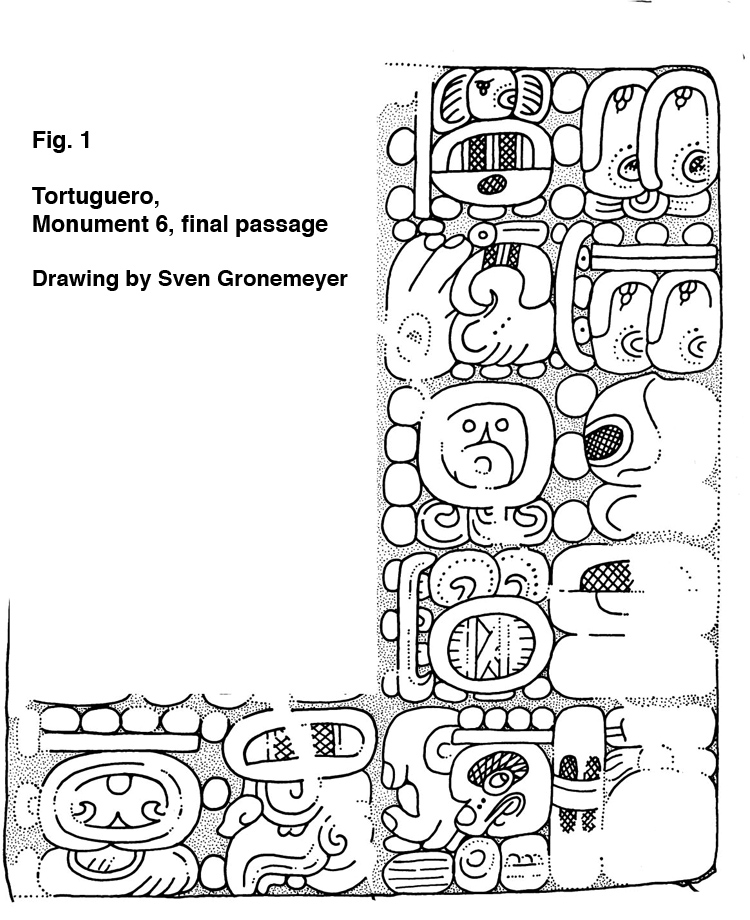

Fig. 1 Portion of Tortuguero Monument 6:pI5-pL5 (drawing by Sven Gronemeyer)
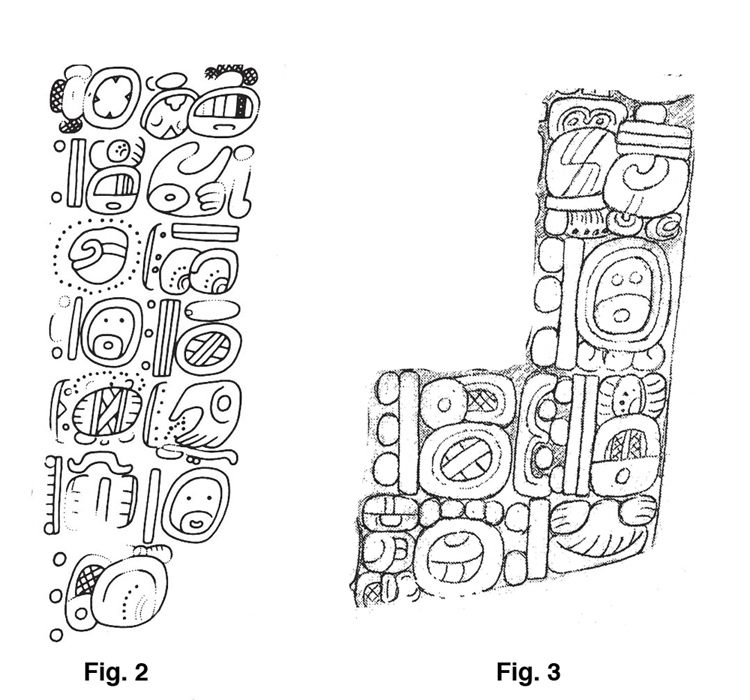
Fig. 2 Portion of Naranjo Altar 1:J5-J11 (drawing by Ian Graham)

Fig. 3 Portion of new La Corona, Panel 2:V5-V8 (drawing by David Stuart)

REFERENCES:

Coe, Michael
1973 The Maya Scribe and His World. New York: The Grolier Club.

Graham, Ian
1978 Corpus of Maya Hieroglyphic Inscriptions, Volume 2, Part 2: Naranjo, Chunhuitz, Xunantunich. Cambridge MA: Peabody Museum of Archaeology and Ethnology, Harvard University.

Houston, Stephen D., and David Stuart
1996 Of Gods, Glyphs, and Kings: Divinity and Rulership among the Classic Maya. Antiquity 70: 289-312.

The Dallas Bone

One of my favorite Maya artworks is this intricately incised bone dating to about 600 A.D., now on display in the Dallas Art Museum. It’s been published and analyzed before (sort of), and is well-known to most scholars, but whenever I see the original I’m always stunned by its tiny size — less than 10 cms. in height.

The scene depicts the crowning of a king, in all likelihood a mythical figure based on the Maize God. An elderly gent resembling God L holds aloft an elaborate royal headdress in the form of the Principal Bird Deity, shown also perched on the celestial band above the throne. The iconography references, I think, an important storyline from ancient Maya origin mythology, where a great supernatural bird — probably based on an eagle, and a basic symbol of royal authority since Preclassic times — descended from the heavens to engender kingship as a political and cosmological paradigm. The story is depicted on many other objects, including the famous Blowgunner Vase (Kerr 1226), where we see a melding of this ancient story with somewhat different motifs and episodes of the later Popol Vuh epic. Marc Zender has traced some aspects of it as well in his discussion of the verb ehm, “to descend.” The San Bartolo mural shows the most vivid scene of the Principal Bird’s descent on the center of its west wall, as Bill Saturno, Karl Taube and I will present in a formal publication in the coming year.

The date recorded on the Dallas Bone is “5 K’an End of Yaxk’in,” perhaps a day of great mythological significance. I say this because in the 260-day calendar 5 K’an comes just two days after 3 Ik’ — the single day written next to with the descending Principal Bird image at San Bartolo. That, in turn, comes two days after the important 1 Ajaw featured in the Blowgunner Vase, and which obviously served as the basis of the name Hun Ajaw (meaning in a mythical sense “First, Original Lord”). So, for what it’s worth, we have three very different references to the myth of the bird that fall into a nice sequential arrangement: 1 Ajaw – 2 Imix – 3 Ik’ – 4 Ak’bal – 5 K’an. I’m as yet unsure what this all means, but the pattern seems worth further consideration.

One interesting aspect of the Dallas Bone’s design is the careful arrangement of the text within the scene. The four glyphs above the headdress provide the date (5 Kan End of Yaxk’in) and the main verb (k’ahlaj, “it was fastened…”). Then the text passes over to the floating glyph at far left, labeling the headdress (? hu’n), before it continuing down to the three glyphs above the image of the seated recipient, reading t-u-baah Lem ? Ixiim?, “…upon the head of Shiny-?-Maize(?).” It’s a fine example of an artist’s carefully considered integration of text and image.

The inscription:

5-“K’AN” / TI’-HAAB / YAX-K’IN-ni / K’AL-ja / ?-HU’N-na / tu-BAAH-hi / LEM?-?-IXIIM?

Jo’ K’an(?) (u-)ti’-haab Yaxk’in k’ahlaj ? hu’n t-u-baah Lem(?) ? Ixiim

(On the day) Five K’an the ‘end’ of Yaxk’in, the ? headdress is fastened upon the head of Shiny-?-Maize(?).

An Early Classic Cave Ritual

by Steve Houston

A few months ago, I happened to visit the Museo Principe Maya in Coban, Guatemala. It is an impressive (and now registered) collection, with dozens of important objects. Few visitors go there, however. The museum lies on a side-street and is unknown, it seems, to the local office of tourism. The staff was baffled when asked about it.

But find it we did, with some pleasant surprises.

The image below comes from a piece of cave flow-stone — under a cm. thick, and obviously cut from a cave, with carbon black painting and a thick, daubed white, perhaps some kind of kaolin. (I vaguely recall seeing this object in an issue of Mexicon but cannot find that reference now. Stanley Guenter was certainly there before me, and had prepared a number of written descriptions of objects, all out in nice, bilingual display.) The entire object is close to a meter high, perhaps a little more than that from side to side. Unfortunately, it’s also behind glass, which makes photography somewhat difficult. For all that, the flow-stone is one of the most important cave texts found in the last 20 years. It’s not on a par with Naj Tunich, of course. But it still provides fascinating glimpses into Early Classic ritual and gives us some notion of a pan-Maya event celebrated in at least two caves.


The iconography on the flow-stone shows two figures, both lords, at least to judge from the jaguar pelts. They are probably not people of the highest rank, as can be seen by their distinctive gathered headdresses, of a type that sometimes occurs with subordinate lords. (Dave Stuart has a full discussion of the headdress in his book on the Palenque Temple XIX texts, esp. figs. 106-107, 108-110.) I would guess that the figures are, in fact, priests of some sort. The animals above the headdresses are doubtless their personal names. The reading of the title for such lords is still under discussion, but *abaat, “worker, servant,” is one possibility. (The term is cognate with a documented expression for “messenger,” noticed by Dave in the 90s and presented in our book with Karl Taube, The Memory of Bones.)

What’s important here is that the date can be worked out — it has to be (8.19.10.0.0) 9 Ajaw 3 Muwaan, Jan. 31, AD 426, Julian. The event is clearly one of the censing. Small nodules of ch’aaj sprinkle from the hand of the person to the left, down to what may be an incense burner.

So, a high-end cave text, painted expertly on thin flow-stone, comemmorating a major period-ending. It involves one of the earliest images of figures with a distinctive headdress (another of comparable date is known from Rio Azul, as illustrated in Dave’s discussion).

It gets even more interesting: Dave pointed out to me that what is probably the *exact same date* also occurs in a painting from the Jolja cave, and with two people as well. At Jolja, the figures have black body-paint, just as on the Coban stone, and one of them holds a torch, of the sort used in burning offerings, like incense or paper. The gesture of the figure to the left is that of incense-sprinkling, again like the figure from the Principe Maya. Karen Bassie has done an excellent, e-report on the Jolja finds, at: http://www.famsi.org/reports/00017/index.html

In any case, comparable events of great ritual importance took place in at least two caves, separated by what I presume to be quite a distance — the artifacts in the Coban museum tend to come from the Peten, not Chiapas. The quality in both instances is high, even of royal commission, and the dates are both 9 Ajaw, itself suggestive of the underworld or cthonic settings — I’m thinking here of the 9 Ajaw house on Tikal Altar 5, which specifies the burial place of Lady Tuun Kaywak. In the Early Classic, the date at Jolja and on the Coban flow-stone would only fall on major Period Endings (katun or lahuntun endings) at fairly rare intervals, as in 8.13.0.0.0, and then again (aside from our date), at 9.6.0.0.0. Dave and I have to wonder if the cave rituals were prompted in some way by preparations for the change of the Baktun a few years later.

More on the nine-year solar cycle at Tonina

Back in 2002 I pointed out the appearance of a strange calendar cycle mentioned in three inscriptions at Tonina, apparently equaling a span nine solar years (9 x 365 days, or in Maya notation, 9.2.5). Stations in this cycle are marked in the inscriptions with a distinctive glyph, depicting a human profile head with a prominent “chinstrap”-like element over the mouth, followed by a -TE’ suffix. In my original analysis the extant dates were actually 18 solar years apart, but a telling reference to one station being the “second” in the reign of K’inich Baknaal Chahk suggested that the true cycle was nine solar years in length. If this seems confusing (it is to me…) maybe my original note posted on Joel Skidmore’s Mesoweb site will clarify.

Several months ago, Yuriy Polyukhovych circulated his analysis of a newly unearthed inscription at Tonina, discovered around 2005-6 by Juan Yadeun and his team (grácias, Yuriy!). This appears on a temple doorjamb that once accompanied a richly decorated and vividly colored wall, all of modelled stucco. Yuriy saw there mention of another date with the same “chinstrap” glyph, easily readable as 9.13.16.8.10 10 Ok 18 Xul. This falls exactly nine solar years (9.2.5) after the earliest attested such station mentioned on Monument 141, and confirms its true nature as marker of a nine-year cycle. Here, then, is an updated list of attested stations, with the newest in boldface.

9.13.7.6.5 1 Chikchan 18 Xul

9.13.16.8.10 10 Ok 18 Xul

9.14.5.10.15 6 Men 18 Xul

9.15.3.15.5 11 Chikchan 18 Xul

The 10 Ok 18 Xul reference is also interesting for what the stucco jamb inscription goes on to mention. As Yuriy pointed out in his analysis, this was also the dedication day for “the wall” itself (u kot), coming 89 days after the a “fire-entering” activation rite of a structure. This building dedication was, in turn, just nine short days after K’inich Baaknal Chahk’s one K’atun anniversary as king — an event and day mentioned in yet another stucco text, as discussed in my previous post. The 10 Ok station would have been the third such “chinstrap” period ending in K’inich Baaknal Chahk’s reign.

Incidentally, the style of the stucco wall and its glyphs looks to be far later than the dates and events recorded in the text, suggesting a possible reuse or refurbishment of the space by a later ruler.


Stucco Glyphs from Tonina

Juan Yadeun’s excavations at Tonina, Chiapas, have revealed a number of beautiful stucco glyphs that once formed an inscription of at least 25+ blocks, most now on housed at the regional site museum, with several others on view the Museo Nacional de Antropología e Historia in Mexico City. On a recent visit to the MNAH I was interested to see two of the glyphs, in different cases, that seem to form a reconstructable date: “3 Eb” and “End of Pop” (see upper two glyphs marked “C” in the accompanying image, below). This Calendar Round turns out to fall on the Long Count 9.13.16.3.12, the one K’atun anniversary of the accession of the important Tonina ruler K’inich Baaknal Chahk. Another stucco glyph in the MNAH case reads tzutz-uy, “it ends,” which may well have accompanied this date, preceding “the first K’atun,” written with yet another glyph now at the Tonina museum.

Two other stuccoes on display at the MNAH (A and B) are “on 13 Ajaw” and part of a Distance Number “3.12.” Together, the various peices are enough to suggest that the following two dates were recorded in the original inscription, now partially reconstructable, as shown in the image below (extant elements are in italics):

9.13.15.0.0 13 Ajaw 18 Pax (Period Ending)

+ 1.3.12

9.13.16.3.12 3 Eb End of Pop (anniversary)

The inscription surely included a number of other dates as well, among them one probably referring to the building’s dedication, as indicated by y-otoot, “his/her house…” I’m reasonably sure other fits and connections will be possible, once we check images of other loose glyphs from the text.

Reconstructed elements: