Bending Time among the Maya

by Stephen Houston

Visitors to Japan, if they make it to Mie prefecture, will wonder at the Ise Grand Shrine. Rebuilt every 20 years, it is said to be exactly similar to buildings first made over a millennium ago (Wada 1995). By the tenets of Shintoism, the shrine is forever new yet perennially old, a replacement that somehow remains the same, regardless of how many times it has been rebuilt. For Mayanists, the example of Ise and its implied concern for the joining of past and present rumble into familiar terrain. After all, every Maya date is relational, existing only in reference to a point in the distant past (the Long Count) or with respect to other positions in a cycle (the Calendar Round and other counts). A present does not exist without a backloaded past and a future that gives it some framing.

A recent book, Anachronic Renaissance, by Alexander Nagel and Christopher Wood (2010), prompts further reflection on the meaning of old and the new in Maya texts and images. The main task of the volume is to examine the paradox of Renaissance art, namely, the simultaneous revival and replacement of the past during a crucial period of Western history. Nagel and Wood use a variety of terms and phrases that will resonate with Mayanists: “plural temporality….[the] doubling or bending of time…[the] cultural project of time management,” and “the temporal instability of the artwork” (Nagel and Wood 2010:8, 9, 10). The latter is a precarious state that, despite the reality of replication—think of the renewed beams and thatch at Ise–coincides with the “ontological stability” of certain objects or buildings (Nagel and Wood 2010:30). This “stability” rests on the direct claim that the essence and identity of the shrine remain intact despite the fact that not one scrap of it survives from previous versions.

A more ambitious aim of Anachronic Renaissance is to chart two modes of representation. Both can co-exist as explanations of origins, although they might also “interfere…with one another” (Nagel and Wood 2010:49). The first mode: “substitution,” a process of creation by which artifacts replace earlier, authoritative ones in a “chain of replicas” (Nagel and Wood 2010:30). Thus, in a “mystical…substitutional logic,” “[m]odern copies of painted icons were understood as effective surrogates for lost originals….and new buildings were understood as reinstantiations…of prior structures” (Nagel and Wood 2010:29, 33). By this means, “a material sample of the past could somehow be both an especially powerful testimony to a distant world and…an ersatz for another, now absent artifact” (Nagel and Wood 2010:31). The well-known propensity of the Maya to replicate and improvise new buildings atop older ones would be solid examples of “substitutes.” Although commissioned by particular kings, the buildings were probably viewed as “reinstantiations…of prior structures.” Indeed, their packaging within later construction hints at the sacred bundles of the Maya, who found no contradiction between ritual centrality and the exclusion of sacred things from sight (e.g., Christenson 2006:237). Continuity is an obvious motivation, but there may have been sociological reasons as well. In other settings, as in the Saite 26th dynasty of Egypt, acts of quotation, citation or whole-scale borrowing flourished at times when Egyptian identities were under threat by “increasing numbers of foreigners” (Der Manuelian 1994:xxxv, 402, 409). They glorified, extolled, an ethnic identity that seemed to be in danger of dilution. Yet, in these works, there was no intent to deceive, and many of these productions expressed a “contemporary originality” (Der Manuelian 1994:409). The state of being poised in two times, invoking one period while residing in another, suggests in precise parallel the “multiple” or “plural temporality” described by Nagel and Wood. (fn 1) They appeal to the past–define it as something distinct—yet nullify their distance from it.

In contrast, Nagel and Wood’s second mode, the “performative” or “authorial,” highlights the historical singularity of an object, its placement in linear time, its novelty and capacity to make fresh, unexpected connections, its attention to the “time of manufacture” and the people behind it (Nagel and Wood 2010:30, 94). This, more than the first, is a mode that finds a lodging for “forgery” or “pastiche,” “the invention of a new work in a plausible past style” (Nagel and Wood 2010:289). Some of these were definitely meant to hoodwink, especially with objects prized by collectors. Yet, many “copies,” seldom exact, had their own value (Welch 2005:288).

These modes serve as a backdrop to the role and meaning of “archaicism” in certain Maya objects. The most striking are those that display Preclassic imagery (>1700 ya) with glyphic texts that are unlikely to date to that time. Alfonso Lacadena and I have long believed, for example, that the so-called “Hauberg Stela” (now in the Princeton University Art Museum) combines an archaic presentation of the body (wide, rounded hips, narrow waist, profile legs that barely overlap) with glyphs that seem to come from some centuries later (cf. Schele 1988, who opted for an early date of AD 199). In much the same way, one Terminal Classic monument at Ceibal, St. 13, appears to have glyphs—“quotations” or “citations”?—from an earlier time (CMHI 7:37). In both cases, the “time-bending” is in the temporal slippage between image and text, albeit with different forms of latching. By means of its image, the Hauberg Stela “bends back” to earlier periods; Ceibal St. 13 does so via the style and contents of its text. At the stuccoed temple of El Diablo, which forms part of El Zotz, Guatemala, my colleague, Edwin Román, and I have found an image of the sun god, surmounted by a glyph, that appears to be far earlier than the probable date of the building, c. AD 350-375. The eyes of the god have slotted eyes that recall Preclassic models. The glyph block above, perched over the forehead, includes a face with down-turned mouth (a Preclassic feature generally, with roots in the Olmec), and an unexpectedly archaic yu sign.

The best example of “substitution” or “bending back” may be the “Diker bowl” (Coe 1973: pl. 1), now in the permanent collection of the Metropolitan Museum of Art (http://www.metmuseum.org/toah/works-of-art/1999.484.3; Figures 1-3). The form of the stone vessel is of a Preclassic chocolate pot, the spouted handle being used to froth the liquid within (e.g., McAnany and Murata 2006; Powis et al. 2002). Not surprisingly, the style of the iconography is pure Preclassic, too. There are two deities, one an avian creature, the other with features of the Maya maize god. The figures float below a skyband marked by Ik’ or “wind” signs, alternating with the sloping lines associated with such bands in Preclassic contexts. Both gods seem to carry their name glyphs above their heads, of which a clear cross-tie appears at A3 in the vertical text on the handle.

Fig. 1. Diker Bowl, with avian god (drawing by Diane Griffiths Peck, from Coe 1973:Pl. 2).

Fig. 2. Diker Bowl, with probable maize god, perhaps AJ BIH in forehead (drawing by Diane Griffiths Peck, from Coe 1973:Pl. 2).

Fig. 3. Diker Bowl, with archaic skyband (drawing by Diane Griffiths Peck, from Coe 1973:Pl. 2).

The text is difficult. Nonetheless, through the kindness of Justin Kerr, I have obtained a photograph that reveals some of its details (Figure 4a, 4b). This is where interest mounts: against expectation, the glyphs appear to be fully Early Classic, not Preclassic, in date (n.b.: it is almost certain that the text and image are contemporary, in that the handle has the same relief as the images and could not have been added later). Position A1 may contain a version of the TI’ logograph identified by David Stuart, and in a schematic form that is securely Early Classic. A sign for “mouth” accords with what was surely a drinking vessel, although it is unlikely to read “drink,” uk’, in this context because of the prefixed u pronoun. Just beneath it lies what may be a reference to the vessel itself, with body and neck somewhat visible. The probable t’abayi sign that composes part of A2 conforms to this dates, as does what appears to be an admittedly aberrant spelling of a transitive verb at A4: u-K’AL-wa TUUN, doubtless in reference to the stone-bowl and its dedication. (The name of the god is, as mentioned before, at A2.) An unusual form of tu, a preposition with ergative pronoun, may figure in A5. To my knowledge, spellings of transitives come exclusively from the Classic period.

Fig. 4: Diker Bowl, with close-up photograph, (a), by J. Kerr (copyright J. Kerr), and, (b), pencil sketch by S. Houston.

What does the Diker Bowl tell us? This: that the Maya were fully capable of executing temporally disjunctive texts and images when they needed to do so. The ease with which they accomplished this task is, in the case of the Diker Bowl, surprising, at least for me. But it fits well with the facility the Maya showed in juxtaposing (and thus hybridizing) images of radically different style. Consider the Teotihuacano “text” on the summit of Temple 26 at Copan, ably drawn by David Stuart, and now reconstituted in the sculpture museum at the site, or the various Tajinesque, Veracruz elements that interweave with Maya designs on Maya vessels (e.g., K1446). Was the invocation of ancient gods the main motivation in showing them in archaic guise, on a cult object that may purportedly have “belonged” to one of them? Whatever the answer, the ability to step out of time, to exist in two periods or two regions all at once, suggests an effortless repositioning….and an expressive domain that we have yet fully to explore.

Footnote 1: Some of these originals were not so much lost as magically created. Examples would include the acheiropoieta (“not handmade”) icons of Byzantium and elsewhere—namely, the images crafted by non-human, divine hands, as in the Shroud of Turin or the painting of Nuestra Señora de Guadalupe in Mexico. Such objects possessed a kind of “absolute singularity”—they could not transmute into “substitutables” for the reason that they uniquely and irreplaceably expressed the shaping hand of God (Nagel and Wood 2010:72; their uniqueness makes them ideal foci of pilgrimage, Nagel and Wood 2010:72)—indeed, the thought come to mind that some Maya god effigies, especially the small, hardstone ones in of Chahk that Karl Taube and I have been noting for some time, were considered acheiropoieta (or something like them) among the Maya.

Acknowledgement: Justin Kerr showed his customary generosity in sharing the photograph reproduced here.

REFERENCES CITED:

Christenson, Allen. 2006. Sacred Bundle Cults in Highland Guatemala. In Sacred Bundles: Ritual Acts of Wrapping and Binding in Mesoamerica, edited by Julia Guernsey and F. Kent Reilly, pp. 226-246. Barnardsville, NC: Boundary End Archaeology Research Center.

Coe, Michael D. 1973. The Maya Scribe and His World. New York: Grolier Club.

Der Manuelian, Peter. 1994. Living in the Past: Studies in Archaicism of the Egyptian Twenty-sixth Dynasty. London: Kegan Paul.

McAnany, Patricia, and S. Murata. 2006. From Chocolate Pots to Maya Gold: Belizean Cacao Farmers through the Ages. In Chocolate in Mesoamerica: A Cultural History of Cacao, edited by Cameron McNeil, pp. 429-450. Gainesville: University Press of Florida.

Nagel, Alexander, and Christopher Wood. 2010. Anachronic Renaissance. New York: Zone Books.

Powis, Terry G., Fred Valdez, Jr., Thomas R. Hester, W. Jeffrey Hurst and Stanley M. Tarka, Jr. 2001. Spouted Vessels and Cacao Use among the Preclassic Maya. Latin American Antiquity 13(1), pp. 85-106.

Schele, Linda. 1985. The Hauberg Stela. Bloodletting and the Mythos of Maya Rulership. In Fifth Palenque Round Table, 1983, edited by M.G. Robertson and V. Fields, pp. 135-150. San Francisco: PARI.

Wada, Atsumu. 1995. The Origins of the Ise Shrine. Acta Asiatica: Bulletin of the Institute of Eastern Culture, 69, pp. 63-83.

Welch, Evelyn. 2005. Shopping in the Renaissance: Consumer Cultures in Italy, 1400-1600. New Haven: Yale University Press.

Maya Creatures I: Maya Musk

by Stephen Houston

Maya imagery often reminds us that it is ethereal and aristocratic, yet, at times, ribald, witty, earthy. [1] The discovery of ritual clowns and buffoonery in Maya art, along with some very detailed views of male genitalia, makes it clear that the Classic Maya had a lively side (e.g., Taube 1989). Their world was not only about the delicate scent of flowers and a decided prudery about royal and noble bodies (Houston et al. 2006:141-152).

Think of smells. Most of us live in sanitized societies with germ phobias, air-fresheners, and sport deodorants. Yet, any visit to a tropical settlement opens the nostrils. Trash rots and cooks slowly in the sun. (And not only tropical settlement: in Medieval France, the stench of charnel houses and malodors of executed criminals was said to permeate the food stalls of city markets [Corbin 1986:24-31, 48-56]). There are smells in the rainy season, too. My least favorite episode of fieldwork–mapping at Dos Pilas, Guatemala, in 1986–took place during Biblical downpours. The mildew was ineradicable. No amount of scrubbing would remove its smell from clothing, boots, bags or, it seemed, my person. For this reason, to search for a community in Colonial Yukatek was “to smell it like a dog,” presumably because of the mighty odor (Houston et al. 2006:141).

A relevant aside: on two occasions I have seen peccary in the wilds of northern Guatemala. Once, I smelled them first. Only after some minutes did the brush shake, sticks break. Two Collared Peccary (Tayassu tajacu) ran across the forest path. The second encounter was near the site of Bejucal, Guatemala. On three sides shuffled a very noisy herd of White-lipped peccary (Tayassu pecari). Their teeth clicked at fast pace. But, above all, there was that same smell, coming in wafts, potent, pressing into my nose.

If such musk exists—and it must have existed centuries ago, too–the Maya, so observant of nature, surely noted the odor. There is now some hard evidence of it.

Figure 1. A peccary support, Early Classic tetrapod, Dallas Museum of Fine Arts, 1988.82.A-B, photograph by Jorge Pérez de Lara, copyright, commissioned by the Peabody-Essex Museum.

A long-standing puzzle in Maya iconography is the peccary. On a bowl in the Dallas Museum of Fine Arts, the heads of four of these beasts do work as tetrapod supports (Figure 1). Their snouts plunge into the “ground,” probably in witty allusion to the way that peccary (and other pigs) eat by rooting around with their noses in jungle dirt and leaves. Such supports are relatively common in the Early Classic period, so the wit was widely understood. [2] On the foreheads of the Dallas peccaries is a sinuous line that epigraphers call the “Kaban curl” after its appearance in the Kaban day sign (Taube 2010:193). Eric Thompson, not always of unerring instinct, followed Eduard Seler in seeing this as the “lock of hair” worn by the Moon goddess (Thompson 1971:86). That lock is, of course, reversed, with a very different orientation. It is not clearly linked to the day sign at all.

A more likely view, perhaps: the Kaban curl invokes a heady, glandular, earthy odor, the musk of the peccary or other mammal, thus joining many other cues in Maya imagery to the nature of smells, both strong and delicate. As a glyph, the sign is securely read KAB, “earth,” as shown by direct substitution with [ka-ba] in texts at Palenque and elsewhere. But, in imagery, “musk, strong odor” helps to explain a number of other features. Many of us have noticed the common appearance of the Kaban curl within the ears and, more rarely, the faces of deer, some of which occur as day signs (Figures 2 and 3, probably Kaban; see examples on panels proved by David Stuart to have come from La Corona in northern Guatemala).

Figures 2 and 3. Figure 1 (left), Deer, K0414, copyright, Justin Kerr and Kerr Associates; Figure 3 (right), La Corona, HS 2, Block XIII:pC2, drawing by D. Stuart.

Of the two types of deer in the Maya world, the White-tailed Deer (Odocoileus virginianus) is known for its glandular odor. Emitted from the forehead and in front of the eye, the smell is so powerful that it can be detected by the human nose. The chances are high that the presence of the Kaban curls on the face and ears of deer refers to this musk. [3]
A second feature is the presence of the Kaban curl with one of the Hero Twins, 1 Ajaw. The “spotted” twin, with large dark circles on his body and cheeks, is the hunter par excellence—indeed, a possible etymology for his name in K’iche’ is “One, He of the Blowgun” (see also Christenson 2007:fn. 163). In rare cases, the spotted Twin appears with deer ear and antlers (Figure 4a). Other scenes show him

Figure 4. (a) Hero Twin on Late Classic vase, photograph by D. Stuart; (b) Hero Twin, on Late Classic, codex-style vase, K1248, copyright, Justin Kerr and Kerr Associates; (c) Kneeling Twin, on Late Classic, codex-style vase, K2772, copyright, Justin Kerr and Kerr Associates.

as a warrior, with deer headdress also marked by a Kaban curl; notably, the same curl is not only on his face but floats in front of his nose (Figure 4b). Even without the headdress, the Twin may have these markings, in a pairing that makes it clear he is a variant of 1 Ajaw—his companion in this instance is the Classic version of Xbalanque, his expected Twin (Figure 4c). The curl in front of the face underscores the ethereal nature of the mark as a scent to be exhaled or smelled. In fact, there seems room for doubt whether the Kaban curl is really about “dirt” or “earth” per se, as opposed to the pungent smell of fresh, fertile, manured soil: in other words, by itself, the curl is an attributive mark, not a directly indexical one. From its earliest examples, the Kaban sign includes stone-markings, too, curving lines with dotted outline. A composite sign, it contains more than the single curl. I am not convinced that the Kaban curl alone is fully equivalent to the day sign in all its particulars. [4]

What to make of the curl and 1 Ajaw? I was raised in (what was then) rural Pennsylvania. As such, I am more than familiar with deer-hunting and its various equipment. For city dwellers, the strangest practice must be the purchase and liberal application of either scent-maskers–to most animals, human odor is quite penetrating and likely to alarm–or scent-attractors, which concentrate or mimic the odor of female deer so as to attract a buck. The 1 Ajaw may both identify with his prey in ways we do not fully understand and exude or smell the odor of his quarry. 1 Ajaw is a musky one, connected to strong, glandular scent. The act by which hunters paint their bodies, as on K1373, from about AD 600, may be mere camouflage. But one wonders whether odors had been prepared and applied according to the time-honored custom of hunters.

To those of us from northerly, colder climes, the Maya world has–and had–its own extremes: hot, humid, wet (or dry, depending on season), and, in final summation, strongly odorous as well. For the Classic Maya, musk appears, not surprisingly, to have infiltrated their elite imagery, offering yet further evidence of close, playful attention to tropical nature.

NOTES

[1] For other entries in the “Maya Creatures” series, see DragonsMosquitoesDogs, Teeth, Fox.

[2] A wahy or supernatural being on some Maya vases displays a “fire-breathing” peccary, as first studied by Nikolai Grube and Werner Nahm (1994:698). A plausible interpretation is that this reflects a mythic gloss on the snorting of peccary. The peccary herd in the upper mural of Room 2, Bonampak, situates the beast in a cosmic context, in an apparent reference to a Maya constellation, as pointed out long ago by Mary Miller.

[3] Several deer ears contain a crossed element, rather like two sticks, a feature found in a number of images (e.g., K1230, 1248, 1991, 2794, 8927). I have no explanation for them, but they must be in some opposed or complementary relation to the Kaban curls.

[4] Against this interpretation, however, is a point made by Michael Coe, that the curlicue is similar—but not identical–to the Postclassic Central Mexican sign for “excrement” (Coe 1973:100). It is reasonable to think that musk would be depicted as one of the smelliest products of the human body. The smell of excrement is one of the first odors encountered in life, and the disposal of ordure remains a ceaseless problem in all settled existence. Another complication here is the use of the Kaban curl in references to wax or the excrescence of bees (honey, e.g., Houston et al. 2006:fig. 3.11a). Did this allude to the idea that honey, like musk, was a waxy secretion, or did it relate to the strong smell of the balche’ drink that would have been brewed from honey?

REFERENCES

Christenson, Allen J. 2007 Popol Vuh: The Sacred Book of the Maya. Norman: University of Oklahoma Press.

Coe, Michael D. 1973. The Maya Scribe and His World. New York: The Grolier Club.

Corbin, Alain. 1986. The Foul and the Fragrant: Odor and the French Social Imagination. Cambridge, MA: Harvard University Press.

Grube, Nikolai, and Werner Nahm. 1994. A Census of Xibalba: A Complete Inventory of Way Characters on Maya Ceramics. In The Maya Vase Book: A Corpus of Rollout Photographs of Maya Vases, Volume 4, edited by Justin Kerr, pp. 686-715. New York: Kerr Associates.

Houston, Stephen D., David Stuart, and Karl Taube. 2006. The Memory of Bones: Body, Being, and Experience among the Classic Maya. Austin: University of Texas Press.

Taube, Karl A. 1989. Ritual Humor in Classic Maya Religion. In Word and Image in Maya Culture: Explorations in Language, Writing, and Representation, edited by William F. Hanks and Don S. Rice, pp. 351-382. Salt Lake City: University of Utah Press.

_________. 2010. Plate 66. In Fiery Pool: The Maya and the Mythic Sea, edited by Daniel Finamore and Stephen D. Houston, pp. 192-193. New Haven: Yale University Press, in cooperation with the Peabody-Essex Museum.

Thompson, J. Eric S. 1971. Maya Hieroglyphic Writing: An Introduction. 3rd ed. Norman: University of Oklahoma Press.

Unusual Signs 2: The “Fringed Crossed-Bands” Logogram

In this post I offer up another rare and unusual sign in the Maya script. This is what I call the “fringed crossed-bands,” which looks to be an obscure logogram (word sign). I have no good suggestion to make about its value or meaning, but only show some of its scattered examples in the hope it might spur progress toward an eventual reading.

The sign seems visually complex. Its main feature is a fringe-like design on its left side, which appears to droop over a small rounded central element.  A crossed-bands motif appears in its upper central area. This sign often (not always) takes a superfix resembling a twisted cord or knot – I suspect these are all variations on the same form – and there’s a possibility that this an integral of a larger sign.

FringeFig1

It appears in four places to my knowledge, mostly in personal names. An early example is from an unpublished Early Classic Tzakol-style vessel, where it looks to be part of a personal name (Figure 1a). On Kerr 1440 (Figure 1b) it may also be part of a name phrase, according to the recent analysis of the passage by Hull, Carrasco and Wald (2009).  There it takes the affixes –ya and -si. Yet another name that makes use of the sign is that of a sculptor who contributed to the carving of Piedras Negras, Stela 14, named on its front, where it again takes the -ya-si suffixes (Figure 1c).  Unfortunately, these cases don’t help us much when working toward a decipherment of the sign – names are contextually “neutral” in terms of their semantic constraints. The -ya-si affixes are difficult to account for, but they suggest a connection to the “body-part” nominal suffix -is noted by Marc Zender (2004).

One last instance of the sign maybe is more revealing (Figure 2).  This appears in the text that ran above along the top of the throne of the platform within Temple XXI at Palenque, in a passage describing a ritual that took place on 9.13.17.9.0 3 Ajaw 3 Yaxk’in (June 14, 709), There it appears as one of two verbs that take a –n-aj verb suffix, in a context that indicates a passive construction for non-CVC transitive stems (Lacadena 2004).
FringeFig2

ha-o-ba ?-na-ja ?-na-ja TA-CH’AB-AK’AB-li
ha’oob ..?..naj .. ..?..naj ta ch’ab ak’bil
it is they (who were) ?ed and ?ed in creation-and-darkness

The mystery sign may stand for a non-CVC transitive verb, paired in this instance with some other obscure action. The subjects (“they”) are the protagonists of the scene on the Temple XXI panel, the future king K’inich Ahkal Mo’s Nahb and his possible brother, Upakal K’inich. With such a nicely specific grammatical setting, we may have an eventual in-road toward an eventual decipherment of the “fringed crossed-bands,” but that’s probably a long way away.

REFERENCES:

Hull, Kerry, Michael Carrasco, and Robert Wald. 2009. The First-Person Singular Independent Pronoun in Classic Ch’olan. Mexicon 31(2):36-43.

Lacadena, Alfonso. 2004. Passive Voice in Classic Mayan Texts: CV-h-C-aj and -na-aj Constructions. In The Linguistics of Maya Writing, edited by S. Wichmann, pp. 165-194. University of Utah Press, Salt Lake City.

Zender, Marc. 2004. On the Morphology of Inanimate Possession in Mayan Languages and Classic Mayan Glyphic Nouns. In The Linguistics of Maya Writing, edited by S. Wichmann, pp. 195-210. University of Utah Press, Salt Lake City.

What Will Not Happen in 2012

by Stephen Houston

Epigraphers await 2012 with trepidation. There will be ill-founded claims, bad Hollywood movies (one now in production), silly reportage, and much distortion of what 2012 meant for the ancient Maya. Every imaginable anxiety will apply to this key event in the Maya calendar. If we are candid, too, there will be renewed interest in our field, which scholars can shape to positive result…if the public ever bothers to listen. A rich ethnography of misunderstanding awaits those who wish to peruse the web.

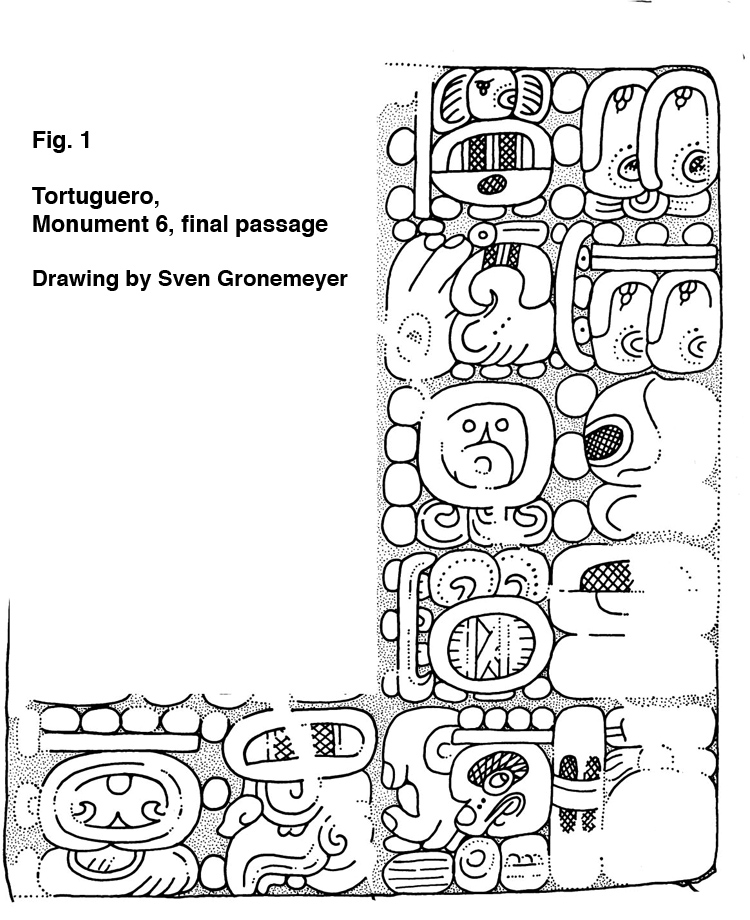
Such an ethnography is not my purpose here. Rather, I present a mea culpa and a rectification. In 1996, Stuart and I discussed part of the text on Tortuguero Monument 6, suggesting that, on 13.0.0.0.0 4 Ajaw 3 K’ank’in, Julian Dec. 10, AD 2012, a god will “descend,” ye-ma or yemal, in what was held to be a nearly unique example of Classic-era prophecy. Why unique? …because when the Classic texts refer to the future, they typically encompass “impersonal temporal events that are safely predictable” (Houston and Stuart 1996:301, fn. 7). Stuart and I left a small escape chute, admitting that “there are some technical problems with this translation” (ibid.).

The relevant, final portions of Monument 6 record a Distance Number that counts from the principal event in the inscription (Fig. 1). The earlier event is the dedication (EL?-le-NAAH-ji-ja) of the building that doubtless housed this T-shaped panel (mentioned at E6-F6, [9.11.16.8.18]). The future events are described as tzuhtzjoom u 13 pih 4 Ajaw 3 Uniiw utoom, all “impersonal” and “safely predictable” insofar as they are straightforward references to the conclusion of a major cycle at a particular Calendar Round. What follows is the discourse marker ‘i-, an eroded glyph, and ye-? 9 YOOK-TE’ ta … By one reading of the text, whatever takes place after the ‘i– elaborates and extends this future sequence of events.

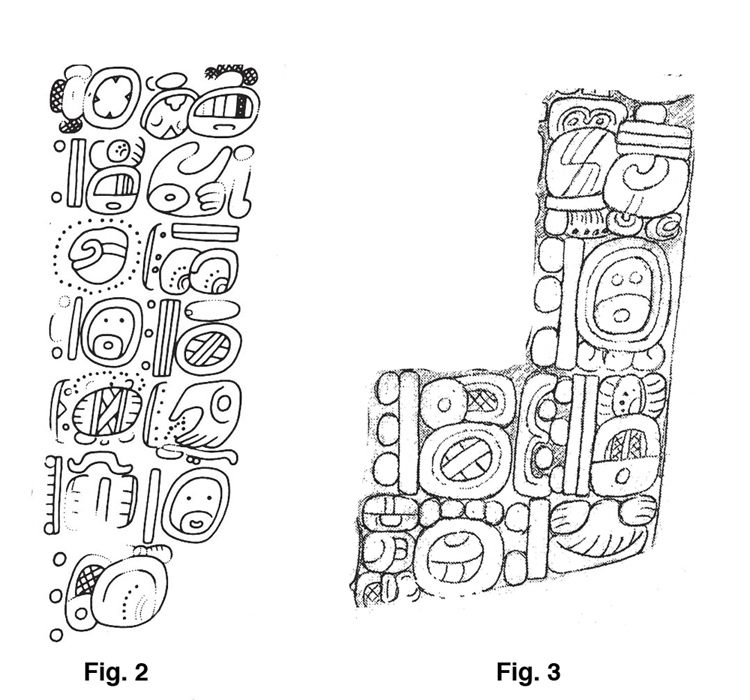
Or that is what we wrote in 1996. It happens that two others texts encapsulate a very similar pattern of dates. One comes from Naranjo, Guatemala, and is now in the Museo Popol Vuh in Guatemala City (Fig. 2, Graham 1978:103). The second, recently found at La Corona, Guatemala, by Marcello Canuto of Yale, has been drawn in pencil by David Stuart. (Avid bibliophiles will discover that a recent coffee-table book published in Guatemala has full photographs of the La Corona texts as well.)

The final portion of the Naranjo text ends by counting forward to a future date, 10.0.0.0.0 7 Ajaw 18 Zip [Julian March 11, AD 830], with a rare future of a mediopassive verb, subfixed, apparently, by –[yi]mo. Thus, the inscription vaults into the future, many decades after the final contemporary date on the monument, and then, at the end, shifts back to that earlier date, (9.)8.0.0.0 5 Ajaw 3 Ch’en [Julian Aug. 22, AD 593]. This is when the current ruler scattered incense, presumably at the dedication of the text and, according to Stela 38, the consecration of two other stones as well, probably Stelae 38 and 39, both found near Structure D-1 at Naranjo. The text accordingly situates itself in present time, leaps to a future presented in highly schematic terms, and then reverts to the present.

The final passages of the La Corona panel do much the same (Fig. 3). The base date is the dedication of the panels themselves, their last truly contemporary date: 9.12.5.7.4 4 K’an 7 Mak, Julian Oct. 24, AD 677. Almost in yo-yo effect, the inscription lurches forward to 9.12.10.0.0 (Julian May 7, AD 682), then, from the 4 K’an base date, forward again to 9.12.15.0.0 (Julian April 11, AD 687), and, in like manner, forward yet again from that base date to 9.13.0.0.0 (Julian March 15, AD 692), one of the most vivid times for the Classic Maya because of its evocation of a 13th cycle. The relevant part of the text terminates the inscription: i-u-ti/tu? 4 K’an 7 Mak. The parallel with Tortuguero Monument 6 is clear, in that a future date jolts back to the present, as marked by a phrase beginning with i-.

Whatever Monument 6 has to tell us pertains to the dedication of the building associated with the sculpture. It has nothing to do with prophecy or the supposed, dread events that await us in AD 2012. About that the Maya are notably silent…or, truth be told, a bit boring.

Note – 9 Yookte’ (Bolon Yookte’) is an enigmatic expression. When postfixed by K’UH, it appears to identify some collective totality of gods. This is evident in the sequence of deities assembled or placed in order at the beginning of the last great cycle, as attested on the Ranieri “square” vessel and its counterpart, the so-called “Vase of the Seven Gods” (Coe 1973: pl. 49). Where understood, the other references to deities in this text signal the presence of pluralities, including the “Palenque Triad” (or its varying multitudes) and the “celestial” and “terrestrial gods.”

fig1trt2
Fig. 1 Portion of Tortuguero Monument 6:pI5-pL5 (drawing by Sven Gronemeyer)

figs232

Fig. 2 Portion of Naranjo Altar 1:J5-J11 (drawing by Ian Graham)

Fig. 3 Portion of new La Corona, Panel 2:V5-V8 (drawing by David Stuart)

REFERENCES:

Coe, Michael
1973 The Maya Scribe and His World. New York: The Grolier Club.

Graham, Ian
1978 Corpus of Maya Hieroglyphic Inscriptions, Volume 2, Part 2: Naranjo, Chunhuitz, Xunantunich. Cambridge MA: Peabody Museum of Archaeology and Ethnology, Harvard University.

Houston, Stephen D., and David Stuart
1996 Of Gods, Glyphs, and Kings: Divinity and Rulership among the Classic Maya. Antiquity 70: 289-312.

te-mu and te-ma as “Throne”

by Stephen Houston

In the early 90s, I happened to be looking at one of Justin Kerr’s most beautiful rollouts, of a fragmentary stuccoed scene (K1524). In it, the Maize god (or some comely youth) sits on a throne, entreated by an aged god — this last is, of course, none other than the deity who helps paddle the Maize god on his watery journey. To the side, other youths dress (?) a dancer, who is, perhaps, a version of the figure on the throne. The loss of the text is regrettable, as it might have helped to explain the scene. There may well be a connection to the dressing and paddling of the Maize god on related images, such as the Museo Popol Vuh vase.

Despite its ruined state, the vessel is a masterwork. The pooled paint and gently blurred outlines impart a truly pulsing energy to the surface, a quality seen on few other vessels. It continues to be one of my favorites.

However, what really drew my attention were the glyphs in red outline that ran along the throne. The scribe had highlighted these with a dark blue wash, making the glyphs somewhat difficult to read. But I could make out the so-called alay (still a problematic reading, in my view), t’abayii (as we would now decipher it, thanks to Dave Stuart), then, [u te mu…]. A quick look at the relevant dictionaries showed that tem was a perfectly acceptable name-tag, and of rather broad distribution among lowland Mayan languages:

Yukatek (Barrera V., p. 783): “poyo o grada, altar o poyo”
Ch’olti’ (Moran source, #2711, 2712 in Bill Ringle’s reworking): “asiento, banco”
common Ch’olan (Kaufman/Norman list, #511): “seat” …with common Mayan *teem

The final term became interesting a few years later. This was because of our much reviled but–let it be said!–obviously correct publication on disharmony, done with fellow co-conspirators David Stuart and John Robertson. The vowel length was predictable, given the final, if somewhat unusual, -u in the spelling. (Our colleagues Alfonso Lacadena and Soren Wichmann have come to prefer a te’m spelling, but we are not yet convinced of it.) I then remembered another such name-tag, on a masonry throne excavated by Eric Thompson in the 30s, at San Jose, Belize (then British Honduras, see Thompson’s 1939 CIW monograph, pl. 9 in particular). Here, too, was a dedicatory context, including a clear indication that the “bat” glyph pertained to the working of stucco. One can just make out a probable u-te-*ma?/*mu. I have since seen paintings of a secure u-te-mu in a similar, if earlier, context from Calakmul, as photographed by Simon Martin. A similar spelling was probably on K5388. Unfortunately, the relevant parts of the text are in bad shape.

The finds on the pot and at San Jose were useful at the time, and continue to be so. They augmented our list of name-tags, contributed a probative, disharmonic spelling, as predicted by a prior linguistic reconstruction, and helped remove–for me anyway–any lingering doubts about Landa’s te as a sign with roots in the Classic period. (Whether the “tree/wood” TE’ ever functions syllabically is quite uncertain.) The question remains of how to read the stray “throne” logographs that appear in the inscriptions, as on the Temple XIX platform so nicely reported by DS (e.g., P4) or, for that matter, the so-called “palanquin” signs that pepper the inscriptions. Their readings are surely different. The palanquin attaches a final syllable that, I sense, triggers disharmony, thus: CVht, CVVt or CV’t — I recall that Dmitri Beliaev suggested pit or, perhaps more likely, pi’t, as the most viable reading.