The Devil’s Writing

Stephen Houston and Felipe Rojas (Brown University)


The Spaniards expressed a certain ambivalence about Maya glyphs. They called them letras, a neutral word suggesting an equivalence to their own writing system. But they could also describe the script in terms of caracteres. This implied, among other nuances, a cipher or emblem of magical import (Drucker 2022:61–62; Hanks 2010:3).[1] At the time, charaktêres, an obvious cognate with caracteres, were mystical signs created by adding circles or other embellishments to preexisting scripts (Gordon 2014:266–67). Devoid of grammar, often written for single use, they were thought to be “unutterable,” being visionary in origin and direct conduits to mystical meaning (Gordon 2014:263). John Dee, the Elizabethan-era occultist, even claimed to have received his own esoteric script from angels (Harkness 1999:166). Maya glyphs, by contrast, were understood to be legible if challenging to read. Like other writing, they recorded, among their quite varied content, “the deeds of each king’s ancestors” and reports of “years, wars, pestilences, hurricanes, inundations, hungers” (Houston et al. 2001:26, 40).

But the Devil was seldom far away. Missionaries and colonial authorities recognized that glyphs served a role in enchantment and conjuring (Hanks 2010:8; Houston et al. 2001:36). The destruction and confiscation of books—the focus was not on the stone carvings from centuries before the Conquest—would, according to the Franciscan Bernardo de Lizana, writing in 1633, cure and cauterize the pestilential cancer [of idolatry] that was eating away at the Christianity that [the friars] had planted with such great effort” (Chuchiak 2010:91). Diego de Landa had paved the way a few generations before: “[w]e found a great number of books of these letters of theirs, and because they had nothing but superstitions and falsities of the devil (demonio), we burned them all, which they felt amazingly and gave them great sorrow” (Landa 1959:105, translation ours, from scanned version by Christian Prager; see also Restall et al. 2023:164; Landa used demonio, “demon,” as a singular and collective noun, for it could apply both to Lucifer and individual Maya gods, including Hunhau [from Hun Ajaw, presumably], said to be the “prince” [príncipe] of them all [Landa 1959:60]). The shift to Latin script, even for esoteric works out of Spanish control, showed how obnoxious the glyphs had become to Spanish authorities and to local scribes wishing to employ a (by then) more prestigious script when integrating Maya and Christian beliefs (Chuchiak 2010:106). 

Thoughts about devilish writing bring to mind a text, from Europe but approximately the same time, said to have been written by the Devil himself (or, more precisely, an “archfiend” named Per Talion, Ansion et Amlion [Clark 1891:497499]; see also Drucker 2022:105, fig. 4.9]). This appears in Teseo Ambrogio degli Albonesi’s Introductio in Chaldaicam lingua[m], Syriaca[m], atq[ue] Armenica[m], & dece[m] alias linguas (original here), 1539, 212r (Figure 1). Ambrogio received a report of this document, supposedly in the demon’s own hand, after the fiend was conjured by one Lodovico de Spoletano. The demon was asked to respond to a money-grubbing query, suitable for the corruptor of venal souls… and in Italian no less, perhaps his notional language! The question: Sel Cavaliero Marchantonio figliolo de riccha donna da Piacenza ha ritrovati tutti li dinari che laso Antonio Maria, et se no in qual loco sono?; “has Cavaliero Marchantonio, son of a rich woman from Piacenza, found all the dinars that Antonio Maria left, and if not where are they?” (Hayden 1855:189).

Figure 1. Demonic writing, 1539. Introductio in Chaldaicam lingua[m], Syriaca[m], atq[ue] Armenica[m], & dece[m] alias linguas, 1539, 212r.
The demon obliged. He caused a pen to levitate over the page and left his script, which, mindful of his soul, Ambrogio declined to study (see the translation of his Latin text below, in Appendix 1). An anonymous poem about the Devil’s letter, from 1746, understands that reserve: “No more, ye critics, be your brains perplex’d T’elucidate the darkness of the text; No farther in the endless search proceed, The devil wrote it – let the devil read!” (Yeowell 1855:146). This book has been much gawked at, especially in a copy at the Queen’s College Library, Oxford. On September 29, 1663, it was viewed by no less a personage than King Charles II of England, along with his queen, Catherine of Braganza, his brother, James, the Duke of York, and Anne, the Duchess of York (Clark 1891:497). A compilation of English comments on the volume at Queen’s appears here.


The pitchfork script and swirling tails point to their purported maker. The way the tails transgress lines hints at some aggressive property of the “writer” and may also establish links between different parts of the text. Generally, a vertical and horizontal orientation guides the pitchforks, separated by the occasional dots, in sets of 1, 3, and 4, or jagged lines of 1, 2, 3 and 4, and a few signs shaped like Xs. The final sign with whiplashing tail, looks vaguely like the astrological sign of Taurus or the planet Mercury. If there is code here, it is seemingly written from left to right, like Latin script. That reading order is confirmed by the shorter, final line, which fails to reach the right side. The lines contain respectively (and somewhat approximately, given the challenge of counting individual signs), 31, 28, 22, 25, 21, 24, and 16 signs, for 143 graphs in total, a wordy response to a question of some 118 letters. (The reading order is confirmed by the shorter, final line.) Out of the entire sequence, only one set of signs appears to repeat, the 10th and 11th from the left in the second row, but that may be from the imperfect application of ink in the block made for this illustration (see the smear of pigment to the upper left). A rough typology of signs, much affected by whether a missing tine is intended or not, or a flange or dot, reaches about 35 signs, the upper range of an alphabet; the inverted pitchfork without central tine may be among the most numerous, coming to some 10 examples. To an intriguing extent, the use of similar signs that find contrast by orienting right, left, up, down, resembles Sir Thomas More’s Utopian alphabet from 1518 (Figure 2). More’s shapes, likely devised by his printer and friend, Pieter Gillis of Antwerp, were influenced by geometrical concepts of the Humanist Renaissance, with a greater number of “closed” forms than evident in the Devil’s pitchforks (Houston and Rojas 2022:251; see also Campbell et al. 1978). 

Figure 2. Orientational scripts of the Humanist period: a, the Utopian alphabet, Thomas More, De optimo reip. statu deque nova insula Utopia (Basel: Johann Froben, 1518), 13 (photo, Folger Shakespeare Library [PR2321.U82 1518 Cage]); b, vignette of Ambrogio’s letter from the Devil.
This is not the only document said to have been written by the Devil. On the morning of August 11, 1676, a nun named Maria Crocifissa della Concezione claimed to have found a letter from the Dark One on the floor of her cell; her own face was covered in ink, hinting at more than some slight role in its production (Figure 3; Langeli 2020:560561). The letter is claimed to have been translated in 2017 by Daniele Abate of the LUDUM Science Center, a children’s museum in Sicily, after, we are told, Abate had obtained software on the “Dark Web.” The wave of publicity, as here, does not seem to have been followed by any publication. Perhaps the “Dark Web” had a pleasing resonance with “Dark Lord.” Later, in his novel The Leopard, Guiseppe Tomasi, Prince of Lampedusa, referred in light disguise to “the two famous and indecipherable letters framed on the wall of a cell, one to the Devil from Blessed Corbèra to convert him to virtue, and the other the Devil’s reply, expressing, it seems, his regret at not being able to comply with her request” (di Lampedusa 1960:82). This was no accident, for Sister Maria was born Isabella Tomasi, Lampedusa’s distant aunt by many generations. In looking at the letter, it is puzzling that the devil would use such a different script, and in the space of only 250 years or so! Most likely, of course, the Sister’s script was influenced by the books of Athanasius Kircher, such as his Oedipus Aegyptiacus (16521654), or by various specimen charts that predated her own wild improvisation (Drucker 2022:figs. 6.4, 6.6). 
Figure 3. The Devil’s letter, given to Maria Crocifissa della Concezione, Monastero di Palma Montechiaro, Agrigento, Sicily.


Also the work of the Devil, at least by far later report, is the Bohemian Codex Gigas, now in the National Library of Sweden. In 1638, during the 30 Year’s War, it was seized by Swedish troops from the collections amassed in Prague by the Emperor Rudolf II. Eventually, it made its way to the royal library in Stockholm. This unusually large book, 89 x 49 cm, consisting of 310 parchment leaves, was made between AD 1200 and 1230 (Figure 4). A popular account insists that the image was painted in homage to the Devil, who assisted in its production, or that it might even have been made by his hand. This fable, emphatically denied by the National Library, is not quite the same as the stories from Ambrogio and Sister Maria, for the image of the Devil, unusual for its frontal position, sits across from an image of Jerusalem. When the book was open, he would squirm across from the city; when closed, his body would collapse into it. Fascination with the image has led to its over-exposure and fading, as can be seen by comparing the two images below.

Figure 4. The Codex Gigas, with signs of fading over time (ca AD 1210-1220), Latin (309) bl, Kungliga Biblioteket, Stockholm, CC BY Per B. Adolphson, https://creativecommons.org/licenses/by/4.0/.

That the Devil was literate, assumed to be capable of polite missives and written colloquies, doubles back to Maya glyphs and Spanish views of them. Those works were just as impenetrable, just as unreadable, as the “characters” confronting Ambrogio and Sister Maria: the Maya books were best burned, or sent as idle curiosities to be viewed back in Europe with interest and, perhaps, trepidation.

Note 1. See the Oxford English Dictionary, with a citation from John Metham, 1449, writing in Middle English, “Anone he dyght hys sacrifyse..hys cerkyl gan dyuyse With carectyrs and fygurys, as longe to the dysposycion Off tho spyrytys.”; Oxford English Dictionary, s.v. “character (n.)”; Singer 1989:53; see also Hamann 2008:35, on these “abstract and esoteric and asonic” fantasies.

Appendix 1. Describing the Devils’ writing

Non tam cito pennam Magus deposuerat, quam cito qui aderant pennam eandem corripi, et in aera sustolli, et in eandem charta infra scriptos characteres velociter scribere viderunt scribentis vero manu nullus comprehendere potuerat Ut mihi aliquem retulit, qui cum multis presens fuer[at et] cum postmodum Papiam venisset, et factum ut fuerat enarraret. Rogatus archetypum mihi reliquit. Cuius verba adscripsi. Characteres vero tales erant. Quid vero characteres illi insinuarent, quam[ve] responsionem ad quaesita redderent scire o[mn]ino non curavi Quandoquidem vanas Magorum superstitiones, et somniis similia deliramenta, naturali quodam semper odio prosecutus fuerim. Nec mihi quispiam persuadere umquam potuerit, ut talia placerent. Non enim me latuit, huiusmodi nequam spiritus, suis semper cultoribus, laqueos tendere, ut irretintos in perniciem trahent. Exemplo nobis iamdudum esse potuit (ut multos praeteream) antiquus ille Simon Magus, qui Apostolroum temporibus misere interiit.Et in presentia hic, de quo loquimur, qui paulo ante, cum se rei militari totum dedisset, ac sub eius vexillo armatos tercetnos, sive quadrigentos duceret pedites, in rusticorum semel manus incidit. Qui tot illum ferris tridentibus (quot invocatus Amon, in suis characteribus effinxerat), appetentes, percusserunt, vulneraverunt, transfixerunt, Et tricipiti apud inferos Cerbero consignandum, mulits undique laeatalibus cribratum vulneribus, exanime tandem corpus ille reliquerunt. Verum cum in dignoscendis variarum linguarum characteribus, ac literarum figuris, propenso semper animo versarer, nolui etiam hoc scribendi genus, pratermittere intactum …

No sooner had Magus put down the quill than those who were present saw that same quill being grabbed and being borne in the air, and [they saw that quill] on the same sheet writing quickly writing the characters below. Yet the hand of the one writing no one could perceive. So he brought me someone, who had been present with many [others] and had just come to Papia. And he related how the deed had happened. Having been asked, he left me the archetype [i.e., the original manuscript], whose words I wrote down.— Such indeed were the signs: As to what those characters actually insinuated, and what response they gave to the questions asked I did not care to know at all, especially since with a certain natural hatred I have always chased away the empty superstitions of “Magicians” and their delirious visions similar to dreams. And no one has ever persuaded me that such things were acceptable. For it does not escape me that such evil spirits lay snares for those who worship them that they may drag them entangled into ruin. That famous Simon Magus, who died a miserable death in the days of the Apostles, can serve as an ancient example for us—I pass over many others [in silence]–this man of whom we speak, who a little before, had devoted himself entirely to military matters, and led three or four hundred footmen armed under his standard, once fell into the hands of peasants, who sought him, struck him, wounded him, and pierced him with as many tridents of iron (as the invoke Amon had represented in his characters). Having been consigned to the triple-headed Cerberus in the underworld, wounded on all sides by fatal wounds, they finally left his body lifeless. Since in distinguishing the characters of various languages, and the shapes of the letters, I ponder them with an ever attentive mind, I did not want to pass over this kind of writing undiscussed …

References

Campbell, Lorne, Margaret Mann Phillips, Hubertus Schulte Herbrüggen, and
J. B. Trapp. 1978. Quentin Matsys, Desiderius Erasmus, Pieter Gillis, and
Thomas More. Burlington Magazine 120:716–25.

Chuchiak, John F., IV. 2010. Writing as Resistance: Maya Graphic Pluralism and Indigenous Elite Strategies for Survival in Colonial Yucatan, 1550–1750. Ethnohistory 57(1):87–116.

Clark, Andrew. 1891. The Life and Times of Anthony Wood, Antiquary of Oxford, 1632-1695, Described by Himself, Volume 1, 1632-1633, pp. 497–99. Oxford: Oxford Historical Society.

di Lampedusa, Giuseppe. 1960. The Leopard, trans. by Archibald Calquhoun. London: Collins and Harvill.

Drucker, Johanna. 2022. Inventing the Alphabet: The Origins of Letters from Antiquity to the Present. Chicago: University of Chicago Press.

Gordon, Richard. 2014. Charaktêres Between Antiquity and Renaissance: Transmission and ReInvention. In Les savoirs magiques et leur transmission de l’Antiquité à la Renaissance, edited by Véronique Dasen and JeanMichel Spieser, pp. 253–300. Florence: SISMEL Edizioni del Galluzzo.

Hamann, Byron E. 2008. How Maya Hieroglyphs Got Their Name: Egypt, Mexico, and China in Western Grammatology since the Fifteenth Century. Proceedings of the American Philosophical Society 152(1):1–68.

Hanks, William F. 2010. Converting Words: Maya in the Age of the Cross. Berkeley: University of California Press.

Harkness, Deborah E. 1999. John Dee’s Conversations with Angels: Cabala, Alchemy, and the End of Nature. Cambridge: Cambridge University Press.

Houston, Stephen D., Oswaldo Chinchilla Mazariegos, and David Stuart, eds. 2001. The Decipherment of Ancient Maya Writing. Norman: University of Oklahoma Press.

———–, and Felipe Rojas. 2022. Sourcing Novelty: On the “Secondary Invention” of Writing. RES: Anthropology and Aesthetics 77/78:25066.

Hayden, Henry H. 1855. “Mysterious Scrawl” in Queen’s College, Library, Oxford. Notes and Queries 11:159.

Kircher, Athanasius. 16521654. Oedipus Aegyptiacus, 3 vols. Rome: V. Mascardi. 

Landa, Diego de. 1959. Relación de las cosas de Yucatán. Biblioteca Porrúa 13. Mexico City: Editorial Porrua.

Langeli, Attilio B. 2020. Scritture nascoste scritture invisibili, ovvero: Giochi di prestigio con l’alfabeto. La Bibliofilía 122(3):557–72.

Restall, Matthew, Amara Solari, John F. Chuchiak IV, and Traci Ardren. 2023. The Friar and the Maya: Diego de Landa and the Account of the Things of Yucatan. Denver: University Press of Colorado.

Singer, Thomas C. 1989. Hieroglyphs, Real Characters, and the Idea of Natural Language in English Seventeenth Century Thought. Journal of the History of Ideas 50:49-70.

Tozzer, Alfred M. 1941. Landa’s Relación de las cosas de Yucatán: A Translation. Papers of the Peabody Museum of American Archaeology and Ethnology XVIII. Cambridge, MA: Harvard University.

Yeowell, J. 1855. “Queen’s College, Oxford.” Notes and Queries 11:146.

The Solar Eclipse Record from Santa Elena Poco Uinic

by David Stuart

This entry is offered in anticipation of the solar eclipse visible over much of Mexico and the United States on April 8, 2024.

Only one record of a solar eclipse is known from Maya inscriptions of the Classic period. This appears on Stela 3 from Santa Elena Poco Uinic, a remote site in highland Chiapas, as part of a lengthy text relating several historical events of the late eighth century. This large monument was first recorded in 1926 by a team led by Enrique Juan Palacios, and it was shortly afterward that the great Mayanist John Teeple saw the published photographs and drawings (Palacios 1928), taking special note of a glyph showing a K’IN (sun) sign covered by two flanking elements (Figure 1b). Its strong resemblance to some “covered suns” represented within the eclipse tables of the Dresden Codex probably also caught Teeple’s eye.

Figure 1. (a) The lower portion of Stela 3 from Santa Elena Poco Uinic. (b) The eclipse glyph at the bottom of the central column. (Photograph by Miguel Othón de Mendizábal and Frank Tannenbaum; drawing by Nikolai Grube).


This “possible eclipse glyph,” as Teeple called it, follows a Calendar Round record of 5 Cib 14 Ch’en. Unlike other historical episodes recorded on the Poco Uinic stela, there is nothing more to the passage – no personal name, nor any other associated event or description. Rhetorically it serves as a simple calendrical statement, much like a Period Ending would be curtly described in a lengthy text, as a day of inherent noteworthiness, with no human actor. The day corresponds to the Long Count 9.17.19.13.16, firmly anchored by the larger narrative, including a Distance Number that connects it to the stela’s dedication date on the k’atun ending 9.18.0.0.0 11 Ahau 18 Mac, 84 days later. Teeple made the simple observation that “according to the Goodman correlation, which we have been using, this 5 Cib 14 Ch’en fell on July 16, 790, and on that day shortly after noon a total eclipse of the sun was visible from the spot where this monument was soon afterward erected” (Teeple 1931:115). Here we should remember that the correlation of ancient Maya and Gregorian calendars was still a matter of great debate when Teeple wrote these words. His masterful compilation of evidence from lunar records in the Classic inscriptions and other lines of evidence made him more comfortable in using a version of the Goodman (Goodman-Martinez-Thompson, or GMT) correlation, although he was still cautious in coming down too strongly in its favor.

Teeple’s eclipse was mentioned here and there in the epigraphic literature after 1931, but its importance was also strangely ignored. This changed in 2012, when Martin and Skidmore revisited the Poco Uinic text, featuring it in their elegant discussion of the correlation question. They made a clear case for its central importance in refining the match between Maya and Gregorian days (Martin and Skidmore 2012). The principal variants of the GMT correlation that most Mayanists used between 1931 and 2012 necessitated placements of the Poco Uinic date on July 13, 790 (using the 584283 Julian Day Number constant) or July 15, 790 (584285). In positing the Poco Uinic eclipse, Teeple had relied on a necessary one-day adjustment (584286), but this variation on the GMT had failed to gain wide acceptance in the years that followed. This was due in large measure to Thompson’s preference for the 584285, and his stubbornness to explore the issue only through postconquest documents of Yucatan (see Martin and Skidmore 2012:6, 9). Today, thanks to Teeple and, more recently, Martin and Skidmore, we can appreciate how a simple statement of a solar eclipse has allowed us to refine the correlation of Maya dates. My own work with new-moon records may offer some small support for it as well (Stuart 2020).

A recent astronomical study of the July 16, 790 eclipse by Hayakawa et al. (2021) noted how the path of totality passed 80 or so miles to the south of Santa Elena Poco Uinic. Still, its maximum magnitude was 0.946 at shortly after noon, and it surely would have been a noticeable event, as the authors note.

The eclipse record is part of a longer text on the Poco Uinic stela, the point of which was to celebrate the k’atun ending 9.18.0.0.0, which fell shortly later on October 8, 790. The inscription also features the accession of a local ruler named Yax Bahlam, which occurred on 9.17.11.14.16 5 Cib 14 Ceh, or September 16, 782. Significantly, the eclipse of 790 occurred on another 5 Cib (Martin and Skidmore 2012:6), as well as on a haab station that fell on the 14th day of Ceh, a “color” month similar to Ch’en. The occurrence of the eclipse on a day so resonant with the accession eight years earlier, and so close to the k’atun ending to come, is striking. It must have been especially meaningful to the Maya of Santa Elena Poco Uinic.

Regarding the eclipse glyph, its reading remains difficult to know. Prager (2006) has suggested that the covering elements around the central K’IN might be read as NAM, but this will need further testing. These strongly resemble the arching element that is part of the K’ABA’, “name,” glyph (Love 2018). The visual form of these covering elements has a complex history of its own, as reflected in one variety of Glyph X from the lunar series, where a reference to darkened suns and moons seems to be included in the proper names of certain lunations (Grube 2018). Love (2018) offers a useful overview of the glyph from Poco Uinic and rightly suggests that many of the so-called “eclipse” glyphs we find in Maya texts and iconography might not all be the same, with some referring to sun-darkening in a more general way.

With a solar eclipse approaching in a few days, visible over much of the United States and Mexico, it seems a good moment to revisit the unique text from Poco Uinic. A century after its recognition by Teeple, it remains a singular record of an intensive “sun-darkening” from Maya history, from over twelve centuries ago.

References Cited

Grube, Nikolai. 2018. The Forms of Glyph X of the Lunar Series. Research Note 9, Textdatenbank und Wörterbuch des Klassischen Maya. Universität Bonn, Bonn.

Hayakawa, Hisashi, Mistturu Soma, and J. Hutch Kinsman. 2021. Analyses of a Datable Solar Eclipse Record in Maya Classic Period Monumental Inscriptions. Publications of the Astronomical Society of Japan. DOI: 10.1093/pasj/psab088

Love, Bruce. 2018. The “Eclipse Glyph” in Maya Text and Iconography: A Century of Misinterpretation. Ancient Mesoamerica 29(1):219-244.

Martin, Simon, and Joel Skidmore. 2012. Exploring the 584286 Correlation between the Maya and European Calendars. The PARI Journal 13(2):3-16. https://www.mesoweb.com/pari/publications/journal/1302/Correlation.pdf

Palacios, Enrique Juan. 1928. En los confines de la selva lacandona. Exploraciones en el estado de Chiapas, Mayo-Agosto 1926. Talleres Gráficos de la Nación, México.

Prager, Christian. 2006. Is T326 a Logograph for NA:M “hide, to go out of sight”? Unpublished Manuscript.

Stuart, David. 2020. Yesterday’s Moon: A Decipherment of the Classic Mayan Adverb ak’biiy. Maya Decipherment (www.mayadecipherment.com), posted August 1, 2020.

Teeple, John E. 1931. Maya Astronomy. Contributions of American Archaeology, No. 2, pp. 29-116. Publication 403. Carnegie Institution of Washington, Washington D.C.

A New Drawing of the Inscription on the Cross Censer Stand from Palenque

by David Stuart (The University of Texas at Austin)

In 1979 Linda Schele and Peter Mathews published their important catalog, The Bodega at Palenque, Chiapas Mexico, presenting various sculpture fragments and artifacts recovered over the course of many years of excavation from the 1930s to the 1960s. Of significant interest to epigraphers, among many pieces, was a badly damaged stone censer stand that had been found on the slope of the Temple of the Cross in 1945 (Schele and Mathews 1979:281).

The sculpture is representative of a particular type that is distinct to Palenque – an upright stone with a near life-size face on its front, two prominent side flanges showing ear ornaments, and other iconography, often with inscriptions on its side edges and back. These stones were inspired by the famous large ceramic censer stands that adorned many of the temples of Palenque (Cuevas 2008). As with their ceramic counterparts, small shallow bowls with copal were placed on the stands, visually atop the elaborate headdresses.

Other examples of such stones, far better preserved, include the stand representing the nobleman Aj Sul, a contemporary of K’inich Janab Pakal, now in the Museo Regional de Palenque. Another is a larger piece in the Museo Amparo in Puebla with a portrait of an Aj K’uhuun from the same period, carved during the reign of K’inich Janab Pakal. The inscriptions on all of these, including the Cross example, are biographical, recounting events in the lives of the figures portrayed. Their narratives close with records of death and burial. Clearly, these served as funerary small funerary altars, bearing the images of deceased ancestors. I have tentatively identified the name of this type as k’ohob’tuun, “image/mask stones” (Stuart 2019). In function and design, these bear a remarkable similarity to some funerary altars from the Roman world.

Unfortunately, the portrait on the front of Cross censer stand is broken and almost completely gone. A long incised inscription on its rear is also badly damaged (see drawing). Its first publication by Schele and Mathews was accompanied by Schele’s drawing and their tentative chronological analysis. The dates of the text were later revised and corrected in an outstanding study made by Ringle (1996), who also recognized strong overlaps between the texts and the contents of the Temple XVIII stucco inscription. In the late 1980s, I determined that a small stone fragment recovered in the western stairs of the Palace, now on display at the Museo Nacional de Antropologia, was likely to be part of the same stone, bearing the opening Long Count date (see left side in drawing). The discovery of these pieces at a great distance from one another offers a fascinating instance of a monument’s intentional destruction and removal, probably after Palerque’s fall.

The fit of the side fragment prompted the drawing presented here, which will also be discussed as part of the upcoming workshop on the stucco glyphs from Temple XVIII, at Boundary End Archaeology Research Center (April 2024).

I agree with most Ringle’s revised chronology, differing only in a couple of dates from the middle of the text, given here only tentatively. The Gregorian dates are given using the Martin-Skidmore (584286) correlation.

9.10.15.6.8  4 Lamat 16 Pop   /   Mar 15, 648  / Birth of Tiwohl Chan Mat
9.11.5.0.0  5 Ahau 3 Zac   /   Sep 16, 657  /  Period Ending (PE)
9.11.6.16.17  13 Caban 10 Ch’en  /  Aug 14, 659  / Arrival of Nuun Ujol Chahk
9.11.7.0.0  10 Ahau 13 Yax  /   Sep 6, 659  /   PE
9.11.9.14.19  2 Cauac 17 Xul   /   Jul 11, 662  / Youth ritual?
9.11.10.0.0  11 Ahau 18 Ch’en  /   Aug 21, 662  /   PE
9.11.13.0.0  12 Ahau 3 Ch’en  /  Aug 5, 665  /  PE
9.11.15.10.7  3 Manik 0 Uayeb???  /  Feb 18, 668  /  Triad event
9.12.0.0.0  10 Ahau 8 Yaxkin  /  Jun 29, 672  / PE
9.12.0.6.18  5 Etz’nab 6 Kankin  / Nov 14, 672 / Death of Lady Tzakbu Ajaw
9.12.8.9.18  7 Etz’nab 6 Muan  /  Dec 2, 680  /  Death of Tiwohl Chan Mat
9.12.8.10.0  9 Ahau 8 Muan  /  Dec 4, 680  /  Burial
9.12.10.0.0  9 Ahau 18 Zotz’  /  May 8, 682  /  Dedication of stone

We see that the thirteen dates on the stone (an intentional number?) cover a thirty-five-year period, corresponding roughly to the life of the stone’s protagonist, Tiwol Chan Mat. As we find in other funerary texts on small stones, the inscription is biographical, recounting the major events of his life. The censer stand was dedicated at the half-k’atun on May 5, 682, 162 days after Tiwohl Chan Mat’s death. There is a poignance to the mention of Pakal overseeing the burial of his youngest son, only eight years after his wife passed away. In fact, The similarity in the death dates of the mother and the son – 5 Etznab 6 Kankin and 7 Etznab 6 Muan – may have given extra meaning to the narrative, linking the mother and her adult son. Pakal’s own death would come soon after.

The prominence of the 659 arrival of Nuun Ujol Chahk, probably the exiled ruler of the Mutul dynasty, is interesting.  This was a transformative event for Palenque’s court, featured prominently in Pakal’s own story as told in the Temple of the Inscriptions. The visit probably helped to advance Pakal’s own political and military power in the western region, and his conflicts against the great Kanul court and its allies. Tiwol Chan Maat was only eleven years old at the time of this royal visit, and it must have left quite a mark on the boy.

Lastly, the dedication of this funerary stone pre-dates the Temple of the Cross, where it was eventually found. This suggests that it was brought to the Cross a decade or more after it was carved. There it would have accompanied the many other ceramic censer stands found on the temple’s slope. The ancestral themes of the tablet in the Temple of the Cross may signal why it was brought there, adding Tiwohl Chan Mat’s story to his older brother’s greater dynastic narrative.

Sources Cited

Cuevas Garcia, Martha. 2008. Los incensarios efigie de Palenque: Diedades y rituales mayas. UNAM, Mexico.

Ringle, William M. 1996. Birds of a Feather: The Fallen Stucco Inscription of Temple XVIII, Palenque, Chiapas. In Eighth Palenque Round Table, 1993, edited by M.G. Robertson, M. J. Macri, and J. McHargue, pp. 45-61. Pre-Columbian art Research Institute, San Francisco.

Schele, Linda, and Peter Mathews. 1979. The Bodega of Palenque, Chiapas, Mexico. Dumbarton Oaks, Washington, D.C.

Stuart, David. 2019. A Possible Logogram for K’OJ or K’OJOB, “Mask, Image.” Unpublished talk (slides only) on academia.edu.

Tikal, Tecali, Teotihuacan

by Stephen Houston (Brown University)

Alabaster was a rarity among the Classic Maya, reserved for fine bowls in elite settings, especially tombs or palaces (Houston 2014:258; Kubler 1977:5n1). Known as xix, a spelling attested in at least two glyphic texts, it appeared to refer to rocks affected by water (Houston et al. 2018; Luin et al. 2022:907, fig. 4). Geologically, xix is a white sedimentary calcite (CaCO3) mined in, among other places, a source near Zinacantan, Chiapas (Berlin 1946:27; for other quarries, see Urcid 2010:fig. 56). A comparable term, tecali, named after a community of that name, was applied to banded stone of similar composition in Mexico (Diehl and Stroh 1978:74). The Maya evidently prized the translucency, crystalline texture, and hard, white surface of alabaster, the better to highlight delicate incisions that could be filled in with red pigment.

An unusual find of two alabaster effigies comes from Burial 195, under Structure 5D-32 in the North Acropolis at Tikal, Guatemala (Figure 1, Coe 1990:565-568, 920, figs. 198-199, 330; Coggins 1975:344; Moholy-Nagy 2008:55, fig. 138). The tomb almost certainly belonged to a ruler of Tikal, ‘Animal Skull’, who died around AD 600.[1] The product of a tumultuous phase in Tikal’s history, Animal Skull does not clearly descend from earlier rulers of the city. His reign took place after a “rupture [that] follows hard on the heels of a major military defeat” at Tikal, leading to a “130-year monument hiatus and an interruption to its dynastic line” (Martin 2020:104, 247, 345).

Figure 1. Burial 195 and its two animal effigies of alabaster, marked “22” (partial plan: Coe 1990:fig. 1998; effigies: Moholy-Nagy 2008:fig. 138).


Despite the gap in monuments, there is no textual hiatus at Tikal. A suprisingly large number of pots belonged to Animal Skull, a pattern seen also with his near-contemporary, “Aj Numsaaj/Aj Nunsaaj” at Naranjo (Zender 2019:35, for discussion of the ruler’s name; see also Houston 2018:71-74). Prestige ceramics must have flowed in special abundance at this time. Perhaps it was a way to reconstitute frayed relationships and build new ones by means of gifted pots. In Animal Skull’s tomb, there was also a quite literal flow of silt that washed into the tomb some years after its completion and sealing. Surrounding perishable objects, it left cavities when offerings in the tomb rotted away, preserving original shapes and coverings of painted stucco. Among the finds was a covered wooden bowl with a remnant text (Martin 2008). It referred to a ruler from the antagonistic kingdom of Caracol, Belize, from which the bowl may have arrived as a gift or as war booty. Apparently, Animal Skull had other broad connections, including ties to the dynasty of Altar de Sacrificios, a royal seat some 100 km southwest of Tikal (Martin 2020:412n16).

Said to be “somewhat eroded,” the alabaster effigies measure ca. 28 cm long, 12 cm wide, and 15 cm high (Moholy-Nagy 2008:55, fig. 138). They occur side-by-side but otherwise alone in a quadrant of Burial 195. One carving is blockier, less curved than the other. Poised on their front legs and haunches, almost ready to jump, they were intended, it seems, to stare eternally at the head of Animal Skull. He lay flat on his back nearby. What sort of animals were they? Some scholars see them as agoutis or sereques (Dasyprocta punctata), but the fuller, rather alert tails point to another identification (Coe 1990:566; Moholy-Nagy 2008:fig. 138): they are rabbits, perhaps cottontails in particular. The small ears cue that mammal rather than hares. Famously procreative as a genus, the rabbits were placed in the tomb as a pair, suggesting a buck and his doe.

It is highly likely these carvings were non-local, deriving instead from the metropolis of Teotihuacan, which was largely in ruins when these alabaster–tecali–pieces were placed in Burial 195. Excavations at the apartment compound of Oztoyahualco found just such a carving, also, probably, of a rabbit, in the center of courtyard (Figure 2a). The dimensions, style of carving, and disposition of limbs are quite close to those of the alabasters at Tikal. Other such finds include a piece in a photographic archive, head gone but with similar limbs (Figure 2b), and two very different creatures, felines both (Figure 2c), including a calcite or tecali example that entered the collection of the British Museum in 1926 (Figures 2d). Two appear to have receptables on their backs for offerings, and the evident dyad of predators (felines) and prey (rabbits) may not be a coincidence. The rabbit at Oztoyahualco dates to the Xolalpan phase, ca. AD 350-550), the shattered mammal (supposedly) to the subsequent Metepec period (AD 550-660), at the time of Teotihuacan’s decisive decline (Beramendi-Orosco 2009:106-107).

Figure 2. Animals at Teotihuacan, Mexico: (a) Oztoyahualco 15b apartment compound (Ortiz Díaz 1993:522, 387); (b) Metepec-period carving (exact provenance unknown, from photo supplied by Joshua Kwoka); (c) image of feline, ca. AD 250-550, 17 x 17.5 x 10 cm (Baez 2009:261, pl. 59); and (d) tecali-feline, Teotihuacan, British Museum Am1926-22, 33 x 21 x 16 cm.


Study of animal bones at Oztoyahualco reveal a notable preponderence of rabbit, with other evidence in the form of possible pens, hide-preparing tools, and osteological signs of butchering (Somerville et al. 2016:3; see also Somerville and Sugiyama 2021:63-64). This evidence indicates that these animals were a key resource for the apartment compound and for Teotihuacan in general. The rabbit effigy itself appears to have been placed on top of a small temple platform in the middle of a courtyard at Oztoyahualco (Figure 3a). Whether this was in homage to a succulent rabbit god is speculative, but it does suggest that such platforms displayed the effigies for local ritual, that these were central, if portable, votive carvings. Indeed, an example of a temple “maquette,” with the same portability as the carvings from Oztoyahualco–and marked by the distinctive talud-tablero (slope-panel) feature of Teotihuacan–has its own super-structure, with a chamber large enough to accommodate such effigies (Figure 3b). Courtyard temples of similar sort have been found at Tikal (Figure 3c), including, not far away, to the east, a recent find in Group 6C-XV (Román et al. 2023)–the latter being part of the city that was abandoned at the end of the Early Classic period, ca. AD 500-600.[2] Perhaps such a temple, with now missing chambers, contained the effigies, which might be switched out for votive need or removal and use in intermittent displays or processions.

Figure 3. (a) effigy atop miniature temple with talud-tablero, Xolalpan (Ortiz Díaz 1993:522); (b) miniature temple, Zacuala, Teotihuacan, 59.5 x 52 x 92.8 cm, likely Xolalpan (Jiménez Delgado 2009:213, pl. 3); and (c) courtyard temple, Structure 48, Group 6C-XVI-Sub, Tikal, Guatemala, AD 400-500 (Laporte and Fialko 1995:66, fig. 44, drawing by Paulino Morales).


The calcite rabbits in Burial 195 have not been linked before to Teotihuacan. Yet they correspond to a type of carving attested at that site, in a material employed for at least one animal effigy of comparable size. Calcite carvings of this nature and scale are not otherwise known in the Maya region. As tomb furniture, this may reflect the need of an upstart ruler, Animal Skull, to find roots in more distant pasts and places…or perhaps in ritual effigies taken from a part of his city abandoned prior to his death and burial.

Acknowledgements  I thank Joshua Kwoka for sharing the image in Figure 2b and Mary Miller for reminding me that we are, as of this writing, in the Year of the Rabbit!

[1] As an epithet, “Animal Skull” is an ersatz place-holder. The actual name remains a puzzle, for it includes a turtle head and, at times, a feline ear, along with a suite of other titles and affixes or infixes that come and go.

[2] Oztoyahualco does not only offer a parallel to Tikal (Taube and Zender 2009:188-189, fig. 7.15). A manopla or boxing cudgel from Caracol, Belize, bears a striking resemblance to an object found in the apartment complex (left below, Oztoyohualco Burial 13, Teotihuacan: Ortiz Díaz 1993:527, 533, 536, figs. 389, 391; right below, Caracol, Belize: Royal Ontario Museum, 971.466, Anderson 1959, mislabeled as a “monkey skull” but correctly noted to be Early Classic in date). Note the “dead” or discolored incisor on the skull, an idiosyncratic hint that it matches an actual person with this injury or decay.


References

Anderson, A. Hamilton. 1959. Actas del XXXIII Congreso Internacional de Americanistas, San José, 20-27 Julio 1958:211-218.

Baez, Miguel. 2009. Sculpture de Jaguar. In Teotihuacan, Cité des Dieux, edited by Felipe Solís, 261. Paris: Musée du Quai Branly/Somogy Éditions d’Art.

Beramendi-Orosco, Laura E., Galia Gonzalez-Hernández, Ana Soler-Arechalde, Manzanilla LR. 2021. A High-Resolution Chronology for the Palatial Complex of Xalla in Teotihuacan, Mexico, Combining Radiocarbon and Archaeomagnetic Dates in a Bayesian Model. Radiocarbon 63(4):1073-1084.

Coe, William R. 1990. Excavations in the Great Plaza, North Terrace, and North Acropolis of Tikal. Philadephia: The University Museum, University of Pennsylvania.

Coggins, Clemency C. 1975. Painting and Drawing Styles at Tikal: An Historical and Iconographic Reconstruction. Unpublished Ph.D. Dissertation, Department of Fine Arts, Harvard University, Cambridge.

Diehl, Richard A., and Edward G. Stroh, Jr. 1978. Tecali Vessel Manufacturing Debris at Tollan, Mexico. American Antiquity 43(1):73–79.

Houston, Stephen D. 2014. Miscellaneous Texts. In Life and Politics at the Royal Court of Aguateca: Artifacts, Analytical Data, and Synthesis. Aguateca Archaeological Project First Phase Monograph Series, Volume 3, edited by Takeshi Inomata and Daniela Triadan, 258–269. Salt Lake City: University of Utah Press.

—-. 2018. The Gifted Passage: Young Men in Classic Maya Art and Text. New Haven: Yale University Press.

—-, David Stuart, and Marc Zender. 2018. If…Alabaster Could Talk. Maya Decipherment: Ideas on Maya Writing and Iconography, Boundary End Archaeological Research Center.

Jiménez Delgado, Jonathan E. 2009. Miniature d’un Temple et de son Soubassement. In Teotihuacan, Cité des Dieux, edited by Felipe Solís, 213. Paris: Musée du Quai Branly/Somogy Éditions d’Art.

Kubler, George. 1977. Aspects of Classic Maya Rulership on Two Inscribed Vessels. Studies in Pre-Columbian Art and Archaeology No. 18. Washington, D.C.: Dumbarton Oaks, Trustees for Harvard University.

Laporte, Juan Pedro, and Vilma Fialko. 1995. Un reencuentro con Mundo Perido, Tikal, Guatemala. Ancient Mesoamerica 6(1):41–94.

Luin, Camilo A., Dmitri Beliaev, and Sergei Vepretskii. 2022. La vasija de travertino del Museo Popol Vuh. In 34 simposio de investigaciones arqueológicas en Guatemala, 2021, tomo 2, edited by Bárbara Arroyo, Luis Méndez Salinas, and Gloria Ajú Álvarez, 903-912. Guatemala City: Ministerio de Cultura y Deportes, Instituto de Antropología e Historia, Asociación Tikal.

Martin, Simon. 2008. A Caracol Emblem at Tikal. Maya Decipherment: Ideas on Maya Writing and Iconography, Boundary End Archaeological Research Center.

—-. 2020. Ancient Maya Politics: A Political Anthropology of the Classic Period 150–900 CE. Cambridge: Cambridge University Press.

Moholy-Nagy, Hattula, with William R. Coe. 2008. The Artifacts of Tikal: Ornamental and Ceremonial Artifacts and Unworked Material. Tikal Reports 27A. Philadelphia: University Museum of Archaeology and Anthropology, University of Pennsylvania.

Ortiz Díaz, Edith. 1993. Ideología y vida doméstica. In Anatomía de un conjunto residencial Teotihuacano en Oztoyahualco, 1: Excavaciones, edited by Linda Manzanilla, 519-547. Mexico City: Instituto de Investigaciones Antropológicas, Universidad Nacional Autónoma de México.

Román Ramírez, Edwin, Lorena Paiz AragónAngelyn BassThomas GarrisonStephen HoustonHeather Hurst, David Stuart, Alejandrina Corado Ochoa, Cristina García Leal, and Rony Estuardo Piedrasanta Castellanos. 2023. A Teotihuacan Altar at Tikal, Guatemala: Central Mexican Ritual and Elite Interaction in the Maya Lowlands, unpublished manuscript. 

Somerville, Andrew D., and Nawa Sugiyama. 2021. Why Were New World Rabbits Not Domesticated? Animal Frontiers 11(3):62–68.

—-, —-, Linda R. Manzanilla, and Margaret J. Schoeninger. 2016. Animal Management at the Ancient Metropolis of Teotihuacan, Mexico: Stable Isotope Analysis of Leporid (Cottontail and Jackrabbit) Bone Mineral. PLoS ONE 11(8): e0159982. doi:10.1371/journal.pone.0159982.

Taube, Karl A., and Marc Zender. 2009. American Gladiators: Ritual Boxing in Ancient Mesoamerica. In Blood and Beauty: Organized Violence in the Art and Archaeology of Mesoamerica and Central America, edited by Heather Orr and Rex Koontz, 161–220. Los Angeles: Cotsen Institute of Archaeology Press.

Urcid, Javier. 2010. Valued Possessions: Materiality and Aesthetics in Western and Southern Mesoamerica. In Pre-Columbian Art at Dumbarton Oaks, Number 3: Ancient Mexican Art at Dumbarton Oaks, Central Highlands, Southwestern Highlands, Gulf Lowlands, edited by Susan T. Evans, 127-220. Washington, D.C.: Dumbarton Oaks Research Library and Collection.

Zender, Marc. 2019. The Classic Maya Causative. The PARI Journal 20(2):28-40.

Seeing Blindness

Stephen Houston (Brown University)

In 1560, a pictorial census was compiled for the province of Huexotzinco in what is now the Mexican state of Puebla (Aguilera 1996:529). Taxation – or its avoidance – was the aim. Known today as the Matrícula de Huexotzinco, this document arose from local complaints about burdens on Indigenous nobility (Prem 1974:708-9). The census seems to have done its job. Don Luis de Velasco y Ruiz de Alarcón, the second Viceroy of New Spain, cited it when turning down later attempts to tax native elites in the area.

Now in the Bibliothèque Nationale de France, where it is labeled Ms. Mex. 387, the Matrícula offers a large trove of Aztec glyphs. Tributaries are shown with heads to specify age and gender, wrinkles for the former, disinctive hair for the latter, along with small lines leading to individual names in Aztec writing (see Houston and Zender 2018). Among other graphs, the Matrícula even has a way of denoting blindness (Wood 2020-present). This occurs on fol. 546v, which declares, in Nahuatl, yzcate yn popoyome, “here are the blind people,” just above a column of at least five heads (Figure 1). Each head has two horizontal bands across the face, one above the eye, the other below. Similar devices appear on fol. 608r, which records blindness, not with bands, but lateral smudges and globs of black ink (Figure 2).

Figure 1. “Here are the blind people,” Matrícula de Huexotzinco, with sample of two male heads and their respective name glyphs, fol. 546v (Creative Commons, “Attribution-NonCommercial-ShareAlike 3.0 License,” CC-BY-NC-SAq 3.0).


Figure 2. Blind individual, Matrícula de Huexotzinco, fol. 608r (Creative Commons, “Attribution-NonCommercial-ShareAlike 3.0 License,” CC-BY-NC-SAq 3.0).


As noted by David Stuart and his colleagues (2017), Aztec script drew at times on earlier systems of writing, including that of the Maya. Examples include the Aztec sign for “writing,” evidently copying a Maya “sky band,” and two distinct glyphs for “day, sun, heat” that are dead-ringers for the “day” (k’in) and “Venus” (ek’) signs (Figure 3). All are celestial in nature, suggesting a certain esotericism to these appropriations.

Figure 3. Aztec signs likely to have originated in Maya writing (source images: Wood 2020-present).


The mark for “blindness” may be a borrowing too. One Maya supernatural, ‘Akan, a being associated in the Classic period with death imagery and inebriation, has among his attributes a dark band and a sign for “night” or “darkness” across his eyes and, in places, his forehead (Figure 4; for ‘Akan, see Grube and Nahm 1994:707-9). To judge from the eyeband, he is probably a god who cannot see.

Figure 4. ‘Akan, a death god: (a) K927 (photograph by Justin Kerr); (b) a patron god of El Perú, Guatemala, with eyes covered by cross-hatching to show the color black, Tikal area, Guatemala (La Fundación La Ruta Maya, No. de Registro IDAEH: 1.2.144.1017, brought to my attention by David Stuart); and (c) the lordly title for Acanceh, Yucatan, ‘AKAN[KEH]-AJAW-wa (drawing by Simon Martin). Note the “percentage” sign that may indicate corruptive splits in flesh.

On the celebrated “Altar” vase, ‘Akan chops his own head off, but gropingly so, his eyes concealed (Figure 5).

Figure 5. CH’AK?-BAAH-‘AKAN-na, “Head-chopping ‘AKAN,” Altar de Sacrificios Vase, Guatemala, with concealed eyes and the “percentage” sign of death gods on his cheek (photograph copyright Inga Calvin).


‘Akan may embody recent death, the eyes open but unseeing, in contrast to skeletal beings stripped of flesh (on eye opening and loss of brain activity, see Laureys 2007). In a kind of taphonomic staging, he corresponds to the newly dead, not those long putrified and excarnated. Analogies may be found in the Kusōkan images of Japan, which contemplate “the nine stages of a decomposing corpse” (Kanda 2005).

For the Classic Maya, the disabling of sight is securely linked to those who have just died. This is attested in two phrases, one from a wooden box citing the death (or “road-entering”) of a lord from the kingdom of Tortuguero, Mexico; the other occurs on a panel from Lacanjá Tzeltal, also in Mexico (Figure 6). Rich in euphemism – both operate in complex cross-references to death – they categorically negate sight, reading: ma-‘a ‘i-‘ILA-ji, “not seeing.” That ‘Akan was also a creature of inebriation leads to another trope, that of being “blind-drunk,” a state in which the eyes coordinate poorly, if at all, with their ready cognition (Clifasefi et al. 2006; for ‘Akan as a drinking god, see Grube 2004).

Figure 6. Death as “not seeing”: (a) wooden box from area of Tortuguero, Mexico:C2-D2 (drawing by Diane Griffiths Peck [Coe 1974]); and (b) Lacanjá Tzeltal Panel 1:G2, Mexico (photograph by Omar Alcover, courtesy Charles Golden and Andrew Scherer [see also Golden et al. 2020]).

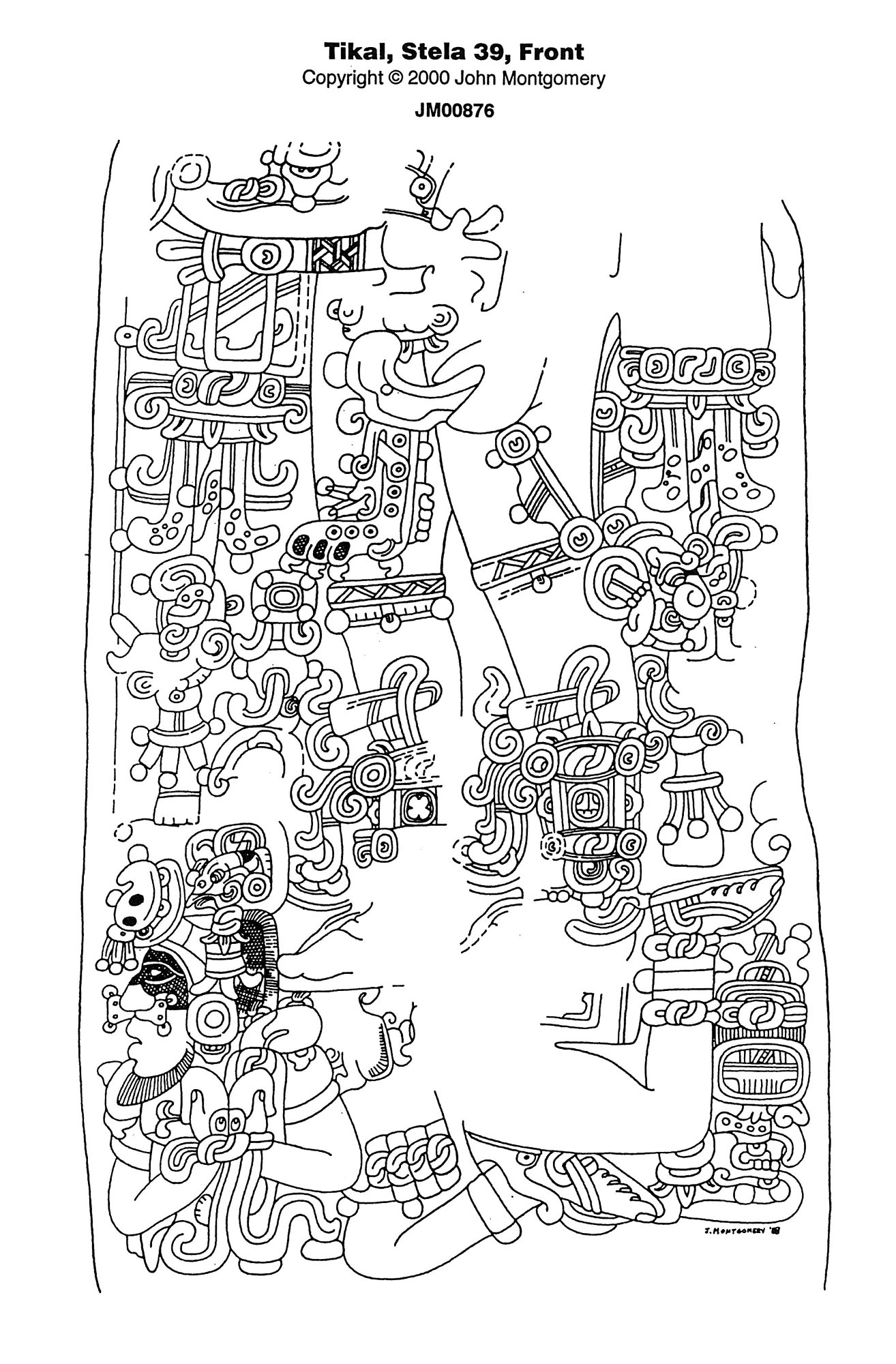
Blinding may not only have come from death. A captive with eyeband from Tikal Stela 39 could conceivably have received this torture at the hands of his captors (Figure 7; for the systematic blinding of captives, if in a Balkan context, see Holmes 2012). This was, to say the least, an immiseration that would hinder opponents and inflict broader psychological trauma.

Figure 7. A possible blinded captive on Tikal Stela 39, Guatemala (drawing by John Montgomery, FAMSI repository).


A captive who was likely blinded – his slit eye oozes with blood – occurs yet more clearly on a vase from the Ik’ kingdom of northern Guatemala (Figure 8).

Figure 8. Blinded captive, Ik’ kingdom, Guatemala, now in a private collection (photographer unknown).


That blindness was shown in Classic Maya text and imagery should not be surprising given the strong, positive emphasis on its opposite, the extromissive powers of sight (Houston et al. 2006:163-76). By comparison, there is, in recent literature on the senses, a latter-day deemphasis on sight, a dethroning of vision in favor of other senses (Jay 1993). To be “ocularcentric” is to miss larger worlds of perception and lend pernicious weight to “sensory normativity” (Petty 2021:297, 298). But the Maya might have disagreed: near-perfect humans were, according to mythic accounts from Highland Guatemala, capable of penetrative sight, to the extent of angering the gods of creation (Groark 2008:427-8). Removing that acuity, as the gods did, reduced the capacities of their hubristic creations. For most humans, death and sightlessness lay ahead in an inevitable future.

Acknowledgements  This essay benefited from comments by Charles Golden, Andrew Scherer, David Stuart, and Karl Taube.


References 

Aguilera, Carmen. 1996. The Matrícula de Huexotzinco: A Pictorial Census from New Spain. Huntington Library Quarterly 59(4):529-41.

Clifasefi, Seema L., Melanie K.T. Takarangi, and Jonah S. Bergman. 2006. Blind Drunk: The Effects of Alcohol on Inattentional Blindness. Applied Cognitive Psychology: The Official Journal of the Society for Applied Research in Memory and Cognition 20(5):697-704.

Coe, Michael D. 1974. A Carved Wooden Box from the Classic Maya Civilization. In Primera Mesa Redonda de Palenque (Part II), edited by Merle Greene Robertson, pp. 51–58. Pebble Beach, CA: Robert Louis Stevenson School, Pre-Columbian Art Research.

Golden, Charles, Andrew K. Scherer, Stephen HoustonWhittaker SchroderShanti Morell-HartSocorro del Pilar Jiménez ÁlvarezGeorg Van KolliasMoises Yerath Ramiro TalaveraMallory MatsumotoJeffrey Dobereiner, and Omar Alcover Firpi. 2020. Centering the Classic Maya Kingdom of Sak Tz’i’. Journal of Field Archaeology 45(2):67-85, DOI: 10.1080/00934690.2019.1684748

Groark, Kevin P. 2008. Social Opacity and the Dynamics of Empathic In-Sight among the Tzotzil Maya of Chiapas, Mexico. Ethos 36(4):427–48.

Grube, Nikolai. 2004. Akan: The God of Drinking, Disease, and Death. In Continuity and Change: Maya Religious Practices in Temporal Perspective, edited by Daniel Graña Behrens, Nikolai Grube, Christian M. Prager, Frauke Sachse, Stefanie Teufel, and Elisabeth Wagner, pp. 59-7. Mark Schwaben: Verlag Anton Saurwein.

__ , and Werner Nahm. 1994. Census of Xibalba: A Complete Inventory of Way Characters on Maya Ceramics. In The Maya Vase Book: A Corpus of Rollout Photographs of Maya Vases, Volume 4, edited by Barbara Kerr and Justin Kerr, pp. 686–715. New York: Kerr Associates.

Holmes, Catherine. 2012. Basil II the Bulgar-slayer and the Blinding of 15,000 Bulgarians in 1014: Mutilation and Prisoners of War in the Middle Ages. In How Fighting Ends: A History of Surrender, edited by Holger Afflerbach, and Hew Strachan, pp. 85-98. Oxford: Oxford University Press.

Houston, Stephen, and Marc Zender. 2018. Touching Text in Ancient Mexican Writing. Maya Decipherment: Ideas on Maya Writing and Iconography – Boundary End Archaeological Research Center.

Jay, Martin. 1993. Downcast Eyes: The Denigration of Vision in Twentieth-Century French Thought. Berkeley: University of California Press.

Kanda, Fusae. 2005. Behind the Sensationalism: Images of a Decaying Corpse in Japanese Buddhist Art. The Art Bulletin 87(1):24–49. http://www.jstor.org/stable/25067154.

Laureys, Steven. 2007. Eyes Open, Brain Shut. Scientific American 296(5):84-89.

Petty, Karis J. 2021. Beyond the Senses: Perception, the Environment, and Vision Impairment. Journal of the Royal Anthropological Institute 27(2):285-302.

Prem, Hanns J. 1974. Matrícula de Huexotzinco: Ms. mex. 387 der Bibliothèque Nationale Paris: Ed., Kommentar, Hieroglyphenglossar. Graz: Akademische. Druck- u. Verlagsanstalt.

Stuart, David, Stephanie M. Strauss, and Elliot Lopez-Finn. 2017. “Art from the Ancient East: Echoes of Classic Maya Writing and Iconography in Aztec-Period Aesthetics.” Paper presented at the University of Texas, Austin, Maya Meeting, Tlillan Tlapallan: The Maya as Neighbors in Ancient Mesoamerica, Jan. 14, 2017, Austin, Texas.

Wood, Stephanie, ed. 2020-present. Visual Lexicon of Aztec Hieroglyphs. Eugene: Wired Humanities Projects, University of Oregon, Version 1.0.