The Misunderstanding of Maya Math

A great many descriptions of ancient Maya mathematical notation read something like this:

The Maya made use of a base-20 (vigesimal) system with the units of 1, 20, 400, 8,000, 160,000, etc.. To write a number, a scribe would show multiples of these units in a set columnar order, moving down from highest to lowest, and add them accordingly. “32” for example would be written as single dot for 1, representing one unit of 20, above the two bars and two dots for 12, corresponding to the “ones” unit (1×20 + 12×1 = 32). A larger number such as 823 would be written in three places as two dots followed by one dot followed in turn by three dots, standing for the necessary multiples of 400, 20, and 1 respectively (2×400 + 1×20 + 3×1 = 823).

Similar descriptions of Maya math pervade the literature, textbooks and the internet. For example Michael Coe writes in the latest edition of The Maya (p. 232):

Unlike our system adopted from the Hindus, which is decimal and increasing in value from right to left, the Maya was vigesimal and increased from bottom to top in vertical columns. Thus, the first and lowest place has the value of one; the next above it the value of twenty; then 400; and so on. It is immediately apparent that “twenty” would be written with a nought in the lowest place and a dot in the second.

The illustration accompanying this text provides many examples of this purely vigesimal system:

Maya number notation from Coe’s The Maya (8th edition, p. 233)

Maya mathematical notation is described the same way in a number of other influential books widely read in classrooms and seminars, such as The Ancient Maya: New Perspectives (McKillop 2004:277) or the venerable The Ancient Maya (Sharer and Traxler 2006:101). In the latter work, two types of counts are represented (see below) – the purely vigesimal or base-20 count (with units of 1, 20, 400, and 8,000) alongside what’s called the “chronological count” (with units of 1, 20, 360, 7,200). The second is of course the basis for the familiar Long Count system.

Maya number notation as shown in The Ancient Maya (6th edition, p. 101).

A big problem exists with all of these seemingly straightforward descriptions of Maya mathematical notation. As far as I am aware no purely vigesemal place-notation system was ever written this way. It’s true that in Mayan languages numbers are base-20 in their overall structure, just as in most Mesoamerican languages. In Colonial Yukatek, for example, we have familiar terms for these units: k’al (20), bak’ (400), pik (8,000), and so on. However, ancient scribes never represented these units in a columnar place notation system, as is so commonly described in the textbooks. That format was instead always reserved for a for the count of time, in what we know as the Long Count. That system is mostly vigesimal, but it is skewed in one of its units (the Tun, of 360 days) in order to conform as much as possible to the number of days in the solar year (365). To reiterate: the columns of numbers we find in the pages of the Dresden Codex or painted on the walls of Xultun (stay tuned, folks…) are all day counts; the positional notation system was never used for reckoning anything else.

In the ancient inscriptions non-calendrical counts using large numbers are quite rare, mostly found in connection to tribute tallies, such as the counting of bundled cacao beans. But in those settings the scribes always seem to show nice rounded numbers (as in ho’ pik kakaw, “5×8,000 [40,000] cacao beans,” shown in the murals of Bonampak) without all the place units we know from the Long Count. In the Dresden and Madrid codices, counts of food offerings are given as groupings of WINIK (20) signs with accompanying bars and dots for 1-19. In this way a cluster of four such elements (4×20) with 19 writes 96 (See Love 1994:58-59; Stuart, in press).

There is a good deal we still don’t know about the ways the Maya wrote quantities, especially of non-calendrical things. The pattern nonetheless seems clear that the place notation system of the Long Count was restricted to time reckoning, and never applied to the purely vigesimal counting structure we see reflected in Mayan languages. The descriptions of written numbers found in the many texts about the ancient Maya therefore need to be corrected.

Sources Cited:

Coe, Michael. 2011. The Maya (8th edition). Thames and Hudson, New York.

Love, Bruce. 1994. The Paris Codex: Handbook for a Maya Priest. University of Texas Press, Austin.

McKillop, Heather. 2006. The Ancient Maya: New Perspectives. W.W. Norton, New York.

Sharer, Robert, and Loa Traxler. 2005. The Ancient Maya (6th edition). Stanford University Press, Stanford.

Stuart, David. In press. The Varieties of Ancient Maya Numeration and Value. To appear in The Construction of Value in the Ancient World, ed. by J. Papadopolous and G. Urton. Cotsen Institute of Archaeology, UCLA, Los Angeles.

A Watery Tableau at El Mirador, Guatemala

by James Doyle (Brown University) and Stephen Houston (Brown University)

The impersonation of gods abounds in Classic Maya texts and imagery (Houston, Stuart, and Taube 2006: 270-275). Humans donned elaborate masks and costumes to channel deities and to perform dances or reenactments of mythic actions. It is now clear that there were Late Preclassic antecedents to such ritual: for example, Kaminaljuyu Stela 11 displays the “x-ray” view of a lord’s face within the head of the Principal Bird Deity (Fields and Reents-Budet, eds., 2005: Cat. 6, 104-105; see also here). The appearance of a possible masked performer in the Preclassic is hardly surprising. Places for performance and assembly– visible pyramid apices, tiered façades, and plaster-covered plazas — reached their pinnacle size at many Lowland Maya sites.

A recent discovery by the important project at El Mirador, Guatemala, consists of a long set of stucco friezes that depicts two more examples of Late Preclassic deity impersonation (Figure 1). The façades are located in a prominent pathway running east-west in the center of the “Central Acropolis.” They appear to front a large plaza at the base of the “Tecolote” pyramid complex, perhaps adorning part of an ancient water collection system (see map). The figures on the lower frieze have been associated with the Hero Twins, Hunahpu and Xbalanque, protagonists of the colonial K’iche Maya creation story, the Popol Vuh (Hansen et al. 2011: 190). Yet, in our view, these figures represent god impersonators and bear no secure connection to twins in the Popol Vuh.

Figure 1. 3D scans of El Mirador friezes, University of South Florida, Alliance for Integrated Spatial Technologies, http://aist.usf.edu/projects/elmirador/.

The lower, more prominent façade contains three beings: two humans with large headdresses, and the large profile head. The figure on the left, whose face is partially damaged, wears a headdress and shell ear spools. His one visible eye has the inverted-“L” found on some early gods; his mouth displays a circular outline, his outstretched arms and bent legs conform to the pattern of many diving figures in Maya art (see Taube et al. 2010: Fig. 54A).

The central figure strikes a similar posture but in the opposite direction. Both are framed by the diagonal elements with elliptical or volute decorations that recall primordial, living sky bands. The attributes of these bands mark them as maxillae of the animate sky, complete with curved fangs and other teeth; another well-known example is present in a Late Preclassic frieze from Calakmul (Carrasco Vargas 2005: Figure 3, 4).

Figure 2: Chahk figures with curled foreheads or hair (blue) and shell ear spools (green). (a) Calakmul Frieze (drawing by James Doyle after Carrasco Vargas 2005: Fig. 3, 4); (b) Uaxactun Group H Frieze (drawing by James Doyle after Valdés 1993: Fig. 50); (c) Kaminaljuyu Stela 4 (drawing by James Doyle after Taube 1996: Fig. 16b); (d),(e) Izapa Stela 1 (drawings by James Doyle after Taube 1996: Fig. 15a, e); (f) El Mirador Lower Frieze, detail (drawing by James Doyle and Stephen Houston).

The central figure wears a simple knotted belt with an effigy head attached to his lower back. His headdress and chinstrap form the gaping jaws of what is likely a version of Chahk, the god of rain (see Taube 1996: Fig. 15, 16): the diagnostic elements are the curled forehead (or hair) and especially the Spondylus ear spool (Figure 2). The figure on the viewer’s left shares many of the same features, but with different, tufted forehead, as though referring to another aspect of the rain deity. Other such costumed diving figures with curled foreheads appear on contemporaneous stucco friezes at Uaxactun Group H (Valdés 1993: Fig. 50), and Calakmul (Carrasco Vargas 2005: Figure 3, 4).

The profile head on the far right of the lower frieze resembles the many depictions of mountains as breathing beasts in Preclassic and Classic period iconography, such as the witz depicted on the North Wall at San Bartolo (Saturno et al. 2005: 14-21). Perhaps there was another such head on the opposite side, framing this scene as a mythic, mountainous locale from which clouds emerged. This trope in particular goes back to Chalcatzingo Monument 1 (Grove, ed. 1987:115-117) and highlighted in variant form on the San Bartolo North Wall.

The upper façade is an early water-band that contains two large water birds with outstretched wings. The water-band passes over two bulbous cloud or muy elements with swirling volutes, another, archaic guise of Chahk (see Stone and Zender 2011: 142-143). A fascinating detail of the upper frieze is that the artist(s) gave faces – in an archaic, almost “Olmec” style with a snarling upper lip and a single tooth – to the clouds, as if they are peering upward at the water. The central bird figure has the head of an older deity within its breast. This enigmatic bird-god figure appears on many Classic Maya vessels (e.g., K8538, K6181, K6438, K3536, see Finamore and Houston, eds. 2010: 104; see also a related Spondylus shell creature on stuccoed vessel K2027), and is not well understood. The bird on the left of the upper frieze (see here) is likely a cormorant, which possibly would have held a fish in its beak (see K6218, Finamore and Houston, eds. 2010: 103). The water band, probably representing flowing streams of water, as well as avian themes are also present on a slightly later stucco altar from Aguacatal, Campeche (Houston et al. 2005).

The stucco artists of El Mirador were concerned with rain, clouds, waters, Chahk, and water birds that all flow together in the Maya view of grand, hydrological cycles. Perhaps the friezes show a situational composition – a Late Preclassic view of the rainy sky and the water that swirls around in it. Or, perhaps the artists commemorated a narrative of the first rainmakers and their watery assistants. In this way the rulers of El Mirador, through the mechanism of deity impersonation, presented themselves as supernatural agents who controlled the rain. The lower freeze shows the mountains breathing out water as the Chahk impersonators swim in the lower sky; the upper frieze then shows the high altitude products of impersonation, clouds that embody Chahk, and undulating water.

REFERENCES CITED

Carrasco Vargas, Ramón. 2005. The Sacred Mountain: Preclassic Architecture in Calakmul. In Lords of Creation: The Origins of Sacred Maya Kingship. Los Angeles: LACMA/Scala Publishers.

Fields, Virginia M., and Dorie Reents-Budet. 2005. The Lords of Creation: The Origins of Sacred Maya Kingship. Los Angeles: Scala Publishers/LACMA.

Finamore, Daniel, and Stephen Houston, eds. 2010. The Fiery Pool: The Maya and the Mythic Sea. New Haven: Yale University Press.

Grove, David C., ed. 1987. Ancient Chalcatzingo. Austin: University of Texas Press. Available Online: http://www.famsi.org/research/grove/chalcatzingo/index.html.

Hansen, Richard D., Edgar Suyuc Ley, and Héctor E. Mejía. 2011. Resultados de la temporada de investigaciones 2009: Proyecto Cuenca Mirador. In XXIV Simposio de Investigaciones Arqueológicas en Guatemala, 2010. B. Arroyo, L. Paiz Aragón, A. Linares Palma, y A. L. Arroyave, eds. Pp. 187-204. Guatemala: Museo Nacional de Arqueología y Etnología.

Houston, Stephen, Karl Taube, Ray Matheny, Deanne Matheny, Zachary Nelson, Gene Ware, and Cassandra Mesick. 2005. The Pool of the Rain God: An Early Stuccoed Altar at Aguacatal, Campeche, Mexico. Mesoamerican Voices 2: 37-62.

Houston, Stephen, and David Stuart, and Karl Taube. 2006. The Memory of Bones: Body, Being, and Experience among the Classic Maya. Austin: University of Texas Press.

Saturno, William, Karl Taube, David Stuart, with Heather Hurst. 2005. The Murals of San Bartolo, El Petén, Guatemala Part 1: The North Wall. Ancient America 7.

Stone, Andrea, and Marc Zender. 2011. Reading Maya Art: A Hieroglyphic Guid to Ancient Maya Painting and Sculpture. New York: Thames & Hudson.

Taube, Karl, William Saturno, David Stuart, and Heather Hurst. 2010. The Murals of San Bartolo, El Petén, Guatemala Part 2: The West Wall. Ancient America 10.

Taube, Karl. 1996. The Rainmakers: The Olmec and Their Contribution to Mesoamerican Belief and Ritual. In The Olmec World: Ritual and Rulership. Princeton: Princeton University Art Museum.

Valdés, Juan Antonio. 1993. Arquitectura y escultura en la Plaza Sure del Grupo H, Uaxactún. In Tikal y Uaxactún en el Preclásico. Mexico City: Universidad Nacional Autónoma de México. 96-121.

More links for El Mirador information:

Mirador Basin Project

Archaeology magazine, 2009

Smithsonian magazine article, 2009

Reuters news article, 2009

MAM: Mayas for Ancient Mayan

Here’s a link to the new website for MAM: Mayas for Ancient Mayan, an important effort to bring ancient Maya literature to indigenous communities in Mexico, Guatemala and Belize.

From their website:

Mayas for Ancient Mayan (MAM) supports indigenous Mayas who are thirsting to learn the ancient hieroglyphic writing and the calendar. With financial aid from MAM, our Maya colleagues attend workshops and conferences in the US, Europe, and Latin America to learn the latest advances in decipherment of the ancient writing. Combining these advances with ancient teachings from their own elders, our colleagues spread this knowledge in workshops and classes to the Mayan-speaking communities. MAM supports these efforts.

Dating Tikal’s Mendez Causeway

In an earlier post on Maya Decipherment I speculated that the lengthy text of Tikal’s Temple of the Inscriptions (or Temple VI, dedicated in 766 AD) refers in part to an early building episode of the temple, as well as to the initial construction of the Mendez Causeway — the ceremonial road leading to the Temple of the Inscriptions from Tikal’s central “downtown.” The specific dates from that text are:

9.4.13.4.16 5 Kib 9 Keh (November 11, 527) – “stone-building/-fashioning”
9.4.13.6.14 4 Ix 7 K’ank’in (December 19, 527) – “road-striking”

To quote my earlier post:

I suspect that these historical episodes in 527 AD involve the construction and dedication of an early temple dedicated to White Owl Jaguar. The final episode in this string of related dates says it is the jatz’ bih-tuun, “the road-striking,” or “the pavement striking.” This is an odd phrase found also at Naranjo (on Altar 2), where Nikolai Grube has suggested it refers to the construction of architectural spaces. One wonders of it could be more specifically referencing the building of causeways (bih-tuun, “road of stone”), an attractive interpretation given that Temple of the Inscriptions lies at the end of a very long and important ceremonial road, the Mendez Causeway. Archaeological probing in and around the complex would be needed to make sure, but I suspect that the events of 527 are key episodes in the architectural history of the Temple of the Inscriptions.

Not long ago, during December’s Maya Field Workshop at Tikal, I came upon this interesting tidbit on the Mendez Causeway from William Coe’s guidebook to the site:

“With a length of about three-fifths of a mile and an average width of 200 feet, this causeway originates at the east side of the East Plaza (behind Temple I) and runs almost straight to the Temple of the Inscriptions. Close to the East Plaza the Late Classic causeway with its parapets overlies an earlier causeway without side parapets. The latter may be Early Classic” (Coe 1967:87).

So, there is indeed as early phase of the Mendez Causeway. It seems natural to wonder if this dates to 527, with the overlying later version corresponding to refurbishment of the causeway and temple some 240 years later.

Reference Cited:

Coe, WIlliam R. 1967. Tikal: A Handbook of the Ancient Maya Ruins. The University Museum, Philadelphia.

The Verb Bix, “Go, Go Away”

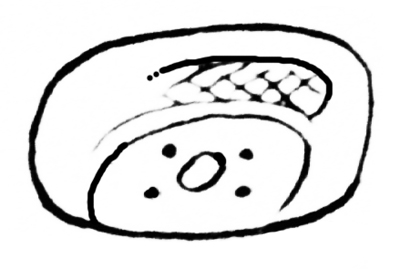
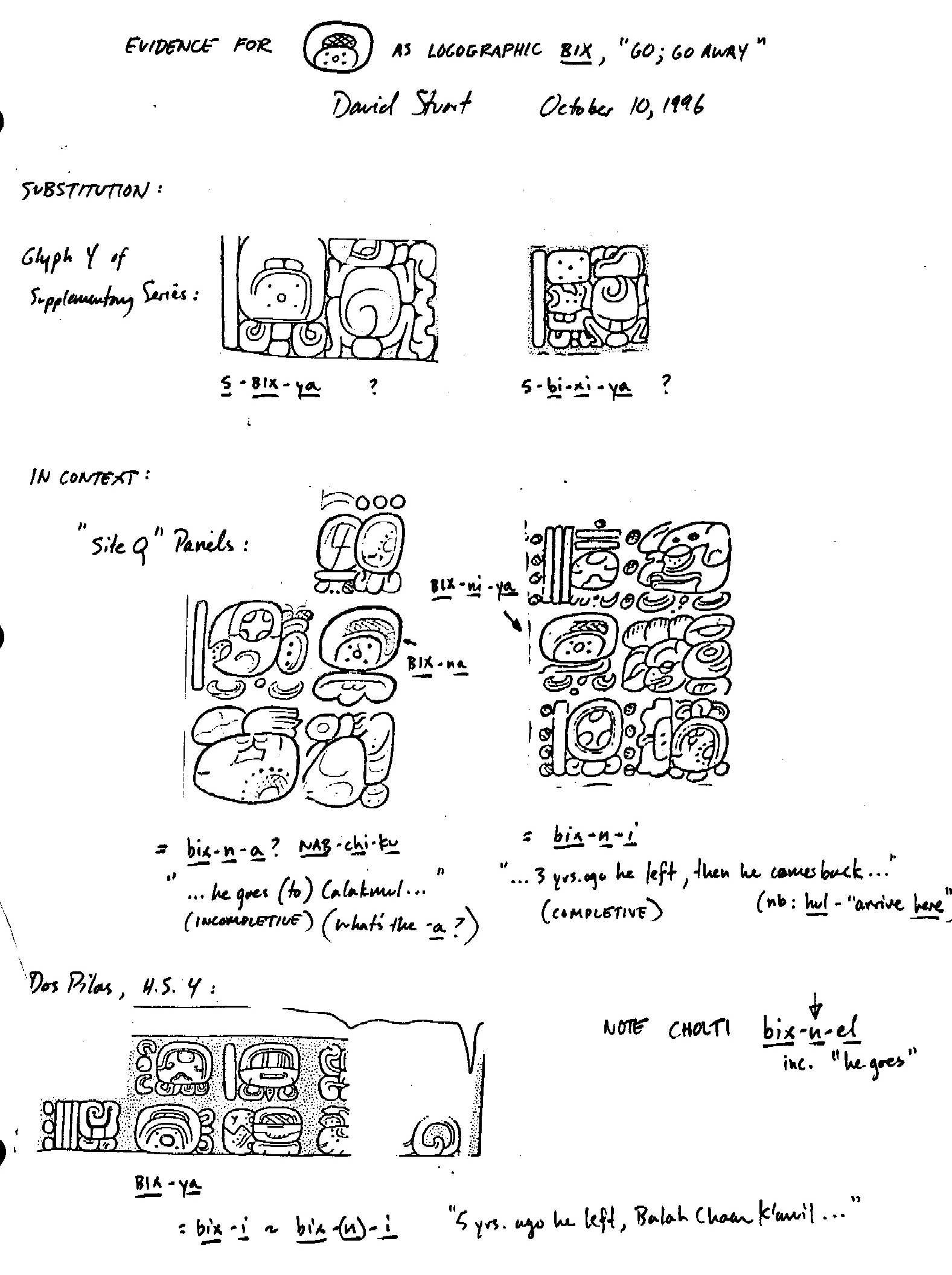
Back in 1996 I made notes about an interesting substitution set that pointed to a reading BIX for a logogram shown here, which makes an appearance in a few inscriptions from Yaxchilan, La Corona, Dos Pilas, Coba, as well as a few others. This value may well have been noted by others back around the same time, if not before, but I thought I would post my old hand-written note summarizing the evidence (having just now found them in an old notebook).

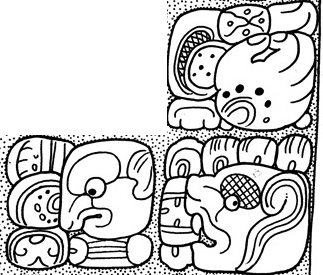
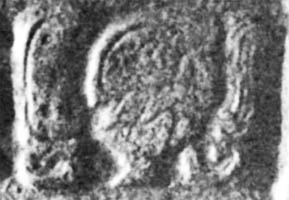
The sign was used to write the intransitive verb bix, “to go,” in a small variety of settings. This verb root can be traced historically to proto-Ch’olan *bix (Kaufman and Norman 1980) and in ancient texts it appears on Dos Pilas HS 4 (see page bottom) as BIX-ya, for bix-iiy, “he went” (in reference to the fleeing of the local ruler Bahlaj Chan K’awiil from Dos Pilas). Spelled BIX-ya or bi-xi-ya, the same verb was used in temporal expressions ho’ bix-iiy, “five days ago” or wuk bix-iiy, “seven days ago” (see top examples on page below). A variant form of  this verb is bix-Vn, “to go, go away,” which appears in Colonial Ch’olti’ and in the glyphs as well. Several examples occur in the texts of La Corona (spelled BIX-na 0r, for the compl,tive, BIX-ni-ya), where they refer to the journeys of the young noble K’inich ? Yook from his home to Calakmul (Chihknahb). A related example turned up long after I wrote those original old notes, on Panel 1 from La Corona (at right), discovered in 2005 by Marcello Canuto.  There we read bix-Vn chihknahb, “he goes to Chihknahb” (the same expression appears on Panel 2, but with a different date — see “Site Q” examples illustrated at the middle of the page).

My favorite example of these “go” verbs comes from Altar de Sacrificios, where on Panel 2 we have bi-xi-ni-ya, for bix-Vn-iiy, “he went away.” Rather than referring to a journey in the real world, this is a citation of a local ruler’s death (cited in more conventional terms on Stela 4, an associated inscription).

I’m as yet unsure what if any semantic distinction existed between between the verbs bix and bix-Vn, and they may just be regional variants.  The bix root is likely based on the noun *bih, “road,” and I find it interesting that this etymology is graphically reflected in the logogram sign itself, which incorporates an infixed BIH/bi element.

Here are my old scribbles on this stuff from 1996: