A Possible Sign for Metate

by David Stuart, Department of Art and Art History, The University of Texas at Austin

The "Bent-Cauac" Sign
The “Bent-Cauac”

Among the still-undeciphered signs in Maya writing is the so-called  “bent-cauac” element (Figure 1). Most epigrpahers seem to agree that it is a logogram (a word sign), but its precise reading has so far remained elusive. In this note I would like to put forth some evidence that points to a possible reading KA’, with the meaning “metate” or “grinding stone.” The reading, if correct, may ultimately help us to understand a key place name cited in historical records of the Classic period.

Figure 2. The "maguey metate" place name. (a) TIK St 31, (b) COL La Florida(?) vessel, (c) COP St 4, (d) COL vessel K1882. Drawings by D. Stuart; K1882 Photo by J. Kerr.
Figure 2. The “chi-altar” place glyph. (a) TIK St 31, (b) COL La Florida(?) vessel, (c) COP St 4, (d) COL vessel K1882. Drawings by D. Stuart; K1882 photo by J. Kerr.

The bent-cauac sign is perhaps best known as part of an important place name in early Maya history, mentioned in the inscriptions from a number of different sites, including Copan, Tikal and Dzibanche. as well as depicted on a few codex-style ceramics (Grube 2004) (Figure 2). Here it is combined with the hand sign chi, which some years ago led to the nickname “chi-witz” (Grube 2004:127) apparently based on the bent-cauac’s imperfect resemblance to the WITZ, “mountain,” logogram identified a number of years ago (Stuart 1987). Clearly it is a different sign, however.[Note 1] More recently, some epigraphers have opted to refer to the place name as “chi-altar,” seeing a connection instead to the large table-like altars sometimes depicted in Maya sculpture and painting (see for example Stone and Zender 2012:93). This visual connection to a stone object seems closer to the mark, yet I believe the “altar” designation remains vague and even problematic. One reason for my hesitance is the distinctive and consistent bent form of the sign’s main element — something altogether different from the flat altar stones with two supports. Moreover, a hieroglyphic sign that actually does depict such stone altars or tables already exists in the texts of Tikal and Copan. Significantly, one inscription at Tikal includes both the the “bent-cauac” and “stone table” signs, easily demonstrating the distinction of the two elements (See Tikal Stela 26, blocks zA7 and yB2). Thus there is good reason to see the bent-cauac as neither a hill nor an altar, but representing some other type of stone object or feature.

Figure 3. Corn-grinding scene on K1272 (Photograph by J. Kerr).
Figure 3. Corn-grinding scene on K1272 (J. Kerr photo).

If we look at the bent-cauac’s visual history, we see that the sign changes somewhat over time. Its earliest known cases show two small stone elements below the larger bent sign (Figure 2a). Later scribes usually opted to place small stones at the upper left and lower right corners of the sign (Figure 1, Figure 2c, Figure 4), lending the sign  aesthetic and visual balance.  In some instances, the smaller stone elements are omitted altogether (Figure 2b).  In the iconographic parallels from codex-style vases, we see that the original early form is retained, showing an irregular, sloped large stone atop two supports (Figure 2d).

In considering what the bent-cauac sign really depicts, we can be sure of a couple of things. One, it is a stone object of irregular shape, sloping downward on one end. Second, it can have “supports” of stone, but not always. What might it be? I suggest that it probably represents a metate, or a grinding stone — an identification that seems to agree well with the depictions of such objects in Maya art (Figure 3).  In the fuller examples of bent-cauac logogram (see Figure 1), the placement of a stone on top may allude to the hand-held “mano,” with the other stone serving as a support beneath.

FIgure 4. Example of the -a suffix on the bent-cauac
Figure 4. Example of the -a suffix on the bent-cauac

Some phonetic evidence may help determine the sign’s value.  In various instances we see the bent-cauac sign with an -a suffix (Figure 2c, Figure 4). This is a sign that in its origin represented a parrot’s beak, abbreviating the fuller parrot head sign also a, also seen conflated with the metate glyph in cases from the Hieroglyphic Stairway at the site of Resbalon. In this context the –a suffix sign can be taken in a couple of ways. The –a element might conceivably be providing the common place name ending  –(h)a’, “water,” as it clearly seems to do in the Yaxha toponym and emblem glyph (YAX-a) (Stuart 1988). Alternatively, the –a may provide a telling phonetic clue to the reading of the logogram, serving as a phonetic complement.

I prefer this second possibility, since it seems to be an optional sign added onto the metate sign in at least two separate contexts.  If the -a is indeed optional, there is a good likelihood that it serves a phonetic complement to the reading of the metate logogram.  In this light, it is interesting to see the various terms for metate in lowland Mayan languages, as listed by Kaufman in his Preliminary Mayan Etymological Dictionary (Kaufman 2003).  There the form reconstructed for proto-Mayan is *ka’, and for Proto-Ch’olan it is *cha’.  I therefore suggest this may be a good working decipherment for the bent cauac sign, either KA’ or CHA’, “metate.”

Metates were, of course, basic implements in domestic food production used throughout the ancient Americas. In Mesoamerica we usually think of stone grinders being used for processing maize, but they were key implements in many different types of food preparation. Interestingly, metates were used for the grinding of maguey and other agave plants in the manufacture of mescal, pulque and perhaps other fermented drinks important in Mesoamerica.  

We might now have a reasonable interpretation of the mysterious place glyph once called “chi-witz.” If I were to propose a phonetic analysis of the compound, something like chi-CHA’ (chi(h) cha’) or chi-KA’ (chi(h) ka’), the “maguey grinder (place),” looks like a workable possibility.

It is important to stress that the geographic frame of reference for this “maguey-grinder” place name still remains very unclear. Some have argued that it might refer to El Mirador or Nakbe, given its early historical connections (see Grube 2004:13-131; Zender and Stone 2012:234). While such connections are tantalizing they still remain circumstantial, and without further evidence it is difficult to know. Perhaps this better semantic understanding of the place name will help us one day in resolving the issue.

It is also important to note that not all appearances of the supposed metate sign are easily understood, even if KA’ or CHA’ turns out to be a correct reading. On Tikal Stela 26 the sign appears in what might be a verbal context (U-KA’-ji) but the surrounding text is obscure. Hopefully these and other issues can be clarified with further analysis.

ACKNOWLEDGEMENTS

Thanks to Stephen Houston, Simon Martin and Karl Taube for some very useful feedback on this proposal.

NOTES

Note 1. Part of the confusion seems to have stemmed from an example from Stela 1 at Arroyo de Piedra (see Grube 2004:130), where the sculptor of the monument bears the title CHIH-WITZ AJAW, “Deer-Mountain Lord.” There is no reason to connect this isolated example of the “Deer Mountain” place name to the “chi-witz” or “chi-altar” glyphs under discussion here, however.

Note 2. The difference in these two readings rests on whether one prefers to transcribe the sign using the reconstructed Ch’olan-Tzeltalan form cha’, or the more “archaic” ka’.  Until recently I would have opted strongly for the latter, given the secure position of Classic Mayan language in the Ch’olan-Tzeltalan group. But it is important to point out that many glyphic spellings point to a more complex scenario of areal diffusion of the k > ch sound change, and that the supposed innovation is not as regular as was earlier assumed (Law, et. al., in press). Until further clarification comes about, KA’ or CHA’ seem equally plausible readings.

SOURCES CITED

Grube, Nikolai. 2004. El origin de la dinastia Kaan. In Los Cautivos de Dzibanche, edited by Enrique Nalda, pp. 117-132. INAH, Mexico D.F.

Kaufman, Terrence. 2003. Preliminary Mayan Etymological Dictionary. On-line resource at http://www.famsi.org/reports/01051/pmed.pdf.

Law, Danny, John Robertson, Stephen Houston, Marc Zender, David Stuart. In press. Areal Shifts in Maya Phonology. Ms. accepted for publication in Ancient Mesoamerica.

Stone, Andrea, and Marc Zender. 2012. Reading Maya Art: A Hieroglyphic Guide to Ancient Maya Painting and Sculpture. Thames and Hudson, New York.

Stuart, David. 1985. The Yaxha Emblem Glyph as YAX-A. Research Reports on Ancient Maya Writing, 1. The Center for Maya Research, Washington, D.C.

_________. 1987. Ten Phonetic Syllables. Research Reports on Ancient Maya Writing, 14. The Center for Maya Research, Washington, D.C.

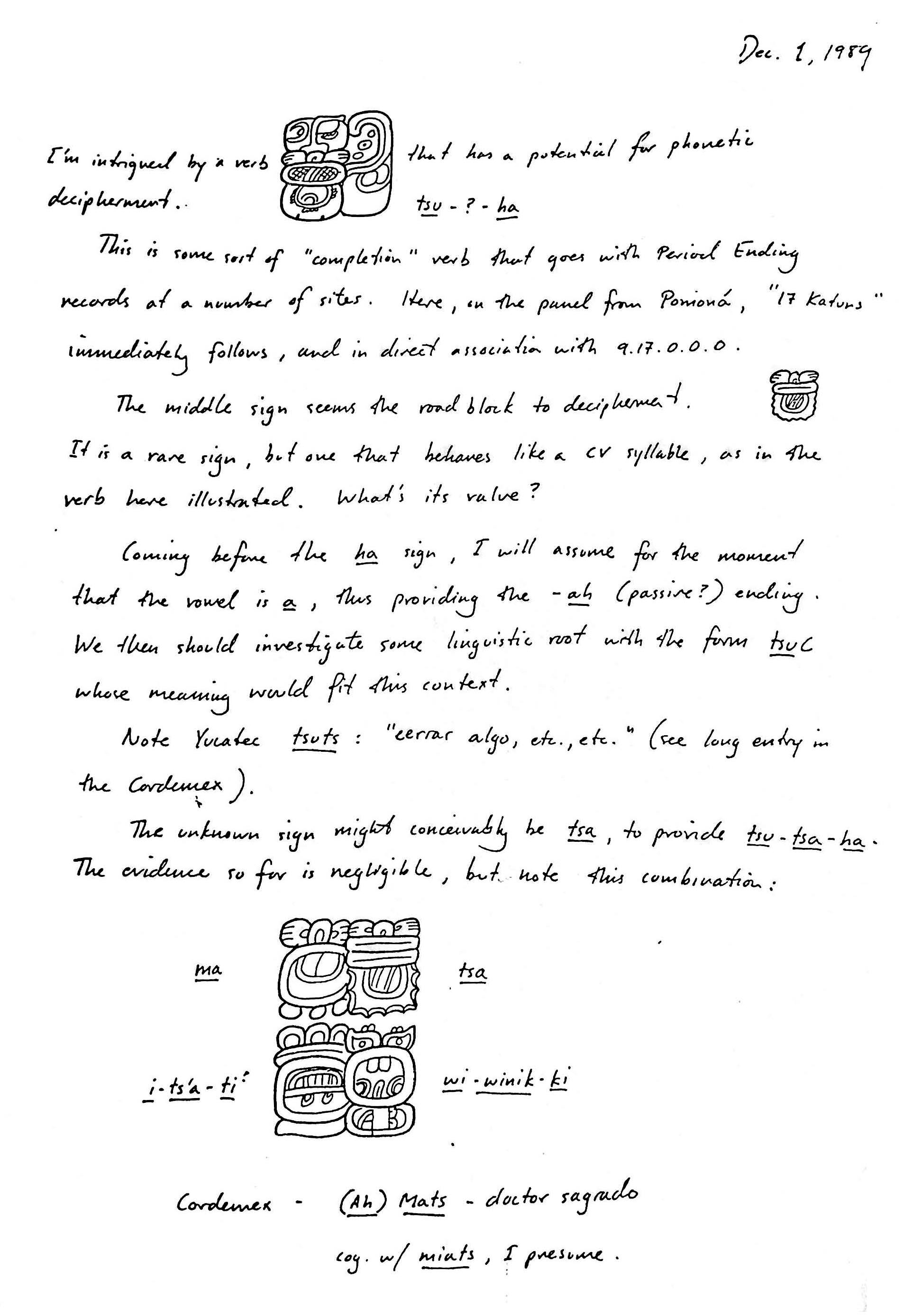
ARCHIVES: The syllable sign tza

tza signBelow is a page from one of my old notebooks, giving some of the evidence I was considering in 1989 for the decipherment of the tza syllable sign, a version of which is shown at right. The reasoning was pretty tentative back then, but it was bolstered in my own mind by considering more examples of the sign in the spellings of tzu-tza-ja and TZUTZ-tza-ja, for the passive for of the verb tzuhtzaj, “it is finished” (See Stuart 2001). Shortly after this page was jotted down I came across completive forms spelled 2tzu-ji-ya (with the tzu syllable doubled) for tzuhtz(a)jiiy, “it was finished,” which made the tza reading fairly certain.

The tza syllable sign is not a very common sign. It crops up in only a handful of other spellings, such as tza-ka or tza-ku for tzak, “to conjure, manifest (a god)” — a reading otherwise familar for the “fish-in-hand” logogram (TZAK).

Reference Cited:

Stuart, David. 2001. A Reading of the “Completion Hand” as TZUTZ. Research Reports on Ancient Maya Writing, No. 49. Center for Maya Research, Washington, D.C.

DS tza notes

ARCHIVES: Daniel Brinton’s Letter on Landa’s Alphabet

Most readers of this blog are probably aware of the fundamental insights of Yuri Knorosov, who in 1952 first published his breakthrough observation that Maya writing was in part phonetic, employing syllabic elements to spell words and grammatical constructions. The key for Knorosov was to see Bishop Diego de Landa’s “alphabet” as a misrepresentation of a syllabary.

Daniel Garrison Brinton, 1837-1899, at age 34, ca. 1871.
Daniel Garrison Brinton, ca. 1871

What few may realize is that Knorosov was not the first to hold this view. I was fascinated to come across clear evidence that Daniel Brinton, the famed American linguist and anthropologist, had pretty much the same view as early as 1879. Brinton’s insight seems to have gone largely unnoticed these days, perhaps because it was published only as an excerpted letter within a somewhat obscure book on Palenque’s Tablet of the Cross by Charles Rau (1879). In fact Brinton was an early advocate of the view that Maya writing was phonetic and quite sophisticated, even if decipherments were few and far between at the time. His thinking evolved over the decades, but at least by 1879 he seems to have had much the same fundamental insight about Landa’s alphabet for which Knorosov is now famous:

Excerpt of letter from Daniel G. Brinton to Charles Rau, dated March 4, 1879:

“My later reading has led me to doubt whether De Landa’s alphabet is really an alphabet in the proper sense of the term, that is, representing elementary sounds of the language by written characters. It appears more likely that the figures he gives represent compound sounds, syllabic or partly so, and that they are but fragments of a large repertory of phonetic signs, never reduced to the elements of sound, used by the Mayas of that age. He evidently very positively considered them phonetic and not ideographic, and he could not have been mistaken on such a point, I should suppose. In his endeavor to arrange them according to the analogy of the Latin alphabet, he obscured their real purport, and I think we should reject the whole of his theory of their use in this manner.” (Quoted in Rau 1879:52-53).

Here Brinton nails it, noting that Landa had fundamentally misunderstood syllable signs as alphabetic elements. What’s odd is that Brinton didn’t follow up his own assessment of Landa’s glyphs as “compound sounds.” It seems he could have taken things a step or two further and applied his thinking to specific glyph readings, in the same way Knorosov would decades later. Interestingly, just a year after Brinton’s letter to Rau, much research on Landa’s alphabet would be roundly criticized by Philipp J. J. Valentini, who declared it to be a “Spanish fabrication” (Valentini 1880). Perhaps this discouraged Brinton from taking up the matter further. Brinton also may have stepped aside to allow Thomas to delve into the atomistic details of Maya epigraphy. Both men saw the same tantalizing clues of phoneticism, but only Thomas went ahead and proposed actual readings. Unlike Brinton, Thomas considered some signs to be possible consonants or “elementary sounds.” While he made a few good insights, Thomas’s specific arguments tended to fall short on many counts, and their weakness eventually exposed the overall phonetic approach to a good deal of criticism from the likes of Eduard Seler and others.

I wonder too if Brinton, a remarkable polymath, might have simply had too much on his plate to focus his mind on Maya glyphs — in ’79 he would soon embark on editing and contributing to many volumes of the Library of Aboriginal American Literature that would appear between 1882 and 1890.  For whatever reason Brinton himself didn’t move forward on teasing out the patterns of phoneticism in the script, despite having described the abstract nature of Mayan writing with what we can see now as remarkable accuracy.

References Cited:

Rau, Charles. 1879. The Palenque Tablet in the United States National Museum, Washington, D.C. Smithsonian Contributions to Knowledge, 331. Smithsonian Instituion, Washington City.

Valentini, Philipp J.J.. 1880. The Landa Alphabet: A Spanish Fabrication. Proceedings of the American Antiquarian Society, no. 75, pp. 59-91. Worcester, MA.

Leaf Glyphs: Spellings with yo and YOP

by David Stuart

yo sign
Figure 1. The sign yo or YOP. (Drawings by D. Stuart)

Decipherment’s progress isn’t always measured by big leaps forward, nor marked by completely new readings of signs or radically new analyses of spellings. More often our work involves fairly small refinements of things we “thought we knew” but which turned out not to be quite correct. A good example might be the familiar sign I long ago proposed as having the value yo (Stuart 1987) (Figure 1). This reading is now widely accepted, but after many years I realized that the syllabic yo reading wasn’t always quite workable in certain contexts. Over a decade ago I came to the realization that the same sign might carry the related logographic value YOP on certain occasions, forcing a few adjustments to readings that had already made their way into print and the epigraphic literature. For students of Maya epigraphy it’s probably a bit confusing to come across this sort of minor tweak or change to seemingly established readings, especially when the arguments behind them remain unpublished, usually circulated as emails among colleagues. Here, therefore, I’ll discuss the yo and YOP values, clarifying how the sign is used in some distinct settings.

yo-yop Fig 2
Figure 2. The yo sign as a prevocalic possessive pronoun. (a) yo-OTOOT-ti, y-otoot, “his/her house,” (b) yo-OHL-la, y-ohl, “his/her/its heart/center.” Drawings by L. Schele and I. Graham.

Most familiar uses of the yo syllable are as a sign prefix, to indicate the pre-vocalic third-person pronoun y- before a word beginning in o-. Thus yo-OTOOT for y-otoot, “his/her dwelling,” or yo-OHL-la for y-ohl, “his/her heart” (Figure 2a and b). On rarer occasions the yo sign is used in non-initial

syllabic yo
Figure 3. The syllable yo in final position. (a) from Comalcalco, Bone Pendant 17A (drawing by M. Zender), (b) from Pomona-area panel (drawing by N. Grube)

position as part of spellings of certain roots (Figure 3a and b), as in xo-yo, perhaps for xoy, “round”(?), or po-mo-yo for the place name Pomoy, an unknown site in the lower Usumacinta region (the toponym is based on the noun pomoy, attested in modern Ch’ol as “capulín cimarrón” (small shrub-like tree, possibly a trema) (Aulie and Aulie 1978:211).

yop Fig4
Figure 4. Spellings of yopte’, “leaf”. (a) yo-po-TE’-NAL, yopte’nal, “leaf place(?),” (b) AJ-YOP-TE’, aj yopte’, “Yopte’ person.” (Drawings by D. Stuart and I. Graham)

Many years ago I noted an interesting use of yo in the glyph yo-po-TE’-NAL, written as part of a caption on the large stucco frieze from Tonina (Figure 4a). This is surely for yopte’, “tree leaf,” with -nal perhaps being a place name suffix. Yop and yopte‘ is a widespread root for “leaf” in Ch’olan langauges, and no doubt the leaf-like form of the yo sign has its origin in this word. This is surely related to another glyph from an early inscription at Yaxchilan (Figure 4b), where the leaf element is combined with TE’ in a personal title. Here, flanked by two logograms, reading the leaf as syllabic yo value seems unlikely (AJ-yo-TE‘); rather it seems natural to see the sign here as a direct logogram for YOP, “leaf,” in the sequence AJ-YOP-TE’, aj yopte’, “he of yopte’” or “the yopte’ person” (here Yopte’ is most likely a place name). There is a reasonable chance therefore that the leaf sign is both the logogram YOP and the syllable yo, depending on context.

Such a direct connection between a logogram and a syllable is not terribly surprising. The use of the simple “fish” sign for ka as well as for KAY/CHAY is perhaps a good parallel, as is the “gopher” logogram BAAH used at times as the syllable ba (although usually in late settings). But in the case of yo and YOP it has led to some misunderstandings and confusions about certain readings, especially this important element we find within royal names at Copan, Quirigua, Naranjo and elsewhere (Figure 5).

yop Fig5
Figure 5. Names of the Copan ruler Yax Pasaj Chan Yopaat. Note the substitution of the YOP-AAT-ti/ta glyph by the Chahk-like deity in final position. (Drawings by D. Stuart and L. Schele)

For many years, the final glyph on this sequence — evidently the name of an important deity related to Chahk — has been read as yo-AAT, although never precisely translated. Aat is “penis” and yo never made much sense as its prefix. If however we read this grouping as YOP-AAT we at least have a more comfortable juxtaposition of two logograms (even if the inescapable translation “leaf-penis” doesn’t make much sense to our ears). For this reason, I have long preferred to read the sequence in such royal names (i.e. the final two glyphs in Figure 5a and b) as CHAN-na YOP-AAT-ti/ta, “Sky Yop-aat.”

Figure 6. Yop-aat headdress from Naranjo St. 13. (Drawing by I. Graham).

One more interesting bit of information supports the YOP-AAT analysis. As just noted, Yopaat seems to refer to a deity with close relations to Chahk, the god of lightning and storms. Visually he seems identical, with the exception of having curved dotted elements on his head — perhaps representations of clouds or mist — and a hammer-like stone in his upraised hand. Yopaat is often represented in the ritual costumes of kings, for example as a small figure dangling from a belt, or else as an elaborate helmet or headdress (Figure 6). Intriguingly, the Yopaat headdress seems to be mentioned in the Yucatec Diccionario de Motul, where the entry yopat is glossed as “una manera de coraza o mitra que usavan los indios antiguos” (Martinez Hernández 1929:456).

I hope this clarifies what might seem a very minor issue over  alternate readings of a single sign, one syllabic and the other logographic. There are a number of other signs that similarly have two related values with different functions, one syllabic and another logographic. While subtle, the case of yo and YOP demonstrates how small changes used in the methods of decipherment over the last couple of decades can lead to slightly better and more refined notions of just what the Maya were writing down.

REFERENCES CITED:

Aulie, H. Wilbur, and Evelyn W. de Aulie. 1978. Diccionario Ch’ol-Español, Español-Ch’ol. Mexico, D.F.: Instituto Linguístico de Verano.

Martinez Hernández, Juan. 1929. Diccionario de Motul. Mérida: La Compañia Tipográfica Yucateca.

Stuart, David. 1987. Ten Phonetic Syllables. Research Reports on Ancient Maya Writing, no. 14. Washington D.C.: Center for Maya Research.

The 584286 Correlation

Simon Martin and Joel Skidmore have recently published in The PARI Journal and posted on Mesoweb their intriguing new analysis of the age-old correlation question — that is, how we best reconcile the ancient Maya and Gregorian calendars. They offer the possibility that the standard Goodman-Martinez-Thompson (GMT) family of solutions so widely accepted by nearly all Mayanists for many decades may be off by up to a few days.

Here’s the link to their article on Mesoweb.