K’ahk’ U Ti’ Suutz’, “Fire-Mouthed Bat,” a common wahy demon on Classic Maya vases (Drawing by D. Stuart).
Around this time of year I often give my “Maya Spooks” lecture to students here at UT-Austin, highlighting the grisly and fright-filled demons (wahyoob) of Classic Maya art and religion. The lecture title is “Spooks, Witchcraft and the ‘Dark Side’ of Maya Art and Rulership (a.k.a. The Halloween Lecture).” This semester I’m teaching on the Aztecs, so in lieu of lecturing I hereby post my brief treatment of the subject written back in 2005. This write-up was part of the larger sourcebook I put together for the Austin Maya Meetings that year, devoted to “Glyphs on Pots: Decoding Classic Maya Ceramics.”
My own thinking on wahy beings keeps being refined somewhat. I still see them as animate dark forces wielded by court sorcerers, perhaps even rulers themselves, in order to inflict harm or disease on others. But wahyoob can be exceedingly complex and multi-layered, and they certainly aren’t really the benign, shamanistic “animal companion spirits” as we often described them a couple of decades ago. I’m hoping to find time write something more in-depth on the fascinating topic of royal sorcery one of these days, perhaps even as a book on Classic Maya witchcraft.
Excerpt from: David Stuart, 2005. Glyphs on Pots: Decoding Classic Maya Ceramics. Sourcebook for the 2005 Maya Meetings at Texas. Department of Art and Art History, UT-Austin, Austin.
Last year I posted this blog entry on Maya Decipherment concerning the tomb recently opened in Temple XX at Palenque. It’s worth revisiting now in the wake of INAH’s recent announcement of the conservation efforts now going on in the chamber.
Figure 1. View of the Temple XX tomb chamber. INAH photo.
Some sources speculate that the tomb may be that of the dynastic founder, K’uk’ B’ahlam who reigned from 431-435 AD. But this timeframe is probably far too early for the tomb. As mentioned in the earlier blog entry and also as summarized in our 2008 book, Palenque: Eternal City of the Maya, it more likely dates to the 6th century:
Recent investiagations near the Cross Group have revealed another significant early tomb, as well as a significant archaeological puzzle. Temple XX is located at the southern end of the Cross Group, next to Temple XIX. Approaching the pyramid, it looks to be an imposing structure, but excavations since 1999 have shown that the base is actually a masonry veneer on a small hillock of bedrock. As archaeologists Alfonso Morales Cleveland and Rudy Larrios Villalta have shown, the structure was modified over many years, and the earliest phase seems to date from the first part of the sixth century. After this initial construction later builders demolished part of the upper temple in order to construct a vaulted tomb beneath. The crypt has not yet been entered as of this writing (in 2006), but photographs taken by a camera inserted within the chamber show red-line paintings of nine figures in an unusual style, jade objects, and pottery that looks to be fairly early (Cascada phase), possibly from the sixth century. Its size and elaboration suggests that the Temple XX tomb is a royal burial, but no clues exist to the identity of its occupant. Interestingly, a preliminary assessment of the painted figures indicates that they are portraits of royal ancestors, including Ahkal Mo’s Nahb and Kan Bahlam. If this is the case, then the Temple XX tomb must date to after Kan Bahlam’s death in 583. Could it be the tomb of Ix Yohl Ik’nal, as Merle Greene Robertson has tentatively suggested? Once the tomb is opened, the ceramics within can help greatly to confirm or deny this preliminary dating of the chamber.
Temple XX remained an important building for many years, and intriguingly its final remodeling at the end of the city’s occupation may never have been finished. When archaeologists first began investigating the pyramid, they were greatly confused by the lack of any masonry veneer and terracing on its front and sides; it was an ancient construction site interrupted in mid-project.
The above quotation from Stuart and Stuart (2008:140).
Figure 2. Photograph of standing figure with Kan Bahlam (Snake Jaguar) in headdress, possibly naming the early Palenque ruler who reigned until 583 AD. INAH photo.
Source Cited:
Stuart, David and George Stuart. 2008. Palenque: Eternal City of the Maya. Thames and Hudson, London.
As usual, Shakespeare (or Hippolyta, Queen of the Amazons) said it all: “…the moon … new-bent in heaven, shall behold the night of our solemnities.”
That a correspondence might exist between a celestial body and terrestrial events is hardly strange. Every tide shows this to be so. But the relation of humans to celestial motions is less clear. Some scholars find a secure correlation between the moon and menstruation in human females; others dispute it entirely (cf. Cutler et al. 1987; Folin and Rizzotti 2001:542, also Fehring et al. 2006:6-7). We do know that the Maya linked the moon to a young woman of child-bearing age. Her favored company: a rabbit, the light-fingered trickster of Classic Maya thought and an emblem of fecundity.[Note 1]
Maya dynasts had a long stake in the sky. A basic unit of time was, of course, the k’in, meaning “day” but also “sun.” Royalty associated themselves with the Sun God, invoking his name as a key prefix to their own. But what of the moon? In the late 1980s my colleagues Barb Macleod, Nikolai Grube, and Dave Stuart sorted out the varied glyphs that went into hul, “arrive.” Hearing of this, the obvious hit me. I am sure it did to some others, too. In one such variant, especially in Glyph D of the Lunar Series, the moon-sign was not the verbal suffix I supposed it to be. It cued the moon. This had to apply equally to Glyph C, which also bore the lunar sign.
By now, epigraphers understand the elements of Glyph D. The compound consists of a number followed by a hand with an extended index finger. That finger points to a lunar crescent. (In Maya imagery, extended fingers mark conversation or emphatic declaration.) The position of the crescent to the right side, concavity to the left, is understandable. At first crescent this is precisely the shape and orientation of the moon. Underneath the hand and moon cluster two glyphic syllables, li and ya. Along with certain specialists, I view these as providing a phonic reinforcement for the final consonant in hul, a marker of single-argument predicates (-i), and a past-tense suffix (-iiy).
Figure 1. a) Balakbal Stela 5:A5 (Ruppert and Denison 1943:pl. 56a); b) Tikal Stela 40:A7 (photograph by D. Chauche); c) Piedras Negras Throne 1:B’3 (Thompson 1971:fig. 58); d) “Siegal Mask”:B4 (drawing by author); e) Calakmul celt (drawing by Alexandre Tokovinine); f) NAR Stela 24:C7-C10, and g) E3-D7 (drawings by Ian Graham, CMHI, Peabody Museum, Harvard University).
Finding an early example of this glyph is somewhat difficult. The sample is ragged. One of the first must occur on Balakbal Stela 5:A5, dating to May 16, AD 406 (Julian). Tikal Stela 40, from June 19, AD 468 (Julian), has it too, at position A7 (Fig. 1a, 1b, respectively). For these and other examples the likelihood is that the “arrivals” refer to the sighting of the new moon as crescent. I find this credible. A rare variant sign is a human eye peering out of a moon glyph. Perhaps this refers to first-sighting (Fig. 1c; note, however, that this may be less the eye of an observer than the Moon Goddess within).[Note 2] I would also speculate that the numbers stray from astronomical predictions—deducible by calculation—because of the difficulties of detection. During the rainy season, bad weather would work mischief with naked-eye astronomy. The example from Balakbal lies about 10 days from its predicted value, the Tikal reference 3 days or so. In both cases, the recorded number is less than the predicted quantity, a pattern consistent with observational error. (One wonders, if this held up, whether weather patterns might be loosely reconstructible for the Classic period! High deviance from prediction would be more likely during rainy seasons.)
The gist of it: at some point, Classic scribes transferred an expression for celestial motion to the arrivals of kings and queens. Heavenly bodies accorded with royal ones. An early version of non-planetary arrival employs the “moon-observation” but to describe the motions of deities—in fact, all such gods on heaven and earth (kanal k’uh, kab[al] k’uh). Their destination is a flowery place (Fig. 1d; Houston and Inomata 2009:fig. 2.3). A later spelling, on a re-used and re-cut jade from Calakmul Tomb 1, Structure 3, carts the expression into a firmly dynastic setting. Somewhat flamboyant—the gesturing hand sports a bracelet, the moon nestles the God or Goddess—the text recounts an arrival at El Zotz, Guatemala, or Yaxchilan, Mexico (Fields and Tokovinine 2012:fig. 99a; the exact site cannot be resolved on present evidence.)
Then there is the celebrated arrival of a princess from Dos Pilas at the site of Naranjo, where she resuscitates the local dynasty (Fig. 1f). About 16 years after the arrival she performs an important sacrifice with the “Stingray-spine” God (a reading first noted by Stuart) and at some point impersonates the Moon Goddess herself (Fig. 1g). That the texts highlight an arrival, the birth of an heir, and the princess’ bloodletting and impersonation as Moon Goddess savors of an overall arc of lunation and cycles of fecundity in females. I doubt it is a coincidence that hula means menstruo o regla de la mujer in Colonial Yukatek. Consider also a term for the Moon Goddess in the Dresden Codex, sak ixik, close to sakal ixik in Yukatek, also for menstruo (Barrera Vásquez 1980:242; also Dresden 18b, 19b).[Note 3] The Dresden may even allude to such cycles in its Moon Goddess pages, which seem unusually concerned with spouses and coupling. On Dresden 21b there is a possible phrase, HUL?-IXIK ya-TA-na, “Ixik arrives, the spouse of…” The HUL is in a late form but notably similar to its Classic precursor. Is the “arrival” metaphoric? A repetitive cycle of xa-HUL?-li KAB-ba > xahuli kab, on Madrid 107 raises the possibility of re-visits. Note the prefix xa, “more” or “again” in Colonial Ch’olti’ (Robertson et al. 2010:180-181, 333).
The merger of celestial and royal movement establishes an intriguing simile. The actions of one might mirror the other. For certain arrivals, the very order of heaven traced out in human activity. Perhaps, to draw a necessary inference, Maya sakbih or causeways need evaluation as the possible correlates of heavenly motion.
Notes:
(1) Oswaldo Chinchilla (2011:199, figs. 86-87, 89) makes a plausible case for a male Moon god as well, with Maize God characteristics—perhaps, to judge from a text on the extraordinary “Hunal Ye box” (now on display in the Museo Nacional de Arqueología y Etnología in Guatemala City), he was Glyph 10A (30) lunation, the female variant being—to conjecture wildly—Glyph 9A (29). A key image is from a pot (K5166) formerly in the Ranieri collection in Crystal River, Florida. When we visited the collection in 2002 or so, David Stuart observed that the vase highlights a sequence of beings that are surely related to the deities in Glyph C of the Lunar Series. There is a Maize God, along with companions like a Death God and God L, 6 in total, a pattern consistent with the 6-month lunation noted long ago by John Teeple. The male deities are in positions of entreaty, subordination, or with the opposed hands, wrists touching, that mark courtship dance in Maya imagery (e.g., K554)—are they “suitors” of the Moon Goddess, supplicants to a coy Penelope? The pot is the best evidence available that certain images are astral or planetary in nature. Stuart detected the sequence of such heads, including the Moon Goddess, in the Xultun murals (Saturno et al. 2012: 715, fig. 2). There, however, the sequence appears to consist of only 3 deities in order.
(2) By Terminal Classic times, the sign could be used flexibly to convey sound rather than meaning, as on Seibal Stela 9:D2, K’UH-HUL > k’uhul. “Seeing” also plays a role in a rare spelling in the Lunar Series, on the Palenque Palace Tablet:B15 or Copan Stela N:A10. In place of Glyph D it presents three elements: K’UH or K’UHUL, an icon for “seeing,” and a possible ordinal, “first.” I remain agnostic about the precise reading order of these signs, but the overall intent is to describe the first sighting of a god or a first “divine” sighting. Another form of Glyph D, found in the Initial Series Text in Room 1 of the Bonampak Murals, La Rejolla Stela 1:B5-A6, and Copan Stela I:B6, is more opaque: k’i~K’A’?-ji~hi-ya HUL-li-ya. Is this form of a “finished journey,” k’a’ with, perhaps, an epenthetic aspirate, based on the well-known expression for “death”? Or is it a completely different term? A more transparent sense of movement is in a spelling of Glyph D from a Coba altar drawn by Ian Graham: BIX-yaHUL-li-ya, with the sense of a past day and of human passage (Stuart 1987:33).
(3) A recent volume on codical astronomy argues that this supernatural, Goddess I in the Schellhas nomenclature, is unrelated to the moon (Bricker and Bricker 2011:674-679). One challenge is that the book overlooks the unambiguous reading of her name glyph, Ixik or Sak Ixik, “Lady” or “White Lady.” I suspect the “white” refers to “weaving” or a clear moon (Barrera Vásquez 1980:709, 710). To be sure, there are ambiguities in the overall identification. Some time ago, in a redaction of his doctoral thesis, Taube pointed out that the goddess fails to appear with a moon sign in the Dresden Codex (Taube 1992:64-69). He nonetheless concludes, correctly I am certain, “it is likely ….Goddess I [is] related to the Classic period moon goddess” (Taube 1992:69). The complexity may arise from a complex or layered evocation: a procreative female, not Ixchel, whom Taube has shown to be an aged midwife, healer, and agent of destruction. The young female’s attributes include fertility and links to the moon.
Sources cited:
Barrera Vásquez, Alfredo. 1980. Diccionario Maya Cordemex, Maya-Español, Español-Maya. Ediciones Cordemex, Mérida. Bricker, Harvey M., and Victoria R. Bricker. 2011. Astronomy in the Maya Codices. American Philosophical Society, Philadelphia.
Chinchilla Mazariegos, Oswaldo. 2011. Imágenes de la mitología maya. Museo Popol Vuh, Guatemala City.
Cutler, Winnifred B., Wolfgang M. Schleidt, Erika Freidmann, George Preti, and Robert Stine. 1987. Lunar Influences on the Reproductive Cycle in Women. Human Biology, vol. 59, no. 6, pp. 959-972.
Fehring, Richard, Mary Schneider, and Kathleen Raviele. 2006. Variability in the Phases of the Menstrual Cycle. Journal of Obstetric, Gynecologic, and Neonatal Nursing, vol. 35, no. 3, pp. 376-384.
Fields, Virginia M., and Alexandre Tokovinine. 2012. Belt Plaque, Plate 18. In Ancient Maya Art at Dumbarton Oaks, ed. by Joanne Pillsbury, Miriam Doutriaux, Reiko Ishihara-Brito, and Alexandre Tokovinine, Pre-Columbian Art at Dumbarton Oaks, Number 4, pp. 178-183. Dumbarton Oaks Research Library and Collection, Washington, DC.
Folin, M., and M. Rizzotti. 2001. Lunation and Primate Menses. Earth, Moon, and Planets, vol. 85-86, pp. 539-544.
Houston, Stephen D., and Takeshi Inomata. 2008. The Classic Maya. Cambridge University Press, Cambridge.
Robertson, John S., Danny Law, and Robbie A. Haertel. 2010. Colonial Ch’olti’: The Seventeenth-Century Morán Manuscript. University of Oklahoma Press, Norman.
Ruppert Karl, and John H. Denison, Jr. 1943. Archaeological Reconnaissance in Campeche, Quintana Roo, and Peten, Publication 543. Carnegie Institution of Washington, DC.
Saturno, William A., David Stuart, Anthony Aveni, and Franco Rossi. 2012. Ancient Maya Astronomy from Xultun, Guatemala. Science, vol. 336, pp. 714-717.
Stuart, David S. 1987. Ten Phonetic Syllables, Research Reports on Ancient Maya Writing 14. Center for Maya Research, Washington, DC.
Taube, Karl A. 1992. The Major Gods of Ancient Yucatan. Studies in Pre-Columbian Art & Archaeology, No 32. Dumbarton Oaks Research Library and Collection, Washington, DC.
Thompson, J. Eric S. 1971. Maya Hieroglyphic Writing: An Introduction, 3rd ed. University of Oklahoma Press, Norman.
A great many descriptions of ancient Maya mathematical notation read something like this:
The Maya made use of a base-20 (vigesimal) system with the units of 1, 20, 400, 8,000, 160,000, etc.. To write a number, a scribe would show multiples of these units in a set columnar order, moving down from highest to lowest, and add them accordingly. “32” for example would be written as single dot for 1, representing one unit of 20, above the two bars and two dots for 12, corresponding to the “ones” unit (1×20 + 12×1 = 32). A larger number such as 823 would be written in three places as two dots followed by one dot followed in turn by three dots, standing for the necessary multiples of 400, 20, and 1 respectively (2×400 + 1×20 + 3×1 = 823).
Similar descriptions of Maya math pervade the literature, textbooks and the internet. For example Michael Coe writes in the latest edition of The Maya (p. 232):
Unlike our system adopted from the Hindus, which is decimal and increasing in value from right to left, the Maya was vigesimal and increased from bottom to top in vertical columns. Thus, the first and lowest place has the value of one; the next above it the value of twenty; then 400; and so on. It is immediately apparent that “twenty” would be written with a nought in the lowest place and a dot in the second.
The illustration accompanying this text provides many examples of this purely vigesimal system:
Maya number notation from Coe’s The Maya (8th edition, p. 233)
Maya mathematical notation is described the same way in a number of other influential books widely read in classrooms and seminars, such as The Ancient Maya: New Perspectives (McKillop 2004:277) or the venerable The Ancient Maya (Sharer and Traxler 2006:101). In the latter work, two types of counts are represented (see below) – the purely vigesimal or base-20 count (with units of 1, 20, 400, and 8,000) alongside what’s called the “chronological count” (with units of 1, 20, 360, 7,200). The second is of course the basis for the familiar Long Count system.
Maya number notation as shown in The Ancient Maya (6th edition, p. 101).
A big problem exists with all of these seemingly straightforward descriptions of Maya mathematical notation. As far as I am aware no purely vigesemal place-notation system was ever written this way. It’s true that in Mayan languages numbers are base-20 in their overall structure, just as in most Mesoamerican languages. In Colonial Yukatek, for example, we have familiar terms for these units: k’al (20), bak’ (400), pik (8,000), and so on. However, ancient scribes never represented these units in a columnar place notation system, as is so commonly described in the textbooks. That format was instead always reserved for a for the count of time, in what we know as the Long Count. That system is mostly vigesimal, but it is skewed in one of its units (the Tun, of 360 days) in order to conform as much as possible to the number of days in the solar year (365). To reiterate: the columns of numbers we find in the pages of the Dresden Codex or painted on the walls of Xultun (stay tuned, folks…) are all day counts; the positional notation system was never used for reckoning anything else.
In the ancient inscriptions non-calendrical counts using large numbers are quite rare, mostly found in connection to tribute tallies, such as the counting of bundled cacao beans. But in those settings the scribes always seem to show nice rounded numbers (as in ho’ pik kakaw, “5×8,000 [40,000] cacao beans,” shown in the murals of Bonampak) without all the place units we know from the Long Count. In the Dresden and Madrid codices, counts of food offerings are given as groupings of WINIK (20) signs with accompanying bars and dots for 1-19. In this way a cluster of four such elements (4×20) with 19 writes 96 (See Love 1994:58-59; Stuart, in press).
There is a good deal we still don’t know about the ways the Maya wrote quantities, especially of non-calendrical things. The pattern nonetheless seems clear that the place notation system of the Long Count was restricted to time reckoning, and never applied to the purely vigesimal counting structure we see reflected in Mayan languages. The descriptions of written numbers found in the many texts about the ancient Maya therefore need to be corrected.
Sources Cited:
Coe, Michael. 2011. The Maya (8th edition). Thames and Hudson, New York.
Love, Bruce. 1994. The Paris Codex: Handbook for a Maya Priest. University of Texas Press, Austin.
McKillop, Heather. 2006. The Ancient Maya: New Perspectives. W.W. Norton, New York.
Sharer, Robert, and Loa Traxler. 2005. The Ancient Maya (6th edition). Stanford University Press, Stanford.
Stuart, David. In press. The Varieties of Ancient Maya Numeration and Value. To appear in The Construction of Value in the Ancient World, ed. by J. Papadopolous and G. Urton. Cotsen Institute of Archaeology, UCLA, Los Angeles.
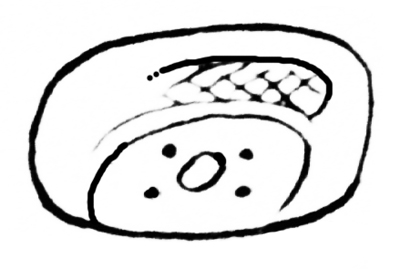
Back in 1996 I made notes about an interesting substitution set that pointed to a reading BIX for a logogram shown here, which makes an appearance in a few inscriptions from Yaxchilan, La Corona, Dos Pilas, Coba, as well as a few others. This value may well have been noted by others back around the same time, if not before, but I thought I would post my old hand-written note summarizing the evidence (having just now found them in an old notebook).
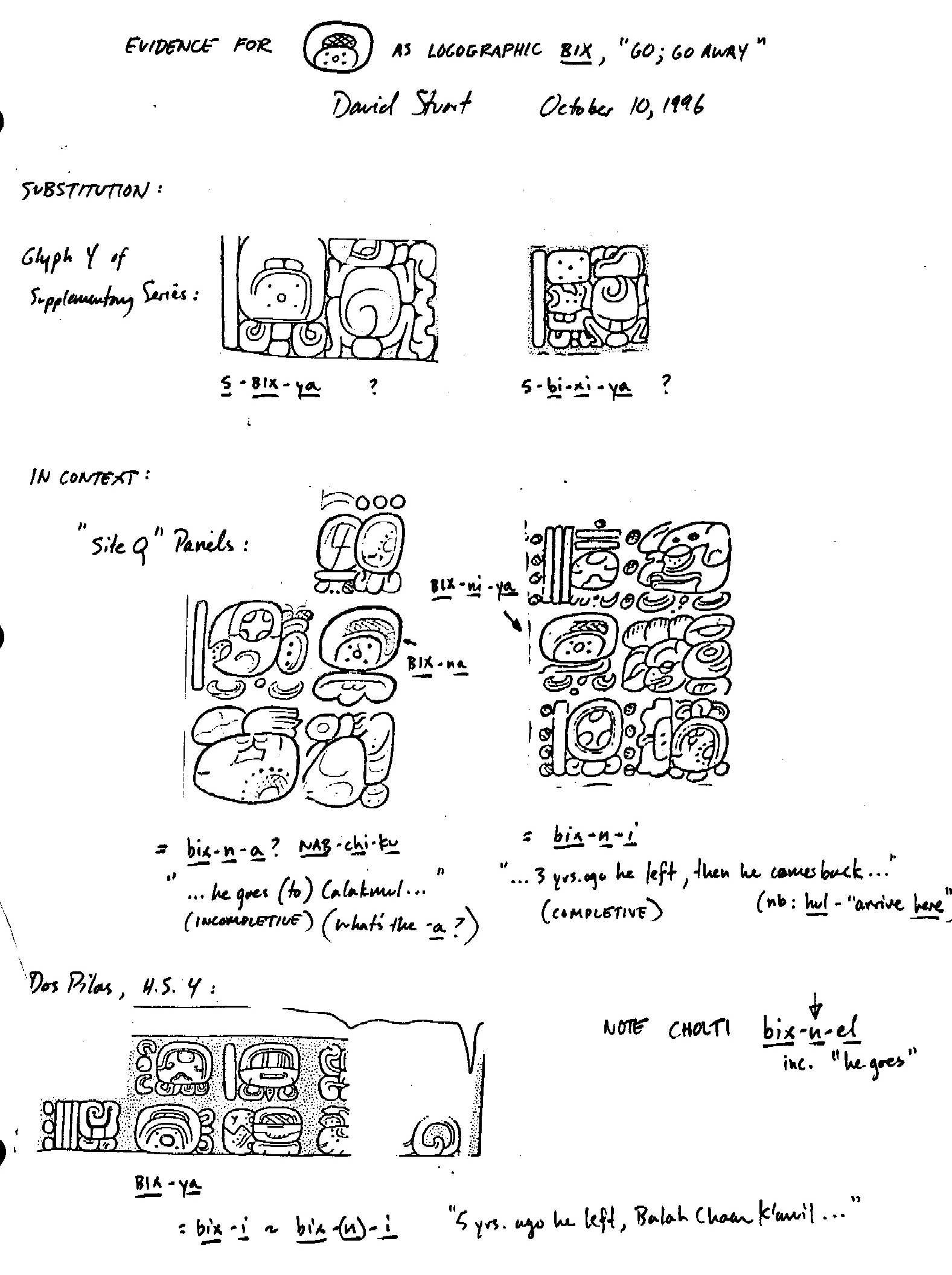
The sign was used to write the intransitive verb bix, “to go,” in a small variety of settings. This verb root can be traced historically to proto-Ch’olan *bix (Kaufman and Norman 1980) and in ancient texts it appears on Dos Pilas HS 4 (see page bottom) as BIX-ya, for bix-iiy, “he went” (in reference to the fleeing of the local ruler Bahlaj Chan K’awiil from Dos Pilas). Spelled BIX-ya or bi-xi-ya, the same verb was used in temporal expressions ho’ bix-iiy, “five days ago” or wuk bix-iiy, “seven days ago” (see top examples on page below). A variant form of this verb is bix-Vn, “to go, go away,” which appears in Colonial Ch’olti’ and in the glyphs as well. Several examples occur in the texts of La Corona (spelled BIX-na 0r, for the compl,tive, BIX-ni-ya), where they refer to the journeys of the young noble K’inich ? Yook from his home to Calakmul (Chihknahb). A related example turned up long after I wrote those original old notes, on Panel 1 from La Corona (at right), discovered in 2005 by Marcello Canuto. There we read bix-Vn chihknahb, “he goes to Chihknahb” (the same expression appears on Panel 2, but with a different date — see “Site Q” examples illustrated at the middle of the page).
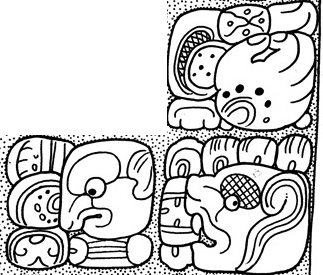
My favorite example of these “go” verbs comes from Altar de Sacrificios, where on Panel 2 we have bi-xi-ni-ya, for bix-Vn-iiy, “he went away.” Rather than referring to a journey in the real world, this is a citation of a local ruler’s death (cited in more conventional terms on Stela 4, an associated inscription).
I’m as yet unsure what if any semantic distinction existed between between the verbs bix and bix-Vn, and they may just be regional variants. The bix root is likely based on the noun *bih, “road,” and I find it interesting that this etymology is graphically reflected in the logogram sign itself, which incorporates an infixed BIH/bi element.
Here are my old scribbles on this stuff from 1996:


You must be logged in to post a comment.