Day Sign Notes: Men / Tz’ikin

by David Stuart 

The Classic-period names for the days of the tzolk’in  (cholq’ij) are often obscure to us. This is true even where we see clear semantic connections to the familiar names used in colonial Yucatan (the names we still use today in describing the ancient Maya calendar, by convention). Was the day “Kan” actually called K’an in Palenque in 750 CE, or was it something else? The problem comes down to the pervasive use of single logograms in writing the days, with only an occasional phonetic sign attached here and there to offer a partial clue about their pronunciations. An additional stumbling block involves the history of the day glyphs themselves. Their forms changed in sometimes surprising ways over nearly two thousand years, such that late variants bear little resemblance to how they were originally designed. Here and in subsequent studies of the Classic Maya days, I offer a few historical and paleographical observations, looking particularly at the origins and iconographic connections of certain signs. The day glyphs have a deep history, unsurprisingly, and even their earliest examples point to centuries of previous development, reaching far back into the Preclassic era. The recent suggestion that the 260-day calendar can be discerned from architectural plans and alignments dating to the Middle Preclassic (or Middle Formative) is a powerful testament to its antiquity (Šprajc et al. 2023). So here we will look at the “visual etymologies” of certain day signs to tease out clues about their origin, as well as about their important associations with Maya iconography. Even with new semantic clues in hand, the ancient names of the days will probably remain difficult to know, at least in many cases.

We begin our series of observations with the fifteenth day, named Men in ancient Yucatan. This was also the name of the fifteenth day in Ch’ol, as reported by Campbell (1988:375). The only plausible source for the name the root men, which in both Yukatekan and Cholan languages is “make, do,” and forms the basis of the Yukatek word hmeen (“a doer, maker”), best known as the title for a ritual specialist or curandero. When a possessed noun, men can form a phrase that signals causation, as is Yukatek u men, “por causa de” or tu menel, “porque.” The same appears in Ch’orti’ u mener, “por, de, a causa de” (Hull 2016: 278). In Ch’ol, the verb mel, “to do,” may be related. The co-occurrence of the day name Men and root men within both Yukatekan and Ch’olan might suggest that the day name was shared throughout much of the lowlands in ancient times, and perhaps during the Classic period. We will return to this point shortly.

In highland Mayan languages the corresponding name for the fifteenth day is Tz’ikin, equivalent to the proto-Mayan word *tz’ikin, “bird.” Here we see a link to the widespread names meaning “Eagle” in Nahuatl, Otomi, and other languages of highland Mexico (Caso 1967, Kaufman 1989). Based on these widespread name patterns, Kaufman suggested that Men was that of an “eagle god,” whose Mayan name associates “with ‘Bird’ in general, as though he were the protean bird.” I agree with his assessment and would add that the best evidence for an “eagle god” may come from the Men’s historical development as a hieroglyphic form.

Figure 1. Classic period variants of Men, (a-e) head variants arranged chronologically, (f-i) simplified forms possibly based on the eye of the head (compare b and f). Drawings by David Stuart.

Two Classic-period variants of Men, arranged over time, are illustrated in Figure 1. The head variants – what we must assume was its “original” form – appear in the upper row of Figure 1 (a-e). These have received little discussion in the epigraphic literature, and many drawings reproduced in various books and other publications look to be highly inaccurate (see, for example, Thompson 1950: Fig. 9, 36&39). These all show a profile head of what appears to be a supernatural bird, with a distinctive squared inner eye. The eye is one clear indication of its deified nature, as are the “shiner” markings we find on the forehead in Early Classic variants. An avian beak is sometimes hard to make out in these highly abstracted forms, but we see it clearly in a few late examples, as from Piedras Negras Panel 3 (example c). Even by the Early Classic the bird’s head was highly abstracted and conventionalized, probably due to calligraphic practice over time, going back to the Late Pre-Classic (examples a and b).

Figure 2. Principal Bird Deity and accompanying name from K4546. Note resemblance of the portrait head glyph to the Men day sign. Drawing by David Stuart

These head variants agree not only with Kaufman’s idea of a “bird god,” but they are identical to representations of the Principal Bird Deity (Bardawil 1979, Cortez 1986, Guernsey 2006, Martin 2015, Nielsen and Helmke 2015), possibly named Kokaj Muut or Yax Kokaj Muut (Boot 2008). The visual equivalence is demonstrated by the name glyph of an aspect of the Principal Bird Deity we find on a codex-style vessel, Kerr 4546, captioning the bird’s portrait nearby (Figure 2). This is a portrait name glyph, and other examples of the bird’s name show the Principal Bird Deity in a more familiar, less abstract way (Figure 2c, d). These are in turn equivalent to what we find in the codices as the name of the more anthropomorphic God D, the Principal Bird being his avian avatar. No other avian figure from Maya art or iconography displays such deified characteristics, so it is clear that the day sign Men originated in the Preclassic and Early Classic as the portrait of the Principal Bird Deity. It seems that the name of the fifteenth day in Postclassic Mesoamerica, whether “Eagle” or “Bird,” are generic reflection of this day’s more mythical origin and identity.

Figure 3. Names of the four bird deities in the four world quarters, from Tomb 12 at Rio Azul, Guatemala. Note visual equivalence to early Men day sign. Drawings by David Stuart.


Figure 4. Directional bird names from Tomb 12, Rio Azul, and incised obsidians from cache at Tikal.

In further support of this connection to the great mythic bird, we can turn to other examples of the Principal Bird Diety’s glyphic name. In Tomb 12 of Rio Azul, four similar deity names feature this same head sign, written on the tomb’s four walls and associated with one of the four quarters or world directions (Figure 3). As I and others have argued, these are names of the Principal Bird Deity, each with a different adjectival descriptor (day, night, moon, and star) (Taube, et al. 2010:52-56). Later examples of these same directional names confirm the visual connection to the Principal Bird Deity (Figure 4). This chronological evolution suggests that the Principal Bird Deity used as the Men Day sign often retained an “early look” throughout much of the Late Classic. There are examples of Men, however, that are more representative of the later bird deity heads we see in Figure 4 (see Naranjo, Stela 23 [F17] and Stela 28 [G18]).

A rarer and far simpler variant of the day Men also appears in Classic-era texts (Figure 1, f-i). I believe this to be an enlarged representation of the great bird’s eye, a pars pro toto form meant as a simplification of the head variant (compare examples b and f in Figure 1). It is also remotely possible that it originated as a highly abstracted form of the bird’s head in full (compare a and f). Other day signs show an eye as a simpler form of a complex head variant (Lamat, Chuen, and Ix, are three examples that come to mind, which we will discuss in later notes). The “eye” forms of Men show a squared inner “pupil,” identical to the eyes we see in early representations of celestial deities, such as K’inich Ajaw. Some Late Classic examples also display small dots in the upper portion of the sign (Figure 1, g-h). I suspect that this minor elaboration arose through the sign’s general resemblance to the distinct logogram TAHN (“within”) which displays the line of dots or a quincunx as a consistent feature.  That is to say, in writing the simplified Men day sign, scribes sometimes were inclined to incorporate the dots out of habit, not realizing the origin of the element as an eye. Here it is interesting to note that representations of deities’ eyes changed throughout the Classic period, with the squared pupil moving from the lower left to the upper left. Yet the reduced form of Men retained the early look, supporting the notion that some scribes used the reduced form of Men without realizing its true visual origin.

So, the visual origin of the Men bird was the Principal Bird Deity, the avian aspect of the old God D (and God N) who was perhaps named Kokaj or Yax Kokaj Mut (Boot 2008, Martin 2015). Here the word men may provide an interesting semantic connection, for as the root for the verb “to make” it resonates with the names of certain creator deities among the later contemporary Maya. (H)meen, the religious title of Yucatan, is also analyzable as “maker, creator,” apt descriptions for the celestial god who we otherwise know was a diviner, and scribe, aj tz’ihb. In one text at Xcalumkin, God D or his avian aspect is called an aj k’in, “day-keeper, diviner” — a clear indication of his role not unlike that of Cipactonal of central Mexico (see Martin 2015: 223-225). Whatever the case, the visual history tells us that the Principal Bird Deity was the core mythical basis for Men, not simply a bird or an eagle.
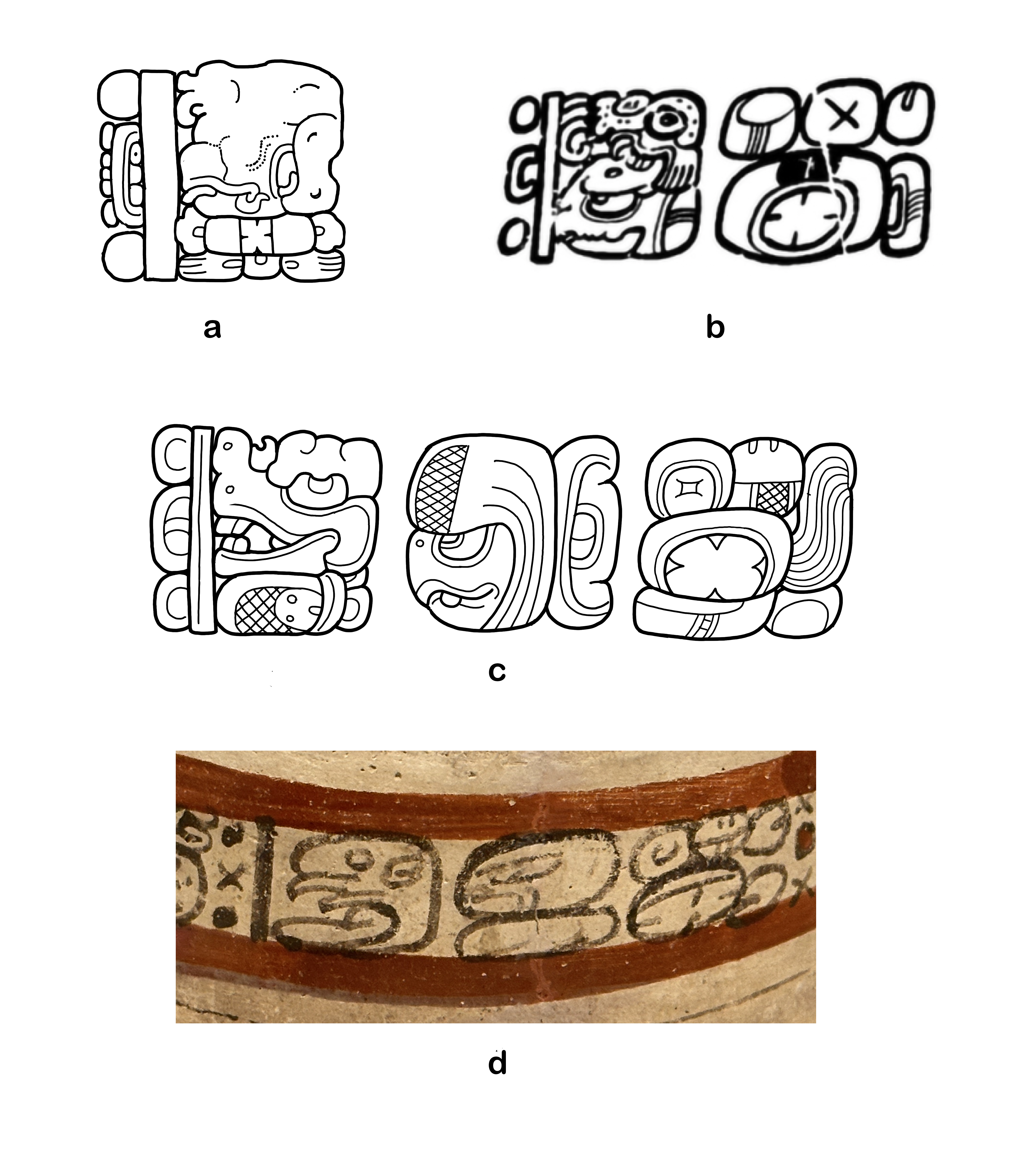
Figure 5. Expanded names of the avian solar god, Wuk Chapaht Men(?) K’inich Ajaw. (a) Tikal, T. IV, Lintel 2, (b) the Cuychen Vase, rim text, (c) Copan, Altar of Stela 13, (d) Terminal Classic vessel in LACMA collections. Drawings a and c by David Stuart, drawing b by Christophe Helmke.

Outside of the context of the day, the same avian head appears as a part of the expanded name phrase of the solar god, K’inich Ajaw (Figure 5). Clearly, the Principal Bird Deity, or an aspect of it, was considered a solar being, a precedent for the Postclassic Mexican idea of the solar eagle. The name phrase is introduced by Uuk Chapaht (“Seven Centipede”), followed by our Men bird (or its reduced form) and then K’inich Ajaw. Semantically we can interpret this as “Seven-Centipede-BIRD.DEITY-Sun Lord.” Whereas I had previously considered TZ’IKIN as a possible reading of the bird logogram, this now seems unlikely. Tellingly, the noun tz’ikin, “bird,” while very old and traceable to proto-Mayan, is nowhere to be found in lowland languages. The day name Tz’ikin is restricted to the highlands as well (in both Eastern and Western Mayan), where it may well have been borrowed across languages and communities.  To reiterate, the attested name in both Yucatec and Ch’ol was Men. We might therefore entertain MEN or some cognate form as an alternate reading, both as a day name and as a logogram. The -na suffix on the head would conceivably agree with this, appearing on examples from the altar of Copan Stela 13, and a Terminal Classic polychrome vessel in the collections of LACMA (M.2010.115.685) (Figure 5c, d). So, while tentative, I believe we can entertain an analysis of the solar god’s full name as Wuk Chapaht Men(?) K’inich Ajaw. I should emphasize that a MEN reading and still needs to be tested outside the context of the tzolk’in.

Figure 6. Postclassic examples of Men from the Dresden Codex, Madrid Codex, and the murals of Coba. Drawings by David Stuart
Finally, we should turn to the very late forms of Men found in the codices (Figure 6). These are consistent in presenting a profile face with a series of parallel lines behind its mouth.  All are derived from the earlier reduced Classic variant where the face is not present (see Figure 1, f-i). I suspect that the eye had already been in long use in manuscripts as a more calligraphic form of the day and that this carried over into the manuscript tradition of the Postclassic. By then, scribes had fully lost any sense of its true visual origin, misinterpreting the eye as a human-like face, taking the small square at the lower left as a mouth, and the small dots above as “eyes” (the dots, we will recall, may have arisen out of yet another mistaken evocation of the TAHN logogram). No attempt was ever made to make it resemble a bird. It seems that the original head variant representing the Principal Bird Deity did not survive at all past the collapse of the Classic period. A visual summary of this proposed development, covering over a thousand years, is shown in Figure 7.

Figure 7. The development of Men. First, a portrait of Principal Bird Deity (Classic), then reduced to its eye as a simplified variant (Classic), then reinterpreted as a head (Postclassic)

Ancient misinterpretations of the Men’s visuals have led to at least one erroneous interpretation of the day’s meaning. In his lengthy discussion of the day signs Thompson (1950:82-84) was confident that it was “the day of the aged patroness of weaving (and) the aged moon goddess.” He was surely mistaken in this, however, basing his ideas only on the late forms of Men as found in the codices. Thompson’s take reflected a common methodological bias of his time when relatively few early Maya inscriptions were known. The early variants were unknown to him, as was the Principal Bird Deity itself.

Spanning over two millennia, the histories of the day signs are full of similar evolutionary twists and visual turns. Late forms often bear little resemblance to their Preclassic originals, which perhaps isn’t too surprising. Indeed, the signs of the tzolk’in often seem as if they operated within their particular ecosystem, set apart somewhat from the many other elements of the script. Tracking of similar paleographical sign histories remains an under-appreciated aspect of Maya epigraphy, in my view, and we will explore similar sign histories in future “Day Sign Notes.” To anticipate where some of these analyses will go, I feel confident in saying that the mundane-sounding names found in later Mesoamerican calendars – such as “Bird” or “Monkey” – can often obscure far older meanings rooted in Maya mythological identities. Likewise, Men was no generic “Eagle,” as the day was dubbed in Postclassic central Mexico. Being Maya in origin, it was first and foremost the Principal Bird Deity, a celestial and solar symbol par excellence. I suspect that each day of the tzolk’in had, in the Preclassic, its own specific iconographic identity as a deity. These are at times only dimly perceptible in later language and scribal usage, but they can still be accessed through the day signs’ visual histories, and the vestiges of meaning they convey.

References Cited

Bardawil, Laurence W. 1976. The Principal Bird Deity in Maya Art – An Iconogrpahic Study of Form and Meaning. In The Art, Iconography and Dynastic History of Palenque, Part III: Proceedings of the Segunda Mesa Redonda de Palenque, edited by Merle Greene Robertson, pp. 195-209. Robert Louis Stevenson School, Pebble Beach.

Bassie-Sweet, Karen. 2008 Maya Sacred Geography and the Creator Deities. University of Oklahoma Press, Norman.

Boot, Erik. 2008. At the Court of Itzam Nah Yax Kokaj Muut: Preliminary Iconographic and Epigraphic Analysis of a Late Classic Vessel. Online article. http://www.mayavase.com/God-D-Court-Vessel.pdf

Campbell, Lyle. 1988. The Linguistics of Southeast Chiapas, Mexico. New World Archaeological Foundation, Brigham Young University. Provo, UT.

Caso, Alfonso. 1967. Los Calendarios Prehispanicos. UNAM, Mexico.

Cortez, Constance. 1986. The Principal Cird Deity in Preclassic and Early Classic Maya Art. MA Thesis, Department of Art and Art History, University of Texas at Austin, Austin, TX.

Guernsey, Julia. 2006. Ritual and Power in Stone: The Performance of Rulership in Mesoamerican Izapan Style Art. University of Texas Press, Austin.

Hull, Kerry. 2016. A Dictionary of Ch’orti’ Mayan-Spanish-English. University of Utah Press, Salt Lake City.

Kaufman, Terry. 1989. The Mesomerican Calendar: The Day Names. Unpublished manuscript in author’s possession.

Martin, Simon. 2015. The Old Man of the Maya Universe: A Unitary Dimension to Ancient Maya Religion. In Maya Archaeology 3, edited by C. Golden, S. Houston and J. Skidmore, pp. 186-227. Precolumbia Mesoweb Press, San Francisco.

Nielsen, Jesper, and Chrisophe Helmke. 2015. The Fall of the Great Celestial Bird: A Master Myth in Early Classic Central Mexico. Ancient America 13. Boundary End Archaeological Research Center and Mesoamerica Center, UT Austin. Barnardsivlle, NC.

Šprajc, Ivan, Takeshi Inomata, and Anthony Aveni. Origins of Mesoamerican astronomy and calendar: Evidence from the Olmec and Maya regions. Science Advances 9eabq7675(2023).DOI:10.1126/sciadv.abq7675

Taube, Karl, William Saturno, David Stuart, and Heather Hurst. 2010. The Murals of San Bartolo, El Peten, Guatemala. Part 2: The West Wall. Ancient America 10. Boundary End Archaeology Research Center, Barnardsville, NC.

Thompson, J. Eric S. 1950. Maya Hieroglyphic Writing: An Introduction. Carnegie Institution of Washington, Washington. D.C.
Design Transfer and the Classic Maya

Stephen Houston (Brown University)

Printing designs on textiles goes far back in time. An example at the Hunan Provincial Museum in China dates to the Western Han dynasty in the 2nd century BC. Likely produced by stencil, it reveals the ease of reproducing designs in this way but also the need, in places, for hand-coloring and fussy adjustment. More than just hastening the process, it yields a pleasing consistency, an orderly repetition of pattern. But it was seldom the act of one person.

Think of a Japanese print, be it an ukiyo-e (Edo-period) or shin-hanga (Meiji and post-Meiji Japan). Despite many museum labels, The Great Wave off Kanagawa, by Hokusai, was not literally by his hand. Hokusai made the original drawing, which was destroyed when a carver attached it to a board and set to work, highlighting the original inkwork while shaving down the background. Another person, a printer, then created what we see today, building on the help of assistants of varying status, in a production supervised by a publisher who took most of the profit (Salter 2002:11, 37, 60, 64).[1] Such complexities must also have entered into textile printing at the time of Hokusai, and earlier still in China and India (Riello 2010:8-9).  

The question is, did block-printing or, more broadly, design transfer occur among the ancient Maya? Evidence of a direct sort is poor. Bark cloth, which must have been abundant, judging from implements to make it, is almost impossible to find archaeologically, although it is well-attested among groups such as the Lacandon of Chiapas, Mexico (Moholy-Nagy 2003:figs. 101-105; Soustelle 1937:60-62, pls. ID, VA, VIC; Tozzer 1907:fig. 1, 129; see also Tolstoy 1963). For their part, early Maya textiles are only preserved under exceptional circumstances. They might occur in water-logged deposits, well-aerated caves, or endure by contact with metal or as decayed impressions visible on other objects (e.g., Johnson 1954; Lothrop 1992; Morehart et al. 2004; Ordoñez 2015). This means that Maya textiles survive in limited samples, although they are frequently depicted in ways that reflect their cut, color, and kind of weave (e.g., Halperin 2016). The quantities of such cloth must have been staggering, and not just for dress, costume or sacrificial offerings. Renderings of textiles on walls at Xelha, Quintana Roo, and suspension holes for cloth at Palenque, Chiapas, point to the wide use of such materials as changeable wall hangings (Anderson 1985; Ruiz Gallut 2001:lám. 13). When exposed, such textiles could not have lasted long. Soon mildewed, soggy, and faded, they would need replacement on a regular basis.

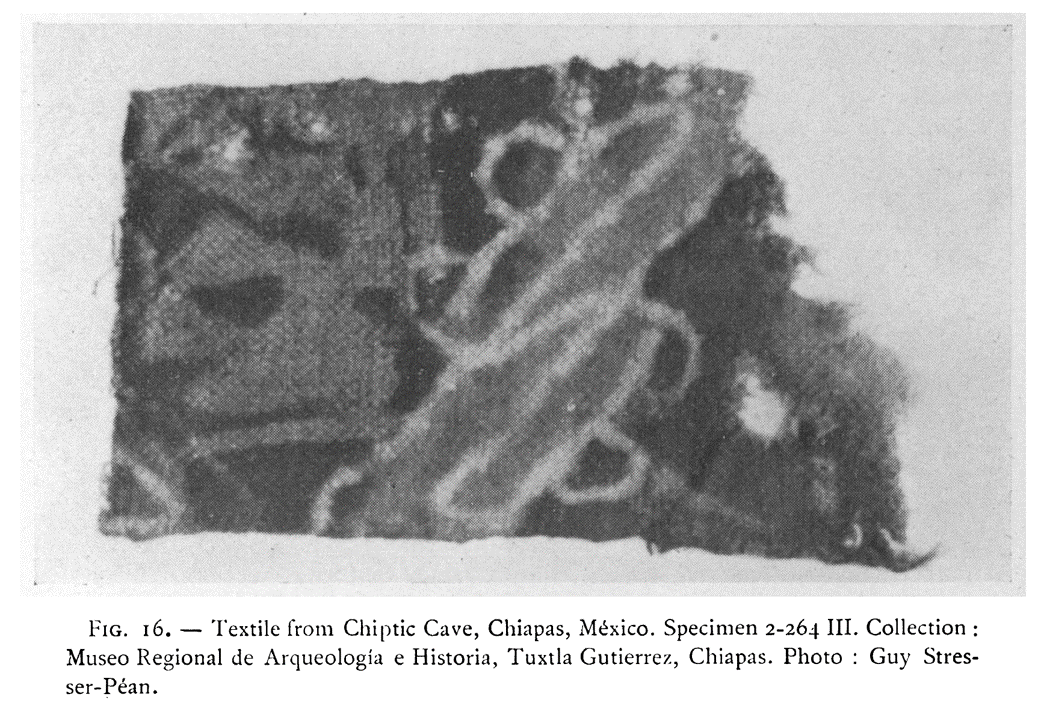
The direct and indirect evidence is that textile threads were colored with dyes, and, as added decoration, when weaving was finished, with freehand and resist painting, a technique attested in cave finds from Chiapas, Mexico (Figure 1, Johnson 1954:fig. 16; see also Filloy Nadal 2017:36). There is no question that the Classic Maya painted textiles and, in a few instances, tagged the calligraphers or the owners of clothing….if in coy ways that never identified such people. Names curl out of view or hide behind other items of dress (see Miller and Brittenham 2012:230, 233 [Captions I-5B, I-5C, I-49B]; Tokovinine 2012:70-71, figs. 32-33; note that such labels probably marked garments passing through tributary networks).

Figure 1. Textile from Chiptic Cave, Chiapas, Mexico, with use of resist paint (Johnston 1954:fig. 16).


There is a paradox, however. Surviving textiles and images show few clear signs of block-printing and its tidy repetitions. Yet there are archaeological objects, all of rugged or durable ceramic, that must have been used for printing or stamping.[2] Several are cylinders, with step-fret designs that are common on textiles and well-suited to the warp-weft constraints of weaving. Such cylinders extend deeply into the Mesoamerican past (Field 1967:22-38). That these cylinders were used in body painting seems improbable. If charged with pigment, they would have left messy or indistinct patterns with their expansive fields of color, and the designs on the cylinders are step-fret or of fragrant blossoms attested on other textiles (e.g., Filloy Nadal 2017:fig. 34). In any case, all images of body painting involve brushes (e.g., K1491, K4022).

Three cylinders occur in the probable tomb of a princess or queen at the site of Buenavista del Cayo, Belize; the tagged weaving bones in that burial hint that such designs might also have been rolled over textiles created by high-ranking women (Figure 2, Ball and Taschek 2018:485-487, fig. 14; see also Moholy Nagy 2008:fig. 219l).

Figure 2. Ceramic roller-stamps, Burial BV88-B13; note that each design could also be applied in inverted orientation (drawings by Jennifer Taschek, in Ball and Taschek 2018:fig. 14).


Others were flat stamps that, more than the cylinders, would have been ill-suited for use on human bodies. A large set was discovered in Tomb 6, a royal burial in Structure II, Calakmul, Mexico (Figure 3, Carrasco Vargas 1999:31). With their figuration, the Calakmul examples are anomalous in comparison to other stamps, a hint of varied, more narrative or setting-oriented imagery on stamped materials. As at Buenavista del Cayo, this less well-reported tomb contained weaving bones and was said unequivocally to hold the remains of woman, perhaps the spouse of the ruler. These finds of weaving implements and stamps, flat or cylindrical, suggest that stamping was a gendered activity among the Classic Maya. Its tools were linked to the process of finishing textiles, and large areas of cloth or barkpaper could be decorated with both speed and care. Nonetheless, as in Japan and elsewhere, more than one person presumably wove, made stamps, concocted pigments, and pressed them onto textiles. The volume of production and need for varying expertise may have demanded it…and an elite or royal lady would not have operated without servants. There is also a suspicion, challenging to prove, that the stamps at Calakmul and at other sites formed part of a much larger inventory during the Classic period. In India, at least historically, most stamps or blocks were of wood, and these would have disappeared long ago in the Maya Lowlands (Lewis 1924:1-2; see [2]).

Figure 3. Flat stamps with water lily creature, hummingbirds over cavity, Venus sign, spirals, and full-frontal images of Teotihuacan-style warrior; from possible burial of royal woman, Tomb 6, Structure II, Calakmul, Campeche; on display, Museo Arqueológico, Fuerte de San Miguel, Campeche, Mexico (photograph by Stephen Houston).


A unique illustration of direct transfer exists in the collection of the Museo Regional de Yucatán, Palacio Cantón (Figure 4); see Mediateca INAH, CC BY-NC). It has no provenience but appears to be a slateware, possibly Muna or Dzitas Slate, the latter associated with Chichen Itza, Yucatan–the dish would need closer study to establish its precise affiliation (George Bey, personal communication, 2023). The central element is a sign for k’in, “sun,” but also, more telling here, for NIK[TE’] or NICH[TE’], “flower.” An extraordinary touch is that the interior rim has a series of designs in which, not a brush, but a flower has been dipped in ink and repeatedly pressed into the surface. The flower itself is difficult to identity yet could relate to the Asteraceae family of plants (Shanti Morell-Hart, personal communication, 2023). The double reference in image and mode of decoration is likely to be deliberate. Perhaps this flowery ceramic was intended to contain flowers, as seen in one mythic scene with an anthropomorphic hummingbird and a youthful God D (K8008). The repeated design itself might have triggered a synesthetic sense of fragrance. The flower on the dish served as its own instrument of depiction; the central glyph nailed the floral reference and standardized it into canonical form.

Figure 4. Painting with flowers on a dish, Museo Regional de Yucatán, Palacio Cantón, Mérida. Mediateca INAH, CC BY-NC.


Whether this object has any parallels remains unclear. There are two images that show scribal gods dipping (or having dipped) an undulating, near-vegetal “brush” into a conch inkwell (Figure 5). They cannot be conventional brushes but do open unexpected possiblities for the toolkit of Maya painters.

Figure 5. Two scribal deities dipping or flourishing near-vegetal “brushes” (images from Justin Kerr Maya archive, Dumbarton Oaks, Trustees for Harvard University, Washington, DC, CC BY-SA 4.0).


Acknowledgments   My new colleague at Brown, Shanti Morell-Hart, assisted with the flower identifcation, and George Bey and William Ringle helped to type and possibly date the plate in the Palacio Cantón, Mérida. Joanne Baron kindly forwarded a high-resolution image of a Kerr photograph.


[1] An exception would be the sōsaku-hanga (“creative-prints”) of the early 20th century in Japan. These were painted, carved, and printed by a single artist, often inflected by Western art and its focus on individual production (Binnie 2013:65).

[2] These were probably not the only such blocks. As in India, examples in wood may have been far more numerous (Lewis 1924:1-2).

References

Anderson, Michael. 1985. Curtain Holes in the Standing Architecture of Palenque. In Fourth Palenque Round Table, 1980, edited by Elizabeth P. Benson, pp. 21-27. San Francisco: Pre-Columbian Art Institute.

Ball, Joseph W., and Jennifer T. Taschek. 2018. Aftermath A.D. 696—Late 7th and Early 8th Century Special Deposits and Elite Main Plaza Burials at Buenavista del Cayo, Western Belize: A Study in Classic Maya “Historical Archaeology.”Journal of Field Archaeology 43(6):472-491.

Binnie, Paul. 2013. The Legacy of Shin Hanga, by an Artist Working in the Tradition. In Fresh Impressions: Early Modern Japanese Prints, by Carolyn M. Putney, Kendall H. Brown, Koyama Shūko, and Paul Binnie, pp. 64-73. Toledo: Toledo Museum of Art.

Carrasco Vargas, Ramón. 1999. Tumbas reales de Calakmul. Ritos funerarios y estructura de poder. Arqueología Mexicana 7(40):28-31.

Field, Frederick V. 1967. Thoughts on the Meaning and Use of Pre-Hispanic Mexican Sellos. Studies in Pre-Columbian Art and Archaeology 3. Washington, DC: Dumbarton Oaks.

Filloy Nadal, Laura. 2017. Mesoamerican Archaeological Textiles: An Overview of Materials, Techniques, and Contexts. In PreColumbian Textile Conference VII / Jornadas de Textiles PreColombinos VII, edited by Lena Bjerregaard and Ann Peters, pp. 7–39. Lincoln: Zea Books.

Halperin, Christina. 2016. Textile Techné: Classic Maya Translucent Cloth and the Making of Value. In Making Value, Making Meaning: Techné in the Pre-Columbian World, edited by Cathy Coastin, pp. 431-463. Washington, DC: Dumbarton Oaks Research Library and Collection.

Johnson, Irmgard Weitlaner. 1954. Chiptic Cave Textiles from Chiapas, México. Journal de La Société Des Américanistes 43: 137–47.

Lewis, Albert B. 1924. Block Prints from India for Textiles. Anthropology Design Series 1. Chicago: Field Museum of Natural History.

Lothrop, Joyce M. 1992. Textiles. In Artifacts from the Cenote of Sacrifice, Chichen Itza, Yucatan, edited by Clemency C. Coggins, pp. 33-90. Memoirs, 10(3). Cambridge, MA: Peabody Museum of Archaeology and Ethnology, Harvard University.

Miller, Mary, and Claudia Brittenham. 2013. The Spectacle of the Late Maya Court: Reflections on the Murals of Bonampak. Austin: University of Texas Press; Mexico City: INAH and CONACULTA.

Moholy-Nagy, Hattula. 2003. The Artifacts of Tikal: Utilitarian Artifacts and Unworked Material. Tikal Reports 27B. Philadelphia: University Museum of Archaeology and Anthropology, University of Pennsylvania.

Moholy-Nagy, Hattula, with William R. Coe. 2008. The Artifacts of Tikal: Ornamental and Ceremonial Artifacts and Unworked Material. Tikal Reports 27A. Philadelphia: University Museum of Archaeology and Anthropology, University of Pennsylvania.

Morehart, Christopher T., Jaime J. Awe, Michael J. Mirro, Vanessa A. Owen, and Christophe G. Helmke. 2004. Ancient Textile Remains from Barton Creek Cave, Cayo District, Belize. Mexicon 26(3):5054.

Ordoñez, Margaret T. 2015. Appendix V: Textiles. In Temple of the Night Sun: A Royal Maya Tomb at El Diablo, Guatemala, by Stephen Houston, Sarah Newman, Edwin Román, and Thomas Garrixon, pp. 258-262. San Francisco: Precolumbia Mesoweb Press, San Francisco.

Riello, Giorgio. 2010. Asian Knowledge and the Development of Calico Printing in Europe in the Seventeenth and Eighteenth Centuries. Journal of Global History 5:1-28.

Ruiz Gallut, María Elena. 2001. Entre formas, astros y colores: aspectos de la astronomía y la pintura mural en sitios del área maya. In La Pintura Mural Prehispánica en México, II Área Maya, Tomo III, Estudios, edited by Leticia Staines Cicero, pp. 283-293. Mexico City: Instituto de Investigaciones Estéticas, Universidad Nacional Autónoma de México.

Salter, Rebecca. 2002. Japanese Woodblock Printing. Honolulu: University of Hawaii Press.

Soustelle, Jacques. 1937. La culture matérielle des Indiens Lacandons. Journal de la Société des Américanistes 29(1):1–95.

Tokovinine, Alexandre. 2012. Carved Panel. In Pre-Columbian Art at Dumbarton Oaks, Number 4: Ancient Maya Art at Dumbarton Oaks, edited by Joanne Pillsbury, Miriam Doutriaux, Reiko Ishihara-Brito, and Alexandre Tokovinine, pp. 68–73. Washington, DC: Dumbarton Oaks Research Library and Collection.

Tolstoy, Paul. 1963. Cultural Parallels between Southeast Asia and Mesoamerica in the Manufacture of Bark-cloth. Transactions of the New York Academy of Sciences 25:646–662.

Tozzer, Alred M. 1907. A Comparative Study of the Mayas and the Lacandones. New York: Macmillan Co.

A New Variant of the Syllable k’o in Maya Writing

by David Stuart (The University of Texas at Austin)

ko-sign
Figure 1. A new variant of the k’o syllable

This brief note presents evidence for the decipherment of Maya hieroglyphic sign syllable k’o in Maya hieroglyphic writing (Figure 1). While not a common element of the script, it has enough appearances and varied contexts to allow for a number of significant new textual readings and understandings, some of them touched upon here. Seeing this sign as a CV syllable represents a change of heart in my own thinking regarding the sign’s function, which earlier I had assumed to be a logogram of unknown value (Stuart 2012). Its syllabic function now seems clear however, based on substitution patterns and in light of the discovery of Altar 5 from La Corona, where it appears in a previously unknown verb spelling that strongly indicates a k’o value (Stuart, Canuto, Barrientos and Gonzalez 2018).

First a word on the sign’s graphic form. At first glance it appears to be composed of two elements and in fact Thompson, in his well-known sign catalog (1963), designated its components as two separate signs: T174:530. However, from its varied contexts it is clear that that it is a single element whose form varies little of the course of several centuries. The sign appears in both Early and Late Classic contexts, and as far as I am aware it does not appear in the codices. Its graphic or iconic origin is difficult to discern, but it seems to reflect a “stony” substance, given the common “cauac” markings on both lower and upper part. It is important to distinguish the sign under consideration from the similar combination of T174:528, where the lower part is the standard “cauac.” The upper element (T174) appears in a variety of other signs, including the logogram SIBIK (“ink, soot, charcoal”) proposed long ago by Nikolai Grube, and in the sign representing ink within a shell inkpot, possibly the syllable t’o (Zender 2004:260).

k'oFig2new
Figure 2. The “fist” variant of k’o. (a) stand alone example, (b) in a spelling of the name a-po-k’o chi-hi (Aj Pok’ Chih), K5722, (drawing by D. Stuart) (c) in yo-k’o-lo, Copan, Str. 9N-82 bench (drawing by B. Fash) (d) in the name YAX-k’o-jo a-AHK (Yax K’oj Ahk), Chancala-area panel (Drawing by C. Prager)

The sign in question is not the first k’o syllable identified in Maya writing. Another k’o representing a closed hand or fist was proposed a number of years ago by Linda Schele (Figure 2a). Her reasoning was based on the sign’s appearance with -jo in contexts that suggested the reading k’oj, “mask,” including the spelling of the personal name YAX-k’o-jo a-ku, Yax K’oj Ahk, which I would translate as “Green Mask Turtle” (Schele 1992:122-123) (Figure 3c) (Schele at the time advocated for a mythical role of this name, whereas I prefer to see it as a historical personage, associated with the court near Chancala, Chiapas). Her identification of the fist variant of k’o came to be widely accepted, especially in light of its consistent appearance with other Co value signs (Figure 2b-d). This sign is perhaps best known in the spellings k’o-ba or k’o-jo-ba that appear as part of the so-called “era expression,” a standardized sequence of terms usually associated with the supposed start date of the Long Count, 13.0.0.0.0 4 Ahau 8 Cumku (Figure 3).  There has long been a temptation to see these pointing to the root k’ob found in the Yucatecan word for “hearth,” k’óoben, but such an analysis seems unlikely, as it is cognate to an original root k’uub found in Eastern Mayan languages (see Kaufman and Justeson 2003: 438). As we will see, its range of contexts and the occasional inclusion of jo suggest a more likely connection to the root k’oj or k’oh and related words for “mask, image,” as in the spellings first noted by Schele. 

k'oFig3new
Figure 3. The “fist” k’o syllable in possible spellings of k’o(h)ob or k’ojob, “mask, image”. (a) Quirigua, St. C, (b) Copan, CPN 19469. (Drawings by D. Stuart)

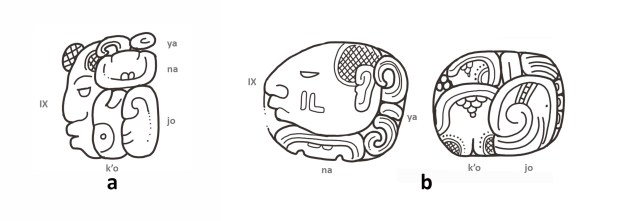
As shown in Figure 4a below, this hand variant of k’o appears in a woman’s name on Tortuguero Monument 8 (Figure 4a), spelled IX-ya-na-k’o-jo, perhaps Ix Yan K’oj (the fist is oriented differently, but this is a known pattern of variation of k’o signs at nearby Palenque). In an alternate version of the name on Monument 6, the fist looks to be replaced by T174:530 (Figure 4b). These appear in parentage expressions for the  local ruler Bahlam Ajaw (see Gronemeyer 2004), so there can be little doubt they refer to his mother, as alternate spellings of the same name. In the case of Monument 6 (Figure 4b), the form of the final jo sign first identified by Houston (1988) appears more elaborate than what we usually see, with the addition small u-shaped nubbins to one side and a “ma”-like element above. I believe that these are features of the jo sign’s original and unabbreviated form. Figure 5 shows a range of jo forms over time. Working from the idea that the final element in the name on Monument 6 is jo, I then considered the possibility that T174:130 might be an alternate version of k’o.

k'Fig4
Figure 4. Comparison of two female names at Tortuguero, both perhaps read Ix Yan K’oj. (a) Mon. 8, (b) Mon. 6. (Drawings by D. Stuart)
k'oFig5
Figure 5. Four examples of the jo syllable arranged chronologically, showing their graphic range. (a) Tortuguero, Mon. 6, (b) Piedras Negras, Pan. 2, (c) Copan, CPN 19469 (disc altar), (d) Dresden 6b. (Drawings by D. Stuart)

A similar substitution also appears in spellings of a term found on several small stones that evidently served as censer stands or pedestals. These appear to be based on the same “image, mask” term noted above k’ojob ~ k’o(h)ob), where we see the “fist” k’o alternating with the new form under discussion here (Figure 6). The spellings are either U-k’o-ba li, possibly for u k’o(h)ob-il,”the image of…,” or the slightly more elaborated U-k’o-ba-TUUN-li, for u k’o(h)ob tuun-il, “the image-stone of…”.  This agrees with Schele’s early ideas on k’o-ba or k’o-jo-ba in other contexts. K’ojob or k’o(h)ob are based on the noun root k’oj or k’oh, “mask, image” (note Chontal k’oh-op, “mask”), and they are fitting terms of reference for these small stone pedestals carved with personal portraits. I suspect these sculptures may have served as the bases for ceramic effigies or burners. At Palenque, these inscribed censer stands assume a more elaborate form as upright, three-dimensional heads (Figure 6c), stone versions of the massive ceramic stands found throughout the Cross Group and elsewhere (Cuevas García 2008).  It seems reasonable to suppose that, at Palenque at least, a k’o(h)ob tuun is a stone version of a k’o(h)ob, an “image” or “mask” that would refer to the ceramic forms of such portraits.

k'oFig6
Figure 6. Small “image stones,” possibly called k’o(h)ob or k’o(h)ob tuun. (a) La Joyanca disc altar (drawings by M. Forné and D. Stuart), (b) Edzna, Hieroglyphic Altar 1 (drawing and photo by C. Pallán), (c) Palenque, stone censer stand (drawing by D. Stuart, photo by L. Schele)
k'oFig8
Figure 7. The text of Altar 5 from La Corona, with the verb k’otoy in Block 9. (Drawing by D. Stuart)

Taken together, the evidence suggests a value of k’o for the single sign T174:130, and its appearance on Altar 5 of La Corona, in a previously unknown spelling, adds what I take to be a final confirmation (Stuart, et. al. 2018) (Figure 7). This verb appears at block 9, a CVC-Vy intransitive spelled ?-to-yi, where the initial sign is T174:530. We can assume, on the basis of synharmony, that we have a verb with the shape Cot-oy, indicating that the first sign is syllabic Co. As far as I can determine there is really only one attested intransitive root in Ch’olan languages that fits this pattern: k’ot, as in Ch’orti’ k’otoy, “to arrive (there)”. What immediately follows in the second part of block 9 ought to be a place name, and it seems to be written with the skeletal head variant of BAAK before TUUN-li. I’m guessing this is a name for a place where a local lord named Chak Tok Ich’aak journeyed to celebrate the Period Ending. The narrative here is highly unusual, but it seems to fit the well-known pattern we see in later La Corona texts, where local lords are often on the move to other locales.

lok'oy
Figure 8. (a) Spelling of lo-k’o-yi on a vase from Uaxactun, (b) a standard logographic form LOK’-yi from Dos Pilas, HS 2 (drawing and photo by D. Stuart)

The k’o reading is further strengthened by its appearance in yet another spelling of another distinctive –Vy verb, this time on a lidded tripod excavated long ago in Burial A19 of Uaxactun (Smith 1955:fig.8j) ceramic report (Figure 8a). This looks to be lo-k’o-yi, as a fully syllabic version of the familiar verb lok’oy, “he leaves, exits,” that is otherwise spelled as a logogram despicting a snake emerging from a hole (Figure 8b). The context of the verb makes it difficult to confirm its semantic role, but the syllabic combination is nonetheless highly suggestive, lok’-oy being one of the very view possible correlates. 

yahk'ol
Figure 9. ya-k’o-ka, y-ahk’ol, “above, on top of.” (Drawing by D. Stuart)

One common setting for this new k’o syllable is in the glyph that I had previously analyzed as a noun meaning something like “effigy,” even though its phonetic reading was then unclear (Figure 9). Its uses at Palenque, Copan and Quirigua suggested that it refers to an object that is venerated, associated with deceased rulers or patron deities — what I called a “commemorative thing.” It was in this environment that I originally supposed that T174:130 functioned as a logogram, but I was mistaken in retrospect. As Stephen Houston has pointed out to me, if we analyze this grouping of signs as ya-k’o-la, we may well have the possessed noun y-ahk’ol, which we know is a relational noun for “above” or “on top of” in lowland languages (pCh *ahk’ol, Yuk *ok’ol).  In the main inscription on Copan’s Altar Q, y-ahk’ol appears before the name of the dynastic founder, K’inich Yax K’uk’ Mo’. Here it seems that the dedication of an object (perhaps of a K’awiil effigy?) occurred “above” the deceased king — an apt physical description of the altar’s placement before Structure 16, atop Copan’s deep architectural stratigraphy, on the general axis point of the Hunal tomb where the founder was buried. Houston and I are presently completing an article that explores the important spatial aspects of the term ahk’ol, and its archaeological implications at Copan, Quirigua and elsewhere (Stuart and Houston, n.d.).

k'oFig10
Figure 10. The raising of the headband “atop” the Triad deities of Palenque. From the Middle Tablet of the Temple of the Inscriptions (Drawing by D. Stuart).

In the tablets of Palenque’s Temple of the Inscriptions, this same term occurs in passages pertaining to the dressing and bejeweling of the three local patron deities known as the Palenque Triad (Macri 1990). There the ya-k’o-la glyph occurs as part of a repeating phrase u k’alhu’n yahk’ol…, “(it is) the paper (headband)-raising above…,” followed by the names of the Triad gods. This would seem to be in reference to the ritual adornment of gods or god-effigies with hu’n paper-cloth, perhaps headbands or headdress streamers much like those attested in the presentation of Aztec deity images. 

Conclusions

This informal note provides a quick outline of the evidence behind the new k’o variant. I believe it emerges from the varied settings as a firm reading, forcing me to change my earlier thinking on the sign’s possible role as a logogram.  One question that remains is whether this k’o syllable can be reduced to T174 by itself. I suspect this may prove to be the case, but I have yet to come across a definitive example. Also, there are a few other contexts of this k’o sign at Copan, Holmul, and other sites that remain to be fully analyzed and explained, and these may await further discussion in Maya Decipherment

Acknowledgements

I thank Tomás Barrientos, Dimitri Beliaev, Marcello Canuto, Stephen Houston, Simon Martin and Marc Zender for their help in the research leading up to this note.

References Cited

Cuevas García, Martha. 2008. Los incensarios efigie de Palenque. Mexico, D.F.: UNAM and INAH.

Houston, Stephen D. 1988. The Phonetic Decipherment of Mayan Glyphs. Antiquity, 62(234), 126-135.

Gronemeyer, Sven. 2006. The Maya site of Tortuguero, Tabasco, Mexico: Its History and Inscriptions. Acta Mesoamericana vol. 17. Markt Schwaben, Germany: Verlag Anton Saurwein.

Macri, Martha. 1990. Prepositions and complementizers in the Classic Period inscriptions. In Sixth Palenque Round Table 1986, ed. by V. Fields, pp. 266-272 (Merle Greene Robertson, series editor). Norman: University of 0klahoma Press.

Schele, Linda. 1992. Workbook for the XVIth Maya Hieroglyphic workshop at Texas, March 14-14, 1992. Department of Art and Art History and the Institute for Latin American Studies, The University of Texas. 

Smith, Robert E. 1955. Ceramic Sequence of Uaxactun, Guatemala, Vol. II: Illustrations. MARI Publication no. 20. New Orleans: MARI, Tulane University. 

Stuart, David. 2012. On Effigies of Ancestors and Gods. Maya Decipherment, January 20, 2012. https://mayadecipherment.com/2012/01/20/on-effigies-of-ancestors-and-gods/

Stuart, David, Marcello Canuto, Tomas Barrientos and Alejandro González. 2018. A Preliminary Analysis of Altar 5 from La Corona. The PARI Journal XIX(2):1-13. http://www.mesoweb.com/pari/journal/archive/PARI1902.pdf

Thompson, J. Eric S. 1963. A Catalog of Maya Hieroglyphs. Norman: University of Oklahoma Press.

Zender, Marc. 2004. A Study of Classic Maya Priesthood. Unpublished Ph.D. dissertation, Department of Archaeology, University of Calgary.

An Update on CHA’, “Metate”

by David Stuart (University of Texas at Austin)

Metate-a

In an earlier post on Maya Decipherment I proposed a reading KA’ or CHA’ for a long-elusive sign known as the “bent cauac” (at right). I suggested that it derived from the representation of a metate, or grinding stone, the word for which is *kaa’ in proto-Mayan and cha’ in all Ch’olan languages, including modern Ch’orti’. The occasional –a sign suffix found in a few examples, as shown here, seemed to offer good support for the identification, pointing to the presence of a glottal-stop after a in the logograph’s root, therefore Ca’. The widespread word for metate would certainly fit the bill.

I’ve come across another occurrence if the “bent cauac” that may offer confirmation of the reading, indirectly pointing to its precise logographic value as CHA’.  But the context is highly unusual, for the sign seems to operate as a syllabic sign, in clear substitution with chi in a familiar spelling of the title k’inich. This raises some larger epigraphic issues about how CV syllables and logograms of similar phonetic shape (CV’, in this case) may have sometimes blurred in function and usage, at least during a certain stage of Maya scribal history.

chaforchi
Figure 2. Name phrases from the vases, showing alternation of chi and ‘metate’ sign in the third block. (Photos: J. Kerr)

The substitution comes from two Late Classic vases in the “Ik’ style,” produced in the region around Lake Peten Itza in what is now northern Guatemala (Just 2012). The two vessels (K533 and K8889 in Justin’s Kerr’s database) were clearly painted by the same artist/scribe – an important point that we will return to later. A royal name, Yajawte’ K’inich, is written in the rim texts of each, referencing a local king who is depicted in the scenes below. His name is common throughout the corpus of Ik’ vessels (Tokovinine and Zender 2102:44-45). If we look closely at the extended name phrases themselves, we see obvious parallels (Figure 2). First we have u-baahil ahn(?) introducing a deity’s name, a version of the so-called “deity impersonation phrase” I have described before, found numerous other inscriptions (Houston and Stuart 1996). This serves to link a historical individual (named later) with a deity or supernatural with whom his/her identity is fused. Here it clearly names the solar deity Wuk Chapaht Tz’ikiin(??) K’inich (Ajaw), first identified in the 1980s in the inscriptions of Copan and other sites. The ruler’s name then follows, written as Yajawte’ K’inich, then the title “the captor of Ik’ Bul.” On K533 we find a fairly standard and recognizable form of the sun god’s name, with a K’INICH logogram followed by chi (see Just 2012:164)However, in the parallel sequence from K8333 the chi hand is replaced by our metate sign, making for a very strange combination. The bent cauac element, no matter what its value, plays no role in what is otherwise a very standard name for the sun god. There seems little choice but to analyze it here as a direct substitution for the syllable chi, where the metate element now takes on a syllabic role, presumably as cha (K’INICH-cha …weird!). The scribe of K8333 uses the conventional cha sign in spelling U-cha-nu, in the penultimate glyph of the illustrated phrase, perhaps as a way to highlight the playful nature of his earlier spelling,

If true, this phonetic function for the metate sign leads to a couple of interesting points.  First, it offers good evidence that the base value of the sign is indeed CHA’, not KA’. This makes sense given the presence of cha’ as “metate” throughout Ch’olan (*KA’ or *KAA’ seemed possibilities as more archaic forms, but less likely). Second and more broadly, it indicates a degree of playfulness on the part of a scribe who opted to steer clear of old, established spellings and introduce something completely outside of convention. Elsewhere the metate never appears syllabic cha, and I suspect its use as such here would have struck any ancient reader (like a modern epigrapher) as odd, even to the trained eye of a fellow Maya scribe of the period. In addition, the use of cha in spelling k’inich falls well outside the familiar rules of synharmony and disharmony, a set of conventions that was came to be tweaked anyway by the end of the Classic period. With K’INICH-cha we seem to have an example of individual scribal innovation, and a very playful one at that.

Crossovers between syllables and logograms occur throughout the history of the Maya script – BIH, “road,” can very often serve as bi, and CH’OH(OK), “rat,” is the basis for the syllable ch’o, and so on.  I believe that the painter of these vases used this familiar precedent to come up with his playful idea to use CHA’ as cha. In certain settings (calligraphic, less formal ones?) scribes may have felt a bit more freedom to draw upon these possibilities and display their creative skills as glyphic composers. For any courtly scribe the act of writing was an act of designing, often creatively and unexpectedly. In any event, all this highlights once again that the spellings found in Maya hieroglyphs were seldom truly “fixed,” as long as scribes conformed to the established rules of graphic variation. The example from the two Ik’ vases demonstrates how at least one ancient painter may have pushed some of these boundaries and conventions, and others no doubt did the same, in different ways. Epigraphic studies will always explore and refine the nature of scribal rules, but it would seem that, at least for some scribes, some leeway was possible in bridging the categories of logograms and syllables.

K8889
Figure 3. Two Ik’-style vases with parallel rim texts, K533 and K8889. (Photos: J. Kerr)

References Cited

Houston, Stephen D., and David Stuart. 1996. Of Gods Glyphs and Kings: Divinity and Rulership among the Classic Maya. Antiquity 70:289-312.

Just, Bryan R.. 2012. Dancing into Dreams: Maya Vase Painting of the Ik’ Kingdom. Princeton University Art Museum and Yale University Press.

Tokovinine, Alexander, and Marc Zender. 2012. Lords of Windy Water: The Royal Court of Motul de San Jose in Classic Maya Inscriptions. In Motul de San Jose: Politics, History and Economy in a Classic Maya Center, A.E. Foias and K.F. Emery, eds., pp. 30-66. Gainesville: University Press of Florida.

Finding the Founder: Old Notes on the Identification of K’inich Yax K’uk’ Mo’ of Copan

KYKM name
Figure 1. Name of K’inich Yax K’uk’ Mo’, from Altar Q of Copan (Photo by D. Stuart).

by David Stuart (The University of Texas at Austin)

One of the most famous of ancient Maya rulers is K’inich Yax K’uk’ Mo’ (KYKM) (“Solar-Green-Quetzal-Macaw”), the Early Classic founder of the Copan dynasty (Figure 1). He was celebrated by ancient Copanecos throughout the site’s 400 year history, and his legend lives on today in the key sources on Copan’s archaeology (W. Fash 2001; B. Fash 2011:35-47). He was even the subject of a 2001 PBS documentary, The Lost King of the Maya.

Given KYKM’s notoriety it’s interesting to reflect on how little we knew of his history before the mid-’80s. By that time archaeologists and epigraphers had a general outline of Copan’s Late Classic dynasty, and KYKM’s glyph had even been recognized as a personal name of some sort (the K’inich prefix being a strong indication, given its established use as a pre-posed title on late royal names at Palenque). But whose name? Proskouriakoff identified the glyph as a title, a reference to “certain ‘parrots’ that seem to turn up in troubled times” (Prouskouriakoff 1986:129). And both Gary Pahl (1976) and Lounsbury (corresponding in 1978) were closer to the mark, each seeing the glyph as a personal name but still unsure as to its exact nature. Pahl proposed it to be a variant name of the sixteenth ruler, whereas Lounsbury couldn’t commit to any historical identification, but thought it to be in reference to a Late Classic figure as well.

KYKM note
Figure 2. Stuart’s 1984 notes on identifying KYKM as an Early Classic ruler

COP St J back
Figure 3. Back of Copan, Stela J. (Photo by D. Stuart, 1987)

In retrospect this ambiguity is understandable, for the name glyph was in those years known only from much later inscriptions dating the reigns of the last five or six Copan kings (very early texts from close to KYKM’s reign finally appear in excavations during the 1990s, such as the “Xukpi Stone” and the “Motmot Marker”). It’s no wonder therefore that Proskourikoff surmised the glyph to be a general title for troublesome parrots (are there any other kind?), and not that of a definable historical figure.

This all changed in the mid 1980s, when KYKM’s true role in Maya history finally came into focus. In 1984 I became convinced that he was not a Late Classic protagonist at all but rather an early king, probably the founder of the dynasty and the first in the long line of sixteen rulers. I recently came across my old notes from that time (Figure 2), showing my line of thinking in proposing his early placement at or near the beginning of the dynasty (Note 2). The famous mat-shaped text on Stela J (Figure 3) offered the most important clue, for it showed that KYKM’s accession could be linked to the much earlier Bak’tun ending of 9.0.0.0.0, in 435 AD. Another piece of the puzzle came a couple of years after these scribblings when, in the summer of 1986, Linda Schele and I recognized that the the first figure depicted on Altar Q wore on his headdress an elaborate combination of the sings K’IN-YAX-K’UK’-MO’, placing  him at the very beginning of the famous sequence of sixteen kings (Figure 4) (Stuart and Schele 1986).  The inscription atop Altar Q soon made more sense as well, for it became clear that that the opening three dates belonged to this same Early Classic time-frame, narrating KYKM’s ch’am-k’awiil accession rite at Teotihuacan in September 6, 426 followed by his arrival back at Copan 152 days later. The last two dates of the altar’s text concerned its dedication centuries later in 775, early in the reign of the sixteenth ruler, Yax Pasaj Chan Yopaat (Note 3).

KYKM Alt Q name
Figure 3. The name-headdress of K’inich Yan K’uk’ Mo’ on the west side of Altar Q (Photo by D. Stuart).

Of course we have learned a good deal more about KYKM since the 1980s. Soon after he was properly placed in Copan’s dynastic sequence, some archaeologists still expressed informal doubts about his historical veracity, positing that he might not have been a true ancestral king but a character in some constructed, questionable history (a strangely cynical outlook on Maya histories in general, I think). But then in the 1990s his tomb and resting place were identified deep within Copan’s acropolis by the University of Pennsylvania excavations, within the so-called Hunal building phase directly under Structure 10L-16 (see Bell, Canuto and Sharer [2004] for an excellent overview of early Copan archaeology and history). Since then, one epigraphic clue suggested that KYKM may originally have been from the site of Caracol, Belize. KYKM’s story remains enigmatic in many ways, but we know that he settled at Copan in 427, probably in anticipation of the great Bak’tun ending that came less than a decade later. After several generations he was remembered as the singular cultural and political hero of ancient Copan, and after nearly twelve centuries of obscurity he’s emerged once again as a great figure in Maya history.

Notes

Note 1. In my overview of early Copan history I mistakenly noted that the identification of KYKM’s role as the dynastic founder came in 1983 (Stuart 2004:227). The dates on surrounding pages in my notebook make it clear it was in 1984.

Note 2. Looking at my old notes, students of epigraphy will see that I make use of old sign readings that are rejected today and may even seem unfamiliar – Thompson’s “hel” reading for the TZ’AK sign, for example, and Lounsbury’s “mak’ina” for what we know to be K’INICH. In fact, on the right margin of the notes here illustrated, one can see the clear inklings of the K’INICH decipherment, noting the K’IN-ni-chi substitution found on Copan’s Hieroglyphic Stairway and in a few other texts. This was confirmed around the same year.

Note 3. In my hand-written notes I botched the Long Counts for the Early Classic dates on Altar Q, even though I correctly placed them roughly 17 k’atuns before the altar’s dedication. I wasn’t using a computer program, and I was thrown-off by the mention of “17 k’atuns” which I took far too literally as a precise expression of elapsed time. It did not take much time to realize that this was instead a rare rounded Distance Number, used from time to time in Copan’s inscriptions. The actual dates on Altar Q’s top are: 8.19.10.10.17 5 Caban 15 Yaxkin (“takes k’awiil”); 8.19.10.11.0 8 Ahau 18 Yaxkin (“comes from the ‘wite’naah'”); 8.19.11.0.13 5 Ben 11 Muan (“arrives”); 9.17.5.0.0 6 Ahau 13 Kayab (PE dedication); 9.17.5.3.4 5 Kan 12 Uo (unknown). On the west face we find the isolated record of Yax Pasaj Chan Yopaat’s accession on 9.16.12.5.17 6 Caban 10 Mol, placed between his portrait and that of the founder.

References

Bell, Ellen E, Marcello Canuto and Robert J. Sharer (eds.). 2004. Understanding Early Classic Copan. Philadelphia: The University of Pennsylvania Museum.

Fash, Barbara. 2011. The Copan Sculpture Museum: Ancient Maya Artistry in Stucco and Stone. Cambridge, MA: Peabody Museum Press.

Fash, William L. 2001. Scribes, Warriors and Kings: The City of Copan and the Ancient Maya. New York: Thames and Hudson.

Pahl, Gary. 1976. A Successor-Relationshop Complex and Associated Signs. In The Art, Iconography, and Dynastic History of Palenque, Part 3, edited by M.G. Robertson, pp. 35-44. Pebble Beach, CA: Robert Louis Stevenson School.

Proskouriakoff, Tatiana. 1986. Maya History. Austin: University of Texas Press.

Stuart, David. 2004. The Beginnings of the Copan Dynasty. In Understanding Early Classic Copan, ed. by E. Bell, M. Canuto and R.J. Sharer, pp. 215-248. Philadelphia: The University of Pennsylvania Museum.

Stuart, David, and Linda Schele. 1986. Yax K’uk’ Mo’, the Founder of the Lineage of Copan. Copan Notes no. 6. Proyecto Acropolis Arqueologico Copan.