Heavenly Bodies

by Stephen D. Houston

As usual, Shakespeare (or Hippolyta, Queen of the Amazons) said it all: “…the moon … new-bent in heaven, shall behold the night of our solemnities.”

That a correspondence might exist between a celestial body and terrestrial events is hardly strange. Every tide shows this to be so. But the relation of humans to celestial motions is less clear. Some scholars find a secure correlation between the moon and menstruation in human females; others dispute it entirely (cf. Cutler et al. 1987; Folin and Rizzotti 2001:542, also Fehring et al. 2006:6-7). We do know that the Maya linked the moon to a young woman of child-bearing age. Her favored company: a rabbit, the light-fingered trickster of Classic Maya thought and an emblem of fecundity.[Note 1]

Maya dynasts had a long stake in the sky. A basic unit of time was, of course, the k’in, meaning “day” but also “sun.” Royalty associated themselves with the Sun God, invoking his name as a key prefix to their own. But what of the moon?  In the late 1980s my colleagues Barb Macleod, Nikolai Grube, and Dave Stuart sorted out the varied glyphs that went into hul, “arrive.” Hearing of this, the obvious hit me. I am sure it did to some others, too. In one such variant, especially in Glyph D of the Lunar Series, the moon-sign was not the verbal suffix I supposed it to be. It cued the moon. This had to apply equally to Glyph C, which also bore the lunar sign.

By now, epigraphers understand the elements of Glyph D. The compound consists of a number followed by a hand with an extended index finger. That finger points to a lunar crescent. (In Maya imagery, extended fingers mark conversation or emphatic declaration.) The position of the crescent to the right side, concavity to the left, is understandable. At first crescent this is precisely the shape and orientation of the moon. Underneath the hand and moon cluster two glyphic syllables, li and ya. Along with certain specialists, I view these as providing a phonic reinforcement for the final consonant in hul, a marker of single-argument predicates (-i), and a past-tense suffix (-iiy).

Figure 1. a) Balakbal Stela 5:A5 (Ruppert and Denison 1943:pl. 56a); b) Tikal Stela 40:A7 (photograph by D. Chauche); c) Piedras Negras Throne 1:B’3 (Thompson 1971:fig. 58); d) “Siegal Mask”:B4 (drawing by author); e) Calakmul celt (drawing by Alexandre Tokovinine); f) NAR Stela 24:C7-C10, and g) E3-D7 (drawings by Ian Graham, CMHI, Peabody Museum, Harvard University).

Finding an early example of this glyph is somewhat difficult. The sample is ragged. One of the first must occur on Balakbal Stela 5:A5, dating to May 16, AD 406 (Julian). Tikal Stela 40, from June 19, AD 468 (Julian), has it too, at position A7 (Fig. 1a, 1b, respectively). For these and other examples the likelihood is that the “arrivals” refer to the sighting of the new moon as crescent. I find this credible. A rare variant sign is a human eye peering out of a moon glyph. Perhaps this refers to first-sighting (Fig. 1c; note, however, that this may be less the eye of an observer than the Moon Goddess within).[Note 2]  I would also speculate that the numbers stray from astronomical predictions—deducible by calculation—because of the difficulties of detection. During the rainy season, bad weather would work mischief with naked-eye astronomy. The example from Balakbal lies about 10 days from its predicted value, the Tikal reference 3 days or so. In both cases, the recorded number is less than the predicted quantity, a pattern consistent with observational error. (One wonders, if this held up, whether weather patterns might be loosely reconstructible for the Classic period! High deviance from prediction would be more likely during rainy seasons.)

The gist of it: at some point, Classic scribes transferred an expression for celestial motion to the arrivals of kings and queens. Heavenly bodies accorded with royal ones. An early version of non-planetary arrival employs the “moon-observation” but to describe the motions of deities—in fact, all such gods on heaven and earth (kanal k’uh, kab[al] k’uh). Their destination is a flowery place (Fig. 1d; Houston and Inomata 2009:fig. 2.3). A later spelling, on a re-used and re-cut jade from Calakmul Tomb 1, Structure 3, carts the expression into a firmly dynastic setting. Somewhat flamboyant—the gesturing hand sports a bracelet, the moon nestles the God or Goddess—the text recounts an arrival at El Zotz, Guatemala, or Yaxchilan, Mexico (Fields and Tokovinine 2012:fig. 99a; the exact site cannot be resolved on present evidence.)

Then there is the celebrated arrival of a princess from Dos Pilas at the site of Naranjo, where she resuscitates the local dynasty (Fig. 1f). About 16 years after the arrival she performs an important sacrifice with the “Stingray-spine” God (a reading first noted by Stuart) and at some point impersonates the Moon Goddess herself (Fig. 1g). That the texts highlight an arrival, the birth of an heir, and the princess’ bloodletting and impersonation as Moon Goddess savors of an overall arc of lunation and cycles of fecundity in females. I doubt it is a coincidence that hula means menstruo o regla de la mujer in Colonial Yukatek. Consider also a term for the Moon Goddess in the Dresden Codex, sak ixik, close to sakal ixik in Yukatek, also for menstruo (Barrera Vásquez 1980:242; also Dresden 18b, 19b).[Note 3] The Dresden may even allude to such cycles in its Moon Goddess pages, which seem unusually concerned with spouses and coupling. On Dresden 21b there is a possible phrase, HUL?-IXIK ya-TA-na, “Ixik arrives, the spouse of…” The HUL is in a late form but notably similar to its Classic precursor. Is the “arrival” metaphoric? A repetitive cycle of xa-HUL?-li KAB-ba > xahuli kab, on Madrid 107 raises the possibility of re-visits. Note the prefix xa, “more” or “again” in Colonial Ch’olti’ (Robertson et al. 2010:180-181, 333).

The merger of celestial and royal movement establishes an intriguing simile. The actions of one might mirror the other. For certain arrivals, the very order of heaven traced out in human activity. Perhaps, to draw a necessary inference, Maya sakbih or causeways need evaluation as the possible correlates of heavenly motion.

Notes:

(1) Oswaldo Chinchilla (2011:199, figs. 86-87, 89) makes a plausible case for a male Moon god as well, with Maize God characteristics—perhaps, to judge from a text on the extraordinary “Hunal Ye box” (now on display in the Museo Nacional de Arqueología y Etnología in Guatemala City), he was Glyph 10A (30) lunation, the female variant being—to conjecture wildly—Glyph 9A (29). A key image is from a pot (K5166) formerly in the Ranieri collection in Crystal River, Florida. When we visited the collection in 2002 or so, David Stuart observed that the vase highlights a sequence of beings that are surely related to the deities in Glyph C of the Lunar Series. There is a Maize God, along with companions like a Death God and God L, 6 in total, a pattern consistent with the 6-month lunation noted long ago by John Teeple. The male deities are in positions of entreaty, subordination, or with the opposed hands, wrists touching, that mark courtship dance in Maya imagery (e.g., K554)—are they “suitors” of the Moon Goddess, supplicants to a coy Penelope? The pot is the best evidence available that certain images are astral or planetary in nature. Stuart detected the sequence of such heads, including the Moon Goddess, in the Xultun murals (Saturno et al. 2012: 715, fig. 2). There, however, the sequence appears to consist of only 3 deities in order.

(2) By Terminal Classic times, the sign could be used flexibly to convey sound rather than meaning, as on Seibal Stela 9:D2, K’UH-HUL > k’uhul. “Seeing” also plays a role in a rare spelling in the Lunar Series, on the Palenque Palace Tablet:B15 or Copan Stela N:A10. In place of Glyph D it presents three elements: K’UH or K’UHUL, an icon for “seeing,” and a possible ordinal, “first.” I remain agnostic about the precise reading order of these signs, but the overall intent is to describe the first sighting of a god or a first “divine” sighting. Another form of Glyph D, found in the Initial Series Text in Room 1 of the Bonampak Murals, La Rejolla Stela 1:B5-A6, and Copan Stela I:B6, is more opaque: k’i~K’A’?-ji~hi-ya HUL-li-ya. Is this form of a “finished journey,” k’a’ with, perhaps, an epenthetic aspirate, based on the well-known expression for “death”? Or is it a completely different term? A more transparent sense of movement is in a spelling of Glyph D from a Coba altar drawn by Ian Graham: BIX-ya HUL-li-ya, with the sense of a past day and of human passage (Stuart 1987:33).

(3) A recent volume on codical astronomy argues that this supernatural, Goddess I in the Schellhas nomenclature, is unrelated to the moon (Bricker and Bricker 2011:674-679).  One challenge is that the book overlooks the unambiguous reading of her name glyph, Ixik or Sak Ixik, “Lady” or “White Lady.” I suspect the “white” refers to “weaving” or a clear moon (Barrera Vásquez 1980:709, 710). To be sure, there are ambiguities in the overall identification. Some time ago, in a redaction of his doctoral thesis, Taube pointed out that the goddess fails to appear with a moon sign in the Dresden Codex (Taube 1992:64-69). He nonetheless concludes, correctly I am certain, “it is likely ….Goddess I [is] related to the Classic period moon goddess” (Taube 1992:69). The complexity may arise from a complex or layered evocation: a procreative female, not Ixchel, whom Taube has shown to be an aged midwife, healer, and agent of destruction. The young female’s attributes include fertility and links to the moon.

Sources cited:

Barrera Vásquez, Alfredo. 1980. Diccionario Maya Cordemex, Maya-Español, Español-Maya. Ediciones Cordemex, Mérida. Bricker, Harvey M., and Victoria R. Bricker. 2011. Astronomy in the Maya Codices. American Philosophical Society, Philadelphia.

Chinchilla Mazariegos, Oswaldo. 2011. Imágenes de la mitología maya. Museo Popol Vuh, Guatemala City.

Cutler, Winnifred B., Wolfgang M. Schleidt, Erika Freidmann, George Preti, and Robert Stine. 1987. Lunar Influences on the Reproductive Cycle in Women. Human Biology, vol. 59, no. 6, pp. 959-972.

Fehring, Richard, Mary Schneider, and Kathleen Raviele. 2006. Variability in the Phases of the Menstrual Cycle. Journal of Obstetric, Gynecologic, and Neonatal Nursing, vol. 35, no. 3, pp. 376-384.

Fields, Virginia M., and Alexandre Tokovinine. 2012. Belt Plaque, Plate 18. In Ancient Maya Art at Dumbarton Oaks, ed. by Joanne Pillsbury, Miriam Doutriaux, Reiko Ishihara-Brito, and Alexandre Tokovinine, Pre-Columbian Art at Dumbarton Oaks, Number 4, pp. 178-183. Dumbarton Oaks Research Library and Collection, Washington, DC.

Folin, M., and M. Rizzotti. 2001. Lunation and Primate Menses. Earth, Moon, and Planets, vol. 85-86, pp. 539-544.

Houston, Stephen D., and Takeshi Inomata. 2008. The Classic Maya. Cambridge University Press, Cambridge.

Robertson, John S., Danny Law, and Robbie A. Haertel. 2010. Colonial Ch’olti’: The Seventeenth-Century Morán Manuscript. University of Oklahoma Press, Norman.

Ruppert Karl, and John H. Denison, Jr. 1943. Archaeological Reconnaissance in Campeche, Quintana Roo, and Peten, Publication 543. Carnegie Institution of Washington, DC.

Saturno, William A., David Stuart, Anthony Aveni, and Franco Rossi. 2012. Ancient Maya Astronomy from Xultun, Guatemala. Science, vol. 336, pp. 714-717.

Stuart, David S. 1987. Ten Phonetic Syllables, Research Reports on Ancient Maya Writing 14. Center for Maya Research, Washington, DC.

Taube, Karl A. 1992. The Major Gods of Ancient Yucatan. Studies in Pre-Columbian Art & Archaeology, No 32. Dumbarton Oaks Research Library and Collection, Washington, DC.

Thompson, J. Eric S. 1971. Maya Hieroglyphic Writing: An Introduction, 3rd ed. University of Oklahoma Press, Norman.
The Verb Bix, “Go, Go Away”

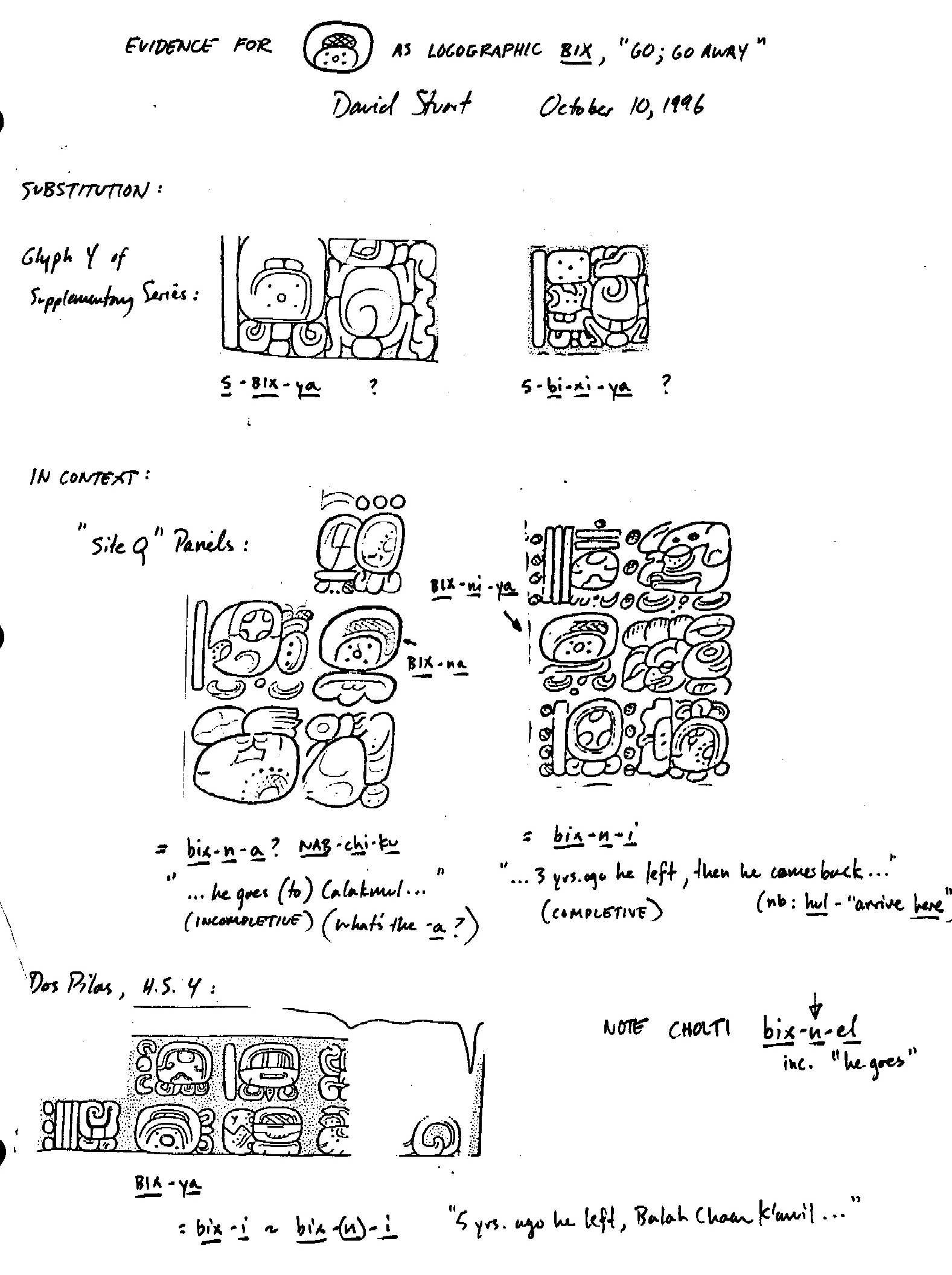
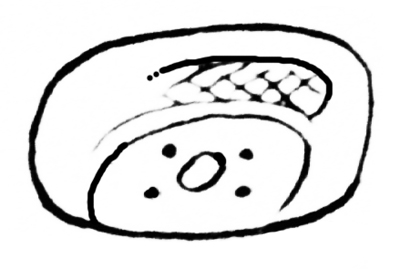
Back in 1996 I made notes about an interesting substitution set that pointed to a reading BIX for a logogram shown here, which makes an appearance in a few inscriptions from Yaxchilan, La Corona, Dos Pilas, Coba, as well as a few others. This value may well have been noted by others back around the same time, if not before, but I thought I would post my old hand-written note summarizing the evidence (having just now found them in an old notebook).

The sign was used to write the intransitive verb bix, “to go,” in a small variety of settings. This verb root can be traced historically to proto-Ch’olan *bix (Kaufman and Norman 1980) and in ancient texts it appears on Dos Pilas HS 4 (see page bottom) as BIX-ya, for bix-iiy, “he went” (in reference to the fleeing of the local ruler Bahlaj Chan K’awiil from Dos Pilas). Spelled BIX-ya or bi-xi-ya, the same verb was used in temporal expressions ho’ bix-iiy, “five days ago” or wuk bix-iiy, “seven days ago” (see top examples on page below). A variant form of  this verb is bix-Vn, “to go, go away,” which appears in Colonial Ch’olti’ and in the glyphs as well. Several examples occur in the texts of La Corona (spelled BIX-na 0r, for the compl,tive, BIX-ni-ya), where they refer to the journeys of the young noble K’inich ? Yook from his home to Calakmul (Chihknahb). A related example turned up long after I wrote those original old notes, on Panel 1 from La Corona (at right), discovered in 2005 by Marcello Canuto.  There we read bix-Vn chihknahb, “he goes to Chihknahb” (the same expression appears on Panel 2, but with a different date — see “Site Q” examples illustrated at the middle of the page).

My favorite example of these “go” verbs comes from Altar de Sacrificios, where on Panel 2 we have bi-xi-ni-ya, for bix-Vn-iiy, “he went away.” Rather than referring to a journey in the real world, this is a citation of a local ruler’s death (cited in more conventional terms on Stela 4, an associated inscription).

I’m as yet unsure what if any semantic distinction existed between between the verbs bix and bix-Vn, and they may just be regional variants.  The bix root is likely based on the noun *bih, “road,” and I find it interesting that this etymology is graphically reflected in the logogram sign itself, which incorporates an infixed BIH/bi element.

Here are my old scribbles on this stuff from 1996:

The Unusual Glyphs of Calakmul’s Stela 52

Figure 1. Calakmul, Stela 52 in its original state. After Rupert and Denison (1943)

by David Stuart

Some years ago I paid a visit to the Museo Dolores Olmedo in Mexico City, and spent a good portion of my time viewing one of its treasures — the scarred and eroded remains of Stela 52 from Calakmul. It’s a far cry from the gorgeous, well-preserved releif that was first photographed in its original setting by one of intrepid Carnegie Institution expeditions of the 1930s (Ruppert and Denison 1943). Looters armed with band saws attacked Stela 52 and other nearby monuments in the 1960s, removing the front carving for transport and eventual sale. As I looked over the stela it dawned on me that I once had an encounter of sorts with those very same looters. In 1999 Ian Graham and I spent two weeks at Calakmul recording many of its monuments, and we one day came upon the clear vestiges of the looters’ camp abandoned over three decades earlier in the woods in front of Structure 1, not far from where Stela 52 and its partner, Stela 54, once stood. The large and rusted band saws lay on the forest floor amidst cans and debris, a scene of an old archaeological crime. Years later, as I took in the stela at the museum, it dawned upon me that those old rusted cutting tools must have been the very ones used on the magnificent sculpture.

Despite the cutting and the weathering, the monument still bears its powerful regal image of a king dressed in an elaborate deity costume, most likely for a ritual dance. The nearby Stela 54 with its similar portrait of a woman is surely the partner of Stela 52, forming a male-female stela pair like others at Calakmul and some of its ally states, such as El Peru (Stelae 33 and 34, for example) (see Marcus 1987). A band of five glyphs runs above the portrait of the Calakmul ruler, and several more along the right side.

Taking a closer look at the text, it is clear that the date is 4 Ahaw 13 Yax, or 9.15.0.0.0, as Ruppert and Denison deciphered decades ago. The same date was inscribed as an Initial Series on the stela’s side, although this is now invisible. The event glyph in the fourth block of the front text is “scattering,” with the name of the ruler in the last block of the vertical band. His name and titles evidently continued in the other blocks below, although these were considerably more weathered. As Simon Martin has shown, this must be a reference of some sort to the ruler known as Yuknoom Took’ K’awiil, who reigned at Calakmul for several decades in the early eighth century (Martin and Grube 2008; Martin 2005).

Fig. 2. Stela 52's upper text. Sketch by D. Stuart

Something curious stands out in these glyphs. On close inspection one sees that a small sign consisting of two small semicircles of dots — much like a TOK or to sign — has been added to each glyph block. On the 4 Ahaw day record these dotted curls form a superfix, and on the Yax month they sit atop the YAX logogram. In the K’atun record, the same element seems to be between the number 15 and the k’atun sign itself. It even appears on the scattering (CHOK-wi-ch’a-ji) verb glyph, above the hand, as well as on the royal name.

The constant presence of the dotted curls sign should indicate that it cannot be a readable element, at least in the conventional sense that we understand Maya writing. The word TOK or the syllable to has no role to play, for example, in the spelling of a day or month glyph, nor in the writing of a verb. In the case of the scattering glyph, one could supposedly entertain the possibility that the “to” is an odd form of the pronoun sign u; however, the -wi suffix markes this form as an anti passive verb, and a prefixed pronoun can only exist in a transitive construction. Surely there is something odd going on here.

The pattern may well continue with all of the other glyphs on the stela’s front. The first set of three smaller glyphs set into the portrait look to be a k’aloomte’ title, with the “to” sign resting atop the head of the deity main sign. Likewise it seems to appear in the next glyph, in a numbered “successor” expression (see Martin 2005).

Why are these elements here? I suspect that the “to” signs that appear throughout Stela 52’s inscription are in no way phonetic, but instead serve as a purely visual devices, designed to integrate the look of the glyphs to the larger iconographic program of the stela. The effect is subtle, however, since no dotted curls appear on the king’s outfit. Demonstrating the link requires a bit of background discussion, and comparisons with similar ritual costumes on other monuments, and other sites.

The distinctive costume worn by the ruler includes an elaborate deity mask integrated with a large mosaic war helmet (perhaps a ko’haw). We see the same garb worn by many of the performing rulers depicted on the monuments of Dos Pilas, for example, where we also find the same dotted curls atop the same helmets and with very similar elaborate masks (see Figure 3). I suspect that this one detail is hidden by the other extra headdress elements shown on Stela 52, but is there nonetheless. So, while the dotted curls are not visible in the headdress on the Calakmul stela, the iconographic consistency of the costumes worn by the Dos Pilas and Calakmul rulers implies their presence.

Figure 3. Detail of Dos Pilas stela, showing similar ritual costume. Note the dotted curls atop the mosaic helmet. Photo by D. Stuart.

The glyphs, then, wear their own outfits in a way. This example of a Maya glyphic “font” is unique to my knowledge. The only comparable example that comes to mind is the remarkable Teotihuacan-inspired text from the upper temple of Structure 26 at Copan, where the full-figure signs are given a central Mexican look and feel (Stuart 2005). But there the oddball glyphs are paired with legible Maya ones, in order to make the text readable. Here on Stela 52, the glyphs are in an elegant Maya style, yet visually tweaked to make them conform to the dress and performance depicted. It’s probably significant that the glyphs on the stela’s sides don’t show the dotted curls anywhere; this may make sense once we realize that the royal portrait wouldn’t have been visible to readers of those texts. The side glyphs might therefore be taken as exceptions that prove the rule.

If my assumptions hold true, it seems that the hieroglyphs on the front of Stela 52 were “costumed” in their own way and, like the king’s dancing persona, came to be infused with a particular deified identity on the occasion of the important period ending.

References Cited

Marcus, Joyce. 1987. The Inscriptions at Calakmul: Royal Marriage at a Maya City in Campeche, Mexico. Ann Arbor: Museum of Anthropology, University of Michigan.

Martin, Simon, 2005. Of Snakes and Bats: Shifting Identities at Calakmul. The PARI Journal, vol. VI, no. 2. http://www.mesoweb.com/pari/publications/journal/602/SnakesBats.html

Martin, Simon, and Nikolai Grube. 2008. The Chronicles of Maya Kings and Queens: Deciphering the Dynasties of the Ancient Maya. 2nd edition. London: Thames and Hudson.

Ruppert, Karl, and John H. Denison, Jr. 1943. Archaeological Reconnaissance in Campeche, Quintana Roo and Peten. Carnegie Institution of Washington, Pub. 543. Washington, D.C.: Carnegie Institution of Washington.

Stuart, David. 2005. A Foreign Past: The Writing and Representation of History on A Royal Ancestral Shrine at Copan. In Copan: The History of An Ancient Maya Kingdom, ed. by E. Wyllys Andrews and William L. Fash. pp. 373-394. SThe School of American Research Press.

More on Tortuguero’s Monument 6 and the Prophecy that Wasn’t

Tortuguero’s Monument 6 continue to be the focus of a good deal of scrutiny, and not just among epigraphers and Mayanists. Many of course claim that the last few glyphs of its long inscription contain the only record of what the ancient Maya had to say or prophesize about the coming end of the Bak’tun in late 2012. I’m partly to blame for the attention given to Monument 6, after some years ago when I posted a brief, off-the-cuff analysis of each glyph on a listserv, where I labelled the passage as the “Tortuguero Prophecy” (see below). Little did I know back then this would soon help set off a frenzy on many New Age websites, associated forum discussions, and even a few book chapters.

Figure 1. The final section of Tortuguero Monument 6. See Figure 4 for a general overview of the text's original form. (Drawing by D. Stuart)

To many, the handful of glyphs at the very end of Monument 6’s text continues to form the linchpin for understanding what the ancient Maya thought about the end of the Bak’tun in 2012, even as the readings of the partially damaged glyphs continue to be discussed and debated. Most recently, Sven Gronemeyer and Barbara Macleod presented their own detailed epigraphic analysis (Gronemeyer and Macleod 2010), and in my recent book The Order of Days (Stuart 2011) I spend a few pages on the topic, without delving into much glyph-by-glyph detail (since the book was intended for a general, non-speacialist readership). One prominent New Age author on 2012 seems especially frustrated with the ongoing discussions among epigraphers — me especially — and the inevitable changes of interpretation that come as a result. So here I take the opportunity to clarify my most recent thinking on the significance of the Tortuguero passage.

On the pages of this weblog Steve Houston offered an important insight into the closing passage of Monument 6, noting that the final glyphs might not pertain to the Bak’tun ending after all, as I and others had earlier supposed. He posited that the closing statement instead serves to reiterate a key dedication episode highlighted earlier in the inscription. I’ve pondered Steve’s cogent reassessment for some time, and in The Order of Days I took a neutral stance on the matter, not knowing quite what to think. Much to the chagrin of some adamant 2012ers, I nonetheless spent a few paragraphs downplaying the significance of Monument 6 in general, given the extensive damage and ambiguities of the pertinent glyphs in the final passage. Upon more reflection, and after looking and a number of comparative examples, I now can lend my full support for Steve’s analysis, as well as his assertion that no prophetic statements about 2012 likely exist in Monument 6’s inscription.

The structure of this text was the topic of some detailed analysis and discussions earlier this year during the Advanced Hieroglyphs workshop led by Danny Law, held  at the 2011 Maya Meetings in Austin. While there it became clear that Steve Houston’s analysis is correct, and that the final passage serves as a re-statement or elaboration of the inscription’s main topic, the dedication of a shrine, tomb or some other structure where Monument 6 was said to have been found. (Rumors at the time, Ian Graham once told me, stated that it had been found covering or blocking a tomb entrance). In other words, the mention of 13.0.0.0.0 4 Ahaw 3 K’ank’in on Tortuguero Monument 6 is an isolated chronological anchor within a larger narrative, projected into the future in order to make a rhetorical point about the nature of the main historical event. The last few glyphs of the text, rather than being wedded to the 13.0.0.0.0 section, should be viewed instead as comprising a record of a contemporary episode — the building dedication — that’s the discursive focus of the entire inscription.

Closing the Narrative Loop

For those who are unfamiliar with the more technical aspects of Classic Maya literary structure and discourse, I’ll illustrate this concept using a modern parallel. Let’s imagine that a scribe living in New York back in the year 1950 wanted to immortalize some great happening of that year on a stone monument. One momentous event of the time was the New York Yankees’ four-game sweep of the Phillies in that year’s World Series (it pains me a bit to write this today, being a traumatized Red Sox fan). If our imaginary scribe were to use the particular ancient Maya rhetorical device under discussion, he or she might say something like this: “On October 7, 1950, the New York Yankees defeated the Philadelphia Phillies to win the World Series. It happened 29 years after the first Yankees victory in the World Series in 1921. And so 50 years before the year 2000 will occur, the Yankees won the World Series” (little would the scribe know, unless he was a prophet, that the Yankees would win it all again in 2000). The last sentence of this commemorative statement is a projection forward to a date of calendrical importance — the fifty-year anniversary as well as the near-start of the new millennium — but notice how the writer swings back to highlight the real event at hand — the 1950 sweep. This is precisely how many ancient Maya texts are structured, including Tortuguero’s Monument 6.

Figure 2. The closing passage of Palenque's Tablet of the Foliated Cross, linking the main event of the tablet to the future K'atun ending 9.13.0.0.0. Photograph by Jorge Perez de Lara.

Let’s look at some specific cases of this text structure in Maya inscriptions. First we can turn to the closing glyphs from the Tablet of the Temple of the Foliated Cross at Palenque (Figure 2). The single main event of this key inscription, as well as it’s two partners on nearby temples, highlights a ritual burning of something called a chitin, perhaps refering to a sweatbath (Houston 1996) or a kiln for ceramic effigies of deities (Stuart 2005). This occurs on 9.12.18.5.16 2 Kib 14 Mol. The last nine blocks of the text serve to anchor this date to the soon-to-come K’atun ending 9.13.0.0.0 8 Ahaw 8 Woh.

4-12-WINIK-ji-ya / 1-HAAB’ / u-to-ma / 8-AJAW 8-CHAK-AT / U-13-WINIKHAAB’? / i-u-ti 2-“KIB” / i-PAT-la-ja / U-1-TAHN-na / K’INICH-KAN=BAHLAM K’UH(UL)-BAAK-AJAW

chan(-eew?) lajcha’ winikijiiy huun haab’
ut-oom waxak ajaw waxak(-te’) chakat u uxlajuun winikhaab'(?)

i uht cha’ ?(“kib'”) i patlaj u huuntahn k’inich kan b’ahlam k’uhul b’aakal ajaw.

“Four-and-twleve score days and one year, before Eight Ahaw the Eighth of Chakat, when the 13th K’atun (9.13.0.0.0 8 Ahaw 8 Woh) will occur, then happens 2 Kib (9.12.18.5.16 2 Kib 14 Mol) when the precious one(s) of K’inich Kan Bahlam, the Holy B’aakal Lord, is/are fashioned.”

This closing passage follows a lengthy description of the significance of the date 2 Kib 14 Mol, taking up all of the previous two columns of the inscription. The purpose of this closing statement is project forward in time to a notable Period Ending and restate the narrative’s focus using somewhat different terms or supplemental information (the king’s relationship to the god(s), in this instance).

From Copan we have a text that bridges present and future over a much greater span of time. Stela J (not illustrated) was dedicated on the period ending 9.13.10.0.0 7 Ahaw 3 Kumk’u, and its text mentions in its final section a projection forward to the Bak’tun ending 10.0.0.0.0 7 Ahaw 18 Sip. No prophesy or prediction is offered, only a simple statement that “the 10th Bak’tun will end” (tzuhtz-j-oom u lajuun pik). The scribe does so because the upcoming Bak’tun ending, still centuries in the future, will be a recurrence of 7 Ahaw, establishing a “like-in-kind” connection on the cosmic clock. A number of monuments at nearby Quirigua do the very same thing, on occasion projecting to similar Ahaw anniversaries that will occur eons forward in time. As we will see, the same is basically true on Monument 6, with “4 Ahaw” being the common denominator between the narrative “present” and a distant future.

Figure 3. The final passage from Naranjo, Altar 1. The glyphs that project forward from 9.8.0.0.0 to the future Bak'tun ending 10.0.0.0.0 are highlighted. Drawing by I. Graham, CMHI.

As Steve Houston has noted, Naranjo’s Altar 1 does much the same thing, and shows even stronger parallels to what we will soon discuss regarding Tortuguero’s Monument 6 (Figure 3). The celebrated event of this text is a Period Ending on 9.7.0.0.0, contemporaneous with the inscriptions carving and dedication during the reign of the important early king known to many as “Aj Wosaj” (a misnomer, probably, for what is written as AJ-?-sa-[ji]).

U-K’AL-TUUN-ni / 5-AJAW / 3-IK’-SIHOOM / U-TZUTZ-wa / U-7-WINIKHAAB? / AJ-?-sa / 3-11-PIK-AJAW / ya-AL / IX-?-CHAN / a-bu-lu-pa-a / U-MIHIIN / ?-CHAN-AHK / 9-TZAK-bu-AJAW / 0-K’IN / 0-WINIK-0-HAAB / 12-WINIKHAAB? / TZUTZ / jo-mo / U-10-PIK / 7 AJAW / 18-CHAK-AT / u-to-ma / u-CHOK-? / AJ-?-sa / 5 AJAW / 3-IK’-SIHOOM

u k’altuun jo’ ajaw ux(-te’) ik’sihoom
u tzutzuw u wuk winikhaab'(?) aj ? ux b’uluch pik ajaw
y-al ix ? abulpa'(?) chan, u mihin ? chan ahk, b’olon tzakab ajaw
mih k’in mih winik mih haab’ lahcha’ winikhaab’
tzuhtz-j-oom u lajuun pik
(ta) wuk ajaw waxaklajuun chakat, utoom
u chok aj ?
(ta) jo’ ajaw ux(-te’) ik’sihoom

“(It is) the stone-binding on Five Ahaw the Third of Woh, when ‘Aj Wosaj’, the three-eleven pik lord, completes the eighth K’atun (9.8.0.0.0). He is the child of the woman Ix ? Chan B’ulpa’, and the child of the man ? Chan Ahk, the dynastic lord. (It is) twelve-score years before the tenth B’ak’tun will be finished (on) 7 Ahaw 18 Sip (10.0.0.0.0) ,when ‘Aj Wosaj’ casts incense(?) on Five Ahaw, the Third of Woh (9.8.0.0.0).”

Here the subject of the ut-oom verb is the date 7 Ahaw 18 Sip, which is “fronted” beforehand. The chok or “scattering” verb appearing after ut-oom is not a future event, for it initiates a new phrase associated with the earlier base of the forward calculation. This is the ritual that was performed by the contemporary Naranjo ruler on 9.8.0.0.0

Figure 4. The Original Form of Tortuguero, Monument 6. (Main section drawing by I. Graham, right wing by D. Stuart)

Tortuguero’s Main Event

Analysis of the entire Monument 6 inscription clearly shows that it’s main thrust is the ritual dedication of a tomb or shrine in the 7th century, specifically on the day 9.11.16.8.18 9 Etz’nab 6 K’ayab (January 11, 669). The record of this episode takes up the majority of text’s overall space, running from block I2 through to the very end. That’s nearly half of the entire inscription. In blocks I6-I8 is the initial portion of this commemoration, stating that some 25 years after B’ahlam Ajaw’s inauguration there was a “house-burning” (el-naah) ritual on the 9 Etz’nab day just mentioned. It goes on to say in blocks J8 through J10 that this occurred just over a year (1.8.18) after the period ending 9.11.15.0.0 4 Ahaw 13 Mol. Such side references to period endings are common in texts such as this, and they serve again to contextualize the focus event by relating it to the comsic mechanisms of the Long Count. The 4 Ahaw station for this nearby PE was especially noteworthy given its importance in Maya cosmology and time keeping, and no doubt the mention of the future occurrence of 4 Ahaw on 13.0.0.0.0 4 Ahaw 3 K’ank’in later on Monument 6 is designed to reflect an essential symmetry between present and future.

Returning to the Tortuguero text, blocks I11 through J13 to record more about the building dedication, giving the buidling or shrine’s proper name at I12 and J12. These follow a highlighting marker (a-AY?-ya) at I11 and a positional verb at J11 reading i-e-ke-wa-ni, for ek-wan or hek-wan, a term difficult to link to any identifiable root in Mayan languages. Evidently this episode had something to do with a “positioning” of the named edifice, at the same time the “house-burning” dedicatory rite occurred. Much of the rest of this passage is missing, but it surely mentioned the ruler B’ahlam Ajaw before the surviving emblem glyph (I16). His parents are named thereafter in blocks J16 through K3.

So, here we come to the thorny part of the text. The pivotal element here is the verb u-to-ma (block  O4) spelling the future participle utoom, “it will happen.” This comes after the date and before the damaged glyphs that close the entire text. The question is what, exactly, is the subject of this verb? Gronemeyer and Macleod believe that the subject must be the following glyph block, which is in turn attached to those that follow. In this sceanrio the final glyphs naturally would contain some description of a happening associated with 2012, as I also suggested some years ago: “…3.8.3.9.2 (before) the thirteenth Bak’tun will end (on) 4 Ahaw 3 K’ank’in, EVENT2 will happen” (EVENT2 being a 2102 occurence). By contrast, Steve Houston’s analysis sees an important break after utoom in the discursive structure of the inscription, whose subject must simply be the future date and Bak’tun ending itself. It serves to reinforce the temporal position of the date just mentioned in order to bring the reader back to the narrative present. In this way the glyphs that follow utoom return to the focused event of the larger narrative — i.e., the house dedication. In other words the subject of utoom is understood to be the date, which has been “fronted” syntactically, as in: “…3.8.3.9.2 (before) the thriteenth Bak’tun will end (when) 4 Ahaw 3 K’ank’in will happen, then EVENT1.” Here the restatement of EVENT1, the shrine dedication, does not include a mention of the earlier Calendar Round 9 Etz’nab 6 K’ayab. This should not be seen as a problem, however, as other texts are known to do the same.

Conclusions

My purpose here has not been to go over the damaged final glyphs of Monument 6, trying to determine their original forms and reason out what the passage originally might have said. Gronemeyer and Macleod have recently done so in exhaustive and admirable detail, even positing a reconstruction of a phrase describing a future “investiture” of the deity Bolon Yookte’ K’uh. Although I have some questions about the specifics of their analysis, my real intent has been to focus more on the question of whether those glyphs are really at all relevant to 2012 anyway. In doing so I follow closely on the points Steve Houston made a number of months ago, including his claim that those enticing glyphs probably don’t say anything at all about 2012 and its meaning to the ancient inhabitants of Tortuguero. For the reasons given here, I think the evidence seems fairly inescapable that Steve was correct.

Stepping back a bit, it’s important to reiterate that Monument 6 never featured the 2012 period ending, except to refer to the future Bak’tun ending in order to temporally orient a more significant here-and-now happening of Tortuguero’s local history. Above all — and not surprisingly given what we know about Maya texts — Monument 6 was a lengthy document on the historical and ritual life of the local ruler B’ahlam Ajaw, highlighting the building and dedication of some important ritual structure he commissioned. I have no doubt that others will continue to focus on Monument 6 for its supposed prophecy about 2012, but they would probably be misguided in doing so.

* * *

ADDENDUM: Here’s my original post of April, 2006, from the UTMesoamerica listserv. Note that this reflects my mistaken belief at the time that the Bolon Yookte’ K’uh reference on Monument 6 pertained to the Bak’tun ending.

As promised here’s a quick translation of the final passage of
Tortuguero Monument 6, recording the 2012 Bak’tun ending:

Tzuhtz-(a)j-oom u(y)-uxlajuun pik
(ta) Chan Ajaw ux(-te’) Uniiw.
Uht-oom ?
Y-em(al)?? Bolon Yookte’ K’uh ta ?.

“The Thirteenth ‘Bak’tun” will be finished
(on) Four Ajaw, the Third of Uniiw (K’ank’in).
? will occur.
(It will be) the descent(??) of the Nine Support? God(s) to the ?.”

This is it. The term following uht-oom is the main puzzle, and largely effaced. The “descent” reference is highly tentative, too. The enigmatic deity Bolon Yookte’ K’uh has been known for some time from many sources, and I suspect that he (or they) has some tangential relationship to the Principal Bird Deity, as well as war associations. Interestingly, he is a protagonist in the deep time mythology of Palenque, as recorded on Palenque’s Temple XIV tablet. A long-lasting character who’s still around somewhere waiting, I suppose.

– Dave S.

REFERENCES CITED:

Houston, Stephen. 1996. Symbolic Sweatbaths of the Ancient Maya: Architectural Meaning in the Cross Group at Palenque, Mexico. Latin American Antiquity 7(2):132-151.

________________. 2008. What Will Not Happen in 2012. Maya Decipherment weblog. http://mayadecipherment.com/2008/12/20/what-will-not-happen-in-2012/

Gronemeyer, Sven, and Barbara Macleod. 2010. What Could Happen 2012: A Re-Analysis of the 13-Bak’tun Prophecy on Tortuguero Monument 6. Wayeb Notes Number 34. http://www.wayeb.org/notes/wayeb_notes0034.pdf

Houston, Stephen D. 1996. Symbolic Sweatbaths of the Maya: Architectural Meaning in the Cross Group at Palenque, Mexico. Latin American Antiquity 7(2):132-151

Stuart, David. 2005. The Palenque Mythology. Sourcebook for the 2005 Maya Meetings. Austin: The Mesoamerica Center, Department of Art and Art History, University of Texas at Austin.

_____________. 2011. The Order of Days: The Maya World and the Truth about 2012. New York: Harmony Books.

Reinterpreting a “Creation” Text from Chancala, Mexico

Fig. 1. Sawn section of a panel, probably from Chancala, Mexico (From Mayer 1991:Pl.96).

The incomplete text panel shown in Figure 1, now in a private collection in Florida, has been the focus of some attention since it was first commented upon by Schele, Friedel and Parker (1993:66) in their analysis of ancient Maya creation mythology surrounding the date 4 Ahaw 8 Kumk’u. It was first published by Mayer (1991:Pl. 96) and more recently by Van Stone (2010); a photograph by Justin Kerr also is available. Given the increasing interest in the 13.0.0.0.0 base-date of the Long Count calendar and its upcoming repetition in 2012, it seems a few words about the interpretation of this partial inscription might be important, especially since widely published readings of the glyphs look to be incorrect in some key details. Others have made similar points in re-assessing this inscription — Steve Houston and Marc Zender in particular — so this is meant to be no more than a summary of more current thinking on the inscription.

The text begins in mid-sentence, with a partion of a Calendar Round date “8 Zip” (8-CHAK-AT). A distance number then follows, written oddly as 18-0-WINIK-ja-ya. These numbers as written simply don’t work, however, and there’s little question that the scribe has here made an error. The date resulting from this calculation is shown later as 4 Ahaw 8 Kumk’u, and the only means of connecting “8 Zip” and “8 Kumk’u” is to make a slight adjustment in the distance number as its written, from 18.0 to *16.0 (“18 Winals” would be an impossibility in any case). So we have the following chronological link between these two dates being the most likely:

[9 Ahaw] 8 Zip
+*16.0 (written in error as 18.0)
4 Ahaw 8 Kumk’u

We have no idea what transpired on the earlier date; that section of the text remains missing.

4 Ahaw 8 Kumk’u will be familiar to many as the Calendar Round for the so-called “Creation” date that serves as the base-line for the shortened Long Count, falling on 13.0.0.0.0. Here it almost certainly does not correspond to 13.0.0.0.0, but instead to a far, far later position in the Long Count, probably near the so-called Terminal Classic era of Maya history. The main reason for thinking this comes from the glyphs that follow the date, which Schele, Freidel and Parker (1993:65) translated as “the first image turtle was seen.” They got it nearly correct, but some key details force us to reassess their interpretation. The verb at pB3 they originally read as IL-la-ji-ya, for ilajiiy, “it was seen,” a passive construction (Schele et al transliterated this as ilahi, following older conventions of Maya epigraphy). However, a closer look at the glyphs clearly shows that this verb takes the initial sign yi-, infixed into the main eye main sign. This would spell the ergative third-person pronoun (u)y- before the initial i- of ilajiiy, meaning that it cannot be a passive verb construction (intransitives, unless they are nominalized, can never take an ergative pronoun prefix). Yilajiiy is well known in ancient texts, functioning either as a derived transitive form, “he saw it,” or as a participial noun “his seeing it” (both interpretations are debated and have merit, although opting for one over the other doesn’t change the meaning of the passage). The subject of this statement comes next in the personal name Yax K’oj Ahk (YAX-k’o-jo a-AHK). Schele et. al., interpreted this as a deity, namely the turtle (ahk) represented in some mythical scenes of the rebirth of the maize god (see Schele, et. al. 1993:65). However, this is far more likely to be a name of a local king or ruler, for the glyph after the name reads Chak K’uh Ajaw, “the Chak K’uh Lord.” Chak K’uh is a known but fairly obscure emblem glyph that I have for some years now associated with the ruins of Chancala, located to the south of Palenque. One fragmentary relief from Chancala bears the same emblem title (see Stuart and Stuart 2008:235), as does a panel that Mary Miller and I long ago posited might be from the same region (Miller and Stuart 1981).

Fig. 2. K'inich Janab Pakal "witnesses" a period ending. PAL:T.I.middle (Drawing by L. Schele)

Yax K’oj Ahk therefore was a historical ruler from the court of Chak K’uh, who “saw” the day 4 Ajaw 8 Kumk’u in his lifetime — not the original “Creation” date, of course, but a recurrence of the same Calendar Round at a far later time. Similar references to the witnessing of period endings and anniversaries are common in Maya texts (Figure 2), and imply some degree of “oversight” of the events and rituals involved with their celebration. As others have noted, there is no reason to consider it a mythical reference.

The text goes on to mention an interval of nine years (9-HA’B-ya) reckoning forward to another date now missing, but which we can easily calculate as 7 Ahaw 3 Pax.

The proportions and style of the glyphs look to me to be late, falling in the so-called Terminal Classic period in early ninth century. Only one placement of the dates in the Long Count seems fitting, anchored to 10.0.6.16.0 4 Ahaw 8 Kumk’u (see below for all three positions).

Transcription of Text (designating the two columns as A and B, and the rows by number; the “p” indicates “provisional” given the incomplete nature of the text):
pA1: 8 CHAK-AT
pB1: 0-*16-WINIK-ji-ya
pA2: i-u-ti
pB2: 4-AJAW
pA3: 8-HUL?-OHL-la
pB3: yi-IL-la-ji-ya
pA4: YAX-ko-jo
pB4: a-AHK
pA5: CHAK-K’UH-AJAW
pB5: 9-HA’B-ya i-u-ti

Summary of Dates:
[10.0.6.0.0 9 Ahaw] 8 Zip
[10.0.6.16.0] 4 Ahaw 8 Kumk’u
[10.0.15.16.0 7 Ahaw 3 Pax]

References:

Mayer, Karl Herbert. 1991. Maya Monuments: Sculptures of Unknown Provenance, Supplement 3. Graz: Verlag Von Hemming.

Miller, Mary Ellen, and David S. Stuart. 1981. Dumbarton Oaks Relief Panel 4. Estudios de Cultura Maya, vol XIII, pp. 197-204.

Schele, Linda, David Freidel and Joy Parker. 1993. Maya Cosmos: Three Thousand Years on the Shaman’s Path. New York: William Morrow.

Stuart, David, and George Stuart. 2008. Palenque: Eternal City of the Maya. New York: Thames and Hudson.

Van Stone, Mark. 2010. 2012 Science and Prophecy of the Ancient Maya. Imperial Beach, CA: Tlacaelel Press.