A New Drawing of the Inscription on the Cross Censer Stand from Palenque

by David Stuart (The University of Texas at Austin)

In 1979 Linda Schele and Peter Mathews published their important catalog, The Bodega at Palenque, Chiapas Mexico, presenting various sculpture fragments and artifacts recovered over the course of many years of excavation from the 1930s to the 1960s. Of significant interest to epigraphers, among many pieces, was a badly damaged stone censer stand that had been found on the slope of the Temple of the Cross in 1945 (Schele and Mathews 1979:281).

The sculpture is representative of a particular type that is distinct to Palenque – an upright stone with a near life-size face on its front, two prominent side flanges showing ear ornaments, and other iconography, often with inscriptions on its side edges and back. These stones were inspired by the famous large ceramic censer stands that adorned many of the temples of Palenque (Cuevas 2008). As with their ceramic counterparts, small shallow bowls with copal were placed on the stands, visually atop the elaborate headdresses.

Other examples of such stones, far better preserved, include the stand representing the nobleman Aj Sul, a contemporary of K’inich Janab Pakal, now in the Museo Regional de Palenque. Another is a larger piece in the Museo Amparo in Puebla with a portrait of an Aj K’uhuun from the same period, carved during the reign of K’inich Janab Pakal. The inscriptions on all of these, including the Cross example, are biographical, recounting events in the lives of the figures portrayed. Their narratives close with records of death and burial. Clearly, these served as funerary small funerary altars, bearing the images of deceased ancestors. I have tentatively identified the name of this type as k’ohob’tuun, “image/mask stones” (Stuart 2019). In function and design, these bear a remarkable similarity to some funerary altars from the Roman world.

Unfortunately, the portrait on the front of Cross censer stand is broken and almost completely gone. A long incised inscription on its rear is also badly damaged (see drawing). Its first publication by Schele and Mathews was accompanied by Schele’s drawing and their tentative chronological analysis. The dates of the text were later revised and corrected in an outstanding study made by Ringle (1996), who also recognized strong overlaps between the texts and the contents of the Temple XVIII stucco inscription. In the late 1980s, I determined that a small stone fragment recovered in the western stairs of the Palace, now on display at the Museo Nacional de Antropologia, was likely to be part of the same stone, bearing the opening Long Count date (see left side in drawing). The discovery of these pieces at a great distance from one another offers a fascinating instance of a monument’s intentional destruction and removal, probably after Palerque’s fall.

The fit of the side fragment prompted the drawing presented here, which will also be discussed as part of the upcoming workshop on the stucco glyphs from Temple XVIII, at Boundary End Archaeology Research Center (April 2024).

I agree with most Ringle’s revised chronology, differing only in a couple of dates from the middle of the text, given here only tentatively. The Gregorian dates are given using the Martin-Skidmore (584286) correlation.

9.10.15.6.8  4 Lamat 16 Pop   /   Mar 15, 648  / Birth of Tiwohl Chan Mat
9.11.5.0.0  5 Ahau 3 Zac   /   Sep 16, 657  /  Period Ending (PE)
9.11.6.16.17  13 Caban 10 Ch’en  /  Aug 14, 659  / Arrival of Nuun Ujol Chahk
9.11.7.0.0  10 Ahau 13 Yax  /   Sep 6, 659  /   PE
9.11.9.14.19  2 Cauac 17 Xul   /   Jul 11, 662  / Youth ritual?
9.11.10.0.0  11 Ahau 18 Ch’en  /   Aug 21, 662  /   PE
9.11.13.0.0  12 Ahau 3 Ch’en  /  Aug 5, 665  /  PE
9.11.15.10.7  3 Manik 0 Uayeb???  /  Feb 18, 668  /  Triad event
9.12.0.0.0  10 Ahau 8 Yaxkin  /  Jun 29, 672  / PE
9.12.0.6.18  5 Etz’nab 6 Kankin  / Nov 14, 672 / Death of Lady Tzakbu Ajaw
9.12.8.9.18  7 Etz’nab 6 Muan  /  Dec 2, 680  /  Death of Tiwohl Chan Mat
9.12.8.10.0  9 Ahau 8 Muan  /  Dec 4, 680  /  Burial
9.12.10.0.0  9 Ahau 18 Zotz’  /  May 8, 682  /  Dedication of stone

We see that the thirteen dates on the stone (an intentional number?) cover a thirty-five-year period, corresponding roughly to the life of the stone’s protagonist, Tiwol Chan Mat. As we find in other funerary texts on small stones, the inscription is biographical, recounting the major events of his life. The censer stand was dedicated at the half-k’atun on May 5, 682, 162 days after Tiwohl Chan Mat’s death. There is a poignance to the mention of Pakal overseeing the burial of his youngest son, only eight years after his wife passed away. In fact, The similarity in the death dates of the mother and the son – 5 Etznab 6 Kankin and 7 Etznab 6 Muan – may have given extra meaning to the narrative, linking the mother and her adult son. Pakal’s own death would come soon after.

The prominence of the 659 arrival of Nuun Ujol Chahk, probably the exiled ruler of the Mutul dynasty, is interesting.  This was a transformative event for Palenque’s court, featured prominently in Pakal’s own story as told in the Temple of the Inscriptions. The visit probably helped to advance Pakal’s own political and military power in the western region, and his conflicts against the great Kanul court and its allies. Tiwol Chan Maat was only eleven years old at the time of this royal visit, and it must have left quite a mark on the boy.

Lastly, the dedication of this funerary stone pre-dates the Temple of the Cross, where it was eventually found. This suggests that it was brought to the Cross a decade or more after it was carved. There it would have accompanied the many other ceramic censer stands found on the temple’s slope. The ancestral themes of the tablet in the Temple of the Cross may signal why it was brought there, adding Tiwohl Chan Mat’s story to his older brother’s greater dynastic narrative.

Sources Cited

Cuevas Garcia, Martha. 2008. Los incensarios efigie de Palenque: Diedades y rituales mayas. UNAM, Mexico.

Ringle, William M. 1996. Birds of a Feather: The Fallen Stucco Inscription of Temple XVIII, Palenque, Chiapas. In Eighth Palenque Round Table, 1993, edited by M.G. Robertson, M. J. Macri, and J. McHargue, pp. 45-61. Pre-Columbian art Research Institute, San Francisco.

Schele, Linda, and Peter Mathews. 1979. The Bodega of Palenque, Chiapas, Mexico. Dumbarton Oaks, Washington, D.C.

Stuart, David. 2019. A Possible Logogram for K’OJ or K’OJOB, “Mask, Image.” Unpublished talk (slides only) on academia.edu.

Tikal, Tecali, Teotihuacan

by Stephen Houston (Brown University)

Alabaster was a rarity among the Classic Maya, reserved for fine bowls in elite settings, especially tombs or palaces (Houston 2014:258; Kubler 1977:5n1). Known as xix, a spelling attested in at least two glyphic texts, it appeared to refer to rocks affected by water (Houston et al. 2018; Luin et al. 2022:907, fig. 4). Geologically, xix is a white sedimentary calcite (CaCO3) mined in, among other places, a source near Zinacantan, Chiapas (Berlin 1946:27; for other quarries, see Urcid 2010:fig. 56). A comparable term, tecali, named after a community of that name, was applied to banded stone of similar composition in Mexico (Diehl and Stroh 1978:74). The Maya evidently prized the translucency, crystalline texture, and hard, white surface of alabaster, the better to highlight delicate incisions that could be filled in with red pigment.

An unusual find of two alabaster effigies comes from Burial 195, under Structure 5D-32 in the North Acropolis at Tikal, Guatemala (Figure 1, Coe 1990:565-568, 920, figs. 198-199, 330; Coggins 1975:344; Moholy-Nagy 2008:55, fig. 138). The tomb almost certainly belonged to a ruler of Tikal, ‘Animal Skull’, who died around AD 600.[1] The product of a tumultuous phase in Tikal’s history, Animal Skull does not clearly descend from earlier rulers of the city. His reign took place after a “rupture [that] follows hard on the heels of a major military defeat” at Tikal, leading to a “130-year monument hiatus and an interruption to its dynastic line” (Martin 2020:104, 247, 345).

Figure 1. Burial 195 and its two animal effigies of alabaster, marked “22” (partial plan: Coe 1990:fig. 1998; effigies: Moholy-Nagy 2008:fig. 138).


Despite the gap in monuments, there is no textual hiatus at Tikal. A suprisingly large number of pots belonged to Animal Skull, a pattern seen also with his near-contemporary, “Aj Numsaaj/Aj Nunsaaj” at Naranjo (Zender 2019:35, for discussion of the ruler’s name; see also Houston 2018:71-74). Prestige ceramics must have flowed in special abundance at this time. Perhaps it was a way to reconstitute frayed relationships and build new ones by means of gifted pots. In Animal Skull’s tomb, there was also a quite literal flow of silt that washed into the tomb some years after its completion and sealing. Surrounding perishable objects, it left cavities when offerings in the tomb rotted away, preserving original shapes and coverings of painted stucco. Among the finds was a covered wooden bowl with a remnant text (Martin 2008). It referred to a ruler from the antagonistic kingdom of Caracol, Belize, from which the bowl may have arrived as a gift or as war booty. Apparently, Animal Skull had other broad connections, including ties to the dynasty of Altar de Sacrificios, a royal seat some 100 km southwest of Tikal (Martin 2020:412n16).

Said to be “somewhat eroded,” the alabaster effigies measure ca. 28 cm long, 12 cm wide, and 15 cm high (Moholy-Nagy 2008:55, fig. 138). They occur side-by-side but otherwise alone in a quadrant of Burial 195. One carving is blockier, less curved than the other. Poised on their front legs and haunches, almost ready to jump, they were intended, it seems, to stare eternally at the head of Animal Skull. He lay flat on his back nearby. What sort of animals were they? Some scholars see them as agoutis or sereques (Dasyprocta punctata), but the fuller, rather alert tails point to another identification (Coe 1990:566; Moholy-Nagy 2008:fig. 138): they are rabbits, perhaps cottontails in particular. The small ears cue that mammal rather than hares. Famously procreative as a genus, the rabbits were placed in the tomb as a pair, suggesting a buck and his doe.

It is highly likely these carvings were non-local, deriving instead from the metropolis of Teotihuacan, which was largely in ruins when these alabaster–tecali–pieces were placed in Burial 195. Excavations at the apartment compound of Oztoyahualco found just such a carving, also, probably, of a rabbit, in the center of courtyard (Figure 2a). The dimensions, style of carving, and disposition of limbs are quite close to those of the alabasters at Tikal. Other such finds include a piece in a photographic archive, head gone but with similar limbs (Figure 2b), and two very different creatures, felines both (Figure 2c), including a calcite or tecali example that entered the collection of the British Museum in 1926 (Figures 2d). Two appear to have receptables on their backs for offerings, and the evident dyad of predators (felines) and prey (rabbits) may not be a coincidence. The rabbit at Oztoyahualco dates to the Xolalpan phase, ca. AD 350-550), the shattered mammal (supposedly) to the subsequent Metepec period (AD 550-660), at the time of Teotihuacan’s decisive decline (Beramendi-Orosco 2009:106-107).

Figure 2. Animals at Teotihuacan, Mexico: (a) Oztoyahualco 15b apartment compound (Ortiz Díaz 1993:522, 387); (b) Metepec-period carving (exact provenance unknown, from photo supplied by Joshua Kwoka); (c) image of feline, ca. AD 250-550, 17 x 17.5 x 10 cm (Baez 2009:261, pl. 59); and (d) tecali-feline, Teotihuacan, British Museum Am1926-22, 33 x 21 x 16 cm.


Study of animal bones at Oztoyahualco reveal a notable preponderence of rabbit, with other evidence in the form of possible pens, hide-preparing tools, and osteological signs of butchering (Somerville et al. 2016:3; see also Somerville and Sugiyama 2021:63-64). This evidence indicates that these animals were a key resource for the apartment compound and for Teotihuacan in general. The rabbit effigy itself appears to have been placed on top of a small temple platform in the middle of a courtyard at Oztoyahualco (Figure 3a). Whether this was in homage to a succulent rabbit god is speculative, but it does suggest that such platforms displayed the effigies for local ritual, that these were central, if portable, votive carvings. Indeed, an example of a temple “maquette,” with the same portability as the carvings from Oztoyahualco–and marked by the distinctive talud-tablero (slope-panel) feature of Teotihuacan–has its own super-structure, with a chamber large enough to accommodate such effigies (Figure 3b). Courtyard temples of similar sort have been found at Tikal (Figure 3c), including, not far away, to the east, a recent find in Group 6C-XV (Román et al. 2023)–the latter being part of the city that was abandoned at the end of the Early Classic period, ca. AD 500-600.[2] Perhaps such a temple, with now missing chambers, contained the effigies, which might be switched out for votive need or removal and use in intermittent displays or processions.

Figure 3. (a) effigy atop miniature temple with talud-tablero, Xolalpan (Ortiz Díaz 1993:522); (b) miniature temple, Zacuala, Teotihuacan, 59.5 x 52 x 92.8 cm, likely Xolalpan (Jiménez Delgado 2009:213, pl. 3); and (c) courtyard temple, Structure 48, Group 6C-XVI-Sub, Tikal, Guatemala, AD 400-500 (Laporte and Fialko 1995:66, fig. 44, drawing by Paulino Morales).


The calcite rabbits in Burial 195 have not been linked before to Teotihuacan. Yet they correspond to a type of carving attested at that site, in a material employed for at least one animal effigy of comparable size. Calcite carvings of this nature and scale are not otherwise known in the Maya region. As tomb furniture, this may reflect the need of an upstart ruler, Animal Skull, to find roots in more distant pasts and places…or perhaps in ritual effigies taken from a part of his city abandoned prior to his death and burial.

Acknowledgements  I thank Joshua Kwoka for sharing the image in Figure 2b and Mary Miller for reminding me that we are, as of this writing, in the Year of the Rabbit!

[1] As an epithet, “Animal Skull” is an ersatz place-holder. The actual name remains a puzzle, for it includes a turtle head and, at times, a feline ear, along with a suite of other titles and affixes or infixes that come and go.

[2] Oztoyahualco does not only offer a parallel to Tikal (Taube and Zender 2009:188-189, fig. 7.15). A manopla or boxing cudgel from Caracol, Belize, bears a striking resemblance to an object found in the apartment complex (left below, Oztoyohualco Burial 13, Teotihuacan: Ortiz Díaz 1993:527, 533, 536, figs. 389, 391; right below, Caracol, Belize: Royal Ontario Museum, 971.466, Anderson 1959, mislabeled as a “monkey skull” but correctly noted to be Early Classic in date). Note the “dead” or discolored incisor on the skull, an idiosyncratic hint that it matches an actual person with this injury or decay.


References

Anderson, A. Hamilton. 1959. Actas del XXXIII Congreso Internacional de Americanistas, San José, 20-27 Julio 1958:211-218.

Baez, Miguel. 2009. Sculpture de Jaguar. In Teotihuacan, Cité des Dieux, edited by Felipe Solís, 261. Paris: Musée du Quai Branly/Somogy Éditions d’Art.

Beramendi-Orosco, Laura E., Galia Gonzalez-Hernández, Ana Soler-Arechalde, Manzanilla LR. 2021. A High-Resolution Chronology for the Palatial Complex of Xalla in Teotihuacan, Mexico, Combining Radiocarbon and Archaeomagnetic Dates in a Bayesian Model. Radiocarbon 63(4):1073-1084.

Coe, William R. 1990. Excavations in the Great Plaza, North Terrace, and North Acropolis of Tikal. Philadephia: The University Museum, University of Pennsylvania.

Coggins, Clemency C. 1975. Painting and Drawing Styles at Tikal: An Historical and Iconographic Reconstruction. Unpublished Ph.D. Dissertation, Department of Fine Arts, Harvard University, Cambridge.

Diehl, Richard A., and Edward G. Stroh, Jr. 1978. Tecali Vessel Manufacturing Debris at Tollan, Mexico. American Antiquity 43(1):73–79.

Houston, Stephen D. 2014. Miscellaneous Texts. In Life and Politics at the Royal Court of Aguateca: Artifacts, Analytical Data, and Synthesis. Aguateca Archaeological Project First Phase Monograph Series, Volume 3, edited by Takeshi Inomata and Daniela Triadan, 258–269. Salt Lake City: University of Utah Press.

—-. 2018. The Gifted Passage: Young Men in Classic Maya Art and Text. New Haven: Yale University Press.

—-, David Stuart, and Marc Zender. 2018. If…Alabaster Could Talk. Maya Decipherment: Ideas on Maya Writing and Iconography, Boundary End Archaeological Research Center.

Jiménez Delgado, Jonathan E. 2009. Miniature d’un Temple et de son Soubassement. In Teotihuacan, Cité des Dieux, edited by Felipe Solís, 213. Paris: Musée du Quai Branly/Somogy Éditions d’Art.

Kubler, George. 1977. Aspects of Classic Maya Rulership on Two Inscribed Vessels. Studies in Pre-Columbian Art and Archaeology No. 18. Washington, D.C.: Dumbarton Oaks, Trustees for Harvard University.

Laporte, Juan Pedro, and Vilma Fialko. 1995. Un reencuentro con Mundo Perido, Tikal, Guatemala. Ancient Mesoamerica 6(1):41–94.

Luin, Camilo A., Dmitri Beliaev, and Sergei Vepretskii. 2022. La vasija de travertino del Museo Popol Vuh. In 34 simposio de investigaciones arqueológicas en Guatemala, 2021, tomo 2, edited by Bárbara Arroyo, Luis Méndez Salinas, and Gloria Ajú Álvarez, 903-912. Guatemala City: Ministerio de Cultura y Deportes, Instituto de Antropología e Historia, Asociación Tikal.

Martin, Simon. 2008. A Caracol Emblem at Tikal. Maya Decipherment: Ideas on Maya Writing and Iconography, Boundary End Archaeological Research Center.

—-. 2020. Ancient Maya Politics: A Political Anthropology of the Classic Period 150–900 CE. Cambridge: Cambridge University Press.

Moholy-Nagy, Hattula, with William R. Coe. 2008. The Artifacts of Tikal: Ornamental and Ceremonial Artifacts and Unworked Material. Tikal Reports 27A. Philadelphia: University Museum of Archaeology and Anthropology, University of Pennsylvania.

Ortiz Díaz, Edith. 1993. Ideología y vida doméstica. In Anatomía de un conjunto residencial Teotihuacano en Oztoyahualco, 1: Excavaciones, edited by Linda Manzanilla, 519-547. Mexico City: Instituto de Investigaciones Antropológicas, Universidad Nacional Autónoma de México.

Román Ramírez, Edwin, Lorena Paiz AragónAngelyn BassThomas GarrisonStephen HoustonHeather Hurst, David Stuart, Alejandrina Corado Ochoa, Cristina García Leal, and Rony Estuardo Piedrasanta Castellanos. 2023. A Teotihuacan Altar at Tikal, Guatemala: Central Mexican Ritual and Elite Interaction in the Maya Lowlands, unpublished manuscript. 

Somerville, Andrew D., and Nawa Sugiyama. 2021. Why Were New World Rabbits Not Domesticated? Animal Frontiers 11(3):62–68.

—-, —-, Linda R. Manzanilla, and Margaret J. Schoeninger. 2016. Animal Management at the Ancient Metropolis of Teotihuacan, Mexico: Stable Isotope Analysis of Leporid (Cottontail and Jackrabbit) Bone Mineral. PLoS ONE 11(8): e0159982. doi:10.1371/journal.pone.0159982.

Taube, Karl A., and Marc Zender. 2009. American Gladiators: Ritual Boxing in Ancient Mesoamerica. In Blood and Beauty: Organized Violence in the Art and Archaeology of Mesoamerica and Central America, edited by Heather Orr and Rex Koontz, 161–220. Los Angeles: Cotsen Institute of Archaeology Press.

Urcid, Javier. 2010. Valued Possessions: Materiality and Aesthetics in Western and Southern Mesoamerica. In Pre-Columbian Art at Dumbarton Oaks, Number 3: Ancient Mexican Art at Dumbarton Oaks, Central Highlands, Southwestern Highlands, Gulf Lowlands, edited by Susan T. Evans, 127-220. Washington, D.C.: Dumbarton Oaks Research Library and Collection.

Zender, Marc. 2019. The Classic Maya Causative. The PARI Journal 20(2):28-40.

Seeing Blindness

Stephen Houston (Brown University)

In 1560, a pictorial census was compiled for the province of Huexotzinco in what is now the Mexican state of Puebla (Aguilera 1996:529). Taxation – or its avoidance – was the aim. Known today as the Matrícula de Huexotzinco, this document arose from local complaints about burdens on Indigenous nobility (Prem 1974:708-9). The census seems to have done its job. Don Luis de Velasco y Ruiz de Alarcón, the second Viceroy of New Spain, cited it when turning down later attempts to tax native elites in the area.

Now in the Bibliothèque Nationale de France, where it is labeled Ms. Mex. 387, the Matrícula offers a large trove of Aztec glyphs. Tributaries are shown with heads to specify age and gender, wrinkles for the former, disinctive hair for the latter, along with small lines leading to individual names in Aztec writing (see Houston and Zender 2018). Among other graphs, the Matrícula even has a way of denoting blindness (Wood 2020-present). This occurs on fol. 546v, which declares, in Nahuatl, yzcate yn popoyome, “here are the blind people,” just above a column of at least five heads (Figure 1). Each head has two horizontal bands across the face, one above the eye, the other below. Similar devices appear on fol. 608r, which records blindness, not with bands, but lateral smudges and globs of black ink (Figure 2).

Figure 1. “Here are the blind people,” Matrícula de Huexotzinco, with sample of two male heads and their respective name glyphs, fol. 546v (Creative Commons, “Attribution-NonCommercial-ShareAlike 3.0 License,” CC-BY-NC-SAq 3.0).


Figure 2. Blind individual, Matrícula de Huexotzinco, fol. 608r (Creative Commons, “Attribution-NonCommercial-ShareAlike 3.0 License,” CC-BY-NC-SAq 3.0).


As noted by David Stuart and his colleagues (2017), Aztec script drew at times on earlier systems of writing, including that of the Maya. Examples include the Aztec sign for “writing,” evidently copying a Maya “sky band,” and two distinct glyphs for “day, sun, heat” that are dead-ringers for the “day” (k’in) and “Venus” (ek’) signs (Figure 3). All are celestial in nature, suggesting a certain esotericism to these appropriations.

Figure 3. Aztec signs likely to have originated in Maya writing (source images: Wood 2020-present).


The mark for “blindness” may be a borrowing too. One Maya supernatural, ‘Akan, a being associated in the Classic period with death imagery and inebriation, has among his attributes a dark band and a sign for “night” or “darkness” across his eyes and, in places, his forehead (Figure 4; for ‘Akan, see Grube and Nahm 1994:707-9). To judge from the eyeband, he is probably a god who cannot see.

Figure 4. ‘Akan, a death god: (a) K927 (photograph by Justin Kerr); (b) a patron god of El Perú, Guatemala, with eyes covered by cross-hatching to show the color black, Tikal area, Guatemala (La Fundación La Ruta Maya, No. de Registro IDAEH: 1.2.144.1017, brought to my attention by David Stuart); and (c) the lordly title for Acanceh, Yucatan, ‘AKAN[KEH]-AJAW-wa (drawing by Simon Martin). Note the “percentage” sign that may indicate corruptive splits in flesh.

On the celebrated “Altar” vase, ‘Akan chops his own head off, but gropingly so, his eyes concealed (Figure 5).

Figure 5. CH’AK?-BAAH-‘AKAN-na, “Head-chopping ‘AKAN,” Altar de Sacrificios Vase, Guatemala, with concealed eyes and the “percentage” sign of death gods on his cheek (photograph copyright Inga Calvin).


‘Akan may embody recent death, the eyes open but unseeing, in contrast to skeletal beings stripped of flesh (on eye opening and loss of brain activity, see Laureys 2007). In a kind of taphonomic staging, he corresponds to the newly dead, not those long putrified and excarnated. Analogies may be found in the Kusōkan images of Japan, which contemplate “the nine stages of a decomposing corpse” (Kanda 2005).

For the Classic Maya, the disabling of sight is securely linked to those who have just died. This is attested in two phrases, one from a wooden box citing the death (or “road-entering”) of a lord from the kingdom of Tortuguero, Mexico; the other occurs on a panel from Lacanjá Tzeltal, also in Mexico (Figure 6). Rich in euphemism – both operate in complex cross-references to death – they categorically negate sight, reading: ma-‘a ‘i-‘ILA-ji, “not seeing.” That ‘Akan was also a creature of inebriation leads to another trope, that of being “blind-drunk,” a state in which the eyes coordinate poorly, if at all, with their ready cognition (Clifasefi et al. 2006; for ‘Akan as a drinking god, see Grube 2004).

Figure 6. Death as “not seeing”: (a) wooden box from area of Tortuguero, Mexico:C2-D2 (drawing by Diane Griffiths Peck [Coe 1974]); and (b) Lacanjá Tzeltal Panel 1:G2, Mexico (photograph by Omar Alcover, courtesy Charles Golden and Andrew Scherer [see also Golden et al. 2020]).

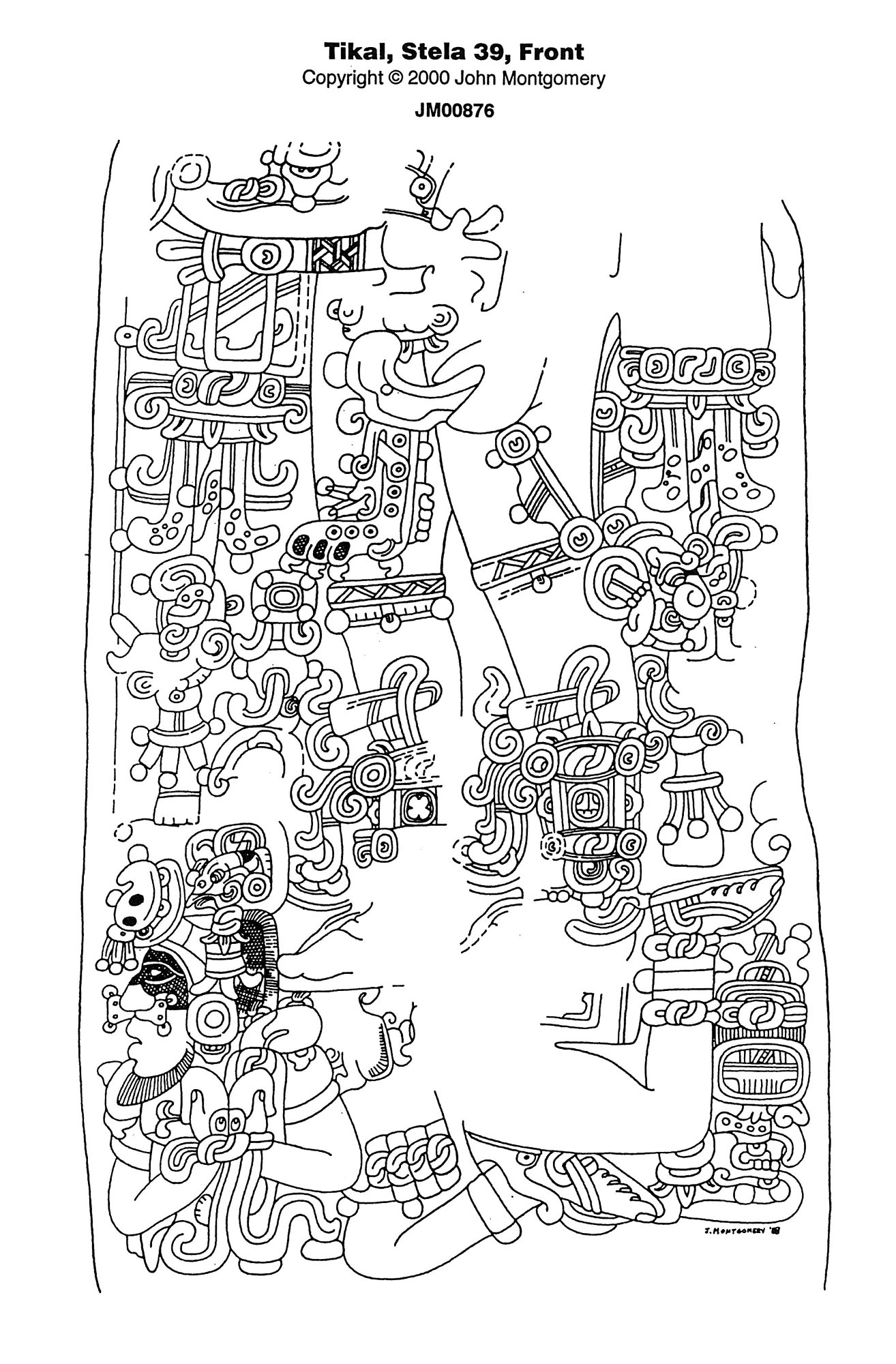
Blinding may not only have come from death. A captive with eyeband from Tikal Stela 39 could conceivably have received this torture at the hands of his captors (Figure 7; for the systematic blinding of captives, if in a Balkan context, see Holmes 2012). This was, to say the least, an immiseration that would hinder opponents and inflict broader psychological trauma.

Figure 7. A possible blinded captive on Tikal Stela 39, Guatemala (drawing by John Montgomery, FAMSI repository).


A captive who was likely blinded – his slit eye oozes with blood – occurs yet more clearly on a vase from the Ik’ kingdom of northern Guatemala (Figure 8).

Figure 8. Blinded captive, Ik’ kingdom, Guatemala, now in a private collection (photographer unknown).


That blindness was shown in Classic Maya text and imagery should not be surprising given the strong, positive emphasis on its opposite, the extromissive powers of sight (Houston et al. 2006:163-76). By comparison, there is, in recent literature on the senses, a latter-day deemphasis on sight, a dethroning of vision in favor of other senses (Jay 1993). To be “ocularcentric” is to miss larger worlds of perception and lend pernicious weight to “sensory normativity” (Petty 2021:297, 298). But the Maya might have disagreed: near-perfect humans were, according to mythic accounts from Highland Guatemala, capable of penetrative sight, to the extent of angering the gods of creation (Groark 2008:427-8). Removing that acuity, as the gods did, reduced the capacities of their hubristic creations. For most humans, death and sightlessness lay ahead in an inevitable future.

Acknowledgements  This essay benefited from comments by Charles Golden, Andrew Scherer, David Stuart, and Karl Taube.


References 

Aguilera, Carmen. 1996. The Matrícula de Huexotzinco: A Pictorial Census from New Spain. Huntington Library Quarterly 59(4):529-41.

Clifasefi, Seema L., Melanie K.T. Takarangi, and Jonah S. Bergman. 2006. Blind Drunk: The Effects of Alcohol on Inattentional Blindness. Applied Cognitive Psychology: The Official Journal of the Society for Applied Research in Memory and Cognition 20(5):697-704.

Coe, Michael D. 1974. A Carved Wooden Box from the Classic Maya Civilization. In Primera Mesa Redonda de Palenque (Part II), edited by Merle Greene Robertson, pp. 51–58. Pebble Beach, CA: Robert Louis Stevenson School, Pre-Columbian Art Research.

Golden, Charles, Andrew K. Scherer, Stephen HoustonWhittaker SchroderShanti Morell-HartSocorro del Pilar Jiménez ÁlvarezGeorg Van KolliasMoises Yerath Ramiro TalaveraMallory MatsumotoJeffrey Dobereiner, and Omar Alcover Firpi. 2020. Centering the Classic Maya Kingdom of Sak Tz’i’. Journal of Field Archaeology 45(2):67-85, DOI: 10.1080/00934690.2019.1684748

Groark, Kevin P. 2008. Social Opacity and the Dynamics of Empathic In-Sight among the Tzotzil Maya of Chiapas, Mexico. Ethos 36(4):427–48.

Grube, Nikolai. 2004. Akan: The God of Drinking, Disease, and Death. In Continuity and Change: Maya Religious Practices in Temporal Perspective, edited by Daniel Graña Behrens, Nikolai Grube, Christian M. Prager, Frauke Sachse, Stefanie Teufel, and Elisabeth Wagner, pp. 59-7. Mark Schwaben: Verlag Anton Saurwein.

__ , and Werner Nahm. 1994. Census of Xibalba: A Complete Inventory of Way Characters on Maya Ceramics. In The Maya Vase Book: A Corpus of Rollout Photographs of Maya Vases, Volume 4, edited by Barbara Kerr and Justin Kerr, pp. 686–715. New York: Kerr Associates.

Holmes, Catherine. 2012. Basil II the Bulgar-slayer and the Blinding of 15,000 Bulgarians in 1014: Mutilation and Prisoners of War in the Middle Ages. In How Fighting Ends: A History of Surrender, edited by Holger Afflerbach, and Hew Strachan, pp. 85-98. Oxford: Oxford University Press.

Houston, Stephen, and Marc Zender. 2018. Touching Text in Ancient Mexican Writing. Maya Decipherment: Ideas on Maya Writing and Iconography – Boundary End Archaeological Research Center.

Jay, Martin. 1993. Downcast Eyes: The Denigration of Vision in Twentieth-Century French Thought. Berkeley: University of California Press.

Kanda, Fusae. 2005. Behind the Sensationalism: Images of a Decaying Corpse in Japanese Buddhist Art. The Art Bulletin 87(1):24–49. http://www.jstor.org/stable/25067154.

Laureys, Steven. 2007. Eyes Open, Brain Shut. Scientific American 296(5):84-89.

Petty, Karis J. 2021. Beyond the Senses: Perception, the Environment, and Vision Impairment. Journal of the Royal Anthropological Institute 27(2):285-302.

Prem, Hanns J. 1974. Matrícula de Huexotzinco: Ms. mex. 387 der Bibliothèque Nationale Paris: Ed., Kommentar, Hieroglyphenglossar. Graz: Akademische. Druck- u. Verlagsanstalt.

Stuart, David, Stephanie M. Strauss, and Elliot Lopez-Finn. 2017. “Art from the Ancient East: Echoes of Classic Maya Writing and Iconography in Aztec-Period Aesthetics.” Paper presented at the University of Texas, Austin, Maya Meeting, Tlillan Tlapallan: The Maya as Neighbors in Ancient Mesoamerica, Jan. 14, 2017, Austin, Texas.

Wood, Stephanie, ed. 2020-present. Visual Lexicon of Aztec Hieroglyphs. Eugene: Wired Humanities Projects, University of Oregon, Version 1.0.

NEW PAPER: An Early Maya Calendar Record from San Bartolo, Guatemala

New paper by David Stuart, Heather Hurst, Boris Beltran and William Saturno. Published as an open access paper in Science Advances, vol. 8, issue 15, 13 April 2022

Abstract: Here, we present evidence for the earliest known calendar notation from the Maya region, found among fragments of painted murals excavated at San Bartolo, Guatemala. On the basis of their sealed contexts in an early architectural phase of the “Las Pinturas” pyramid, we assign these fragments to between 300 and 200 BCE, preceding the other well-known mural chamber of San Bartolo by approximately 150 years. The date record “7 Deer” represents a day in the 260-day divinatory calendar used throughout Mesoamerica and among indigenous Maya communities today. It is presented along with 10 other text fragments that reveal an established writing tradition, multiple scribal hands, and murals combining texts with images from an early ritual complex. The 7 Deer day record represents the earliest securely dated example of the Maya calendar and is important to understanding the development of the 260-day count and associated aspects of Mesoamerican religion and cosmological science.

RRAMW 64: The Logogram for Wax, “Grey Fox,” in Maya Hieroglyphic Writing

With this post we are pleased to present another new issue of the long-running series Research Reports on Maya Hieroglyphic Writing, published by the Boundary End Archaeological Research Center. Number 64 of the series is available here for download as a pdf, and future numbers will be posted here on Maya Decipherment. The full digital archive of the RRAMW series (1984-present) will soon be available on the BEARC website, and announced here as well.

RRAMW 64: A Logogoram for WAX “Grey Fox,” in Maya Hieroglyphic Writing by Christian Prager.