K’ahk’ U Ti’ Suutz’, “Fire-Mouthed Bat,” a common wahy demon on Classic Maya vases (Drawing by D. Stuart).
Around this time of year I often give my “Maya Spooks” lecture to students here at UT-Austin, highlighting the grisly and fright-filled demons (wahyoob) of Classic Maya art and religion. The lecture title is “Spooks, Witchcraft and the ‘Dark Side’ of Maya Art and Rulership (a.k.a. The Halloween Lecture).” This semester I’m teaching on the Aztecs, so in lieu of lecturing I hereby post my brief treatment of the subject written back in 2005. This write-up was part of the larger sourcebook I put together for the Austin Maya Meetings that year, devoted to “Glyphs on Pots: Decoding Classic Maya Ceramics.”
My own thinking on wahy beings keeps being refined somewhat. I still see them as animate dark forces wielded by court sorcerers, perhaps even rulers themselves, in order to inflict harm or disease on others. But wahyoob can be exceedingly complex and multi-layered, and they certainly aren’t really the benign, shamanistic “animal companion spirits” as we often described them a couple of decades ago. I’m hoping to find time write something more in-depth on the fascinating topic of royal sorcery one of these days, perhaps even as a book on Classic Maya witchcraft.
Excerpt from: David Stuart, 2005. Glyphs on Pots: Decoding Classic Maya Ceramics. Sourcebook for the 2005 Maya Meetings at Texas. Department of Art and Art History, UT-Austin, Austin.
Dancing into Dreams: Maya Vase Painting of the Ik’ Kingdom
Bryan Just; with contributions by Christina T. Halperin, Antonia E. Foias, and Sarah Nunberg
Yale University Press, 2012
Dancing Into Dreams explores 8th-century Maya vase painting of the Ik’ kingdom, located in the tropical lowlands of present day Guatemala. Ik’ vases are acclaimed for their naturalistic color, veristic portraiture, and calligraphic line. Their painted surfaces depict historical subject matter and often include the names of the artists and patrons, as well as hieroglyphic explanations of the portrayed events and vessel production. Collectively, such self-consciously historical works offer a precision and nuance, unparalleled in the ancient Americas, to the study of the role of art in elite society.
Authoritative and accessible, this handsomely illustrated volume presents a history of Ik’ vase painting and describes the dramatic scenes represented on the vases with compelling and historically accurate vignettes.
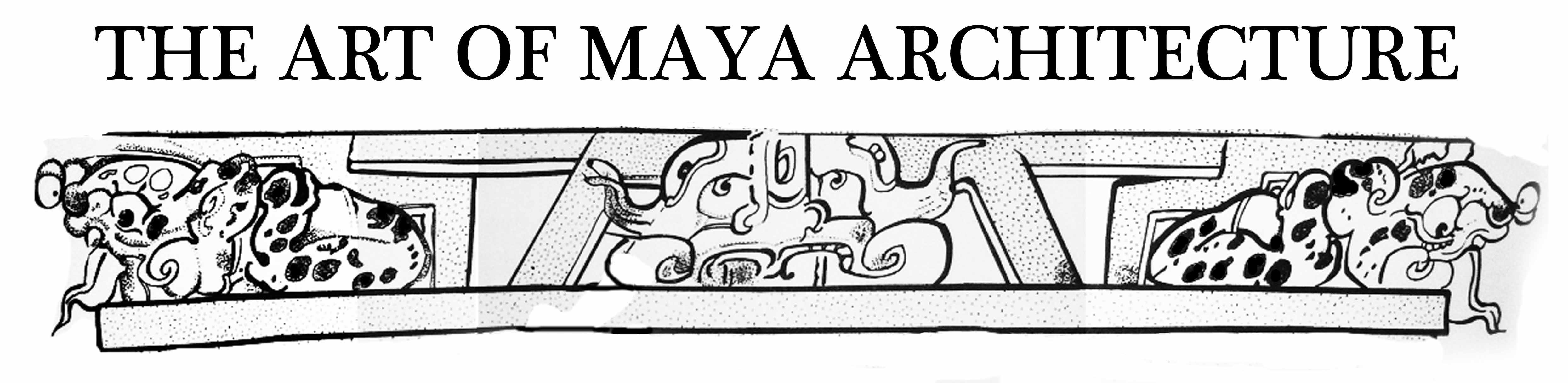
The 2013 Maya Meetings will explore new ideas about the art and meaning of ancient Maya architectural decoration and design. The last several years of archaeological research in the Maya region have revealed many examples of ornate temple decoration, as well as important reconsiderations of the symbolism and significance of buildings long known to archaeologists and art historians. Using archaeology, iconography, epigraphy, and the study of architectural forms, the Maya Meetings will focus on the built environment as expressions of ritual, cosmological and political space. This year we will have a number of compelling presenters, including several rising scholars in the field of Maya research.
At the European Maya Conference in Copenhagen in 2011, I sat in for a time in Sven Gronemeyer’s and Dmitiri Beliaev’s workshop “From Ochk’in Kaloomte to Dzuloob: Mesoamerica in the Maya World.” This workshop reviewed a number of so-called entrada events that occurred in the Maya lowlands over time, of which the most famous is probably that of Sihyaj K’ahk’ arriving at Tikal in A.D. 378 (Proskouriakoff 1993:4-10; Stuart 2000). In the sourcebook for the workshop, several examples of Sihyaj K’ahk’s name glyph were shown from a number of sites including El Peru, Tikal, Uaxactun, Rio Azul and others.
The question arose whether his name also appears on Stela 6 at La Sufricaya (Figure 1). The drawing of Stela 6 in the workbook comes from Grube’s study of the monuments of La Sufricaya (Grube 2003:700) in which he suggests the possibility that Sihyaj K’ahk’s name glyph appears at position D3. Although the drawing leaves some doubt as to the identification of the glyphs in question, the context is indeed suggestive. The Long Count date (8.17.?.9.9) seems roughly contemporaneous with Sihyaj K’ahk’s entrada to Petén (ibid., 700) and there are published artifacts and murals at the site in Teotihuacan style (Estrada-Belli 2009)(Note 1). In fact, Mural 7 from La Sufricaya marks the arrival of Sihyaj K’ahk’ to Tikal (although his personal name is absent) and appears to mark the one-year anniversary of that event (ibid.:238-243) (Figure 2).
Figure 1. La Sufricaya, Stela 6. Photograph by Bruce Love.Figure 2. Mural 7 from La Sufricaya, a painted text recording the arrival of Sihyaj K’ahk’ to Tikal in 378, and the dedication of a building on that day’s one year anniversary. Drawing by Heather Hurst.
In order to clarify the presence or absence of Sihyaj K’ahk’s name glyph, I asked Francisco Estrada-Belli, director of the Holmul Archaeological Project (of which La Sufricaya is an integral part), if I could photograph and draw Stela 6. As a result, on May 7, 2012, I photographed the stela, took detail shots of the glyphs with various light angles, and later made a drawing of the purported name glyph based on the photographs. The monument itself is currently housed in the IDAEH bodega in Melchor de Mencos, Petén.
The face of the monument is highly eroded as Figure 1 shows. The glyph in question is at D3.
In addition to the portrait photograph shown in Figure 1, several close-ups with different light angles were taken to record details. A selected close-up of D3, the one with the most information in my opinion, is shown in Figure 3 accompanied by a drawing of the same.
FIgure 3. Detail and drawing of glyph D3 on Stela 6. (Both by Bruce Love)
Although Sihyaj K’ahk’ is mentioned indirectly in the Mural 7 text, and (2) the Long Count date on the monument seems within the time period of his activities, and a number of monuments at sites in Petén do record the entrada event, I believe that Stela 6 does not. The results of this study indicate that the glyph in question fails to show any clear characteristics of Sihyaj K’ahk’s name.
Note 1. The tun and winal glyphs, not visible on the face of Stela 6, were found on a fragment that had separated from the main body of the monument.
Appreciation: I thank Sven Gronemeyer and Dmitri Beliaev for their workshop and the use of their workbook “From Ochk’in Kaloomte to Dzuloob: Mesoamerica in the Maya World,” 16th European Maya Conference, Copenhagen, 2011; and special thanks to Francisco Estrada-Belli for access to the monuments, for suggestions to improve this note, and encouragement to write these results.
References Cited
Estrada-Belli, Francisco, Alexandre Tokovinine, Jennifer Foley, Heather Hurst, Gene Ware, David Stuart, and Nikolai Grube. 2009. A Maya Palace at Holmul, Peten, Guatemala and the Teotihuacan ‘Entrada’: Evidence from Murals 7 and 9. Latin American Antiquity 20(1):228-259.
Grube, Nikolai. 2003. Monumentos jeroglíficos de Holmul, Petén, Guatemala. In XVI Simposio de Investigaciones de Arqueología de Guatemala, edited by Laporte, J. P., B. Arroyo, H. Escobedo, H. Mejía, pp. 701-710. Museo Nacional de Arqueología y Etnología, Guatemala.
Proskouriakoff, Tatiana. 1993. Maya History. University of Texas Press, Austin
Stuart, David. 2000. The “Arrival of Strangers”: Teotihuacan and Tollan in Classic Maya History. In Mesoamerica’s Classic Heritage: From Teotihuacan to the Aztecs, ed. by D. Carrasco, L. Jones, and S. Sessions, pp. 465-514. University Press of Colorado, Boulder.
The ritual role of paper is by now a commonplace in studies of Classic Maya royalty. Kings show their station by wearing headbands, presumably made from the cortex of the strangler fig or amate (Ficus sp.), kopo’ in some Mayan languages.(Note 1)
Much could be written about Classic paper. There is the matter of its manufacture with “bark beaters.” Lashed to wooden handles, these grooved tools helped to mash and fuse fibers for eventual smoothing, sizing with lime-powder, and painting.(Note 2) Epigraphers might pay more attention to the reading of “paper” in Maya texts: hu’n, a term cueing “book,” “headband,” even “diadem” or “crown.” (Note 3) (The material came first, other meanings later.) Yet not all head coverings were Ficus. Some years ago, Michael Coe noted the probable use of henequen fibers in some headdresses (Coe 1973:49). An uncomfortable material, perhaps, but it was also durable, shapable, dramatic in effect, light to wear.
Two glyphic spellings indicate a third material for headgear. A paper, hu’n, it nonetheless seems to consist of something other than Ficus. One example occurs on Aguateca Stela 1, dating to AD 741 (Fig. 1; Graham 1967:fig. 3). The text offers an
Fig. 1. Figure 1. Aguateca Stela 1:A7, with close-up of royal headband (Graham 1967:figs. 2, 3).
unusual lead-up to the accession of a ruler, K’awiil Chan K’inich of Aguateca and Dos Pilas, by referring to an act of ka-cha-ji u-sa-ya-HU’N. The root is doubtless related to “tying,” kach, an event entirely appropriate for a headband (Grube 1992:213). In this spelling, the hu’n itself is visible as a paper bow. The reference comes 22 days prior to enthronement and may represent the pre-accession tying of a headband or the preparation of regalia for the ceremony. Another spelling is on the famed “Princeton Vase” at the Princeton Art Museum (Fig. 2; K511; Coe 1978:pl. 1). An ‘a-sa-ya HU’N-na is clearly visible at positions L2-K3, although the context is opaque. The caption, alluding to a person—note the agentive ‘a (or is it a pronoun, “your”?)—may refer to the scene of God L and his harem.
Figure 2. Princeton Vase, close up of caption (Coe 1978:pl. 1, photograph copyright Justin Kerr).
What can be made of these references to hu’n, once in secure connection to regalia and accession to high office?
An ethnography of the Q’eqchi’ Maya draws attention to a sedge, a grass or rush-like plant known as say (Cyperus sp.; Wilson 1972: 148, 169, 260, Table 19): “Today the principal fiber plant apart from ik’e (maguey) is a sedge, say…Say is used by plaiting rather than spinning; the three faces of the stem are split apart and woven into fine mats (sayil pōp) on which to sit or sleep.” Use of say appears to have been gendered among the Q’eqchi’, as it was worked only by women. Say produces a finer product than other plaited or twilled materials, and the Ch’orti’, too, made full use of it (Wisdom 1940:153-154; yet note Ch’orti’ pohp’ for “sedge”). Ground up and mixed with oil for poultice, the sedge was employed by Ch’orti’ midwives, at least until the 1930s, to heal the umbilical wounds of babies (Wisdom 1940:288): soothing, applicable at a key moment in life’s passage. Colonial Yukatek refers to the same material, as in the Calepino Motul: “Çay [say] el coraçón o junco de que hazen petates o esteras” or “the heart or rush from which petates or mats are made” (Cuidad Real 2001:136).
There is another possibility too. Colonial and recent Tzotzil mention a tree called saya-vun [hun], “saya-paper,” a wild mulberry (Morus celtidfolia; Breedlove and Laughlin 2000: 142, 153). A plant from a related plant, like Ficus and the mulberry in the Moraceae family, was commonly used in Polynesia for tapa cloth and throughout Asia as the basis of a resilient and valued paper (Seelenfreund et al. 2010). What is striking in the image on Aguateca Stela 1 is that a lashing around the forehead is cross-hatched. This is either because it is dark—a common Maya convention—or because it renders a rougher, more textured material (Fig. 1).
The Classic Maya wove, plaited, twilled, and otherwise joined materials from the vegetal world around them. Two glyphic examples suggest that some such works were labeled as “paper” yet from fibers that were coarser and tougher than Ficus. Truly: diadems in the rough. A second option is that, as in Asia and Polynesia, where the tradition had great antiquity, the Maya transformed mulberry into a high-quality paper for ritual use.
Endnotes
Note 1. A useful paper by Erik Boot highlights a pot with a text reading, in part, u-ko-po-lo che-‘e-bu (Boot 1997: 64-67, fig. 4, photographed by Justin Kerr as K7786). Boot proposes u-po-ko-lo, from a root meaning “wash,” for the first glyph block. I might suggest a different order, with signs that sequence from upper left to lower left, then pass from upper right to lower right. The relevance here is that kopol could be an adjectival reference to amate, kopol, in connection to che’b, “quill, brush.” Thus, “fig-tree-quill.” Whatever the interpretation, the presence of the term in a name-tag remains enigmatic—at least we know that the owner of this bowl served a higher-ranking ajaw. In my view, a second example noted by Boot, MT347, from Burial 160 at Tikal, possibly with po-ko-lo, is fragmentary and the context uncertain. I am unsure how it relates to the spelling on K7786.
Note 2. For controversy about such objects, there is no beating Paul Tolstoy on barkbeaters, which he understood in pan-diffusionist terms (Tolstoy 1963, 1981). The first discussion of such objects appears in Uhle (1889-90), likening New World examples to comparable pieces from Sulawesi.
Note 3. Excellent discussion of the phonology and glyphic spellings appears in Grube (2004: 65-66, 73). In 1986, Don Federico Fahsen showed me two texts in Guatemala, both from the early years of the Late Classic period, both painted in similar style if not by the same hand. I immediately noticed a sign alternation of the sort that is so productive in decipherment. The number “one” alternated in crisp pattern with a sign combination that, in Glyph F of the inscriptions, represented a Maya book (this last identification was made with great style and insight by Michael Coe [1977]). The unavoidable conclusion, for those ceramics, at the time of their painting: the word for “one,” jun, was a near-homophone of the term for “book,” hu’n. The phonological details of the words were less clear in the 1980s. Now, I would read “one” as juun, “book” or “paper” as hu’n, following the evidence and reasoning in Robertson et al. (2007:7, 48). The scribe or atelier producing these ceramics would have been unusually expansive in their embrace of homophony.
Breedlove, Dennis E., and Robert M. Laughlin. 2000. The Flowering of Man: A Tzotzil Botany of Zinacantán. Abridged edition. Smithsonian Institution Press, Washington, DC.
Ciudad Real, Antonio de. 2001. Calepino Maya de Motul, edición crítica y anotada por Réne Acuña. Plaza y Valdés Editores, México, DF.
Coe, Michael D. 1973. The Maya Scribe and His World. Grolier Club, New York.
___________. 1977. Supernatural Patrons of Maya Scribes and Artists. In Social Process in Maya Prehistory: Studies in Honour of Sir Eric Thompson, ed. by N. Hammond, pp. 327-347. Academic Press, London.
___________. 1978. Lords of the Underworld: Masterpieces of Classic Maya Ceramics. Art Museum, Princeton University, Princeton.
Graham, Ian. 1967. Archaeological Explorations in El Peten, Guatemala. Middle American Research Institute, Publication 33. Tulane University, New Orleans.
Robertson, John, Stephen Houston, Marc Zender, and David Stuart. 2007. Universals and the Logic of the Material Implication: A Case Study from Maya Hieroglyphic Writing. Research Reports on Ancient Maya Writing, Number 62. http://www.utmesoamerica.org/pdf_meso/RRAMW62.pdf.
Grube, Nikolai. 1992. Classic Maya Dance: Evidence from Hieroglyphs and Iconography. Ancient Mesoamerica, vol. 3, pp. 201-218. 2004. The Orthographic Distinction between Velar and Glottal Spirants in Maya Hieroglyphic Writing, The Linguistics of Maya Writing, ed. by Søren Wichmann, pp. 61-81. University of Utah Press, Salt Lake City.
Tolstoy, Paul. 1963. Cultural Parallels between Southeast Asia and Mesoamerica in the Manufacture of Bark-cloth. Transactions of the New York Academy of Sciences, vol. 25, pp. 646–662.
__________. 1991. Paper route: Were the Man the Manufacture and Use of Bark Paper Introduced into Mesoamerica from Asia? Natural History, vol. 100, no. 6, pp. 6-8, 10, 12-14.
Seelenfreund, D., A. C. Clarke, N. Oyanedel, R. Piña, S. Lobos, E.A. Matisoo-Smith, and A. Seelenfreund. 2010. Paper Mulberry (Broussonetia papyrifera) as a Commensal Model for Human Mobility in Oceania: Anthropological, Botanical, and Genetic considerations. New Zealand Journal of Botany, vol. 48, pp. 3-4, 231-247.
Uhle, Max, 1889–90. Kultur und Industrie südamerikanischer Völker. A. Ascher, Berlin.
Wilson, Michael R. 1972. A Highland Maya People and Their Habitat: The Natural History, Demography, and Economy of the K’ekchi’. Ph.D. dissertation, Dept. of Geography, University of Oregon.
Wisdom, Charles. 1940. The Chorti Maya of Guatemala. University of Chicago Press, Chicago.




You must be logged in to post a comment.