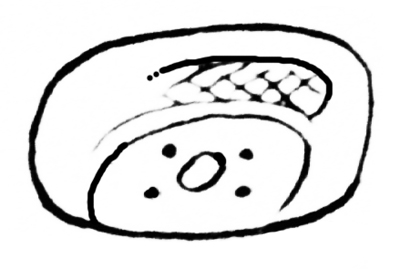
Back in 1996 I made notes about an interesting substitution set that pointed to a reading BIX for a logogram shown here, which makes an appearance in a few inscriptions from Yaxchilan, La Corona, Dos Pilas, Coba, as well as a few others. This value may well have been noted by others back around the same time, if not before, but I thought I would post my old hand-written note summarizing the evidence (having just now found them in an old notebook).
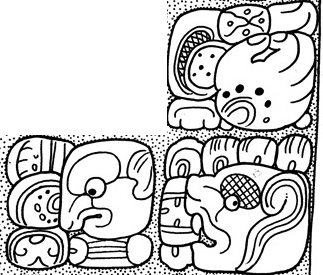
The sign was used to write the intransitive verb bix, “to go,” in a small variety of settings. This verb root can be traced historically to proto-Ch’olan *bix (Kaufman and Norman 1980) and in ancient texts it appears on Dos Pilas HS 4 (see page bottom) as BIX-ya, for bix-iiy, “he went” (in reference to the fleeing of the local ruler Bahlaj Chan K’awiil from Dos Pilas). Spelled BIX-ya or bi-xi-ya, the same verb was used in temporal expressions ho’ bix-iiy, “five days ago” or wuk bix-iiy, “seven days ago” (see top examples on page below). A variant form of this verb is bix-Vn, “to go, go away,” which appears in Colonial Ch’olti’ and in the glyphs as well. Several examples occur in the texts of La Corona (spelled BIX-na 0r, for the compl,tive, BIX-ni-ya), where they refer to the journeys of the young noble K’inich ? Yook from his home to Calakmul (Chihknahb). A related example turned up long after I wrote those original old notes, on Panel 1 from La Corona (at right), discovered in 2005 by Marcello Canuto. There we read bix-Vn chihknahb, “he goes to Chihknahb” (the same expression appears on Panel 2, but with a different date — see “Site Q” examples illustrated at the middle of the page).
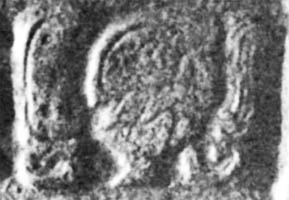
My favorite example of these “go” verbs comes from Altar de Sacrificios, where on Panel 2 we have bi-xi-ni-ya, for bix-Vn-iiy, “he went away.” Rather than referring to a journey in the real world, this is a citation of a local ruler’s death (cited in more conventional terms on Stela 4, an associated inscription).
I’m as yet unsure what if any semantic distinction existed between between the verbs bix and bix-Vn, and they may just be regional variants. The bix root is likely based on the noun *bih, “road,” and I find it interesting that this etymology is graphically reflected in the logogram sign itself, which incorporates an infixed BIH/bi element.
Here are my old scribbles on this stuff from 1996:
This post offers a few speculative thoughts on the glyph shown at right that’s long eluded any firm decipherment, but which for many years now has been thought to refer to an important type of ritual object or space, such as an altar or shrine. In fact, in the epigraphic literature of the past couple of decades it has often simply been glossed as “stone altar.” Here I would like to offer a somewhat different interpretation and suggest that it might better be interpreted as a term referring to a more specific sort of object known as an effigy incense burner. These remarkable and ornate ceramics are elaborated vessels, with lids that assume the form fully three dimensional portraits of historical ancestors or deities. They have been found at a number of sites, perhaps most notably at Copan, Palenque and Tikal, often in funerary contexts. It is clear that these elaborate objects were imposing ritual props, even sometimes nearly monumental in scale.
Fig. 1. Copan, Altar Q, with upper text passage noting the dedication of an object associated with the dynastic founder. (Photograph and drawing by D. Stuart)
We begin with the famous Altar Q at Copan (Fig. 1), a large box-shaped stone commemorating the dynastic founder, K’inich Yax K’uk’ Mo’, and his royal successors. The inscription atop the altar is best known for mentioning of the arrival of the founder, but toward the end we come to the record of then-contemporary events, including the dedication of an important monument or object under the auspices of Ruler 16, Yax Pahsaj Chan Yopaat. Interestingly, this item was “owned” or pertained to K’inich Yax K’uk’ Mo’, by them deceased for nearly four centuries. The glyph for this object (ya-?-la) has long eluded decipherment, but we have always assumed it stands in reference to either the altar itself, or perhaps even to the pyramid before which Altar Q was placed, Temple 16. In any event, it is important to note that the elusive term is for some sort of commemorative “thing” that is “of” K’inich Yax K’uk’ Mo’.
Fig. 2. Opening section of the Temple Inscription from Str. 10L-26 at Copan (Drawing by D. Stuart).
The same glyph appears again at Copan on the Temple Inscription, from the upper shrine of Structure 10L-26, the temple of the Hieroglyphic Stairway (Fig. 2). There, in beautiful full-figure glyphs, we read of another fashioning (the verb pa-ta-wa-ni at block a4) of the same class of object on 9.13.14.0.1 5 Imix 4 Kayab, and that it was “of the lord” or “of the lords” (ya-?-la-AJAW at block a6). This reference is vague, but given the parallel with Altar Q we might speculate that the term again refers to an ancestor or collectively to a group of ancestors. Importantly, Structure 10L-26 was also a major funerary monument at Copan, built by Rulers 13 and 15 above the tomb of Ruler 12. Ruler 12 died on 9.13.3.5.7 and was placed in his tomb 14 days afterwards. The funerary stairway above the tomb was built by his son many years later on 9.13.18.17.9, possibly in association with the Esmeralda construction phase of the pyramid. But the question is: what was made or dedicated in connection with this temple four years before the stairway, and over a decade after Ruler 12’s death? A building? An altar? No evidence exists of a major construction episode in 10L-26 between the times the tomb was placed and the large Esmeralda pyramid and its stairway were built above it, suggesting that the area around Ruler 12’s tomb was very accessible for a number of years. At any rate, the pattern suggests also that the glyph in question is probably not an architectural term (like “shrine,” for example).
A third occurrence of the same glyph perhaps appears in another Copan temple, Structure 10L-11. There it appears on the west jamb of the temple’s north dorrway in connection with the date 9.16.18.2.12 8 Eb 10 Zip, again with a “make” or “fashion” (pat-wan) event. In this case, its “owner” is named as Ruler 15, who died some six years earlier and who may be buried under Temple 11’s superstructure. Here once more we find our mystery term associated with a verb of “making” and owned by an ancestral figure.
Fig. 3. Passage from Quirigua, Zoomorph P. (Drawing by M. Looper)
Moving from Copan to nearby Quirigua, a similar pattern seems to be at work. The inscription of Zoomorph P records the Period Ending 9.18.5.0.0, at which time the local ruler “scatters incense” at a temple called the “13 Kawak House” (Fig. 3). This is in all likelihood one of the principal buildings in Quirigua’s acropolis, directly behind (to the south of) the monument (According to Zoomorph G this same “13 Kawak House” is where the great Quirigua Ruler K’ahk’ Tiliw Chan Yopaat was buried). The Zoomorph P inscription goes on to say that the incense ritual (chok ch’aaj) was performed on or with regard to the “object” of K’ahk’ Tiliw Chan Yopaat, as well as, it seems, with the same “object” of Ruler 13 of Copan. This is a remarkable statement, for Ruler 13 had earlier been the war captive of K’ahk’ Tiliw Chan Yopaat and was sacrificed at or near Quirigua in 736 A.D., decades before the zoomorph itself was dedicated in 795. Here, both the Quirigua king and his illustrious prisoner were associated with the same type of commemorative object mentioned three times at Copan, and again we find it in direct association with deceased kings and ancestors.
Turning to Palenque, we find that the same hieroglyph occurs in the tablets of the Temple of the Inscriptions, in the passages that record complex dressing rites associated with the three gods of the Palenque Triad. Chief among these was the tying of paper-cloth headbands (sakhu’n), headdresses (ko’haw) and jewels (tup) upon what must we can only presume to be effigy figures of the these deities, as Martha Macri (1988, 1997) and others suggested some years ago. A summary statement of the rites appears near the beginning of the west tablet (Fig. 4), where we have the simple mention that:
Fig. 4. Passage pertaining to the "headband-binding" on effigies of the three gods of the Palenque Triad. PAL, TI, west, B3-B6. (Drawing by L. Schele)
u k’alhu’n y-a..?..l u k’uh-ul
“It is the paper-binding of the ? of his gods …”
Here once more the glyph in question is a possessed noun associated with venerated figures, in this instance the gods of the Palenque Triad.
So what can this glyphic term actually mean? A few telling clues stand out thus far:
(1) The glyph must somehow refer to a class of commemorative object associated with deceased ancestral figures as well as deities.
(2) It can be “made” or “fashioned,” as revealed by its association with the verb pat.
(3) Specific actions associated with this object involve ritual dressing with paper-cloth (Palenque) and adornment with headgear and jewels. Significantly, they are also in some manner involved in incense rituals (Quirigua).
(4) The term has close ties to funerary temples at Copan and possibly at Quirigua, in direct connection to historical ancestors.
Taken together, one is tempted to think that the glyph refers to ritual statuary or figural representation, and perhaps more specifically to effigy incense burners. Such objects are known in Maya archaeology of course, perhaps the most spectacular examples being the ornate figural incensarios unearthed near Ruler 12’s tomb at Copan, inside Structure 10L-26. These objects were dressed and bejeweled (note the ear holes, etc.), and as burners were obviously used in important incense rites. The Copan censers represent all of the kings up to and including Ruler 12 himself, and so they fit well with the pattern of ancestral commemoration. And use of the verb pat would seem appropriate for this sort of object, given its known meaning in connection to the manufacture of ceramic objects (Yukatek pat kum, “hacer ollas”). And as we’ve seen, the mention of the “fashioning” of our mystery object in the Temple Inscription of Stucture 26 seems in some way to be connected with Ruler 12’s tomb. Might it specifically refer to the making of these effigy incensarios? It’s a tantalizing connection to ponder.
So, some general conclusions and speculations:
– Altar Q at Copan may refer to the dedication of an effigy censer in the form of the great ancestral ruler K’inich Yax K’uk’ Mo’. If so, the altar itself was likely intended as a pedestal or platform for its display, in front of his funerary temple.
– Copan’s Structure 10L-11 refers to the manufacture of a possible effigy censer of Ruler 15. This was perhaps intended to be displayed on the platform in the center of the north-south passageway of the temple, framed by the snake-centipede “maw” carved into the wall at either side.
– Quirigua’s Zoomporph P refers to the incense rite involving the effigy censers of two historical figures: K’ahk’ Tiliw Chan Yopaat as well as Ruler 13 of Copan, in association with the former’s funerary temple in the acropolis.
– In the case of Palenque, I suspect that some local variety of deity censer was mentioned in the Temple of the Inscriptions, each representing one of the Triad gods and ritually adorned as part of the calendar ceremonies performed by K’inich Janab Pakal.
Fig. 5. Two of the twelve ruler effigies (censer lids) found outside of Ruler 12's tomb in Copan's Structure 10L-26.
With Structre 26 of Copan, the making of the “? of the lord(s)” may well refer to the censers discovered outside of Ruler 12’s tomb (Fig. 5). The rather anonymous and general ajawterm seems unlike any other example discussed, leading me to think it is a collective reference to the twelve ancestors. My tentative conclusion is that the Copan effigy ancestors were made collectively on 9.13.14.0.1, and that they together served for a few years as important objects of ritual veneration, perhaps at the site of Ruler 12’s tomb or somewhere else in the acropolis. At the time of the construction of Esmeralda, these were terminated around the tomb’s exterior, and buried in the construction fill for the more grandiose funerary temple that the son had designed for his father.
I’ll close with a brief word on the glyph’s possible phonetic reading. The main clue in the decipherment of the central compound sign is its ya- prefix, a clear indication that the possessed noun begins with the vowel a-. The -la suffix on the glyph likely marks a -Vl ending on the possessed noun, so we ought to look for a noun root that begins with the vowel a- and fits this semantic context, having some connection with burning, incense, or effigy forms.
The element atop our mystery glyph (T174) is part of a main sign that still resists a firm phonetic decipherment, but it is important to note that the same element also appears with another logogram (T174:T704) with the value SABAK or SIBIK, “soot, ash” — a reading proposed a number of years ago by Nikolai Grube. Interestingly, another widespread Mayan term with much the same meaning is abak, “soot, charcoal, ash.” I do wonder if the logogram at the heart of the supposed “effigy” glyph might eventually prove to be ABAK, producing ya-ABAK-la, for y-abak-al, “its soot.” The semantics might have been extended somewhat to include the containers for burnt offerings, in the forms of ash-filled effigy censers. A different possibility worth considering is that the ya- sign prefix signals the presence of the agentive prefix aj- before a still obscure root, so that the possessed noun referring to effigy figures is aj-?.
The phonetic reading still remains elusive, yet the semantic domain of the noun in question seems much firmer in its connection to effigy figures and burners, ritual objects that were of great importance in ancient Maya ceremonial practice.
References:
Macri, Martha. 1997. Noun Morphology and Possessive COnstructions in Old Palenque Ch’ol. In The Language of Maya Hieroglyphs, edited by M. J. Macri and A. Ford, pp. 89-95. San Francisco: Pre-Columbian Art Research Institute.
A perennial attraction of Maya writing to the modern eye is its playful balance between convention and observed detail. A recent work does rich justice to the wit and fun that arose from Maya minds and hands (Stone and Zender 2011). But there may be another element to the creation of signs, of a sort that needs definition and testing. This is the conceptual connection that exists in ancient Maya thought between a unique exemplar and a more general class of thing or being.
John Milton would have understood the issue. For him, every man contained the essence of Adam, a singular prototype. Adam was Man but also a man. His companion in the Fall, Eve, was by that same logic both a woman and Woman. These beings were at once unique and susceptible to generalization. There is a reason, too, that Adam and Eve appeared in book called “Genesis.” They animated an explanatory story of origins and accounted for why descendants are as they are, ever willful by some views, ever disobedient to heavenly instruction.
There may be a more subtle matter at stake. For decades, ethnobiologists have considered the nature and hierarchical patterns of Maya classification (e.g., Berlin et al. 1974:153-157). What is missing, however, is the process, familiar to Plato, by which humans thought with equal effort about ideal forms and concrete reality. This might involve, to offer one case, an exemplary concept of “Tree” versus the many ways in which arboreal vegetation might exist, flourish, wither, scar or flower. To George Santayana (1915:ch. 1), “[t]he Platonic idealist is … so wedded to perfection that he sees in everything not the reality but the faultless ideal which the reality misses and suggests.”
But it is unlikely that the ancient Maya were Platonists. The originals were not ideals, but, as argued here, for a number of examples, highly specific things or creatures that were extended to identify a general class. Reciprocally, the general class of such things might fold back in reference to a mythic prototype. Robert Laughlin comes closest to this groove with his stories of Tzotzil plant lore. Weeds, “the ancestors’ corn and beans, were so fussy and complaining that Our Lord banished them to the wilds” and “[c]hili sprouted from the drops of Christ’s blood” (Laughlin 1993, 105, 106). Implicit in such stories are theories of origins and causation, but also of first things and their inescapable bearing on the present.
Much of this is intuitively obvious to Mayanists. The Ajaw face, a youthful, male profile, headbanded, check with distinctive spot, is both every lord read AJAW, and a particular being of mythic stamp and story, often paired with a similar figure, but with jaguar pelage. As Karl Taube (2003) showed so cogently, the first exercises dominion over humans, the second over animals, although the name of the latter remains elusive. The head for woman, IXIK, may similarly refer to a First Woman. The clearest cases are where glyphic terms are those of natural categories of animal—as confirmed by full phonetic spellings or complemented forms—yet the logographic versions of the same depict supernatural beasts. A partial list would include the following (illustration below):
—the jaguar: both general, for the “jaguar,” BAHLAM, and eponymous, as a water-lily jaguar sprouting a water-lily from its forehead (Figure 1a). (A few such cats appear to be read HIX, as on Copan St. 13:E5, or to be depicted as this, possibly more generic feline, as in the jade from Tikal Burial 196; Coe 1967:65.)
—the Xook shark: both general, for a fearsome “shark,” XOOK, and eponymous, as monstrous fish speared in primordial times (Figure 1b).
—the crocodile: both general, for the reptile AHIIN, and eponymous, as a being with cross-bands in its eye, a mythic, sacrificial prototype (Figure 1c).
—the snake: both general, for the reptile KAAN/CHAN, and eponymous, as a specific being with flower-like element in its forehead (Figure 1d). —the trickster rabbit with marked ear: both general, as T’UHL, and eponymous, as an oversexed and cunning creature who, among his many deeds, bests the god of trading (Figure 1e).
—the eagle/bird: both general, as TZ’IKIN/MEEN?,” as an everyday category of avian, and as supernatural bird linked to the sun (Figure 1f). This is part of a larger phenomenon of words and concepts that are ostensibly prosaic, yet always realized in mythic or metaphysical terms.
—the so-called “Patron of Pax”: both general, the glyph TE’, most often as a numeral classifier, and eponymous, as the base of a mythic world tree, te’, perhaps the primordial ceiba (Figure 1g; see David Stuart, 2007, http://mayadecipherment.com/2007/04/14/the-ceiba-tree-on-k1226/
—the sky-eagle: both general, in reference to a denizen linked to the sky, CHAN, and eponymous, as a bird that defines the lustrous arc of the sky. Or, in a related form, a solar eagle associated with war-flints, as at Tonina (Mon. 91:pB1, Karl Taube, pers. comm. 1985; Figure 1h).
A reasoned proposal might be made that each of these, some more secure than others, are not merely a set of generic words signs. In tandem they evoke a singular mythic prototype, a First Exemplar—implying a compendium of etiological, causational stories—along with everyday incarnations of that prototype. To see and depict such things and beings might have been, for the ancient Maya, a binocular process. It perceived the specific in the general, and the general amidst the wondrous particulars of ever-present myth.
Figure 1. (a) Copan Altar K:J1 (drawing by Barbara Fash, CMHI Project, Harvard University); (b) Tikal Cache 198:F1, Str. 5D-46 (drawing, University of Pennsylvania Museum); (c) Tikal Stela 31:F11; (d) Copan Stela A:H5 (drawing by Barbara Fash, CMHI Project, Harvard University; (e) K1340:C1 (photograph by Justin Kerr, Kerr Associates); (f) Río Azul Tomb 12, north wall (photograph by George Mobley, courtesy, George Stuart); (g) Copan Hieroglyphic Stairway (photograph from Barbara Fash, Copan Hieroglyphic Stairway Project, Peabody Museum, Harvard); and (h) Copan Stela A:G3 (drawing by Barbara Fash, CMHI Project, Harvard University).
References Cited
Berlin, Brent, Dennis E. Breedlove, and Peter H. Raven. 1974. Principles of Tzeltal Plant Classification: An Introduction to the Botanic Ethnography of a Mayan-Speaking People of Highland Chiapas. New York: Academic Press.
Coe, William R. 1967. Tikal: A Handbook of the Ancient Maya Ruins. Philadelphia: University Museum, University of Pennsylvania.
Laughlin, Robert M. 1993. Poetic License. In The Flowering of Man: A Tzotzil Botany of Zinacantán, by Dennis E. Breedlove and Robert M. Laughlin, pp. 101-108. Smithsonian Contributions to Anthropology No. 35. Washington, DC: Smithsonian Institution Press.
Santayana, George. 1915. Egotism in German Philosophy. New York: Scribner’s.
Stone, Andrea, and Marc Zender. 2011. Reading Maya Art : A Hieroglyphic Guide to Ancient Maya Painting and Sculpture. London: Thames & Hudson.
Taube, Karl. 2002. Ancient and Contemporary Maya Conceptions of the Field and Forest. In Lowland Maya Area: Three Millennia at the Human-Wildland Interface, edited by A. Gómez-Pompa, M. F. Allen, S. Fedick, and J. Jiménez-Moreno, pp. 461-494. New York: Haworth Press.
 Back in 1996 I made notes about an interesting substitution set that pointed to a reading BIX for a logogram shown here, which makes an appearance in a few inscriptions from Yaxchilan, La Corona, Dos Pilas, Coba, as well as a few others. This value may well have been noted by others back around the same time, if not before, but I thought I would post my old hand-written note summarizing the evidence (having just now found them in an old notebook).
 where they refer to the journeys of the young noble K’inich ? Yook from his home to Calakmul (Chihknahb). A related example turned up long after I wrote those original old notes, on Panel 1 from La Corona (at right), discovered in 2005 by Marcello Canuto. There we read bix-Vn chihknahb, “he goes to Chihknahb” (the same expression appears on Panel 2, but with a different date — see “Site Q” examples illustrated at the middle of the page).
 My favorite example of these “go” verbs comes from Altar de Sacrificios, where on Panel 2 we have bi-xi-ni-ya, for bix-Vn-iiy, “he went away.” Rather than referring to a journey in the real world, this is a citation of a local ruler’s death (cited in more conventional terms on Stela 4, an associated inscription).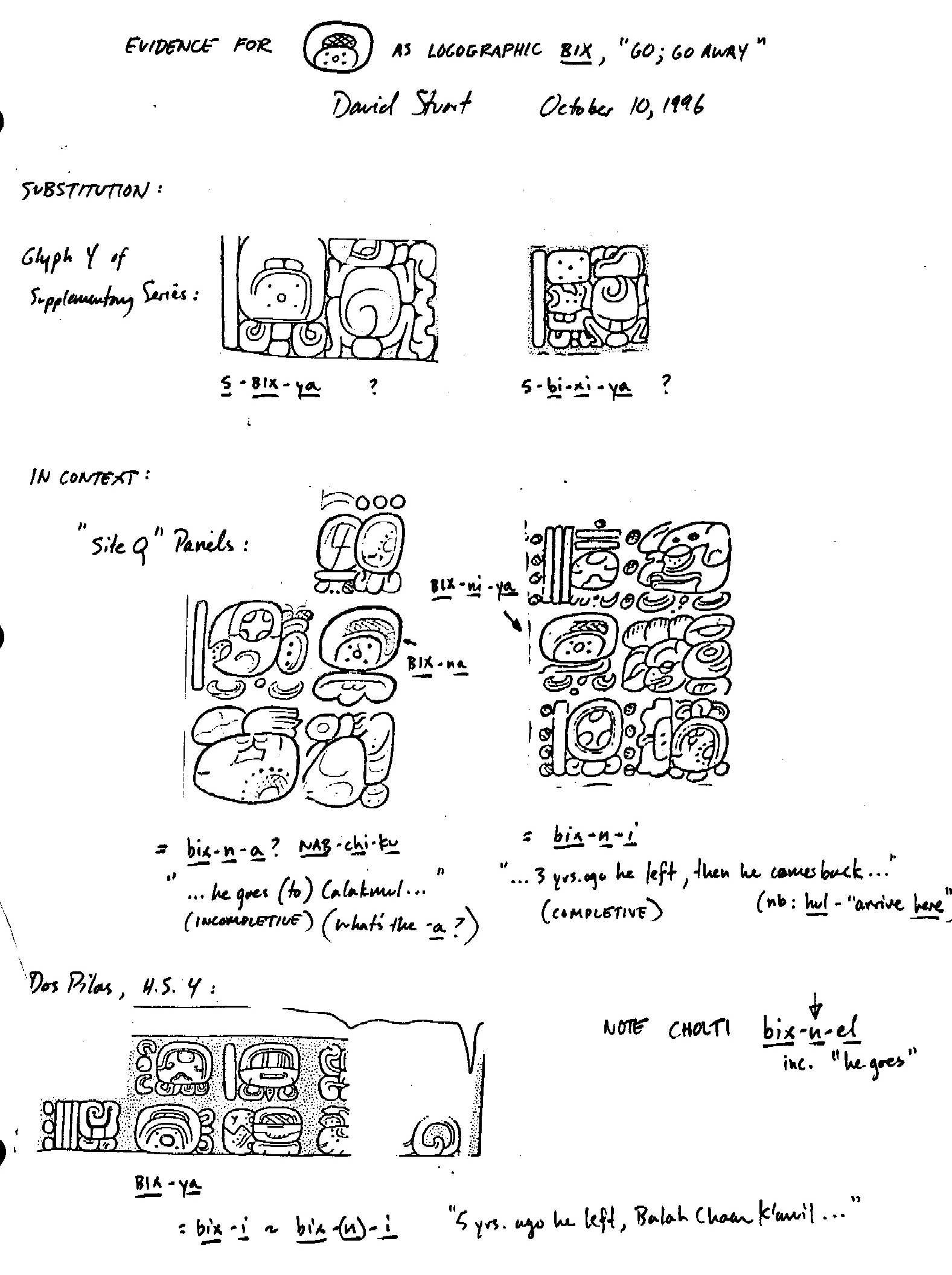


You must be logged in to post a comment.