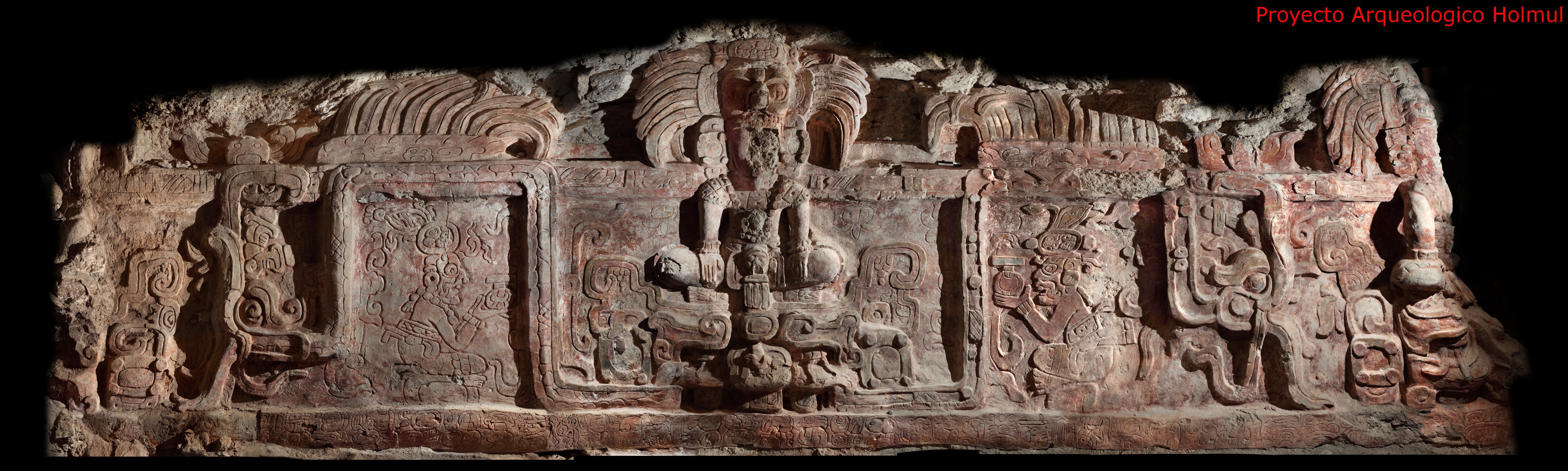
A large and beautifully preserved temple facade has been unearthed this year at Holmul, Guatemala, by an archaeological team led by Francisco Estrada-Belli. The imagery features a local Holmul ruler named ? Chan Yopaat seated atop a world mountain (witz). Large serpents emerge from the witz mask and face toward other seated figures — possibly ancestors — at the corners.
One unusual and important feature of the Holmul facade is a long hieroglyphic text that runs along the bottom of the scene. This is now being closely studied and documented by Alex Tokovinine of the Holmul project. It contains a number of royal names, including that of the contemporary ruler from nearby Naranjo, “Aj Wosaaj.” The inscription also refers to the ruler of the Snake kingdom (Kaanul or Kaanal) when it was based at Dzibanche.
A great find. I only wish Francisco had found this before we had our Art of Maya Architecture gathering at the 2013 UT Maya Meetings!
The El Peru Regional Archaeological Project has announced some significant epigraphic discoveries made over the past two seasons, focusing on two new inscribed monuments, numbered Stela 43 and 44. These include some interesting new historical characters and hints at wider regional politics of the 6th century, a time that is still poorly understood in Maya history overall.
A by-product of giving public talks is that, at times, a member of the audience will introduce themselves and offer an unexpected image: a glyphic text not seen before or since. This happened to Houston in 1994, at a Maya Society meeting in Washington, DC. The chat was brief, the name of the owner escapes us now (if it was ever noted), and the photos settled into one of many piles in Houston’s office. Yet such finds are always worth sharing, whatever their current location.
Figure 1. Photograph of earspool set and “hair-ornament” (Photographer unknown)Figure 2. Same photograph with enhancement (Photographer unknown, enhancement courtesy of Simon Martin).Figure 3. Drawing of set by Alexandre Tokovinine.
The attached images and drawings—the latter by Tokovinine, with slight suggestions by Houston—show a set of earspools and what might be a perforated jade bead to gather a ponytail or serve as a forehead ornament (Figures 1, 2 and 3). There was no scale in the photograph, but the assumption is that the earspools were fairly large, perhaps 7 to 9 cm across, at least to judge from similar examples with known measurements (e.g., K1365, K3166). Carved by the same lapidary artist, the pair clearly forms a coherent whole. One depicts the so-called “baktun” bird, perhaps a celestial eagle. Its pectoral indicates some close but unspecified tie to the Principal Bird Deity. The other displays, not a bird in full flight, but a swimming lizard with scutes running up and down his front and back legs. The central design, a quadripartite element with four lobes, appears to represent a cavity at the center of each creature. Was this a witty reference to the central perforation or an allusion to their emergent state?
Cosmic layering must have related in some poorly understood manner to the display function of such earspools, one to either side of a ruler or nobleman’s face (Carter et al. 2012; http://antiquity.ac.uk/projgall/carter333/). The creatures on our earspools do not, however, show any evidence of complementary orientation. Rather than facing into the royal visage, as in some ornaments with human bodies or faces, they appear to face in the same direction. The position of the glyphs on the reptile or turtle suggests that it was oriented so that the text could be viewed in vertical position. The “Baktun” bird is less clear in placement.
The site from which these objects came is uncertain. Two possibilities come to mind:
(1) On the reptile earspool, the main sign of the Naranjo emblem occurs with the number 4, at the beginning of that text (the number “6” also occurs with this sign on Naranjo Stela 45 and a stucco frieze found by William Saturno at Xultun and reported at the 2013 Texas Maya Meetings). The presence of the number hints at cosmic directional symbolism. Perhaps the following glyphs designate a place within a particular location. Presumably, the first glyph reads AHK-ku or AHK-TUUN, followed by a toponymic sequence that is well-attested in Maya inscriptions (Stuart and Houston 1994:figure 9). Indeed, the reptile on the earspool may refer to the toponym in some way.
Figure 4. Name of Naatz Chan Ahk on Naranjo Stela 45 (Field Drawing by Alexandre Tokovinine).
There are other dynastic links on the “Baktun” bird, close to another earspool discovered in Tomb 2 of Río Azul 1 At the back of the bird, carried notionally on its back (cf. K2131, of the Principal Bird Deity), is na-tzu-[CHAN?]AHK, a ruler of Naranjo, Naatz Chan Ahk (Martin and Grube 2008:70-71). The chan (or kan) glyph seems to be missing here, but it may have been elided or incorporated into the ahk head, as on Naranjo Stela 45 (Figure 4).
(2) A similar name occurs at Río Azul, also from the Early Classic period. The name appears in two places. The first is on a looted vessel in the Detroit Museum of Fine Arts (#1984.12.A, formerly Peter Wray collection, see also K1446; Taylor 2000). The Detroit vessel likely originated in the sacked Río Azul Tomb 12, which contains the second example: na-tzu-AHK (Adams 1999:Figure 3-16). The Detroit vessel shows the turtle with gaping mouth and pronounced beak. In an email, David Stuart wonders whether this creature is a snapping turtle, that ferocious consumer of human toes and fingers. After all, the snapper is, in Stuart’s memorable phrase, the “badass of turtles”!
Figure 5. Incised turtle shell with name highlighted in grey-tone (Drawing by Linda Schele).
The parallel with the earspool from Tomb 2 at Río Azul is suggestive. The living lord appears, not on the tail of the bird, but on its head. Our suspicion is that the name on our earspool is a hitherto undetected ruler of Naranjo or, perhaps less likely, of Río Azul. The glyphs are difficult to read with any precision, but may have included a WAHY(IS) — note the characteristic percentage sign on the forehead of the spelling on the turtle shell. In all likelihood, the same ruler owned, as a MAM, “grandfather/ancestor,” an incised turtle shell that is also unprovenanced (Figure 5, note the highlighted glyph). Could this object have come from the same deposit as the earspools?
Incidentally, it is intriguing that the turtle shell was called a yu-k’e-sa?, “weeper,” a tag found in another context by Marc Zender (2010:84, pl. 43; cf. the so-called “Pearlman Conch,” now in the Chrysler Museum of Art, #86.457, Coe 1982:123, with its unambiguous yu-k’e-sa). Clearly used in music making, these objects might have been less about joyful celebration than a different intent, to make the sounds of mourning or the keening summons of spirits. Indeed, many Maya objects, especially of ancestral shells, might have been rough equivalents to the jet mourning jewelry of the Victorians: a reminder and fetishized evocation of the deceased.
As for the bead or hair- or forehead ornament, there is little to be said: a K’AWIIL above the head of a human being with K’IN earspool.
Any addition to the corpus of texts is welcome. These finds, taken illicitly from Guatemala, remind us of how little is known about Maya ornament. Of small size but large meaning, they invite closer study and broader comparison.
NOTES:
Note 1. This earspool is on display in the Museo Nacional in Guatemala City, with the name of a local ruler, JOL-BAHLAM, on its head. The same name occurs on Temple Structure A-2 at the site, reproduced in a lamentable drawing by R. E. W. Adams (1999:Figure 3-19, B7).
REFERENCES CITED:
Adams, R. E. W. 1999. Río Azul: An Ancient Maya City. University of Oklahoma Press, Norman.
Carter, Nicholas P., Rony E. Piedrasanta, Stephen D. Houston, and Zachary Hruby. 2012. Signs of Supplication: Two Mosaic Earflare Plaques from El Zotz, Guatemala. Antiquity 86:Project Gallery; http://antiquity.ac.uk/projgall/carter333/.
Coe, Michael D. 1982. Old Gods and Young Heroes: The Pearlman Collection of Maya Ceramics. Israel Museum, Jerusalem.
Martin, Simon, and Nikolai Grube. 2008. Chronicles of the Maya Kings and Queens: Deciphering the Dynasties of the Ancient Maya. 2nd ed. Thames and Hudson, London.
Stuart, David, and Stephen Houston. 1994. Classic Maya Place Names. Studies in Pre-Columbian Art and Archaeology 33. Dumbarton Oaks Research Library and Collection, Washington, D.C.
Taylor, Dicey. 2000. A Chocolate Cup for Eternity in the Road of Awe: The Detroit Cylinder Tripod. Bulletin of the Detroit Institute of Arts 74(1-2):4–19.
Alfred M. Tozzer during his 1905 fieldwork with the Lacandon Maya
These days it might seem easy to dismiss the idea of “lost cities” as a thing of the past, or as a romanticized notion from a by-gone era in Maya archaeology and exploration. After all, most significant sites are pretty well-known by now, even if not fully explored and mapped by archaeologists. But a few unknown places and remains are still “out there” awaiting discovery, as this year’s announcement about the site of Chactun dramatically demonstrates.
Another intriguing case involves a Maya ruin called Tzendales, located somewhere in the remote forests of the Selva Lacandona of Chiapas, Mexico. As far as I’m aware no one knows its exact location, yet the site was visited in 1905 by the Harvard anthropologist Alfred Tozzer when he was doing ethnographic fieldwork among the Lacandon Maya of the area. Tozzer paid a brief visit to the ruins and noted the presence of large buildings, one bearing a sizable roof-comb. Inside a vaulted chamber he came upon a well-preserved panel or stela bearing the portrait of a Maya king. No outsider ever returned to the ruins after Tozzer’s first visit, so at least from the vantage point of archaeological research Tzendales remains a true “lost city.”
An excellent article on the mystery of Tzendales was written a few years ago by the Mexican author Carlos Tello Díaz. I recall meeting Carlos when he stopped by our offices at the Peabody Museum at Harvard at the time he was researching in the archives and looking over Tozzer’s original field notes. We chatted about the remarkable case of Tzendales, and our mutual amazement that how no one yet knew its location even a century after Tozzer’s visit. Carlos ended up going to the Chiapas rain forest in 2000 and found the abandoned lumber camp where Tozzer stayed before and after his foray to the ruins. But still Tzendales itself remained elusive in the surrounding jungle.
The Tzendales stela. This drawing was published by Herbert Spinden in his 1913 A Study of Maya Art, based on Tozzer’s original field sketches.
What of the stela? Thanks to the accuracy of Tozzer’s old sketch we can make out a good deal about its inscription. The text first runs down the long vertical column then up to the two glyphs above the headdress. It all begins with the Calendar Round date 7 Imix 13 Zip and later on cites the period ending 8 Ahau 8 Uo (9.13.0.0.0). A Distance number of 16.19 bridges the two dates, giving us a firm anchor for both in the Long Count:
The first episode refers to the dedication or ritual refurbishment of a tomb for a local ruler named K’ahk’ Witz'(?) K’awiil (a name that is very similar to that of Ruler 12 of Copan, by the way). The portrait is probably of this same local ruler, or just perhaps of the living king who oversaw the dedicatory ceremonies for his deceased ancestor. An emblem glyph (court title) in the thirteenth block is intriguing but unrecognizable.
Roughly translated, the text reads:
“At the day’s darkening, on Seven Imix (G3, F) the thirteenth of Chakat,
the fire enters into the eht(?) naah, which is the name of his burial (at?) Juuntz’i’nal,
of the k’atun lord K’ahk’ Witz’ K’awiil, the ? Lord.
It is nineteen and sixteen-score days before
Eight Ajaw the eighth of Ik’at, (when) the thirteenth k’atun will occur,
that it happens.”
No one can say for sure if the Tzendales stela or panel even still exists; it’s just possible that it still lies in the deep forest where Tozzer left it over a century ago.
INAH (Mexico’s Instituto Nacional de Antropología e Historia) has posted video footage of the newly discovered site of Chactun, Campeche. The ruins were located and surveyed this season by archaeologist Ivan Sprajc and his colleagues. It looks like a fascinating place with large structures and inscribed monuments, one of which mentions a Late Classic ruler by the name of K’inich Bahlam. Ivan and Octavio Esparza are featured in the video, explaining the significance of the discoveries.
A big congratulations to Ivan, Octavio and everyone involved. I’m sure many can’t wait to hear more about the find.




You must be logged in to post a comment.