Our friends over at Mesoweb have launched a new series of short reports called La Corona Notes, featuring interpretations and data from the Proyecto Arqueológico Regional La Corona. The series editors are Marcello Canuto of Tulane University, Tomás Barrientos of the Universidad del Valle de Guatemala, and David Stuart of The University of Texas at Austin.
A number of upcoming contributions to the series will feature epigraphic studies of La Corona’s many inscriptions, including the new texts from Hieroglyphic Stairway 2, discovered last year. Maya Decipherment will regularly announce and provide links to these future works as they come up.
The first note in the series is “The Importance of La Corona” by project directors Marcello Canuto and Tomás Barrientos.
(Photo: Detail of La Corona Panel 1, by D. Stuart)
Narrative scenes in Maya art are not always as simple as they might seem. Take for example this image of a ballgame on Monument 171 from Tonina, Chiapas. This small relief sculpture was discovered some years ago in the site’s acropolis, and is now on display near the entrance to the Sala Maya in the Museo Nacional de Antropología in Mexico City.
Figure 1. Monument 171 from Tonina, showing the king of Calakmul, at right, playing ball with the deceased ruler of Tonina K’inich Baaknal Chahk, at left (Photograph by D. Stuart).
Like many scenes of the Maya ballgame, the Tonina relief shows two players in action with knees on the floor and a large ball between them. Three text panels are integrated within the scene and identify the actors and the time-frames of the game depicted. The central and right-hand sections form one continuous text, with the text at the the far left as a stand-alone caption for the left-hand figure. (Note: In the accompanying illustration I have re-lettered the columns to reflect the true reading order, so that columns A-B are at the center of the composition, above the large ball; columns A-B in the Corpus publication are here given as F-G).
Figure 2. Drawing of Monument 171 by Ian Graham, showing new column designations to reflect true reading order. (Adapted from Graham, et. al. 2006)
The date opening the main caption (A1-A2) is 9.14.16.2.12 7 Eb 5 Kankin, or October 31, 727 AD, during the reign of the Tonina ruler known as K’inich Yich’aak(?) Chapat, who had assumed the throne a few years earlier in 723 (See Mathews 2001 for a useful tabulation of Tonina’s dates and history). The event phrase (B2-A3) is very clear as u baah ta pitz, “(it is) his image in (the act of) ball-playing,” repeating a sequence of glyphs found also in the secondary caption at the far left (a curious echoing of phrase that is meaningful, and which we will return to).
So who’s playing ball? One might think that the text would simply name the two players, but in fact there are three people named in the accompanying glyphs. As I hope to explain, the added complexity reveals interesting aspects about how Maya artisans sometimes layered narrative history and manipulated text-image relationships in order to point emphasize certain important narrative elements involving actors and time-frames that might otherwise be obscure.
The subject of the main ball-playing expression is named in blocks B3-C1, and here we find something of a surprise. This is not the name of the local Tonina king, but instead looks to be that of the king who was ruling at distant Calakmul, an important character known in the literature as Took’ K’awiil (a provisional nickname; see Martin and Grube 2000:112). His name phrase is quite clear, reading across the body of the right ballplayer to highlight his identity, and identical to examples known from Calakmul and surrounding areas. After the name and the accompanying kaloomte’ title (C1) we come upon an undeciphered glyph — clearly a possessed noun (U-ma-?-li) (D1) — followed by the name of the local ruler K’inich Yich’aak(?) Chapat (E1-D2) and his two royal court titles (emblem glyphs), followed in turn by another example of the honorific term kaloomte’. The undeciphered glyph at D1 must express some relationship between the ballgame or the Calakmul king and the contemporary Tonina ruler, although the nature of this connection still remains unclear (I recall seeing one other example of this same odd relationship glyph in another Tonina inscription that remains unpublished).
The ballplayer to the left is named in the caption behind him. This reads, in loose translation:
He is playing ball, the one k’atun kaloomte’, K’inich Baaknal Chahk, the Holy Lord of Po’
Here we have another ruler familiar from the Tonina’s history. However — and this is the truly odd aspect of the scene — at the time of the ballgame K’inich Baaknal Chahk had not been a ruler for nearly twenty years. He had been an important king who waged several notable wars against Palenque and its allies, but who died probably around the year 709, shortly before his young successor, Ruler 4, came to power on 9.13.16.16.18 9 Etznab 6 Muan. The next ruler after him, in turn, was K’inich Yich’aak(?) Chapat. So we have an odd situation at hand: a scene from the year 727 depicting a long-deceased Tonina ruler playing ball with a foreign Calakmul lord, with the current king named but not even shown.
So what gives? I believe we have here an excellent example of a common but little known convention in Maya art where times and identities can intentionally “merge” for narrative effect. One might even call it a form of visual poetics used by artists to carefully draw parallels and connections that, while not explicit on the surface, were nonetheless readable and knowable to those familiar with the conventions of Maya imagery. The 727 ballgame was probably real, a ritual contest involving the ruler of Calakmul Took’ K’awiil and the Tonina king who was alive at the time, K’inich Yich’aak(?) Chapat. Such royal ballgame scenes were frequently commissioned as a means of documenting long-distance alliances and hierarchical connections, and were used especially in the sphere of the Calakmul (Kaanal) court (examples are known from La Corona, Uxul and Hixwitz, among other places). The point of adding K’inich Baaknal Chahk’s image to this scene is, I think, to collapse this 727 event with a similar ballgame of a prior generation, involving the same Calakmul king and a deceased Tonina hero. The Calakmul ruler Took’ K’awiil was alive and on the throne in both time-frames, having acceded to the throne in 698. I suspect that he may held some important role in the complex geopolitics of Chiapas at the end of the seventh century, perhaps turning his attention westward after the defeat of the Kaanal kingdom by Tikal in 695. It’s probably no accident that Calakmul would find an ally in Tonina, who had for years been in conflict with its northern neighbor Palenque, itself an old enemy of the Kaanal kingdom. At any rate, the connection between the two ballgame events isn’t described textually or in conventional narrative fashion, yet it seems implicit in the juxtaposition of time with the actors shown.
Similar depictions of two subjects “out of time” with one another appear with some frequency in Maya sculpture. For example, La Corona Panel 1 shows two standing figures facing one another, each identified as the same ruler, K’inich ? Yook, on different ritual occasions. The scenes of the three tablets of the Cross Group at Palenque offer a similar juxtaposition of two inward-facing portraits of one king, K’inich Kan Bahlam, at different stages of life (as a young boy and as a middle aged man). A better parallel perhaps comes from the bench tablet of Temple XXI from Palenque, showing the deceased ruler K’inich Janab Pakal overseeing the bloodletting rites of his grandsons. In many of the Palenque narratives, earlier events and subjects are presented on the left, with later or contemporaneous protagonists on the right (the more “dominant” side of a composition).
I suggest that the Tonina ballgame scene presents a similar artistic stratagem. The written date and the subjects are carefully specified but are historically incompatible, a incongruence that serves to highlight the artist’s underlying message, linking an episode of current history with something parallel and similar in the past. I suspect this is why we have the apparent redundancy of two repeating phrases in the scene that simply state “he is playing ball” — each is needed because they serve in different historical moments. In Maya texts, the rhetorical links between such like-in-kind episodes are extremely common, and I would argue that Maya artists were just as keen in showing such connections, though perhaps not so linearly or directly. This then is a figurative ballgame, documenting to a old alliance between Tonina and the Kaanal court during the reign of K’inich Baaknal Chahk, and collapsing it with a more current relationship during the reign of K’inich Yich’aak(?) Chapat.
So this small elegant carving gives us with a fine example of how the ancient Maya conveyed layered and complex meanings involving time and identity, offering much more than first meets the eye.
REFERENCES CITED
Graham, Ian, David Stuart, Peter Mathews, and Lucia R. Henderson. 2006. Corpus of Maya Hieroglyphic Inscriptions, Volume 9, Part 2: Tonina. Peabody Museum, Harvard University, Cambridge, MA.
Martin, Simon, and Nikolai Grube. 2000. Chronicles of the Maya Kings and Queens: Deciphering the Dynasties of the Ancient Maya. Thames and Hudson, London.
Mathews, Peter. 2001. The Dates of Tonina and a Dark Horse in Its History. The PARI Journal 2(1):1-5. Link to pdf here.
Located within the deep tropical rainforest of Chiapas, Mexico, the Maya site of Bonampak is home to the most complete and magnificent mural program of the ancient Americas. In three rooms, a pageant of rulership opens up, scene by scene, like pages of an ancient Maya book. Painted c. AD 800, the murals of Bonampak reveal a complex and multifaceted view of the ancient Maya at the end of their splendor during the last days of the Classic era. Members of the royal court engage in rituals and perform human sacrifice, dance in extravagant costumes and strip the clothing from fallen captives, acknowledge foreign nobles, and receive abundant tribute. The murals are a powerful and sophisticated reflection on the spectacle of courtly life and the nature of artistic practice, a window onto a world that could not know its doomed future.
This major new study of the paintings of Bonampak incorporates insights from decades of art historical, epigraphic, and technical investigation of the murals, framing questions about artistic conception, facture, narrative, performance, and politics. Lavishly illustrated, this book assembles thorough documentation of the Bonampak mural program, from historical photographs of the paintings—some never before published—to new full-color reconstructions by artist Heather Hurst, recipient of a MacArthur award, and Leonard Ashby. The book also includes a catalog of photographs, infrared images, and line drawings of the murals, as well as images of all the glyphic texts, which are published in their entirety for the first time. Written in an engaging style that invites both specialists and general readers alike, this book will stand as the definitive presentation of the paintings for years to come.
Back in 1979, excavations at Yaxchilan overseen by Roberto García Moll unearthed several carved bone objects within Tomb 2 of Structure 23 (Mathews 1997:161; Perez Campa 1990:150). Among them were the two artifacts in the figure below, each with a carved deity head on one end and a short hieroglyphic inscription (there were other similar bones as well, not treated here). In this report I would like to offer a few observations on the short texts, focusing mainly on the relationship they bear to the deity images.
As one can see in the drawings, these intriguing bones are pointed at one end, which might lead one to think they functioned as ritual bloodletters. I’m not so sure this is the case here, given their blunt appearance. It’s possible that they were pin-like devices inserted in some sort of unknown material, not unlike similar objects recently described by Martin (2012:77) in the paintings of Structure Sub 1-4 at Calakmul. Unfortunately the texts do not say exactly what they were used for — as we will see, one is simply a “jaguar bone” (Bone 1) and the other is an “offering bone” (Bone 2).
Each text is structured somewhat differently, but both clearly label the objects as belonging to Ix K’abal Xook, the noted queen of Yaxchilan from the early eighth century who is depicted on a number of sculptures at the site, including the famous carved door lintels of Structure 23 (Lintels 24, 25 and 26). Each text also includes a god’s name corresponding to the carved head, placed differently in each case.
BONE 1:
A1-A5: u-ba ke-le BAHLAM-ma IX (k’a-ba)-la u baakel bahlam Ix K’abal (it is) the jaguar’s bone of Lady K’abal
B1-B3: XOOK?-ki AJ-K’AHK’ o?-CHAHK-ki Xook / Aj K’ahk’ O’ Chahk Xook. (It is) Aj K’ahk’ O’ Chahk.
BONE 2:
A1-A3: to-k’a-la AJAW-wa U-MAY-ya-ji took’al ajaw u mayij Flint Lord is the offering
B1-B3: ba-ki IX-(k’a-ba)-la XOOK?-ki baak Ix K’abal Xook bone of Lady K’abal Xook.
The text on Bone 1 (a provisional designation, by the way) looks to have two segments. One is a name-tag based on the interesting term u baakel bahlam, “her jaguar bone…,” with he name of the owner, Lady K’abal Xook, continuing to glyph B1 on the obverse side. Glyphs B2 and B3, larger in size than the others, seem to stand apart as a separate name. This is familiar from a number of other texts as Aj K’ahk’ O’ Chahk, an important royal patron deity of Yaxchilan. The small head atop Bone 1 does indeed resemble as aspect of Chahk, the storm god, with a possible pointed diadem and and rope pectoral.
Aj K’ahk’ O’ Chahk was a local deity, named and depicted only at Yaxchilan and environs. I suspect he was the principle patron of the royal throne of Yaxchilan, not unlike GI was for Palenque, given his central role in the rhetoric of royal accession at the site (as on Lintel 25 and 35, among others). The first part of his name, Aj K’ahk’, means “He of Fire,” although this title doesn’t always seem to be present. The core portion of the name simply seems to be O’ Chahk (and, no, there is no evidence he was Irish). O’ is the name of a raptorial bird whose image appears in the glyphs as the head sign with the values o (a syllable)or O’ (a logogram); this head sign is usually simply abbreviated as the spotted feather, so that in these deity names we seem to have the sequence O’-CHAHK-(ki) (see Figure 2a and 2b, below). The O’ Chahk name corresponds to the headdress worn by Yaxchilan’s rulers during important dedication ceremonies, as shown in Figure 2a. Here the o’ bird is stacked atop the head of Chahk, essentially replicating the hieroglyphic name O’-CHAHK in iconographic form.
Figure 2. (a) The deity O’ Chahk as a headdress, from La Pasadita, Lintel 1. (b) the name Aj K’ahk’ O’ Chahk from Yaxchilan, Lintel 25, (c) The name O’ Chahk from Yaxchilan, Lintel 35. (Drawings by Ian Graham)
Bone 2 references a different god named Took’al Ajaw, “Flint-knife Lord,” who thus far has gone unrecognized. The inscribed statement is a bit more direct about the identity of the object, saying that “Took’al Ajaw is her offering bone.” Atop the bone we see a god resembling the so-called “Jaguar God of the Underworld,” with a long beard-like feature as well as a pointed, animated flint knife for a forehead — hence his name. This deity is also of local importance at Yaxchilan. Several portraits of him can be fount at the tops of stelae that depict consecration rites on important Period Endings and anniversaries, where he is always shown above a sky band and in-between ancestral portraits of the rulers mother and father (Figure 3). Otherwise we know little about him, or his connection to other members of the local pantheon.
Figure 3. The top fragment of Stela 4 from Yaxchilan (front), showing the parents of Shield Jaguar II as the sun and the moon. Took’al Ajaw, with his flint headdress, appears between them as another celestial deity. (Photograph by Teobert Maler)
It seems that Structure 23 was the formal “house” of Ix K’abal Xook, with Tomb 2 her likely burial place (See Plank 2004:35-54). Several other bones bearing her name were found in the tomb, including one very elaborate mayij baak named for another deity named Bolon Kalneel Chahk. He was evidently another aspect of the storm god who was important in local rituals and political symbolism.
What were these small objects used for, then? It is difficult to say for sure, and the texts on them are not as explicit on this point as we would like them to be. The job of these glyphs was more to identify the owner (Ix K’abal Xook) and the deity depicted. If allowed to speculate, I wonder if such pointed bones might themselves have been used as elaborate figural “labels,” inserted into incense or food offerings (mayij) or some other substance as a way of attributing or directing them to different gods. There is no way to prove such a function, but it might be a useful avenue to ponder and explore further. At any rate, I hope to revisit these issues in a future post, looking at other examples and varieties of inscribed bone artifacts.
References:
Martin, Simon. 2012. Hieroglyphs from the Painted Pyramid: The Epigraphy of Chiik Nahb Structure Sub 1-4, Calakmul, Mexico. In Maya Archaeology 2, pp. 60-81. Precolumbia Mesoweb Press.
Mathews, Peter Lawrence. 1997. La Escultura de Yaxchilan. INAH, México, D.F.
Perez Campa, Mario. 1990. La vida en Yaxchilan. In La exposición de la civilización maya, pp. 149-154. Mainichi Shinbunsha, Tokyo, Japan.
Plank, Shannon E. 2004. Maya Dwellings in Hieroglyphs and Archaeology: An Integrative Approach to Ancient Architecture and Spatial Cognition. BAR International Series 1324, Oxford, England.
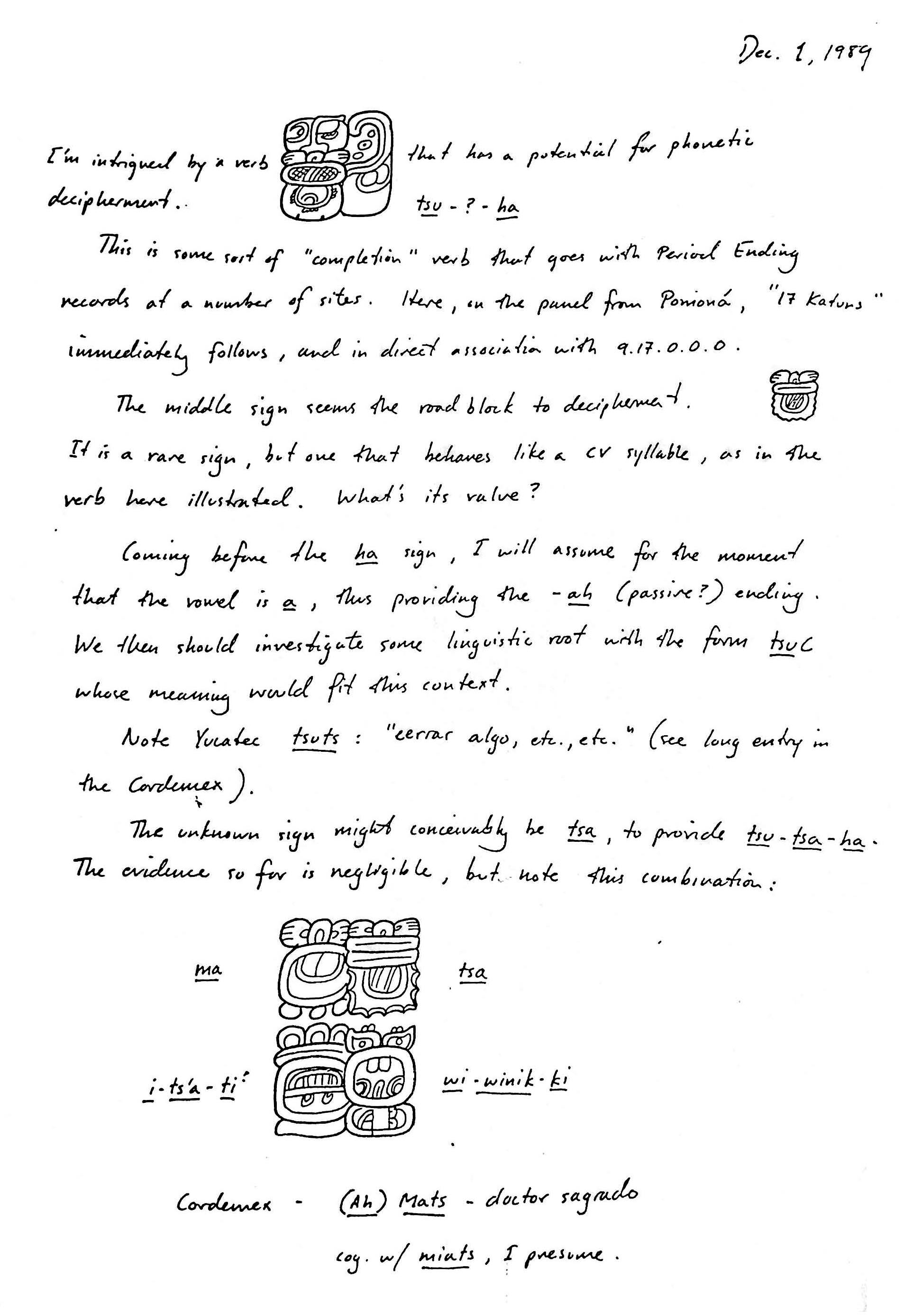
Below is a page from one of my old notebooks, giving some of the evidence I was considering in 1989 for the decipherment of the tza syllable sign, a version of which is shown at right. The reasoning was pretty tentative back then, but it was bolstered in my own mind by considering more examples of the sign in the spellings of tzu-tza-ja and TZUTZ-tza-ja, for the passive for of the verb tzuhtzaj, “it is finished” (See Stuart 2001). Shortly after this page was jotted down I came across completive forms spelled 2tzu-ji-ya (with the tzu syllable doubled) for tzuhtz(a)jiiy, “it was finished,” which made the tza reading fairly certain.
The tza syllable sign is not a very common sign. It crops up in only a handful of other spellings, such as tza-ka or tza-ku for tzak, “to conjure, manifest (a god)” — a reading otherwise familar for the “fish-in-hand” logogram (TZAK).
Reference Cited:
Stuart, David. 2001. A Reading of the “Completion Hand” as TZUTZ. Research Reports on Ancient Maya Writing, No. 49. Center for Maya Research, Washington, D.C.


You must be logged in to post a comment.