A Watery Tableau at El Mirador, Guatemala

by James Doyle (Brown University) and Stephen Houston (Brown University)

The impersonation of gods abounds in Classic Maya texts and imagery (Houston, Stuart, and Taube 2006: 270-275). Humans donned elaborate masks and costumes to channel deities and to perform dances or reenactments of mythic actions. It is now clear that there were Late Preclassic antecedents to such ritual: for example, Kaminaljuyu Stela 11 displays the “x-ray” view of a lord’s face within the head of the Principal Bird Deity (Fields and Reents-Budet, eds., 2005: Cat. 6, 104-105; see also here). The appearance of a possible masked performer in the Preclassic is hardly surprising. Places for performance and assembly– visible pyramid apices, tiered façades, and plaster-covered plazas — reached their pinnacle size at many Lowland Maya sites.

A recent discovery by the important project at El Mirador, Guatemala, consists of a long set of stucco friezes that depicts two more examples of Late Preclassic deity impersonation (Figure 1). The façades are located in a prominent pathway running east-west in the center of the “Central Acropolis.” They appear to front a large plaza at the base of the “Tecolote” pyramid complex, perhaps adorning part of an ancient water collection system (see map). The figures on the lower frieze have been associated with the Hero Twins, Hunahpu and Xbalanque, protagonists of the colonial K’iche Maya creation story, the Popol Vuh (Hansen et al. 2011: 190). Yet, in our view, these figures represent god impersonators and bear no secure connection to twins in the Popol Vuh.

Figure 1. 3D scans of El Mirador friezes, University of South Florida, Alliance for Integrated Spatial Technologies, http://aist.usf.edu/projects/elmirador/.

The lower, more prominent façade contains three beings: two humans with large headdresses, and the large profile head. The figure on the left, whose face is partially damaged, wears a headdress and shell ear spools. His one visible eye has the inverted-“L” found on some early gods; his mouth displays a circular outline, his outstretched arms and bent legs conform to the pattern of many diving figures in Maya art (see Taube et al. 2010: Fig. 54A).

The central figure strikes a similar posture but in the opposite direction. Both are framed by the diagonal elements with elliptical or volute decorations that recall primordial, living sky bands. The attributes of these bands mark them as maxillae of the animate sky, complete with curved fangs and other teeth; another well-known example is present in a Late Preclassic frieze from Calakmul (Carrasco Vargas 2005: Figure 3, 4).

Figure 2: Chahk figures with curled foreheads or hair (blue) and shell ear spools (green). (a) Calakmul Frieze (drawing by James Doyle after Carrasco Vargas 2005: Fig. 3, 4); (b) Uaxactun Group H Frieze (drawing by James Doyle after Valdés 1993: Fig. 50); (c) Kaminaljuyu Stela 4 (drawing by James Doyle after Taube 1996: Fig. 16b); (d),(e) Izapa Stela 1 (drawings by James Doyle after Taube 1996: Fig. 15a, e); (f) El Mirador Lower Frieze, detail (drawing by James Doyle and Stephen Houston).

The central figure wears a simple knotted belt with an effigy head attached to his lower back. His headdress and chinstrap form the gaping jaws of what is likely a version of Chahk, the god of rain (see Taube 1996: Fig. 15, 16): the diagnostic elements are the curled forehead (or hair) and especially the Spondylus ear spool (Figure 2). The figure on the viewer’s left shares many of the same features, but with different, tufted forehead, as though referring to another aspect of the rain deity. Other such costumed diving figures with curled foreheads appear on contemporaneous stucco friezes at Uaxactun Group H (Valdés 1993: Fig. 50), and Calakmul (Carrasco Vargas 2005: Figure 3, 4).

The profile head on the far right of the lower frieze resembles the many depictions of mountains as breathing beasts in Preclassic and Classic period iconography, such as the witz depicted on the North Wall at San Bartolo (Saturno et al. 2005: 14-21). Perhaps there was another such head on the opposite side, framing this scene as a mythic, mountainous locale from which clouds emerged. This trope in particular goes back to Chalcatzingo Monument 1 (Grove, ed. 1987:115-117) and highlighted in variant form on the San Bartolo North Wall.

The upper façade is an early water-band that contains two large water birds with outstretched wings. The water-band passes over two bulbous cloud or muy elements with swirling volutes, another, archaic guise of Chahk (see Stone and Zender 2011: 142-143). A fascinating detail of the upper frieze is that the artist(s) gave faces – in an archaic, almost “Olmec” style with a snarling upper lip and a single tooth – to the clouds, as if they are peering upward at the water. The central bird figure has the head of an older deity within its breast. This enigmatic bird-god figure appears on many Classic Maya vessels (e.g., K8538, K6181, K6438, K3536, see Finamore and Houston, eds. 2010: 104; see also a related Spondylus shell creature on stuccoed vessel K2027), and is not well understood. The bird on the left of the upper frieze (see here) is likely a cormorant, which possibly would have held a fish in its beak (see K6218, Finamore and Houston, eds. 2010: 103). The water band, probably representing flowing streams of water, as well as avian themes are also present on a slightly later stucco altar from Aguacatal, Campeche (Houston et al. 2005).

The stucco artists of El Mirador were concerned with rain, clouds, waters, Chahk, and water birds that all flow together in the Maya view of grand, hydrological cycles. Perhaps the friezes show a situational composition – a Late Preclassic view of the rainy sky and the water that swirls around in it. Or, perhaps the artists commemorated a narrative of the first rainmakers and their watery assistants. In this way the rulers of El Mirador, through the mechanism of deity impersonation, presented themselves as supernatural agents who controlled the rain. The lower freeze shows the mountains breathing out water as the Chahk impersonators swim in the lower sky; the upper frieze then shows the high altitude products of impersonation, clouds that embody Chahk, and undulating water.

REFERENCES CITED

Carrasco Vargas, Ramón. 2005. The Sacred Mountain: Preclassic Architecture in Calakmul. In Lords of Creation: The Origins of Sacred Maya Kingship. Los Angeles: LACMA/Scala Publishers.

Fields, Virginia M., and Dorie Reents-Budet. 2005. The Lords of Creation: The Origins of Sacred Maya Kingship. Los Angeles: Scala Publishers/LACMA.

Finamore, Daniel, and Stephen Houston, eds. 2010. The Fiery Pool: The Maya and the Mythic Sea. New Haven: Yale University Press.

Grove, David C., ed. 1987. Ancient Chalcatzingo. Austin: University of Texas Press. Available Online: http://www.famsi.org/research/grove/chalcatzingo/index.html.

Hansen, Richard D., Edgar Suyuc Ley, and Héctor E. Mejía. 2011. Resultados de la temporada de investigaciones 2009: Proyecto Cuenca Mirador. In XXIV Simposio de Investigaciones Arqueológicas en Guatemala, 2010. B. Arroyo, L. Paiz Aragón, A. Linares Palma, y A. L. Arroyave, eds. Pp. 187-204. Guatemala: Museo Nacional de Arqueología y Etnología.

Houston, Stephen, Karl Taube, Ray Matheny, Deanne Matheny, Zachary Nelson, Gene Ware, and Cassandra Mesick. 2005. The Pool of the Rain God: An Early Stuccoed Altar at Aguacatal, Campeche, Mexico. Mesoamerican Voices 2: 37-62.

Houston, Stephen, and David Stuart, and Karl Taube. 2006. The Memory of Bones: Body, Being, and Experience among the Classic Maya. Austin: University of Texas Press.

Saturno, William, Karl Taube, David Stuart, with Heather Hurst. 2005. The Murals of San Bartolo, El Petén, Guatemala Part 1: The North Wall. Ancient America 7.

Stone, Andrea, and Marc Zender. 2011. Reading Maya Art: A Hieroglyphic Guid to Ancient Maya Painting and Sculpture. New York: Thames & Hudson.

Taube, Karl, William Saturno, David Stuart, and Heather Hurst. 2010. The Murals of San Bartolo, El Petén, Guatemala Part 2: The West Wall. Ancient America 10.

Taube, Karl. 1996. The Rainmakers: The Olmec and Their Contribution to Mesoamerican Belief and Ritual. In The Olmec World: Ritual and Rulership. Princeton: Princeton University Art Museum.

Valdés, Juan Antonio. 1993. Arquitectura y escultura en la Plaza Sure del Grupo H, Uaxactún. In Tikal y Uaxactún en el Preclásico. Mexico City: Universidad Nacional Autónoma de México. 96-121.

More links for El Mirador information:

Mirador Basin Project

Archaeology magazine, 2009

Smithsonian magazine article, 2009

Reuters news article, 2009

MAM: Mayas for Ancient Mayan

Here’s a link to the new website for MAM: Mayas for Ancient Mayan, an important effort to bring ancient Maya literature to indigenous communities in Mexico, Guatemala and Belize.

From their website:

Mayas for Ancient Mayan (MAM) supports indigenous Mayas who are thirsting to learn the ancient hieroglyphic writing and the calendar. With financial aid from MAM, our Maya colleagues attend workshops and conferences in the US, Europe, and Latin America to learn the latest advances in decipherment of the ancient writing. Combining these advances with ancient teachings from their own elders, our colleagues spread this knowledge in workshops and classes to the Mayan-speaking communities. MAM supports these efforts.

Dating Tikal’s Mendez Causeway

In an earlier post on Maya Decipherment I speculated that the lengthy text of Tikal’s Temple of the Inscriptions (or Temple VI, dedicated in 766 AD) refers in part to an early building episode of the temple, as well as to the initial construction of the Mendez Causeway — the ceremonial road leading to the Temple of the Inscriptions from Tikal’s central “downtown.” The specific dates from that text are:

9.4.13.4.16 5 Kib 9 Keh (November 11, 527) – “stone-building/-fashioning”
9.4.13.6.14 4 Ix 7 K’ank’in (December 19, 527) – “road-striking”

To quote my earlier post:

I suspect that these historical episodes in 527 AD involve the construction and dedication of an early temple dedicated to White Owl Jaguar. The final episode in this string of related dates says it is the jatz’ bih-tuun, “the road-striking,” or “the pavement striking.” This is an odd phrase found also at Naranjo (on Altar 2), where Nikolai Grube has suggested it refers to the construction of architectural spaces. One wonders of it could be more specifically referencing the building of causeways (bih-tuun, “road of stone”), an attractive interpretation given that Temple of the Inscriptions lies at the end of a very long and important ceremonial road, the Mendez Causeway. Archaeological probing in and around the complex would be needed to make sure, but I suspect that the events of 527 are key episodes in the architectural history of the Temple of the Inscriptions.

Not long ago, during December’s Maya Field Workshop at Tikal, I came upon this interesting tidbit on the Mendez Causeway from William Coe’s guidebook to the site:

“With a length of about three-fifths of a mile and an average width of 200 feet, this causeway originates at the east side of the East Plaza (behind Temple I) and runs almost straight to the Temple of the Inscriptions. Close to the East Plaza the Late Classic causeway with its parapets overlies an earlier causeway without side parapets. The latter may be Early Classic” (Coe 1967:87).

So, there is indeed as early phase of the Mendez Causeway. It seems natural to wonder if this dates to 527, with the overlying later version corresponding to refurbishment of the causeway and temple some 240 years later.

Reference Cited:

Coe, WIlliam R. 1967. Tikal: A Handbook of the Ancient Maya Ruins. The University Museum, Philadelphia.

The Verb Bix, “Go, Go Away”

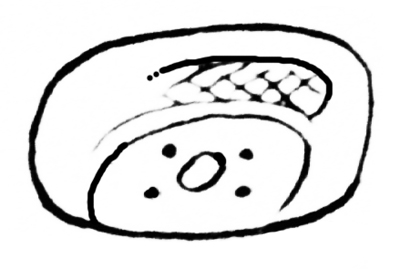
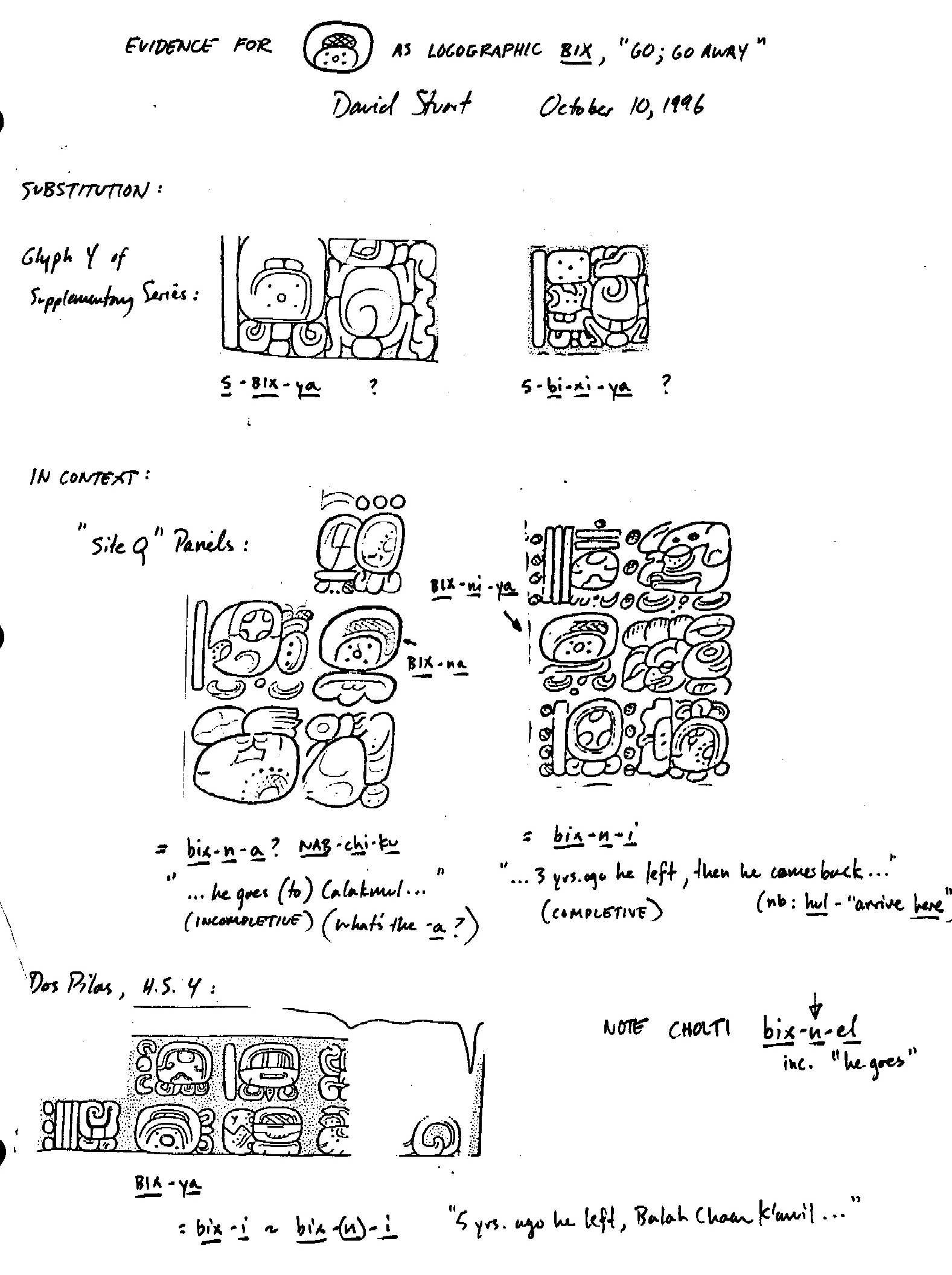
Back in 1996 I made notes about an interesting substitution set that pointed to a reading BIX for a logogram shown here, which makes an appearance in a few inscriptions from Yaxchilan, La Corona, Dos Pilas, Coba, as well as a few others. This value may well have been noted by others back around the same time, if not before, but I thought I would post my old hand-written note summarizing the evidence (having just now found them in an old notebook).

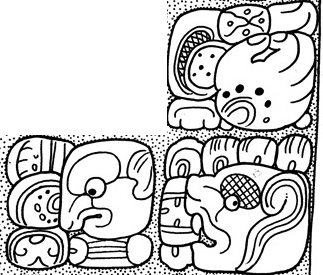
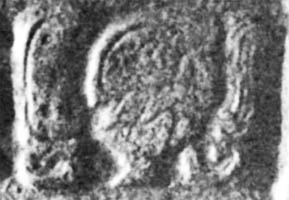
The sign was used to write the intransitive verb bix, “to go,” in a small variety of settings. This verb root can be traced historically to proto-Ch’olan *bix (Kaufman and Norman 1980) and in ancient texts it appears on Dos Pilas HS 4 (see page bottom) as BIX-ya, for bix-iiy, “he went” (in reference to the fleeing of the local ruler Bahlaj Chan K’awiil from Dos Pilas). Spelled BIX-ya or bi-xi-ya, the same verb was used in temporal expressions ho’ bix-iiy, “five days ago” or wuk bix-iiy, “seven days ago” (see top examples on page below). A variant form of  this verb is bix-Vn, “to go, go away,” which appears in Colonial Ch’olti’ and in the glyphs as well. Several examples occur in the texts of La Corona (spelled BIX-na 0r, for the compl,tive, BIX-ni-ya), where they refer to the journeys of the young noble K’inich ? Yook from his home to Calakmul (Chihknahb). A related example turned up long after I wrote those original old notes, on Panel 1 from La Corona (at right), discovered in 2005 by Marcello Canuto.  There we read bix-Vn chihknahb, “he goes to Chihknahb” (the same expression appears on Panel 2, but with a different date — see “Site Q” examples illustrated at the middle of the page).

My favorite example of these “go” verbs comes from Altar de Sacrificios, where on Panel 2 we have bi-xi-ni-ya, for bix-Vn-iiy, “he went away.” Rather than referring to a journey in the real world, this is a citation of a local ruler’s death (cited in more conventional terms on Stela 4, an associated inscription).

I’m as yet unsure what if any semantic distinction existed between between the verbs bix and bix-Vn, and they may just be regional variants.  The bix root is likely based on the noun *bih, “road,” and I find it interesting that this etymology is graphically reflected in the logogram sign itself, which incorporates an infixed BIH/bi element.

Here are my old scribbles on this stuff from 1996:

On Effigies of Ancestors and Gods

This post offers a few speculative thoughts on the glyph shown at right that’s long eluded any firm decipherment, but which for many years now has been thought to refer to an important type of ritual object or space, such as an altar or shrine. In fact, in the epigraphic literature of the past couple of decades it has often simply been glossed as “stone altar.” Here I would like to offer a somewhat different interpretation and suggest that it might better be interpreted as a term referring to a more specific sort of object known as an effigy incense burner. These remarkable and ornate ceramics are elaborated vessels, with lids that assume the form fully three dimensional portraits of historical ancestors or deities. They have been found at a number of sites, perhaps most notably at Copan, Palenque and Tikal, often in funerary contexts. It is clear that these elaborate objects were imposing ritual props, even sometimes nearly monumental in scale.

Fig. 1. Copan, Altar Q, with upper text passage noting the dedication of an object associated with the dynastic founder. (Photograph and drawing by D. Stuart)

We begin with the famous Altar Q at Copan (Fig. 1), a large box-shaped stone commemorating the dynastic founder, K’inich Yax K’uk’ Mo’, and his royal successors. The inscription atop the altar is best known for mentioning of the arrival of the founder, but toward the end we come to the record of then-contemporary events, including the dedication of an important monument or object under the auspices of Ruler 16, Yax Pahsaj Chan Yopaat.    Interestingly, this item was “owned” or pertained to K’inich Yax K’uk’ Mo’, by them deceased for nearly four centuries.  The glyph for this object (ya-?-la) has long eluded decipherment, but we have always assumed it stands in reference to either the altar itself, or perhaps even to the pyramid before which Altar Q was placed, Temple 16. In any event, it is important to note that the elusive term is for some sort of commemorative “thing” that is “of” K’inich Yax K’uk’ Mo’.

Fig. 2. Opening section of the Temple Inscription from Str. 10L-26 at Copan (Drawing by D. Stuart).

The same glyph appears again at Copan on the Temple Inscription, from the upper shrine of Structure 10L-26, the temple of the Hieroglyphic Stairway (Fig. 2). There, in beautiful full-figure glyphs, we read of another fashioning (the verb pa-ta-wa-ni at block a4) of the same class of object on 9.13.14.0.1 5 Imix 4 Kayab, and that it was “of the lord” or “of the lords” (ya-?-la-AJAW at block a6). This reference is vague, but given the parallel with Altar Q we might speculate that the term again refers to an ancestor or collectively to a group of ancestors. Importantly, Structure 10L-26 was also a major funerary monument at Copan, built by Rulers 13 and 15 above the tomb of Ruler 12.  Ruler 12 died on 9.13.3.5.7 and was placed in his tomb 14 days afterwards. The funerary stairway above the tomb was built by his son many years later on 9.13.18.17.9, possibly in association with the Esmeralda construction phase of the pyramid.  But the question is: what was made or dedicated in connection with this temple four years before the stairway, and over a decade after Ruler 12’s death? A building? An altar? No evidence exists of a major construction episode in 10L-26 between the times the tomb was placed and the large Esmeralda pyramid and its stairway were built above it, suggesting that the area around Ruler 12’s tomb was very accessible for a number of years. At any rate, the pattern suggests also that the glyph in question is probably not an architectural term (like “shrine,” for example).

A third occurrence of the same glyph perhaps appears in another Copan temple, Structure 10L-11. There it appears on the west jamb of the temple’s north dorrway in connection with the date 9.16.18.2.12 8 Eb 10 Zip, again with a “make” or “fashion” (pat-wan) event.  In this case, its “owner” is named as Ruler 15, who died some six years earlier and who may be buried under Temple 11’s superstructure.  Here once more we find our mystery term associated with a verb of “making” and owned by an ancestral figure.

Fig. 3. Passage from Quirigua, Zoomorph P. (Drawing by M. Looper)

Moving from Copan to nearby Quirigua, a similar pattern seems to be at work. The inscription of Zoomorph P records the Period Ending 9.18.5.0.0, at which time the local ruler “scatters incense” at a temple called the “13 Kawak House” (Fig. 3). This is in all likelihood one of the principal buildings in Quirigua’s acropolis, directly behind (to the south of) the monument (According to Zoomorph G this same “13 Kawak House” is where the great Quirigua Ruler K’ahk’ Tiliw Chan Yopaat was buried). The Zoomorph P inscription goes on to say that the incense ritual (chok ch’aaj) was performed on or with regard to the “object” of K’ahk’ Tiliw Chan Yopaat, as well as, it seems, with the same “object” of Ruler 13 of Copan. This is a remarkable statement, for Ruler 13 had earlier been the war captive of K’ahk’ Tiliw Chan Yopaat and was sacrificed at or near Quirigua in 736 A.D., decades before the zoomorph itself was dedicated in 795. Here, both the Quirigua king and his illustrious prisoner were associated with the same type of commemorative object mentioned three times at Copan, and again we find it in direct association with deceased kings and ancestors.

Turning to Palenque, we find that the same hieroglyph occurs in the tablets of the Temple of the Inscriptions, in the passages that record complex dressing rites associated with the three gods of the Palenque Triad. Chief among these was the tying of paper-cloth headbands (sakhu’n), headdresses (ko’haw) and jewels (tup) upon what must we can only presume to be effigy figures of the these deities, as Martha Macri (1988, 1997) and others suggested some years ago. A summary statement of the rites appears near the beginning of the west tablet (Fig. 4), where we have the simple mention that:

Fig. 4. Passage pertaining to the "headband-binding" on effigies of the three gods of the Palenque Triad. PAL, TI, west, B3-B6. (Drawing by L. Schele)

u k’alhu’n y-a..?..l u k’uh-ul

“It is the paper-binding of the ? of his gods …”

Here once more the glyph in question is a possessed noun associated with venerated figures, in this instance the gods of the Palenque Triad.

So what can this glyphic term actually mean? A few telling clues stand out thus far:

(1) The glyph must somehow refer to a class of commemorative object associated with deceased ancestral figures as well as deities.

(2) It can be “made” or “fashioned,” as revealed by its association with the verb pat.

(3) Specific actions associated with this object involve ritual dressing with paper-cloth (Palenque) and adornment with headgear and jewels. Significantly, they are also in some manner involved in incense rituals (Quirigua).

(4) The term has close ties to funerary temples at Copan and possibly at Quirigua, in direct connection to historical ancestors.

Taken together, one is tempted to think that the glyph refers to ritual statuary or figural representation, and perhaps more specifically to effigy incense burners. Such objects are known in Maya archaeology of course, perhaps the most spectacular examples being the ornate figural incensarios unearthed near Ruler 12’s tomb at Copan, inside Structure 10L-26. These objects were dressed and bejeweled (note the ear holes, etc.), and as burners were obviously used in important incense rites. The Copan censers represent all of the kings up to and including Ruler 12 himself, and so they fit well with the pattern of ancestral commemoration. And use of the verb pat would seem appropriate for this sort of object, given its known meaning in connection to the manufacture of ceramic objects (Yukatek pat kum, “hacer ollas”). And as we’ve seen, the mention of the “fashioning” of our mystery object in the Temple Inscription of Stucture 26 seems in some way to be connected with Ruler 12’s tomb. Might it specifically refer to the making of these effigy incensarios? It’s a tantalizing connection to ponder.

So, some general conclusions and speculations:

– Altar Q at Copan may refer to the dedication of an effigy censer in the form of the great ancestral ruler K’inich Yax K’uk’ Mo’. If so, the altar itself was likely intended as a pedestal or platform for its display, in front of his funerary temple.

– Copan’s Structure 10L-11 refers to the manufacture of a possible effigy censer of Ruler 15.  This was perhaps intended to be displayed on the platform in the center of the north-south passageway of the temple, framed by the snake-centipede “maw” carved into the wall at either side.

– Quirigua’s Zoomporph P refers to the incense rite involving the effigy censers of two historical figures: K’ahk’ Tiliw Chan Yopaat as well as Ruler 13 of Copan, in association with the former’s funerary temple in the acropolis.

– In the case of Palenque, I suspect that some local variety of deity censer was mentioned in the Temple of the Inscriptions, each representing one of the Triad gods and ritually adorned as part of the calendar ceremonies performed by K’inich Janab Pakal.

Fig. 5. Two of the twelve ruler effigies (censer lids) found outside of Ruler 12's tomb in Copan's Structure 10L-26.

With Structre 26 of Copan, the making of the “? of the lord(s)” may well refer to the censers discovered outside of Ruler 12’s tomb (Fig. 5). The rather anonymous and general ajawterm seems unlike any other example discussed, leading me to think it is a collective reference to the twelve ancestors. My tentative conclusion is that the Copan effigy ancestors were made collectively on 9.13.14.0.1, and that they together served for a few years as important objects of ritual veneration, perhaps at the site of Ruler 12’s tomb or somewhere else in the acropolis.  At the time of the construction of Esmeralda, these were terminated around the tomb’s exterior, and buried in the construction fill for the more grandiose funerary temple that the son had designed for his father.

I’ll close with a brief word on the glyph’s possible phonetic reading. The main clue in the decipherment of the central compound sign is its ya- prefix, a clear indication that the possessed noun begins with the vowel a-. The -la suffix on the glyph likely marks a -Vl ending on the possessed noun, so we ought to look for a noun root that begins with the vowel a- and fits this semantic context, having some connection with burning, incense, or effigy forms.

The element atop our mystery glyph (T174) is part of a main sign that still resists a firm phonetic decipherment, but it is important to note that the same element also appears with another logogram (T174:T704) with the value SABAK or SIBIK, “soot, ash” — a reading proposed a number of years ago by Nikolai Grube. Interestingly, another widespread Mayan term with much the same meaning is abak, “soot, charcoal, ash.” I do wonder if the logogram at the heart of the supposed “effigy” glyph might eventually prove to be ABAK, producing ya-ABAK-la, for y-abak-al, “its soot.” The semantics might have been extended somewhat to include the containers for burnt offerings, in the forms of ash-filled effigy censers. A different possibility worth considering is that the ya- sign prefix signals the presence of the agentive prefix aj- before a still obscure root, so that the possessed noun referring to effigy figures is aj-?.

The phonetic reading still remains elusive, yet the semantic domain of the noun in question seems much firmer in its connection to effigy figures and burners, ritual objects that were of great importance in ancient Maya ceremonial practice.

References:

Macri, Martha. 1997. Noun Morphology and Possessive COnstructions in Old Palenque Ch’ol. In The Language of Maya Hieroglyphs, edited by M. J. Macri and A. Ford, pp. 89-95. San Francisco: Pre-Columbian Art Research Institute.